
 Download PDF
Market Overview
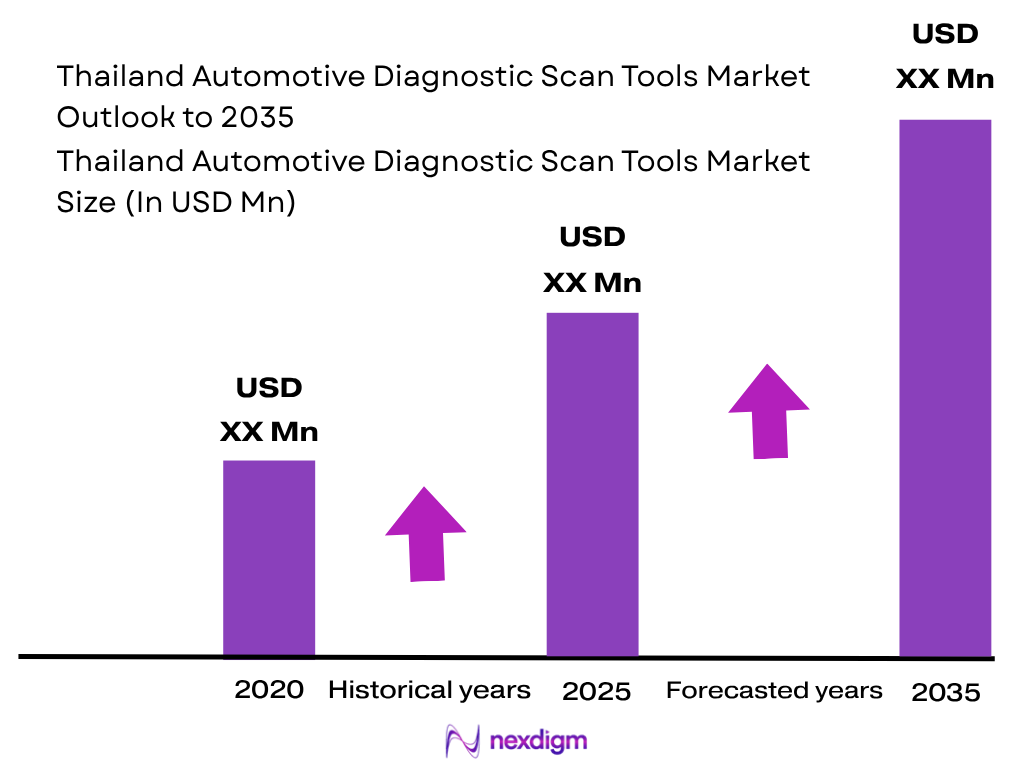
The Thailand Automotive Diagnostic Scan Tools Market is supported by a substantial vehicle manufacturing and service ecosystem that generates recurring requirements for electronic fault diagnosis, ECU testing, OBD communication, programming and calibration. Thailand produced 1,468,997 vehicles in 2024, while domestic sales reached 572,675 units and vehicle exports reached 1,019,213 units. The country’s automotive industry therefore creates demand across manufacturing plants, dealerships, independent workshops and commercial-vehicle service facilities. The World Bank records Thailand’s GDP at USD 526.52 billion in 2024, with GDP growth of 2.5, providing a broad economic base for automotive-service activity.
Thailand’s diagnostic-tool demand is concentrated around Bangkok and the country’s Eastern automotive manufacturing corridor because these locations combine vehicle assembly, parts production, dealerships, logistics operations and dense aftermarket-service activity. The Ministry of Industry identifies Thailand as a major regional automotive production base, while the country’s EV transition is adding electronic diagnostic requirements. The BOI reported 70,582 new BEV passenger-car registrations in 2024, while 57,289 BEV passenger cars were registered during the first half of 2025. Thailand also had 3,720 charging stations and 11,622 installed chargers by March 2025, expanding the need for EV-focused diagnostic capability.
Market Segmentation
By Tool Type
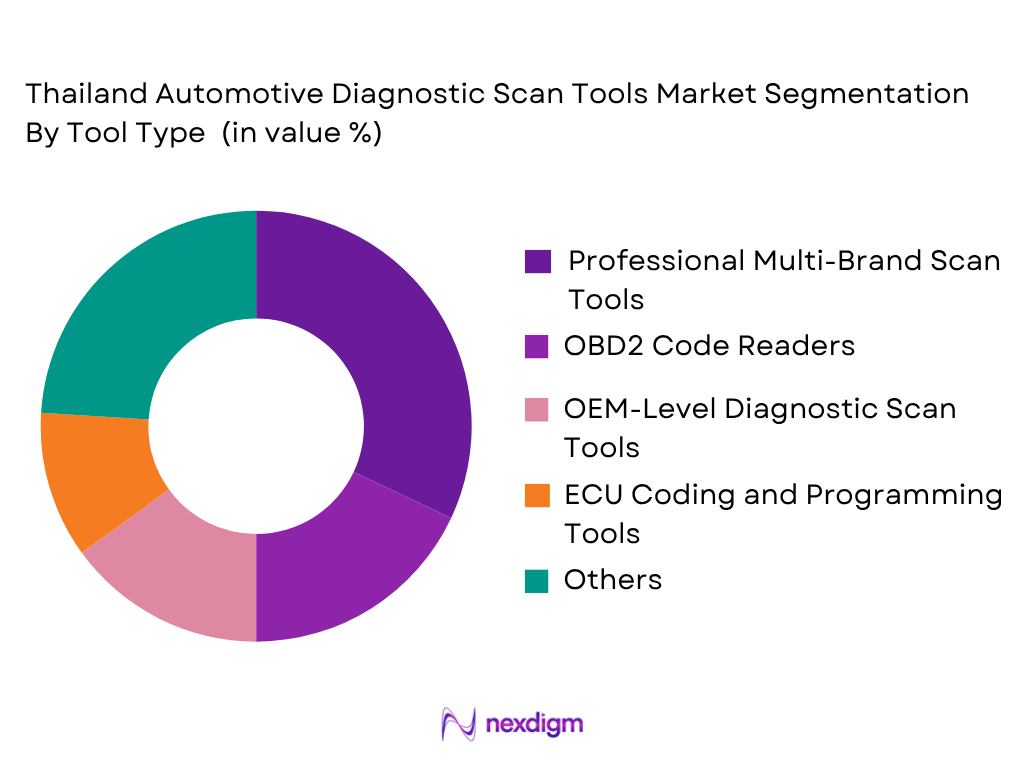
The Thailand Automotive Diagnostic Scan Tools Market is segmented by tool type into professional multi-brand diagnostic scan tools, OBD-II code readers, OEM-level diagnostic scan tools, ECU coding and programming tools, battery and electrical diagnostic tools, ADAS diagnostic and calibration equipment, heavy-duty diagnostic tools, oscilloscopes and emission diagnostic equipment. Professional Multi-Brand Diagnostic Scan Tools are expected to hold the dominant share because independent workshops require one platform capable of servicing multiple vehicle brands. Thailand’s domestic vehicle market includes Japanese, European, American and increasingly Chinese brands, increasing the value of broad vehicle coverage. The country’s 572,675 domestic vehicle sales in 2024 create a continuing service base, while 1,468,997 vehicles produced in the same period expand the installed fleet requiring diagnostics throughout its operating life. EV penetration further increases the technical requirements of workshops, with 70,582 BEV passenger cars registered in 2024. Multi-brand platforms can combine OBD diagnostics, ECU communication, service resets and selected coding functions in one system, making them particularly relevant to independent repair businesses.
By End User
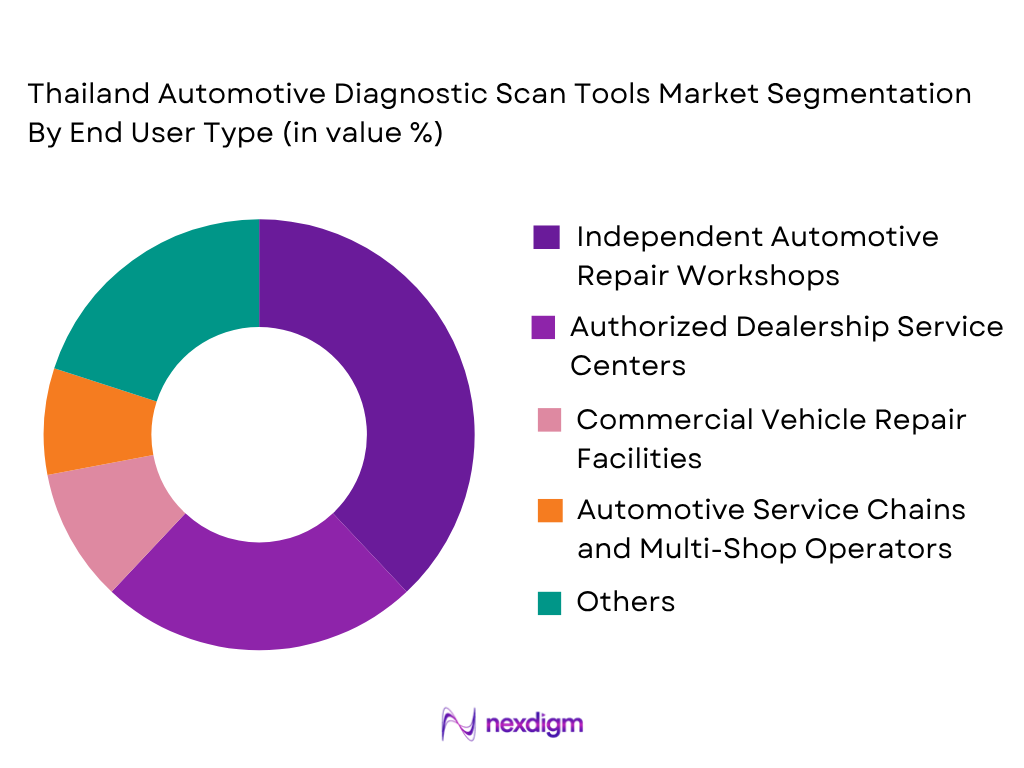
The Thailand Automotive Diagnostic Scan Tools Market is segmented by end user into independent automotive repair workshops, authorized dealership service centers, automotive service chains, commercial-vehicle repair facilities, fleet maintenance facilities, automotive electrical specialists, vehicle inspection centers, mobile diagnostic service providers and automotive technical-service facilities. Independent Automotive Repair Workshops are expected to represent the leading end-user segment because Thailand has a large and diverse vehicle parc requiring servicing outside authorized dealership networks. The segment benefits from the continued presence of combustion-engine vehicles while simultaneously adapting to EVs, hybrids and increasingly electronic vehicle architectures. Commercial vehicles also provide an important service base: domestic commercial-vehicle sales represented a substantial component of Thailand’s 572,675 domestic vehicle sales in 2024. Meanwhile, BEV registrations reached 70,582 passenger cars during 2024, increasing demand for technicians capable of handling battery, inverter, charging and electronic-control diagnostics. The expansion of ADAS and connected vehicle functions should further increase demand for professional equipment capable of advanced module access and calibration.
Competitive Landscape
The Thailand Automotive Diagnostic Scan Tools Market is characterized by international diagnostic-equipment manufacturers competing across professional workshop scanners, OEM-level systems, ECU programming, heavy-duty diagnostics, EV diagnostics and ADAS calibration. Global suppliers benefit from broad vehicle databases and software capabilities, while specialist providers compete through localized distribution, technician support and application-specific tools. The competitive environment is increasingly influenced by Thailand’s transition toward EVs and advanced electronic architectures. BOI reported that 24 brands were participating in the EV3 scheme and that more than 118,000 vehicles across categories had been produced under the promoted ecosystem by mid-2024.
| Company | Establishment Year | Headquarters | Multi-Brand Diagnostics | ECU Programming | EV Diagnostics | ADAS Calibration | Heavy-Duty Diagnostics |
| Bosch | 1886 | Stuttgart, Germany | ~ | ~ | ~ | ~ | ~ |
| Snap-on | 1920 | Kenosha, USA | ~ | ~ | ~ | ~ | ~ |
| Autel | 2004 | Shenzhen, China | ~ | ~ | ~ | ~ | ~ |
| LAUNCH Tech | 1992 | Shenzhen, China | ~ | ~ | ~ | ~ | ~ |
| Hella Gutmann | 1980 | Ihringen, Germany | ~ | ~ | ~ | ~ | ~ |
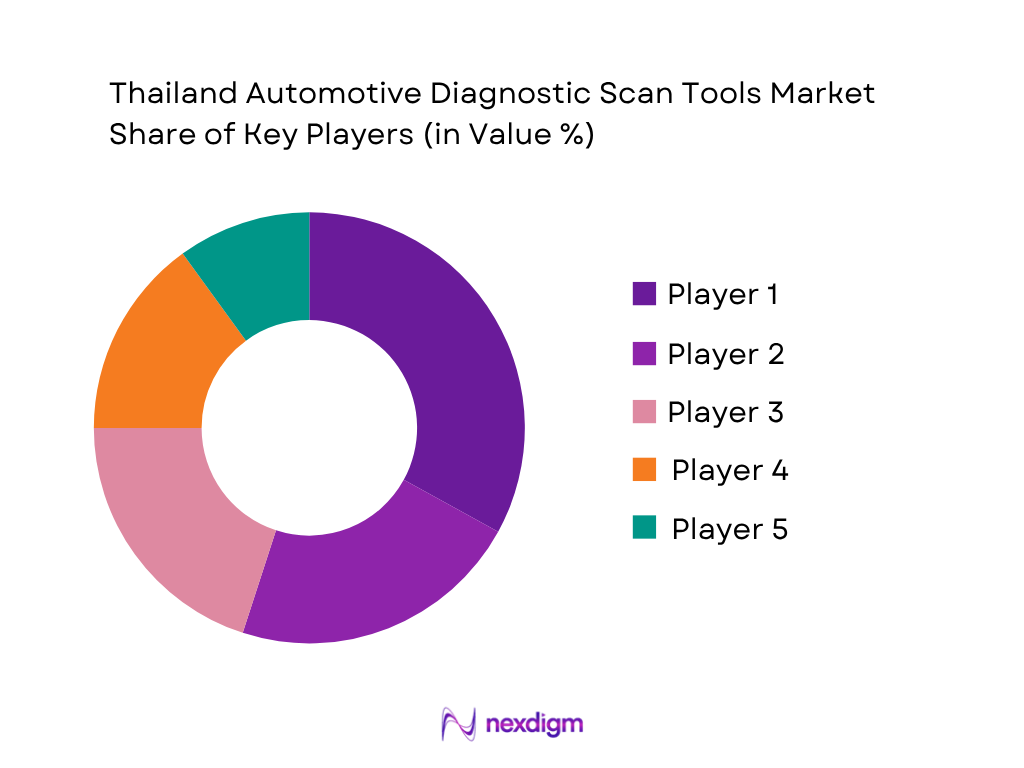
Thailand Automotive Diagnostic Scan Tools Market Analysis
Growth Drivers
Expansion of Vehicle Parc
The expansion and continued utilization of Thailand’s vehicle parc is a fundamental driver for the Automotive Diagnostic Scan Tools Market because every additional vehicle creates a recurring requirement for fault-code reading, ECU diagnostics, electrical testing, service resets and system calibration throughout its operating life. Thailand produced 1,468,997 vehicles in 2024, while domestic vehicle sales reached 572,675 units, demonstrating the scale of the country’s automotive ecosystem. Vehicle exports also reached 1,019,213 units, reinforcing Thailand’s position as a major automotive manufacturing and distribution hub. The broader economic environment supports workshop investment, with Thailand recording USD 526.52 billion in GDP and USD 7,346.6 GDP per capita in 2024, according to the World Bank. The Department of Land Transport maintains dedicated datasets covering new and first-time vehicle registrations, providing evidence of an extensive addressable installed base. As vehicles remain operational for multiple years, diagnostic requirements extend beyond initial sales into preventive maintenance, breakdown repair, inspection and component replacement. Consequently, independent workshops, dealerships, fleet operators and commercial-vehicle service centers require diagnostic equipment capable of supporting multiple vehicle generations and increasingly complex electronic architectures.
Increasing Vehicle Electronic Content
Rising electronic content per vehicle is increasing the technical complexity of automotive repair and strengthening demand for professional diagnostic scan tools in Thailand. Modern vehicles increasingly integrate electronically controlled engines, transmission control units, body-control modules, electronic braking systems, battery-management systems, driver-assistance functions and networked communication architectures. Thailand’s transition toward electrified mobility reinforces this requirement. The Board of Investment reported 70,582 new BEV passenger cars registered in 2024, while the country had 203,000 BEV passenger cars on the road by the first half of 2025. Electric motorcycles reached 71,900 units, while electric buses and trucks reached 3,800 units. The charging ecosystem had expanded to 3,720 charging stations and 11,622 installed chargers by March 2025. These developments increase demand for tools capable of diagnosing high-voltage systems, battery-management systems, inverters, charging systems and electronic control units. Thailand’s USD 526.52 billion GDP and 2.5 economic growth recorded in 2024 provide an economic base for continued automotive technology investment. As vehicle electronics become more integrated, workshops require advanced scanners rather than basic code readers, supporting demand for multi-brand, ECU-level and EV-compatible diagnostic platforms.
Market Challenges
High Dependence on Imported Diagnostic Hardware and Software
Thailand’s Automotive Diagnostic Scan Tools Market faces structural exposure to imported hardware, proprietary software platforms, electronic components and international vehicle databases. Advanced scanners depend on processors, communication interfaces, software libraries and regularly updated diagnostic coverage, much of which is supplied through international technology ecosystems. This creates exposure to exchange-rate movements, international logistics, component availability and software licensing requirements. Thailand recorded USD 526.52 billion GDP in 2024 and USD 7,346.6 GDP per capita, indicating a sizeable economy but also a market where imported technology remains important for sophisticated automotive electronics. The country’s automotive manufacturing ecosystem produced 1,468,997 vehicles in 2024, increasing the need for reliable diagnostic equipment across assembly, dealership and aftermarket operations. At the same time, Thailand exported 1,019,213 vehicles, demonstrating the international orientation of its automotive industry and the diversity of vehicle technologies operating domestically. Diagnostic suppliers must therefore maintain coverage for Japanese, European, American and Chinese vehicle platforms. Dependence on imported technology can complicate procurement and after-sales support, particularly when new vehicle platforms introduce proprietary protocols. This challenge encourages distributors and workshops to maintain multiple diagnostic platforms, increasing technical complexity and equipment-management requirements.
Limited Access to OEM-Level Diagnostic Information
Restricted access to proprietary OEM diagnostic information represents a significant challenge for Thailand’s independent workshop ecosystem. Modern vehicles increasingly rely on secure communication architectures, encrypted vehicle networks, protected ECUs and manufacturer-specific software functions. Independent workshops may therefore encounter limitations when performing advanced coding, programming, immobilizer functions, module replacement or secure-gateway operations. Thailand’s growing EV population makes the issue more significant because diagnostic procedures increasingly involve battery-management systems, high-voltage components, charging systems and electronic powertrain controls. The Board of Investment reported 203,000 BEV passenger cars on Thai roads by the first half of 2025, alongside 3,800 electric buses and trucks and 71,900 electric motorcycles. The country’s automotive production ecosystem also manufactured 1,468,997 vehicles in 2024, creating a broad installed base spanning numerous manufacturers and electronic architectures. Thailand’s economy recorded 2.5 economic growth and USD 526.52 billion GDP in 2024, supporting continued automotive-service activity. However, access restrictions can increase dependence on authorized service channels and limit the capabilities of independent repair businesses. Diagnostic-tool providers consequently need secure, compliant methods for authorized access, while workshops require equipment with regularly updated coverage for protected vehicle systems.
Market Opportunities
Expansion of EV and Hybrid Diagnostic Services
The increasing deployment of electrified vehicles creates a substantial opportunity for specialized diagnostic services covering battery-management systems, high-voltage circuits, inverters, electric motors, charging systems and thermal-management components. Thailand registered 70,582 new BEV passenger cars in 2024, and the Board of Investment reported 203,000 BEV passenger cars on the road by the first half of 2025. The installed EV ecosystem also included 71,900 electric motorcycles, 3,800 electric buses and trucks, and 1,000 electric three-wheeled tuk tuks. Charging infrastructure reached 3,720 stations and 11,622 installed chargers by March 2025. These figures indicate that EV servicing is moving beyond a limited early-adopter base toward a broader operational ecosystem. Thailand’s automotive manufacturing industry produced 1,468,997 vehicles in 2024, providing an established manufacturing and aftermarket infrastructure into which EV diagnostic services can be integrated. Diagnostic equipment manufacturers can therefore expand beyond conventional OBD fault-code readers into battery state-of-health assessment, cell-level monitoring, insulation testing, high-voltage safety diagnostics and charging-system troubleshooting. Thailand’s USD 526.52 billion GDP further supports the development of specialized automotive service infrastructure. The opportunity is particularly relevant for independent workshops seeking to retain customers as the propulsion mix changes.
Growth of ADAS Diagnostic and Calibration Equipment
Increasing vehicle electronic sophistication creates an opportunity for diagnostic suppliers to expand from conventional fault-code scanning into advanced driver-assistance system diagnostics and calibration. ADAS functions rely on cameras, radar sensors, ultrasonic sensors, electronic braking systems and vehicle-network communication, making correct calibration increasingly important following windshield replacement, collision repairs, suspension work or sensor replacement. Thailand’s automotive manufacturing base produced 1,468,997 vehicles in 2024, while domestic vehicle sales reached 572,675 units, providing a substantial service base for electronically equipped vehicles. The country’s EV transition further accelerates the integration of advanced electronic systems, with 70,582 BEV passenger cars registered in 2024 and 57,289 new BEV passenger cars registered during the first half of 2025. Thailand also had 3,720 charging stations and 11,622 chargers by March 2025, demonstrating the broader development of technologically intensive automotive infrastructure. The World Bank recorded USD 526.52 billion GDP and 2.5 economic growth for Thailand in 2024. These conditions create opportunities for workshops to adopt ADAS calibration frames, radar targets, camera calibration systems and integrated diagnostic platforms. Suppliers combining scanning, calibration, ECU access and reporting functions can address increasingly complex repair workflows.
Future Outlook
The Thailand Automotive Diagnostic Scan Tools Market is expected to experience continued technological transformation as the country’s vehicle fleet incorporates more electronic control systems, EV powertrains, connected functions and ADAS technologies. Thailand’s automotive production base provides a substantial installed fleet for diagnostic-service demand, while the transition toward EV manufacturing creates new requirements for battery and high-voltage diagnostics. The BOI reported 203,000 BEV passenger cars on the road and 3,800 electric buses and trucks in Thailand by the first half of 2025.
Growth is expected to increasingly shift toward professional multi-brand scanners, ECU programming, secure-gateway access, EV battery diagnostics, ADAS calibration and cloud-connected diagnostic platforms. Diagnostic suppliers that combine broad vehicle coverage with frequent software updates and local technical support are positioned to address the evolving requirements of Thailand’s workshops and fleet operators.
Major Players
- Bosch
- Snap-on Incorporated
- Autel Intelligent Technology
- LAUNCH Tech
- HELLA Gutmann
- TOPDON
- DENSO Corporation
- Continental AG
- ZF Friedrichshafen
- MAHLE
- AVL List
- ACTIA Group
- MAHA Maschinenbau Haldenwang
- NEXIQ Technologies
- BRAIN BEE
Key Target Audience
- Automotive Diagnostic Equipment Manufacturers
- Automotive Workshop Equipment Distributors
- Independent Automotive Repair Workshop Operators
- Authorized Automotive Dealership Service Networks
- Commercial Vehicle and Fleet Maintenance Operators
- Investments and Venture Capitalist Firms
- Government and Regulatory Bodies (Department of Land Transport, Ministry of Industry, Board of Investment of Thailand)
- Automotive Electronics and EV Service Technology Providers
Research Methodology
Step 1: Identification of Key Variables
The initial phase involves constructing an ecosystem map covering diagnostic-tool manufacturers, distributors, automotive OEMs, dealerships, independent workshops, fleet operators and vehicle inspection organizations. The assessment identifies vehicle parc, production, sales, electronic-system penetration, EV adoption, diagnostic-tool deployment and workshop equipment requirements as core market variables.
Step 2: Market Analysis and Construction
Historical automotive production, domestic sales, exports, vehicle registrations and EV deployment are compiled to establish the addressable diagnostic-service base. Tool demand is then assessed across workshops, dealerships, commercial-vehicle facilities and inspection centers, with separate consideration of OBD, ECU programming, EV and ADAS diagnostic requirements.
Step 3: Hypothesis Validation and Expert Consultation
Market hypotheses are validated through structured discussions with automotive diagnostic-equipment suppliers, distributors, workshop operators, dealership service personnel and automotive-electronics specialists. Inputs are used to assess vehicle coverage, software-update practices, purchase criteria, tool utilization and adoption of advanced diagnostic functions.
Step 4: Research Synthesis and Final Output
The final stage integrates supply-side and demand-side findings using top-down and bottom-up approaches. Market estimates are reconciled against vehicle-production, registration and aftermarket indicators, while competitive benchmarking evaluates product breadth, diagnostic functionality, software capability, EV readiness, ADAS capability and distribution strength.

- Executive Summary
- Research Methodology (Market Definition and Scope, Thailand Automotive Diagnostic Scan Tools Classification, Diagnostic Communication Protocol Mapping, OBD and OBD-II Architecture Assessment, ECU Diagnostic Workflow Analysis, Vehicle Electronic Control Unit Mapping, OEM and Aftermarket Diagnostic Ecosystem Assessment, EV and Hybrid Diagnostic Requirements, ADAS Diagnostic and Calibration Assessment, Automotive Workshop Structure Analysis, Vehicle Inspection Equipment Mapping, Demand-Side and Supply-Side Validation, Top-Down and Bottom-Up Market Sizing, Data Triangulation, Forecasting Framework)

- Definition and Scope
- Thailand Automotive Diagnostic Scan Tools Industry Evolution
- Automotive Diagnostic Scan Tool Architecture
- Thailand Automotive Diagnostic Scan Tools Value Chain Analysis
- Thailand Automotive Diagnostic Scan Tools Supply Chain Analysis

- Growth Drivers (Expansion of Vehicle Parc, Increasing Vehicle Electronic Content, Growth of Automotive Aftermarket Service Demand, Increasing OBD-Based Emission Diagnostics, Expansion of Electric and Hybrid Vehicles, Rising Adoption of Professional Multi-Brand Diagnostic Platforms)
- Market Challenges (High Dependence on Imported Diagnostic Hardware and Software, Limited Access to OEM-Level Diagnostic Information, Technician Skills Gap for Advanced Vehicle Electronics, Rapid Changes in Vehicle Communication Protocols, High Software Update Requirements, Cybersecurity and Secure Gateway Access Constraints)
- Market Opportunities (Expansion of EV and Hybrid Diagnostic Services, Growth of ADAS Diagnostic and Calibration Equipment, Increasing Cloud-Based Diagnostic Platforms, Expansion of ECU Programming and Coding Services, Growth of Fleet and Commercial Vehicle Diagnostics, Increasing Digitalization of Independent Automotive Workshops)
- Market Trends (Growth of Multi-Brand Diagnostic Platforms, Increasing Cloud-Connected Diagnostics, AI-Assisted Fault Detection, Expansion of Secure Gateway Diagnostics, Increasing DoIP and CAN FD Adoption, Growth of EV Battery Diagnostics, Increasing ADAS Calibration Requirements, Integration of Diagnostic and Workshop Management Software)
- Government Regulations and Standards (Department of Land Transport Vehicle Inspection Requirements, Thai Vehicle Inspection Standards, Automotive Emission Testing Requirements, OBD and Emission Diagnostic Requirements, Electric Vehicle Safety Regulations, Vehicle Type Approval Requirements, Automotive Workshop Equipment Standards, Cybersecurity and Connected Vehicle Requirements)
- SWOT Analysis
- Porter’s Five Forces Analysis
- PESTLE Analysis
- Stakeholder Ecosystem
- Competition Ecosystem

- By Market Value (2020-2025)
- By Diagnostic Scan Tool Installation Volume (2020-2025)
- By Professional Workshop Diagnostic Tool Deployment Volume (2020-2025)
- By Authorized Dealership Diagnostic Equipment Deployment Volume (2020-2025)
- By Commercial Vehicle Diagnostic Tool Deployment Volume (2020-2025)
- By Average Selling Price of Diagnostic Scan Tools (2020-2025)

- By Tool Type (In Value %)
OBD-II Code Readers
Professional Multi-Brand Diagnostic Scan Tools
OEM-Level Diagnostic Scan Tools
ECU Coding and Programming Tools
Battery and Electrical System Diagnostic Tools
ADAS Diagnostic and Calibration Equipment
Heavy-Duty and Commercial Vehicle Diagnostic Tools
Oscilloscopes and Advanced Electrical Diagnostic Equipment
Emission and Engine Diagnostic Equipment
Remote and Cloud-Based Diagnostic Platforms - By Vehicle Type (In Value %)
Passenger Cars
Pickup Trucks
Light Commercial Vehicles
Heavy Commercial Vehicles
Buses and Coaches
Hybrid Vehicles
Two-Wheelers and Motorcycles
Specialty and Fleet Vehicles - By Diagnostic Function (In Value %)
Engine and Powertrain Diagnostics
Transmission Diagnostics
ABS and Brake System Diagnostics
Airbag and SRS Diagnostics
Body Control Module Diagnostics
ECU Coding and Programming
Battery and Charging System Diagnostics
ADAS Diagnostics and Calibration
Emission and Exhaust System Diagnostics
Vehicle Network and Communication Diagnostics - By Technology and Communication Protocol (In Value %)
OBD-II and EOBD
CAN Bus
CAN FD
DoIP
J1939
LIN
FlexRay
UDS
KWP2000
Wireless Bluetooth and Wi-Fi Diagnostics - By End User (In Value %)
Independent Automotive Repair Workshops
Authorized Dealership Service Centers
Automotive Service Chains
Commercial Vehicle Repair Facilities
Fleet Maintenance Facilities
Automotive Electrical and Electronic Specialists
Vehicle Inspection Centers
Automotive Training and Technical Service Facilities
Mobile Automotive Diagnostic Service Providers - By Sales Channel (In Value %)
Automotive OEM and Dealership Supply
Tier-1 and Automotive Equipment Supplier Network
Automotive Diagnostic Equipment Distributors
Specialized Workshop Equipment Dealers
Independent Automotive Equipment Suppliers
Online Automotive Equipment Platforms
Direct Manufacturer Sales

- Market Share of Major Players (By Revenue, Tool Type, Vehicle Type, Diagnostic Function, End User, Distribution Channel, Technology Platform, OEM and Aftermarket Presence)
- Cross Comparison Parameters (Multi-Brand Vehicle Coverage and Diagnostic Database Breadth, ECU Coding and Programming Capability, EV and Hybrid Diagnostic Capability, ADAS Diagnostic and Calibration Capability, OBD-II/CAN FD/DoIP/J1939 Protocol Support, OEM-Level Diagnostic Functionality and Secure Gateway Access, Cloud Connectivity and Software Update Infrastructure, Thailand Distributor and Technical Support Network Coverage)
- SWOT Analysis of Major Players
- Pricing and Product Category Benchmarking
- Detailed Profiles of Major Companies
Bosch
Snap-on Incorporated
Autel Intelligent Technology
LAUNCH Tech
HELLA Gutmann
TOPDON
DENSO Corporation
Continental AG
ZF Friedrichshafen
MAHLE
AVL List
ACTIA Group
Maha Maschinenbau Haldenwang
NEXIQ Technologies
BRAIN BEE

- End User Segmentation Assessment
- Independent Automotive Workshop Analysis
- Authorized Dealership Service Center Analysis
- Commercial Vehicle Workshop Analysis
- Fleet Operator Diagnostic Requirements Analysis

- By Market Value (2026-2035)
- By Diagnostic Scan Tool Installation Volume (2026-2035)
- By Professional Workshop Diagnostic Tool Deployment Volume (2026-2035)
- By Authorized Dealership Diagnostic Equipment Deployment Volume (2026-2035)
- By Commercial Vehicle Diagnostic Tool Deployment Volume (2026-2035)
- By Average Selling Price of Diagnostic Scan Tools (2026-2035)


 Request a Sample
 Ask for Customization
 Get a Quote
 Enquire Now