

 Download PDF
Market Overview
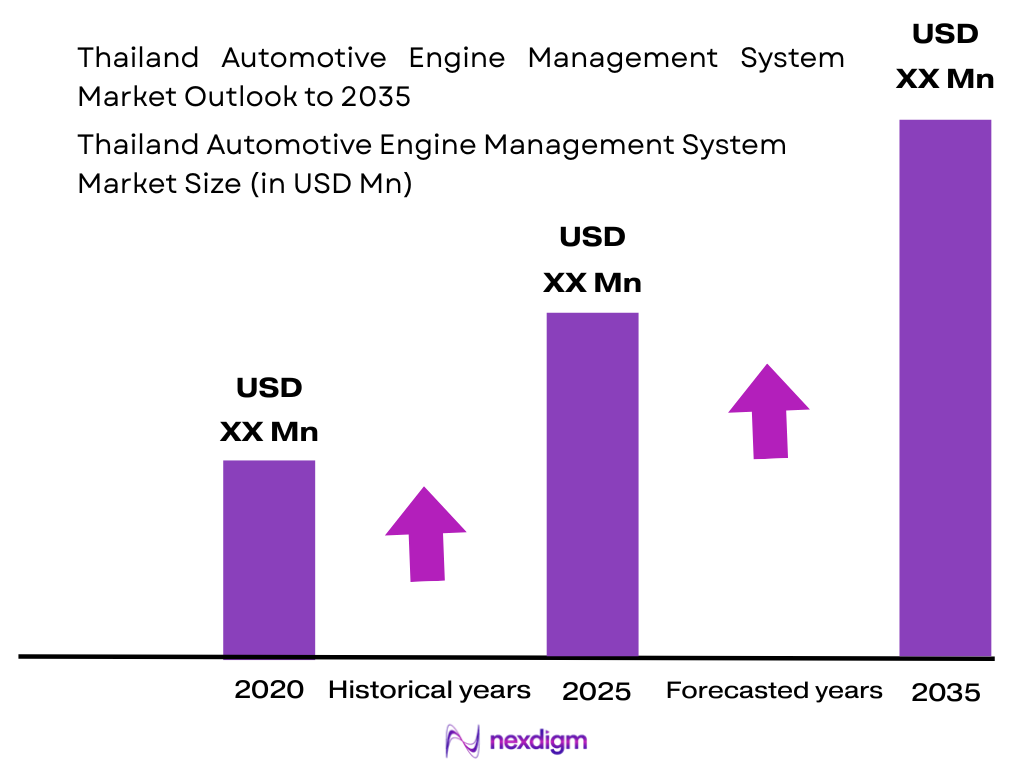
The Thailand Automotive Engine Management System Market is valued at approximately USD ~ million, supported by Thailand’s large vehicle-manufacturing base, diesel pickup ecosystem, engine-electronics localization and aftermarket replacement demand. Vehicle production moved from 1.83 million units to 1.47 million units across the latest two completed annual datasets, while domestic sales in the latter period totaled 572,675 vehicles. These volumes directly influence demand for ECUs, injectors, sensors, fuel-delivery components and ignition systems. Chonburi, Rayong, Chachoengsao and the Bangkok industrial belt dominate Thailand’s engine-management ecosystem because OEM assembly, electronics suppliers and Tier-1 production are concentrated around the Eastern Economic Corridor. The EEC spans more than 13,000 square kilometers, while DENSO’s Chonburi common-rail operation has expanded to 85,500 square meters and supplies products linked to exports reaching 50 countries. Rayong also hosts Mitsubishi Electric’s local automotive-equipment operation producing ECUs, fuel pumps, ignition coils and EGR components.
Market Segmentation
By Component Type
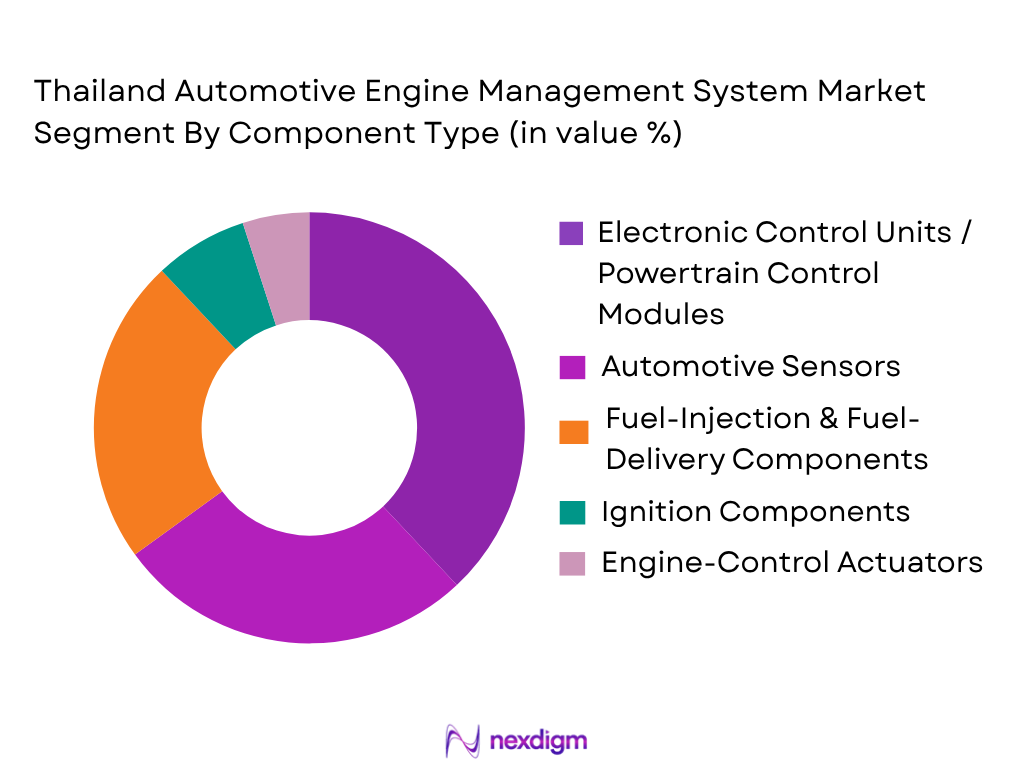
The Thailand Automotive Engine Management System Market is segmented by component type into electronic control units, sensors, fuel-injection and fuel-delivery components, ignition components, and engine-control actuators. Electronic control units hold the dominant modeled share because the ECU functions as the central processing layer connecting fuel injection, ignition timing, throttle control, combustion parameters, emissions monitoring and diagnostics. Increasing software intensity in gasoline, diesel and hybrid vehicles further raises ECU value content. Thailand also possesses an established engine-electronics development ecosystem: DENSO operates powertrain ECU software development activities in Bangkok, while Mitsubishi Electric manufactures ECUs locally in Rayong. Diesel pickups add further complexity because common-rail pressure, injection timing, EGR operation and exhaust conditions require coordinated electronic control. Consequently, ECU demand is supported not only by vehicle output but also by tighter emissions management, hybrid powertrain integration and increasing diagnostic sophistication.
By Vehicle Type
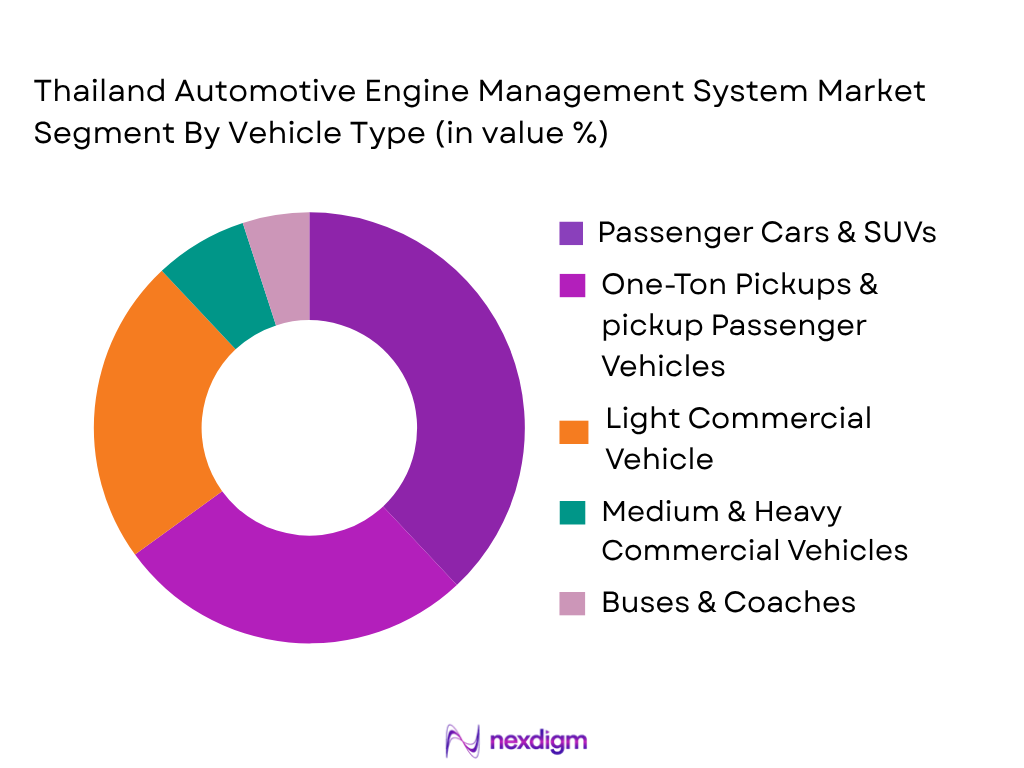
The Thailand Automotive Engine Management System Market is segmented by vehicle type into passenger cars, one-ton pickup trucks and pickup passenger vehicles, light commercial vehicles, medium and heavy commercial vehicles, and buses/coaches. Passenger cars account for the largest modeled value share when gasoline cars, SUVs and hybrid passenger vehicles are aggregated, as these platforms require ECUs, oxygen sensors, throttle-control systems, fuel injectors, ignition coils and increasingly sophisticated emissions-control electronics. However, pickup trucks form an unusually important EMS demand pool compared with many automotive markets because Thailand is a major pickup production and export base. Diesel common-rail hardware increases the value of engine-management content through injectors, high-pressure pumps, rail-pressure sensing and exhaust-control systems. DENSO explicitly identifies its Thai common-rail facility as a production base supporting commercial and pickup vehicle manufacturing, demonstrating the strategic depth of this segment.
Competitive Landscape
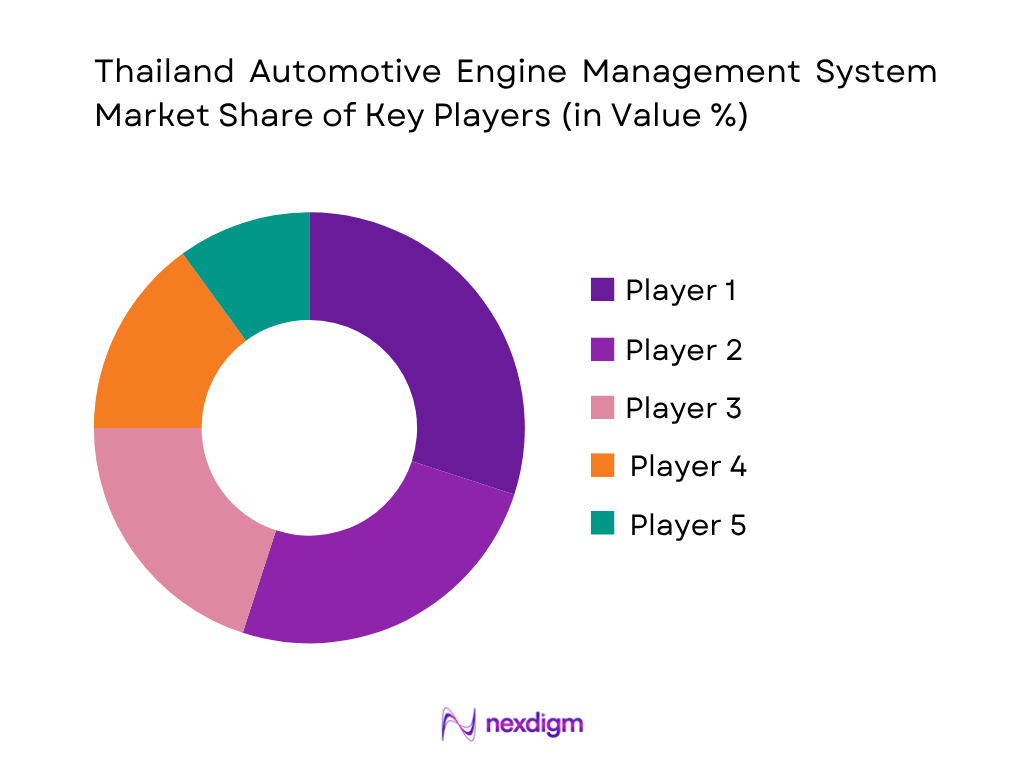
The Thailand Automotive Engine Management System Market features a concentrated group of Japanese, European and global Tier-1 suppliers with long-standing OEM relationships and high technological entry barriers. DENSO, Robert Bosch, Astemo, Mitsubishi Electric and Continental-related powertrain technologies have strong relevance across ECUs, injection systems, sensors, actuators and powertrain electronics. DENSO is particularly embedded in Thailand through common-rail production and local powertrain ECU software development, while Mitsubishi Electric operates automotive-equipment manufacturing in Rayong.
| Company | Establishment | Headquarters | Thailand Footprint | ECU / Control Capability | Fuel-System Capability | Sensor / Emission Capability | Ignition / Actuation Capability | Principal Market Position |
| DENSO Corporation | 1949 | Kariya, Japan | ~ | ~ | ~ | ~ | ~ | ~ |
| Robert Bosch GmbH | 1886 | Gerlingen, Germany | ~ | ~ | ~ | ~ | ~ | ~ |
| Astemo, Ltd. | 2021 | Tokyo, Japan | ~ | ~ | ~ | ~ | ~ | ~ |
| Mitsubishi Electric Corporation | 1921 | Tokyo, Japan | ~ | ~ | ~ | ~ | ~ | ~ |
| Continental AG / related powertrain technology lineage | 1871 | Hanover, Germany | ~ | ~ | ~ | ~ | ~ | ~ |
Thailand Automotive Engine Management System Market Analysis
Growth Drivers
Expansion of Hybrid Vehicle Manufacturing and Increasing Electronic Control Content
Thailand’s accelerating shift toward hybrid vehicle manufacturing is strengthening demand for higher-value engine management electronics because HEVs and PHEVs retain internal-combustion engines while requiring more complex integration between combustion, electric propulsion, battery management and vehicle-control functions. Unlike battery-electric vehicles, hybrid platforms continue using fuel injectors, engine ECUs, oxygen sensors, pressure and temperature sensors, throttle controls, ignition systems and exhaust-management hardware, while adding greater software and calibration requirements. Thailand’s Board of Investment reports 14 promoted HEV and PHEV projects representing approximately THB 39.3 billion of combined investment, demonstrating that hybrid production has developed into a material industrial pillar rather than a transitional niche. BOI data also show that Thailand’s broader automotive and parts industry attracted 309 investment applications valued at THB 102.4 billion in 2024, creating an increasingly favorable localization environment for powertrain electronics, sensors and control systems.
Hybrid applications are especially relevant for EMS suppliers because engine operation becomes more dynamic
Repeated engine start-stop events, transitions between electric and combustion propulsion, cold-start emission management and engine load optimization require rapid ECU processing and precise sensor feedback. Thailand’s regulatory environment reinforces this requirement. The BOI’s investment framework covers HEV and PHEV manufacturing, while Thailand’s excise framework distinguishes hybrid vehicles according to engine displacement, carbon-dioxide output and technology characteristics, creating an economic incentive for manufacturers to improve combustion efficiency and electronic control. From January 2026, qualifying hybrid vehicles with engines not exceeding 3,000 cc fall within dedicated excise categories, making emissions and powertrain efficiency an increasingly important vehicle-development consideration. Thailand’s electronics ecosystem provides another supporting factor. In 2024, the country recorded THB 1.86 trillion of electronics exports, while semiconductor exports reached THB 436 billion, demonstrating an established manufacturing platform from which automotive microcontrollers, sensors, power devices and related electronic assemblies can increasingly be localized. In January 2026, Thailand’s National Semiconductor and Advanced Electronics Policy Committee identified power semiconductors, sensors, photonics, discrete devices and analog semiconductors as strategic development areas; sensors and analog devices are directly relevant to pressure measurement, temperature measurement, exhaust monitoring and signal conditioning within engine management systems.
Market Challenges
Rapid BEV Penetration Reducing the Addressable ICE Engine Management Base
Rapid development of Thailand’s battery-electric vehicle ecosystem represents the clearest structural challenge for conventional automotive engine management suppliers because a pure BEV eliminates the internal-combustion engine and therefore removes demand for traditional engine ECUs, fuel injectors, high-pressure fuel pumps, spark-ignition hardware, oxygen sensors, EGR controls and most combustion-specific sensors. Thailand’s policy-driven EV industrialization has already reached a scale large enough to influence long-term sourcing decisions. The Thailand Board of Investment reports that approved BEV manufacturing investments comprise 18 projects representing approximately THB 39.5 billion, with approved domestic production capacity exceeding 370,000 vehicles per year. By September 2025, more than 238,000 electric vehicles had been registered under the EV3 and EV3.5 support schemes, while cumulative approved investment across Thailand’s EV supply chain reached approximately THB 140 billion by October 31, 2025. These figures show that BEV substitution is no longer limited to imported vehicles: localized assembly, batteries, electronics and charging infrastructure are creating a domestic industrial base capable of competing directly with traditional ICE production. For EMS suppliers, the impact is asymmetric.
Cyclical Vehicle Production and Tight Automotive Credit Conditions
Thailand’s engine management system industry is exposed to fluctuations in new-vehicle production because factory-fitted ECU, injector, pump, sensor and ignition demand is directly linked to OEM assembly volumes, and recent automotive weakness has demonstrated the scale of this sensitivity. Thailand produced 1.47 million vehicles in 2024 compared with 1.83 million vehicles in 2023, while domestic vehicle sales reached only 572,675 units in 2024. This production contraction directly reduced the number of factory-fit engine management assemblies required by Thai vehicle plants, affecting Tier-1 suppliers with high fixed manufacturing capacity and platform-specific production lines. Credit conditions have been a particularly important factor because pickups and entry-level vehicles rely heavily on financing. The National Economic and Social Development Council reported household debt of THB 16.34 trillion in the third quarter of 2024, and the Bank of Thailand separately identified auto lending as one of the areas contributing to weaker new household borrowing. At the banking-system level, gross non-performing loans reached THB 553.4 billion in the third quarter of 2024, prompting continued lender caution toward borrowers with weaker debt-service capacity. This matters directly to the EMS market because restricted vehicle financing affects OEM sales first, which subsequently leads vehicle producers to adjust production schedules and supplier call-offs.
Market Opportunities
Hybrid-Compatible Engine Control Systems and Advanced Emission Electronics
Hybrid-compatible engine control represents one of the strongest future opportunities in the Thailand Automotive Engine Management System Market because it provides a pathway for engine-management suppliers to participate in electrification without losing all combustion-related content. Current industrial data already provide a substantial platform for this opportunity: Thailand’s promoted HEV and PHEV manufacturing portfolio comprises 14 projects with approximately THB 39.3 billion in combined investment, while its automotive and automotive-parts sector recorded 309 investment applications worth THB 102.4 billion in 2024. These are existing investment commitments rather than future market projections, and they demonstrate that OEMs and suppliers are actively allocating production capital toward Thailand’s next generation of vehicles. A hybrid vehicle retains the engine-management architecture required by a combustion vehicle but raises the technical requirements placed on it. The ECU must manage engine restarts, rapid load changes, electric-assist events, battery state interactions, catalyst temperature, air-fuel ratios and emissions during intermittent combustion operation. Consequently, opportunities extend beyond basic ECUs to wideband oxygen sensors, pressure sensors, temperature sensors, electronically controlled throttles, higher-precision injectors and software calibration.
Localized ECU, Sensor and Automotive Electronics Manufacturing
Localization of ECUs, sensors and associated automotive electronics offers a significant future opportunity because Thailand already possesses both a large automotive customer base and an expanding semiconductor/electronics ecosystem, allowing suppliers to shorten automotive supply chains and increase locally produced value per vehicle. Current investment activity provides strong evidence for this opportunity. The Thailand Board of Investment received 309 automotive and parts investment applications valued at THB 102.4 billion in 2024, while Thailand exported THB 1.86 trillion of electronics products and THB 436 billion of semiconductors during the same period. In January 2026, the National Semiconductor and Advanced Electronics Policy Committee explicitly prioritized power semiconductors, sensors, photonics, discrete components and analog semiconductors, several of which are directly applicable to engine management. An automotive ECU depends on microcontrollers, analog signal-conditioning devices, power drivers, printed circuit boards, connectors and embedded software; engine sensors similarly require semiconductor sensing elements, signal processing and automotive-grade packaging.
Future Outlook
The Thailand Automotive Engine Management System Market is forecast to expand at a CAGR of approximately ~% during the forecast period, although growth will increasingly shift from conventional standalone ICE systems toward sophisticated hybrid-compatible engine controls, advanced sensors and higher-value emissions-management systems. The market will simultaneously face structural erosion from battery-electric vehicles, which eliminate most conventional engine-management hardware. Hybridization represents the most important medium-term opportunity. Thailand’s Board of Investment has approved incentives for hybrid manufacturing, while its current investment framework requires HEVs and PHEVs marketed domestically under relevant promoted projects to comply with Euro 5-or-higher pollution standards. This supports higher specifications for combustion control, oxygen sensing, emissions monitoring and ECU calibration. Diesel EMS demand should remain strategically relevant because Thailand retains an extensive pickup and commercial-vehicle manufacturing ecosystem. Common-rail injectors, high-pressure pumps, rail-pressure sensors, EGR systems and exhaust sensors therefore represent important revenue pools even as passenger-car powertrains electrify. DENSO’s designation of Thailand as its first common-rail manufacturing location in the country and third-largest global common-rail production base demonstrates this specialization. The countervailing risk is faster BEV adoption. Thailand’s incentive system has attracted major electric-vehicle investment, creating substitution pressure on conventional ECUs, injectors, fuel pumps and ignition systems. Consequently, suppliers with diversified hybrid controls, sensors, semiconductor content, software and aftermarket operations should be better positioned than companies heavily concentrated in mechanical ICE components.
Major Players
- Robert Bosch GmbH / Bosch Thailand
- DENSO Corporation / DENSO Thai Group
- Continental AG
- Astemo, Ltd.
- Mitsubishi Electric Corporation / Mitsubishi Electric Thai Auto-Parts
- Marelli
- PHINIA Inc. / Delphi|
- Aisan Industry Co., Ltd.
- Mikuni Corporation
- Niterra Co., Ltd. / NGK–NTK
- FORVIA HELLA
- Valeo
- Schaeffler AG
- TI Fluid Systems
- Sensata Technologies
Key Target Audience
- Automotive Engine Management System Manufacturers
- Automotive OEMs and Vehicle Assemblers
- Tier-1 and Tier-2 Automotive Component Suppliers
- Automotive Electronics, Semiconductor and Sensor Manufacturers
- Automotive Parts Distributors and Aftermarket Service Networks
- Investments and Venture Capitalist Firms
- Private Equity Firms and Strategic Automotive Investors
- Government and Regulatory Bodies
Research Methodology
Step 1: Identification of Key Variables
The initial research phase constructs the Thailand automotive EMS ecosystem across OEMs, Tier-1 suppliers, ECU manufacturers, fuel-system companies, sensor producers, distributors and service networks. Desk research identifies variables including vehicle production, powertrain mix, EMS content per vehicle, component ASP, localization levels, replacement cycles and supplier penetration. Official industry and corporate databases are used to establish the underlying market architecture.
Step 2: Market Analysis and Construction
Historical vehicle production is mapped by passenger car, pickup and commercial-vehicle categories and linked to gasoline, diesel and hybrid powertrains. A bottom-up model applies component fitment assumptions covering ECUs, injectors, pumps, sensors, ignition systems and actuators. The supply-side assessment reconstructs supplier revenues using Thailand manufacturing footprints, OEM relationships, import-export flows and aftermarket channel activity.
Step 3: Hypothesis Validation and Expert Consultation
Market hypotheses are validated through structured interviews and CATIs with executives from automotive OEMs, Tier-1 companies, component manufacturers, distributors, diesel specialists and independent workshops. Interviews test assumptions concerning component prices, replacement intervals, sourcing patterns, localization, supplier concentration and hybrid technology adoption. Contradictory inputs are reconciled through additional secondary evidence and cross-participant validation.
Step 4: Research Synthesis and Final Output
The final stage triangulates top-down automotive production data with bottom-up component demand and supplier-side revenues. OEM production trends are compared against component penetration, engine technology and aftermarket replacement demand. Forecast scenarios incorporate hybridization, BEV substitution, pickup production, emissions requirements and localization. The resulting dataset is normalized to prevent double-counting between integrated systems, individual components and replacement-channel revenues.

- Executive Summary
- Research Methodology (Market Definition, EMS Bill-of-Materials Scope, Top-Down Sizing, Bottom-Up Sizing, Vehicle Production Mapping, Vehicle Parc Mapping, OEM Sourcing Assessment, Replacement Rate Analysis)

- Market Definition and Scope
- Automotive Engine Management System Architecture
- Engine Management System Functional Map
- Thailand EMS Industry Evolution
- Development of Electronic Fuel Injection and Common-Rail Diesel Systems in Thailand
- Evolution from Standalone Engine Control to Integrated Powertrain Control
- Thailand Automotive Manufacturing Ecosystem

- Growth Drivers
Large Automotive Manufacturing Base
High One Ton Pickup and Diesel Engine Production
Established Common-Rail Diesel Manufacturing Ecosystem
Increasing Engine Electronic Content
Expansion of Hybrid Vehicle Manufacturing
Tightening Tailpipe Emission Requirements
Increasing Sensor Count per ICE/Hybrid Vehicle
Aging ICE Vehicle Parc Supporting Replacement Demand
Growth of Independent Automotive Repair Networks
Increasing Diagnostic Sophistication in Workshops - Market Challenges
Rapid BEV Penetration Reducing Long-Term ICE EMS Addressable Demand
Cyclicality in Domestic Vehicle Production
Weakness in Pickup Financing and Credit Availability
Semiconductor Supply Exposure
Dependence on Imported High-Value Electronic Components
OEM Price-Down Pressure on Tier-1 Suppliers
Long Automotive Supplier Qualification Cycles
Counterfeit and Low-Cost Aftermarket Components - Market Opportunities
Hybrid-Compatible Engine Control Systems
Higher-Pressure Gasoline Direct Injection
Advanced Common-Rail Diesel Systems
Euro-Compliant Sensors and Emission-Control Electronics
Localized ECU and Sensor Manufacturing
EMS Software and Calibration Engineering
Remanufactured Common-Rail Components
Advanced Diagnostics and Predictive Maintenance
Independent Aftermarket Expansion
ASEAN Export Supply Opportunities - Market Trends
ECU Functional Consolidation
Software-Intensive Powertrain Control
Increasing Sensor Fusion
Closed-Loop Combustion Optimization
Increased Rail Pressure and Injection Precision
Wideband Lambda Sensing
Electronic Throttle Adoption
Downsized Turbocharged Gasoline Engines

- By Market Value (2020-2025)
- By EMS Unit Shipments (2020-2025)
- By Vehicle Production-Linked Demand (2020-2025)
- By Aftermarket Replacement Demand (2020-2025)
- By Average EMS Content per Vehicle (2020-2025)

- By Component Type (in value %)
Engine Control Unit / Powertrain Control Module
Fuel Injectors
High-Pressure Fuel Pumps
Low-Pressure / In-Tank Fuel Pumps
Fuel Rail and Pressure-Control Components - By Vehicle Type (in value %)
Passenger Cars
One-Ton Pickup Trucks
Pickup Passenger Vehicles
Sport Utility Vehicles
Light Commercial Vehicles
Medium Commercial Vehicles
Heavy Commercial Vehicles
Buses and Coaches - By Powertrain Type (in value %)
Pure Internal Combustion Engine
Mild Hybrid Electric Vehicle
Full Hybrid Electric Vehicle
Plug-in Hybrid Electric Vehicle
Range-Extended / Engine-Assisted Electrified Powertrain - By Fuel / Engine Type (in value %)
Gasoline
Diesel
Gasoline-Hybrid
Diesel-Hybrid
LPG / CNG-Compatible Engine Systems
Flex-Fuel / Alternative Liquid Fuel-Compatible Systems - By Fuel-Injection Technology (in value %)
Gasoline Port Fuel Injection
Gasoline Direct Injection
Diesel Common-Rail Direct Injection
Multi-Point Fuel Injection
Dual Injection
High-Pressure Electronic Injection - By Geographic Cluster (in value %)
Eastern Economic Corridor
Bangkok Metropolitan Region
Central Thailand Automotive Belt
Eastern Thailand Industrial Cluster
Northern Thailand
Northeastern Thailand
Southern Thailand

- Competitive Market Structure
- Tier-1 vs Component-Specialist Competitive Positioning
- Market Share of Leading Suppliers
- Cross Comparison Parameters (Thailand EMS Product Breadth, Local EMS Manufacturing Footprint, OEM Customer Penetration, Diesel Common-Rail Capability, Hybrid-Compatible EMS Capability, Sensor & ECU Integration Capability, Thailand Aftermarket Distribution Reach, Local Engineering & Calibration Capability)
- Competitive Benchmarking Matrix
- SWOT Analysis of Major Players
- Porter’s Five Forces
- Detailed Profiles of Major Companies
Robert Bosch GmbH / Bosch Thailand
DENSO Corporation / DENSO Thai Group
Continental AG
Astemo, Ltd.
Mitsubishi Electric Corporation / Mitsubishi Electric Thai Auto-Parts
Marelli
PHINIA Inc. / Delphi
Aisan Industry Co., Ltd.
Mikuni Corporation
Niterra Co., Ltd. / NGK–NTK
FORVIA HELLA
Valeo
Schaeffler AG
TI Fluid Systems
Sensata Technologies

- Passenger Vehicle OEMs
- Pickup & Light Commercial Vehicle OEMs
- Medium & Heavy Commercial Vehicle OEMs
- Authorized Service Centers
- Independent Workshops & Diesel Specialists
- Automotive Aftermarket Distributors & Retailers
- Fleet Operators & Commercial Maintenance Networks

- By Market Value (2026-2035)
- By EMS Unit Shipments (2026-2035)
- By Vehicle Production-Linked Demand (2026-2035)
- By Aftermarket Replacement Demand (2026-2035)
- By Average EMS Content per Vehicle (2026-2035)


 Request a Sample
 Ask for Customization
 Get a Quote
 Enquire Now