
 Download PDF
Market Overview
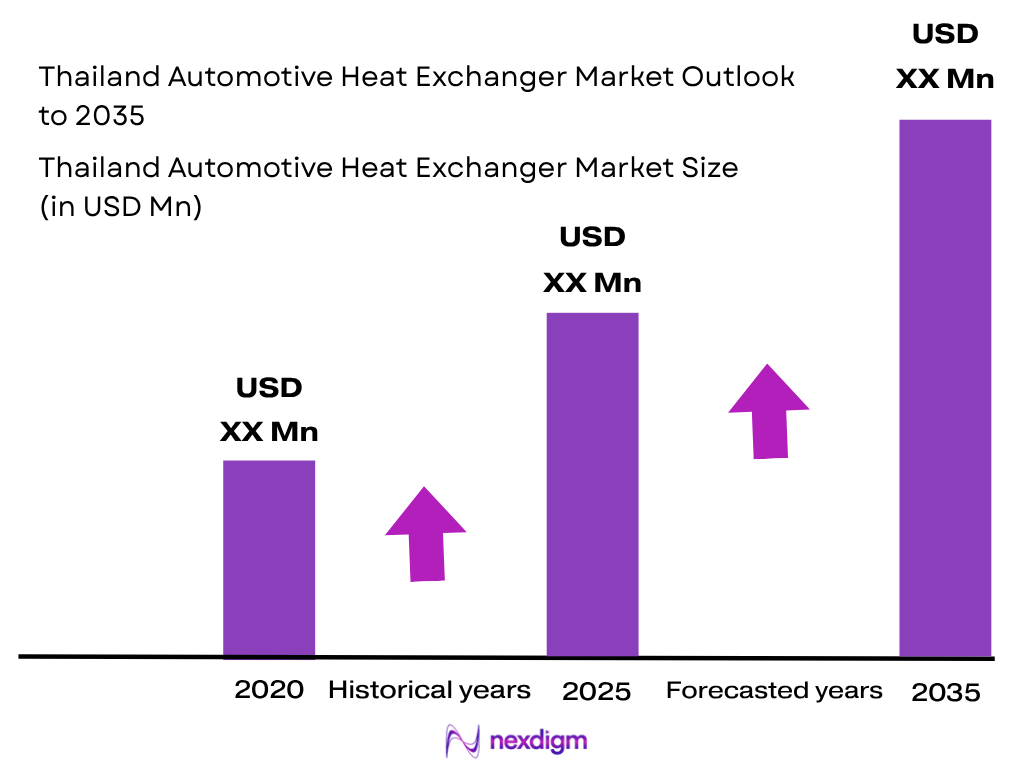
The Thailand Automotive Heat Exchanger Market is valued at ~USD XX million, based on historical demand analysis, and is forecast to expand at ~XX% CAGR during 2026–2035. Demand is supported by a vehicle-production base of 1,468,997 units, compared with 1,834,986 units in the preceding period, alongside 1,019,213 completely built vehicle exports. Thailand’s pickup-intensive manufacturing structure sustains radiator, condenser, intercooler, oil-cooler, HVAC, and transmission-cooling requirements across OEM and replacement channels.
Chonburi, Rayong, Chachoengsao, and Samut Prakan dominate Thailand Automotive Heat Exchanger Market activity because these provinces form the core of the country’s automotive assembly and component-manufacturing corridor. Thailand hosts more than 720 Tier-1 suppliers and over 1,100 Tier-2 and Tier-3 suppliers, with manufacturers concentrated in the Central and Eastern regions. DENSO also manufactures condensers, radiators, intercoolers, and oil coolers in Chachoengsao, demonstrating the area’s direct thermal-component specialization.
Market Segmentation
By Heat Exchanger Type
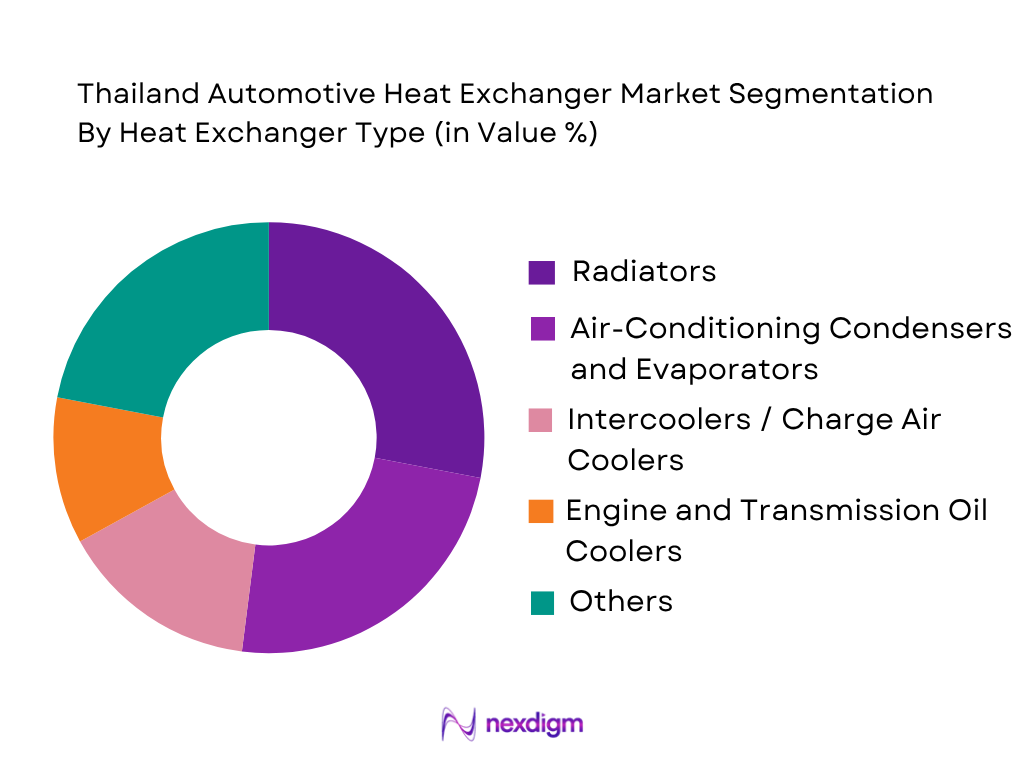
The Thailand Automotive Heat Exchanger Market is segmented into radiators, air-conditioning condensers and evaporators, intercoolers, oil coolers, HVAC units, EGR coolers, battery cooling systems, and power-electronics heat exchangers. Radiators hold the dominant modeled share because Thailand maintains a very large internal-combustion vehicle production and installed fleet, including a particularly important pickup and commercial-vehicle segment. Thailand manufactured 1,468,997 vehicles in 2024, while one-ton pickups and derivative vehicles historically constitute a major portion of national production. Pickup trucks commonly operate diesel engines requiring substantial radiator capacity and frequently combine engine cooling with charge-air and transmission cooling. Air-conditioning condensers and evaporators are another substantial category because climatic conditions make cabin cooling fundamental across passenger and commercial vehicles. Battery thermal products remain smaller but are gaining strategic importance as local BEV and hybrid manufacturing develops.
By Vehicle Type
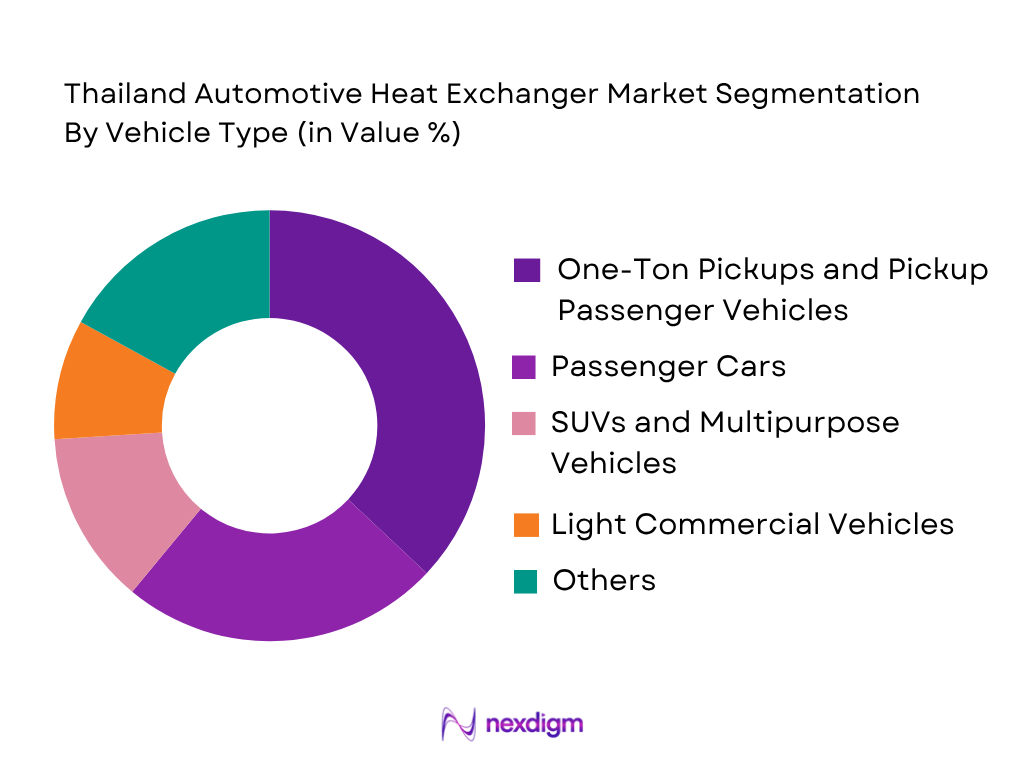
The Thailand Automotive Heat Exchanger Market is segmented into one-ton pickups, pickup passenger vehicles, passenger cars, SUVs, light commercial vehicles, heavy commercial vehicles, hybrids, and battery-electric vehicles. One-ton pickups and pickup-derived vehicles constitute the dominant modeled thermal-component segment, reflecting Thailand’s long-standing specialization as a global pickup manufacturing base. Actual domestic pickup sales reached 200,190 units in 2024, while total commercial-vehicle sales reached 348,527 units and passenger-car sales reached 224,148 units. Pickup platforms typically use diesel engine radiators, air-conditioning condensers, charge-air coolers, transmission coolers, and EGR cooling equipment, giving them relatively high thermal content per vehicle. Thailand also exports substantial volumes of pickup-based vehicles, extending heat-exchanger demand beyond domestic retail conditions. Hybrid and BEV categories are becoming increasingly important as domestic assembly shifts toward electrified models requiring low-temperature coolant circuits, battery chillers, and integrated thermal modules.
Competitive Landscape
The Thailand Automotive Heat Exchanger Market is characterized by established Japanese and global Tier-1 suppliers integrated into Thailand’s OEM manufacturing ecosystem, alongside international thermal-management specialists supplying regional vehicle programs and replacement markets. DENSO has particularly deep localization, operating multiple facilities in Thailand and manufacturing condensers, radiators, intercoolers, oil coolers, evaporators, and other automotive air-conditioning products. Competitive strength depends increasingly on local OEM relationships, aluminium brazing capability, pickup cooling expertise, ASEAN export integration, and the ability to transition from conventional engine cooling to EV battery and power-electronics thermal management.
| Company | Established | Headquarters | Core Heat Exchanger Portfolio | Thailand Manufacturing / Supply Footprint | OEM Integration | Aluminium & Microchannel Capability | EV Thermal Management | ASEAN Supply Capability |
| DENSO Corporation | 1949 | Kariya, Japan | ~ | ~ | ~ | ~ | ~ | ~ |
| Valeo | 1923 | Paris, France | ~ | ~ | ~ | ~ | ~ | ~ |
| MAHLE GmbH | 1920 | Stuttgart, Germany | ~ | ~ | ~ | ~ | ~ | ~ |
| Hanon Systems | 1986 | Daejeon, South Korea | ~ | ~ | ~ | ~ | ~ | ~ |
| T.RAD Co., Ltd. | 1936 | Tokyo, Japan | ~ | ~ | ~ | ~ | ~ | ~ |
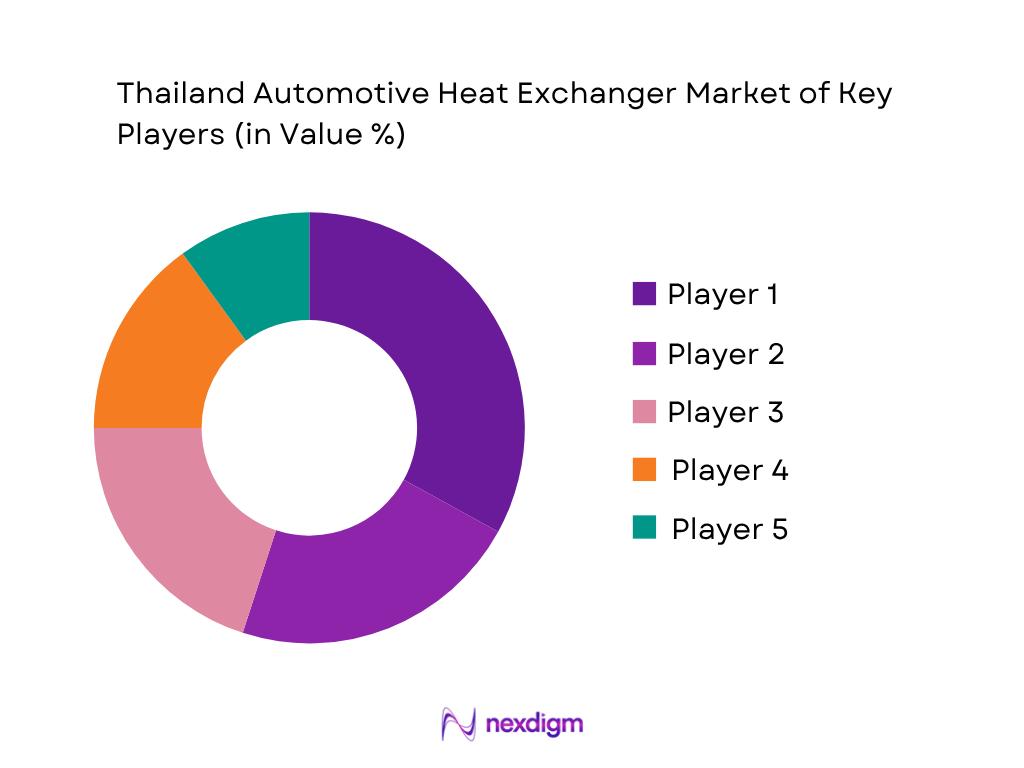
Thailand Automotive Heat Exchanger Market Analysis
Growth Drivers
Large Domestic Vehicle Manufacturing Base
Thailand’s large domestic vehicle manufacturing base is a fundamental growth driver for the Thailand Automotive Heat Exchanger Market because every locally assembled passenger car, pickup, SUV, truck, hybrid, or battery-electric vehicle requires multiple thermal-management components before leaving the production line. Thailand produced exactly 1,468,997 vehicles in 2024, including approximately 558,000 passenger cars, 894,000 pickups, and 17,000 other commercial vehicles, according to automotive industry data compiled from the Federation of Thai Industries. Vehicle production remained substantial at 1,455,569 units in 2025, comprising 550,456 passenger vehicles and 905,113 pickup trucks and other commercial vehicles. This manufacturing scale directly supports OEM demand for radiators, condensers, evaporators, intercoolers, transmission oil coolers, EGR coolers, battery chillers, and low-temperature radiators. Pickup production is particularly important because these vehicles frequently combine diesel-engine cooling with charge-air, transmission, cabin-air-conditioning, and exhaust-gas thermal systems, increasing thermal-component content per vehicle. Thailand’s manufacturing ecosystem also extends well beyond vehicle assemblers. Board of Investment documentation identifies more than 720 Tier-1 automotive suppliers and over 1,100 Tier-2 and Tier-3 suppliers, concentrated mainly in the Central and Eastern regions, particularly the Eastern Economic Corridor. This dense component network supports aluminium forming, tube and fin fabrication, brazing, plastics, electronics, compressors, pumps, valves, and final thermal-module integration. The manufacturing base also serves a large domestic sales channel. Thailand recorded 572,675 domestic vehicle sales in 2024, while sales increased to 621,166 units in 2025, according to FTI-linked industry statistics.
Expanding BEV and Hybrid Manufacturing
Expanding BEV and hybrid manufacturing is reshaping the Thailand Automotive Heat Exchanger Market because electrified vehicles require a broader mix of thermal components than conventional ICE platforms and are increasingly being assembled domestically rather than supplied exclusively through imports. Thailand produced approximately 190,837 hybrid vehicles and 9,688 battery-electric vehicles in 2024, while the shift accelerated substantially in 2025, when production reached 214,317 HEVs, 17,296 PHEVs, and 70,914 BEV passenger vehicles. These production volumes create direct demand for battery chillers, aluminium cooling plates, low-temperature radiators, condensers, heat-pump heat exchangers, inverter coolers, electronic coolant pumps, and integrated thermal-control modules. Hybrid vehicles also retain conventional engine radiators while adding battery, motor, and electronics cooling, allowing them to carry thermal content from both ICE and electrified architectures. Vehicle registration data confirm that the domestic operating base is expanding alongside production. Thailand recorded 70,582 new BEV passenger-car registrations in 2024; during the first six months of 2025 alone, another 57,289 new BEV passenger cars were registered. By mid-2025, Thailand had more than 203,000 BEV passenger cars on the road, together with approximately 71,900 electric motorcycles, 3,800 electric buses and trucks, and 1,000 electric three-wheelers. This installed base increases the future replacement and service requirement for electrified thermal components while giving local workshops, distributors, and component producers an incentive to invest in EV-specific technical capabilities. Investment activity strengthens the manufacturing case.
Market Challenges
ICE-to-EV Production Transition
The ICE-to-EV production transition is a major structural challenge for the Thailand Automotive Heat Exchanger Market because suppliers must preserve capacity for conventional radiators, intercoolers, oil coolers, EGR coolers, and engine-related thermal systems while simultaneously investing in battery cooling plates, chillers, low-temperature radiators, heat pumps, and electronic coolant modules. The scale of this technological overlap is visible in current production data. Thailand produced 1,468,997 vehicles in 2024, but overall production eased to 1,455,569 vehicles in 2025. Within passenger-car manufacturing, however, the technology mix changed sharply: production in 2025 included 247,929 ICE passenger vehicles, 214,317 HEVs, 17,296 PHEVs, and 70,914 BEVs. BEV passenger-car production alone increased from 9,688 units in 2024 to 70,914 units in 2025, while hybrid production reached 214,317 units. This shift creates a difficult investment problem for heat exchanger manufacturers. Conventional ICE platforms require large-volume radiator, condenser, intercooler, oil-cooler, and EGR-cooler production, particularly in Thailand’s pickup-heavy manufacturing sector. EVs remove several of these engine-dependent products but introduce new components requiring different designs, manufacturing tolerances, joining technologies, pressure specifications, materials, and electronic integration. A supplier operating a brazed radiator line cannot automatically convert the same production assets into battery cold plates or refrigerant chillers without additional engineering and process investment.
Domestic Vehicle Sales Volatility and Conventional Capacity Pressure
Domestic vehicle sales volatility is a significant challenge for the Thailand Automotive Heat Exchanger Market because fluctuations in local automobile demand directly influence OEM heat exchanger orders, capacity utilization, distributor inventory, and the balance between domestic and export-oriented thermal-component production. Thailand’s domestic vehicle sales fell to exactly 572,675 units in 2024, compared with a significantly stronger domestic market in the preceding period, while vehicle production declined to 1,468,997 units. Automotive industry data show that production in 2024 included approximately 894,000 pickups, 558,000 passenger cars, and only 17,000 other commercial vehicles. The market then changed direction in 2025, when domestic vehicle sales recovered to 621,166 units, while total production still edged down to 1,455,569 units. This divergence creates uncertainty for thermal-system manufacturers because domestic sales can improve while total factory output remains constrained by export conditions and changes in propulsion mix. Pickup trucks intensify this challenge. Thailand’s automotive production system has historically been heavily concentrated in one-ton pickups, which require radiators, intercoolers, condensers, EGR coolers, oil coolers, and transmission cooling components. In 2025, total pickup production reached approximately 894,000 units, with 728,219 one-ton pickups produced for export. Because these high-volume thermal applications support specialized manufacturing lines and supplier capacity, weakness in domestic pickup sales or export demand can leave conventional heat exchanger capacity underutilized. Export performance adds another source of volatility. Thailand exported 1,019,213 completely built vehicles in 2024, but CBU exports declined to 935,750 vehicles in 2025. Export-oriented vehicle production totaled 956,230 units in 2025, while domestic-production allocation was 499,339 units. Heat exchanger suppliers embedded in export vehicle programs therefore face demand exposure not only to Thai consumers but also to economic conditions, model cycles, environmental regulations, and competitive shifts across Australia, ASEAN, the Middle East, and other destination markets.
Market Opportunities
EV Battery Cooling Systems and Localized Battery Chillers
EV battery cooling systems and localized battery chillers represent one of the clearest future opportunities in the Thailand Automotive Heat Exchanger Market because current production, registration, charging, and investment figures show that the domestic EV ecosystem has reached sufficient scale to support specialized thermal-component localization. Thailand produced 9,688 BEV passenger vehicles in 2024, but output expanded to 70,914 units in 2025, demonstrating a major increase in locally assembled electric vehicles requiring battery cooling hardware. Current registrations provide an equally important demand indicator. Thailand recorded 70,582 new BEV passenger-car registrations in 2024, and another 57,289 BEV passenger cars were registered in the first half of 2025. By that point, the country had more than 203,000 BEV passenger cars on the road. Every BEV requires precise thermal control of the battery, motor, inverter, onboard charger, and passenger cabin. Depending on vehicle architecture, this can involve aluminium cold plates, refrigerant-to-coolant chillers, low-temperature radiators, condensers, electronically controlled pumps, coolant valves, manifolds, and heat-pump assemblies. Battery chillers are especially relevant because they connect the refrigerant circuit to the battery coolant loop and allow active thermal management during high ambient temperatures, high-load driving, and fast charging.
ASEAN Thermal Component Export Expansion
ASEAN and broader regional thermal-component export expansion represents a significant future opportunity for the Thailand Automotive Heat Exchanger Market because the country already functions as an export-oriented vehicle manufacturing hub with extensive OEM supply-chain integration, high pickup production, and a large domestic supplier base. Thailand exported exactly 1,019,213 completely built vehicles in 2024, while CBU exports remained substantial at 935,750 units in 2025. In addition, 956,230 vehicles were produced specifically for export in 2025, representing the majority of the country’s total manufacturing output. This export intensity means automotive heat exchangers manufactured in Thailand can reach overseas markets indirectly as original equipment installed in exported vehicles and directly as components supplied to regional OEM plants, distributors, and aftermarket networks. Pickup trucks provide a particularly strong platform for thermal-component exports. Thailand produced 728,219 one-ton pickups for export in 2025, including 513,292 double-cab pickups, 136,154 pickup passenger vehicles, and 78,773 cargo pickups. These vehicle categories require substantial radiator, condenser, intercooler, EGR-cooler, transmission-cooler, and oil-cooler content, giving Thailand-based thermal manufacturers experience in high-duty cooling systems that can be supplied across other pickup-intensive markets. The export ecosystem already generates significant automotive component trade.
Future Outlook
The Thailand Automotive Heat Exchanger Market is expected to undergo a structural transition from conventional engine and HVAC cooling toward broader vehicle thermal-management systems. Traditional radiators, condensers, intercoolers, and oil coolers will remain important because Thailand continues to maintain substantial pickup, passenger-car, and export-oriented ICE manufacturing.
At the same time, domestic production of hybrid and battery-electric vehicles is introducing demand for battery cooling plates, coolant-to-refrigerant chillers, low-temperature radiators, power-electronics cooling, electronic pumps, and integrated heat-pump modules. Actual production already included 190,837 hybrid vehicles and 9,688 BEVs in 2024, demonstrating that electrified production has become part of Thailand’s manufacturing structure rather than only an import-led market.
Major Players
- DENSO Corporation
- Valeo
- MAHLE GmbH
- Hanon Systems
- T.RAD Co., Ltd.
- Sanden Corporation
- Marelli
- Modine Manufacturing Company
- Dana Incorporated
- BorgWarner
- Nissens Automotive
- Koyorad
- Yinlun Group
- AKG Group
- Tokyo Radiator Manufacturing Co., Ltd.
Key Target Audience
- Automotive Heat Exchanger and Thermal Management Manufacturers
- Passenger Vehicle and Pickup Truck OEMs
- Automotive Tier-1 and Tier-2 Component Suppliers
- Automotive Aftermarket Distributors and Service Networks
- Electric Vehicle, Battery and Power Electronics Manufacturers
- Commercial Vehicle and Fleet Operators
- Investments and Venture Capitalist Firms
- Government and Regulatory Bodies (Thailand Board of Investment, Department of Land Transport, Office of Industrial Economics, Thai Industrial Standards Institute)
Research Methodology
Step 1: Identification of Key Variables
The initial phase constructs a comprehensive ecosystem map of the Thailand Automotive Heat Exchanger Market covering vehicle assemblers, heat exchanger manufacturers, Tier-1 suppliers, Tier-2 component companies, distributors, workshops, and fleet operators. Critical variables include vehicle production, exports, sales, propulsion type, pickup production, thermal content per vehicle, component localization, replacement cycles, and OEM versus aftermarket demand.
Step 2: Market Analysis and Construction
Historical vehicle production, domestic sales, CBU exports, component manufacturing, and propulsion-mix data are compiled to create top-down and bottom-up market models. The bottom-up assessment maps radiators, condensers, intercoolers, oil coolers, HVAC units, battery cooling systems, and EV thermal modules against relevant vehicle categories and production volumes to develop segment-level demand estimates.
Step 3: Hypothesis Validation and Expert Consultation
Market hypotheses are validated through computer-assisted telephone interviews with thermal-system manufacturers, OEM sourcing executives, automotive component suppliers, distributors, aftermarket service operators, and fleet-maintenance professionals. Discussions assess component fitment, replacement frequency, local sourcing, export programs, aluminium manufacturing capability, EV thermal requirements, and supplier relationships to test assumptions derived from secondary research.
Step 4: Research Synthesis and Final Output
Primary findings are triangulated with vehicle-production statistics, government investment information, industry data, company disclosures, and import-export indicators. Top-down market calculations are reconciled with bottom-up component demand and supplier-level observations. The final output integrates segmentation, competitive positioning, OEM production demand, aftermarket replacement activity, localization trends, export exposure, and electrification to produce a comprehensive Thailand Automotive Heat Exchanger Market assessment.

- Executive Summary
- Research Methodology (Market Definition and Scope, Automotive Thermal Management Ecosystem Mapping, Heat Exchanger Classification Framework, Vehicle Production and Sales Analysis, Vehicle Registration Assessment, Export-Oriented OEM Demand Analysis, Automotive Component Localization Assessment, Top-Down Market Sizing, Bottom-Up Heat Exchanger Installation Model, OEM and Aftermarket Demand Assessment, Primary Interviews with Tier-1 Suppliers and Distributors, Automotive Cluster Validation, Data Triangulation, Forecasting Framework, Assumptions and Limitations)

- Definition and Scope
- Automotive Heat Exchanger Industry Evolution
- Thailand Automotive Thermal Management Ecosystem
- Automotive Heat Exchanger Value Chain Analysis
- Automotive Heat Exchanger Supply Chain Analysis
- Thailand Automotive Manufacturing and Export Ecosystem
- Eastern Economic Corridor Automotive Component Cluster

- Growth Drivers (Large Domestic Vehicle Manufacturing Base, Strong Vehicle Export Ecosystem, One-Ton Pickup Production Concentration, Expanding BEV and Hybrid Manufacturing, High Automotive Air-Conditioning Utilization, Deep Tier-1 and Tier-2 Supplier Localization)
- Market Challenges (ICE-to-EV Production Transition, Dependence on Imported Advanced EV Thermal Components, Domestic Vehicle Sales Volatility, Excess Conventional Powertrain Capacity Risk, High Precision Aluminium Brazing Requirements, Increasing Thermal System Integration Complexity)
- Market Opportunities (EV Battery Cooling Systems, Integrated Heat Pump Modules, Localized Battery Chillers and Cooling Plates, Lightweight Aluminium Heat Exchangers, Pickup and Commercial Vehicle Thermal Systems, ASEAN Thermal Component Export Expansion)
- Market Trends (Microchannel Aluminium Heat Exchangers, Multi-Circuit EV Cooling Systems, Battery and Cabin Thermal Integration, Electrically Controlled Coolant Modules, Natural Refrigerant Thermal Systems, Localized EV Component Manufacturing, Thermal Management Module Consolidation)
- Government Regulations and Industry Programs (Thailand Board of Investment EV Incentives, EV Promotion Measures, Local Content Promotion for EV Components, Excise Tax Framework for Electrified Vehicles, Eastern Economic Corridor Investment Framework, Automotive Emission Standards, Industrial Product Standards, Vehicle Type Approval Requirements)
- SWOT Analysis (Export Manufacturing Strength, Local Supplier Depth, ICE Production Exposure, Electrification Opportunity)
- Porter’s Five Forces Analysis (OEM Buyer Power, Tier-1 Supplier Concentration, Raw Material Supplier Power, Aftermarket Substitution, New Entrant Barriers)
- PESTLE Analysis (Industrial Policy, Automotive Export Conditions, Domestic Credit Environment, Vehicle Electrification, Manufacturing Technology, Environmental Regulation)

- By Market Value (2020-2025)
- By Heat Exchanger Unit Demand (2020-2025)
- By Domestic Vehicle Production Demand (2020-2025)
- By Export Vehicle Production Dmand (2020-2025)
- By OEM Installation Demand (2020-2025)
- By Aftermarket Replacement Demand (2020-2025)
- By ICE and Electrified Vehicle Thermal System Demand (2020-2025)

- By Heat Exchanger Type (In Value %)
Radiators
Air Conditioning Condensers
Evaporators
Heater Cores
Intercoolers / Charge Air Coolers
Engine Oil Coolers
Transmission Oil Coolers
EGR Coolers
Battery Cooling Heat Exchangers
Power Electronics Cooling Heat Exchangers
Refrigerant-to-Coolant Chillers
Integrated Thermal Management Modules - By Vehicle Type (In Value %)
Passenger Cars
One-Ton Pickup Trucks
Pickup Passenger Vehicles
Sport Utility Vehicles
Light Commercial Vehicles
Heavy Commercial Vehicles
Buses and Coaches
Battery Electric Vehicles
Hybrid Electric Vehicles
Plug-in Hybrid Electric Vehicles - By Propulsion Type (In Value %)
Gasoline Internal Combustion Engine Vehicles
Diesel Internal Combustion Engine Vehicles
Hybrid Electric Vehicles
Plug-in Hybrid Electric Vehicles
Battery Electric Vehicles - By Application (In Value %)
Engine Cooling
Cabin HVAC and Air Conditioning
Charge-Air Cooling
Engine and Transmission Oil Cooling
Exhaust Gas Recirculation Cooling
Battery Thermal Management
Electric Motor Cooling
Inverter and Power Electronics Cooling
Heat Pump and Integrated Refrigerant Thermal Management - By Material Type (In Value %)
Aluminium Heat Exchangers
Copper-Brass Heat Exchangers
Steel Heat Exchangers
Multi-Material Heat Exchangers
Advanced Lightweight Aluminium Alloys
Brazed Plate and Microchannel Heat Exchangers - By Sales Channel (In Value %)
OEM Direct Supply
Tier-1 Module Integration
Authorized Dealer and Service Networks
Independent Automotive Workshops
Automotive Parts Distributors
Fleet Maintenance Networks
Online Automotive Parts Channels

- Market Share of Major Players (By Heat Exchanger Type, OEM Supply, Export Vehicle Programs, EV Thermal Systems, Aftermarket Distribution)
- Cross Comparison Parameters (Product Portfolio Breadth, Thailand Heat Exchanger Manufacturing Footprint, OEM Supply Relationships, Aluminium Brazing and Microchannel Capability, EV Battery Thermal Management Capability, Pickup and Commercial Vehicle Cooling Expertise, ASEAN Export Supply Reach, Integrated Thermal Module R&D Capability)
- SWOT Analysis of Major Players
- Detailed Profiles of Major Companies
DENSO Corporation
Valeo
MAHLE GmbH
Hanon Systems
T.RAD Co., Ltd.
Sanden Corporation
Marelli
Modine Manufacturing Company
Dana Incorporated
BorgWarner
Nissens Automotive
Koyorad
Yinlun Group
AKG Group
Tokyo Radiator Manufacturing Co., Ltd.

- Vehicle Production Demand Assessment
- OEM Thermal Content per Vehicle Assessment
- Domestic versus Export Vehicle Demand Analysis
- Pickup Truck Thermal Management Analysis
- Automotive Air-Conditioning Demand Analysis

- By Market Value (2026-2035)
- By Heat Exchanger Unit Demand (2026-2035)
- By Domestic Vehicle Production Demand (2026-2035)
- By Export Vehicle Production Dmand (2026-2035)
- By OEM Installation Demand (2026-2035)
- By Aftermarket Replacement Demand (2026-2035)
- By ICE and Electrified Vehicle Thermal System Demand (2026-2035)


 Request a Sample
 Ask for Customization
 Get a Quote
 Enquire Now