
 Download PDF
Market Overview
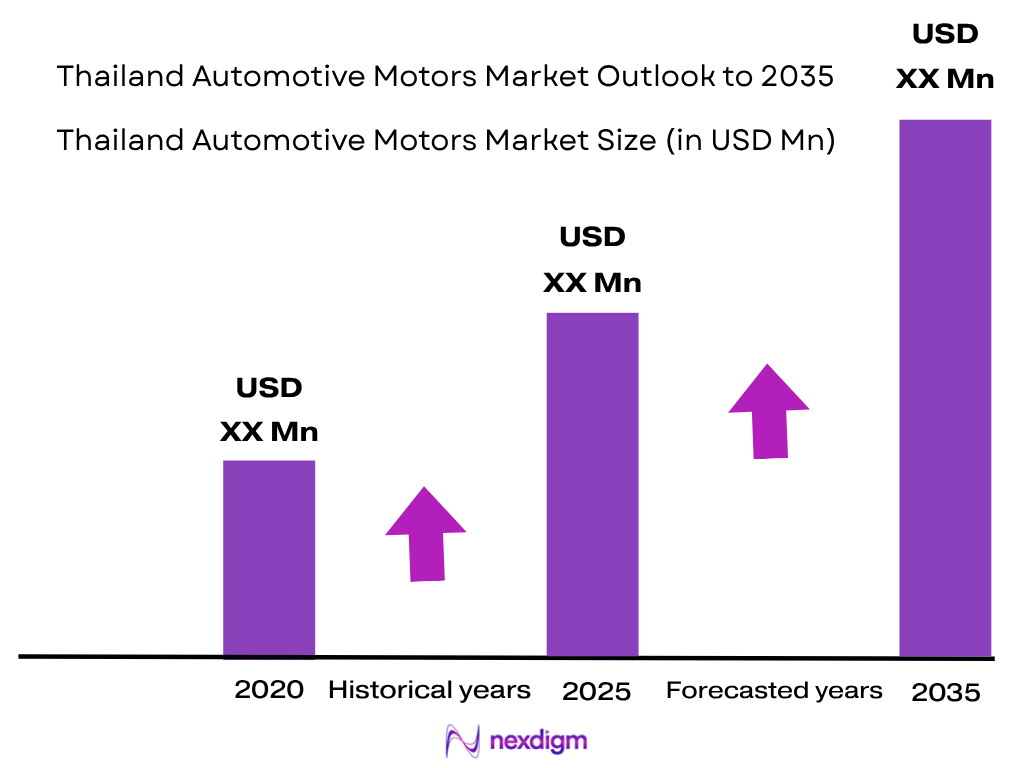
The Thailand Automotive Motors Market is valued at approximately ~USD XX million, based on the requested placeholder valuation. Demand is supported by Thailand’s large automotive manufacturing base, extensive one-ton pickup production, established Japanese OEM ecosystem, and rising xEV assembly. The industry produced more than 1.8 million vehicles and exported more than 1.1 million vehicles across the latest two reporting periods, creating sustained OEM demand for starters, alternators, traction motors, motor-generators, electric pumps and auxiliary motor systems.
Thailand’s automotive motor demand is concentrated in Rayong, Chonburi, Chachoengsao, Samut Prakan and Ayutthaya, where vehicle assembly, Tier-1 manufacturing and automotive component production are clustered. These locations dominate because they host major industrial estates, Eastern Economic Corridor investment, port-linked export logistics and large concentrations of powertrain and electrical suppliers. Passenger vehicles, pickups, hybrids and battery-electric platforms manufactured in these clusters generate strong demand for conventional motors, electrified motor-generators and high-voltage traction systems.
Market Segmentation
By Motor Type
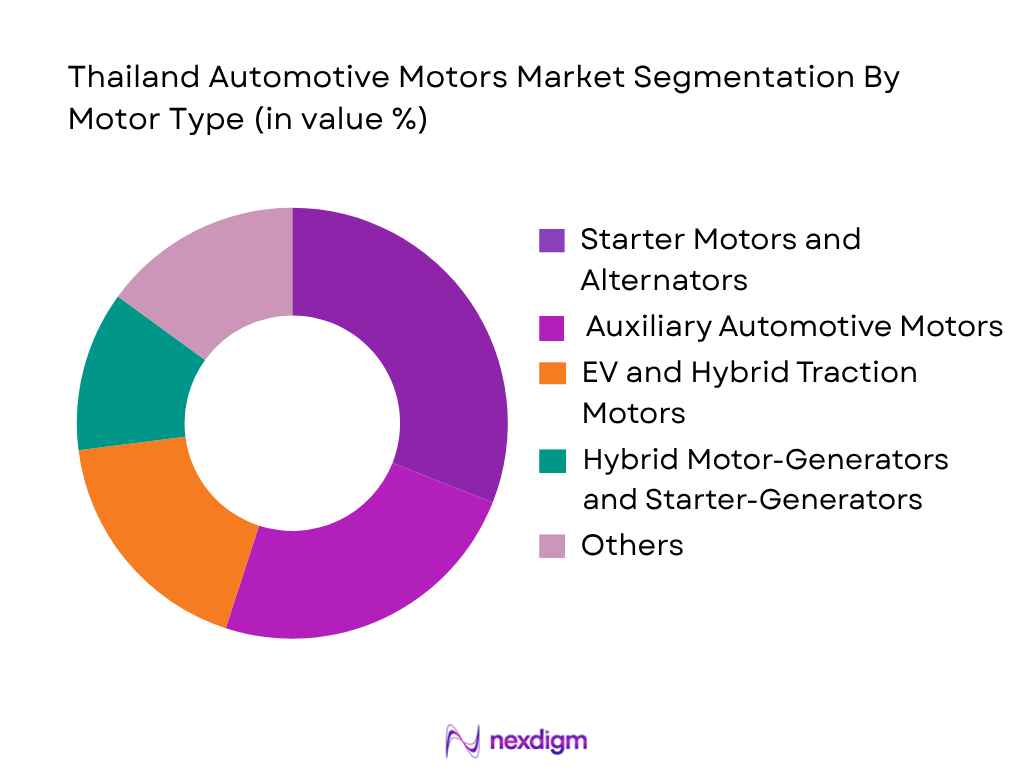
The Thailand Automotive Motors Market is segmented by motor type into starter motors, alternators and starter-generators, hybrid motor-generators, traction motors, electric power steering motors, HVAC and cooling motors, electric pump motors and other auxiliary automotive motors. Starter motors and alternators hold the dominant analytical market share because Thailand remains one of Asia’s major internal-combustion vehicle and one-ton pickup manufacturing bases, sustaining high installation volumes across gasoline and diesel platforms. The country’s export-oriented pickup production further reinforces demand for high-torque starter systems and high-output alternators. At the same time, hybrids and battery-electric vehicles are changing the product mix by increasing demand for motor-generators, permanent-magnet traction motors, electric compressors and thermal-management motors. Thailand’s supplier ecosystem also has local manufacturing capability for conventional automotive electrical components, giving starter and charging systems structural strength. However, EV traction motors and hybrid motor-generators represent the most important strategic growth categories as local xEV assembly and EV component localization increase.
By Vehicle Type
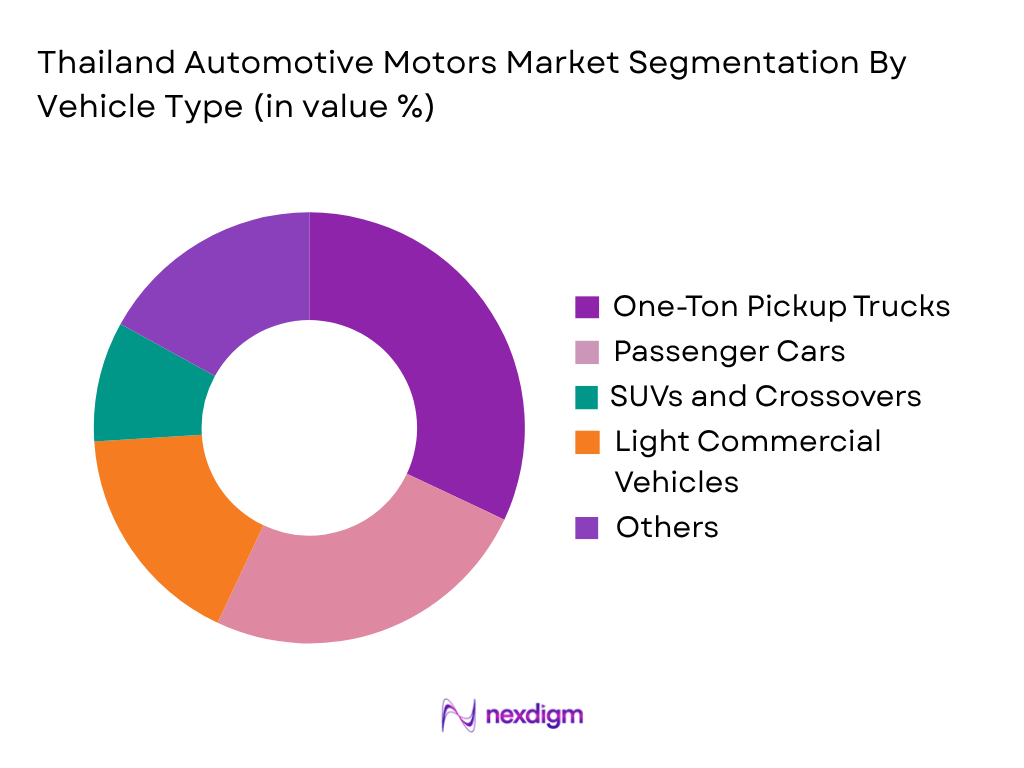
The Thailand Automotive Motors Market is segmented by vehicle type into passenger cars, SUVs and crossovers, one-ton pickup trucks, light commercial vehicles, medium and heavy commercial vehicles, buses and coaches, motorcycles and specialist vehicles. One-ton pickup trucks hold the dominant analytical market share because Thailand has developed a globally significant pickup production and export ecosystem supported by Japanese OEMs, local component suppliers and specialized diesel powertrain manufacturing. Pickups require robust starter motors, alternators, cooling systems, electric pumps and other auxiliary motors designed for higher-duty applications. Passenger cars and SUVs also represent major demand pools, particularly as hybrid and battery-electric models expand. Electrified passenger platforms increase motor content through traction motors, electric compressors, battery cooling motors and e-drive systems. Commercial vehicles add demand for higher-output starter and charging systems, while motorcycles contribute a separate volume base for electric starter and auxiliary systems. The result is a diversified market centered on pickups but increasingly influenced by xEV passenger vehicle production.
Competitive Landscape
The Thailand Automotive Motors Market is characterized by a strong concentration of global Tier-1 suppliers with established manufacturing relationships across Japanese, European and increasingly Chinese vehicle OEMs. DENSO, Mitsubishi Electric, Bosch, Valeo and Nidec represent key participants spanning starter motors, alternators, auxiliary motors, hybrid systems and traction motor technologies. Competitive positioning increasingly depends on Thailand manufacturing presence, OEM integration, local-content capability, electrified powertrain technology, EEC investment footprint and ability to support ASEAN export programs.
| Company | Establishment Year | Headquarters | Starter & Alternator Capability | Traction Motor / E-Drive Capability | Auxiliary Motor Capability | Hybrid / 48V Capability | Thailand Manufacturing / Localization | ASEAN Export Capability |
| DENSO Corporation | 1949 | Kariya, Japan | ~ | ~ | ~ | ~ | ~ | ~ |
| Mitsubishi Electric Corporation | 1921 | Tokyo, Japan | ~ | ~ | ~ | ~ | ~ | ~ |
| Robert Bosch GmbH | 1886 | Gerlingen, Germany | ~ | ~ | ~ | ~ | ~ | ~ |
| Valeo SE | 1923 | Paris, France | ~ | ~ | ~ | ~ | ~ | ~ |
| Nidec Corporation | 1973 | Kyoto, Japan | ~ | ~ | ~ | ~ | ~ | ~ |
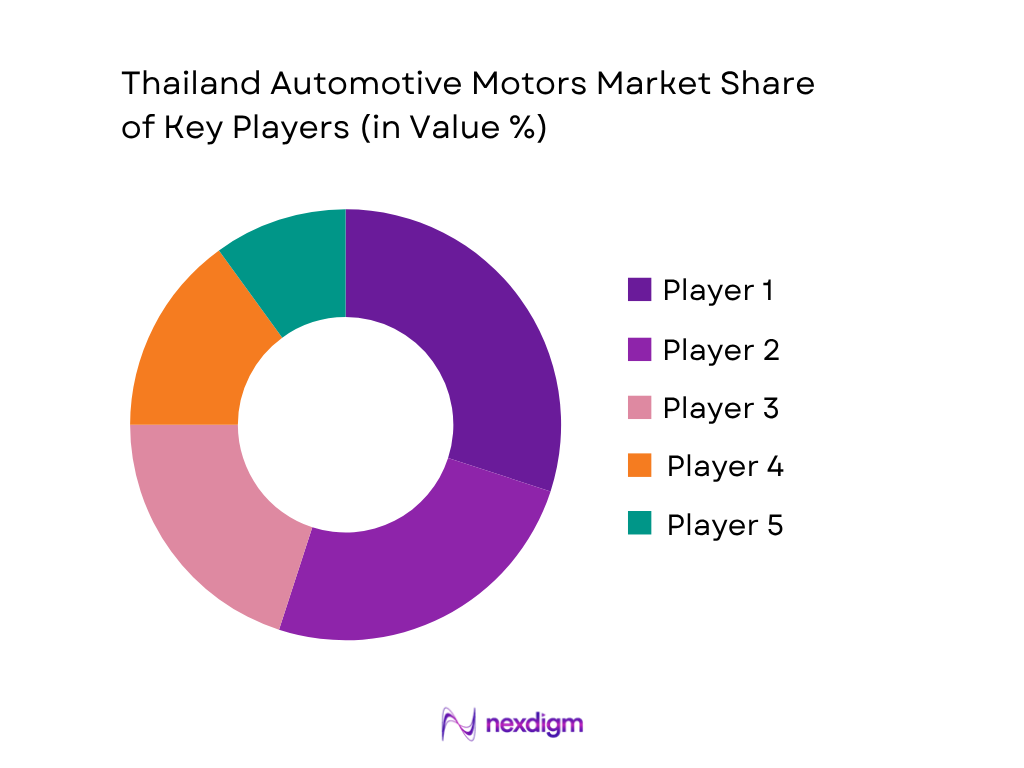
Thailand Automotive Motors Market Analysis
Growth Drivers
Large Vehicle Manufacturing and Export Base Sustains Automotive Motor Demand
Thailand’s large automotive manufacturing ecosystem is a fundamental demand driver for starter motors, alternators, electric power-steering motors, cooling motors, pumps and increasingly electrified drivetrain motors. The Office of Industrial Economics, using Federation of Thai Industries automotive data, recorded 1,468,997 vehicles produced in 2024, while 1,019,213 completely built vehicles were exported. The preceding production base stood at 1,841,686 vehicles, demonstrating the industrial scale available to automotive electrical suppliers even during a cyclical slowdown. Domestic vehicle sales totaled 572,675 units in 2024, creating additional OEM and replacement demand. The industry’s export orientation broadens motor requirements beyond domestic vehicle consumption because Thai plants manufacture passenger cars, one-ton pickups and commercial platforms for international markets. In December 2024 alone, factories produced 104,878 vehicles and exported 76,346 units, indicating continuous throughput for locally integrated electrical components. World Bank data place Thailand’s 2024 GDP at USD 526.52 billion and GDP per capita at USD 7,346.6, providing a macroeconomic foundation for its manufacturing economy. This production-and-export ecosystem directly supports sustained automotive motor installation volumes across ICE, hybrid and electric vehicle architectures.
Expanding EV Supply Chain Investment Accelerates Demand for Traction Motors and Electrified Components
Thailand’s accelerating EV manufacturing localization is expanding demand beyond conventional starters and alternators toward traction motors, motor-generators, electric pumps, integrated e-drives and associated power electronics. The Thailand Board of Investment reported 70,582 new BEV passenger-car registrations in 2024 and 57,289 additional BEV passenger-car registrations during the first half of 2025. Thailand subsequently had approximately 203,000 BEV passenger cars, 71,900 electric motorcycles, 3,800 electric buses and trucks and 1,000 electric three-wheelers operating in the market. More importantly for automotive motor suppliers, cumulative approved EV-supply-chain investment reached THB 137.7 billion by mid-2025. This included 21 BEV production projects, 53 battery projects and 42 key-component projects covering products such as traction motors, battery-management systems, drive-control units and onboard chargers. Approved BEV manufacturing capacity across these projects reached 386,000 vehicles annually, demonstrating the emerging domestic production ecosystem rather than reliance exclusively on imported finished EVs. World Bank data record Thailand’s 2024 GDP at USD 526.52 billion. These industrial investments strengthen the commercial case for localized traction motors, stators, rotors, housings, e-drive assemblies and high-voltage auxiliaries.
Market Challenges
Automotive Production Contraction Pressures Conventional Starter and Alternator Volumes
Thailand’s automotive motor suppliers face significant exposure to fluctuations in domestic vehicle production, particularly companies concentrated in conventional starters, alternators and pickup-oriented electrical systems. Federation of Thai Industries data show vehicle production declined from 1,841,686 units in 2023 to 1,468,997 units in 2024, while domestic vehicle sales fell from 775,780 units to 572,675 units. Vehicle exports also decreased from 1,117,539 units to 1,019,213 units. The Office of Industrial Economics attributed the domestic weakness partly to stricter vehicle-loan approvals and weaker purchasing conditions, factors that directly reduce OEM component installation volumes. December 2024 production was only 104,878 vehicles, with domestic sales of 54,016 units and exports of 76,346 units, illustrating the lower operating level facing suppliers at year-end. This matters particularly for Thailand’s established starter-motor and alternator supply chain because one-ton pickups and internal-combustion vehicles have historically generated substantial demand for these components. The World Bank recorded Thailand’s 2024 GDP at USD 526.52 billion and GDP per capita at USD 7,346.6. Consequently, suppliers must manage declining legacy-platform volumes while protecting utilization of existing ICE-oriented manufacturing capacity.
Rapid Powertrain Transition Creates Localization and Technology Conversion Pressure
Thailand’s transition from internal-combustion vehicles toward BEVs, HEVs and PHEVs creates a major restructuring challenge for automotive motor manufacturers because each architecture requires different electrical and drivetrain technologies. The BOI recorded 70,582 new BEV passenger-car registrations in 2024, while the operating BEV passenger-car fleet subsequently reached approximately 203,000 units. Meanwhile, approved investment included 42 projects covering key EV components such as traction motors, battery-management systems, drive-control units and onboard chargers. EV3.5 also links imported electric vehicles to domestic production, with manufacturers required to compensate eligible imported units at a 1:2 production ratio in 2026. This creates localization demand but also forces suppliers to accelerate capability development in high-voltage motors, inverter integration, permanent-magnet systems and precision e-drive manufacturing. The transition is already visible in production: July 2026 factories produced 13,422 BEV passenger cars, 1,661 PHEVs and 24,173 HEVs, while conventional passenger-car production was 8,251 units. World Bank data put Thailand’s 2024 GDP at USD 526.52 billion. Legacy electrical suppliers therefore face the simultaneous challenge of supporting existing ICE platforms while investing in fundamentally different electrified motor architectures and manufacturing processes.
Market Opportunities
Localized Traction Motor and Integrated E-Drive Manufacturing
Traction motors and integrated electric-drive systems represent a substantial future growth avenue for Thailand’s Automotive Motors Market as current EV investment begins creating a deeper local component ecosystem. The Thailand Board of Investment reported THB 137.7 billion in cumulative approved EV-supply-chain investment by mid-2025, including 42 key-component projects involving traction motors, battery-management systems, drive-control units and onboard chargers. These component projects represented THB 6.52 billion of approved investment, while 21 BEV manufacturing projects had combined production capacity of 386,000 vehicles annually. The addressable domestic EV fleet is already material, with approximately 203,000 BEV passenger cars operating in Thailand and 70,582 new BEV passenger cars registered during 2024. Manufacturing momentum continued into 2026: factories produced 13,422 BEV passenger cars in July alone, showing that Thailand is evolving from an EV-import market into an EV-production location. BOI measures also encourage local component utilization, creating openings for stators, rotors, motor housings, bearings, windings and integrated motor-inverter-reducer assemblies. World Bank data record a 2024 GDP of USD 526.52 billion. These current industrial conditions support future expansion of localized traction-motor and e-axle supply serving Thai OEM plants and regional vehicle programs.
Hybrid and 48V Motor-Generator Systems Create a Second Electrification Growth Path
Hybridization provides an additional future opportunity for Thailand’s automotive motor suppliers because the country’s electrification transition is expanding across HEV, PHEV and mild-hybrid architectures rather than moving exclusively toward BEVs. Production data already demonstrate the scale of this transition. In July 2026, Thailand produced 24,173 HEV passenger vehicles and 1,661 PHEVs, alongside 13,422 BEV passenger cars. During the first seven months of 2026, total vehicle production reached 834,595 units, preserving a sizeable industrial platform on which electrified motor content can expand. The Board of Investment reported that approved EV-sector projects include 7 HEV projects with THB 29.9 billion of investment and 7 PHEV projects with THB 9.429 billion, while government measures also recognize mild-hybrid electrical architectures. Hybrid platforms create direct demand for integrated starter-generators, belt starter-generators, regenerative motor-generators, electric water pumps, electrically driven compressors and other high-efficiency auxiliary motors while retaining parts of Thailand’s established ICE supply chain. World Bank data place Thailand’s 2024 GDP at USD 526.52 billion and GDP per capita at USD 7,346.6. The coexistence of large vehicle manufacturing capacity and rapidly expanding hybrid production therefore creates a distinct growth route for suppliers capable of bridging conventional electrical systems and full electric propulsion.
Future Outlook
The Thailand Automotive Motors Market is forecast to expand at approximately ~X.X% CAGR during 2026–2035, using the requested placeholder forecast. Growth will increasingly shift from conventional starter and alternator systems toward hybrid motor-generators, traction motors, integrated e-axles and electrically driven thermal-management components. Thailand’s position as a major regional vehicle manufacturing and export hub provides a strong base for this transition. Government support for xEV production and component localization is expected to encourage additional investments in motors, inverters, reducers and e-drive assemblies.
Hybrid vehicles will remain important because they allow existing OEMs and suppliers to transition gradually from internal-combustion platforms toward higher levels of electrification while preserving established local production networks. Battery-electric vehicle localization, particularly within Rayong, Chonburi and the wider Eastern Economic Corridor, is expected to create new opportunities for traction motor manufacturing, motor-inverter integration and high-voltage auxiliary systems.
Major Players
- DENSO (Thailand) Co., Ltd. – Starter Motors / Alternators / Wiper Motors / Automotive Electrical Systems
- Mitsubishi Electric Automotive (Thailand) – Starter Motors / Alternators / Electric Power Steering / Electrified Automotive Systems
- Robert Bosch Limited Thailand – Automotive Electrical Systems / Auxiliary Drives / Electrified Mobility Systems
- Valeo Automotive (Thailand) Co., Ltd. – Starter-Alternators / 48V Systems / Electric Motors / Thermal and Electrification Systems
- Nidec Corporation – Traction Motors / E-Axle Systems / Electric Pumps / Cooling Fan and Auxiliary Motors
- AISIN Corporation / AISIN Thailand – Hybrid Drive Systems / Electric Drive Modules / E-Axles / Automotive Components
- Astemo, Ltd. – Electric Motors / Inverters / Electric Powertrain and Chassis Systems
- Schaeffler Manufacturing (Thailand) Co., Ltd. – Electric Motors / Hybrid Modules / E-Axles / Electrified Drivetrain Components
- ZF Group Thailand – Electric Motors / E-Drive Systems / Electric Axles / Commercial Vehicle Electrification
- BorgWarner Inc. – High-Voltage Traction Motors / Integrated Drive Modules / Electric Drive Systems
- MAHLE Group Thailand – Electric Traction Motors / Electric Auxiliary Drives / Thermal-Management Systems
- SEG Automotive – Starter Motors / Alternators / 48V Electrification Systems
- Magna International Inc. – Electric Motors / Integrated E-Drive Systems / Electrified Powertrains
- Hyundai Mobis Co., Ltd. – Traction Motors / Electric Drive Systems / Integrated EV Power Electronics
- Marelli – Electric Motors / Thermal-Management Systems / Power Electronics / Electrified Automotive Systems
Key Target Audience
- Automotive Motor and Electric Drive Manufacturers
- Passenger Vehicle, Pickup and Commercial Vehicle OEMs
- Automotive Tier-1 and Tier-2 Component Manufacturers
- Automotive Parts Importers, Exporters and Authorized Distributors
- Electric Vehicle, Hybrid Powertrain and E-Axle Manufacturers
- Automotive Component Manufacturers and Industrial Estate Investors
- Investments and Venture Capitalist Firms
- Government and Regulatory Bodies (Thailand Board of Investment, Department of Land Transport, Excise Department, Office of Industrial Economics, Thai Industrial Standards Institute, Eastern Economic Corridor Office)
Research Methodology
Step 1: Identification of Key Variables
The initial phase involves constructing an ecosystem map covering automotive motor manufacturers, vehicle OEMs, Tier-1 suppliers, Tier-2 component companies, distributors, exporters and aftermarket participants within the Thailand Automotive Motors Market. Secondary and proprietary information is assessed to identify vehicle production, motor installation intensity, localization, propulsion mix, export dependence and replacement-cycle variables that directly influence market demand.
Step 2: Market Analysis and Construction
Historical information relating to Thailand’s vehicle production, domestic sales, exports, xEV assembly, component localization and aftermarket activity is compiled and analyzed. Top-down assessment is combined with bottom-up motor-content modeling across passenger cars, pickups, commercial vehicles, hybrids and battery-electric platforms to construct starter, alternator, motor-generator, traction motor and auxiliary motor demand.
Step 3: Hypothesis Validation and Expert Consultation
Market hypotheses are developed and validated through computer-assisted telephone interviews with automotive suppliers, component manufacturers, distributors, workshops and industry specialists. These discussions assess OEM sourcing, production utilization, localization requirements, motor technology adoption, export demand and aftermarket replacement behavior, helping refine assumptions and corroborate the structure of the Thailand Automotive Motors Market.
Step 4: Research Synthesis and Final Output
The final phase triangulates vehicle-production information with supplier-side motor manufacturing and component availability. Conventional starter and alternator installations, hybrid motor-generators, EV traction systems, auxiliary motor content, export supply and replacement demand are reconciled through top-down and bottom-up methodologies. This synthesis produces a consistent and validated assessment of Thailand’s automotive motor ecosystem and long-term technology transition.

- Executive Summary
- Research Methodology (Market Definition and Scope, Thailand Automotive Motor Taxonomy, Starter Motor and Alternator Classification, Traction Motor and E-Drive Classification, Auxiliary Automotive Motor Mapping, Vehicle Production Assessment, New Vehicle Registration Assessment, EV and Hybrid Vehicle Mapping, OEM Production and Fitment Assessment, Automotive Component Localization Assessment, Aftermarket Replacement Analysis, Automotive Motor Export Mapping, Market Sizing Framework)

- Definition and Scope
- Thailand Automotive Motor Industry Evolution and Electrification Development
- Automotive Motor Manufacturing and Assembly Process
- Automotive Motor Value Chain Analysis
- Thailand Automotive Motor Supply Chain Analysis
- Rotor, Stator, Electrical Steel, Copper Winding, Permanent Magnet, Bearing and Power Electronics Ecosystem Analysis
- Thailand Automotive Motor Manufacturing Footprint and Localization Assessment
- OEM, Tier-1, Tier-2 and Automotive Parts Supplier Framework

- Growth Drivers (Large Domestic Vehicle Production Base, Established Japanese OEM and Tier-1 Ecosystem, One-Ton Pickup Manufacturing Leadership, Expansion of BEV and Hybrid Production, Increasing Automotive Motor Content per Vehicle, Domestic Starter and Alternator Manufacturing, EV Component Localization Requirements, Expansion of Eastern Economic Corridor Automotive Investment)
- Market Challenges (Automotive Production Cycle Volatility, ICE-to-EV Supplier Transition, Dependence on Imported Permanent Magnets and Advanced Power Electronics, EV Production Capacity Utilization, Technology Gaps among Tier-2 Suppliers, High-Voltage Engineering Skill Requirements, Regional EV Manufacturing Competition, Legacy ICE Component Capacity Transition)
- Market Opportunities (Localized Traction Motor Manufacturing, Integrated E-Axle Production, Hybrid Motor-Generator Systems, 48V Starter-Generator Systems, Electric Pickup Drivetrains, Electric Commercial Vehicle Motors, High-Efficiency Auxiliary Motors, ASEAN E-Drive Component Exports)
- Market Trends (Permanent Magnet Synchronous Motor Adoption, Integrated E-Axles, Hairpin Winding Technology, 800V Electric Architectures, Hybrid and Range-Extender Systems, Brushless Auxiliary Motor Adoption, Motor-Inverter-Reducer Integration, Localization of EV Critical Components)
- Regulatory and Standards Landscape (Thailand EV3 and EV3.5 Framework, 30@30 Zero-Emission Vehicle Policy, Board of Investment EV Component Promotion, Local Production Offset Requirements, Made in Thailand Local-Content Framework, Excise Department EV Incentives, Automotive Parts Joint-Venture Promotion Measures, Eastern Economic Corridor Investment Incentives, Thai Industrial Standards Automotive Requirements)
- SWOT Analysis
- Porter’s Five Forces Analysis
- PESTLE Analysis
- Stakeholder Ecosystem
- Competition Ecosystem

- By Market Value (2020-2025)
- By Automotive Motor Production Volume (2020-2025)
- By Starter Motor Volume (2020-2025)
- By Alternator and Starter-Generator Volume (2020-2025)
- By Traction Motor and E-Drive Volume (2020-2025)
- By Auxiliary Automotive Motor Volume (2020-2025)

- By Motor Type (In Value %)
Starter Motors
Alternators
Integrated Starter Generators
Belt Starter Generators
Hybrid Motor-Generators
EV Traction Motors
Integrated E-Axle Motors
Electric Power Steering Motors
HVAC Blower Motors
Cooling Fan Motors
Electric Water Pump Motors
Electric Oil Pump Motors
Electric Compressor Motors
Power Window Motors
Power Seat Motors
Windshield Wiper Motors
Other Auxiliary Automotive Motors - By Vehicle Type (In Value %)
Passenger Cars
SUVs and Crossovers
One-Ton Pickup Trucks
Pickup Passenger Vehicles
Light Commercial Vehicles
Medium and Heavy Commercial Vehicles
Buses and Coaches
Battery Electric Passenger Vehicles
Hybrid Passenger Vehicles
Motorcycles and Electric Motorcycles
Government and Municipal Vehicles
Special-Purpose Vehicles - By Propulsion Type (In Value %)
Gasoline Internal Combustion Vehicles
Diesel Internal Combustion Vehicles
Mild Hybrid Electric Vehicles
Full Hybrid Electric Vehicles
Plug-In Hybrid Electric Vehicles
Battery Electric Vehicles
Range-Extended Electric Vehicles
Fuel Cell Electric Vehicles
Other Electrified Powertrains - By Motor Technology (In Value %)
Brushed DC Motors
Brushless DC Motors
Permanent Magnet Synchronous Motors
AC Induction Motors
Switched Reluctance Motors
Wound Rotor Synchronous Motors
Axial Flux Motors
Integrated Motor-Generator Systems
Other Automotive Motor Technologies - By Sales Channel (In Value %)
OEM and Vehicle Manufacturer Fitment
Tier-1 Module and System Integration
Authorized Automotive Distributors
Authorized Dealer Service Networks
Independent Automotive Parts Distributors
Independent Workshops and Garages
Automotive Electrical Specialist Networks
Fleet Maintenance Networks
Automotive Component Exporters
Online Automotive Parts Platforms - By Production Cluster (In Value %)
Chonburi Automotive Cluster
Rayong Automotive and EV Cluster
Chachoengsao Automotive Cluster
Samut Prakan Automotive Component Cluster
Ayutthaya Industrial Cluster
Pathum Thani Industrial Cluster
Greater Bangkok Automotive Distribution Hub
Other Thailand Automotive Manufacturing Locations

- Market Share of Major Players (By Revenue, Motor Type, OEM Fitment, Vehicle Application, Propulsion Type, Domestic Production, Export Supply, Aftermarket Channel)
- Cross Comparison Parameters (Thailand Automotive Motor Manufacturing and OEM Fitment Footprint, Starter Alternator and 48V Motor-Generator Production Capability, EV Traction Motor and Integrated E-Axle Technology Capability, Auxiliary Motor and Thermal-Management Portfolio Breadth, Pickup Passenger Commercial and xEV Application Coverage, EEC Manufacturing Local-Content and Thai Supplier Integration Strength, Thailand Aftermarket Service Parts and Technical Support Network, ASEAN Export Electrification and Future-Mobility Supply Capability)
- SWOT Analysis of Major Players
- Competitive Positioning Matrix
- Product and Technology Portfolio Benchmarking
- Pricing and Distribution Network Benchmarking
- Market Entry Strategy Assessment
- Detailed Profiles of Major Companies
DENSO (Thailand) Co., Ltd. – Starter Motors / Alternators / Wiper Motors / Automotive Electrical Systems
Mitsubishi Electric Automotive (Thailand) – Starter Motors / Alternators / Electric Power Steering / Electrified Automotive Systems
Robert Bosch Limited Thailand – Automotive Electrical Systems / Auxiliary Drives / Electrified Mobility Systems
Valeo Automotive (Thailand) Co., Ltd. – Starter-Alternators / 48V Systems / Electric Motors / Thermal and Electrification Systems
Nidec Corporation – Traction Motors / E-Axle Systems / Electric Pumps / Cooling Fan and Auxiliary Motors
AISIN Corporation / AISIN Thailand – Hybrid Drive Systems / Electric Drive Modules / E-Axles / Automotive Components
Astemo, Ltd. – Electric Motors / Inverters / Electric Powertrain and Chassis Systems
Schaeffler Manufacturing (Thailand) Co., Ltd. – Electric Motors / Hybrid Modules / E-Axles / Electrified Drivetrain Components
ZF Group Thailand – Electric Motors / E-Drive Systems / Electric Axles / Commercial Vehicle Electrification
BorgWarner Inc. – High-Voltage Traction Motors / Integrated Drive Modules / Electric Drive Systems
MAHLE Group Thailand – Electric Traction Motors / Electric Auxiliary Drives / Thermal-Management Systems
SEG Automotive – Starter Motors / Alternators / 48V Electrification Systems
Magna International Inc. – Electric Motors / Integrated E-Drive Systems / Electrified Powertrains
Hyundai Mobis Co., Ltd. – Traction Motors / Electric Drive Systems / Integrated EV Power Electronics
Marelli – Electric Motors / Thermal-Management Systems / Power Electronics / Electrified Automotive Systems

- Automotive Motor Buyer Segmentation
- OEM and Tier-1 Procurement Behaviour
- Automotive Motor Supplier Selection Criteria
- OEM and Aftermarket Buyer Pain Points
- Motor Technology and Electrification Adoption Assessment
- Replacement and Repurchase Behaviour

- By Market Value (2026-2035)
- By Automotive Motor Production Volume (2026-2035)
- By Starter Motor Volume (2026-2035)
- By Alternator and Starter-Generator Volume (2026-2035)
- By Traction Motor and E-Drive Volume (2026-2035)
- By Auxiliary Automotive Motor Volume (2026-2035)


 Request a Sample
 Ask for Customization
 Get a Quote
 Enquire Now