

 Download PDF
Market Overview
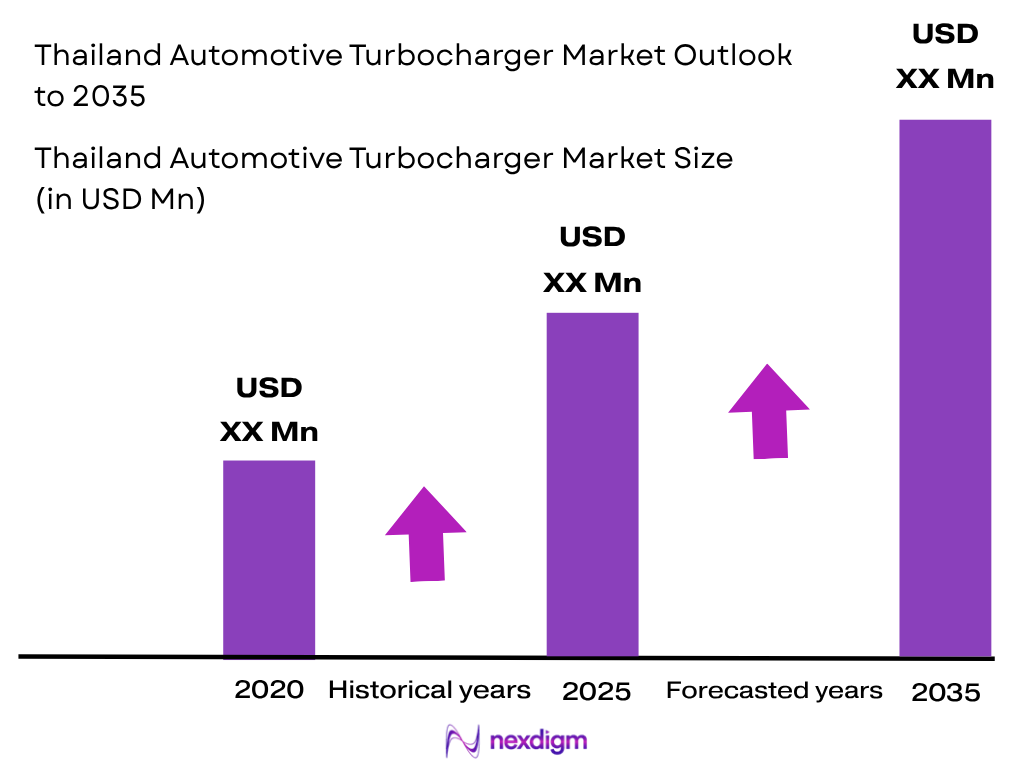
The Thailand Automotive Turbocharger Market is valued at ~USD XX million, supported by the country’s position as a major automotive manufacturing and export hub in Southeast Asia. The market is driven by turbocharged diesel pickup trucks, commercial vehicles, passenger vehicles and increasing adoption of fuel-efficient engine technologies. Thailand produced more than 1.84 million vehicles in 2023 and approximately 1.47 million vehicles in 2024, according to the Federation of Thai Industries, creating a strong installed base for turbocharger-equipped vehicles. Demand is further supported by engine downsizing, emission compliance requirements and rising preference for high-performance fuel-efficient engines.
Thailand’s automotive turbocharger demand is concentrated around major automotive manufacturing clusters including Bangkok, Chonburi, Rayong, Chachoengsao and Samut Prakan. The Eastern Economic Corridor, particularly Rayong and Chonburi, dominates due to the presence of vehicle assembly plants, engine manufacturing facilities, automotive suppliers and export-oriented industrial infrastructure. Thailand’s automotive ecosystem includes global manufacturers such as Toyota, Isuzu, Mitsubishi, Honda and Ford, supporting significant demand for turbocharged engines, especially diesel pickup trucks and commercial vehicles. The country’s established Tier-1 and Tier-2 supplier network further strengthens turbocharger integration and aftermarket availability.
Market Segmentation
By Vehicle Type
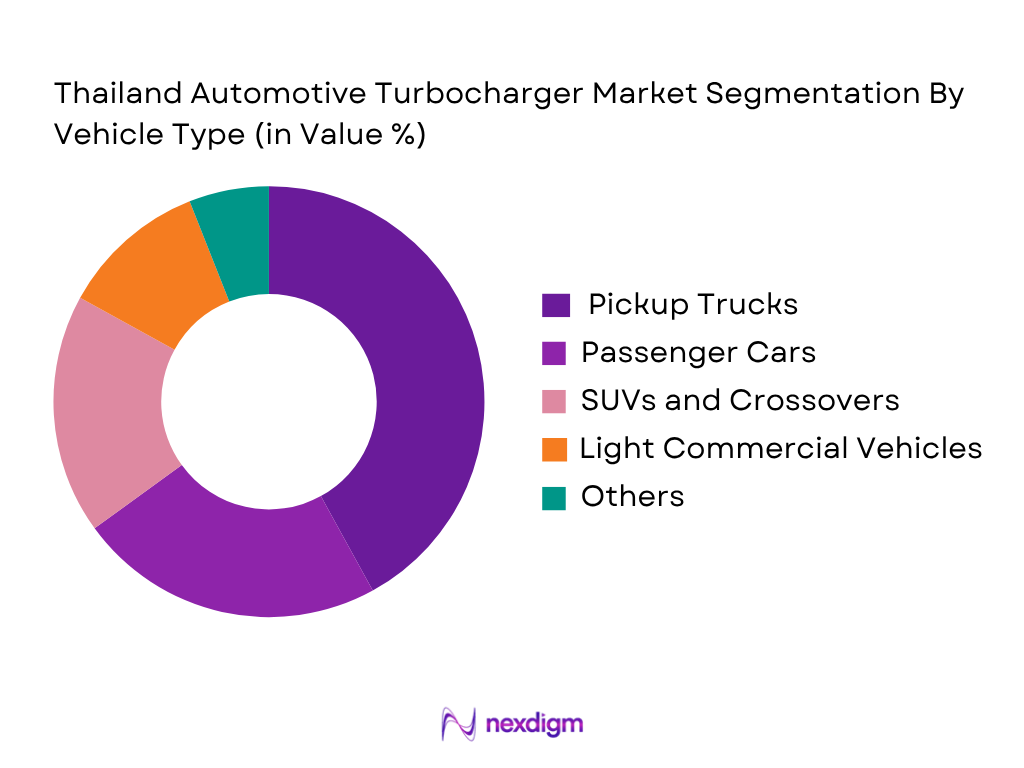
Thailand Automotive Turbocharger Market is segmented by vehicle type into pickup trucks, passenger cars, SUVs and crossovers, light commercial vehicles and medium/heavy commercial vehicles. Pickup trucks represent the dominant segment due to Thailand’s position as one of the world’s largest pickup truck production bases and the widespread use of diesel-powered one-ton pickup vehicles for commercial and personal applications. Turbocharged diesel engines are preferred in pickup trucks because they provide higher torque output, improved load-carrying capability and better fuel efficiency. The strong presence of manufacturers including Toyota, Isuzu, Mitsubishi and Ford supports continuous turbocharger demand in this segment. Commercial usage in agriculture, logistics and small businesses further strengthens replacement demand.
By Turbocharger Technology
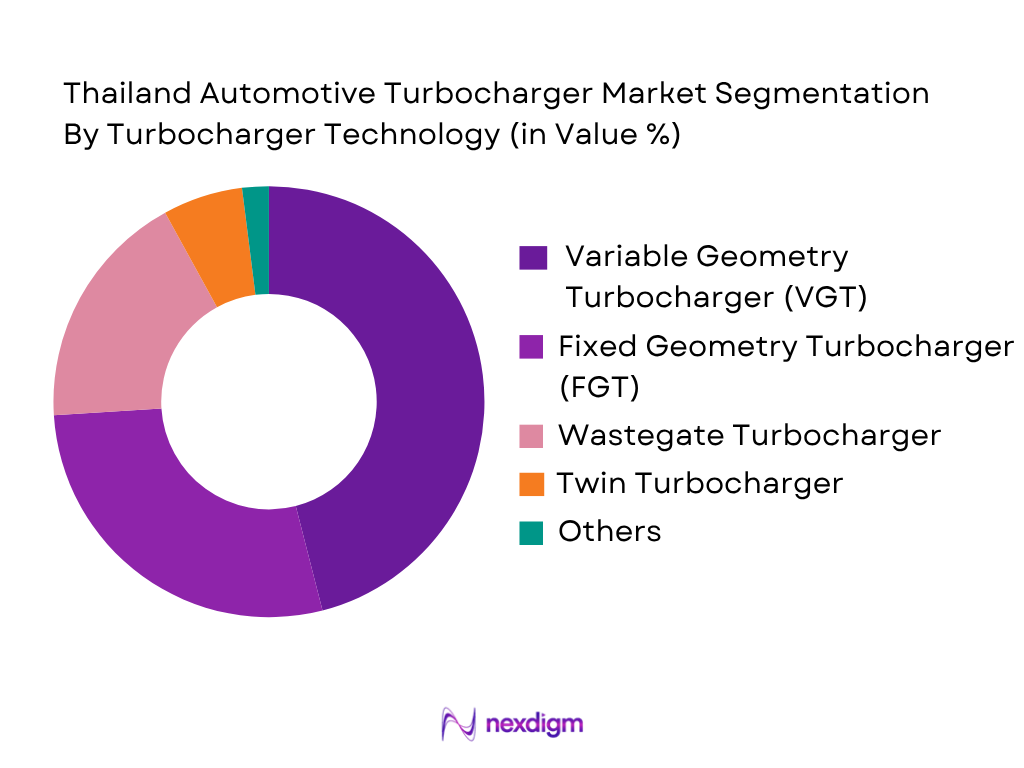
Thailand Automotive Turbocharger Market is segmented by turbocharger technology into variable geometry turbochargers, fixed geometry turbochargers, wastegate turbochargers, twin turbochargers and electric/hybrid turbochargers. Variable geometry turbochargers dominate due to their ability to provide improved engine response, higher efficiency and better emissions performance across different engine operating conditions. Diesel pickup trucks and commercial vehicles increasingly utilize variable geometry technology because these applications require strong low-speed torque and efficient power delivery. Fixed geometry turbochargers continue to maintain demand in cost-sensitive applications, while electric and hybrid turbocharging technologies remain emerging areas driven by electrification trends and advanced engine efficiency requirements.
Competitive Landscape
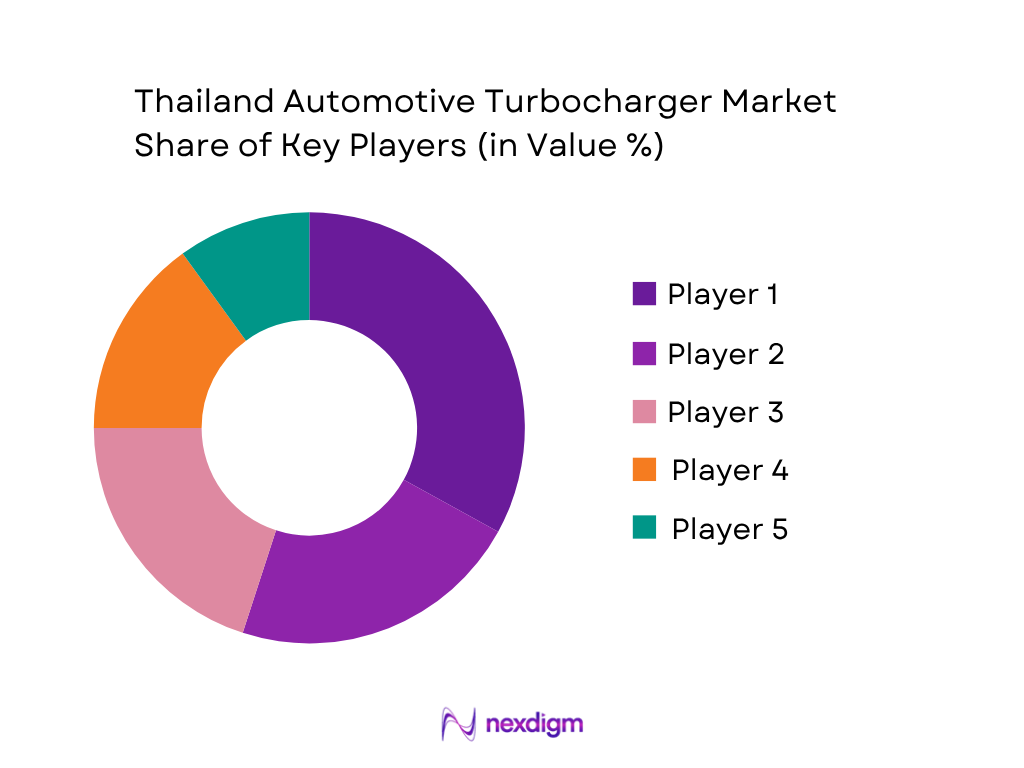
The Thailand Automotive Turbocharger Market is characterized by the presence of global turbocharger manufacturers supplying OEMs, engine manufacturers and aftermarket distributors. Major players compete through technology capability, OEM partnerships, manufacturing footprint, product reliability and aftermarket support. The market is influenced by strong relationships between turbocharger suppliers and vehicle manufacturers operating production facilities in Thailand.
| Company | Establishment Year | Headquarters | Thailand Presence | Key Products | OEM Applications | Technology Focus | Aftermarket Network |
| Garrett Motion | 1936 | USA | ~ | ~ | ~ | ~ | ~ |
| BorgWarner | 1928 | USA | ~ | ~ | ~ | ~ | ~ |
| Mitsubishi Heavy Industries Engine & Turbocharger | 1884 | Japan | ~ | ~ | ~ | ~ | ~ |
| IHI Corporation | 1853 | Japan | ~ | ~ | ~ | ~ | ~ |
| Cummins | 1919 | USA | ~ | ~ | ~ | ~ | ~ |
Thailand Automotive Turbocharger Market Analysis
Growth Drivers
Expansion of Automotive Manufacturing and Export-Oriented Vehicle Production
Thailand’s position as a major automotive manufacturing hub continues to support demand for turbochargers, particularly for diesel-powered pickup trucks, commercial vehicles and passenger vehicles. According to the Thailand Automotive Institute, Thailand produced approximately 1.47 million vehicles in 2024, supported by its established manufacturing ecosystem and export-oriented production base. The country exported around 1 million vehicles in 2024, reinforcing demand for turbocharged powertrains used in international markets. The World Bank reported that Thailand’s GDP reached approximately US$526 billion in 2024, while real economic growth was recorded at 2.7%, reflecting continued industrial activity supporting automotive supply chains. Thailand remains one of the world’s largest pickup truck production centres, with manufacturers operating large-scale facilities in provinces such as Chonburi, Rayong and Samut Prakan. Diesel pickup trucks commonly utilize variable geometry turbochargers to improve torque delivery, fuel efficiency and emissions performance. The presence of more than 2,000 automotive component manufacturers in Thailand, according to the Thailand Automotive Institute, further strengthens the domestic ecosystem for turbocharger manufacturing, assembly and aftermarket supply. The combination of vehicle production, export demand and component localization creates sustained requirements for turbocharger technologies across original equipment and replacement applications.
Growth in Commercial Vehicle Demand and Diesel Engine Applications
Thailand’s logistics, agriculture and industrial sectors continue to support turbocharger demand through widespread use of diesel-powered commercial vehicles. The country’s freight transportation network relies heavily on pickup trucks, light commercial vehicles and heavy-duty trucks equipped with turbocharged engines to achieve higher load capacity and operating efficiency. According to the Department of Land Transport, Thailand had more than 44 million registered vehicles in 2024, including a substantial base of commercial vehicles requiring periodic maintenance and component replacement. The World Bank reported that Thailand’s merchandise trade value remained above US$500 billion in 2024, supporting logistics activity across ports, industrial zones and regional distribution networks. Turbocharged diesel engines remain preferred in many commercial applications because they provide higher torque output under heavy-load conditions compared with naturally aspirated engines. Thailand’s agricultural sector also contributes to demand, with the World Bank recording agricultural value added at approximately US$37 billion in 2024, supporting rural transportation requirements. The continued use of diesel-powered pickup trucks for farming, construction and freight operations creates opportunities for turbocharger suppliers focused on durability, high-temperature performance and aftermarket compatibility. Growth in logistics infrastructure, industrial production and commercial vehicle utilization continues to reinforce turbocharger adoption across Thailand’s automotive ecosystem.
Market Challenges
Transition Toward Electrification and Declining Long-Term Internal Combustion Engine Dependence
The gradual shift toward electric vehicles presents a structural challenge for Thailand’s automotive turbocharger market as battery-electric vehicles do not require conventional exhaust-driven turbocharging systems. Thailand has accelerated electric vehicle adoption through government policies under the EV 3.5 incentive programme, encouraging manufacturers to establish local EV production capabilities. The Thailand Board of Investment reported that approved electric vehicle investment projects exceeded THB 80 billion in 2024, indicating increasing industry focus on electrified vehicle manufacturing. The country recorded more than 70,000 newly registered battery electric passenger vehicles in 2024, according to the Department of Land Transport, reflecting growing consumer and manufacturer interest in alternative powertrains. While internal combustion engines remain dominant in commercial applications, passenger vehicle electrification may gradually reduce demand for conventional turbocharger systems. Automotive manufacturers are also investing in hybrid powertrains, which may require fewer turbocharged applications compared with traditional combustion vehicles. This transition creates pressure for turbocharger suppliers to diversify into electrically assisted turbocharging, hybrid powertrain components and advanced thermal management solutions. Companies operating in Thailand must balance existing diesel turbocharger demand from pickup trucks and commercial vehicles with emerging electrification trends affecting future vehicle architectures.
Dependence on Export Markets and Global Automotive Supply Chain Volatility
Thailand’s automotive turbocharger industry remains exposed to fluctuations in global vehicle demand because a significant portion of domestic vehicle production is export-oriented. The Thailand Automotive Institute reported that approximately 1 million vehicles were exported in 2024, making international market conditions a critical factor influencing production volumes and component demand. The International Monetary Fund recorded Thailand’s export-oriented economy as sensitive to external conditions, including global trade fluctuations and manufacturing slowdowns. Automotive supply chains have also experienced disruptions related to semiconductor availability, logistics constraints and raw material availability, affecting production planning for vehicle manufacturers and component suppliers. Turbochargers require specialized materials such as high-temperature alloys, precision-machined components and electronic control systems, making supply chain reliability essential. The World Bank reported Thailand’s industrial sector remained an important contributor to economic activity in 2024, but manufacturing performance continued to face pressure from weaker global demand conditions. Additionally, competition from regional automotive production hubs creates pressure on suppliers to maintain technological capability and cost efficiency. Turbocharger manufacturers must therefore strengthen localized supply networks, improve manufacturing flexibility and develop advanced products to remain competitive in Thailand’s evolving automotive industry.
Market Opportunities
Development of Advanced Turbocharger Technologies for Hybrid and High-Efficiency Engines
Thailand’s transition toward cleaner mobility creates opportunities for advanced turbocharger technologies designed for hybrid vehicles, downsized engines and improved fuel efficiency applications. Although battery electric vehicles are expanding, internal combustion and hybrid vehicles continue to play an important role, particularly in commercial transportation and export markets. Thailand produced approximately 1.47 million vehicles in 2024, creating a large installed base requiring efficient engine technologies. The Ministry of Industry has promoted automotive technology development through Thailand’s EV and next-generation vehicle policies, encouraging manufacturers to upgrade production capabilities. Advanced turbocharger technologies such as electrically assisted turbochargers, variable geometry systems and electronically controlled boosting systems can support manufacturers seeking lower emissions while maintaining engine performance. The International Energy Agency reported that global electric vehicle deployment exceeded 17 million new electric car sales in 2024, increasing pressure on conventional powertrain suppliers to innovate. In Thailand, opportunities exist for turbocharger manufacturers supplying hybrid powertrains, commercial vehicles and export-oriented models requiring higher efficiency. The presence of established automotive clusters in Rayong, Chonburi and the Eastern Economic Corridor provides infrastructure for technology development, component manufacturing and supplier collaboration. These conditions create opportunities for suppliers offering next-generation turbocharging solutions compatible with evolving vehicle platforms.
Expansion of Automotive Aftermarket and Replacement Turbocharger Demand
Thailand’s large vehicle parc provides continued opportunities for aftermarket turbocharger sales, remanufacturing and replacement component supply. According to the Department of Land Transport, Thailand had more than 44 million registered vehicles in 2024, creating a significant installed base requiring maintenance throughout vehicle lifecycles. Pickup trucks represent a major portion of Thailand’s automotive landscape and are widely used in commercial, agricultural and logistics applications where turbocharger performance directly affects vehicle productivity. The country’s extensive freight network and industrial activity further support replacement demand because commercial vehicles typically experience higher operating hours and heavier usage conditions. Thailand’s automotive aftermarket ecosystem is supported by thousands of independent repair shops, distributors and component suppliers serving both domestic users and neighbouring Southeast Asian markets. The Ministry of Commerce reported Thailand’s automotive parts exports remained above US$20 billion in 2024, highlighting the strength of the domestic component supply chain. Turbocharger suppliers can leverage this ecosystem by offering remanufactured units, high-durability replacement products and application-specific solutions for diesel pickup trucks, commercial vehicles and fleet operators. The combination of a large vehicle population, strong component manufacturing capability and regional export connectivity creates long-term opportunities in the aftermarket turbocharger segment.
Future Outlook
Over the forecast period, the Thailand Automotive Turbocharger Market is expected to experience steady expansion driven by continued automotive manufacturing activity, demand for fuel-efficient engines and increasing adoption of advanced turbocharging technologies. Although electric vehicle adoption may reduce long-term demand for conventional engine components, turbochargers will remain relevant in diesel commercial vehicles, pickup trucks and hybrid powertrains. Growth opportunities are expected from variable geometry turbochargers, electric-assisted turbo systems, commercial vehicle efficiency solutions and aftermarket replacement demand.
Major Players
- Garrett Motion
- BorgWarner Inc.
- Mitsubishi Heavy Industries Engine & Turbocharger
- IHI Corporation
- Cummins Inc.
- Bosch Mobility
- Continental AG
- Hitachi Astemo
- Honeywell International
- Mahle GmbH
- Marelli Holdings
- Delphi Technologies
- Rotomaster International
- Turbo Technics
- Turbo International
Key Target Audience
- Automotive Original Equipment Manufacturers
- Vehicle Engine Manufacturers
- Turbocharger Manufacturers
- Automotive Component Suppliers
- Commercial Vehicle Fleet Operators
- Investments and Venture Capitalist Firms
- Government and Regulatory Bodies (Department of Land Transport, Ministry of Industry Thailand, Thailand Board of Investment)
- Automotive Aftermarket Distributors and Service Providers
Research Methodology
Step 1: Identification of Key Variables
The initial phase involves mapping the Thailand Automotive Turbocharger Market ecosystem by identifying key stakeholders including vehicle manufacturers, engine suppliers, turbocharger producers, component manufacturers, distributors and aftermarket service providers. Secondary research is conducted using automotive production databases, government publications, industry associations and trade statistics to define market variables influencing demand and supply.
Step 2: Market Analysis and Construction
Historical automotive production trends, vehicle registrations, engine technology adoption and turbocharger installation rates are analyzed to construct the market framework. The assessment includes evaluation of vehicle segments, turbocharger technologies, OEM supply relationships and aftermarket replacement demand to establish a comprehensive market structure.
Step 3: Hypothesis Validation and Expert Consultation
Market assumptions are validated through discussions with automotive industry professionals, component suppliers, distributors and fleet operators. These consultations provide operational insights related to turbocharger adoption, technology preferences, replacement cycles and supply-chain dynamics.
Step 4: Research Synthesis and Final Output
The final stage integrates primary and secondary research findings to develop validated market insights. Data from manufacturers, automotive associations and industry stakeholders is triangulated to ensure accuracy in market segmentation, competitive assessment and future opportunity analysis.

- Executive Summary
- Research Methodology (Market Definition and Scope, Turbocharger Classification Framework, Automotive Application Mapping, Vehicle Production Assessment, Engine Technology Assessment, Top-Down Market Sizing, Bottom-Up Market Reconstruction, OEM Production Analysis, Turbocharger Installation Rate Analysis, Import-Export Assessment, Aftermarket Demand Evaluation, Primary Industry Interviews, Supply-Side Validation, Demand-Side Validation, Data Triangulation, Forecasting Framework, Market Assumptions and Limitations)

- Definition and Scope
- Automotive Turbocharger Industry Evolution
- Thailand Automotive Manufacturing Ecosystem
- Turbocharger Value Chain Analysis
- Automotive Turbocharger Supply Chain Analysis
- Thailand Vehicle Production and Engine Manufacturing Landscape

- Growth Drivers (Automotive Manufacturing Hub, Pickup Truck Production, Diesel Commercial Vehicles, Vehicle Export Demand, Engine Downsizing, Fuel Efficiency Requirements, Emission Regulation Compliance)
- Market Challenges (EV Powertrain Transition, Turbocharger Replacement by Electrification, Raw Material Price Volatility, Imported Component Dependence, High Precision Manufacturing Requirements, Aftermarket Counterfeit Products, Thermal Stress and Durability Requirements)
- Market Opportunities (Hybrid Turbo Systems, Electric Turbochargers, Commercial Vehicle Efficiency Solutions, Turbocharger Remanufacturing, Advanced Variable Geometry Systems, Regional Export Expansion, High-Efficiency Diesel Applications)
- Market Trends (Engine Downsizing, Electrified Turbocharging, Variable Geometry Adoption, Integrated Turbocharger Systems, Lightweight Turbo Components, Smart Actuators, Thermal Management Improvements)
- Porter’s Five Forces Analysis
- PESTLE Analysis
- SWOT Analysis

- By Market Value (2020-2025)
- By Turbocharger Unit Volume (2020-2025)
- By Average Turbocharger Selling Price (2020-2025)
- By Vehicle Production (2020-2025)
- By Engine Production (2020-2025)
- By OEM Demand (2020-2025)
- By Original Equipment Demand (2020-2025)

- By Vehicle Type (in value %)
Passenger Cars
Pickup Trucks
SUVs and Crossovers
Light Commercial Vehicles
Medium and Heavy Commercial Vehicles
Buses
Performance Vehicles - By Engine Type (in value %)
Diesel Engines
Gasoline Engines
Hybrid Engines
Plug-in Hybrid Engines
Commercial Diesel Powertrains - By Turbocharger Technology (in value %)
Fixed Geometry Turbochargers
Variable Geometry Turbochargers
Twin Turbochargers
Electric Turbochargers
Hybrid Turbocharging Systems
Wastegate Turbochargers - By Application (in value %)
Passenger Vehicle Turbochargers
Pickup Truck Turbochargers
Commercial Vehicle Turbochargers
Agricultural Vehicle Turbochargers
Industrial Vehicle Turbochargers
Motorsport and Performance Turbochargers - By Fuel Type (in value %)
Diesel Fuel
Gasoline Fuel
Alternative Fuel Engines
Hybrid Powertrains - By Engine Displacement (in value %)
Below 1.5 L Engines
1.5–2.0 L Engines
2.0–3.0 L Engines
Above 3.0 L Engines

- Market Share of Major Players (By Revenue, Unit Volume, Vehicle Segment, Engine Type, Technology Type, OEM Supply, Aftermarket)
- Cross Comparison Parameters (Turbocharger Product Portfolio Breadth, OEM Customer Coverage, Variable Geometry Turbocharger Capability, Commercial Vehicle Turbocharger Expertise, Manufacturing Capacity, Thailand Production Footprint, Aftermarket Distribution Reach, Turbocharger Technology Innovation Capability)
- SWOT Analysis Of Major Players
- Detailed Profiles of Major Companies
Garrett Motion
BorgWarner Inc.
Mitsubishi Heavy Industries Engine & Turbocharger, Ltd.
IHI Corporation
Cummins Inc.
Bosch Mobility
Continental AG
Hitachi Astemo
Honeywell International Inc.
Marelli Holdings
Delphi Technologies
Mahle GmbH
Rotomaster International
Turbo International
Turbo Technics

- Consumer Profile Analysis
- Consumer Purchasing Decision Factors
- Vehicle Usage Behaviour Analysis
- Consumer Brand Preference Analysis
- Aftermarket Consumer Analysis
- Consumer Technology Adoption Analysis

- By Market Value (2026-2035)
- By Turbocharger Unit Volume (2026-2035)
- By Average Turbocharger Selling Price (2026-2035)
- By Vehicle Production (2026-2035)
- By Engine Production (2026-2035)
- By OEM Demand (2026-2035)
- By Original Equipment Demand (2026-2035)


 Request a Sample
 Ask for Customization
 Get a Quote
 Enquire Now