
 Download PDF
Market Overview
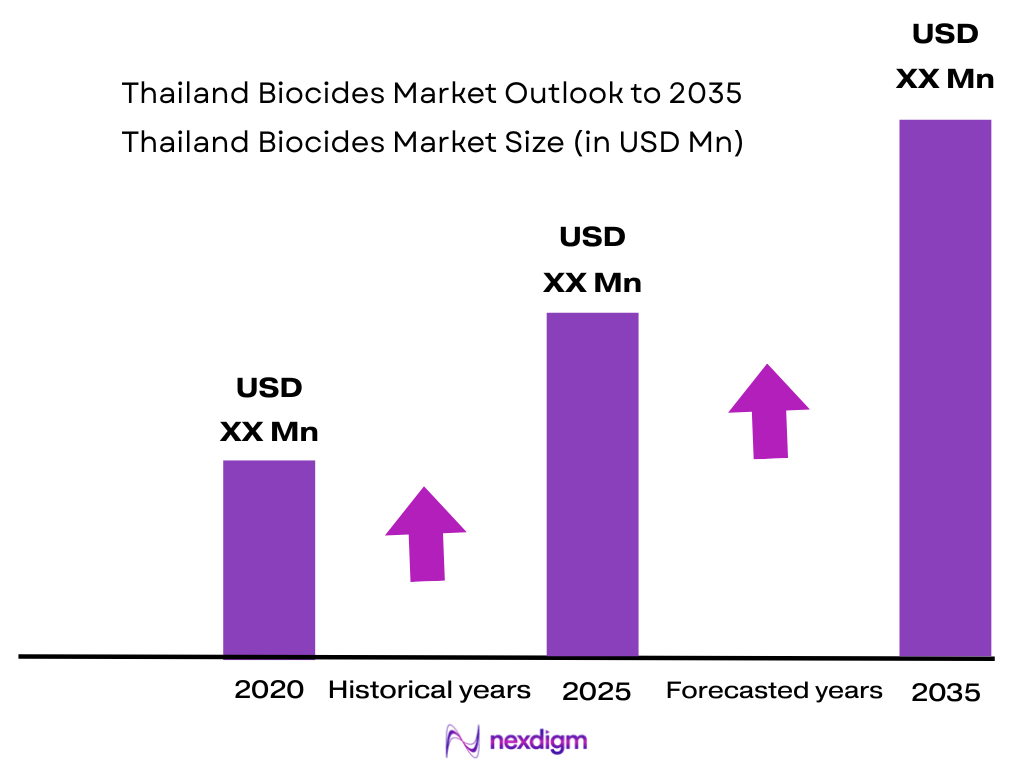
The Thailand Biocides Market is supported by water treatment, food and beverage manufacturing, chemicals, petrochemicals, pharmaceuticals, paints and coatings, aquaculture, healthcare and industrial sanitation. Thailand’s GDP reached USD 526.52 billion in the latest World Bank data, compared with roughly USD 515.95 billion in the preceding observation, while real GDP growth was 2.5%, compared with 2.0%. Thailand’s manufacturing ecosystem is particularly relevant: commercial-bank credit data cover 1.95 trillion baht of manufacturing exposure, including 520.57 billion baht for food manufacturing and 191.86 billion baht for chemicals and chemical products.
Bangkok and the surrounding Central region, the Eastern Economic Corridor, Chonburi, Rayong, Samut Prakan and Ayutthaya represent the principal demand centers because they combine manufacturing estates, food processing, chemicals, petrochemicals, electronics, automotive production, ports and commercial infrastructure. The Eastern seaboard is particularly important for chemical and petrochemical applications, while Bangkok and its surrounding provinces concentrate food, healthcare, hospitality and institutional demand. Thailand’s industrial ecosystem also has substantial electronics exposure: foreign direct investment net inflows into computer, electronic and optical manufacturing reached USD 909.51 million in the latest observation, while electrical-equipment manufacturing received USD 415.42 million.
Market Segmentation
By Product Type
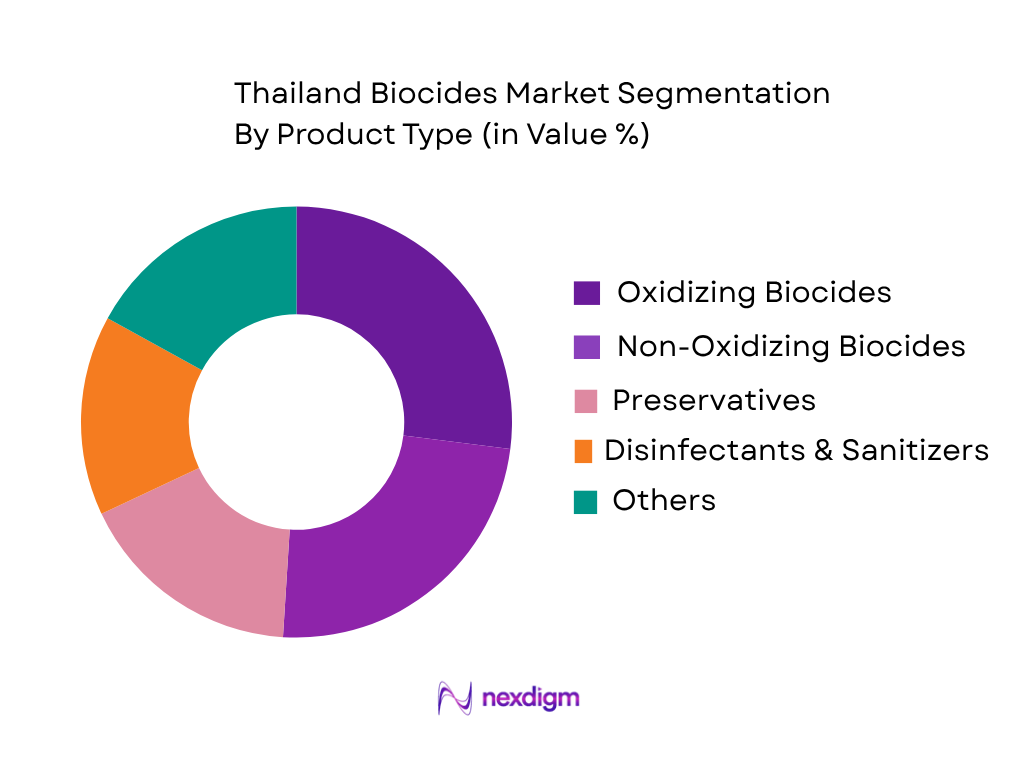
The Thailand Biocides Market is segmented into oxidizing biocides, non-oxidizing biocides, preservatives, disinfectants and sanitizers, antimicrobial additives, algaecides, fungicides, biofilm-control agents and other specialty biocides. Oxidizing biocides are positioned as the leading category because of their broad application across water treatment, wastewater, cooling systems, institutional hygiene and food-processing environments. Chlorine- and bromine-based chemistries can address bacteria, algae and biofilm-related problems across multiple operating conditions, making them relevant to both municipal and industrial customers. Non-oxidizing products remain important where longer residual performance, targeted microbial control or material compatibility is required. Preservatives serve paints, coatings, polymers and formulated products, while disinfectants and sanitizers are relevant to healthcare, hospitality and food facilities. Thailand’s industrial base supports this broad product mix: commercial-bank credit to food manufacturing reached 520.57 billion baht, while credit to chemical and chemical-product manufacturing reached 191.86 billion baht.
By Application
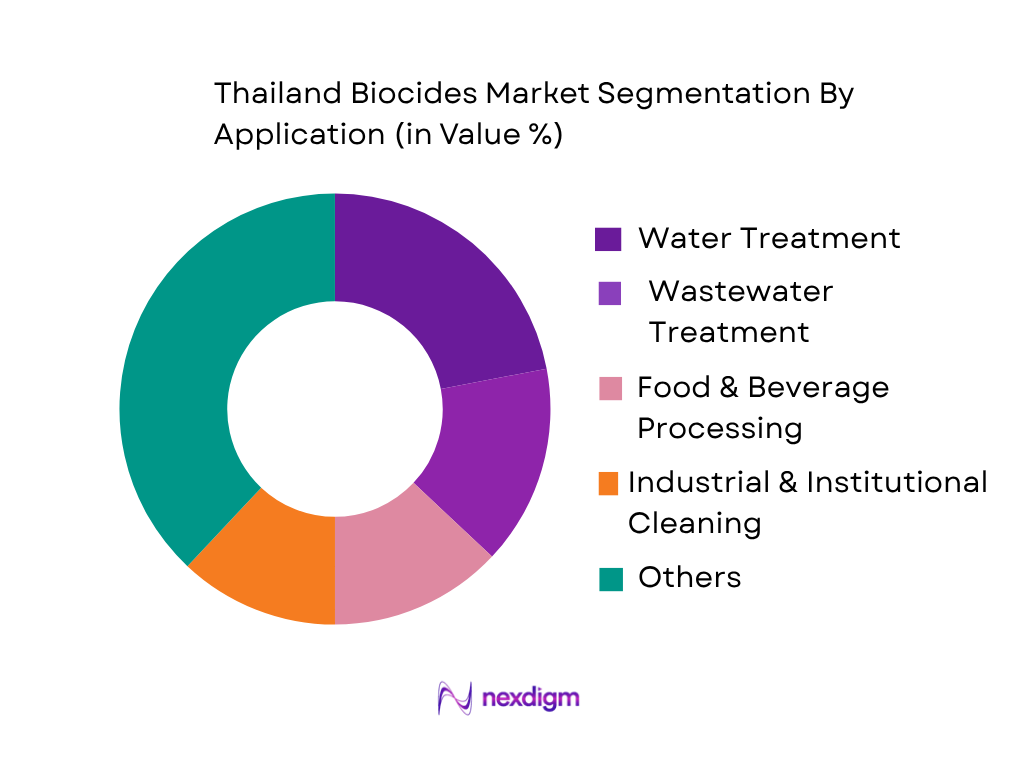
The Thailand Biocides Market is segmented by application into water treatment, wastewater treatment, cooling-water treatment, food and beverage processing, industrial and institutional cleaning, paints and coatings, aquaculture, oil and gas, personal care and cosmetics, pulp and paper, textiles and marine applications. Water treatment is positioned as the largest application because microbial control is required across municipal systems, industrial process water, cooling towers, wastewater facilities and membrane-based treatment. Industrial water demand is reinforced by Thailand’s large manufacturing base, with commercial-bank credit to manufacturing totaling 1.95 trillion baht, including 520.57 billion baht in food manufacturing and 201.25 billion baht in chemicals and chemical products in the latest reporting period. Chemical imports also reached 80.09 billion baht in the latest annual trade series, demonstrating the country’s extensive chemical-intensive industrial structure. Food processing, aquaculture and institutional hygiene create additional recurring applications for preservatives, sanitizers and targeted microbial-control products.
Competitive Landscape
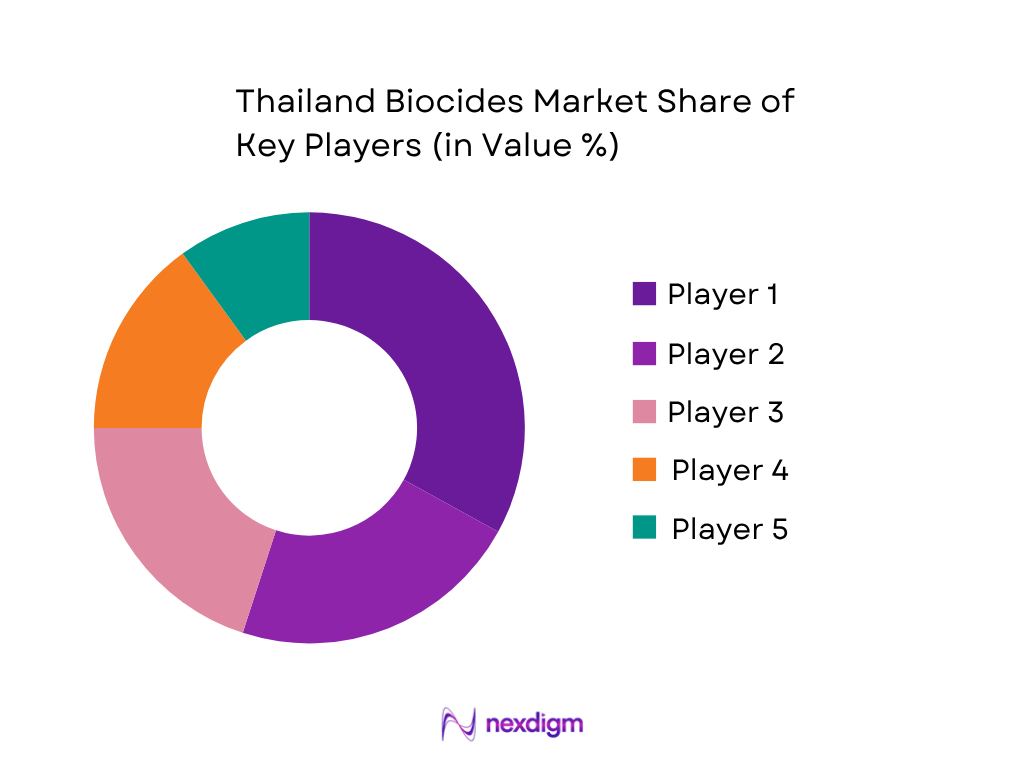
The Thailand Biocides Market is characterized by multinational specialty-chemical manufacturers, water-treatment suppliers, industrial hygiene companies and chemical distributors. Competition is shaped by active-ingredient breadth, water-treatment expertise, regulatory capability, technical service, local distribution and formulation flexibility. Thailand’s manufacturing base creates demand across several biocide-intensive industries: commercial-bank credit to manufacturing reached 1.95 trillion baht, with 520.57 billion baht associated with food manufacturing and 191.86 billion baht with chemicals and chemical products in the reported series. Electronics and electrical manufacturing also attract significant foreign investment.
| Company | Established | Headquarters | Active Ingredient Portfolio | Water Treatment Capability | Food & Institutional Hygiene | Industrial Biocides | Local/Regional Distribution | Regulatory Capability |
| LANXESS | 2004 | Cologne, Germany | ~ | ~ | ~ | ~ | ~ | ~ |
| Ecolab | 1923 | St. Paul, USA | ~ | ~ | ~ | ~ | ~ | ~ |
| BASF | 1865 | Ludwigshafen, Germany | ~ | ~ | ~ | ~ | ~ | ~ |
| Arxada | 2021 | Basel, Switzerland | ~ | ~ | ~ | ~ | ~ | ~ |
| Nouryon | 2018 | Amsterdam, Netherlands | ~ | ~ | ~ | ~ | ~ | ~ |
Thailand Biocides Market Analysis
Market Growth Drivers
Expansion of Industrial Water Treatment, Food and Beverage Manufacturing, and Electronics Manufacturing
Thailand’s expanding industrial base supports recurring demand for biocides used in process water, cooling systems, wastewater treatment, food-processing sanitation and manufacturing environments. Bank of Thailand data show commercial-bank credit to manufacturing reached THB 1,953,137 million in the latest reporting period, including THB 520,569 million for food-product manufacturing and THB 74,078 million for beverage manufacturing. Credit associated with computer, electronic and optical-product manufacturing stood at THB 75,381 million, including THB 58,788 million for electronic components and boards. These industries operate water-intensive production, cleaning and cooling systems where bacterial growth, algae, slime and biofilm can impair process performance. The manufacturing ecosystem is further supported by Thailand’s USD 526.52 billion GDP and USD 7,346.6 GDP per capita in 2024, according to the World Bank. The Bank of Thailand also reported that manufacturing production increased in selected categories including food and beverages and integrated circuits during 2024. This combination of food production, electronics, industrial processing and associated utility systems broadens the addressable requirement for oxidizing biocides, non-oxidizing biocides, preservatives and specialized biofilm-control products.
Aquaculture, Petrochemical, Pharmaceutical and Hospitality Activity
Thailand’s diversified production economy creates several specialized environments where microbial control is required, particularly aquaculture, petrochemicals, pharmaceuticals, hospitality and healthcare. Thailand’s Department of Fisheries maintains dedicated production statistics for marine shrimp aquaculture, demonstrating the continuing scale of commercial aquatic production and the associated requirement for water-quality, biofouling and pathogen management. Bank of Thailand data also show THB 9,812 million in commercial-bank credit associated with crude petroleum and natural-gas extraction and THB 4,431.59 million in Thailand’s outward investment position in coke and refined petroleum products in 2024. Manufacturing credit for food products reached THB 520,569 million, providing a substantial food-processing base requiring sanitation and microbial-control chemistry. Thailand’s economy generated USD 526.52 billion of GDP in 2024, while GDP growth reached 2.5, according to the World Bank. The World Bank also projected 36.1 million tourist arrivals for 2024, compared with 28.2 million in 2023, highlighting the scale of hospitality infrastructure requiring water hygiene, surface disinfection and wastewater management. These conditions create demand across industrial cooling, refinery systems, pharmaceutical production environments, hotels, hospitals, food facilities and aquaculture operations, supporting increasingly specialized biocide applications.
Market Challenges
Imported Specialty Active Ingredients, Chemical Registration Requirements and Formulation Complexity
The Thailand Biocides Market faces supply-chain and compliance challenges because specialty microbial-control products often depend on sophisticated active ingredients, imported intermediates and specialized formulation technology. Bank of Thailand data show Thailand’s manufacturing sector carries substantial industrial financing exposure, with commercial-bank credit reaching THB 1,953,137 million, while food-product manufacturing represented THB 520,569 million and chemical-intensive manufacturing remained a major industrial category. This broad industrial base creates demand for products with precise microbial spectra, pH stability, thermal stability and compatibility with membranes, metals, polymers and food-processing equipment. At the same time, regulatory requirements can differ according to whether a product is positioned as a pesticide, disinfectant, industrial chemical, preservative or treatment chemical. Thailand’s industrial chemical framework therefore requires suppliers to manage registration, product classification, labeling, safety documentation and environmental obligations. The challenge becomes greater for formulations using multiple active ingredients because technical performance must be demonstrated while maintaining regulatory compliance and safe handling. The World Bank recorded USD 526.52 billion of Thai GDP in 2024, illustrating the size of the industrial economy that requires regulatory control across numerous applications. Consequently, suppliers without local regulatory expertise, technical support or formulation capabilities may face longer commercialization pathways and greater product-development complexity.
Environmental Discharge Controls, Aquatic Toxicity, Biocide Resistance and Hazardous Chemical Handling
Environmental compatibility is a significant challenge for Thailand’s Biocides Market because many applications ultimately interact with wastewater, aquatic environments or industrial discharge systems. This is particularly relevant to aquaculture, where Thailand’s Department of Fisheries maintains dedicated statistics for marine-shrimp production and other fisheries activities. Biocides used in ponds, hatcheries, cooling-water systems and wastewater treatment must therefore balance microbial efficacy with residual management and aquatic toxicity considerations. Industrial customers face an additional technical issue from microbial resistance: repeated use of the same active chemistry can reduce treatment effectiveness, requiring rotation, combination treatment or more targeted biofilm-control programs. Hazardous chemical handling adds another operational requirement across manufacturing and water-treatment facilities. Thailand’s industrial economy had THB 1,953,137 million in manufacturing-related commercial-bank credit in the latest Bank of Thailand data, meaning these requirements apply across a large and diverse industrial customer base. Thailand’s GDP reached USD 526.52 billion in 2024, while inflation was 1.4, according to the World Bank, indicating a relatively stable macroeconomic environment but not eliminating application-specific environmental obligations. Suppliers therefore need to demonstrate efficacy, safe handling, discharge compatibility and appropriate environmental profiles rather than compete solely on microbial-control performance.
Market Opportunities
Advanced Water-Treatment Biocides, Cooling-Tower Microbial Control and Wastewater Reuse
Advanced water-treatment chemistry provides an opportunity for the Thailand Biocides Market as industrial users increasingly require microbial-control programs that protect process equipment, cooling systems, membranes and wastewater infrastructure. Bank of Thailand data show commercial-bank credit to manufacturing reached THB 1,953,137 million, demonstrating the extensive industrial infrastructure requiring reliable utility systems. Food-product manufacturing accounted for THB 520,569 million, while electronic and optical-product manufacturing accounted for THB 75,381 million. These sectors operate process-water, cooling-water and sanitation systems where microbial growth can cause biofilm formation, heat-transfer deterioration, membrane fouling and contamination risks. Thailand’s GDP reached USD 526.52 billion in 2024, while the World Bank recorded GDP growth of 2.5, providing a broad economic foundation for industrial infrastructure investment. The opportunity is therefore shifting toward specialized formulations rather than generic disinfection alone, including membrane-compatible biocides, low-residual treatment chemistry, biofilm-specific products and automated dosing programs. Wastewater-reuse applications can further support demand where treated water is circulated through industrial systems. Suppliers able to combine chemical treatment with microbial monitoring, dosing optimization and technical service can address more complex operating conditions and build recurring treatment relationships with industrial customers.
Aquaculture Microbial Control, Food-Processing Sanitation and Local Formulation
Thailand’s aquaculture and food-processing ecosystem creates opportunities for application-specific microbial-control products designed around water quality, sanitation, pathogen management and biofilm prevention. The Department of Fisheries maintains dedicated statistics for marine shrimp production, demonstrating the continuing importance of commercial aquaculture and its associated water-management requirements. Food manufacturing provides an even broader industrial base: Bank of Thailand data show commercial-bank credit to food-product manufacturing at THB 520,569 million, with meat, fish, crustacean, mollusc, fruit and vegetable processing accounting for THB 121,472 million. These activities require microbial-control solutions for processing water, equipment sanitation, cleaning-in-place systems, storage environments and wastewater. Thailand’s GDP reached USD 526.52 billion in 2024, while the World Bank recorded GDP per capita at USD 7,346.6, supporting a substantial domestic production and consumption base. The opportunity extends to local formulation and regional distribution because customers increasingly require application-specific concentrations, packaging formats, dosing guidance and technical support rather than undifferentiated chemical products. Low-residual formulations, biofilm-specific chemistry and products designed for aquatic environments can provide further differentiation. Suppliers combining regulatory expertise, local inventory and application engineering can therefore capture opportunities across aquaculture, seafood processing, beverage manufacturing and broader food-industry sanitation.
Future Outlook
The Thailand Biocides Market is expected to benefit from continued development of industrial water treatment, food processing, electronics, chemicals, petrochemicals, pharmaceuticals and aquaculture. Thailand’s economy reached USD 526.52 billion, while GDP per capita reached USD 7,346.6. The country’s industrial structure provides multiple recurring microbial-control applications. Commercial-bank credit to manufacturing reached 1.95 trillion baht, including 520.57 billion baht in food manufacturing and 201.25 billion baht in chemicals and chemical products in the latest reporting series. Future demand is expected to increasingly favor advanced membrane biocides, cooling-tower treatment, biofilm-specific chemistry, low-residual formulations, wastewater-reuse applications and specialized industrial microbial-control programs.
Major Player
- LANXESS
- Ecolab
- BASF
- Arxada
- Nouryon
- Dow
- Solenis
- Kemira
- Clariant
- Evonik Industries
- Veolia Water Technologies
- Buckman
- Italmatch Chemicals
- Troy Corporation
- Thor Group
Key Target Audience
- Biocides and specialty-chemical manufacturers
- Water-treatment and wastewater-treatment operators
- Food and beverage processing companies
- Aquaculture and fisheries operators
- Electronics, semiconductor and advanced-manufacturing companies
- Investments and venture capitalist firms
- Government and regulatory bodies (Department of Industrial Works, Thailand Food and Drug Administration, Department of Agriculture, Department of Fisheries, Pollution Control Department, Ministry of Industry, Ministry of Public Health)
- Oil and gas, petrochemical, pharmaceutical, paints and coatings, healthcare and hospitality companies
Research Methodology
Step 1: Identification of Key Variables
The initial phase maps the Thailand Biocides Market ecosystem across manufacturers, active-ingredient suppliers, importers, formulators, distributors and industrial end users. Variables include product chemistry, active ingredient, formulation, application, microbial target, regulatory classification, end-use industry, import dependency and distribution structure.
Step 2: Market Analysis and Construction
Historical and current indicators are compiled across water treatment, manufacturing, food processing, chemicals, electronics, pharmaceuticals, aquaculture and industrial hygiene. The market is constructed using product-level and application-level demand, separating commodity disinfectants from specialty microbial-control products and distinguishing domestic formulation from imported products.
Step 3: Hypothesis Validation and Expert Consultation
Market hypotheses are validated through consultations with chemical manufacturers, distributors, water-treatment operators, food processors, aquaculture companies and industrial users. Discussions focus on active-ingredient selection, treatment frequency, microbial targets, regulatory requirements, procurement criteria, technical service and substitution between oxidizing and non-oxidizing chemistries.
Step 4: Research Synthesis and Final Output
The final model triangulates government statistics, regulatory information, trade data, company disclosures and industry indicators. Market estimates are reconciled across product type, application and end-use industry to minimize double counting. Competitive benchmarking evaluates 8 core parameters, including active-ingredient breadth, water-treatment capability, industrial application depth, food-hygiene capability, regulatory expertise, technical service, distribution reach and sustainable-formulation capability.

- Executive Summary
- Research Methodology (Market Definition and Scope, Biocide Classification Framework, Active Ingredient Mapping, Market Sizing Architecture, Top-Down Assessment, Bottom-Up Assessment, Demand-Side Assessment, Supply-Side Assessment, Import-Export Analysis, Primary Industry Interviews, Regulatory Validation, Data Triangulation, Forecasting Framework, Scenario Analysis, Assumptions and Limitations)

- Definition and Scope
- Thailand Biocides Industry Structure
- Biocidal Active Ingredient Ecosystem
- Biocide Formulation and Manufacturing Landscape
- Evolution of Microbial-Control Applications

- Market Growth Drivers (Expansion of Industrial Water Treatment, Food and Beverage Manufacturing, Aquaculture Production, Electronics Manufacturing, Petrochemical and Refining Activity, Pharmaceutical Manufacturing, Hospitality Infrastructure, Healthcare Hygiene Requirements)
- Market Challenges (Imported Specialty Active Ingredients, Chemical Registration Requirements, Environmental Discharge Controls, Aquatic Toxicity, Biocide Resistance, Hazardous Chemical Handling, Active Ingredient Restrictions, Formulation Complexity)
- Market Opportunities (Advanced Water-Treatment Biocides, Cooling-Tower Microbial Control, Wastewater-Reuse Applications, Aquaculture Microbial Control, Food-Processing Sanitation, Oilfield Biocides, Low-Toxicity Formulations, Biofilm-Specific Technologies, Local Formulation and Regional Distribution)
- Market Trends (Low-Residual Biocide Adoption, Biofilm-Specific Treatment, Integrated Microbial Management, Automated Chemical Dosing, Industrial Water Recycling, Sustainable Biocide Chemistry, Membrane Protection, Advanced Disinfection, Specialty Formulation Localization)
- Regulatory and Chemical-Safety Landscape (Hazardous Substance Control, Industrial Chemical Registration, Pesticide Registration, Disinfectant Requirements, Environmental Discharge, Product Labeling, Worker Safety)
- SWOT Analysis
- Porter’s Five Forces Analysis
- PESTLE Analysis

- By Market Value (2020-2025)
- By Biocidal Active Ingredient Consumption Volume (2020-2025)
- By Formulated Biocide Consumption Volume (2020-2025)
- By Application Consumption (2020-2025)
- By End-Use Industry Consumption (2020-2025)
- By Domestic Production and Imported Biocides (2020-2025)

- By Product Type (In Value %)
Oxidizing Biocides
Non-Oxidizing Biocides
Preservatives
Disinfectants and Sanitizers
Antimicrobial Additives
Algaecides
Fungicides
Biofilm-Control Agents
Other Specialty Biocides - By Active Ingredient (In Value %)
Chlorine-Based Biocides
Bromine-Based Biocides
Chlorine Dioxide
Glutaraldehyde
Isothiazolinones
Quaternary Ammonium Compounds
DBNPA
Bronopol
Copper-Based Biocides
Organic Acids
Other Active Ingredients - By Application (In Value %)
Water Treatment
Wastewater Treatment
Cooling-Water Treatment
Industrial and Institutional Cleaning
Food and Beverage Processing
Paints and Coatings
Personal Care and Cosmetics
Oil and Gas
Pulp and Paper
Textiles
Marine and Offshore
Agriculture and Animal Facilities
Aquaculture - By End-Use Industry (In Value %)
Water and Wastewater Utilities
Food and Beverage Manufacturing
Aquaculture and Fisheries
Agriculture and Animal Production
Oil and Gas and Petrochemicals
Paints and Coatings
Construction Materials
Healthcare and Institutional Facilities - By Formulation Type (In Value %)
Liquid Biocides
Powder and Granular Biocides
Concentrated Formulations
Ready-to-Use Disinfectants
Water-Soluble Formulations
Emulsion and Dispersion Formulations
Controlled-Release Formulations - By Functional Requirement (In Value %)
Bacterial Control
Fungal Control
Algae Control
Biofilm Control
Slime Control
Preservation
Disinfection
Biofouling Prevention
Membrane Protection
Microbiologically Influenced Corrosion Control

- Market Share of Major Players (By Value, Volume, Product Type, Active Ingredient, Application, End-Use Industry, Distribution Channel)
- Cross Comparison Parameters (Active Ingredient Portfolio Breadth, Industrial Water-Treatment Capability, Food and Beverage Hygiene Expertise, Electronics and Ultrapure-Water Capability, Aquaculture Microbial-Control Capability, Regulatory Registration Expertise, Local Distribution and Technical-Service Reach, Sustainable and Low-Residual Formulation Capability)
- SWOT Analysis of Major Players
- Detailed Profiles of Major Companies
LANXESS
Ecolab
BASF
Arxada
Nouryon
Dow
Solenis
Kemira
Clariant
Evonik Industries
Veolia Water Technologies
Buckman
Italmatch Chemicals
Troy Corporation
Thor Group

- Industrial Water-Treatment Demand Assessment
- Food and Beverage Customer Analysis
- Electronics and Advanced Manufacturing Customer Analysis
- Aquaculture Customer Analysis
- Agriculture and Animal-Production Customer Analysis
- Oil and Gas Customer Analysis

- By Market Value (2026-2035)
- By Biocidal Active Ingredient Consumption Volume (2026-2035)
- By Formulated Biocide Consumption Volume (2026-2035)
- By Application Consumption (2026-2035)
- By End-Use Industry Consumption (2026-2035)
- By Domestic Production and Imported Biocides (2026-2035)


 Request a Sample
 Ask for Customization
 Get a Quote
 Enquire Now