
 Download PDF
Market Overview
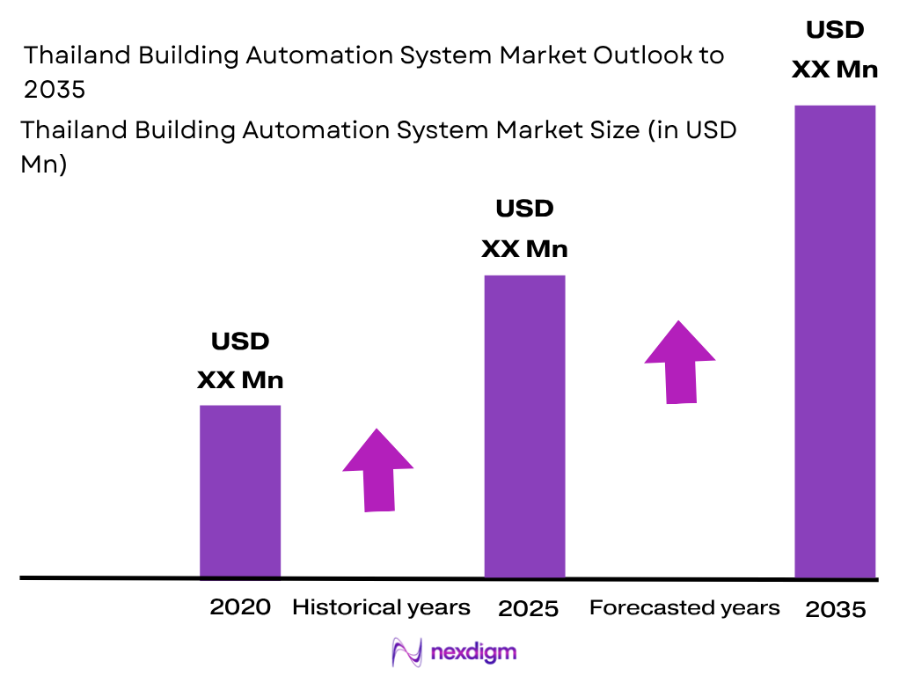
The Thailand Building Automation System market is supported by commercial construction, industrial development, data-centre investment, HVAC optimization and increasingly stringent building-energy requirements. Thailand recorded 2.5 real GDP growth in the latest completed annual period, compared with 2.0 previously, while its population reached 71.67 million and per-capita GDP reached USD 7,347. Building Energy Code requirements apply to 9 building categories with floor areas of at least 2,000 sq. m., creating a regulatory foundation for automated HVAC, lighting and energy-management systems. International Monetary Fund
Bangkok and its surrounding metropolitan provinces remain the principal BAS demand centre because they combine high-rise offices, shopping centres, hotels, hospitals, condominiums and large mixed-use developments. The latest official building data records 8,913 permits in Bangkok and 23,306 permits in the surrounding vicinity, while the Central region recorded 55,085 permits. The Eastern Economic Corridor is another strategic demand centre because industrial estates and technology-intensive facilities require automated HVAC, energy monitoring and integrated controls.
Market Segmentation
By Building Type
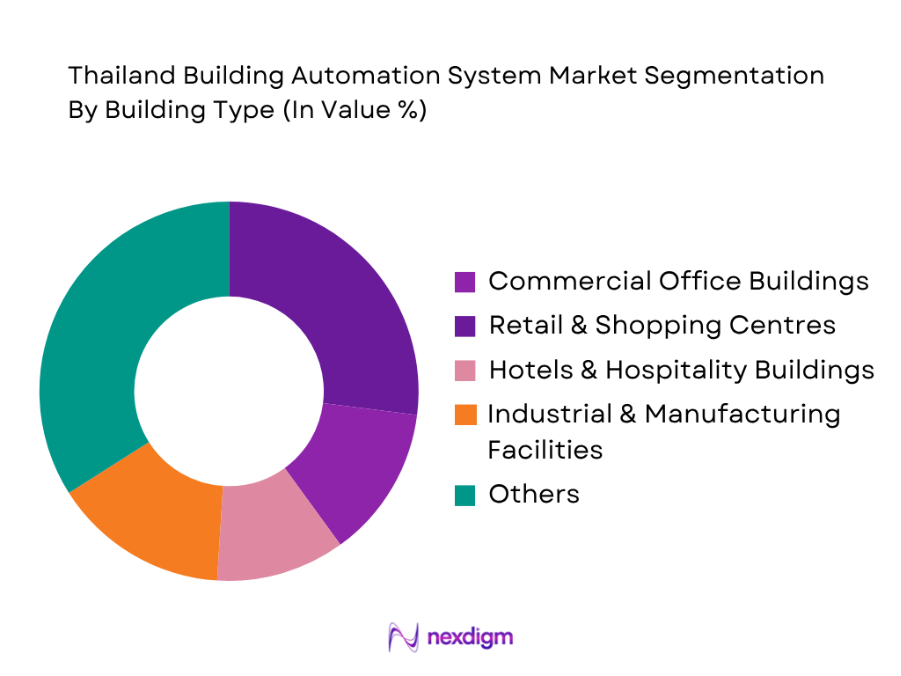
The Thailand Building Automation System market is segmented by building type into commercial office buildings, retail and shopping centres, hotels and hospitality buildings, healthcare facilities, educational institutions, industrial and manufacturing facilities, warehouses and logistics facilities, data centres, government and public buildings, transportation facilities, and residential and mixed-use buildings. Commercial office buildings are expected to represent the leading segment, supported by Bangkok’s concentration of corporate offices, high-rise properties and mixed-use developments. Office buildings require centralized HVAC management, lighting controls, occupancy monitoring, energy metering and facility-management platforms, making them natural applications for BAS. Retail and hospitality properties also have significant automation requirements because cooling, ventilation, lighting and centralized plant systems operate for extended periods. Industrial facilities are increasingly important as manufacturing investment moves toward higher-value electronics and technology operations. Data centres represent a smaller but strategically important segment because continuous cooling and environmental monitoring require sophisticated controls. The country’s BEC framework further supports automation opportunities in qualifying offices, hotels, shopping centres and other large buildings.
By System Component
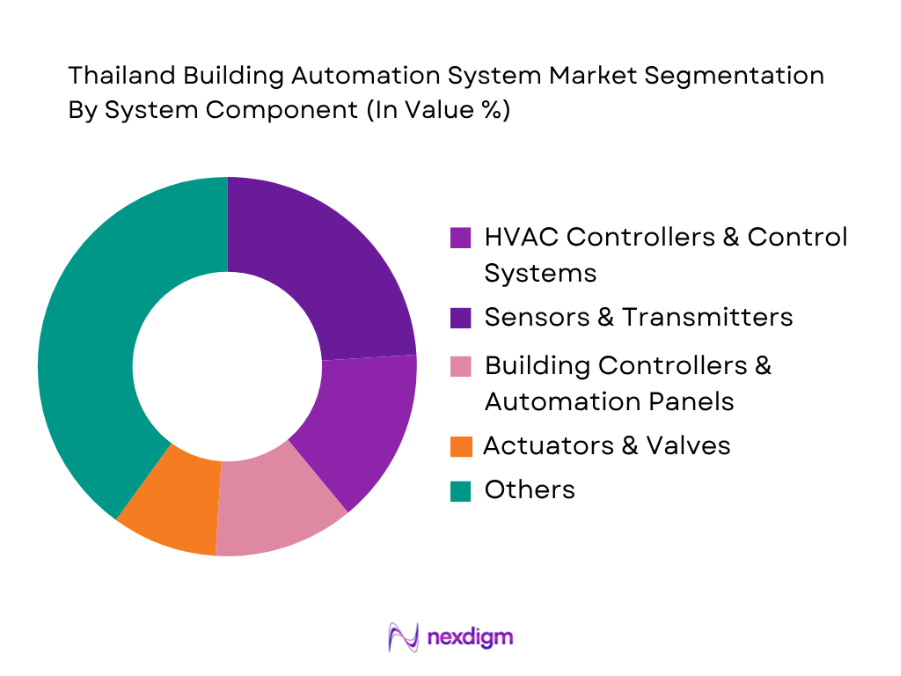
The Thailand Building Automation System market is segmented by system component into HVAC controllers, building controllers, sensors and transmitters, actuators and valves, variable-frequency drives, smart meters, lighting-control systems, communication gateways, supervisory controllers, BAS software platforms, cloud-based building-management platforms, and analytics and optimization software. HVAC controllers and building controllers are expected to remain the leading component category because Thailand’s climate creates sustained demand for air-conditioning and centralized cooling management across offices, hotels, retail properties, hospitals and industrial facilities. BAS deployments require controllers to coordinate chillers, pumps, air-handling units, variable-air-volume systems and terminal equipment. Sensors and actuators are closely linked to this demand because automated control depends on temperature, humidity, occupancy, pressure and air-quality information. Software is gaining importance as building owners move from isolated equipment controls toward centralized energy monitoring and analytics. The BEC framework specifically addresses building envelope, lighting, air-conditioning, hot-water, overall energy and renewable-energy systems, creating a broad technical environment for integrated automation.
Competitive Landscape
The Thailand Building Automation System market is characterized by global BAS providers, HVAC manufacturers, industrial automation companies and specialist controls suppliers. Competition is increasingly based on HVAC and chiller integration, open-protocol connectivity, energy-management capabilities, cloud connectivity, analytics and local project-execution capability. Data-centre investment is adding another competitive dimension: Thailand’s BOI reported 16 data-centre and cloud-service investment applications worth THB 241.494 billion in the latest annual investment cycle, compared with 7 projects worth THB 40.268 billion in the earlier period. This strengthens the strategic importance of high-reliability BAS and critical-environment controls.
| Company | Established | Headquarters | BAS / Controls Platform | HVAC Integration | Open-Protocol Capability |
| Johnson Controls | 1885 | Cork, Ireland | ~ | ~ | ~ |
| Siemens | 1847 | Munich, Germany | ~ | ~ | ~ |
| Schneider Electric | 1836 | Rueil-Malmaison, France | ~ | ~ | ~ |
| Honeywell | 1906 | Charlotte, USA | ~ | ~ | ~ |
| ABB | 1883 | Zurich, Switzerland | ~ | ~ | ~ |
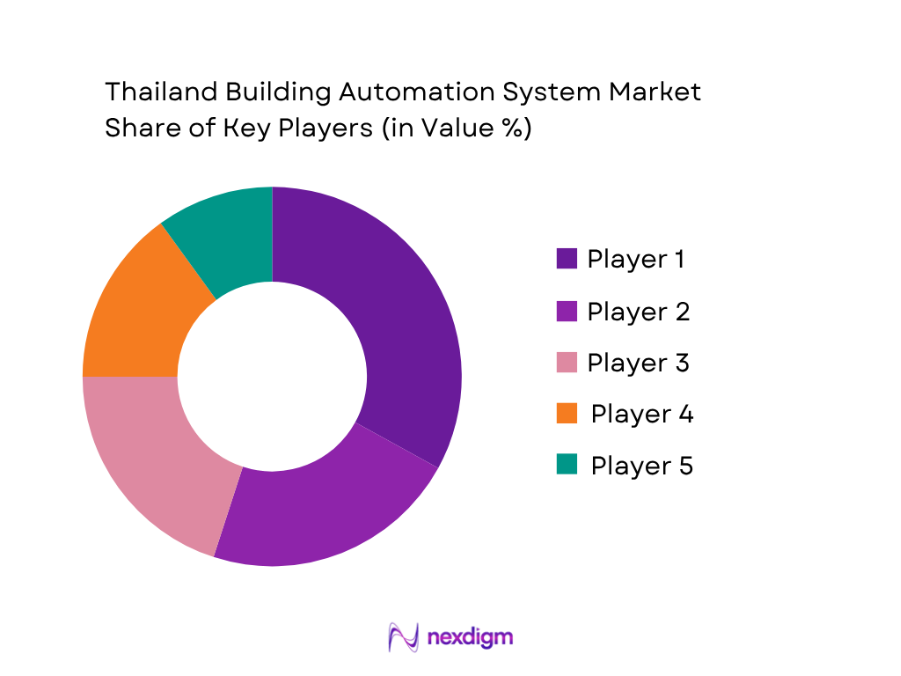
Thailand Building Automation System Market Analysis
Growth Drivers
Commercial & Digital Infrastructure Growth
Thailand’s building automation demand is being supported by continued commercial construction, industrial investment and rapid digital-infrastructure development. Thailand’s National Statistical Office recorded 188,461 building-construction permits and 256,994 new building units in 2024, while total new building construction area reached 58.86 million sq. m. Bangkok alone accounted for 4.90 million sq. m. of new building construction and the surrounding vicinity added 13.75 million sq. m., providing a substantial installed base for HVAC controls, lighting automation, metering and centralized building-management systems. The commercial-building pipeline is also relevant because commercial construction permits increased to 7,778 nationally in 2024, while office-building permits reached 1,279 and hotel permits reached 541. The Eastern and industrial-development opportunity is reinforced by Thailand’s investment environment: the Board of Investment recorded 1.14 trillion baht in investment-promotion applications in 2024, with 150 digital-sector projects representing 243.3 billion baht, including data centres and cloud services. Data-centre development directly increases requirements for automated cooling, environmental monitoring, power-management integration and high-availability controls. At the building level, the Building Energy Code applies to 9 building categories with floor areas of at least 2,000 sq. m., including offices, hotels, hospitals, shopping centres and condominiums, creating a regulatory basis for energy-efficient HVAC and automation.
HVAC & Energy Optimization
Thailand’s climate and building-energy requirements make HVAC optimization a particularly relevant driver for BAS deployment. The Department of Alternative Energy Development and Efficiency’s Building Energy Code covers 9 building categories and applies to new construction or major alterations involving buildings of at least 2,000 sq. m. The code addresses 6 energy-related systems, including building envelope, lighting, air-conditioning, hot-water production, overall building energy use and renewable-energy utilization. This regulatory structure creates direct application areas for automated temperature control, variable-speed drives, chilled-water optimization, occupancy-based scheduling, air-handling controls, smart meters and centralized energy dashboards. The commercial-property pipeline adds scale: Thailand recorded 7,778 commercial-building construction permits, 1,279 office-building permits and 541 hotel permits in 2024, while Bangkok recorded 19,603 building permits across all categories and 4.90 million sq. m. of new building construction. Industrial and technology facilities provide another demand layer. The Board of Investment recorded 1.14 trillion baht in total investment-promotion applications in 2024, while digital-sector projects reached 243.3 billion baht across 150 projects. Such facilities require tighter control of cooling, ventilation, electrical loads and environmental conditions. BAS therefore increasingly shifts from basic equipment control toward continuous energy monitoring, fault detection and coordinated HVAC operation.
Market Challenges
Legacy Systems & Interoperability
Thailand’s installed-building base creates technical challenges because new BAS equipment frequently has to coexist with existing HVAC, electrical and mechanical infrastructure. The National Statistical Office recorded 188,461 new building-construction permits in 2024, but the much larger existing building stock means modernization often involves integration rather than greenfield deployment. The challenge is particularly relevant in Bangkok, where 19,603 building permits were recorded in 2024 across construction activity and where existing commercial properties include offices, hotels, retail centres, hospitals and mixed-use buildings. Thailand’s Building Energy Code further demonstrates the breadth of systems that may need coordination: it covers 6 technical energy systems, including air-conditioning, lighting, building-envelope performance, hot water, overall energy consumption and renewable-energy systems. Consequently, BAS retrofits can involve multiple equipment generations, different controllers, field devices and communication architectures. Skilled personnel represent another constraint. Thailand had 607,433 ICT professionals in 2024, according to the National Statistical Office, but the World Bank has identified broader digital-skills gaps and limitations in advanced capabilities. BAS engineering requires a combination of HVAC, controls, electrical, networking and software expertise, rather than general IT capability alone. These conditions can increase commissioning complexity and make interoperability, protocol translation, system documentation and lifecycle support important purchasing criteria.
Cybersecurity & Skills Gaps
Increasing connectivity between building-management systems, cloud platforms, IoT sensors and enterprise networks introduces cybersecurity and data-management challenges for Thailand’s BAS market. The National Cyber Security Agency recorded 1,827 cyber-threat incidents during the October 2023–September 2024 reporting period, demonstrating the scale of the broader digital-security environment in which connected building systems operate. The reported incidents included website compromises, fake websites, privileged-account compromise, vulnerabilities, data breaches, distributed denial-of-service attacks and security misconfiguration. Although these figures are not specific to BAS installations, they are relevant to connected building infrastructure because modern BAS architectures increasingly use IP networks, remote access, gateways and cloud-connected analytics. Thailand’s digital transformation also creates integration complexity. The World Bank’s digital-data-infrastructure assessment identifies gaps involving skills, governance, interoperability and institutional coordination, all of which can affect deployment of connected building platforms. The workforce challenge is material: Thailand had 607,433 ICT professionals in 2024, including 444,248 working in municipal areas and 166,185 outside municipalities. BAS projects require additional specialist capabilities covering HVAC controls, networking, cybersecurity, commissioning and data integration. Multi-vendor environments can therefore create requirements for protocol gateways, cybersecurity segmentation, access-control policies and standardized data models. Building owners also need to determine how operational data from HVAC, lighting, meters, occupancy sensors and other systems can be securely integrated without compromising availability or exposing critical facility infrastructure.
Market Opportunities
Data Centres & AI-Enabled BAS
Thailand’s rapidly expanding digital infrastructure creates a substantial opportunity for advanced BAS applications in data centres and cloud facilities. The Board of Investment reported 150 digital-sector investment-promotion projects worth 243.3 billion baht in 2024, with data centres and cloud services among the leading investment categories. The same investment programme included major data-centre projects involving international technology and cloud companies, strengthening the need for high-availability cooling controls, environmental monitoring, electrical-system integration and centralized supervisory platforms. The momentum continued into 2025: the BOI reported 36 data-centre projects with combined investment exceeding USD 23.1 billion, equivalent to 728 billion baht, distributed across provinces including Bangkok, Chachoengsao, Chonburi, Pathum Thani, Rayong and Samut Prakan. These facilities require more sophisticated automation than conventional buildings because cooling, humidity, power quality and equipment operating conditions must be continuously monitored. This creates an opportunity for BAS suppliers to combine conventional HVAC control with cloud-based analytics, predictive maintenance, AI-assisted optimization and digital twins. Industrial automation provides another addressable application. Thailand’s BOI recorded 309 automotive and parts investment applications worth 102.4 billion baht in 2024, illustrating the continuing scale of industrial investment. Advanced factories require integrated HVAC, process-environment monitoring, energy management and facility controls. Consequently, Thailand’s expanding digital and industrial infrastructure provides a foundation for higher-value BAS deployments rather than basic standalone controls.
Smart Retrofits & Integrated Energy
Thailand’s existing commercial and institutional building stock creates an opportunity for modernization through connected BAS rather than relying exclusively on new construction. National Statistical Office data recorded 188,461 building-construction permits in 2024, with 7,778 commercial-building permits, 1,279 office-building permits and 541 hotel permits. The same dataset recorded 58.86 million sq. m. of new building construction area nationally, demonstrating the continuing addition of properties that will eventually require monitoring, maintenance and modernization. Bangkok represented 4.90 million sq. m. of new construction area, while surrounding provinces represented 13.75 million sq. m., supporting demand for multi-site facility-management platforms. Energy regulation strengthens the retrofit opportunity. Thailand’s Building Energy Code covers 9 building categories above 2,000 sq. m. and regulates 6 energy-system areas, including air-conditioning, lighting, overall energy consumption and renewable-energy use. This creates an opportunity to combine BAS with smart metering, indoor-air-quality sensors, occupancy analytics and energy dashboards. The digitalization opportunity is reinforced by Thailand’s 607,433 ICT professionals in 2024, providing an established technology workforce for connected facility-management services. Building owners can increasingly use BAS data to identify inefficient HVAC operation, coordinate equipment schedules, manage indoor environmental conditions and integrate distributed energy resources. As buildings add solar generation, EV charging and other electrical loads, BAS can evolve into an integrated energy-management layer connecting HVAC, lighting, meters, renewable generation and flexible loads.
Future Outlook
The Thailand Building Automation System market is expected to benefit from commercial-property modernization, industrial expansion, data-centre development and the increasing emphasis on building energy performance. Thailand’s investment-promotion applications reached THB 1.14 trillion, with digital-sector projects accounting for THB 243.3 billion. Data-centre and cloud-service investment has therefore become an important technology-demand catalyst. The regulatory environment also supports long-term adoption. The Building Energy Code covers 9 categories of buildings with areas of at least 2,000 sq. m., while the Department of Alternative Energy Development and Efficiency states that BEC can support building electricity savings of more than 10. These requirements create opportunities for automated HVAC, lighting, metering and energy-management solutions. BEC
Major Players
- Johnson Controls
- Siemens
- Schneider Electric
- Honeywell
- ABB
- Delta Electronics
- Mitsubishi Electric
- Daikin
- Trane Technologies
- Carrier
- Azbil Corporation
- Bosch Building Technologies
- Belimo
- Distech Controls
- Automated Logic
Key Target Audience
- Commercial real estate developers and property owners
- Industrial and manufacturing facility operators
- Data centre operators and digital infrastructure developers
- Hotel and hospitality operators
- HVAC manufacturers and controls suppliers
- BAS system integrators and MEP contractors
- Investments and venture capitalist firms
- Government and regulatory bodies (Ministry of Energy, Department of Alternative Energy Development and Efficiency, Ministry of Industry, Board of Investment of Thailand)
Research Methodology
Step 1: Identification of Key Variables
The initial phase maps the Thailand Building Automation System ecosystem across BAS manufacturers, HVAC suppliers, system integrators, MEP contractors, facility managers, property developers, industrial operators and data-centre companies. Key variables include BAS hardware, software, services, HVAC controls, energy management, IoT connectivity, building type, deployment model and geographic concentration.
Step 2: Market Analysis and Construction
This phase compiles building-construction activity, commercial development, industrial investment, data-centre projects and building-energy requirements to establish the addressable BAS opportunity. Building permits, floor area, construction activity, investment applications and qualifying BEC buildings are evaluated to construct demand across building types and applications.
Step 3: Hypothesis Validation and Expert Consultation
Market hypotheses are validated through discussions with BAS manufacturers, HVAC OEMs, system integrators, MEP contractors, facility managers and property owners. The consultation process focuses on system specifications, controller adoption, HVAC integration, retrofit requirements, procurement criteria, open-protocol deployment and the adoption of cloud and analytics technologies.
Step 4: Research Synthesis and Final Output
The final stage triangulates primary research with official construction, investment, energy and economic statistics. Bottom-up estimates are compared with building-level requirements, component penetration, project pipelines and system deployment patterns to develop a validated market structure covering building type, component, application, deployment and end-user categories.

- Executive Summary
- Research Methodology (Market Definition and Scope, BAS Ecosystem Mapping, Top-Down Market Sizing, Bottom-Up Market Sizing, Building Stock Assessment, Construction Pipeline Analysis, BAS Component-Level Assessment, Demand-Side Analyis, Supply-Side Analysis, Primary Interviews, System Integrator Validation, Project-Level Triangulation, Historical Data Reconciliation, Forecasting Framework, Scenario Analysis, Assumptions and Limitations)

- Definition and Scope
- Building Automation System Ecosystem
- Thailand BAS Industry Evolution
- Building Controls and Automation Value Chain
- BAS Equipment and Technology Supply Chain
- New-Build versus Retrofit Deployment Landscape
- Building Automation Project Lifecycle

- Growth Drivers (Commercial Building Development, Bangkok Commercial Expansion, Eastern Economic Corridor Industrial Development, Data Centre Investment, Cloud Infrastructure Expansion, HVAC Energy Optimization, Chiller Automation, Smart Building Adoption, Green Building Development, Facility Management Digitization, IoT Sensor Deployment, Occupancy-Based Controls)
- Market Challenges (Legacy Building Management Systems, Proprietary Control Architectures, BAS Interoperability Constraints, Protocol Compatibility, Retrofit Engineering Complexity, Skilled Controls Engineer Availability, Cybersecurity Exposure, Multi-Vendor Integration, Existing HVAC Integration, Long Equipment Replacement Cycles, Building Data Management, High System Customization Requirements)
- Market Opportunities (Data Centre BAS, Cloud-Based Building Automation, AI-Enabled Energy Optimization, Predictive HVAC Maintenance, Smart Chiller Management, Commercial Building Retrofits, Green Building Modernization, Industrial Facility Automation, Indoor Air Quality Monitoring, Occupancy Analytics, Digital Twin Integration, Multi-Site Facility Management, Demand Response Integration, Building Electrification Controls, Solar-BMS Integration, EV Charging and Building Energy Management)
- Market Trends (Cloud-Connected BAS, AI-Based HVAC Optimization, Edge Building Controls, IoT Sensorization, Smart Chiller Sequencing, Predictive Maintenance, Occupancy-Based HVAC Control, Indoor Air Quality Monitoring, Digital Twin Adoption, Integrated Energy Management, Connected Facility Management, Data Centre Cooling Optimization)
- Government Regulations and Standards (Building Energy Code, Energy Conservation Promotion Act, Energy Efficiency Requirements, Building Energy Performance Requirements, Green Building Standards, Energy Management Requirements, Smart Building Guidelines, Data Centre Energy Requirements, Electrical Safety Requirements, Cybersecurity Requirements)
- PESTLE Analysis
- Porter’s Five Forces Analysis
- SWOT Analysis
- Stakeholder Ecosystem
- Competition Ecosystem

- By Market Value (2020-2025)
- By Installed BAS Systems (2020-2025)
- By New-Build BAS Deployments (2020-2025)
- By Retrofit BAS Deployments (2020-2025)
- By Hardware Revenue (2020-2025)
- By Software Revenue (2020-2025)

- By Building Type (In Value %)
Commercial Office Buildings
Retail and Shopping Centres
Hotels and Hospitality Buildings
Healthcare Facilities
Educational Institutions
Industrial and Manufacturing Facilities
Warehouses and Logistics Facilities
Data Centres
Government and Public Buildings
Transportation Facilities
Residential and Mixed-Use Buildings - By System Component (In Value %)
HVAC Controllers
Building Controllers
Sensors and Transmitters
Actuators and Valves
Variable Frequency Drives
Smart Meters and Energy-Monitoring Devices
Lighting Control Systems
Communication Gateways
BAS Supervisory Controllers
BAS Software Platforms
Cloud Building Management Platforms
Analytics and Optimization Software - By Application (In Value %)
HVAC and Chiller Automation
Energy Management
Lighting Automation
Indoor Air Quality Management
Occupancy-Based Controls
Fire and Life-Safety Integration
Access and Security Integration
Power Monitoring
Elevator and Escalator Monitoring
Water Management
Equipment Monitoring and Predictive Maintenance
Integrated Facility Management - By Deployment (In Value %)
New Construction
Building Retrofit
System Replacement
BAS Expansion
Partial-System Upgrade
Full Building Automation Deployment - By End User (In Value %)
Real Estate Developers
Commercial Property Owners
Industrial Facility Operators
Data Centre Operators
Hotel and Hospitality Operators
Educational Institutions
Retail Operators
Logistics and Warehouse Operators

- Market Share of Major Players (By Value, Building Type, Component, Application, Deployment, Geographic Region)
- Cross Comparison Parameters (BAS Platform Portfolio Breadth,HVAC and Chiller Control Capability, Open-Protocol and Interoperability Capability, IoT and Connected-Sensor Integration, Cloud and Remote Building Management Capability, AI and Predictive Analytics Capability, Energy Management and Optimization Capability,Thailand System Integration and After-Sales Network, Competitive Benchmarking, Technology
- SWOT Analysis of Major Players
- Detailed Profiles of Major Companies
Johnson Controls
Siemens
Schneider Electric
Honeywell
ABB
Delta Electronics
Mitsubishi Electric
Daikin
Trane Technologies
Carrier
Azbil Corporation
Bosch Building Technologies
Belimo
Distech Controls
Automated Logic

- Building Owner Requirements
- Facility Manager Requirements
- Developer Procurement Criteria
- Commercial Building BAS Adoption
- Industrial BAS Adoption
- Data Centre BAS Requirements

- By Market Value (2026-2035)
- By Installed BAS Systems (2026-2035)
- By New-Build BAS Deployments (2026-2035)
- By Retrofit BAS Deployments (2026-2035)
- By Hardware Revenue (2026-2035)
- By Software Revenue (2026-2035)


 Request a Sample
 Ask for Customization
 Get a Quote
 Enquire Now
