

 Download PDF
Market Overview
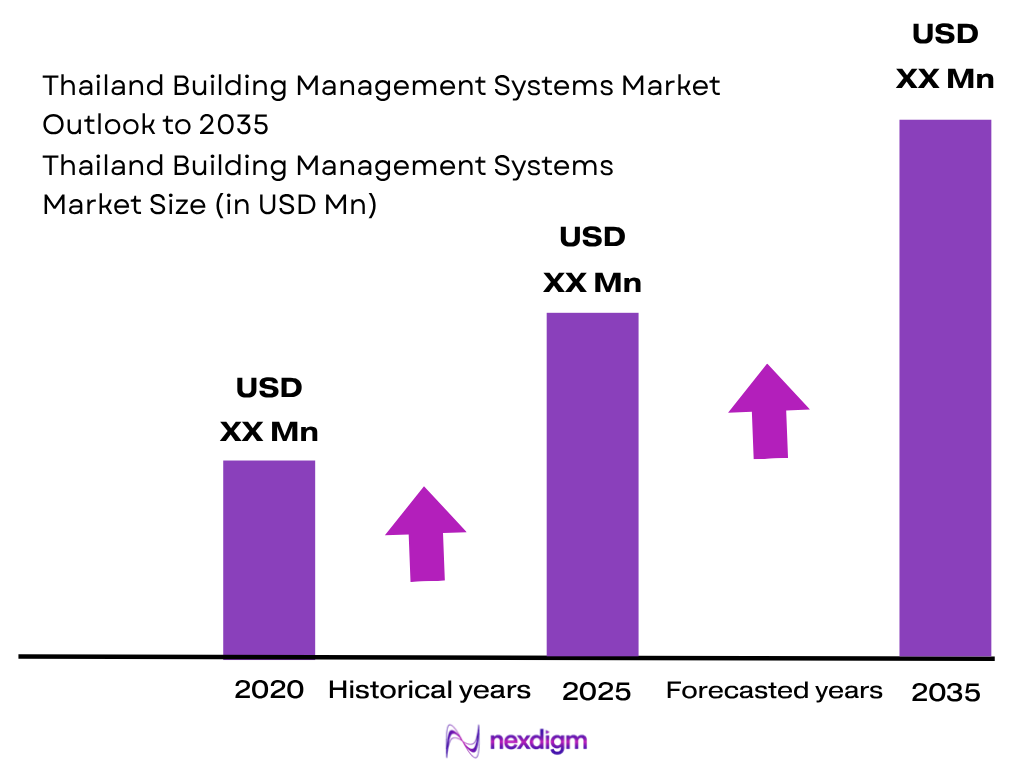
The Thailand Building Management Systems Market is valued at approximately ~USD XX million, supported by commercial buildings, hotels, hospitals, industrial facilities and data centres requiring centralized HVAC and energy controls. Thailand’s permitted new-building area moved from 60,851,513 sq. m. in the preceding reporting period to 58,862,540 sq. m. in the latest period, while addition and alteration activity reached 2,818,557 sq. m., sustaining demand for both new BMS installations and modernization.
Bangkok and its surrounding metropolitan provinces dominate Thailand Building Management Systems demand because they contain the country’s largest concentration of offices, condominiums, hospitals, malls, hotels and mixed-use developments. Combined permitted new-building area across Bangkok and its vicinities shifted from 18,644,216 sq. m. to 15,871,698 sq. m. between the two latest reporting periods. Chonburi, Rayong and Samut Prakan are increasingly important because data-centre, electronics and industrial investments are expanding high-intensity automation requirements.
Market Segmentation
By System Type
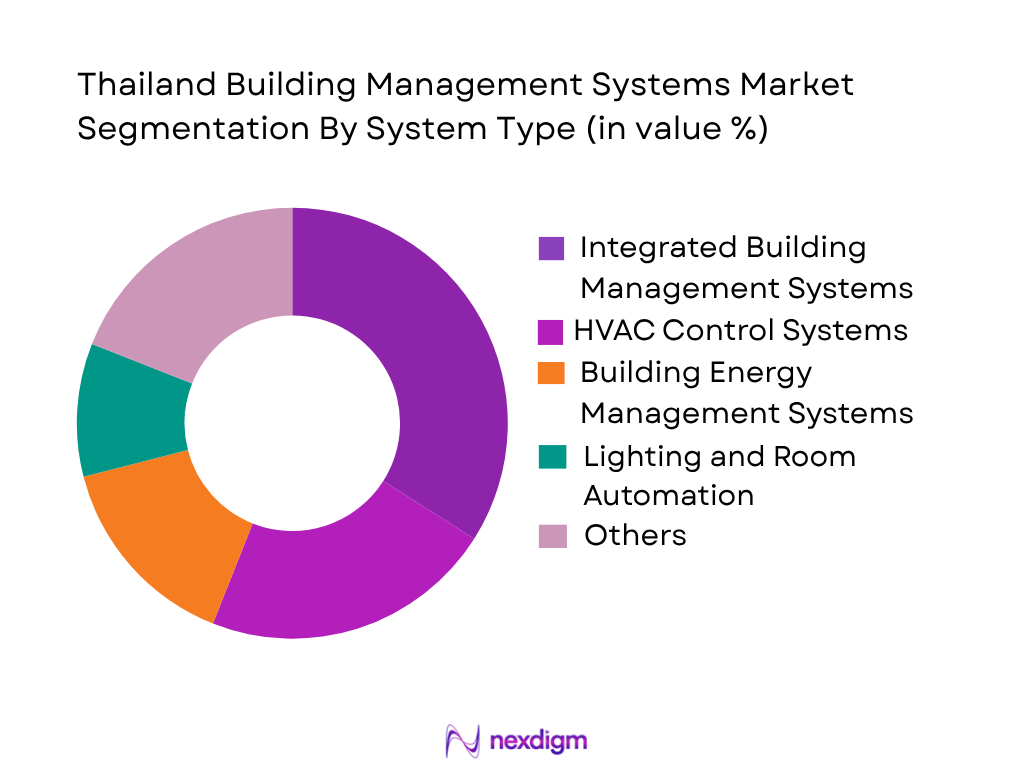
The Thailand Building Management Systems Market is segmented into integrated building management systems, HVAC control systems, building energy management systems, lighting and room automation, security-integrated BMS, cloud-based BMS and other specialized platforms. Integrated building management systems hold the dominant position because Thailand’s newer Grade-A offices, hotels, hospitals, data centres and mixed-use developments increasingly require centralized supervision of HVAC, lighting, electricity, fire alarms, access control and energy consumption. Bangkok’s transition toward international-standard and ESG-certified office buildings strengthens demand for platforms capable of coordinating several building services from a single command layer. Integrated systems also offer advantages for facilities operating large chilled-water plants, where chiller sequencing, pump control, cooling-tower management and demand optimization can materially improve operating performance. Open communication standards such as BACnet, Modbus and KNX further support this category by allowing property owners to integrate equipment supplied by multiple OEMs instead of relying exclusively on proprietary control architectures.
By Building Type
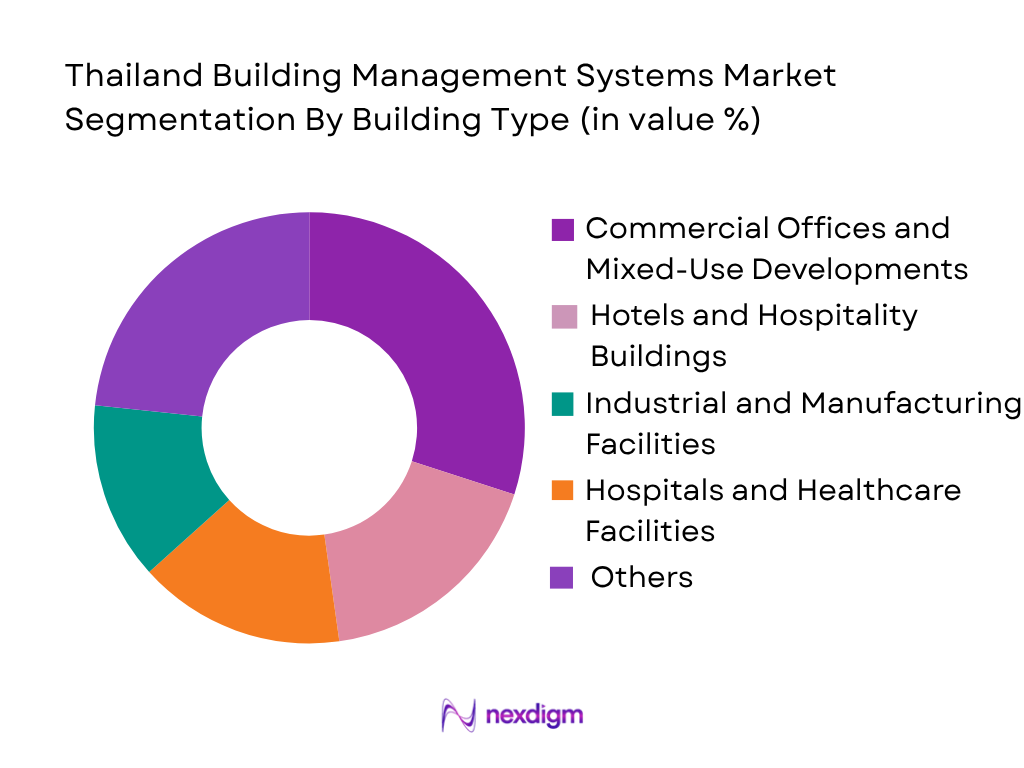
The Thailand Building Management Systems Market is segmented into commercial offices, mixed-use developments, hotels and resorts, hospitals, high-rise residential buildings, data centres, industrial facilities, retail properties and government buildings. Commercial offices and mixed-use developments are considered the dominant sub-segment because Bangkok contains a dense stock of high-rise buildings using centralized cooling plants, electrical distribution, lighting controls and tenant-management systems. Such projects typically require larger BMS point counts and deeper integration than low-rise residential buildings. Hotels are also significant because guest-room comfort, occupancy controls and energy consumption require continuous management, while hospitals require stringent environmental and HVAC reliability. Data centres are emerging as an increasingly important category, particularly in Chonburi, Rayong, Samut Prakan and Bangkok. Thailand’s approved digital-sector pipeline includes large hyperscale facilities requiring high-availability cooling, environmental sensing, electrical monitoring and integration between BMS and data-centre infrastructure-management platforms. This broad building mix supports both conventional BMS and next-generation cloud-connected systems.
Competitive Landscape
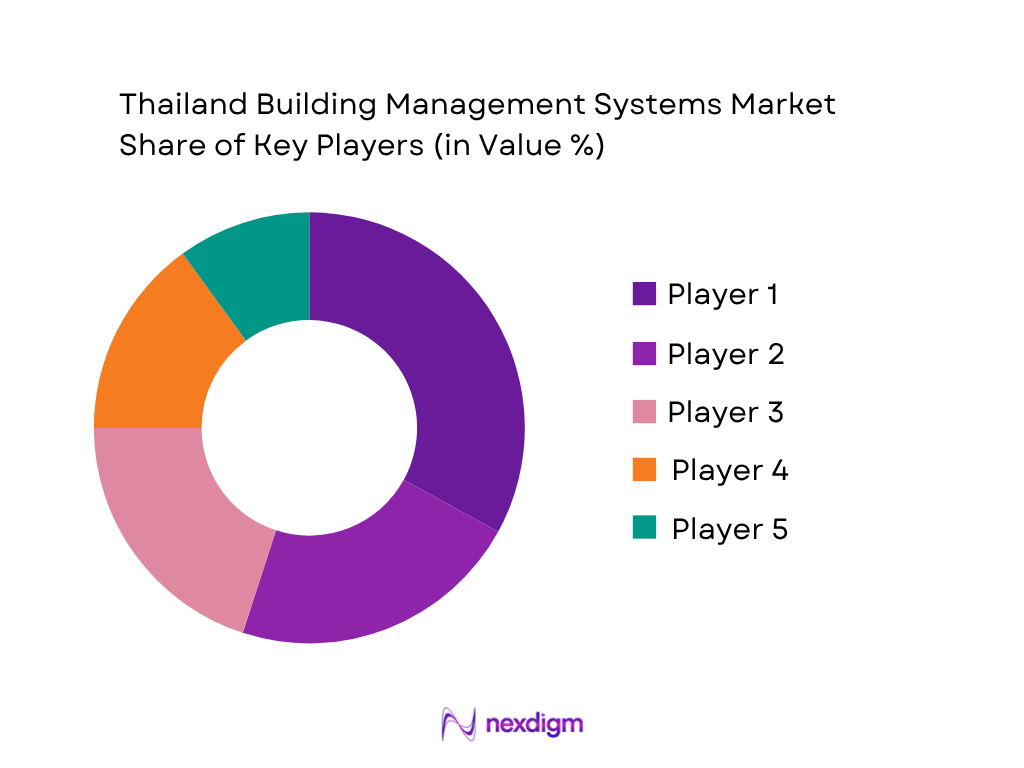
The Thailand Building Management Systems Market combines large global automation companies with specialist controls vendors and local system integrators. Schneider Electric, Honeywell, Siemens, Johnson Controls and ABB have broad portfolios spanning controllers, HVAC automation, energy management, electrical integration and digital building platforms. Competition increasingly extends beyond hardware into cloud connectivity, analytics, cybersecurity, energy optimization, open protocols and lifecycle services. System integrator capabilities are particularly important because Thai projects require local engineering, programming, commissioning, language support and long-term maintenance.
| Major Player | Establishment Year | Headquarters | Core BMS Offering | HVAC & Plant Controls | Cloud / Analytics Capability | Open-Protocol Capability | Thailand Service Capability | Retrofit Capability |
| Schneider Electric | 1836 | Rueil-Malmaison, France | ~ | ~ | ~ | ~ | ~ | ~ |
| Honeywell Building Technologies | 1906 | Charlotte, USA | ~ | ~ | ~ | ~ | ~ | ~ |
| Siemens Smart Infrastructure | 1847 | Munich, Germany | ~ | ~ | ~ | ~ | ~ | ~ |
| Johnson Controls | 1885 | Cork, Ireland | ~ | ~ | ~ | ~ | ~ | ~ |
| ABB | 1988 | Zurich, Switzerland | ~ | ~ | ~ | ~ | ~ | ~ |
Thailand’s Building Management Systems Market Analysis
Growth Drivers
Building Energy Code Compliance and Rising Cooling-System Automation
Thailand’s Building Management Systems Market is supported by tighter energy-performance requirements and the heavy cooling load of large commercial buildings. The Department of Alternative Energy Development and Efficiency requires 9 building categories with total floor area of at least 2,000 square metres to comply with the Building Energy Code, covering offices, hotels, hospitals, shopping centres, condominiums, educational facilities and other large buildings. The code evaluates 6 energy systems, including air-conditioning, lighting, building envelope performance, hot-water systems, renewable energy and total building energy consumption, directly increasing the relevance of centralized monitoring and HVAC controls. Electricity Generating Authority of Thailand data show national net electricity generation reached 220,590.44 GWh in 2024, while system peak demand reached 36,477.80 MW. These operating loads create a strong case for chiller sequencing, variable-speed control, smart metering and demand-based ventilation. The IMF records Thailand’s nominal GDP at THB18,582.7 billion, equivalent to USD526.5 billion, with GDP per capita of USD7,347 in 2024. This substantial economic base supports continued investment in sophisticated commercial and institutional buildings where BMS platforms can reduce operational inefficiencies, coordinate major mechanical systems and provide centralized energy-performance visibility.
Data Centre and Digital Infrastructure Investment
Thailand’s rapidly expanding data-centre pipeline is creating a highly automation-intensive demand channel for BMS platforms, environmental sensors, cooling controls, smart meters and critical alarm-management systems. Thailand’s Board of Investment recorded 150 digital-sector investment applications worth THB243.3 billion in 2024, with data centres and cloud-service projects forming a major component. Investment momentum continued with approved facilities including 50 MW, 80 MW, 96 MW, 160 MW and 150 MW data-centre projects across Chonburi and Rayong, demonstrating the scale of cooling and electrical infrastructure that must be monitored continuously. By 2025, BOI had received 36 data-centre projects representing more than THB728 billion of investment across Bangkok, Chachoengsao, Chonburi, Pathum Thani, Rayong and Samut Prakan. These facilities require BMS integration with chilled-water plants, CRAH or CRAC equipment, leak detection, temperature sensors, humidity monitoring and electrical systems. The IMF reports Thailand’s 2024 net foreign direct investment at USD6.95 billion, nominal GDP at USD526.5 billion, and population at 71.67 million. This combination of foreign investment and digital-infrastructure expansion strengthens demand for high-availability BMS architectures, redundant controllers, secure network integration and interfaces with dedicated data-centre infrastructure-management platforms.
Market Challenges
Softening New-Build Construction Pipeline and Uneven Project Conversion
Thailand’s BMS industry faces near-term pressure from uneven construction activity because new systems are typically specified during the design and MEP installation phases of commercial, hospitality, healthcare and residential projects. National Statistical Office data show permitted new-building area moved from 60,851,513 square metres to 58,862,540 square metres in 2024, while Bangkok declined from 4,897,773 square metres to 3,654,628 square metres. Bangkok’s surrounding provinces recorded 12,217,070 square metres, compared with 13,746,443 square metres in the preceding period. This moderation is particularly relevant because Bangkok and its vicinities contain the highest concentration of offices, condominiums, hotels, hospitals and retail properties that typically require sophisticated BMS installations. At the macro level, the IMF records Thailand’s nominal GDP at THB18,582.7 billion, or USD526.5 billion, while gross fixed investment was relatively subdued and external debt stood at USD195.4 billion in 2024. A slower or less predictable building pipeline affects automation vendors beyond hardware sales because commissioning, software licensing and annual maintenance opportunities depend on completed projects entering operation. BMS suppliers therefore need greater exposure to retrofit, data-centre and industrial projects rather than relying only on Bangkok greenfield development.
Imported Automation Hardware and Multi-Vendor Supply Dependence
Thailand’s BMS market remains exposed to imported controllers, sensors, gateways, communication modules and specialized electrical components, which can complicate procurement and system standardization for large projects. National Statistical Office and Ministry of Commerce data show Thailand imported THB10,896,479.9 million of goods in 2024, including THB770,191.6 million of electrical machinery and components. World Bank trade data separately record USD65.21 billion of electrical machinery, equipment and associated parts imported during the year, with China supplying USD24.70 billion, Taiwan-related sources USD11.85 billion, Japan USD6.01 billion, Malaysia USD3.60 billion and Vietnam USD3.37 billion. This international supply structure is relevant to BMS installations because controllers, sensors, drives, networking components and automation hardware often come from multiple manufacturing locations. The IMF records Thailand’s average exchange rate at 35.29 baht per US dollar, nominal GDP at USD526.5 billion, and external debt at USD195.4 billion in 2024. Multi-country sourcing can lengthen replacement cycles for proprietary equipment and make legacy-system maintenance more difficult when specific controller generations become obsolete. System integrators therefore face challenges in maintaining spare-device availability, preserving protocol compatibility and commissioning heterogeneous BACnet, Modbus, KNX and proprietary architectures across existing buildings.
Market Opportunities
Retrofit, Cloud Migration and Energy Optimization of Existing Buildings
Thailand’s large stock of operating commercial and institutional buildings creates substantial future opportunity for BMS modernization, especially as owners replace obsolete controllers, add energy meters and move supervisory software to cloud-connected platforms. National Statistical Office data show 2,818,557 square metres of building addition and alteration activity in 2024, including 1,290,644 square metres across Bangkok’s surrounding provinces and 133,060 square metres within Bangkok itself. These projects provide a direct addressable base for controls upgrades without depending exclusively on entirely new construction. The Building Energy Code further expands the relevance of modernization because it applies to 9 building categories above 2,000 square metres and evaluates 6 major energy systems, including HVAC and lighting. Electricity Generating Authority of Thailand data show net generation of 220,590.44 GWh and peak system demand of 36,477.80 MW in 2024, reinforcing the operational importance of energy optimization. At the macro level, IMF data record nominal GDP of USD526.5 billion, GDP per capita of USD7,347, and net foreign direct investment of USD6.95 billion. These conditions support future demand for controller replacement, cloud dashboards, fault detection, smart metering, chiller optimization and portfolio-level remote monitoring across Bangkok offices, hospitals, malls, hotels and institutional facilities.
Data Centre, Industrial and Eastern Economic Corridor Automation
Thailand’s Eastern Economic Corridor and digital-investment pipeline provide a strong future opportunity for advanced BMS systems because these facilities require continuous environmental control, utility monitoring and high system reliability. Thailand’s Board of Investment recorded THB1.14 trillion of total investment-promotion applications in 2024, while the digital sector alone generated 150 applications worth THB243.3 billion. Data-centre projects subsequently approved in Chonburi and Rayong included facilities with 50 MW, 80 MW, 96 MW, 160 MW and 150 MW of IT load. Another group of approved projects included 223 MW across three facilities in Chonburi and Samut Prakan and 120 MW across two facilities in Rayong and Samut Prakan. This creates future BMS demand not only inside data halls but also across cooling plants, electrical rooms, administration buildings and utility infrastructure. The IMF records Thailand’s 2024 nominal GDP at THB18,582.7 billion, net foreign direct investment at USD6.95 billion, and population at 71.67 million. Industrial and digital facilities in Chonburi, Rayong and Chachoengsao therefore offer BMS vendors an opportunity to move beyond conventional office automation into critical cooling, cleanroom environments, process-support utilities, energy monitoring and predictive maintenance, supported by open-protocol integration and resilient edge-control architectures.
Future Outlook
The Thailand Building Management Systems Market is forecast to expand at approximately ~X.X% CAGR during 2026-2035, with growth increasingly shifting from conventional building controls toward connected, software-led building operations. New construction will remain important, but retrofit, cloud migration, chiller optimization and analytics will become larger opportunity pools as the installed building base matures.
Thailand’s Building Energy Code will remain a significant structural driver. It applies to new or modified buildings with combined floor area of at least 2,000 sq. m. across 9 specified building categories and evaluates building envelopes, lighting, air-conditioning equipment, hot-water systems and overall energy consumption. This creates a clear role for BMS platforms in monitoring and controlling major energy-consuming equipment.
Major Players
- Schneider Electric Thailand
- Honeywell Building Technologies
- Siemens Thailand
- Johnson Controls Thailand
- ABB Thailand
- Carrier Thailand / Automated Logic
- Trane Thailand
- Delta Electronics Thailand
- Azbil (Thailand) Co., Ltd.
- Belimo Thailand
- Beckhoff Automation Thailand
- Distech Controls
- Bosch Building Technologies
- Lutron Electronics
- Legrand Thailand
Key Target Audience
- Building Management System Manufacturers and Building Automation Technology Providers
- BMS System Integrators and Controls Engineering Companies
- Real Estate Developers, Commercial Property Owners and Asset Management Companies
- Facility Management and Integrated Facility Management Companies
- MEP Contractors and Building Automation Contractors
- Investments and Venture Capitalist Firms
- Government and Regulatory Bodies (Department of Alternative Energy Development and Efficiency, Department of Public Works and Town & Country Planning, Metropolitan Electricity Authority, Provincial Electricity Authority, Energy Regulatory Commission)
- Data Centre, Hospitality, Healthcare, Industrial and Retail Property Operators
Research Methodology
Step 1: Identification of Key Variables
The initial phase involves constructing a comprehensive ecosystem map of the Thailand Building Management Systems Market, including BMS manufacturers, controller vendors, sensor suppliers, system integrators, MEP contractors, developers, facility managers and major building operators. Secondary research and proprietary databases are used to identify building categories, control architectures, installed BMS bases, energy regulations and project pipelines. Critical variables include connected points, building floor area, hardware-software mix, service intensity and automation complexity.
Step 2: Market Analysis and Construction
Historical information is analyzed across commercial construction, hospitality, healthcare, data centres, industrial buildings and BMS retrofit projects. The top-down approach converts relevant building floor area and automation penetration into addressable project value, while the bottom-up approach evaluates vendor sales, controller deployments, software licenses, system-integrator activity and annual maintenance contracts. Results from both approaches are reconciled to establish a consistent historical market framework.
Step 3: Hypothesis Validation and Expert Consultation
Market assumptions are validated through structured interviews and computer-assisted telephone interviews with BMS vendors, controls contractors, MEP specialists, facility managers, property developers and technical engineers. Discussions assess typical points per building, control-system architectures, protocol preferences, commissioning practices, software adoption, maintenance contracts and retrofit cycles. Expert feedback is used to validate assumptions and distinguish between new-build, modernization and recurring-service demand.
Step 4: Research Synthesis and Final Output
The final phase triangulates supply-side vendor information with building activity, project databases and demand-side interviews. Hardware, software and service revenues are cross-checked against connected points, installed buildings, smart-building pipelines and retrofit activity. Forecast scenarios incorporate BEC enforcement, data-centre construction, Bangkok building modernization, EEC industrial development, cloud migration, AI analytics and predictive maintenance to generate the final Thailand Building Management Systems Market outlook.

- Executive Summary
- Research Methodology (Market Definitions and Assumptions, Thailand Building Management Systems Market Classification, Building Automation Scope, BMS Architecture Mapping, HVAC Controls Assessment, Chiller Plant Automation Assessment, Lighting Controls Assessment, Electrical Monitoring Assessment, Energy Management System Assessment, Smart Metering Assessment, Fire and Life Safety Integration Assessment, Security and Access Control Integration Assessment, Indoor Air Quality Monitoring Assessment, Room Automation Assessment, Occupancy Sensor Assessment, IoT Sensor Assessment, DDC Controller Assessment, Automation Server Assessment, Edge Controller Assessment, Cloud BMS Assessment, Building Analytics Assessment, Digital Twin Integration Assessment, BACnet Assessment, KNX Assessment, Modbus Assessment, MQTT and IP-Based Integration Assessment, BMS Cybersecurity Assessment, Building Energy Code Compliance Assessment, OTTV and RTTV Assessment, Lighting Power Density Assessment, Supply-Side Assessment, Demand-Side Assessment, Top-Down Market Sizing, Bottom-Up Market Sizing, Primary Industry Interviews, Smart Building Project Pipeline Assessment, Data Triangulation, Forecasting Framework)

- Definition and Scope
- Thailand Building Automation Industry Evolution and Development of Standalone HVAC Controls, Direct Digital Controls, Centralized BMS Platforms, Integrated Building Management Systems, Web-Based Building Automation, Open-Protocol BMS, IP-Based Building Controls, Smart Building Platforms, Cloud-Connected BMS, AI-Based Building Analytics, Digital Twin Integration, Energy Management Systems, Smart Metering, Occupancy-Based Controls, Predictive Maintenance, Indoor Environmental Quality Monitoring, Portfolio-Level Building Management
- Building Management Systems Value Chain Analysis
- Building Management Systems Supply Chain Analysis
- Temperature and Humidity Sensor Suppliers, CO2 and Indoor Air Quality Sensor Suppliers, Smart Meter Manufacturers, HVAC Equipment Suppliers, Valve and Actuator Suppliers, DDC Controller Manufacturers, Automation Server Suppliers, BMS Software Vendors, Energy Management Platform Providers, IoT Gateway Suppliers, Cybersecurity Providers, System Integrators, MEP Contractors, Controls Contractors, Commissioning Specialists, Smart Building Solution Providers, Facility Management Companies, Property Developers, Building Owners, Hotel Operators, Hospital Operators, Data Centre Operators, Industrial Estate Operators, Government Building Authorities

- Growth Drivers (Bangkok High-Rise Development, Eastern Economic Corridor Industrial Expansion, Data Centre Investment, Hotel and Tourism Infrastructure, Hospital Development, Building Energy Code Compliance, Cooling Energy Optimization, Smart Metering, Building Retrofit Demand, Cloud and IoT Adoption, Predictive Maintenance)
- Market Challenges (Legacy BMS Fragmentation, Proprietary Protocol Lock-In, Cybersecurity Exposure, Controls Engineer Availability, Multi-Vendor Integration Complexity, Retrofit Disruption, Inconsistent Data Quality, Commissioning Quality Variation, System Obsolescence, Facility Team Training Requirements)
- Market Opportunities (Cloud BMS Migration, AI-Based Fault Detection, Data Centre Automation, Hotel Energy Optimization, Hospital BMS Modernization, Chiller Plant Analytics, Smart Factory Building Controls, Building Energy Code-Compliant Energy Monitoring, Digital Twin Integration, Open-Protocol Modernization)
- Market Trends (BACnet/IP Adoption, Cloud-Connected BMS, AI Building Analytics, IoT Sensors, Wireless Room Controls, Occupancy Analytics, Mobile Facility Management, Edge Computing, Semantic Data Models, Predictive Maintenance, Portfolio Dashboards, Integrated Energy Management, Indoor Air Quality Monitoring)
- Government Regulations and Standards (Thailand Building Energy Code, Department of Alternative Energy Development and Efficiency Requirements, OTTV Requirements, RTTV Requirements, Lighting Power Density Requirements, Air-Conditioning Efficiency Requirements, Overall Building Energy Requirements, Energy Conservation Promotion Act, Thai Green Building Institute TREES Requirements, Electrical and Fire Safety Requirements)
- SWOT Analysis
- Porter’s Five Forces Analysis
- PESTLE Analysis
- Stakeholder Ecosystem
- Smart Building and BMS Project Ecosystem

- By Market Value (2020-2025)
- By BMS Hardware Revenue (2020-2025)
- By BMS Software Revenue (2020-2025)
- By BMS Services Revenue (2020-2025)
- By DDC Controllers and Automation Servers Revenue (2020-2025)
- By Sensors and Field Devices Revenue (2020-2025)
- By Smart Meter and Energy Monitoring Revenue (2020-2025)
- By Cloud BMS and Building Analytics Revenue (2020-2025)
- By New-Build BMS Installation Value (2020-2025)
- By Retrofit and BMS Modernization Value (2020-2025)
- By Annual Maintenance and Managed Services Value (2020-2025)
- By Commercial Building BMS Value (2020-2025)
- By Hospitality BMS Value (2020-2025)

- By Component Type (In Value %)
Hardware
DDC Controllers
Automation Servers
Edge Controllers
Temperature Sensors
Humidity Sensors
CO2 and Indoor Air Quality Sensors
Occupancy Sensors
Smart Meters
Thermostats
Actuators
Control Valves - By System Type (In Value %)
Integrated Building Management Systems
HVAC Control Systems
Building Energy Management Systems
Lighting Management Systems
Room Automation Systems
Security-Integrated Building Management Systems
Enterprise Building Management Platforms
Cloud-Based Building Management Systems
IoT-Enabled Building Management Systems
AI-Enabled Building Operations Platforms - By Deployment Architecture (In Value %)
On-Premise BMS
Web-Based BMS
Cloud-Connected BMS
Cloud-Native Building Management Platforms
Hybrid Edge-Cloud BMS
Standalone Building Automation
Integrated Building Management Systems
Multi-Site Portfolio Management Platforms
Digital Twin-Integrated BMS - By Building Type (In Value %)
Commercial Office Buildings
Mixed-Use Developments
Shopping Malls and Retail Complexes
Hotels and Resorts
High-Rise Residential Buildings
Hospitals and Healthcare Facilities
Educational Buildings
Government Buildings
Data Centres
Industrial Plants
Factories and Advanced Manufacturing Facilities
Warehouses and Logistics Facilities
Airports and Transportation Facilities
Convention and Exhibition Centres
Entertainment and Leisure Buildings - By Region (In Value %)
Bangkok Metropolitan Region
Bangkok
Nonthaburi
Pathum Thani
Samut Prakan
Eastern Economic Corridor
Chonburi
Rayong
Chachoengsao
Central Thailand
Northern Thailand
Northeastern Thailand
Southern Thailand
Phuket
Chiang Mai

- Market Share of Major Players (By Thailand Revenue, BMS Project Value, Installed BMS Base, Connected Point Count, Controller Portfolio, BMS Software Capability, Cloud Platform Capability, Building Analytics Capability, HVAC and Chiller Plant Control Capability, Open-Protocol Capability, Data Centre Project Portfolio, Commercial Building Project Portfolio, System Integrator Network, Retrofit Capability, Building Energy Code Monitoring Capability, Service and Maintenance Network)
- Cross Comparison Parameters (Thailand BMS Installed-Base Strength, Open-Protocol Interoperability, HVAC and Chiller Plant Control Capability, Cloud and Building Analytics Capability, Building Energy Code and Energy Monitoring Capability, Local System Integrator and Service Network, Data Centre and Critical Facility Capability, Retrofit and Legacy Migration Capability)
- SWOT Analysis of Major Players
- Competitive Positioning Matrix
- Building Management Systems Technology and Performance Benchmarking
- Major Companies
Schneider Electric Thailand
Honeywell Building Technologies
Siemens Thailand
Johnson Controls Thailand
ABB Thailand
Carrier Thailand / Automated Logic
Trane Thailand
Delta Electronics Thailand
Azbil (Thailand) Co., Ltd.
Belimo Thailand
Beckhoff Automation Thailand
Distech Controls
Bosch Building Technologies
Lutron Electronics
Legrand Thailand

- Real Estate Developer BMS Requirement Assessment
- MEP Consultant Specification Assessment
- Main Contractor Procurement Assessment
- MEP Contractor Project Requirement Analysis
- System Integrator Requirement Assessment
- Facility Management Operator Assessment
- Commercial Building BMS Requirement Assessment
- Hotel and Resort BMS Requirement Assessment
- Hospital and Healthcare BMS Requirement Assessment
- Data Centre BMS Requirement Assessment
- Industrial and Factory BMS Requirement Assessment
- Government Building BMS Requirement Assessment

- By Market Value (2026-2035)
- By BMS Hardware Revenue (2026-2035)
- By BMS Software Revenue (2026-2035)
- By BMS Services Revenue (2026-2035)
- By DDC Controllers and Automation Servers Revenue (2026-2035)
- By Sensors and Field Devices Revenue (2026-2035)
- By Smart Meter and Energy Monitoring Revenue (2026-2035)
- By Cloud BMS and Building Analytics Revenue (2026-2035)
- By New-Build BMS Installation Value (2026-2035)
- By Retrofit and BMS Modernization Value (2026-2035)
- By Annual Maintenance and Managed Services Value (2026-2035)
- By Commercial Building BMS Value (2026-2035)
- By Hospitality BMS Value (2026-2035)
- By Residential and Mixed-Use BMS Value (2026-2035)


 Request a Sample
 Ask for Customization
 Get a Quote
 Enquire Now
