

 Download PDF
Market Overview
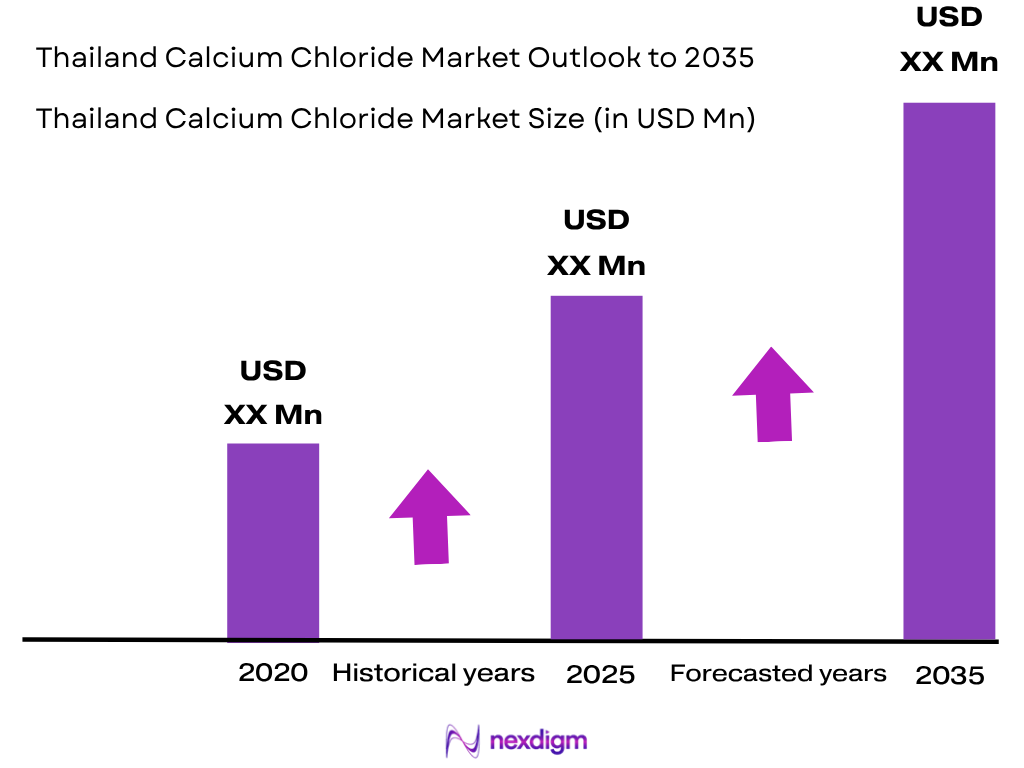
The Thailand Calcium Chloride Market is valued at ~USD XX million in 2024, with the forecast CAGR for 2026–2035 at ~XX%. The market is supported by Thailand’s sizeable manufacturing base, food-processing activity, water-treatment requirements, construction activity and chemical-processing ecosystem. Thailand recorded GDP of approximately USD 529.4 billion in 2024, while manufacturing generated substantial industrial output and remains a major component of economic activity. Calcium chloride demand is consequently linked to industrial processing, concrete applications, food processing, refrigeration, wastewater treatment and chemical manufacturing.
Bangkok and the surrounding metropolitan area remain important commercial and distribution centers because chemical importers, industrial distributors and downstream manufacturers are concentrated around the country’s principal logistics infrastructure. The Eastern Economic Corridor, particularly Rayong, Chonburi and Chachoengsao, represents the most relevant industrial cluster for calcium chloride demand because it combines petrochemical, automotive, electronics, food, chemical and logistics activities. Thailand’s EEC officially covers these 3 provinces, while industrial estates in Rayong and Chonburi provide utilities, wastewater treatment and port connectivity for industrial users.
Market Segmentation
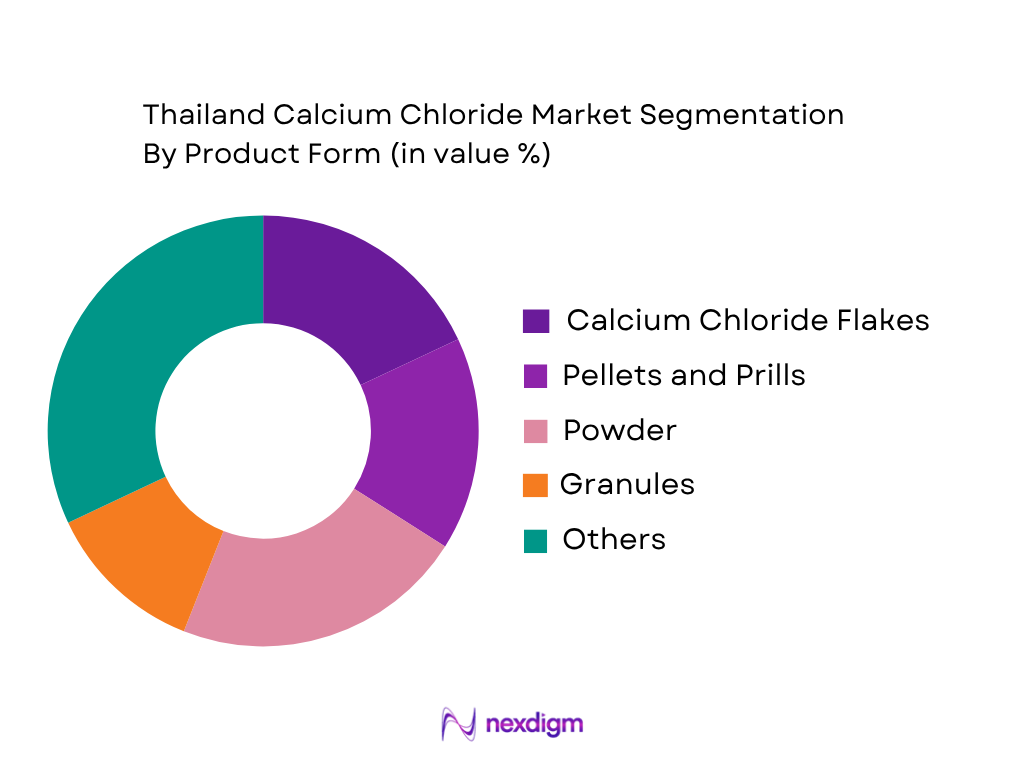
By Product Form
The Thailand Calcium Chloride Market is segmented by product form into flakes, pellets and prills, powder, granules, liquid calcium chloride, hydrated calcium chloride and anhydrous calcium chloride. The solid calcium chloride category represents an important commercial configuration because Thailand’s industrial users require products that can be stored, transported and converted into solutions according to application requirements. OxyChem, for example, identifies calcium chloride products across liquid and multiple solid forms, including flakes, pellets and briquettes, while Aditya Birla Chemicals Thailand manufactures 94% purity calcium chloride through limestone and hydrochloric acid processing. Product form is closely linked to application requirements: liquid grades are suitable for brine and process applications, while solid grades are relevant to concrete, industrial processing, dust control and other applications. The absence of official Thai statistics that disclose form-level market shares means that exact 2024 percentages cannot be established from public government trade data without proprietary company-level sales information.
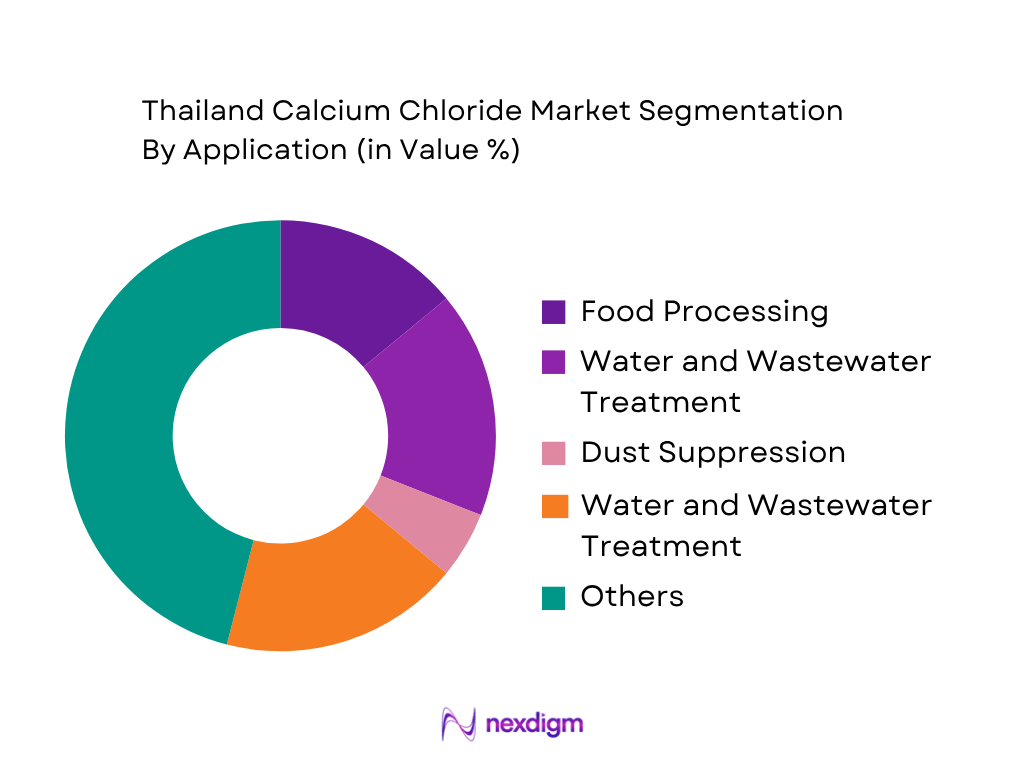
By Application
The Thailand Calcium Chloride Market is segmented by application into water and wastewater treatment, food processing, construction and concrete acceleration, refrigeration brines, oil and gas, chemical processing, dust control and road maintenance, mining and mineral processing, paper and pulp processing, and other industrial uses. Water treatment and industrial processing are structurally relevant because calcium chloride can assist in removing contaminants from wastewater, while its hygroscopic and ionic characteristics enable use in several process applications. Food processing is another important application because calcium chloride is used for firmness, coagulation and mineral adjustment in products such as dairy foods and processed fruits and vegetables. Thailand’s food industry provides a sizeable downstream base: food exports were valued at USD 9.44 billion in Q4 2024, while domestic food sales reached 119.39 million metric tons during the quarter.
Competitive Landscape
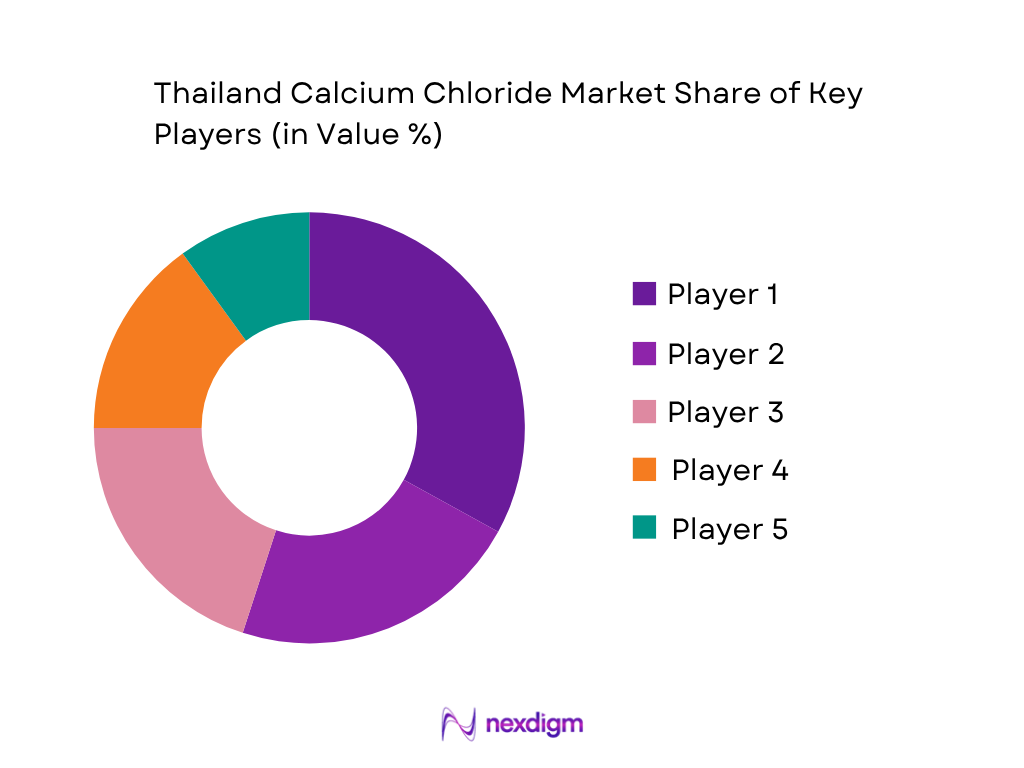
The Thailand Calcium Chloride Market includes international calcium chloride producers, integrated chemical manufacturers and chemical distributors serving industrial customers through direct supply and distribution channels. Competition is differentiated by production technology, grade availability, product form, application expertise, logistics capabilities and ability to supply industrial customers consistently. Aditya Birla Chemicals has a manufacturing presence in Thailand and lists calcium chloride at 94% purity, while global suppliers such as OxyChem and TETRA maintain dedicated calcium chloride portfolios. Distribution companies such as Brenntag provide an additional route to market for industrial and specialty chemicals.
| Company | Establishment | Headquarters | Calcium Chloride Forms | Key Grades / Purity | Key Applications | Manufacturing / Supply Model | Thailand Market Relevance |
| Aditya Birla Chemicals | 1969* | Bangkok / Thailand operations | ~ | ~ | ~ | ~ | ~ |
| OxyChem | 1920 | Dallas, Texas, USA | ~ | ~ | ~ | ~ | ~ |
| TETRA Technologies | 1981 | Spring, Texas, USA | ~ | ~ | ~ | ~ | ~ |
| Solvay | 1863 | Brussels, Belgium | ~ | ~ | ~ | ~ | ~ |
| Brenntag | 1874 | Essen, Germany | ~ | ~ | ~ | ~ | ~ |
Thailand Calcium Chloride Market Analysis
Growth Drivers
Expansion of Food Processing and Cold-Chain Infrastructure
Thailand’s food-processing ecosystem provides a direct downstream demand base for calcium chloride used in food firmness, coagulation, mineral adjustment and processing applications, while cold-chain development supports refrigeration-related calcium chloride use. Thailand’s food exports reached USD 9.44 billion in Q4 2024, while domestic food sales reached 119.39 million metric tons during the same quarter, according to Thailand’s Office of Industrial Economics. The country’s food-processing activity also recorded a 96.9 Manufacturing Production Index in Q4 2024, demonstrating continued industrial throughput. Thailand’s broader manufacturing-product exports reached approximately THB 8.33 trillion in 2024, reinforcing the scale of downstream processing activity. Calcium chloride suppliers can therefore serve food processors, cold-storage operators, refrigeration-system users and manufacturers requiring controlled brine solutions. The combination of food manufacturing, refrigerated logistics and export-oriented processing creates multiple consumption pathways rather than dependence on one application. The country’s position within ASEAN trade networks also enables processed-food manufacturers to operate regional supply chains, increasing requirements for reliable ingredient and industrial-chemical availability. These conditions support continued demand development for food-grade and industrial calcium chloride across Thailand’s processing ecosystem.
Growth of Water and Wastewater Treatment
Water and wastewater treatment represents a structurally relevant demand pathway for calcium chloride because the chemical can be used in industrial water-treatment processes and wastewater applications. Thailand’s extensive manufacturing base creates recurring requirements for treatment chemicals as industrial estates, factories and food-processing facilities manage wastewater streams. The Eastern Economic Corridor provides an especially important demand environment because it encompasses 3 provinces—Chonburi, Rayong and Chachoengsao and contains large concentrations of manufacturing and chemical-processing facilities. Industrial-estate infrastructure includes dedicated wastewater-treatment systems, with the Eastern Seaboard Industrial Estate reporting wastewater-treatment capacity of 30,000 cubic meters per day and water-distribution capacity of 36,000 cubic meters per day. Thailand’s manufacturing-product exports were approximately THB 8.33 trillion in 2024, indicating the scale of industrial activity generating water-management requirements. Calcium chloride can consequently benefit from industrial wastewater treatment, process-water management and related chemical-treatment requirements. Demand is also supported by food, beverage, chemical and other factories operating within industrial estates, where consistent water-quality management is necessary for production and environmental compliance. Expansion and modernization of industrial infrastructure therefore create recurring opportunities for suppliers capable of providing appropriate industrial grades, dependable delivery and technical documentation for water-treatment applications.
Market Challenges
Dependence on Imported Calcium Chloride
Thailand’s calcium chloride supply chain shows substantial dependence on international sourcing, creating exposure to overseas producers, shipping conditions, foreign supply availability and geopolitical or logistical disruptions. Thailand imported 41,957,800 kg of calcium chloride valued at USD 11.08 million in 2024, while exports were only 1,543,940 kg valued at USD 1.29 million. China alone supplied 32,115,500 kg to Thailand, while India supplied 3,719,330 kg, Japan supplied 2,840,960 kg and Malaysia supplied 2,057,120 kg. This supplier structure means Thai buyers must manage international procurement, lead times, freight availability, customs procedures and inventory planning. The concentration of imports from China is particularly relevant because any disruption affecting production, transportation or cross-border trade can influence availability for Thai downstream users. Food processors, water-treatment companies, construction-material manufacturers and chemical users may require different purity levels and physical forms, making substitution between suppliers less straightforward. Import dependence also creates a need for adequate warehouse inventories and diversified sourcing arrangements. For Thailand’s calcium chloride market, strengthening local distribution capacity, maintaining multiple international supply relationships and improving inventory planning are therefore important for reducing exposure to external supply-chain disruptions.
Storage and Handling Requirements Due to Hygroscopicity
Calcium chloride’s hygroscopic characteristics create operational requirements for packaging, transportation and storage, particularly in Thailand’s humid tropical climate. Industrial users handling solid calcium chloride need moisture-resistant packaging and controlled warehouse conditions to reduce moisture absorption, caking and deterioration of physical handling characteristics. Thailand imported 41.96 million kg of calcium chloride in 2024, meaning that a substantial quantity of material must move through ports, warehouses, distributors and downstream industrial facilities before consumption. The issue becomes more relevant when products are transported or stored for extended periods before use. Different customer applications can also require flakes, pellets, powder or liquid grades, meaning storage arrangements need to match the physical form and intended use. Food-grade customers additionally require appropriate documentation and controlled handling practices, while industrial customers may prioritize bulk delivery and efficient transfer systems. Thailand’s high-volume manufacturing and food-processing sectors create geographically distributed demand, increasing the importance of reliable logistics from import gateways to industrial estates and processing plants. Consequently, suppliers need moisture-resistant packaging, appropriate warehousing, efficient stock rotation and application-specific handling procedures. These requirements can increase operational complexity for importers and distributors and create barriers for suppliers without established logistics infrastructure.
Market Opportunities
Expansion of Food-Grade Calcium Chloride Applications
Thailand’s large food-processing industry creates opportunities for expansion of food-grade calcium chloride in applications including firmness control, coagulation, mineral adjustment and processing of dairy, fruit, vegetable and other food products. Thailand recorded USD 9.44 billion in food exports during Q4 2024, while domestic food sales reached 119.39 million metric tons in the same quarter. The food industry also recorded a 96.9 Manufacturing Production Index during Q4 2024, demonstrating continuing industrial production. These figures indicate a sizeable downstream manufacturing base in which ingredient reliability, food-safety documentation and consistent product specifications are commercially important. Suppliers can develop opportunities through dedicated food-grade portfolios, application-specific technical support, traceability documentation and supply programs tailored to large processors. Demand can also extend beyond domestic consumption because Thailand’s food manufacturers serve export markets throughout Asia and other international destinations. This creates opportunities for suppliers able to meet the documentation and quality requirements associated with export-oriented food production. Calcium chloride producers and distributors can additionally target smaller processors through packaged products and regional distribution networks, while larger manufacturers can be supplied through bulk formats. The combination of food exports, domestic processing and established manufacturing infrastructure provides a foundation for broader adoption of food-grade calcium chloride applications
Regional Export and ASEAN Supply Opportunities
Thailand has an opportunity to strengthen its role as a regional calcium chloride distribution point because its calcium chloride trade already extends to neighboring ASEAN economies. In 2024, Thailand exported 1,543,940 kg of calcium chloride valued at USD 1.29 million, including 946,000 kg to Myanmar, 203,917 kg to Malaysia, 101,925 kg to Laos, 121,816 kg to Vietnam and 70,125 kg to Cambodia. Malaysia alone imported 380,138 kg of calcium chloride from Thailand during the year. This existing cross-border trade provides evidence of regional commercial connectivity and creates a platform for suppliers to develop ASEAN-oriented distribution networks. Thailand’s manufacturing-product exports reached approximately THB 8.33 trillion in 2024, while its location provides access to major mainland Southeast Asian markets. Calcium chloride distributors can build on this infrastructure by combining imported material with local warehousing, repackaging, technical support and regional delivery. Opportunities are particularly relevant for industrial users requiring dependable chemical availability across multiple ASEAN production locations. Regional distribution can also reduce reliance on a single domestic customer base and enable Thai suppliers to serve water treatment, food processing, construction and industrial customers in neighboring markets.
Future Outlook
The Thailand Calcium Chloride Market is expected to benefit from continued industrial activity, food-processing expansion, wastewater-treatment requirements and chemical manufacturing across Thailand’s major industrial clusters. The EEC provides a particularly relevant demand environment because Rayong, Chonburi and Chachoengsao combine manufacturing facilities, ports, industrial estates and supporting infrastructure. Thailand’s manufacturing exports were valued at approximately THB 8.33 trillion in 2024, demonstrating the scale of downstream industrial activity that can support demand for process chemicals.
Major Players
- Aditya Birla Chemicals (Thailand) Limited
- OxyChem
- TETRA Technologies, Inc.
- Solvay
- Brenntag SE
- Nedmag B.V.
- Tereos
- SEQENS
- Nouryon
- Tata Chemicals
- Nirma Limited
- Weifang Haizhiyuan Chemical Industry Co., Ltd.
- Shandong Haihua Group Co., Ltd.
- Zhejiang Wujing Chemical Co., Ltd.
- Tiger Calcium Services Inc.
Key Target Audience
- Calcium Chloride Manufacturers and Chemical Producers
- Industrial Chemical Distributors and Importers
- Food Processing and Food Ingredient Manufacturers
- Water and Wastewater Treatment Companies
- Construction Chemical and Concrete Manufacturers
- Oilfield and Industrial Chemical Service Providers
- Investments and Venture Capitalist Firms
- Government and Regulatory Bodies (Ministry of Industry, Department of Industrial Works, Thai Food and Drug Administration, Industrial Estate Authority of Thailand)
Research Methodology
Step 1: Identification of Key Variables
The initial phase involves mapping Thailand’s calcium chloride ecosystem across manufacturers, importers, distributors and end-use industries. Key variables include calcium chloride imports, exports, domestic production, product forms, purity grades, industrial applications and downstream consumption. Official trade classifications, industrial statistics and company disclosures are used to establish the market framework.
Step 2: Market Analysis and Construction
This phase compiles historical information on calcium chloride trade flows, consumption indicators, industrial demand and downstream applications. Thailand’s HS 282720 trade data are evaluated alongside manufacturing, food-processing, construction and industrial statistics to establish demand relationships. In 2024, Thailand imported 41.96 million kg and exported 1.54 million kg of calcium chloride, providing an important quantitative foundation.
Step 3: Hypothesis Validation and Expert Consultation
Market hypotheses are validated through consultations with calcium chloride manufacturers, chemical distributors, food processors, water-treatment operators, construction chemical companies and industrial users. Discussions focus on product grades, form preferences, procurement practices, import dependency, application requirements, supply reliability and customer specifications. Company-level information is cross-checked against available trade and industrial data.
Step 4: Research Synthesis and Final Output
The final phase integrates supply-side and demand-side findings to construct the Thailand Calcium Chloride Market outlook. Trade statistics, industrial indicators, company product portfolios and application-level findings are triangulated to identify the principal market drivers, challenges, opportunities and competitive dynamics. The resulting assessment distinguishes publicly reported data from proprietary market estimates to avoid unsupported assumptions.

- Executive Summary
- Research Methodology (Market Definition and Scope, Thailand Calcium Chloride Market Classification, Calcium Chloride Grade Assessment, Calcium Chloride Product Form Analysis, Domestic Production and Import Assessment, Manufacturing Capacity Mapping, Raw Material and Feedstock Analysis, Demand-Side Assessment, Supply-Side Assessment, Application-Level Demand Mapping, End-Use Industry Assessment, Trade Flow Analysis, Import Dependency Assessment, Pricing and Procurement Benchmarking, Primary Industry Interviews, Data Triangulation, Market Sizing Approach, Top-Down Analysis, Bottom-Up Analysis, Forecasting Framework, Limitations and Future Conclusions)

- Definition and Scope
- Thailand Calcium Chloride Industry Evolution
- Thailand Calcium Chloride Value Chain Analysis
- Thailand Calcium Chloride Supply Chain Analysis

- Growth Drivers (Expansion of Food Processing and Cold-Chain Infrastructure, Growth of Water and Wastewater Treatment, Expansion of Construction and Concrete Applications, Oil and Gas and Industrial Chemical Demand, Growth of Processed Food Manufacturing, Expansion of Refrigeration Infrastructure, Mining and Mineral Processing Activity, Development of Industrial Estates and Manufacturing Infrastructure)
- Market Challenges (Dependence on Imported Calcium Chloride, Raw Material and Feedstock Availability, Exposure to International Chemical Supply Chains, Storage and Handling Requirements Due to Hygroscopicity, Competition from Alternative Salts and De-Icing Chemicals, Quality Consistency Across Imported Products, Transportation and Logistics Constraints, Regulatory Compliance Requirements)
- Market Opportunities (Expansion of Food-Grade Calcium Chloride Applications, Growth of Industrial Water Treatment, Development of Specialty High-Purity Grades, Expansion of Oilfield and Drilling Chemical Applications, Growth of Cold-Chain and Refrigeration Infrastructure, Increasing Local Chemical Processing Capability, Expansion of Construction Chemical Applications, Regional Export and ASEAN Supply Opportunities)
- Market Trends (Growth of Food-Grade Calcium Chloride, Increasing Demand for High-Purity Grades, Liquid Calcium Chloride Adoption, Industrial Water Treatment Expansion, Food Preservation Applications, Sustainable Chemical Manufacturing, Integrated Chemical Production, Specialty Grade Development)
- Government Regulations (Thai Food and Drug Administration Food Additive Requirements, Industrial Chemical Control Requirements, Department of Industrial Works Regulations, Thai Industrial Standards, Food Safety and Food Additive Standards, Hazardous Substance Regulations, Import and Customs Requirements, Environmental and Waste Management Requirements, Occupational Health and Chemical Handling Standards)
- SWOT Analysis
- Porter’s Five Forces Analysis
- PESTLE Analysis
- Stakeholder Ecosystem
- Competition Ecosystem

- By Market Value (2020-2025)
- By Calcium Chloride Consumption Volume (2020-2025)
- By Domestic Production Volume (2020-2025)
- By Import Volume (2020-2025)
- By Export Volume (2020-2025)
- By Apparent Consumption (2020-2025)

- By Grade (In Value %)
Industrial Grade Calcium Chloride
Food Grade Calcium Chloride
Pharmaceutical Grade Calcium Chloride
Technical Grade Calcium Chloride
High-Purity Calcium Chloride - By Product Form (In Value %)
Calcium Chloride Flakes
Calcium Chloride Pellets and Prills
Calcium Chloride Powder
Liquid Calcium Chloride
Calcium Chloride Granules
Calcium Chloride Dihydrate
Calcium Chloride Anhydrous - By Application (In Value %)
Water Treatment
Oil and Gas Drilling and Completion Fluids
Construction and Concrete Acceleration
Food Processing and Food Preservation
Refrigeration Brines
Dust Control
Road Maintenance and De-Icing
Chemical Processing
Paper and Pulp Processing
Mining and Mineral Processing - By End-Use Industry (In Value %)
Water and Wastewater Treatment Industry
Food and Beverage Industry
Oil and Gas Industry
Construction Industry
Chemical Manufacturing Industry
Refrigeration and Cold-Chain Industry
Mining Industry
Paper and Pulp Industry
Agriculture and Fertilizer Industry
Pharmaceutical Industry - By Distribution Channel (In Value %)
Direct Manufacturer Supply
Direct Import Supply
Industrial Chemical Distributors
Specialty Chemical Distributors
Food Ingredient Distributors
Oilfield Chemical Suppliers
Water Treatment Chemical Suppliers
Construction Chemical Suppliers
Online Chemical Distribution Platforms - By Region (In Value %)
Central Thailand
Eastern Thailand
Northern Thailand
Northeastern Thailand
Southern Thailand
Bangkok Metropolitan Region
Eastern Economic Corridor

- Market Share of Major Players (By Thailand Revenue, Calcium Chloride Sales Volume, Domestic Production Volume, Import Volume, Industrial-Grade Sales, Food-Grade Sales, Product Form Portfolio, Application Coverage, Manufacturing Capacity, Distribution Network Coverage, Customer Industry Coverage, Regional Supply Capability)
- Cross Comparison Parameters (Calcium Chloride Production Capacity, Domestic Manufacturing Footprint, Import Supply Capability, Product Form Portfolio Breadth, Grade Portfolio Breadth, Food-Grade Certification Coverage, Industrial Application Coverage, Distribution Network Reach)
- SWOT Analysis of Major Players
- Detailed Profiles of Major Companies
Aditya Birla Chemicals (Thailand) Limited
Tetra Technologies, Inc.
Occidental Petroleum Corporation (OxyChem)
Nedmag B.V.
SEQENS
Nouryon
Weifang Haizhiyuan Chemical Industry Co., Ltd.
Tianjin Bohua Yongli Chemical Industry Co., Ltd.
Shandong Haihua Group Co., Ltd.
Zhejiang Wujing Chemical Co., Ltd.
Tiger Calcium Services Inc.
Ward Chemical Inc.
Solvay
Brenntag SE
Univar Solutions Inc.

- Food Manufacturer Calcium Chloride Procurement Assessment
- Dairy and Cheese Manufacturer Calcium Chloride Application Assessment
- Processed Food Manufacturer Firming and Preservation Requirement Analysis
- Water Treatment Operator Calcium Chloride Requirement Assessment
- Oilfield Service Provider Calcium Chloride Brine and Completion Fluid Assessment

- By Market Value (2026-2035)
- By Calcium Chloride Consumption Volume (2026-2035)
- By Domestic Production Volume (2026-2035)
- By Import Volume (2026-2035)
- By Export Volume (2026-2035)
- By Apparent Consumption (2026-2035)


 Request a Sample
 Ask for Customization
 Get a Quote
 Enquire Now