

 Download PDF
 Download PDF
Market Overview
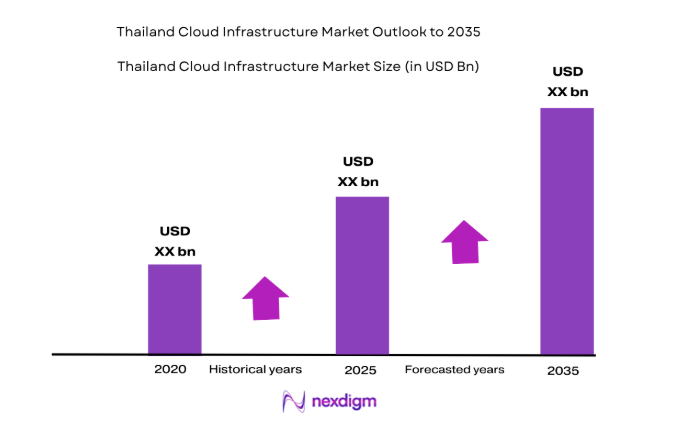
Based on a recent historical assessment, Thailand’s cloud infrastructure market is valued at approximately USD ~ billion, driven by accelerated enterprise digitization, hyperscale data center investments, and government backed digital economy programs. Expansion of e commerce platforms, financial services modernization, and manufacturing automation continues to raise demand for scalable compute and storage systems. Rising adoption of artificial intelligence workloads and hybrid cloud architectures further stimulates infrastructure spending across colocation and enterprise environments nationwide.
Bangkok dominates Thailand’s cloud infrastructure landscape due to dense enterprise clusters, subsea cable connectivity, and established carrier neutral data center ecosystems enabling hyperscale deployments. The Eastern Economic Corridor region is gaining prominence as industrial cloud demand expands across smart manufacturing zones and logistics hubs. Multinational cloud providers prioritize these regions due to power availability, network latency advantages, and proximity to enterprise customers, reinforcing geographic concentration of large scale cloud infrastructure investments within Thailand.
Market Segmentation
By Product Type
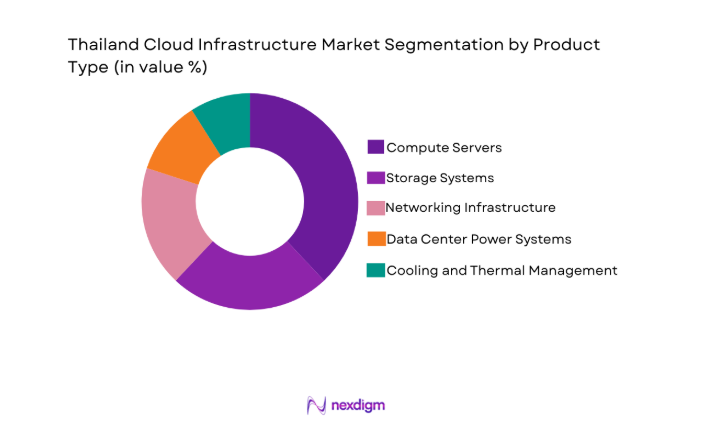
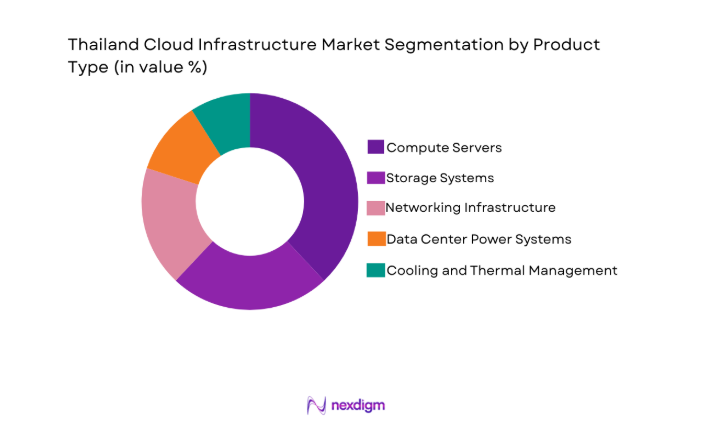
Thailand Cloud Infrastructure market is segmented by product type into compute servers, storage systems, networking infrastructure, data center power systems, and cooling and thermal management. Recently, compute servers has a dominant market share due to high density processing demand from cloud native and artificial intelligence workloads. Hyperscale regional expansion and enterprise digitalization across finance, e commerce, and manufacturing sectors reinforce servers as the largest infrastructure spending category in Thailand’s cloud ecosystem.
By Platform Type
Thailand Cloud Infrastructure market is segmented by platform type into hyperscale cloud data centers, enterprise private cloud infrastructure, colocation cloud facilities, edge cloud infrastructure, and government sovereign cloud platforms. Recently, hyperscale cloud data centers has a dominant market share due to regional expansion by global providers and strong demand for elastic capacity from SaaS and digital commerce platforms. Enterprise and telecom interconnection with hyperscale facilities further reinforces hyperscale leadership across Thailand’s cloud infrastructure ecosystem.
Competitive Landscape
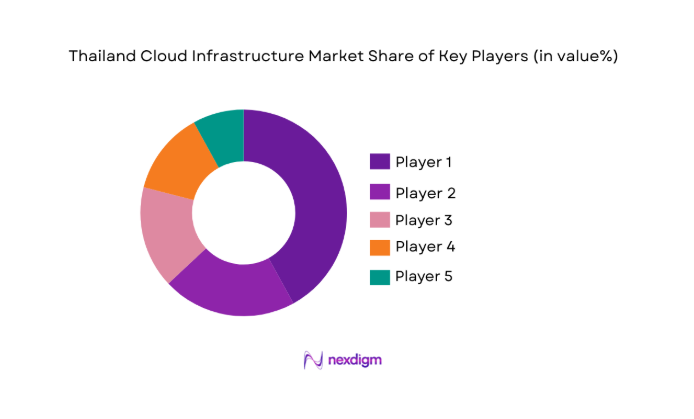
Thailand’s cloud infrastructure market shows moderate consolidation, with hyperscale global cloud providers and regional data center operators controlling large scale deployments while domestic telecom and IT service firms compete in enterprise and colocation segments. Strategic partnerships between telecom carriers and hyperscale vendors enable hybrid cloud connectivity, strengthening ecosystem integration. Infrastructure differentiation increasingly depends on energy efficiency, latency performance, and sovereign compliance capabilities as enterprises prioritize resilient digital platforms across Thailand’s expanding cloud economy.
| Company Name | Establishment Year | Headquarters | Technology Focus | Market Reach | Key Products | Revenue | Data Center Capacity in Thailand |
| Amazon Web Services | 2006 | USA | ~ | ~ | ~ | ~ | ~ |
| Microsoft | 1975 | USA | ~ | ~ | ~ | ~ | ~ |
| 1998 | USA | ~ | ~ | ~ | ~ | ~ | |
| ST Telemedia Global Data Centres | 2004 | Singapore | ~ | ~ | ~ | ~ | ~ |
| True IDC | 2001 | Thailand | ~ | ~ | ~ | ~ | ~ |
Thailand Cloud Infrastructure Market Analysis
Growth Drivers
National Digital Economy and Cloud First Policy Acceleration
Thailand’s national digital transformation strategy strongly promotes adoption of cloud infrastructure across government, enterprises, and industrial sectors, creating sustained demand for scalable computing environments and secure data platforms. Public sector modernization initiatives require migration of legacy IT systems to centralized cloud architectures, increasing procurement of domestic data center and sovereign cloud capacity. Regulatory encouragement of digital services including e government platforms, digital identity systems, and smart city programs stimulates cloud infrastructure deployment nationwide. Enterprises across banking, retail, and manufacturing sectors align with digital economy frameworks to enhance competitiveness and productivity through cloud based automation and analytics capabilities. Incentives for data localization and national cybersecurity resilience further motivate investment in domestic hyperscale and enterprise cloud facilities. Telecommunications operators expand fiber and 5G connectivity enabling cloud access across urban and industrial zones, strengthening infrastructure utilization. Government support for startup ecosystems and digital innovation hubs accelerates adoption of cloud native applications requiring scalable infrastructure. Integration of artificial intelligence and big data analytics in national development initiatives drives high performance computing demand. Regional positioning of Thailand as a digital hub for mainland Southeast Asia encourages global cloud providers to expand infrastructure presence domestically, reinforcing sustained market growth.
Enterprise Digital Transformation and AI Workload Expansion
Enterprises across Thailand are rapidly adopting digital platforms, artificial intelligence systems, and data driven decision frameworks, creating strong demand for cloud infrastructure capable of supporting advanced computing workloads and real time analytics environments. Financial institutions deploy AI based risk modeling, fraud detection, and customer personalization platforms requiring scalable processing and storage resources. Retail and e commerce sectors implement recommendation engines, supply chain analytics, and omnichannel platforms hosted on cloud architectures. Manufacturing industries adopt industrial IoT, predictive maintenance, and automation technologies relying on edge and cloud computing integration. Healthcare providers increasingly utilize digital imaging, telemedicine, and health data platforms requiring secure cloud storage and processing capacity. Media and entertainment firms deploy content streaming and digital distribution systems demanding high bandwidth cloud environments. Enterprises shift from on premise infrastructure to hybrid and multi cloud architectures to improve flexibility and operational efficiency. Data intensive applications including machine learning training and simulation workloads require high performance cloud compute clusters. Cloud platforms enable faster deployment of digital services and scalable innovation, making infrastructure expansion a strategic priority across Thailand’s enterprise economy.
Market Challenges
Power Infrastructure Constraints and Energy Sustainability Pressures
Cloud infrastructure expansion in Thailand faces constraints related to power availability, grid reliability, and increasing sustainability expectations associated with large scale data center operations and hyperscale facilities. High density cloud computing environments require continuous electricity supply and advanced cooling systems, creating significant energy consumption pressures. Urban data center clusters in Bangkok encounter grid capacity limitations and rising electricity costs impacting operational efficiency. Renewable energy sourcing remains limited relative to hyperscale demand, complicating sustainability commitments of global cloud providers expanding domestic facilities. Enterprises increasingly prioritize low carbon digital operations, pushing operators to invest in energy efficient cooling and power management technologies. Regulatory scrutiny on environmental impact of data centers is intensifying, influencing site selection and expansion planning decisions. Climate conditions in Thailand necessitate advanced thermal management systems, increasing infrastructure complexity and costs. Power reliability challenges in emerging industrial regions constrain edge and regional data center deployment. Balancing infrastructure growth with environmental sustainability and energy resilience remains a critical operational challenge for Thailand’s cloud infrastructure ecosystem.
Data Sovereignty Compliance and Cybersecurity Risk Management Complexity
Thailand’s evolving data protection regulations and cybersecurity frameworks create compliance complexities for cloud infrastructure providers and enterprises managing sensitive data across hybrid and multi cloud environments. Organizations handling financial, healthcare, and government data must ensure storage within national jurisdictions, driving investment in sovereign cloud capacity while limiting cross border optimization. Compliance with personal data protection laws requires secure infrastructure architectures and continuous monitoring systems. Cybersecurity threats targeting cloud platforms increase need for advanced protection mechanisms including encryption, identity management, and threat detection infrastructure. Enterprises migrating critical workloads to cloud environments face concerns regarding data breaches and operational continuity risks. Regulatory audits and certification requirements add operational overhead for providers operating domestic facilities. Integration of global hyperscale platforms with local compliance mandates requires architectural adaptation and partnership models. Limited availability of specialized cybersecurity talent in Thailand constrains effective infrastructure security management. Ensuring trust, regulatory alignment, and resilience across expanding cloud environments remains a significant challenge shaping infrastructure investment strategies.
Opportunities
Hyperscale Regional Hub Development for Southeast Asia
Thailand’s geographic location, digital economy growth, and connectivity infrastructure position it as a strategic hub for hyperscale cloud infrastructure serving mainland Southeast Asia and cross border digital service markets. Expansion of subsea cable networks and regional internet exchange points enhances Thailand’s role as a connectivity gateway. Global cloud providers can establish regional availability zones serving neighboring economies lacking large scale infrastructure capacity. Demand for low latency digital services across logistics, manufacturing, and e commerce supply chains supports regional cloud traffic concentration in Thailand. Government initiatives promoting digital investment zones and data center incentives encourage hyperscale campus development. Industrial growth corridors provide land and power resources suitable for large scale facilities outside congested urban regions. Regional enterprises seeking data localization within ASEAN jurisdictions view Thailand as a compliant hosting destination. Development of hyperscale ecosystems stimulates colocation, interconnection, and managed service markets domestically. Positioning Thailand as a regional cloud infrastructure hub creates long term investment and revenue opportunities across Southeast Asia’s expanding digital economy.
Edge Cloud Infrastructure for Smart Industry and 5G Applications
Expansion of 5G networks and industrial digitalization across Thailand creates significant opportunity for distributed edge cloud infrastructure supporting real time processing and low latency applications across manufacturing, logistics, and urban systems. Smart factories require localized computing for robotics control, machine vision, and predictive analytics. Autonomous logistics and port operations demand edge processing for operational safety and efficiency. Smart city deployments including traffic management, surveillance analytics, and public safety systems rely on nearby cloud nodes. Telecommunications operators integrating edge cloud with 5G networks can deliver enterprise services such as private networks and industrial automation platforms. Healthcare applications including remote monitoring and imaging analysis benefit from localized computing environments. Content delivery and gaming platforms require edge infrastructure to improve user experience across Thailand’s urban population. Edge deployments complement hyperscale facilities by extending cloud capability to distributed industrial zones. Rapid adoption of real time digital services across sectors creates strong growth potential for edge cloud infrastructure investment nationwide.
Future Outlook
Thailand’s cloud infrastructure market is expected to expand steadily as hyperscale deployments, enterprise digitalization, and artificial intelligence workloads intensify infrastructure demand. Expansion of 5G connectivity and edge computing will extend cloud adoption across industrial and regional ecosystems. Government digital economy initiatives and data localization policies will continue supporting domestic infrastructure investment. Sustainability driven data center design and renewable energy integration will shape competitive differentiation. Increasing enterprise reliance on cloud native platforms will reinforce long term infrastructure growth across Thailand.
Major Players
- Amazon Web Services
- Microsoft
- ST Telemedia Global DataCentres
- True IDC
- NTT Data
- Huawei Cloud
- Alibaba Cloud
- Equinix
- KDDI Telehouse
- Chindata
- EdgeCentres
- Singtel
- AIS Cloud
- TCC Technology
Key Target Audience
- Hyperscale Cloud Providers
- Data Center Operators
- Telecommunications Companies
- Enterprise IT Infrastructure Buyers
- Government and Regulatory Bodies
- Investments and Venture Capitalist Firms
- Industrial Manufacturing Firms
- Financial Services Institutions
Research Methodology
Step 1: Identification of Key Variables
Key variables influencing Thailand’s cloud infrastructure market were identified including hyperscale investment, enterprise digital adoption, data center capacity expansion, connectivity infrastructure, regulatory environment, and sector specific cloud demand drivers across industries.
Step 2: Market Analysis and Construction
Market size and segmentation were constructed through synthesis of industry reports, infrastructure investment announcements, enterprise adoption trends, and regional data center capacity mapping to estimate Thailand’s cloud infrastructure landscape.
Step 3: Hypothesis Validation and Expert Consultation
Findings were validated through consultation of infrastructure experts, telecom operators, cloud architects, and enterprise IT stakeholders to confirm technology trends, demand patterns, and infrastructure deployment dynamics.
Step 4: Research Synthesis and Final Output
All validated insights were integrated into a structured market framework covering segmentation, competition, drivers, challenges, and opportunities to produce a comprehensive Thailand cloud infrastructure market outlook.

- Executive Summary
- Research Methodology (Definitions, Scope, Industry Assumptions, Market Sizing Approach, Primary & Secondary Research Framework, Data Collection & Verification Protocol, Analytic Models & Forecast Methodology, Limitations & Research Validity Checks)

- Market Definition and Scope
- Value Chain & Stakeholder Ecosystem
- Regulatory / Certification Landscape
- Sector Dynamics Affecting Demand
- Strategic Initiatives & Infrastructure Growth

- Growth Drivers
Enterprise digital transformation and migration to cloud-native architectures
Expansion of hyperscale and colocation data center investments in Thailand
Government cloud-first and digital economy initiatives - Market Challenges
Data sovereignty and compliance constraints affecting cross-border cloud deployment
High capital and energy costs for data center infrastructure expansion
Limited skilled cloud and data center engineering workforce - Market Opportunities
Rising demand for sovereign and government cloud infrastructure
Edge cloud deployment for 5G and IoT ecosystem growth
Industry-specific cloud platforms for finance and manufacturing - Trends
Shift toward hybrid and multi-cloud operating models
Integration of AI-ready and GPU-enabled cloud infrastructure
Adoption of green and energy-efficient data center designs - Government Regulations & Defense Policy
Thailand Personal Data Protection Act compliance for cloud hosting
National digital economy and cloud-first public sector policies
Data center investment incentives under BOI promotion schemes - Swot Analysis
Strong regional connectivity and telecom backbone supporting cloud growth
Dependence on foreign hyperscalers for advanced cloud capabilities
Growing domestic enterprise adoption across regulated industries - Porters 5 forces
High entry barriers due to capital and regulatory requirements
Strong supplier power from global hyperscale technology vendors
Increasing enterprise bargaining power through multi-cloud strategies

- By Market Value 2020-2025
- By Installed Units 2020-2025
- By Average System Price 2020-2025
- By System Complexity Tier 2020-2025

- By System Type (In Value%)
Public Cloud Infrastructure
Private Cloud Infrastructure
Hybrid Cloud Infrastructure
Edge Cloud Infrastructure
Multi-cloud Management Platforms - By Platform Type (In Value%)
Hyperscale Data Centers
Enterprise Data Centers
Telecom Cloud Platforms
Colocation Facilities - By Fitment Type (In Value%)
On-premise Deployment
Hosted Deployment
Managed Cloud Services
Integrated Hybrid Deployment
Dedicated Single-tenant Deployment - By End User Segment (In Value%)
Banking and Financial Services
Telecommunications and Digital Services
Government and Public Sector
Manufacturing and Industrial Enterprises
E-commerce and Digital Platforms - By Procurement Channel (In Value%)
Direct Vendor Procurement
System Integrator Contracts
Managed Service Providers
Cloud Marketplace Platforms
Telecom-led Bundled Procurement

- Market structure and competitive positioning
Market share snapshot of major players - Cross Comparison Parameters (Service Portfolio Breadth, Data Center Footprint, Compliance Certifications, Deployment Models, Industry Solutions)
- SWOT Analysis of Key Competitors
- Pricing & Procurement Analysis
- Key Players
Amazon Web Services
Microsoft Azure
Google Cloud
Alibaba Cloud
Huawei Cloud
NTT Ltd.
Equinix
Digital Realty
ST Telemedia Global Data Centres
Telehouse Thailand
True IDC
AIS Cloud
CAT Telecom
TCC Technology
Gulf Edge

- Financial institutions prioritizing compliant and sovereign cloud environments
- Telecom operators integrating cloud with 5G and edge services
- Government agencies accelerating national cloud adoption programs
- Digital-native enterprises scaling through hyperscale and hybrid platforms

- Forecast Market Value 2026-2035
- Forecast Installed Units 2026-2035
- Price Forecast by System Tier 2026-2035
- Future Demand by Platform 2026-2035


 Request a Sample
 Ask for Customization
 Get a Quote
 Enquire Now