
 Download PDF
Market Overview
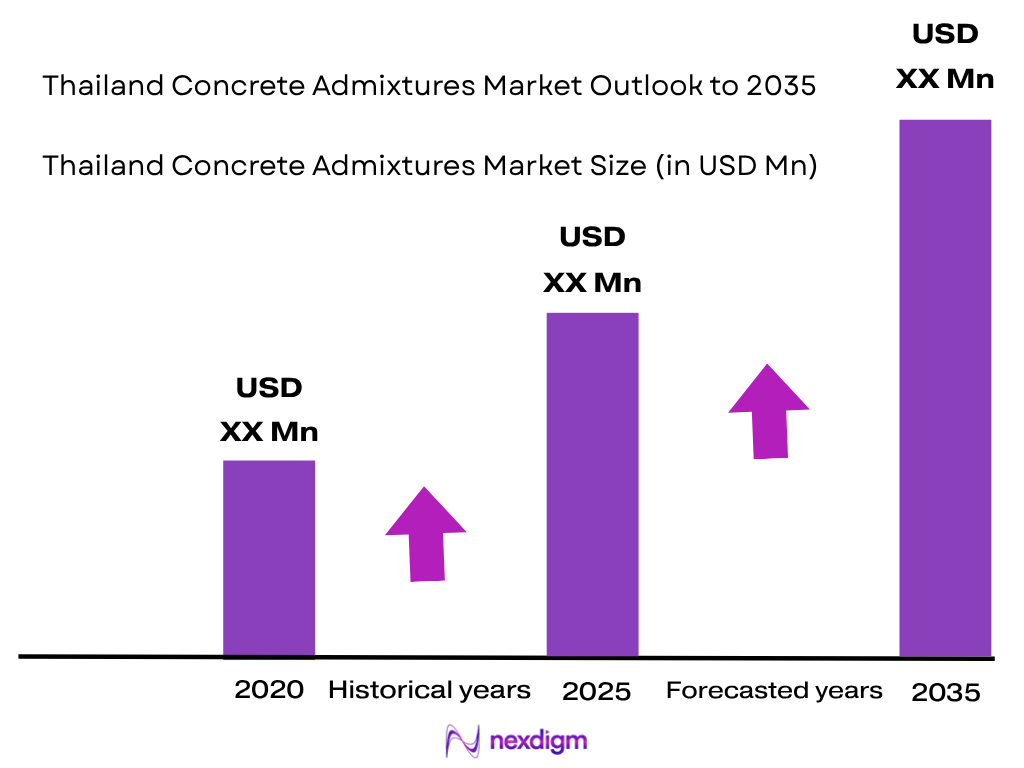
The Thailand Concrete Admixtures Market is valued at approximately USD ~XX million, supported by a large national building pipeline and extensive ready-mix usage. Thailand recorded 60.85 million square metres of permitted new-building construction in the earlier annual observation and 58.86 million square metres in the latest observation. The market is driven by superplasticizer requirements for pumpability, extended workability, precast productivity, infrastructure concrete and lower water-cement ratios across large construction projects.
Bangkok, its surrounding metropolitan provinces and Central Thailand dominate admixture demand because they concentrate high-rise developments, industrial estates, transport projects and large batching networks. Central Thailand recorded 19.54 million square metres of new construction in the earlier observation and 21.68 million square metres subsequently, while Bangkok and its vicinities together accounted for substantial additional building activity. Chonburi, Rayong and Chachoengsao further strengthen demand through the Eastern Economic Corridor’s industrial and infrastructure development.
Market Segmentation
By Admixture Type
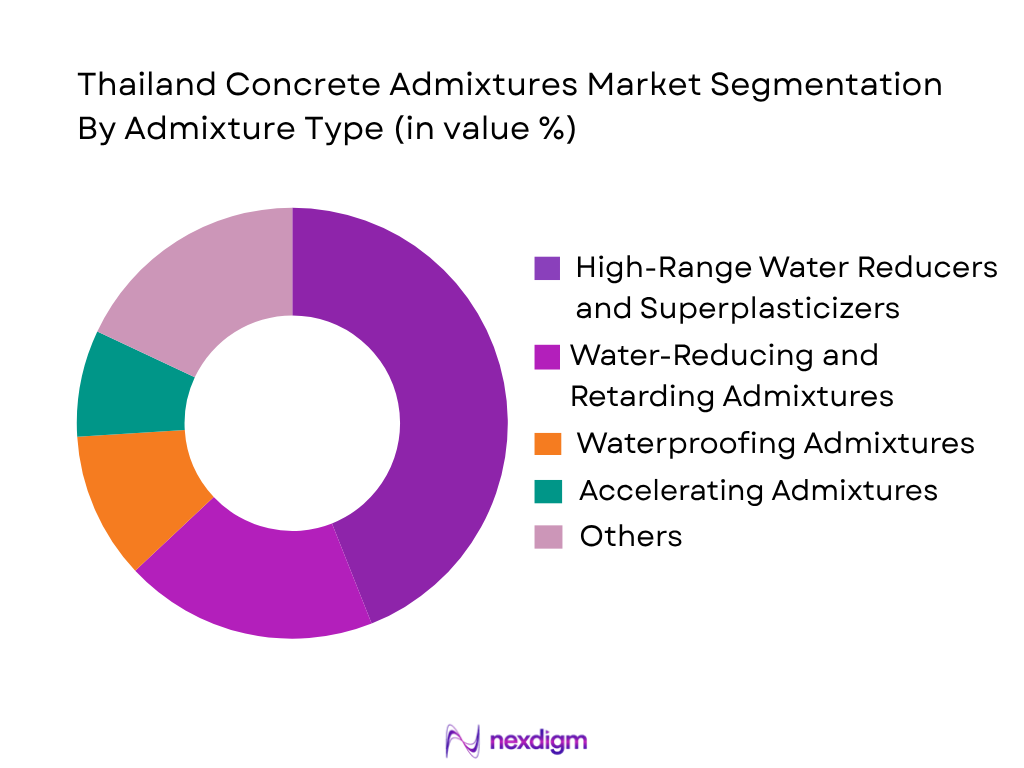
The Thailand Concrete Admixtures Market is segmented into high-range water reducers and superplasticizers, water-reducing and retarding admixtures, accelerators, waterproofing admixtures, viscosity modifiers and other specialty products. High-range water reducers and superplasticizers hold the dominant market share because Thailand’s ready-mix industry increasingly requires high workability, lower water-cement ratios, extended slump retention and efficient pumping. PCE-based technologies are particularly important for Bangkok projects where concrete may experience extended transportation and pumping times. Their use also extends into high-strength, self-compacting and precast concrete. Thailand-specific products available commercially provide extended workability, high water reduction and compatibility with reinforced concrete, confirming the technical importance of this category. Conventional SNF and lignosulfonate chemistries remain relevant for price-sensitive and less demanding applications, while retarders have significant usage where high ambient temperatures accelerate hydration and reduce placement windows.
By Application
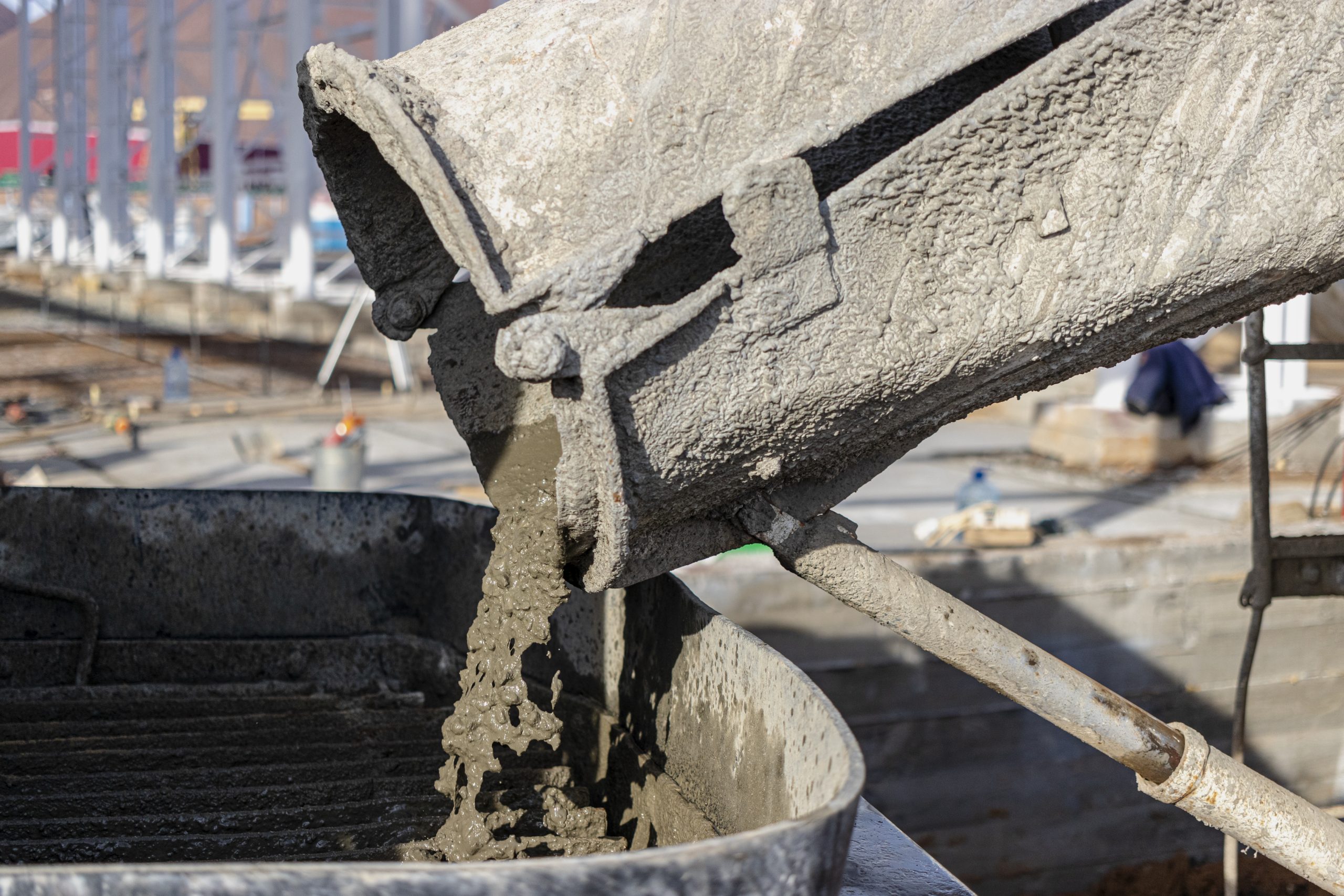
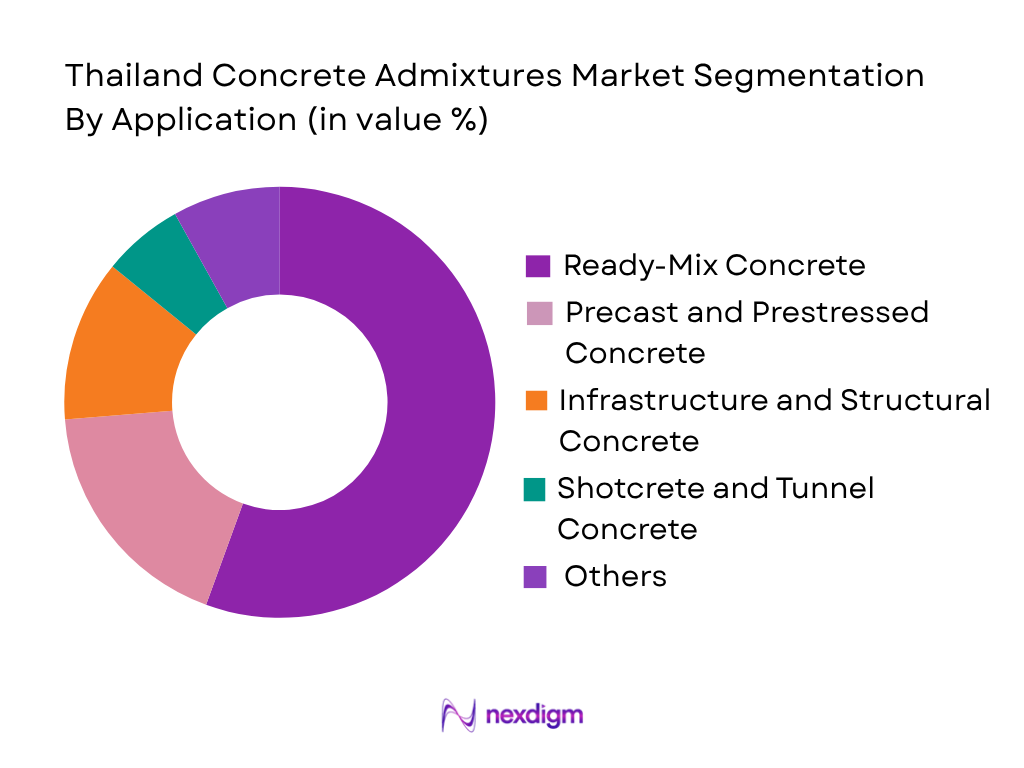
The Thailand Concrete Admixtures Market is segmented into ready-mix concrete, precast and prestressed concrete, infrastructure concrete, shotcrete and tunnel concrete, industrial concrete and other applications. Ready-mix concrete has the dominant market share because Thailand’s urban construction system relies heavily on centralized batching for residential, commercial, industrial and infrastructure projects. TIS 213 defines ready-mixed concrete as concrete produced at a plant or in a truck mixer and delivered to the construction location in a ready-to-use condition, reinforcing the formal role of centralized concrete production. Ready-mix applications consume large quantities of water reducers and retarders to maintain flowability during delivery and placement. Products sold specifically in Thailand are formulated for extended workability, hot-weather placement and transportation requirements, including PCE products capable of maintaining workability for extended periods. Precast demand is also significant because infrastructure, industrial and building projects increasingly use factory-manufactured structural elements requiring rapid early-strength development.
Competitive Landscape
The Thailand Concrete Admixtures Market consists of multinational construction-chemical companies, specialty underground-construction suppliers and locally established product platforms. Sika, Master Builders Solutions, Fosroc, Saint-Gobain CHRYSO and Mapei compete across ready-mix, precast and infrastructure applications, while firms such as Normet and Cormix have stronger positioning in tunnelling, shotcrete and underground works. Competitive differentiation depends on PCE formulation capability, cement compatibility, slump retention, local technical service, trial-mix support and nationwide bulk-delivery capability.
| Major Player | Establishment Year | Headquarters | PCE / Superplasticizer Capability | Slump-Retention Capability | Precast Concrete Capability | Tunnel / Shotcrete Capability | Waterproofing & Durability Capability | Technical & Field Support |
| Sika | 1910 | Baar, Switzerland | ~ | ~ | ~ | ~ | ~ | ~ |
| Master Builders Solutions | 1909 legacy construction-chemicals roots | Mannheim, Germany | ~ | ~ | ~ | ~ | ~ | ~ |
| Fosroc | 1972 | Dubai, UAE | ~ | ~ | ~ | ~ | ~ | ~ |
| Saint-Gobain CHRYSO | 1942 | Courbevoie, France | ~ | ~ | ~ | ~ | ~ | ~ |
| Mapei | 1937 | Milan, Italy | ~ | ~ | ~ | ~ | ~ | ~ |
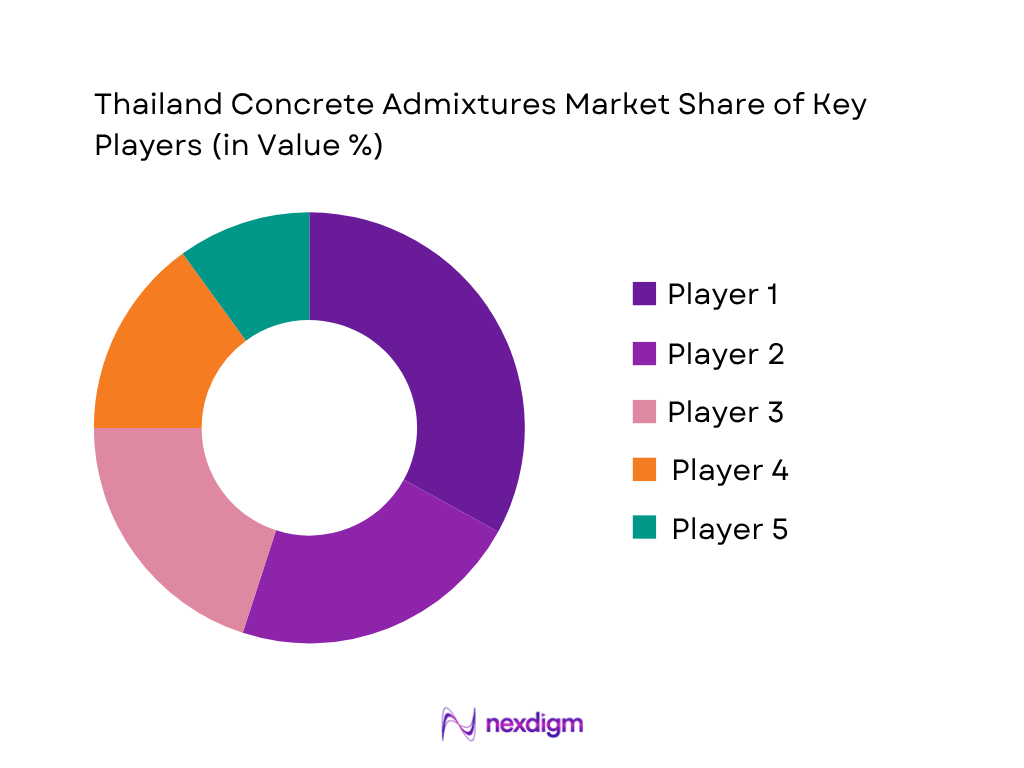
Thailand Concrete Admixtures Market Analysia
Growth Drivers
Large Building Construction Base Sustaining Ready-Mix and Admixture Consumption
Thailand’s substantial building-construction activity is a primary growth driver for concrete admixtures because every major ready-mix, structural, foundation and precast application requires controlled workability, water reduction and setting performance. The National Statistical Office recorded 58,862,540 square metres of new building construction in 2024, including 21,677,863 square metres in Central Thailand, 12,217,070 square metres in Bangkok’s surrounding provinces, 8,246,647 square metres in Southern Thailand, 6,960,621 square metres in the Northeast, 6,105,711 square metres in the North and 3,654,628 square metres in Bangkok. Thailand also recorded 256,994 newly constructed buildings during 2024, creating a broad consumption base for PCE superplasticizers, retarders, waterproofing admixtures and pumping aids. These chemicals are particularly important where ready-mix concrete requires long transportation times, high pumpability and reduced water-cement ratios. The macroeconomic environment supports continued construction demand: World Bank data place Thailand’s 2024 GDP at US$526.52 billion and GDP per capita at US$7,346.6. This combination of nationwide construction volume and a large economic base supports recurring admixture consumption across residential, commercial and industrial concrete applications.
Industrial and Digital Investment Expanding High-Performance Concrete Applications
Thailand’s accelerating industrial investment is strengthening concrete admixture demand because factories, data centres, semiconductor facilities and logistics projects require large foundations, reinforced floors, structural frames and utility infrastructure with demanding concrete specifications. The Thailand Board of Investment recorded 1.14 trillion baht of investment-promotion applications in 2024. Within this total, the digital sector generated 150 projects worth 243.3 billion baht, while electronics and electrical appliances contributed 407 projects worth 231.7 billion baht, automotive investment accounted for 309 projects worth 102.4 billion baht, and petrochemicals and chemicals generated 235 projects worth 49.1 billion baht. These capital-intensive facilities create demand for high-range water reducers, PCE superplasticizers, shrinkage-control products, industrial-flooring admixtures and waterproofing systems because project owners require high strength, low permeability and reliable placement productivity. Thailand’s macroeconomic foundation was also substantial, with the World Bank reporting US$526.52 billion of GDP in 2024 and US$7,346.6 of GDP per capita. Consequently, the expansion of technically sophisticated industrial assets broadens admixture demand beyond traditional residential construction toward higher-value performance concrete applications.
Market Challenges
Geographic Dispersion and Urban Delivery Conditions Complicating Slump-Retention Performance
Thailand’s concrete admixture suppliers face a significant operational challenge from geographically dispersed construction activity and the need to maintain ready-mix workability during transportation and placement. National Statistical Office data show 58,862,540 square metres of new building construction in 2024, distributed across 21,677,863 square metres in Central Thailand, 12,217,070 square metres in Bangkok’s surrounding provinces, 8,246,647 square metres in Southern Thailand, 6,960,621 square metres in the Northeast, 6,105,711 square metres in the North and 3,654,628 square metres in Bangkok. This wide construction footprint forces admixture suppliers to formulate products for different cement sources, aggregate characteristics, haul distances and placement conditions. Bangkok and metropolitan projects additionally require extended slump retention because traffic and vertical pumping can lengthen the interval between batching and discharge. Excessive retardation can delay finishing and early strength, while insufficient retention can cause slump loss, pumping difficulty or rejected loads. The challenge exists within an economy generating US$526.52 billion of GDP in 2024, with US$7,346.6 GDP per capita, according to the World Bank. Suppliers therefore require regional technical service, laboratory testing and mix-specific dosage optimization.
Rapid Expansion of Complex Industrial Projects Increasing Product Qualification Requirements
Thailand’s increasing concentration of advanced manufacturing and digital infrastructure raises technical qualification challenges for concrete admixture manufacturers because industrial projects often impose stricter requirements for strength development, dimensional stability, low permeability and placement consistency. The Board of Investment recorded 150 digital-sector projects worth 243.3 billion baht in 2024, 407 electronics and electrical appliance projects worth 231.7 billion baht, 309 automotive projects worth 102.4 billion baht, and 235 petrochemical and chemical projects worth 49.1 billion baht. Such facilities typically require large-volume slabs, equipment foundations, clean production areas, utility structures and heavy-duty industrial floors. Admixture suppliers must therefore demonstrate compatibility with multiple cementitious systems and provide reliable PCE, shrinkage-control, waterproofing and early-strength technologies. Product changes cannot be made casually because altered chemistry can affect slump, setting, bleeding, surface finish and strength development, necessitating additional trial mixes and project approvals. Thailand’s 2024 GDP of US$526.52 billion and GDP per capita of US$7,346.6, reported by the World Bank, underline the scale of economic activity supporting these technically demanding developments. As project sophistication rises, qualification cycles and technical-support requirements become more intensive for admixture suppliers.
Market Opportunities
Eastern Economic Corridor Development Creating Scope for Advanced Concrete Formulations
The Eastern Economic Corridor presents a major future opportunity for Thailand’s concrete admixture suppliers because its industrial, transport and specialized economic-zone developments require high-volume structural and infrastructure concrete. The EEC Office reported that from January 2023 to September 2024 it engaged 139 investors, with 35 investors submitting 36 Letters of Intent projects across healthcare, digital, next-generation automotive, BCG economy and service industries. Of these, 12 projects progressed to applications for benefits under EEC legislation with combined investment of approximately 135 billion baht. These current commitments create a pipeline for factories, logistics assets, utilities, roads and supporting infrastructure in Chonburi, Rayong and Chachoengsao. Future concrete demand arising from this base can increase consumption of PCE superplasticizers, high-early-strength admixtures, waterproofing systems, shrinkage reducers and products optimized for large industrial floors and foundations. Thailand’s broader macroeconomic foundation supports continued capital formation, with World Bank data showing US$526.52 billion of GDP in 2024 and US$7,346.6 GDP per capita. Admixture manufacturers with local blending, bulk delivery and project-specific mix-design capability are positioned to capture this expanding industrial concrete opportunity.
Data Centre and Advanced Electronics Investment Opening High-Performance Concrete Opportunity
Thailand’s expanding data-centre and advanced-electronics investment pipeline creates a future growth opportunity for specialized concrete admixtures because these facilities require heavy foundations, low-shrinkage floors, durable structural systems and tightly controlled construction tolerances. The Board of Investment recorded 150 data-centre and cloud-related digital projects worth 243.3 billion baht in 2024, while the electronics and electrical appliance sector generated 407 projects worth 231.7 billion baht. The automotive sector added 309 projects worth 102.4 billion baht, further expanding the base of technologically intensive industrial construction. Data centres and electronics plants can require high-strength pumped concrete, extended workability, controlled setting, reduced permeability and crack-management performance, creating opportunities for PCE superplasticizers, viscosity modifiers, shrinkage reducers and integral waterproofing products. This current investment base provides a strong foundation for future admixture consumption without relying on projected construction statistics. Thailand’s national economy recorded US$526.52 billion of GDP in 2024, while GDP per capita reached US$7,346.6, according to the World Bank. Suppliers able to combine laboratory mix optimization, consistent local manufacturing and project-site technical service can increasingly participate in these specification-intensive concrete applications.
Future Outlook
The Thailand Concrete Admixtures Market is expected to register approximately ~XX% CAGR during 2026-2035, supported by transport infrastructure, Eastern Economic Corridor development, industrial investment and increasing use of performance concrete. PCE-based superplasticizers are expected to remain central to market development because contractors increasingly require strong water reduction with controlled workability retention. Precast, tunnel and low-carbon concrete applications should create additional opportunities for specialty formulations.
Thailand’s industrial investment pipeline will reinforce concrete demand, particularly in the Eastern Economic Corridor. Investment-promotion applications reached THB1.14 trillion, with data centre and cloud projects alone accounting for THB243.3 billion across 150 projects, creating a large pipeline of industrial and digital facilities requiring structural, foundation and utility concrete.
Major Players
- Sika (Thailand) Limited
- Master Builders Solutions
- Fosroc
- Saint-Gobain CHRYSO
- Mapei
- MC-Bauchemie
- Normet
- Cormix International Limited
- Penetron
- Kryton International Inc.
- GCP Applied Technologies / Saint-Gobain Construction Chemicals
- Euclid Chemical
- Cementaid
- TOA Performance Coating Corporation
- LANKO / Saint-Gobain Weber Thailand
Key Target Audience
- Concrete Admixture and Construction Chemical Manufacturers
- Ready-Mix Concrete Producers
- Precast and Prestressed Concrete Manufacturers
- Infrastructure and Tunnel Contractors
- Property and Industrial Estate Developers
- Cement, SCM and Concrete Raw-Material Suppliers
- Investments and Venture Capitalist Firms
- Government and Regulatory Bodies (Thai Industrial Standards Institute, Department of Public Works and Town & Country Planning, Mass Rapid Transit Authority of Thailand, Expressway Authority of Thailand, Eastern Economic Corridor Office)
Research Methodology
Step 1: Identification of Key Variables
The initial phase involves constructing an ecosystem map covering concrete admixture manufacturers, polymer suppliers, cement producers, ready-mix companies, precast producers, contractors, developers and infrastructure agencies. The analysis identifies variables such as concrete production, admixture dosage, PCE penetration, project type, cement chemistry, regional construction concentration, transport time, precast output and infrastructure exposure.
Step 2: Market Analysis and Construction
Historical data for the Thailand Concrete Admixtures Market is compiled using building-construction activity, infrastructure development, ready-mix demand and application-level admixture consumption. Bottom-up estimates assess concrete volume and average admixture dosage by application, while top-down calculations evaluate overall construction-material activity. Both models are reconciled to construct the historical market and individual segment shares.
Step 3: Hypothesis Validation and Expert Consultation
Market hypotheses are validated through computer-assisted telephone interviews with concrete technologists, ready-mix producers, admixture manufacturers, precast operators, contractors and procurement professionals. Discussions examine PCE adoption, formulation selection, slump-retention requirements, cement compatibility, bulk delivery, customer qualification, trial-mix procedures, tunnelling applications and technical-service requirements across Thailand.
Step 4: Research Synthesis and Final Output
Primary insights are triangulated with National Statistical Office construction data, Thai Industrial Standards, EEC project information, BOI investment information and supplier technical documentation. The final estimates reconcile top-down and bottom-up outputs and incorporate project pipelines, PCE migration, infrastructure investment, precast adoption, industrial development and changing concrete-performance specifications into the forecast framework.

- Executive Summary
- Research Methodology (Market Definitions and Assumptions, Thailand Concrete Admixtures Market Classification, Chemical Admixture Scope, Ready-Mix Concrete Assessment, Precast Concrete Assessment, Site-Batched Concrete Assessment, Water-Reducing Admixture Assessment, High-Range Water Reducer Assessment, PCE-Based Admixture Assessment, SNF-Based Admixture Assessment, Retarding Admixture Assessment, Accelerating Admixture Assessment, Waterproofing Admixture Assessment, Crystalline Admixture Assessment, Corrosion-Inhibiting Admixture Assessment, Shrinkage-Reducing Admixture Assessment, Viscosity-Modifying Admixture Assessment, High-Performance Concrete Assessment, Self-Compacting Concrete Assessment, Hot-Weather Concreting Assessment)

- Definition and Scope
- Thailand Concrete Admixtures Industry Evolution and Development of Conventional Water Reducers, Lignosulfonate-Based Plasticizers, Sulfonated Naphthalene Formaldehyde Superplasticizers, Polycarboxylate Ether Superplasticizers, Extended Slump-Retention Admixtures, Retarding Admixtures, Accelerating Admixtures, Viscosity-Modifying Admixtures, Integral Waterproofing Admixtures, Crystalline Waterproofing Technologies, Corrosion-Inhibiting Admixtures, Shrinkage-Reducing Admixtures, High-Performance Concrete Technologies, Self-Compacting Concrete Technologies, Precast Concrete Admixtures, Shotcrete Accelerators, Tunnel Segment Concrete Technologies, Low-Carbon Concrete Admixtures, High-Strength Concrete Applications, Industrial Concrete Solutions
- Concrete Admixtures Value Chain Analysis
- Concrete Admixtures Supply Chain Analysis
- PCE Monomer Suppliers, Acrylic Polymer Suppliers, Lignosulfonate Suppliers, Naphthalene-Based Chemical Suppliers, Specialty Chemical Manufacturers, Concrete Admixture Manufacturers, Local Polymer Blending Facilities, Ready-Mix Concrete Producers, Precast Concrete Manufacturers

- Growth Drivers (Bangkok Urban Construction, Eastern Economic Corridor Development, Expressway Expansion, Metro and Rail Construction, Industrial Estate Expansion, Data Centre Construction, High-Rise Residential Development, Ready-Mix Concrete Demand, Precast Construction, High-Performance Concrete Adoption, Infrastructure Rehabilitation, Low-Carbon Concrete Adoption)
- Market Challenges (Cement Chemistry Variability, Aggregate Quality Variation, High Ambient Temperature, Rapid Slump Loss, Urban Delivery Congestion, PCE-Cement Compatibility, Imported Specialty Feedstock Dependence, Raw Material Availability, Ready-Mix Price Competition, Inconsistent Site Dosing, Product Qualification Requirements, Skilled Concrete Technologist Availability)
- Market Opportunities (PCE Superplasticizer Penetration, Extended Slump-Retention Admixtures, Low-Viscosity Concrete Technology, Precast Productivity Admixtures, Shotcrete Accelerators, Tunnel Segment Concrete, Metro Infrastructure, EEC Industrial Construction, Crystalline Waterproofing, Low-Carbon Concrete, SCM-Compatible Admixtures, Local Polymer Manufacturing, Automated Admixture Dosing)
- Market Trends (PCE-Based Superplasticizers, Long Workability Retention, Low-Viscosity Concrete, Self-Compacting Concrete, Precast High-Early-Strength Concrete, Alkali-Free Shotcrete Accelerators, Crystalline Waterproofing, Reduced-Clinker Concrete, SCM-Compatible Admixtures, Digital Batching, Automated Dosing, Customized Cement-Specific Formulations, Performance-Based Mix Design)
- Government Regulations and Standards (TIS 733 Chemical Admixtures for Concrete, TIS 213 Ready-Mixed Concrete, TIS 15 Portland Cement, TIS 80 Mixed Cement, TIS 566 Concrete Aggregate, Department of Public Works and Town & Country Planning Specifications, Expressway Authority of Thailand Concrete Specifications, Mass Rapid Transit Authority Project Specifications, Industrial Estate Authority of Thailand Requirements, Environmental and Construction Material Compliance Requirements)
- SWOT Analysis
- Porter’s Five Forces Analysis
- PESTLE Analysis
- Stakeholder Ecosystem
- Concrete Admixtures Manufacturing and Construction Project Ecosystem

- By Market Value (2020-2025)
- By Admixture Consumption Volume (2020-2025)
- By Superplasticizer Consumption Volume (2020-2025)
- By PCE-Based Admixture Consumption (2020-2025)
- By Retarding Admixture Consumption (2020-2025)
- By Waterproofing Admixture Consumption (2020-2025)
- By Ready-Mix Concrete Admixture Consumption (2020-2025)
- By Precast Concrete Admixture Consumption (2020-2025)
- By Infrastructure Concrete Admixture Consumption (2020-2025)
- By Building Construction Admixture Consumption (2020-2025)
- By Tunnel and Underground Concrete Admixture Consumption (2020-2025)
- By Locally Manufactured Admixture Consumption (2020-2025)
- By Imported Admixture Consumption (2020-2025)

- By Admixture Type (In Value %)
Water-Reducing Admixtures
High-Range Water Reducers and Superplasticizers
Water-Reducing and Retarding Admixtures
Water-Reducing and Accelerating Admixtures
Set-Retarding Admixtures
Set-Accelerating Admixtures
Viscosity-Modifying Admixtures
Air-Entraining Admixtures
Integral Waterproofing Admixtures
Crystalline Waterproofing Admixtures
Corrosion-Inhibiting Admixtures
Shrinkage-Reducing Admixtures
Hydration-Control Admixtures
Pumping Aids
Specialty Performance Admixtures - By Chemical Technology (In Value %)
Polycarboxylate Ether-Based Admixtures
Sulfonated Naphthalene Formaldehyde-Based Admixtures
Sulfonated Melamine Formaldehyde-Based Admixtures
Lignosulfonate-Based Admixtures
Acrylic Polymer-Based Admixtures
Polymer-Modified Hybrid Admixtures
Crystalline Reactive Chemicals
Hydrophobic Waterproofing Chemistries
Calcium Nitrate-Based Accelerators and Corrosion Inhibitors
Non-Chloride Accelerator Chemistries
Other Specialty Chemistries - By Application (In Value %)
Ready-Mix Concrete
Precast Concrete
Prestressed Concrete
Site-Batched Concrete
Shotcrete and Sprayed Concrete
Piling Concrete
Diaphragm Wall Concrete
Raft Foundation Concrete
Mass Concrete
Pumped High-Rise Concrete
Tunnel Segment Concrete
Tunnel and Underground Concrete
Marine and Coastal Concrete
Water-Retaining Structures
Industrial Flooring Concrete
Road and Pavement Concrete - By Performance Requirement (In Value %)
Extended Slump Retention
High Water Reduction
High Early Strength
Delayed Setting
Rapid Setting
Improved Pumpability
Low-Viscosity Concrete Performance
Self-Compacting Performance
Segregation Control
Reduced Permeability
Waterproofing
Corrosion Protection
Crack and Shrinkage Control
Anti-Washout Performance - By Source (In Value %)
Locally Manufactured Admixtures
Locally Blended Admixtures
Imported Finished Admixtures
Imported Raw Materials with Local Formulation - By Region (In Value %)
Bangkok Metropolitan Region
Bangkok
Samut Prakan
Pathum Thani
Nonthaburi
Chonburi
Rayong
Chachoengsao
Eastern Economic Corridor
Central Thailand
Northern Thailand
Northeastern Thailand
Southern Thailand

- Market Share of Major Players (By Thailand Revenue, Admixture Consumption Volume, Superplasticizer Volume, PCE-Based Admixture Portfolio, Ready-Mix Concrete Exposure, Precast Concrete Exposure, Infrastructure Project Exposure, Metro and Tunnel Project Exposure, Industrial Project Portfolio, Local Manufacturing Capacity, Polymer Blending Capability, Technical Laboratory Capability, Bulk Delivery Network, Regional Distribution Coverage, Low-Carbon Concrete Capability)
- Cross Comparison Parameters (PCE Superplasticizer Portfolio Breadth, Extended Slump-Retention and Low-Viscosity Concrete Capability, Ready-Mix and Precast Customer Coverage, Thailand Manufacturing and Blending Capability, Low-Carbon and Blended-Cement Compatibility, Tunnel Shotcrete and Underground Construction Capability, Technical Laboratory and Mix-Design Support, Bulk Delivery and Nationwide Field-Service Network)
- SWOT Analysis of Major Players
- Competitive Positioning Matrix
- Major Companies
Sika (Thailand) Limited
Master Builders Solutions
Fosroc
Saint-Gobain CHRYSO
Mapei
MC-Bauchemie
Normet
Cormix International Limited
Penetron
Kryton International Inc.
GCP Applied Technologies / Saint-Gobain Construction Chemicals
Euclid Chemical
Cementaid
TOA Performance Coating Corporation
LANKO / Saint-Gobain Weber Thailand

- Ready-Mix Concrete Producer Requirement Assessment
- Precast Concrete Manufacturer Requirement Assessment
- Main Contractor Procurement Assessment
- High-Rise Building Concrete Requirement Assessment
- Infrastructure Contractor Requirement Assessment
- Metro and Tunnel Concrete Requirement Assessment
- Industrial Estate Developer Concrete Specification Assessment
- Property Developer Concrete Specification Assessment
- Low-Carbon Concrete Requirement Assessment
- Extended Slump-Retention Requirement Assessment
- Superplasticizer Compatibility Assessment
- Technical Laboratory and Field Service Requirement Assessment

- By Market Value (2026-2035)
- By Admixture Consumption Volume (2026-2035)
- By Superplasticizer Consumption Volume (2026-2035)
- By PCE-Based Admixture Consumption (2026-2035)
- By Retarding Admixture Consumption (2026-2035)
- By Waterproofing Admixture Consumption (2026-2035)
- By Ready-Mix Concrete Admixture Consumption (2026-2035)
- By Precast Concrete Admixture Consumption (2026-2035)
- By Infrastructure Concrete Admixture Consumption (2026-2035)
- By Building Construction Admixture Consumption (2026-2035)
- By Tunnel and Underground Concrete Admixture Consumption (2026-2035)
- By Locally Manufactured Admixture Consumption (2026-2035)
- By Imported Admixture Consumption (2026-2035)


 Request a Sample
 Ask for Customization
 Get a Quote
 Enquire Now
