
 Download PDF
Market Overview
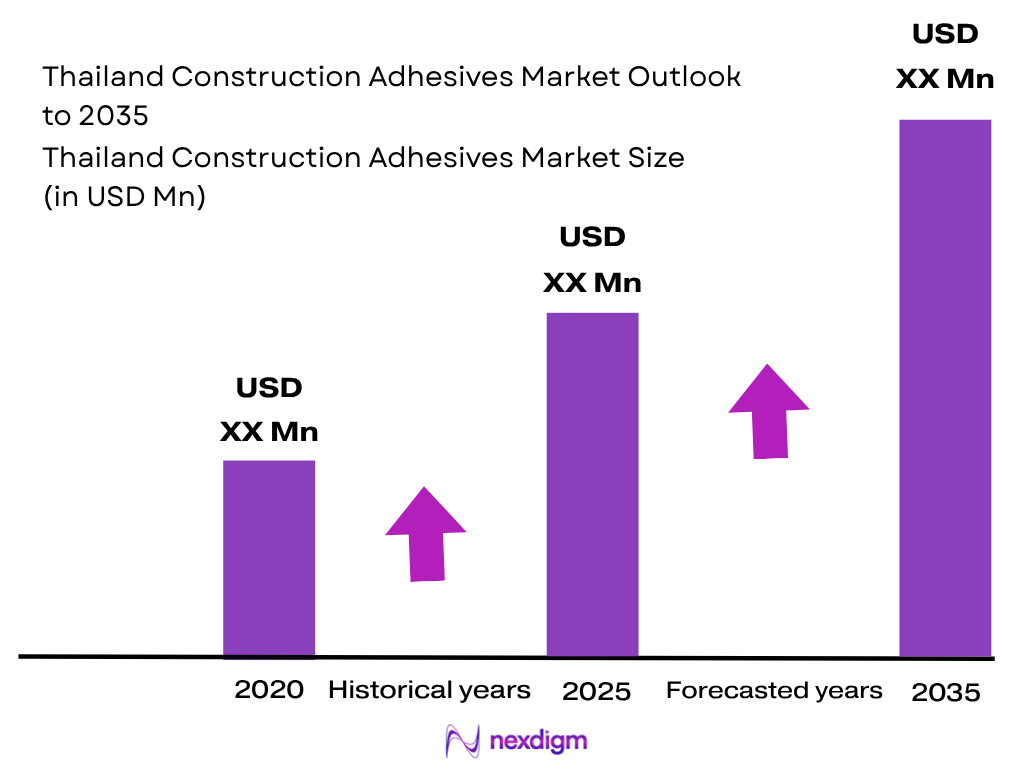
The Thailand Construction Adhesives Market is valued at approximately ~USD XX million, supported by residential construction, commercial fit-outs, industrial facilities and tile installation. Thailand recorded 214,199 and 208,741 building permits across the latest two observations, while permitted building area moved from 62.23 million square metres to 60.85 million square metres. Commercial construction remained comparatively resilient, supporting demand for polymer-modified tile adhesives, flooring adhesives, structural epoxy systems and interior bonding products.
Bangkok, its surrounding provinces and the Eastern/Central construction corridor dominate the Thailand Construction Adhesives Market because they concentrate high-rise buildings, industrial estates, commercial properties and interior fit-out activity. Permitted building area in Bangkok moved from 7.999 million square metres to 4.898 million square metres, while the Bangkok vicinities increased from 13.633 million to 13.746 million square metres and Central Thailand increased from 18.190 million to 19.539 million square metres, sustaining substantial adhesive-consuming construction activity.
Market Segmentation
By Adhesive Chemistry
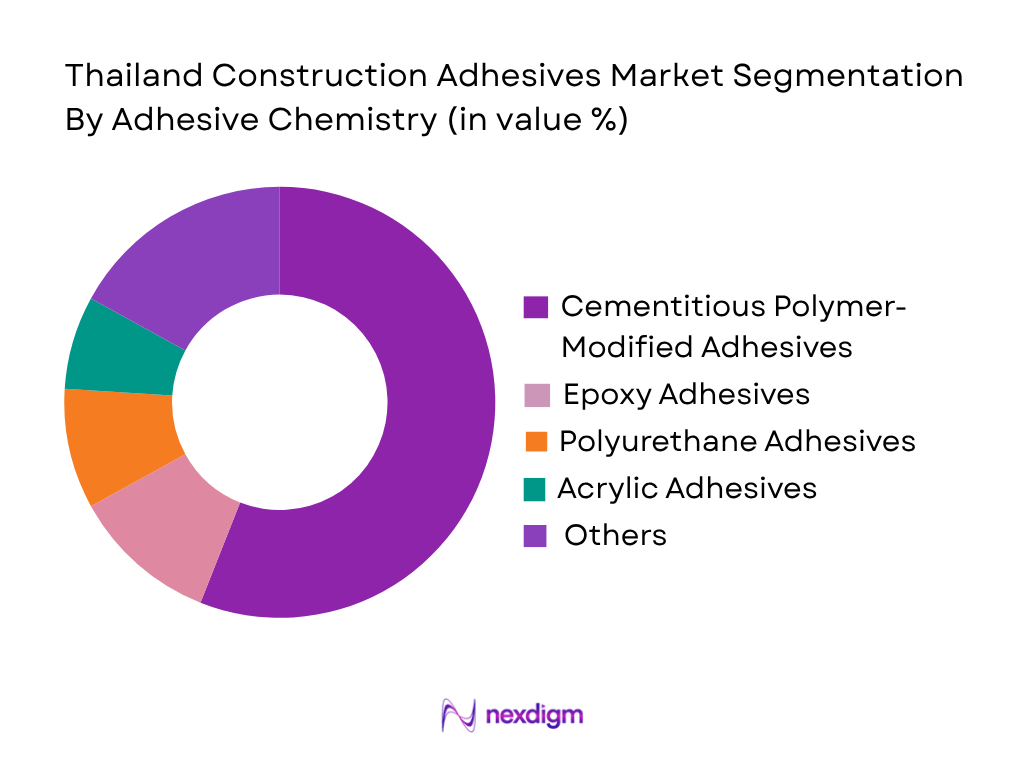
The Thailand Construction Adhesives Market is segmented into cementitious polymer-modified adhesives, epoxy adhesives, polyurethane adhesives, acrylic adhesives, MS polymer and hybrid adhesives, silicone-based systems, synthetic rubber products and specialty formulations. Cementitious polymer-modified adhesives hold the dominant modeled market share because ceramic and porcelain tile installation represents a large-volume construction activity across housing, commercial buildings, hotels and renovation projects. These products combine Portland cement, graded mineral fillers, cellulose ethers and redispersible polymers to deliver improved adhesion, open time and slip resistance compared with traditional cement-sand installation. Thailand also has a mature domestic dry-mix manufacturing base, lowering logistical barriers for bagged tile adhesives. TISI’s revised TIS 2703-2566, effective from May 2024, specifically covers cement adhesives for interior and exterior ceramic floor and wall installations, strengthening formal product-performance requirements. Local suppliers also increasingly offer higher-performance C2, flexible and large-format tile systems as installation practices become more technically demanding.
By Application
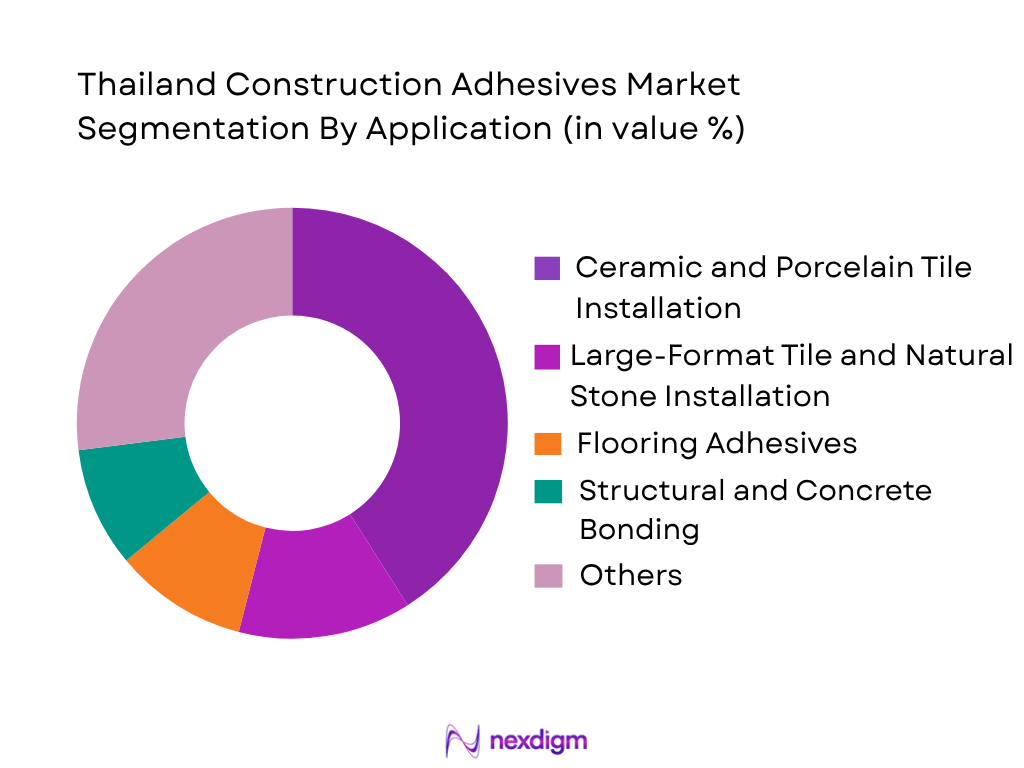
The Thailand Construction Adhesives Market is segmented into ceramic tiling, porcelain and large-format tile installation, natural stone installation, flooring, structural bonding, chemical anchoring, AAC block installation, façade and panel bonding and interior fit-out. Tile and stone installation holds the dominant modeled market share because tiled floors and walls remain widely used across Thai residential, hospitality, retail and commercial buildings. The country had 256,994 newly permitted building constructions in 2024, including 238,025 residential structures, providing a broad installation base for packaged tile adhesives. Higher-value demand is increasingly coming from porcelain, large-format slabs, wet areas and exterior applications where conventional cement-sand bedding delivers insufficient flexibility or bond consistency. Thailand also had 21,090 accommodation establishments and 794,514 rooms, including 6,859 hotels, sustaining renovation and tiling demand in hospitality properties. Large-format tiles and swimming-pool applications additionally favor polymer-modified adhesives with improved open time, deformation resistance and water-immersion performance.
Competitive Landscape
The Thailand Construction Adhesives Market combines established international construction-chemical manufacturers with major domestic dry-mix mortar and tile-installation specialists. Sika/LANKO, Saint-Gobain Weber, Bostik, Jorakay and MAPEI compete across cementitious tile adhesives, structural bonding, flooring and specialty construction applications. Competitive advantage depends on local manufacturing, C2/S1/S2 technology, contractor and applicator training, distribution penetration and the ability to provide complete systems for tile installation rather than single adhesive products.
| Major Player | Establishment Year | Headquarters | Tile Adhesive Portfolio | Flexible / Large-Format Capability | Structural / Reactive Adhesives | Thailand Manufacturing Presence | Distribution Reach | Technical / Installer Support |
| Sika | 1910 | Baar, Switzerland | ~ | ~ | ~ | ~ | ~ | ~ |
| Saint-Gobain Weber Thailand | 1986* | Bangkok, Thailand | ~ | ~ | ~ | ~ | ~ | ~ |
| Jorakay Corporation | 1992 | Bangkok, Thailand | ~ | ~ | ~ | ~ | ~ | ~ |
| Bostik | 1889 | Colombes, France | ~ | ~ | ~ | ~ | ~ | ~ |
| MAPEI | 1937 | Milan, Italy | ~ | ~ | ~ | ~ | ~ | ~ |
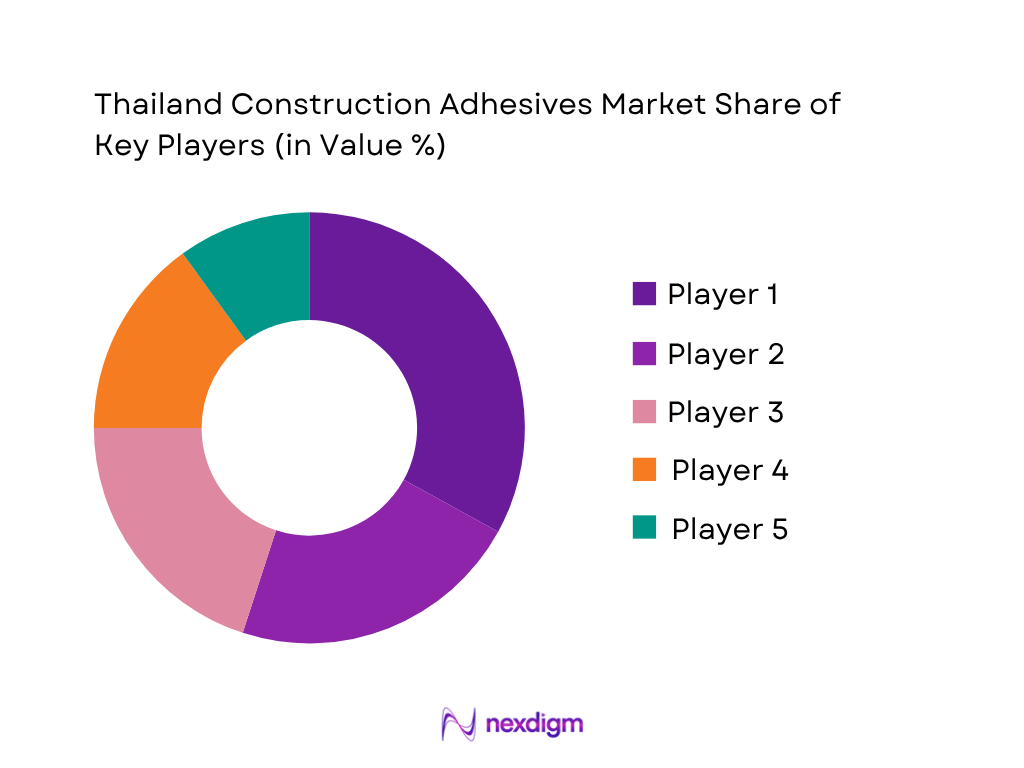
Thailand Construction Adhesives Market Analysis
Growth Drivers
Large Building Construction Base Sustains Tile, Flooring and Interior Adhesive Consumption
Thailand’s continuing building-construction base supports demand for polymer-modified tile adhesives, flooring adhesives, grab adhesives and structural bonding products across residential, commercial and institutional projects. National Statistical Office data show 208,741 permitted building projects covering 60,851,513 square metres in 2024, including 8,913 permits and 4,897,773 square metres in Bangkok, 23,306 permits and 13,746,443 square metres in the surrounding metropolitan provinces, and 55,085 permits covering 19,538,592 square metres in Central Thailand. These volumes create recurring consumption of cementitious tile adhesives for ceramic and porcelain finishes and higher-performance products for wet areas, façades and large-format installations. Construction activity continued into 2025, when quarterly building permits stood at 42,024 in Q1, 40,520 in Q2, and 42,867 in Q3, maintaining a substantial installation pipeline for adhesive suppliers. The macroeconomic base is also large: IMF data record Thailand’s 2024 nominal GDP at THB 18,582.7 billion, equivalent to USD 526.5 billion, with a population of 71.67 million and GDP per capita of USD 7,347. This scale supports sustained residential finishing, retail fit-out and renovation activity requiring packaged construction adhesives.
Industrial, Digital and EEC Investment Expands Higher-Performance Adhesive Applications
Thailand’s industrial and digital investment pipeline is expanding demand beyond conventional tile-setting products toward epoxy bonding, chemical anchoring, flooring adhesives, panel bonding and low-VOC interior systems. The Board of Investment recorded THB 1.14 trillion in investment-promotion applications during 2024, with the digital sector accounting for 150 projects worth THB 243.3 billion and electrical and electronics projects representing THB 231.7 billion. The Eastern Economic Corridor provides a concentrated construction platform, with 32 industrial-estate-type Special Economic Promotion Zones spanning Chonburi, Rayong and Chachoengsao and supporting automotive, electronics, logistics, automation and digital industries. These facilities require durable adhesives for industrial flooring, cleanrooms, raised floors, insulation panels, structural anchors and equipment-area finishes where conventional cement mortars are insufficient. Investment momentum also continued into 2025, when foreign direct investment applications reached THB 267.7 billion in the first quarter, including THB 72.7 billion directed to digital-sector projects from Hong Kong-based applicants alone. Supporting this activity, IMF data place Thailand’s 2024 nominal GDP at THB 18,582.7 billion, or USD 526.5 billion, providing a substantial economic platform for technology-intensive industrial construction and associated specialty adhesive demand.
Market Challenges
Slower Building Permit Activity Creates Uneven Demand for Mainstream Construction Adhesives
The Thailand Construction Adhesives Market faces pressure from uneven building activity, particularly for high-volume cementitious tile adhesives linked to new residential projects. National Statistical Office data show 208,741 building permits and 60,851,513 square metres of permitted building area in 2024. During 2025, quarterly building permits moved from 42,024 in Q1 to 40,520 in Q2, before reaching 42,867 in Q3, while the comparable 2024 quarterly series included 46,405 permits in Q3 and 43,442 in Q4. New-construction permits also decreased from 53,246 in Q1 2024 to 41,466 in Q1 2025. This softer flow can constrain straightforward volume growth for standard tile adhesives and increase dependence on refurbishment, industrial projects, premium tile formats and specialist bonding applications. Manufacturers therefore need product portfolios capable of addressing both new construction and renovation rather than relying solely on housing expansion. The challenge is reinforced by a relatively moderate macroeconomic environment: IMF data place Thailand’s 2024 nominal GDP at THB 18,582.7 billion, equivalent to USD 526.5 billion, while population stood at 71.67 million. The same IMF assessment recorded gross fixed investment of roughly THB 4.5 trillion-equivalent within the national accounts structure, indicating a large but selectively deployed investment base.
Performance Standards and Installation Complexity Raise Product Qualification Requirements
Thailand’s shift toward formally classified construction adhesives creates a technical challenge for suppliers and applicators because product performance must increasingly be demonstrated rather than assumed from conventional cement-sand installation practices. The Thai Industrial Standards Institute introduced TIS 2703-2566 for cement adhesives, effective 5 May 2024, replacing the previous TIS 2703-2559 standard. The regulation covers cement adhesives used for ceramic floor and wall tiles in both interior and exterior applications, increasing the importance of controlled tensile adhesion, open time, slip resistance and formulation consistency. The challenge intensifies as Thailand’s installed building base expands: 208,741 permits covering 60,851,513 square metres were recorded in 2024, creating a wide range of substrates, tile formats and site conditions. Larger porcelain units, swimming pools, exterior façades and industrial floors require more sophisticated polymer-modified systems and tighter application control than traditional bedding mortars. Incorrect water ratios, inadequate coverage and poor substrate preparation can negate even compliant formulations. Thailand’s macroeconomic scale raises the commercial consequences of inconsistent performance: IMF data show 2024 nominal GDP of THB 18,582.7 billion, equivalent to USD 526.5 billion, with 71.67 million residents generating extensive residential, commercial and infrastructure demand requiring reliable installation standards.
Market Opportunities
High-Performance C2, Flexible and Large-Format Tile Adhesives Offer Premium Growth Potential
Thailand’s transition toward standardized and performance-based tile installation creates a future opportunity for C2-grade, flexible, extended-open-time and large-format tile adhesives. TIS 2703-2566 became effective on 5 May 2024, establishing an updated national framework for cement adhesives used on interior and exterior ceramic floors and walls. This creates a stronger basis for manufacturers to differentiate products through verified bond performance rather than compete only with conventional cement-sand bedding. The opportunity is supported by Thailand’s large active building base: 208,741 permitted projects covered 60,851,513 square metres in 2024, with 19,538,592 square metres in Central Thailand, 13,746,443 square metres in Bangkok’s surrounding provinces and 4,897,773 square metres in Bangkok itself. These urban markets contain high-rise residential, hotel, shopping-centre and commercial projects where porcelain tiles and larger formats require better deformability, slip control and full-bed adhesion. Current construction volumes therefore create an installed base from which premium adhesive adoption can expand without relying on speculative future project numbers. IMF data record Thailand’s 2024 GDP at THB 18,582.7 billion, equivalent to USD 526.5 billion, and population at 71.67 million, supporting continued expenditure on residential finishes, renovation and higher-specification building materials.
EEC and Data-Centre Construction Create Future Demand for Structural and Specialty Adhesives
Thailand’s rapidly expanding digital and industrial project base creates a future opportunity for construction adhesives positioned beyond ordinary tile installation, particularly chemical anchors, structural epoxies, flooring adhesives, panel bonding systems and low-VOC hybrid polymers. BOI recorded 150 digital-sector projects worth THB 243.3 billion in 2024, while total investment-promotion applications reached THB 1.14 trillion. The Eastern Economic Corridor currently contains 32 industrial-estate-type Special Economic Promotion Zones, including major estates in Chonburi, Rayong and Chachoengsao serving intelligent electronics, automotive, robotics, logistics and digital industries. Many zones are located within 10–45 kilometres of Laem Chabang or Map Ta Phut infrastructure, encouraging concentrated factory, warehouse and technology-facility construction. Investment remained active in 2025, when first-quarter foreign investment applications totaled THB 267.7 billion, with digital-sector projects accounting for THB 72.7 billion from Hong Kong applicants alone. These current investments create an expanding project base for raised-floor bonding, cleanroom finishes, epoxy flooring, precast connections, structural anchors and insulation-panel adhesives. Thailand’s 2024 nominal GDP of THB 18,582.7 billion, equivalent to USD 526.5 billion according to the IMF, provides the macroeconomic scale supporting continued adoption of higher-value construction adhesive systems in these industrial clusters.
Future Outlook
The Thailand Construction Adhesives Market is forecast to expand at approximately ~X.X% CAGR during 2026–2035. Future growth is expected to shift progressively toward polymer-modified tile adhesives, flexible C2S1/C2S2 systems, large-format slab adhesives, chemical anchors, structural epoxies and low-VOC hybrid adhesives. Industrial investment, data centres, hospitality refurbishment and higher installation-performance standards will support value-added adhesive consumption beyond conventional residential tiling.
Industrial and digital infrastructure will be an important demand engine. Thailand’s Board of Investment received investment-promotion applications totaling THB 1.14 trillion in 2024. Digital-sector applications included 150 projects worth THB 243.3 billion, while electrical and electronics projects numbered 407 with THB 231.7 billion in pledged investment. Data-centre, electronics and advanced industrial facilities use construction adhesives across raised floors, technical rooms, wall panels, anchoring, flooring and interior finishing.
Major Players
- Sika (Thailand) Limited / LANKO
- Saint-Gobain Weber Thailand
- Bostik Thailand / Arkema
- Jorakay Corporation Co., Ltd. / Crocodile
- MAPEI Thailand
- TOA Performance Coating Corporation
- Fosroc Thailand
- Henkel Thailand
- H.B. Fuller Thailand
- Hilti Thailand
- Soudal Thailand
- SCG Building Materials
- TPI Polene Building Products
- Den Braven Thailand / Bostik
- Bosny Thailand
Key Target Audience
- Construction Adhesive and Dry-Mix Mortar Manufacturers
- Tile and Stone Installation Product Manufacturers
- Building Material Distributors and Modern Trade Retailers
- Property Developers and Main Contractors
- Industrial Estate and Data Centre Developers
- Tile, Flooring and Specialist Installation Contractors
- Investments and Venture Capitalist Firms
- Government and Regulatory Bodies (Thai Industrial Standards Institute, Department of Public Works and Town & Country Planning, Industrial Estate Authority of Thailand, Eastern Economic Corridor Office, Thailand Board of Investment)
Research Methodology
Step 1: Identification of Key Variables
The initial phase involves constructing an ecosystem map covering adhesive manufacturers, cement and polymer suppliers, dry-mix mortar producers, distributors, tile retailers, applicators, contractors and property developers. Extensive secondary research identifies critical variables including construction area, tile installation activity, adhesive consumption, chemistry mix, product performance class, distribution channels and local manufacturing capability.
Step 2: Market Analysis and Construction
Historical Thailand Construction Adhesives Market demand is analyzed through top-down and bottom-up methodologies. Top-down analysis evaluates building permits, construction area, industrial investment and refurbishment activity, while bottom-up analysis calculates adhesive consumption using tiled surface area, typical adhesive coverage, flooring installations, anchoring applications, dry-mix production and product penetration across building categories.
Step 3: Hypothesis Validation and Expert Consultation
Market hypotheses are validated through computer-assisted telephone interviews with construction adhesive manufacturers, distributors, tile installers, flooring contractors, dry-mix producers and project procurement teams. These consultations validate conversion from cement-sand setting, C2 and flexible adhesive adoption, large-format tile requirements, pack sizes, application practices, channel dynamics and technical specification trends.
Step 4: Research Synthesis and Final Output
The final phase triangulates National Statistical Office construction data, BOI investment statistics, TISI standards, manufacturer information and primary research. Bottom-up adhesive-consumption calculations are reconciled with top-down building and investment indicators. The resulting analysis establishes the market’s chemistry mix, application structure, regional concentration, competitive positioning and future opportunities in tiling, renovation, industrial development and specialty bonding.

- Executive Summary
- Research Methodology (Market Definitions and Assumptions, Thailand Construction Adhesives Market Classification, Cementitious Adhesive Scope, Polymer-Modified Mortar Assessment, Epoxy Adhesive Assessment, Polyurethane Adhesive Assessment, Acrylic Adhesive Assessment, MS Polymer and Hybrid Adhesive Assessment, Tile Adhesive Assessment, Flooring Adhesive Assessment, Structural Bonding Assessment, Concrete-to-Concrete Bonding Assessment, Chemical Anchoring Assessment, AAC and Lightweight Block Adhesive Assessment, Panel and Insulation Adhesive Assessment, Large-Format Tile Assessment, Natural Stone Adhesive Assessment, Wet-Area Tiling Assessment, Exterior Tiling Assessment, Swimming Pool Adhesive Assessment, TIS 2703 Assessment, ISO 13007 Assessment, EN 12004 Classification Mapping, C1-C2-S1-S2 Performance Assessment, Tensile Adhesion Strength Assessment)

- Definition and Scope
- Thailand Construction Adhesives Industry Evolution and Development of Conventional Cement-Sand Tile Setting, Cementitious Polymer-Modified Tile Adhesives, Redispersible Polymer-Modified Dry Mortars, C1 and C2 Tile Adhesive Systems, Flexible S1 and S2 Tile Adhesives, Large-Format Porcelain Tile Adhesives, Natural Stone Adhesives, Ready-Mixed Paste Adhesives, Epoxy Structural Adhesives, Polyurethane Construction Adhesives, MS Polymer and Hybrid Adhesives, High-Grab Construction Adhesives, Flooring Adhesives, AAC Block Adhesives, Concrete Bonding Agents, Chemical Anchoring Adhesives, Façade and Panel Bonding Systems, Fast-Setting Renovation Adhesives, Low-VOC Construction Adhesives and Performance-Classified Tile Adhesive Systems
- Construction Adhesives Value Chain Analysis
- Construction Adhesives Supply Chain Analysis
- Cement Suppliers, Redispersible Polymer Powder Suppliers, Cellulose Ether Suppliers, Acrylic Polymer Suppliers, Epoxy Resin Suppliers, Polyurethane Raw Material Suppliers, Silane-Terminated Polymer Suppliers, Mineral Filler Suppliers, Specialty Additive Suppliers, Construction Adhesive Manufacturers, Dry-Mix Mortar Producers, Local Formulators, Importers, Distributors, Building Material Dealers, Tile and Sanitaryware Retailers, Modern Trade Home Improvement Stores, Flooring Contractors, Tile Installers, General Contractors, Fit-Out Contractors, Property Developers, Industrial Estate Developers, Testing Laboratories and Government Agencies

- Growth Drivers (Bangkok Metropolitan Construction, Eastern Economic Corridor Development, Industrial Estate Expansion, Data Centre Construction, High-Rise Residential Development, Commercial Fit-Out, Renovation and Repair Activity, Large-Format Porcelain Tile Adoption, Replacement of Conventional Cement-Sand Setting, Modern Retail Expansion, Hotel and Hospitality Development, Factory and Warehouse Construction)
- Market Challenges (Traditional Cement-Sand Installation Practices, Contractor Price Sensitivity, Applicator Skill Variability, Surface Preparation Issues, Incorrect Water Mixing, Insufficient Adhesive Coverage, Tile Debonding, Imported Polymer Raw Material Dependence, Large-Format Tile Installation Complexity, Low-Quality Product Competition, Product Misapplication, Adhesive Specification Enforcement)
- Market Opportunities (C2 High-Performance Tile Adhesives, Flexible C2S1 and C2S2 Adhesives, Large-Format Tile and Slab Installation, Fast-Setting Renovation Adhesives, Tile-on-Tile Systems, Natural Stone Adhesives, Epoxy Structural Bonding, Chemical Anchoring, Data Centre Fit-Out Adhesives, Industrial Flooring Adhesives, AAC Block Adhesives, Low-VOC Construction Adhesives, Local Dry-Mix Manufacturing)
- Market Trends (Polymer-Modified Cementitious Adhesives, High-Performance C2 Adhesives, Flexible S1 and S2 Systems, Large-Format Porcelain Tiles, Extended Open-Time Products, Fast-Setting Formulations, Low-Dust Dry Mortars, Epoxy Bonding Systems, MS Polymer Adhesives, Low-VOC Formulations, Tile-on-Tile Renovation Systems, System-Based Tile Installation, Automated Dry-Mix Production)
- Government Regulations and Standards (TIS 2703 Ceramic Tile Adhesive Requirements, ISO 13007 Tile Adhesive Classification and Testing, EN 12004 Tile Adhesive Performance Classification, Thai Industrial Standards Institute Product Requirements, Department of Public Works and Town & Country Planning Construction Specifications, Industrial Estate Authority of Thailand Requirements, Building Material Labelling Requirements, Chemical Safety and SDS Requirements, Occupational Safety Requirements, Environmental and Construction Material Compliance Requirements)
- SWOT Analysis
- Porter’s Five Forces Analysis
- PESTLE Analysis
- Stakeholder Ecosystem
- Construction Adhesives Manufacturing and Project Ecosystem

- By Market Value (2020-2025)
- By Consumption Volume (2020-2025)
- By Cementitious Adhesive Consumption (2020-2025)
- By Polymer-Modified Tile Adhesive Consumption (2020-2025)
- By Epoxy Adhesive Consumption (2020-2025)
- By Polyurethane and Hybrid Adhesive Consumption (2020-2025)
- By Flooring Adhesive Consumption (2020-2025)
- By Structural Bonding Adhesive Consumption (2020-2025)
- By Chemical Anchoring Adhesive Consumption (2020-2025)
- By Lightweight Block Adhesive Consumption (2020-2025)
- By Residential Construction Adhesive Consumption (2020-2025)
- By Commercial and Industrial Construction Adhesive Consumption (2020-2025)
- By Renovation and Refurbishment Adhesive Consumption (2020-2025)
- By Locally Manufactured Adhesive Consumption (2020-2025)
- By Imported Adhesive Consumption (2020-2025)

- By Adhesive Chemistry (In Value %)
Cementitious Polymer-Modified Adhesives
Epoxy Adhesives
Polyurethane Adhesives
Acrylic Adhesives
MS Polymer and Hybrid Adhesives
Silicone-Based Adhesives
Synthetic Rubber Adhesives
Vinyl and EVA-Based Adhesives
Other Specialty Construction Adhesives - By Product Type (In Value %)
Standard Tile Adhesives
High-Performance C2 Tile Adhesives
Flexible S1 Tile Adhesives
Highly Deformable S2 Tile Adhesives
Large-Format Tile Adhesives
Rapid-Setting Tile Adhesives
Natural Stone Adhesives
Swimming Pool and Wet-Area Adhesives
Ready-Mixed Tile Adhesives
Structural Epoxy Adhesives
Concrete Bonding Adhesives
Chemical Anchoring Adhesives
Grab and Nail-Free Adhesives
Flooring Adhesives
Panel and Insulation Adhesives
AAC and Lightweight Block Adhesives - By Application (In Value %)
Ceramic Tile Installation
Porcelain Tile Installation
Large-Format Tile and Slab Installation
Natural Stone and Marble Installation
Swimming Pool and Wet-Area Tiling
Tile-on-Tile Installation
Vinyl and LVT Flooring
Wood and Laminate Flooring
Concrete-to-Concrete Bonding
Precast Component Bonding
Structural Repair Bonding
Rebar and Anchor Fixing
Façade and Wall Panel Bonding
Interior Fit-Out and Decorative Bonding
Insulation Board Bonding
AAC and Lightweight Block Bonding - By Performance Requirement (In Value %)
High Tensile Adhesion Strength
Extended Open Time
Slip Resistance
High Deformability
Rapid Setting
Water Immersion Resistance
Heat Resistance
Exterior Weather Resistance
Vibration Resistance
High Initial Grab
Gap-Filling Capability
Structural Load Transfer
Low-VOC Performance
Chemical Resistance - By Region (In Value %)
Bangkok Metropolitan Region
Bangkok
Samut Prakan
Pathum Thani
Nonthaburi
Chonburi
Rayong
Chachoengsao
Eastern Economic Corridor
Central Thailand
Northern Thailand
Northeastern Thailand
Southern Thailand

- Market Share of Major Players (By Thailand Revenue, Adhesive Consumption Volume, Cementitious Tile Adhesive Portfolio, High-Performance C2 Adhesive Portfolio, Flexible S1 and S2 Adhesive Portfolio, Large-Format Tile Adhesive Portfolio, Structural Epoxy and Anchoring Portfolio, Flooring Adhesive Portfolio, Industrial and EEC Project Exposure, Local Manufacturing Capacity, Dry-Mix Production Capability, Technical Laboratory Capability, Applicator Training Coverage, Distributor Network, Modern Trade Presence)
- Cross Comparison Parameters (Cementitious and Polymer-Modified Adhesive Portfolio Breadth, C2 S1 S2 and Large-Format Tile Adhesive Capability, Structural Epoxy and Chemical Anchoring Capability, Flooring Panel and Multi-Substrate Adhesive Capability, Thailand Manufacturing and Dry-Mix Formulation Presence, Bangkok EEC and Nationwide Distribution Network Reach, TIS 2703 ISO 13007 and EN 12004 Compliance Capability, Applicator Training Technical Laboratory and Project-Site Support)
- SWOT Analysis of Major Players
- Competitive Positioning Matrix
- Major Companies
Sika (Thailand) Limited / LANKO
Saint-Gobain Weber Thailand
Bostik Thailand / Arkema
Jorakay Corporation Co., Ltd. / Crocodile
MAPEI Thailand
TOA Performance Coating Corporation
Fosroc Thailand
Henkel Thailand
H.B. Fuller Thailand
Hilti Thailand
Soudal Thailand
SCG Building Materials
TPI Polene Building Products
Den Braven Thailand / Bostik
Bosny Thailand

- Tile and Stone Contractor Requirement Assessment
- General Contractor Procurement Assessment
- Flooring Contractor Requirement Assessment
- Structural Repair Contractor Requirement Assessment
- Property Developer Adhesive Specification Assessment
- Industrial Estate Developer Requirement Assessment
- Data Centre Contractor Requirement Assessment
- Fit-Out Contractor Requirement Assessment
- Large-Format Tile Installation Requirement Assessment
- Wet-Area Adhesive Requirement Assessment
- Structural Adhesive and Anchoring Performance Assessment
- Technical Service and Applicator Training Requirement Assessment

- By Market Value (2026-2035)
- By Consumption Volume (2026-2035)
- By Cementitious Adhesive Consumption (2026-2035)
- By Polymer-Modified Tile Adhesive Consumption (2026-2035)
- By Epoxy Adhesive Consumption (2026-2035)
- By Polyurethane and Hybrid Adhesive Consumption (2026-2035)
- By Flooring Adhesive Consumption (2026-2035)
- By Structural Bonding Adhesive Consumption (2026-2035)
- By Chemical Anchoring Adhesive Consumption (2026-2035)
- By Lightweight Block Adhesive Consumption (2026-2035)
- By Residential Construction Adhesive Consumption (2026-2035)
- By Commercial and Industrial Construction Adhesive Consumption (2026-2035)


 Request a Sample
 Ask for Customization
 Get a Quote
 Enquire Now
