

 Download PDF
Market Overview
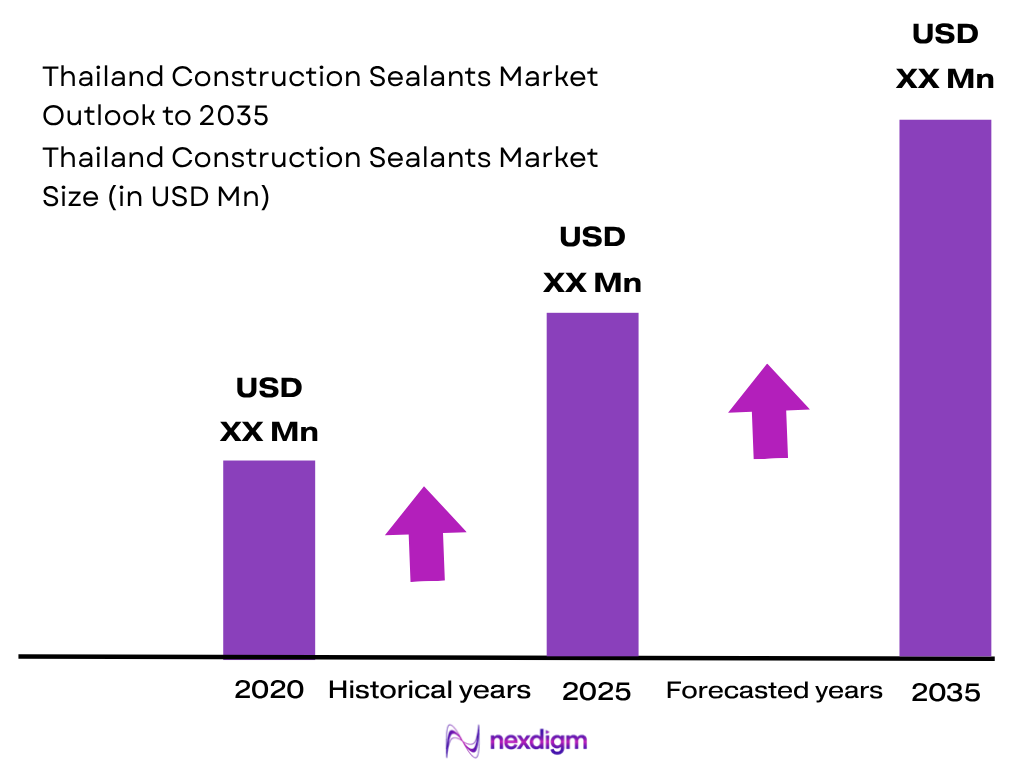
The Thailand Construction Sealants Market is valued at approximately ~USD XX million, supported by residential, industrial, commercial, façade and infrastructure construction. Across the latest two comparable annual observations, permitted new-building area moved from 60.85 million square metres to 52.10 million square metres, while new housing registrations in Bangkok and its vicinity changed from 99,370 units to 97,129 units. These volumes sustain demand for silicone, polyurethane, hybrid-polymer and acrylic sealing systems.
Bangkok, its surrounding provinces and the Eastern Economic Corridor dominate the Thailand Construction Sealants Market because they combine high-rise façades, condominiums, factories, warehouses, data centres and infrastructure. Bangkok’s new-building area increased from 3.65 million square metres to 4.90 million square metres, while surrounding provinces increased from 12.22 million to 13.75 million square metres across the two latest annual observations, supporting dense demand for weatherseal, glazing and movement-joint sealants.
Market Segmentation
By Sealant Chemistry
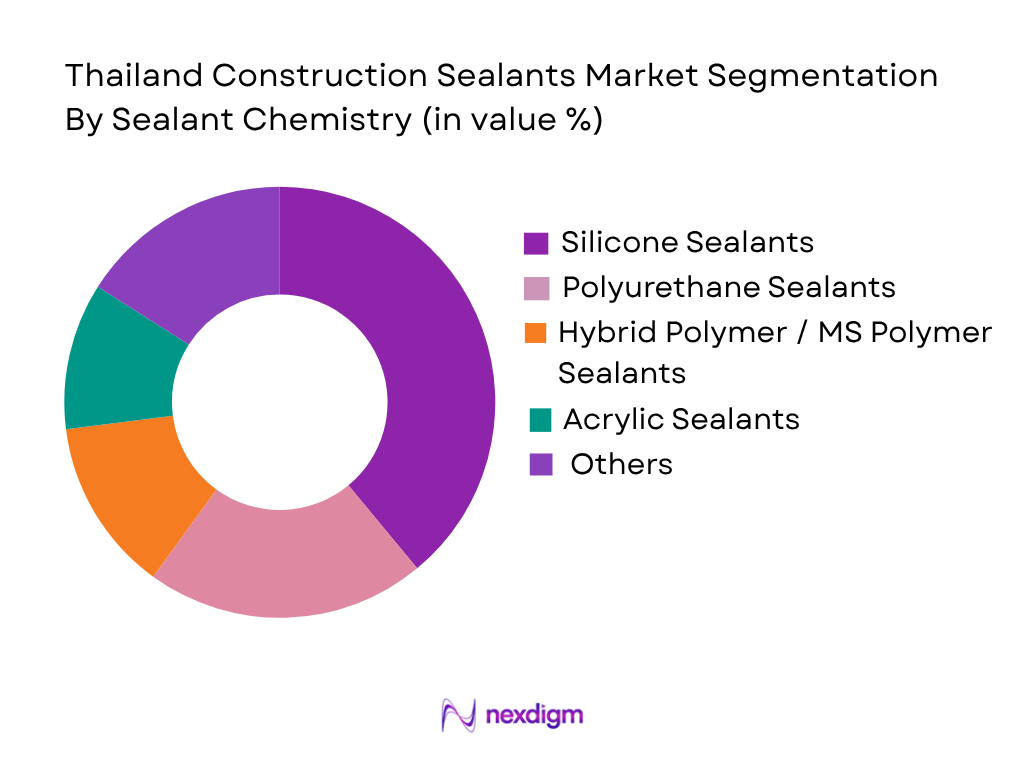
The Thailand Construction Sealants Market is segmented into silicone sealants, polyurethane sealants, hybrid polymer and MS polymer sealants, acrylic sealants, polysulfide sealants, butyl sealants and other specialty products. Silicone sealants hold the dominant market share because Thailand’s high-rise residential, commercial, hospitality and institutional buildings increasingly rely on aluminium-and-glass façades, windows and curtain-wall systems requiring durable weatherproofing. Neutral-cure silicone is particularly suitable for glass, aluminium and coated metal, while structural grades are used in façade glazing and unitized curtain-wall fabrication. Thailand’s tropical environment also reinforces demand for products capable of resisting prolonged humidity, rainfall, UV radiation and thermal movement. Silicone systems further serve sanitary areas, windows, natural-stone joints and fire-rated applications. Supplier portfolios in Thailand include ASTM C920 Class 50 façade weatherseal products and structural glazing systems, demonstrating the importance of silicone technology in specification-driven building-envelope applications.
By Application
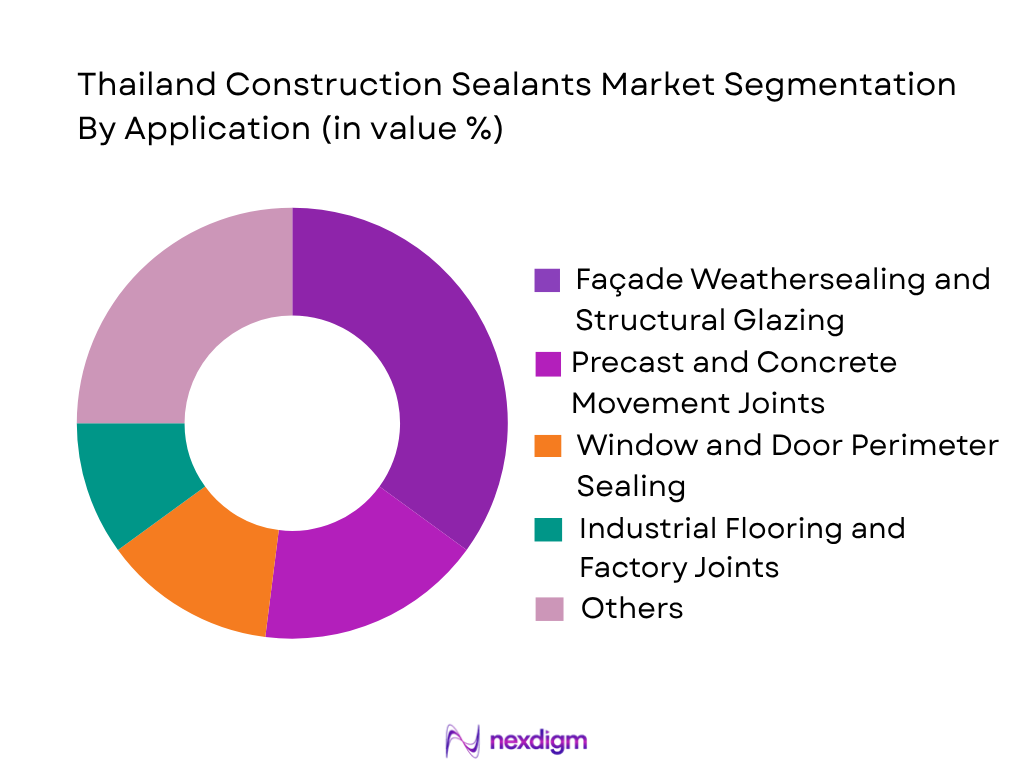
The Thailand Construction Sealants Market is segmented into façade and glazing, precast and concrete joints, window and door sealing, industrial flooring, firestopping, roofing, sanitary applications and infrastructure joints. Façade and glazing applications hold the dominant market share because Bangkok and surrounding urban areas contain a large base of condominiums, hotels, offices, hospitals and mixed-use buildings with aluminium-and-glass envelopes. Structural silicones provide glass-to-frame bonding, while low-modulus weatherseal products absorb movement between façade units and limit water penetration during heavy rainfall. Bangkok’s latest permitted building area reached approximately 4.90 million square metres, while the surrounding provinces recorded about 13.75 million square metres, creating a significant base for windows, façade joints and perimeter seals. Industrial growth in Chonburi, Rayong and Chachoengsao expands PU and hybrid-joint applications, but building-envelope sealing remains the broadest cross-sector application.
Competitive Landscape
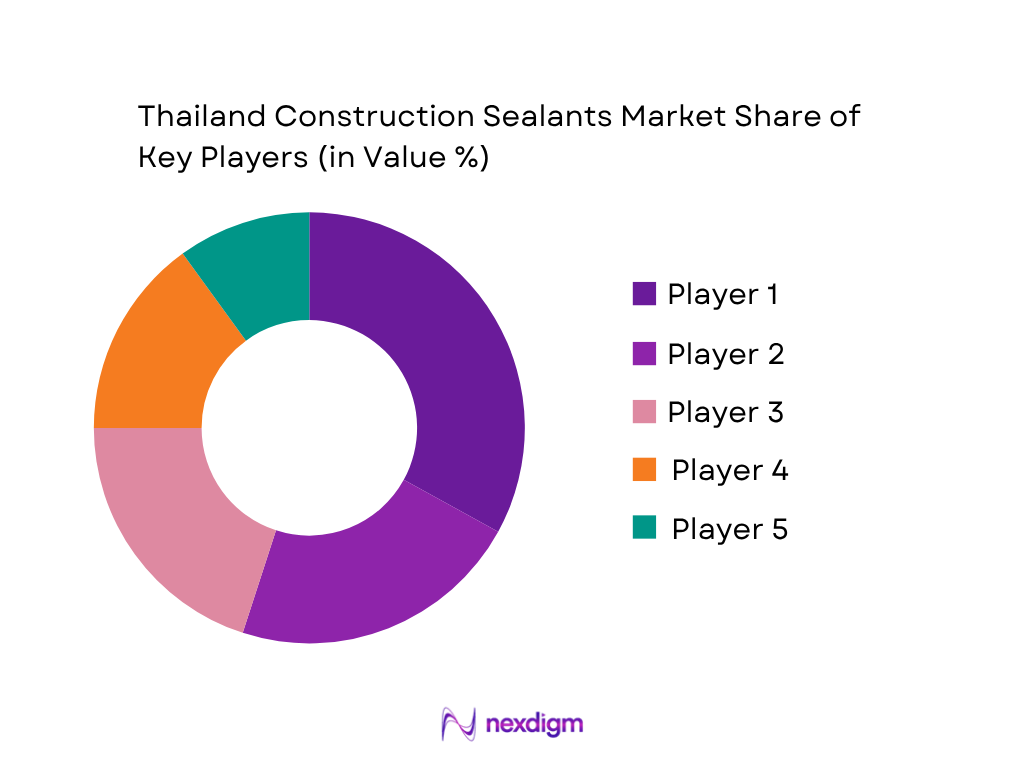
The Thailand Construction Sealants Market features multinational construction-chemical manufacturers, specialty silicone suppliers and regional building-material companies. Sika, Bostik, Dow, Tremco CPG and Henkel compete across façade weathersealing, structural glazing, PU movement joints, hybrid polymers, firestop systems and industrial sealing. Competition is increasingly determined by ASTM C920 performance, movement class, tropical-weather durability, structural glazing capability, compatibility testing, fire-rating documentation and local distributor and technical-support reach.
| Company | Establishment Year | Headquarters | Structural Glazing Capability | Weatherseal / Joint Capability | Firestop Capability | Industrial / Precast Capability | Technical Support | Thailand Presence |
| Sika | 1910 | Baar, Switzerland | ~ | ~ | ~ | ~ | ~ | ~ |
| Bostik | 1889 | Colombes, France | ~ | ~ | ~ | ~ | ~ | ~ |
| Dow | 1897 | Midland, USA | ~ | ~ | ~ | ~ | ~ | ~ |
| Tremco CPG | 1928 | Beachwood, USA | ~ | ~ | ~ | ~ | ~ | ~ |
| Henkel | 1876 | Düsseldorf, Germany | ~ | ~ | ~ | ~ | ~ | ~ |
Thailand Construction Sealants Market Analysis
Growth Drivers
Bangkok Metropolitan Construction and Building-Envelope Activity
Thailand’s concentrated urban construction base is a major driver for structural glazing silicones, façade weatherseal products, window-perimeter sealants, precast-joint sealants and sanitary systems. The country recorded 60.85 million square metres of permitted new-building area in 2024, including 4.90 million square metres in Bangkok and 13.75 million square metres across surrounding metropolitan provinces. Bangkok also issued 8,913 new-construction permits, while the surrounding provinces recorded 23,306 permits, creating a large recurring base of façade interfaces, window joints, movement joints and wet-area sealing applications. Residential building area accounted for the majority of approved floor space, while commercial, office, hotel and factory projects added higher-specification façade and joint demand. This concentration is particularly important for silicone and hybrid sealants because multi-storey buildings require weather resistance, adhesion to aluminium and glass, and long-term joint movement capability. Thailand’s macroeconomic base further supports these applications: World Bank data show USD526.52 billion in GDP and USD7,346.6 GDP per capita in 2024. These construction volumes directly support continuing consumption of high-movement façade, glazing and perimeter-sealing systems.
Eastern Economic Corridor, Data Centres and Industrial Construction
Industrial and digital investment is broadening the Thailand Construction Sealants Market beyond conventional residential caulking toward firestop systems, industrial-floor joints, precast panel sealing, equipment-room interfaces and high-performance building envelopes. Investment applications reached THB1.14 trillion across 3,137 projects in 2024, with digital-sector applications totaling THB243.3 billion across 150 projects. The momentum accelerated in 2025, when total investment applications reached THB1.876653 trillion across 3,370 projects, including THB746.198 billion across 151 digital projects. Data-centre development became particularly relevant to sealant demand: 36 projects valued above THB728 billion were recorded during 2025 across Bangkok, Chachoengsao, Chonburi, Pathum Thani, Rayong and Samut Prakan. In the first half of 2026, investment applications reached THB1.473718 trillion across 1,299 projects, including THB1.11526 trillion across 90 digital projects. These facilities require tested firestop joints, MEP penetration sealing, industrial-floor sealants and weatherproofing systems. Thailand’s 2024 GDP of USD526.52 billion and GDP per capita of USD7,346.6 provide the macroeconomic foundation supporting this shift toward technically demanding construction applications.
Market Challenges
Imported Specialty Polymer and Additive Dependence
The Thailand Construction Sealants Market remains exposed to imported polymers, prepolymers, silanes, catalysts, plasticizers and specialty additives used in silicone, polyurethane, hybrid and fire-rated formulations. Thailand imported goods worth THB10.89648 trillion in 2024, including THB4.533993 trillion of raw materials and intermediate products and THB2.751095 trillion of capital goods. This scale of intermediate-goods dependence matters for local sealant formulation because high-performance structural silicones, PU joint sealants, MS polymers and intumescent systems require consistent chemical inputs and approved formulations. Supply disruptions or changes in qualified raw materials can complicate local filling, batch consistency and inventory planning, particularly for projects requiring ASTM C920, structural-glazing or firestop compliance. At the same time, Thailand’s permitted building area remained substantial at 60.85 million square metres, meaning construction demand can absorb significant volumes of finished and locally formulated sealants. The challenge is therefore not simply import dependence, but maintaining continuity of identical approved formulations across thousands of active building and industrial projects. World Bank data record Thailand’s 2024 GDP at USD526.52 billion and GDP per capita at USD7,346.6, highlighting the scale of the economy within which supply-chain reliability directly affects specification-driven construction execution.
Tropical Exposure, Joint Preparation and Application Consistency
Thailand’s humid tropical climate creates a technical challenge because construction sealants must retain adhesion and elasticity under repeated rainfall, elevated moisture, UV exposure and substrate movement. The country had 256,994 new building-construction units associated with 188,461 permits in 2024, while total permitted new-building area reached 60.85 million square metres. Bangkok alone accounted for 4.90 million square metres, and surrounding provinces added 13.75 million square metres, concentrating sealant installation in dense urban environments where curtain walls, precast façades, windows, podiums and roofs contain large numbers of movement joints. Civil construction also generated 4,979 new projects measured by area and 20,067 projects measured by length, expanding joint-sealant requirements into roads, drainage, bridges and other infrastructure. Sealant failures can occur where substrates are wet, dusty or poorly primed, or where backer rods and joint depths are incorrectly installed. These risks increase the importance of movement-class selection and site technical support. Thailand’s USD526.52 billion GDP and USD7,346.6 GDP per capita in 2024 underscore the economic scale of assets exposed to premature water ingress or joint failure.
Market Opportunities
High-Movement Hybrid, MS Polymer and Façade Weatherseal Systems
Thailand’s expanding metropolitan, commercial and industrial building base creates a strong future opportunity for high-movement silicone, hybrid and MS polymer sealants that combine elasticity, adhesion and weather resistance. Current construction activity provides a large installed base: 60.85 million square metres of new-building area received approval in 2024, including 4.90 million square metres in Bangkok, 13.75 million square metres in surrounding metropolitan provinces and 19.54 million square metres in the Central Region. Commercial-building construction area also increased within the latest annual dataset, while Bangkok and its surroundings remain Thailand’s most intensive façade, window and precast-joint markets. Hybrid and MS polymer technologies are positioned to benefit where contractors require paintability, low odour, broad substrate adhesion and elastic movement across concrete, aluminium, steel and masonry interfaces. The opportunity also extends into building refurbishment because sealant replacement is a recurring lifecycle requirement for façade and perimeter joints exposed to tropical weathering. Thailand’s 2024 macroeconomic base of USD526.52 billion in GDP and USD7,346.6 GDP per capita supports continued investment in higher-performance building-envelope systems. These current construction indicators provide a foundation for future migration from basic acrylic and PU products toward higher-value weatherproofing systems.
Firestop, Data-Centre and Industrial Joint Sealing Systems
Thailand’s digital and industrial investment pipeline creates substantial future growth potential for fire-rated acrylics, fire-rated silicones, industrial-floor sealants, precast-joint products and MEP penetration systems. In 2025, Thailand received 36 data-centre projects valued above THB728 billion across six provinces, including Bangkok, Chachoengsao, Chonburi, Pathum Thani, Rayong and Samut Prakan. One approved Rayong data centre alone involved THB23.7 billion of investment and approximately 203 MW of IT load, while another group of approved facilities represented a combined 120 MW of IT load. The investment pipeline strengthened further in H1 2026, when Thailand recorded THB1.473718 trillion across 1,299 investment applications, including THB1.11526 trillion across 90 digital projects, THB120.23 billion across 179 electronics projects and THB39.461 billion across 221 energy and infrastructure projects. These projects require tested firestop penetration systems, movement joints, equipment-room sealing and chemical-resistant floor joints. Thailand’s 2024 GDP of USD526.52 billion and GDP per capita of USD7,346.6 support continued development of these specification-intensive assets, creating future opportunities for certified rather than commodity sealant systems.
Future Outlook
The Thailand Construction Sealants Market is projected to expand at approximately ~XX.X% CAGR during 2026–2035, supported by data-centre development, industrial estates, Bangkok transit infrastructure, EEC manufacturing investment, façade-intensive commercial construction and refurbishment. Demand is expected to move progressively toward high-movement silicones, hybrid/MS polymers, certified firestop systems, industrial PU sealants and products engineered for humid tropical conditions.
Investment activity provides a strong future construction base. BOI investment applications reached THB1.14 trillion across 3,137 projects in 2024, compared with THB846.5 billion across 2,235 projects in the preceding annual cycle. Digital-sector projects alone accounted for THB243.3 billion across 150 applications, while electrical and electronics attracted THB231.7 billion across 407 projects.
Major Players
- Sika (Thailand) Limited
- Bostik (Thailand) Co., Ltd.
- Dow Thailand Group
- Tremco CPG Asia Pacific
- Henkel Thailand
- 3M Thailand
- Hilti Thailand
- Fosroc Thailand
- Mapei Thailand
- Soudal
- Wacker Chemicals South Asia
- Momentive Performance Materials
- Saint-Gobain Weber Thailand
- TOA Paint (Thailand) Public Company Limited
- Cormix International Limited
Key Target Audience
- Construction Sealant Manufacturers
- Façade and Glazing Contractors
- General, Precast and Industrial Contractors
- Property and Industrial Estate Developers
- Building Material and Construction Chemical Distributors
- Data Centre and Infrastructure Developers
- Investments and Venture Capitalist Firms
- Government and Regulatory Bodies (Department of Public Works and Town & Country Planning, Thai Industrial Standards Institute, Board of Investment of Thailand, Eastern Economic Corridor Office, Bangkok Metropolitan Administration)
Research Methodology
Step 1: Identification of Key Variables
The initial phase involves creating an ecosystem map of polymer suppliers, sealant manufacturers, importers, distributors, façade contractors, precast manufacturers, industrial contractors and developers within the Thailand Construction Sealants Market. Key variables include chemistry, joint length, application, movement class, façade area, firestop intensity, industrial exposure, local manufacturing and imported-product dependence.
Step 2: Market Analysis and Construction
Historical market development is evaluated through top-down and bottom-up approaches. The top-down framework assesses permitted construction area, Bangkok development, industrial investment, infrastructure and data-centre activity. The bottom-up model evaluates joint dimensions, sealant consumption per linear metre, façade configuration, precast-panel density, flooring-joint requirements and chemistry-specific usage.
Step 3: Hypothesis Validation and Expert Consultation
Market hypotheses are validated through CATI-based and structured consultations with sealant manufacturers, façade contractors, glazing specialists, firestop contractors, industrial installers, distributors and specifiers. These discussions evaluate silicone versus PU usage, movement requirements, tropical-weather performance, fire-rating needs, substrate compatibility, contractor practices and technical-service expectations.
Step 4: Research Synthesis and Final Output
The final phase triangulates primary industry feedback with official construction statistics, BOI investment activity, supplier product portfolios and relevant performance standards. Top-down construction indicators are reconciled with bottom-up sealant-use models to develop segmentation, competitive positioning, application forecasts and the final Thailand Construction Sealants Market outlook.

- Executive Summary
- Research Methodology (Market Definitions and Assumptions, Thailand Construction Sealants Market Classification, Silicone Sealant Scope, Polyurethane Sealant Assessment, Hybrid Polymer Sealant Assessment, Acrylic Sealant Assessment, Butyl Sealant Assessment, Polysulfide Sealant Assessment, Structural Glazing Sealant Assessment, Weatherseal Sealant Assessment, Window and Door Sealant Assessment, Concrete Joint Sealant Assessment, Traffic-Grade Sealant Assessment, Fire-Rated Sealant Assessment, Acoustic Sealant Assessment, Roofing Sealant Assessment, Building Envelope Assessment, ASTM C920 Assessment, ASTM C719 Movement Capability Assessment, ASTM C1184 Structural Silicone Assessment, ASTM C1248 Staining Assessment, ISO 11600 Assessment, EN 15651 Assessment, Joint Movement Assessment, Substrate Compatibility Assessment, Tropical Humidity Exposure Assessment, UV Resistance Assessment, Firestop Certification Assessment, Industrial Joint Assessment, Precast Joint Assessment)

- Definition and Scope
- Thailand Construction Sealants Industry Evolution and Development of Acrylic Caulks, Butyl Sealants, Polysulfide Joint Sealants, One-Component Polyurethane Sealants, Two-Component Polyurethane Sealants, Acetoxy Silicone Sealants, Neutral-Cure Silicone Sealants, Structural Silicone Glazing Systems, Low-Modulus Weatherseal Silicones, Hybrid Polymer Sealants, Silyl-Modified Polymer Sealants, Firestop Sealants, Acoustic Sealants, Traffic-Grade Joint Sealants, Precast Panel Sealants, Industrial Flooring Joint Sealants, Window and Door Sealants, Roofing Sealants, Sanitary Sealants, Façade Perimeter Sealants, Low-VOC Sealants and High-Movement ASTM C920 Sealant Systems
- Construction Sealants Value Chain Analysis
- Construction Sealants Supply Chain Analysis
- Silicone Polymer Suppliers, Polyurethane Prepolymer Suppliers, Acrylic Polymer Suppliers, Polysulfide Polymer Suppliers, Silane-Modified Polymer Suppliers, Plasticizer Suppliers, Mineral Filler Suppliers, Catalyst Suppliers, Pigment Suppliers, Fire-Retardant Additive Suppliers, Packaging Suppliers, Construction Sealant Manufacturers, Local Formulators, Local Cartridge and Sausage Filling Facilities, Importers, Building Product Distributors, Façade Contractors, Glazing Contractors, Firestop Contractors, Precast Contractors, Industrial Flooring Contractors, Waterproofing Contractors, Infrastructure Contractors

- Growth Drivers (Bangkok High-Rise Construction, Eastern Economic Corridor Development, Industrial Estate Expansion, Data Centre Construction, Hotel and Resort Development, Airport Expansion, Metro and Rail Infrastructure, Curtain Wall and Glass Façade Penetration, Precast Construction, Industrial Flooring Demand, Building Envelope Modernization, Façade Refurbishment, Fire and Life Safety Compliance, Weatherproofing Demand)
- Market Challenges (Silicone and Polyurethane Feedstock Dependency, High Humidity, Intense UV Exposure, Monsoon Rainfall, Façade Joint Movement, Sealant-Substrate Compatibility Failures, Natural Stone Staining Risk, Adhesion Failure, Incorrect Joint Geometry, Backer Rod Installation Errors, Skilled Applicator Availability, Firestop System Certification Requirements, Specification Complexity, Tropical Storage Requirements)
- Market Opportunities (Structural Glazing Silicones, High-Movement Weatherproofing Sealants, Fire-Rated and Intumescent Sealants, Low-VOC Sealants, Hybrid Polymer Sealants, MS Polymer Sealants, Non-Staining Natural Stone Sealants, Airport and Bridge Joint Sealants, Data Centre Firestop Sealants, Precast Panel Sealants, Industrial Flooring Joint Sealants, Façade Restoration, Local Sealant Formulation and Filling)
- Market Trends (Neutral-Cure Silicone Adoption, Two-Part Structural Glazing Systems, High-Movement Class 50 Sealants, Low-Modulus Weatherseal Silicone, Hybrid SMP Technology, Faster Skin Formation, Tropical Weather Resistance, Primerless Substrate Bonding, Non-Staining Façade Sealants, Low-VOC Formulations, Firestop System Integration, Sausage Packaging, Contractor Training, Compatibility Testing)
- Government Regulations and Standards (Thailand Building Control Act Requirements, Department of Public Works and Town & Country Planning Requirements, Thai Fire Safety Requirements, Thai Industrial Standards Applicable to Building Materials, ASTM C920 Elastomeric Joint Sealants, ASTM C719 Cyclic Movement Testing, ASTM C1184 Structural Silicone Sealants, ASTM C1248 Staining of Porous Substrates, ISO 11600 Building Sealant Classification, EN 15651 Sealant Requirements, Firestop Testing and Approval Requirements, Chemical Safety and SDS Requirements, Green Building Low-Emission Material Requirements)
- SWOT Analysis
- Porter’s Five Forces Analysis
- PESTLE Analysis
- Stakeholder Ecosystem
- Construction Sealants Manufacturing and Project Ecosystem

- By Market Value (2020-2025)
- By Sealant Consumption Volume (2020-2025)
- By Silicone Sealant Consumption (2020-2025)
- By Polyurethane Sealant Consumption (2020-2025)
- By Hybrid Polymer Sealant Consumption (2020-2025)
- By Acrylic Sealant Consumption (2020-2025)
- By Building Envelope Sealant Consumption (2020-2025)
- By Window and Door Sealant Consumption (2020-2025)
- By Glazing and Façade Sealant Consumption (2020-2025)
- By Concrete and Precast Joint Sealant Consumption (2020-2025)
- By Industrial and Infrastructure Sealant Consumption (2020-2025)
- By Fire-Rated and Acoustic Sealant Consumption (2020-2025)
- By Residential Construction Sealant Consumption (2020-2025)

- By Sealant Chemistry (In Value %)
Silicone Sealants
Polyurethane Sealants
Hybrid Polymer and Silyl-Modified Polymer Sealants
Acrylic Sealants
Siliconized Acrylic Sealants
Butyl Sealants
Polysulfide Sealants
Polyether Sealants
Other Specialty Construction Sealants - By Product Type (In Value %)
One-Component Sealants
Two-Component Sealants
Non-Sag Gun-Grade Sealants
Self-Leveling Sealants
Pourable Joint Sealants
Structural Glazing Sealants
Weatherseal Sealants
Traffic-Grade Sealants
Fire-Rated Sealants
Acoustic Sealants
Window and Door Sealants
Roofing Sealants
Sanitary Sealants
Precast Joint Sealants
Sealant Tapes and Butyl Tapes - By Application (In Value %)
Building Expansion and Movement Joints
Window and Door Perimeter Sealing
Curtain Wall Weathersealing
Structural Silicone Glazing
Insulating Glass Secondary Sealing
Precast Concrete Panel Joints
Façade Perimeter Joints
Industrial Flooring Joints
Roofing and Flashing Sealing
Concrete Floor and Podium Joints
Parking Structure Joints
Airport Runway and Taxiway Joints
Bridge and Highway Joints
Firestopping
Acoustic Sealing
Interior Wet-Area and Sanitary Sealing - By Performance Requirement (In Value %)
High-Movement ±50 Sealants
Medium-Movement ±25 Sealants
Low-Movement Sealants
Low-Modulus Sealants
High-Modulus Sealants
Structural Glazing Performance
Non-Staining Performance
Traffic-Grade Performance
Water Immersion Resistance
Tropical Humidity Resistance
UV and Weathering Resistance
Fire Resistance
Acoustic Performance
Low-VOC Performance
Primerless Adhesion - By Region (In Value %)
Bangkok Metropolitan Region
Bangkok
Samut Prakan
Pathum Thani
Nonthaburi
Chonburi
Rayong
Chachoengsao
Eastern Economic Corridor
Central Thailand
Northern Thailand
Northeastern Thailand
Southern Thailand

- Market Share of Major Players (By Thailand Revenue, Sealant Consumption Volume, Silicone Sealant Portfolio, Polyurethane Sealant Portfolio, Hybrid Polymer Portfolio, Façade and Glazing Exposure, Structural Glazing Exposure, Firestop Sealant Exposure, Precast and Concrete Joint Exposure, Industrial Project Exposure, Infrastructure Project Exposure, Thailand Manufacturing or Filling Capacity, Technical Laboratory Capability, Distributor Network, Specification Support)
- Cross Comparison Parameters (Structural Glazing and Weatherproofing Silicone Portfolio Breadth, ASTM C920 ISO 11600 and EN 15651 Performance Capability, Polyurethane Hybrid and MS Polymer Joint Sealant Capability, Firestop and Intumescent Sealant Certification Capability, Thailand Façade Precast Industrial and Infrastructure Project Reference Base, High-UV High-Humidity and Movement-Joint Performance Capability, Thailand Manufacturing Filling Warehousing and Nationwide Distribution Network Reach, Compatibility Testing Technical Training and Project-Site Support Capability)
- SWOT Analysis of Major Players
- Competitive Positioning Matrix
- Major Companies
Sika (Thailand) Limited
Bostik (Thailand) Co., Ltd.
Dow Thailand Group
Tremco CPG Asia Pacific
Henkel Thailand
3M Thailand
Hilti Thailand
Fosroc Thailand
Mapei Thailand
Soudal
Wacker Chemicals South Asia
Momentive Performance Materials
Saint-Gobain Weber Thailand
TOA Paint (Thailand) Public Company Limited
Cormix International Limited

- Glazing Contractor Requirement Assessment
- Façade Contractor Requirement Assessment
- Building Envelope Contractor Requirement Assessment
- Waterproofing Contractor Requirement Assessment
- General Contractor Procurement Assessment
- Concrete and Infrastructure Contractor Requirement Assessment
- Firestop Contractor Requirement Assessment
- Precast Contractor Requirement Assessment
- Industrial Contractor Requirement Assessment
- Architect and Façade Consultant Specification Assessment
- Property Developer Requirement Assessment
- Facility Manager Sealant Replacement Requirement Assessment
- Technical Compatibility Testing and Field Support Requirement Assessment

- By Market Value (2026-2035)
- By Sealant Consumption Volume (2026-2035)
- By Silicone Sealant Consumption (2026-2035)
- By Polyurethane Sealant Consumption (2026-2035)
- By Hybrid Polymer Sealant Consumption (2026-2035)
- By Acrylic Sealant Consumption (2026-2035)
- By Building Envelope Sealant Consumption (2026-2035)
- By Window and Door Sealant Consumption (2026-2035)
- By Glazing and Façade Sealant Consumption (2026-2035)
- By Concrete and Precast Joint Sealant Consumption (2026-2035)
- By Industrial and Infrastructure Sealant Consumption (2026-2035)
- By Fire-Rated and Acoustic Sealant Consumption (2026-2035)
- By Residential Construction Sealant Consumption (2026-2035)


 Request a Sample
 Ask for Customization
 Get a Quote
 Enquire Now
