
 Download PDF
Market Overview
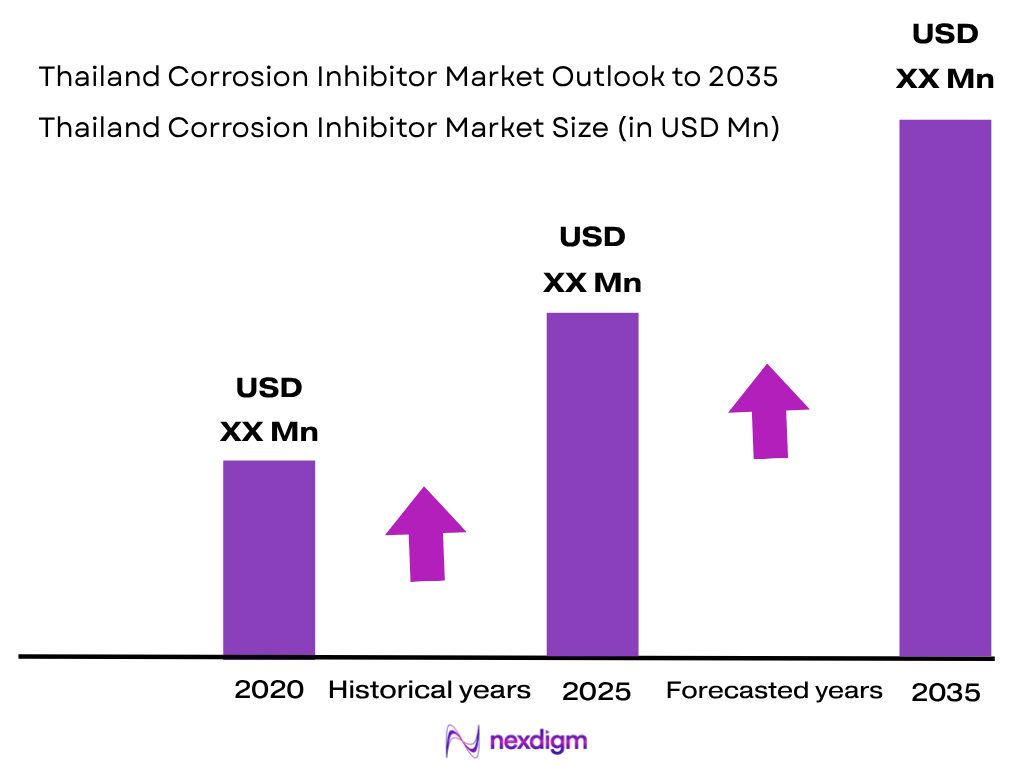
The Thailand Corrosion Inhibitor Market is valued at approximately USD ~X.X million, based on historical top-down and bottom-up assessment. Demand is supported by petroleum refining, petrochemicals, power generation, industrial cooling and boiler systems. Thailand’s national electricity system supplied 220,590.44 GWh in the latest full period compared with 208,106.28 GWh previously, while contracted generating capacity reached 51,414.30 MW, creating a substantial equipment base requiring cooling-water, boiler and condensate corrosion protection.
Rayong, Chonburi and the Bangkok metropolitan industrial corridor dominate the Thailand Corrosion Inhibitor Market because they concentrate refineries, petrochemical complexes, industrial estates, automotive plants, electronics manufacturers, ports and utility infrastructure. Map Ta Phut Industrial Estate alone provides 15,300 cubic metres/day of water capacity, 11,200 cubic metres/day of combined wastewater-treatment capacity and 1,545 MW of electrical infrastructure. Investment applications nationally also rose from 2,235 projects to 3,137 projects, reinforcing industrial chemical-treatment demand.
Market Segmentation
By Product Chemistry
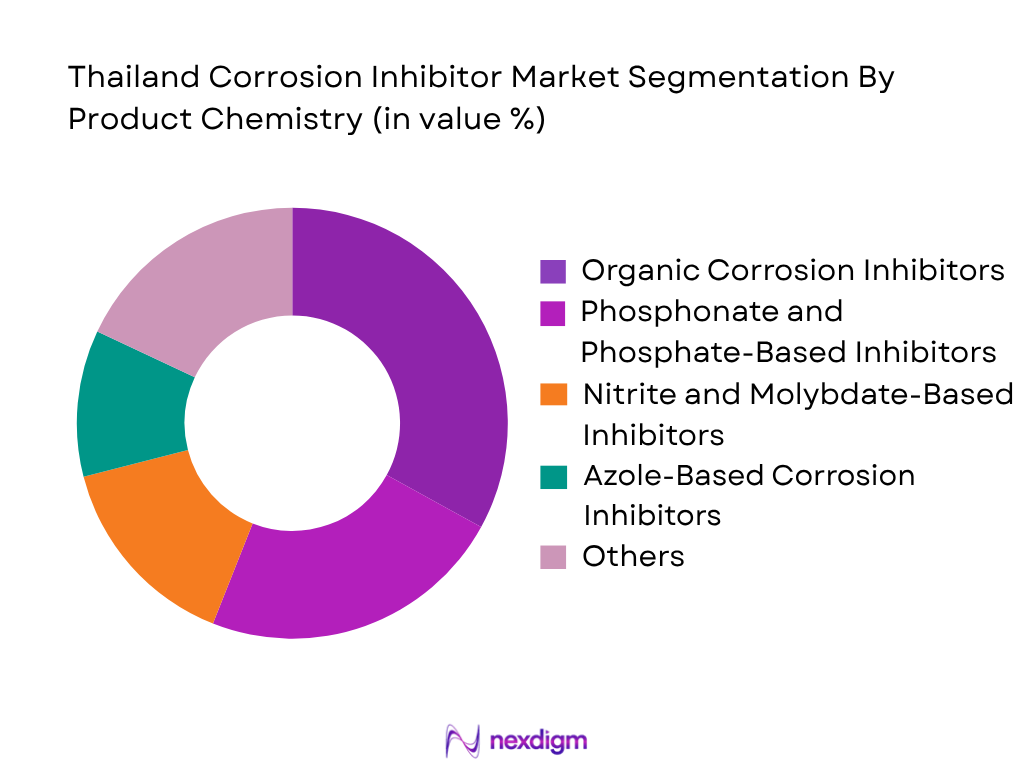
The Thailand Corrosion Inhibitor Market is segmented into organic corrosion inhibitors, phosphonate and phosphate inhibitors, nitrite and molybdate inhibitors, azole-based inhibitors, silicate and zinc-based inhibitors, and multifunctional specialty formulations. Organic corrosion inhibitors dominate the product-chemistry segmentation because Thailand has a large refinery, petrochemical, power-generation and industrial-processing base requiring film-forming and adsorption-based protection across carbon-steel equipment, steam-condensate systems and process-water circuits. Organic amines and film-forming products are particularly suited to boilers and condensate networks, while blended organic chemistries provide corrosion, scale and deposit control in cooling systems. Map Ta Phut’s extensive utility infrastructure and Rayong’s process-industry concentration reinforce the requirement for performance-oriented formulations rather than basic commodity inhibitors. Thailand’s electricity system also handled 220,590.44 GWh of net energy in 2024, illustrating the scale of thermal and utility equipment requiring controlled water chemistry.
By End-Use Industry
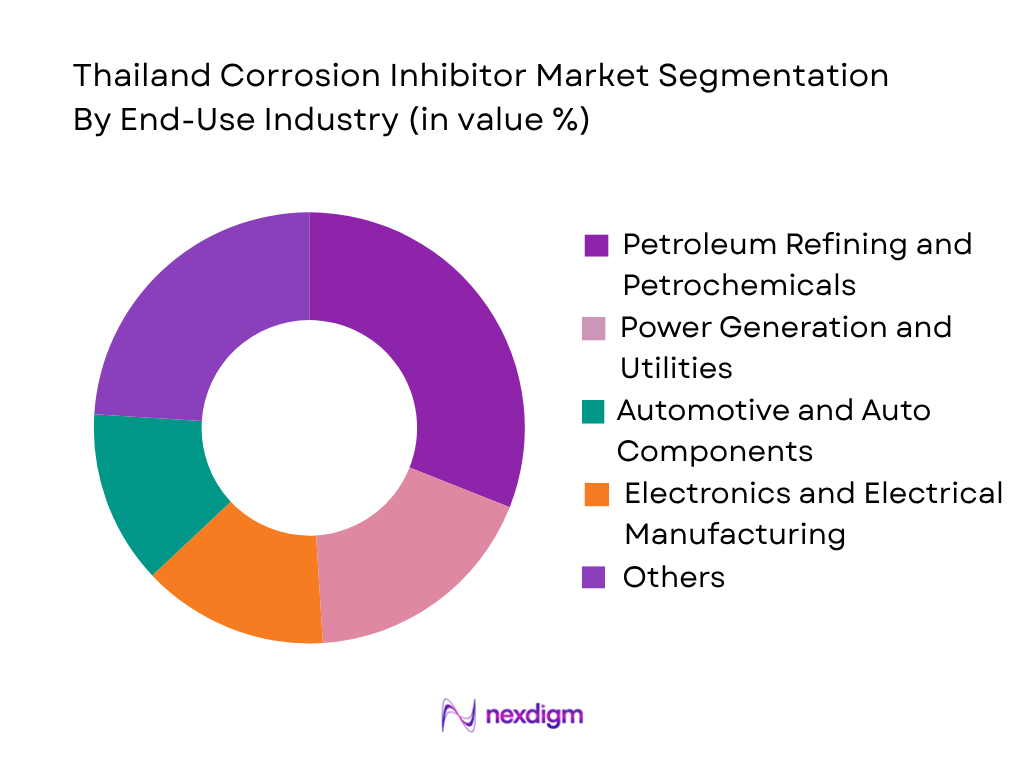
The Thailand Corrosion Inhibitor Market is segmented into petroleum refining and petrochemicals, power generation, automotive and auto components, electronics and electrical manufacturing, food and beverage processing, marine and other industrial applications. Petroleum refining and petrochemicals dominate this segmentation because the Map Ta Phut-Rayong cluster contains a dense installed base of process units, cooling towers, boilers, steam-condensate lines, heat exchangers, tanks and industrial pipelines requiring continuous corrosion mitigation. Thailand’s investment pipeline also supports this concentration: petrochemical and chemical projects accounted for 162 applications worth THB 34.3 billion during the first nine months of 2024. The cluster’s demand is reinforced by centralized industrial water infrastructure and proximity to Map Ta Phut Industrial Port. Power generation remains another substantial user because EGAT’s system recorded 51,414.30 MW of contracted capacity, while expanding automotive, electronics and food-processing investments add closed-loop, boiler and cooling-water treatment requirements.
Competitive Landscape
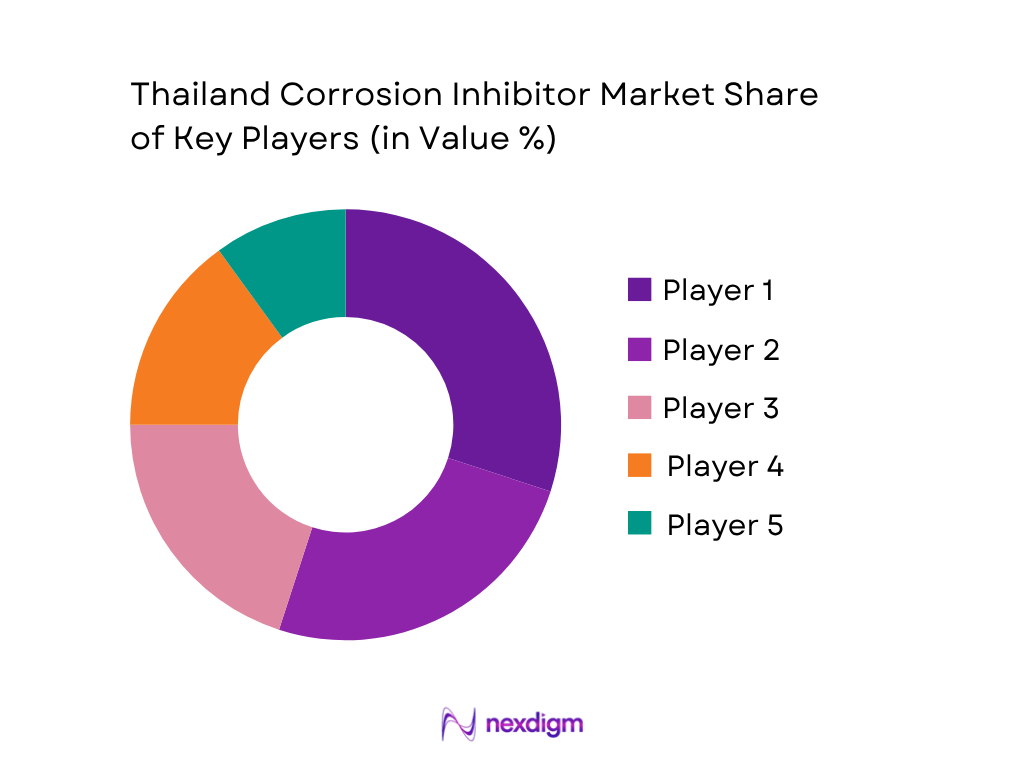
The Thailand Corrosion Inhibitor Market comprises global water-treatment specialists, process-chemical suppliers and integrated industrial-service companies competing on refinery qualification, cooling-water chemistry, boiler treatment, phosphorus-reduction capability, digital monitoring and local technical support. Large multinational suppliers benefit from established application laboratories and treatment platforms, while Thailand-based operations and distribution networks are important because industrial customers in Rayong, Chonburi and other manufacturing clusters require rapid chemical delivery, water testing and on-site troubleshooting.
| Company | Establishment Year | Headquarters | Cooling-Water Capability | Boiler & Condensate Capability | Refinery/Petrochemical Exposure | Advanced/Low-Phosphorus Chemistry | Digital Monitoring | Thailand/Regional Service Footprint |
| Nalco Water / Ecolab | 1923 | St. Paul, USA | ~ | ~ | ~ | ~ | ~ | ~ |
| Kurita | 1949 | Tokyo, Japan | ~ | ~ | ~ | ~ | ~ | ~ |
| Solenis | 2014 | Wilmington, USA | ~ | ~ | ~ | ~ | ~ | ~ |
| Veolia | 1853 | Paris, France | ~ | ~ | ~ | ~ | ~ | ~ |
| Baker Hughes | 1907 heritage | Houston, USA | ~ | ~ | ~ | ~ | ~ | ~ |
Thailand Corrosion Inhibitor Market Analysis
Growth Drivers
Expanding Refinery, Petrochemical and Industrial Utility Infrastructure
Thailand’s large refinery, petrochemical and chemical-processing base is a primary driver for corrosion-inhibitor consumption because these facilities continuously operate cooling towers, heat exchangers, boilers, condensate networks, storage systems and process-water circuits. The Industrial Estate Authority of Thailand reports that Map Ta Phut Industrial Estate provides 15,300 cubic metres/day of water-production capacity, 11,200 cubic metres/day of combined wastewater-treatment capacity and 1,545 MW of electrical infrastructure, illustrating the concentration of corrosion-sensitive industrial assets in Rayong. Thailand Board of Investment data further show 235 petrochemical and chemical investment applications valued at THB 49.1 billion in 2024. During January–September 2025, the sector generated another 230 applications worth THB 36.8 billion, sustaining expansion of equipment requiring corrosion-control treatment. Power infrastructure adds another demand layer: EGAT recorded 220,590.44 GWh of net electricity generation and a system peak demand of 36,477.80 MW in 2024. At the macroeconomic level, World Bank data place Thailand’s GDP at USD 526.52 billion and GDP per capita at USD 7,346.6 in 2024, supporting continuing industrial production and maintenance expenditure on high-value operating assets.
Growth of Electronics, Automotive and Power-Intensive Manufacturing
Thailand’s movement toward electronics, semiconductor-related manufacturing, electric mobility and other high-value industries is enlarging the installed base of closed cooling loops, chilled-water systems, process utilities and high-purity production equipment requiring corrosion protection. Thailand Board of Investment records show 407 electrical and electronics projects worth THB 231.7 billion in 2024, alongside 309 automotive and parts projects worth THB 102.4 billion. Investment momentum continued in 2025, when electrical and electronics applications reached 382 projects representing THB 184.1 billion during the first nine months and automotive applications reached 229 projects worth THB 71 billion. New semiconductor-equipment facilities approved for Chonburi and Rayong are expected to employ more than 1,400 workers and generate annual exports exceeding THB 6 billion, reinforcing utility-water requirements in the Eastern Economic Corridor. Thailand’s electricity system already produced 220,590.44 GWh in 2024, compared with 208,106.28 GWh one year earlier, demonstrating the scale of electricity-dependent industrial operations. World Bank data recorded national GDP of USD 526.52 billion in 2024, giving these manufacturing investments a sizeable macroeconomic foundation for sustained spending on reliability, cooling-water treatment and asset protection.
Market Challenges
Complex Water Chemistry and Intensive Corrosion-Control Requirements
Corrosion-inhibitor suppliers in Thailand must formulate treatment programs for technically demanding industrial water systems that combine high thermal loads, mixed metallurgy, variable makeup-water chemistry and continuous operation. Map Ta Phut Industrial Estate alone operates water-production capacity of 15,300 cubic metres/day and wastewater-treatment capacity of 11,200 cubic metres/day, while Eastern Seaboard Industrial Estate in Rayong has water-distribution capacity of 36,000 cubic metres/day, wastewater-treatment capacity of 30,000 cubic metres/day and electrical distribution capacity of 1,000 MVA. These large circulating-water environments increase the complexity of controlling corrosion alongside scaling, deposition and microbiological activity. EGAT’s power system reached peak demand of 36,477.80 MW in 2024 and generated 220,590.44 GWh, meaning corrosion-management failures in boilers, condensers and cooling systems can affect equipment serving substantial energy loads. Treatment programs therefore require precise inhibitor selection, monitoring and site-specific chemistry rather than standardized formulations. The World Bank reports Thailand’s 2024 GDP at USD 526.52 billion and GDP per capita at USD 7,346.6, underscoring the value of the industrial economy exposed to reliability risks when heat-exchange and utility-water equipment is inadequately protected.
Imported Specialty Inputs and Supply-Chain Dependence for Advanced Formulations
Thailand has a substantial domestic chemical-processing base, but advanced corrosion-inhibitor programs frequently depend on specialized amines, phosphonates, azoles, polymers, molybdates and other active ingredients connected to regional and global chemical supply chains. This creates procurement and inventory challenges for suppliers serving refineries, petrochemical complexes, electronics plants and power facilities where unexpected chemical shortages can disrupt established water-treatment programs. The scale of industrial expansion amplifies this requirement: Thailand received 3,137 investment-promotion applications worth THB 1.14 trillion in 2024, compared with 2,235 applications worth THB 846.5 billion in the preceding period. Petrochemical and chemical projects accounted for 235 applications worth THB 49.1 billion, while electronics and electrical appliances contributed 407 projects worth THB 231.7 billion, increasing demand for qualified specialty treatment inputs. During January–September 2025, total applications reached 2,622 projects, with petrochemicals and chemicals alone accounting for 230 projects worth THB 36.8 billion. World Bank data place Thailand’s GDP at USD 526.52 billion in 2024, highlighting why resilience in specialty-chemical sourcing is increasingly important to an economy supported by complex manufacturing and export-oriented industrial operations.
Market Opportunities
High-Specification Corrosion Treatment for Data Centers and Advanced Electronics
Thailand’s accelerating digital and advanced-electronics investment creates a substantial future opportunity for corrosion inhibitors used in chilled-water loops, cooling towers, heat exchangers and mission-critical thermal-management systems. Thailand Board of Investment data show that the digital sector received 150 investment applications worth THB 243.3 billion in 2024, while electrical and electronics manufacturing attracted 407 projects worth THB 231.7 billion. Momentum strengthened in 2025: during January–September, digital investment reached 119 projects worth THB 612.8 billion, and electrical and electronics applications reached 382 projects worth THB 184.1 billion. Separately, BOI reported 36 data-center projects representing more than THB 728 billion of investment during 2025, with facilities spread across Bangkok, Chachoengsao, Chonburi, Pathum Thani, Rayong and Samut Prakan. Individual projects include two Rayong and Samut Prakan facilities with combined IT load of 120 MW and another Bangkok facility with 25 MW. These installations expand demand for closed-loop inhibitors, yellow-metal protection and digitally monitored chemical dosing. Thailand’s USD 526.52 billion GDP in 2024 provides the macroeconomic base for continued high-value infrastructure development.
Local Formulation and Specialized Treatment for the Eastern Economic Corridor
The Eastern Economic Corridor offers a strong future opportunity for locally blended corrosion inhibitors and technically supported water-treatment programs because Rayong, Chonburi and neighboring industrial areas combine petrochemicals, automotive plants, electronics manufacturing, power infrastructure and large centralized utilities. Map Ta Phut Industrial Estate has 15,300 cubic metres/day of water-production capacity, 11,200 cubic metres/day of wastewater-treatment capacity and 1,545 MW of electrical infrastructure. The Eastern Seaboard Industrial Estate adds 36,000 cubic metres/day of water-distribution capacity, 30,000 cubic metres/day of wastewater treatment and 1,000 MVA of electricity distribution. Manufacturing investment is continuing around these assets. BOI data show 309 automotive and parts projects worth THB 102.4 billion, 407 electrical and electronics projects worth THB 231.7 billion, and 235 petrochemical and chemical projects worth THB 49.1 billion in 2024. During the first nine months of 2025, petrochemical and chemical applications alone reached 230 projects worth THB 36.8 billion. These current investments create opportunities for local blending, rapid technical service, film-forming chemistry, low-phosphorus treatment and automated corrosion monitoring. World Bank data record Thailand’s 2024 GDP at USD 526.52 billion, supporting continued industrial-capital formation.
Future Outlook
The Thailand Corrosion Inhibitor Market is projected to grow at approximately ~X.X% CAGR during 2026-2035, supported by continued development of the Eastern Economic Corridor, electronics manufacturing, data centers, petrochemicals, power infrastructure and high-specification industrial water treatment. Future demand is expected to increasingly favor multifunctional, low-phosphorus and digitally monitored corrosion-control programs. Industrial expansion provides a strong demand pipeline. Thailand received 3,137 investment-promotion applications worth THB 1.14 trillion in 2024 compared with 2,235 applications worth THB 846.5 billion in the preceding period. Electronics, data centers, automotive manufacturing, chemicals and food processing—all industries operating substantial cooling, chilled-water, boiler and process-water systems—were prominent contributors.
Thailand’s electronics sector is particularly relevant to future corrosion-control requirements. Electronics exports reached THB 1.86 trillion in 2024, while semiconductor exports reached THB 436 billion. High-value electronics manufacturing relies on stable cooling, chilled-water and utility systems, raising demand for carefully controlled corrosion chemistry that protects metals without introducing contamination or deposits.
Major Players
- Nalco Water / Ecolab Thailand
- Kurita-GK Chemical
- Solenis Thailand
- Veolia Water Technologies Thailand
- Baker Hughes
- Clariant
- Thermax Thailand
- Metito Thailand
- NCH / Chem-Aqua Thailand
- Italmatch Chemicals
- LANXESS Thailand
- Chem House Thailand
- Dynamic Engineering System
- Accepta Thailand
- Drew Marine
Key Target Audience
- Corrosion Inhibitor and Industrial Water-Treatment Chemical Manufacturers
- Refinery, Petrochemical and Chemical Process Operators
- Power Generation and Industrial Utility Operators
- Automotive, Electronics and Advanced Manufacturing Companies
- Industrial Estate, Marine and Port Infrastructure Operators
- Investments and Venture Capitalist Firms
- Private Equity Firms and Strategic Industrial Investors
- Government and Regulatory Bodies (Industrial Estate Authority of Thailand, Department of Industrial Works, Thailand Board of Investment, Electricity Generating Authority of Thailand, Energy Policy and Planning Office, Eastern Economic Corridor Office)
Research Methodology
Step 1: Identification of Key Variables
The first phase develops an ecosystem map covering corrosion-inhibitor manufacturers, active-ingredient suppliers, local blenders, industrial water-treatment companies, refineries, petrochemical producers, power plants and manufacturing customers. Key variables include installed cooling-tower capacity, boiler populations, process-water consumption, inhibitor dosage, metallurgy, water chemistry, industrial output, chemical imports and domestic blending capability.
Step 2: Market Analysis and Construction
Historical demand is assessed using parallel top-down and bottom-up approaches. Top-down analysis maps corrosion-control requirements across refining, petrochemicals, power generation, automotive, electronics, food processing, marine and industrial estates. Bottom-up calculations evaluate supplier revenues, product volumes, dosing frequency, water throughput, installed equipment, chemical imports and local formulation activity to construct market value and volume estimates.
Step 3: Hypothesis Validation and Expert Consultation
Initial market hypotheses are validated through structured interviews with water-treatment professionals, corrosion engineers, chemical distributors, refinery personnel, plant-utility engineers, power operators and industrial procurement teams. These discussions are used to verify chemistry preferences, dosing practices, qualification requirements, treatment frequency, customer switching behavior, local inventory requirements, digital-monitoring adoption and the competitive positioning of major suppliers.
Step 4: Research Synthesis and Final Output
Primary insights are triangulated with information from government agencies, industrial-estate statistics, electricity-system data, investment records, corporate disclosures and trade information. Top-down industry demand is reconciled with bottom-up supplier and application calculations. The final synthesis establishes market size, segment distribution, competitive structure, demand drivers, technology shifts, barriers and future opportunities within the Thailand Corrosion Inhibitor Market.

- Executive Summary
- Research Methodology (Market Definition and Scope, Thailand Corrosion Inhibitor Market Classification, Refinery and Petrochemical Corrosion Inhibitor Demand Assessment, Industrial Cooling Water Corrosion Inhibitor Consumption Mapping, Boiler and Condensate Corrosion Control Assessment, Power Plant Water Chemistry Assessment, Automotive and Electronics Manufacturing Utility Assessment, Marine and Shipboard Corrosion Inhibitor Demand Mapping, Domestic Chemical Formulation and Blending Capacity Assessment, Import Dependency Analysis, Amine Phosphonate Phosphate Azole Nitrite Molybdate Silicate and Carboxylate Chemistry Assessment)

- Definition and Scope
- Thailand Corrosion Inhibitor Industry Evolution and Development of Refinery Process Chemicals, Petrochemical Corrosion Control, Industrial Cooling Water Treatment, Boiler Water Treatment, Closed-Loop Protection and Marine Corrosion Management Ecosystem
- Organic Corrosion Inhibitor, Inorganic Corrosion Inhibitor, Film-Forming Amine, Phosphonate,
- Thailand Corrosion Inhibitor Value Chain Analysis
- Thailand Corrosion Inhibitor Supply Chain Analysis
- Specialty Chemical Feedstock Supplier, Active Ingredient Manufacturer, Chemical Formulator, Toll Blender, Industrial Water Treatment Company, Process Chemical Supplier, Industrial Chemical
- Corrosion Inhibitor Integration Across Petroleum Refining, Petrochemicals, Gas Processing, Chemicals, Power Generation, Automotive Manufacturing, Electronics, Food and Beverage

- Growth Drivers (Large Map Ta Phut Refinery and Petrochemical Installed Base, High Industrial Cooling Water Consumption, Eastern Economic Corridor Manufacturing Activity, Boiler and Steam System Treatment Demand, Power Plant Cooling and Feedwater Requirements, Automotive and Electronics Manufacturing Utility Demand, Asset Reliability Requirements, Marine and Port Infrastructure Exposure, Industrial Water Reuse)
- Market Challenges (Dependence on Imported Specialty Active Ingredients, Long Qualification Cycles for Refinery and Petrochemical Applications, High-Chloride and High-Conductivity Water Conditions, Complex Mixed-Metallurgy Cooling Systems, Industrial Wastewater Compliance Requirements, Competition from Chemical-Free Water Treatment Technologies, Price Competition in Standard Cooling Water Chemicals)
- Market Opportunities (Map Ta Phut Refinery and Petrochemical Treatment Programs, Eastern Economic Corridor Industrial Water Treatment, Phosphorus-Free Cooling Water Inhibitors, Film-Forming Amine Boiler Programs, High-Salinity Cooling Water Formulations, Automotive Plant Closed-Loop Treatment, Electronics Manufacturing Utility Protection, Marine Cooling Water Inhibitors)
- Market Trends (Film-Forming Amine Adoption, Phosphate-Reduced Cooling Water Treatment, High-Salinity Corrosion Chemistry, Multifunctional Corrosion-Scale Programs, Automated Dosing, Online Corrosion Monitoring, Remote Water Chemistry Management, Solid Chemical Treatment, Digital Water Management, Local Chemical Tolling, Performance-Based Chemical Contracts, Low-Toxicity Treatment Chemistry)
- Regulatory and Standards Landscape (Department of Industrial Works Hazardous Substance Requirements, Industrial Estate Authority of Thailand Environmental Requirements, Factory Effluent Discharge Requirements, Occupational Chemical Handling Requirements, Thai Industrial Standards, Environmental Impact Assessment Requirements, Petroleum and Petrochemical Operator Specifications, Boiler and Pressure Equipment Requirements)
- SWOT Analysis
- Porter’s Five Forces Analysis
- PESTLE Analysis
- Stakeholder Ecosystem
- Competition Ecosystem

- By Market Value (2020-2025)
- By Corrosion Inhibitor Consumption Volume (2020-2025)
- By Cooling Water Corrosion Inhibitor Consumption Volume (2020-2025)
- By Boiler and Condensate Corrosion Inhibitor Consumption Volume (2020-2025)
- By Refinery and Petrochemical Corrosion Inhibitor Consumption Volume (2020-2025)
- By Closed-Loop and Chilled-Water Corrosion Inhibitor Consumption Volume (2020-2025)
- By Domestic Corrosion Inhibitor Formulation and Blending Volume (2020-2025)
- By Corrosion Inhibitor Import Value (2020-2025)
- By Average Selling Price (2020-2025)

- By Product Chemistry (In Value %)
Organic Corrosion Inhibitors
Amine-Based Corrosion Inhibitors
Film-Forming Amines and Polyamines
Phosphonate-Based Corrosion Inhibitors
Phosphate-Based Corrosion Inhibitors
Nitrite-Based Corrosion Inhibitors
Molybdate-Based Corrosion Inhibitors
Azole-Based Copper and Yellow-Metal Inhibitors
Silicate-Based Corrosion Inhibitors
Zinc-Based Corrosion Inhibitors
Carboxylate-Based Corrosion Inhibitors
Volatile and Vapor-Phase Corrosion Inhibitors
Multifunctional Corrosion and Scale Inhibitors
Low-Phosphorus and Phosphorus-Free Corrosion Inhibitors - By Corrosion Inhibition Mechanism (In Value %)
Anodic Corrosion Inhibitors
Cathodic Corrosion Inhibitors
Mixed Corrosion Inhibitors
Film-Forming Corrosion Inhibitors
Passivating Corrosion Inhibitors
Neutralizing Corrosion Inhibitors
Adsorption-Based Organic Corrosion Inhibitors
Oxygen-Scavenging Corrosion Control Programs
Volatile Corrosion Inhibitors
Combined Scale-Corrosion Control Programs - By Application System (In Value %)
Open Recirculating Cooling Towers
Closed Cooling Water Systems
Chilled-Water Networks
Industrial Heat Exchangers
Boiler Feedwater Systems
Steam and Condensate Networks
Refinery Process Units
Petrochemical Process Systems
Gas Processing Systems
Industrial Utility Water Systems
Hydrostatic Testing and Equipment Preservation
Marine Diesel Engine Cooling Systems
Shipboard Boilers
Seawater-Cooled Heat Exchangers
Commercial HVAC Systems
Metal Storage and Lay-Up Applications - By End-Use Industry (In Value %)
Petroleum Refining
Petrochemicals
Oil and Gas Processing
Specialty Chemicals
Power Generation
Automotive and Auto Components
Electronics and Electrical Equipment
Food and Beverage Processing
Pulp and Paper
Steel and Metal Processing
Industrial Water Treatment
Marine and Shipping
Ports and Shipyards
Commercial Buildings and HVAC
Pharmaceutical Manufacturing
Rubber and Tire Manufacturing
General Manufacturing - By Water System Type (In Value %)
Open Recirculating Cooling Water
Closed Recirculating Cooling Water
Once-Through Cooling Water
Boiler Feedwater
Steam and Condensate Systems
Chilled Water Systems
Demineralized Water Systems
Process Water Systems
Industrial Reuse Water Systems
Seawater-Exposed Utility Systems

- Market Share of Major Players (By Thailand Revenue, Corrosion Inhibitor Sales Volume, Cooling Water Chemical Sales Volume, Boiler Treatment Sales Volume, Refinery and Petrochemical Exposure, End-Use Industry, Thailand Manufacturing and Blending Footprint, Technical Service and Digital Monitoring Coverage)
- Cross Comparison Parameters (Thailand Corrosion Inhibitor Revenue, Cooling Water-Boiler-Refinery Corrosion Inhibitor Portfolio Breadth, High-Salinity and Mixed-Metallurgy Chemistry Capability, Map Ta Phut-EEC Refinery Petrochemical and Manufacturing Customer Exposure, Thailand Manufacturing Tolling and Chemical Blending Capability, Low-Phosphorus Film-Forming and Advanced Chemistry Capability, Digital Dosing Corrosion Monitoring and Automation Capability, Thailand Laboratory Distribution and Field Technical Support Footprint)
- SWOT Analysis of Major Players
- Competitive Positioning Matrix
- Corrosion Inhibitor Product and Chemistry Portfolio Benchmarking
- Pricing and Corrosion Inhibitor Category Benchmarking
- Chemical Formulation, Blending and Corrosion Monitoring Technology Assessment
- End-Use Industry and Critical Corrosion Application Exposure Assessment
- Domestic Formulation Versus Imported Corrosion Inhibitor Supply Positioning
- Detailed Profiles of Major Companies
Nalco Water / Ecolab Thailand
Kurita-GK Chemical
Solenis Thailand
Veolia Water Technologies Thailand
Baker Hughes
Clariant
Thermax Thailand
Metito Thailand
NCH / Chem-Aqua Thailand
Italmatch Chemicals
LANXESS Thailand
Chem House Thailand
Dynamic Engineering System
Accepta Thailand
Drew Marine

- Map Ta Phut Refinery Corrosion Inhibitor Procurement Assessment
- Petrochemical and Specialty Chemical Plant Corrosion Control Requirement Analysis
- Power Generation Boiler and Cooling Water Treatment Assessment
- Automotive Manufacturer Utility Water Treatment Assessment
- Electronics Manufacturer Cooling System Requirement Analysis
- Eastern Economic Corridor Industrial Estate Utility Provider Procurement Assessment
- Food and Beverage Processing Boiler Treatment Requirement Analysis
- Pulp and Paper Corrosion Control Requirement Assessment
- Marine and Port Operator Corrosion Treatment Procurement Analysis
- Industrial Water Treatment Contractor Chemical Procurement Assessment

- By Market Value (2026-2035)
- By Corrosion Inhibitor Consumption Volume (2026-2035)
- By Cooling Water Corrosion Inhibitor Consumption Volume (2026-2035)
- By Boiler and Condensate Corrosion Inhibitor Consumption Volume (2026-2035)
- By Refinery and Petrochemical Corrosion Inhibitor Consumption Volume (2026-2035)
- By Closed-Loop and Chilled-Water Corrosion Inhibitor Consumption Volume (2026-2035)
- By Domestic Corrosion Inhibitor Formulation and Blending Volume (2026-2035)
- By Corrosion Inhibitor Import Value (2026-2035)
- By Average Selling Price (2026-2035)


 Request a Sample
 Ask for Customization
 Get a Quote
 Enquire Now