

 Download PDF
 Download PDF
Market Overview
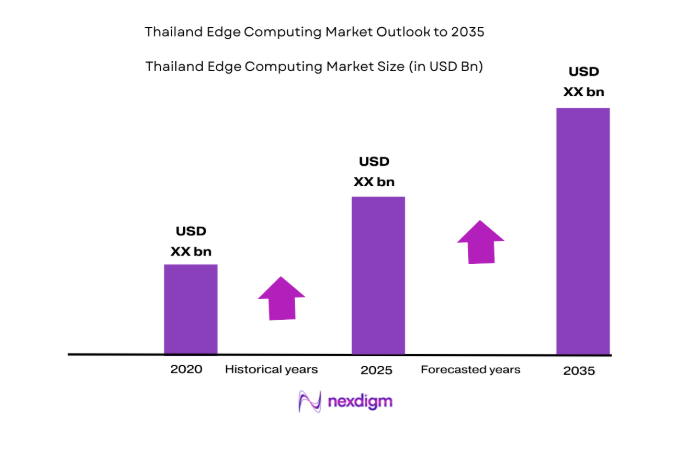
Thailand edge computing market is valued at approximately USD ~ million based on a recent historical assessment, driven by rapid enterprise digitalization, expansion of low-latency applications, and telecom network densification across industrial and urban environments. Deployment of edge data centers, 5G-enabled processing nodes, and localized analytics platforms is accelerating due to manufacturing automation demand, real-time logistics visibility requirements, and rising data sovereignty needs among regulated sectors such as finance and healthcare.
Bangkok dominates the Thailand edge computing market due to its concentration of hyperscale connectivity infrastructure, enterprise headquarters, and advanced telecom backbone networks supporting distributed computing deployments. Eastern Economic Corridor cities including Chonburi and Rayong are emerging hubs because of industrial automation investments, smart manufacturing adoption, and proximity to ports and logistics corridors enabling latency-sensitive processing. Regional expansion into Chiang Mai and Phuket is supported by smart city initiatives, tourism analytics platforms, and localized content delivery demand across digitally intensive service economies.
Market Segmentation
By Product Type
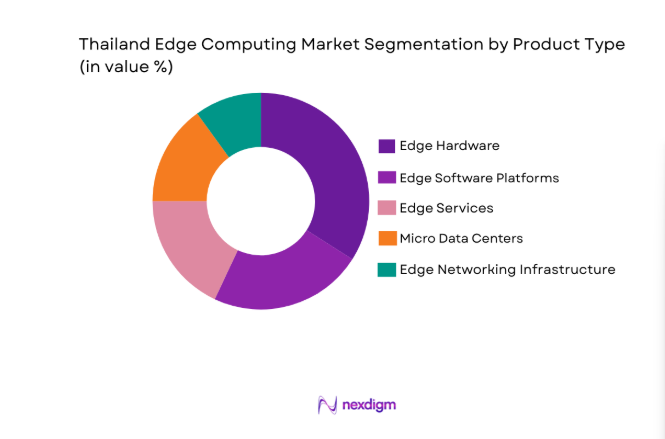
Thailand edge computing market is segmented by product type into edge hardware, edge software platforms, edge services, micro data centers, and edge networking infrastructure. Recently, edge hardware has a dominant market share due to factors such as enterprise demand for on-premise processing appliances, telecom operator deployment of base-station compute modules, industrial automation gateways, and localized data storage nodes required for latency-critical operations. Manufacturing facilities, logistics hubs, and smart infrastructure projects prioritize physical edge nodes to ensure deterministic performance, regulatory compliance, and resilience against connectivity disruptions across distributed environments.
By Platform Type
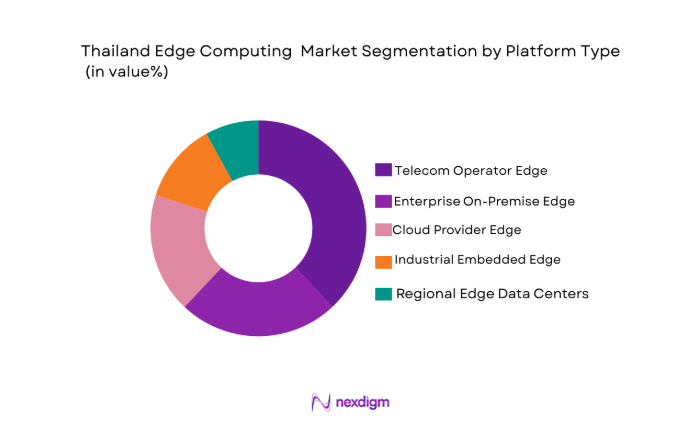
Thailand edge computing market is segmented by platform type into telecom operator edge, enterprise on-premise edge, cloud provider edge, industrial embedded edge, and regional edge data centers. Recently, telecom operator edge has a dominant market share due to factors such as nationwide 5G infrastructure ownership, base-station integrated compute nodes, and ability to host multi-access edge computing environments accessible to enterprises and developers. Telecom platforms provide scalable distributed coverage, managed connectivity, and service orchestration capabilities, enabling rapid deployment of low-latency applications across industries without requiring enterprises to build independent infrastructure.
Competitive Landscape
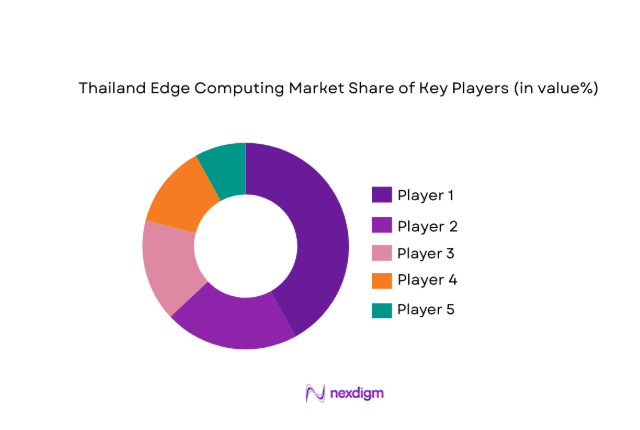
Thailand edge computing market shows moderate consolidation with telecom operators and global infrastructure vendors dominating core deployments while specialized edge platform providers expand through partnerships and localized solutions. Major players influence standards adoption, interoperability frameworks, and distributed cloud architectures, leveraging existing connectivity assets and enterprise relationships to scale nationwide edge ecosystems across industrial and urban applications.
| Company Name | Establishment Year | Headquarters | Technology Focus | Market Reach | Key Products | Revenue | Edge Infrastructure Capacity |
| Huawei Technologies | 1987 | Shenzhen, China | ~ | ~ | ~ | ~ | ~ |
| Dell Technologies | 1984 | Texas, USA | ~ | ~ | ~ | ~ | ~ |
| HPE | 1939 | Texas, USA | ~ | ~ | ~ | ~ | ~ |
| Nokia | 1865 | Espoo, Finland | ~ | ~ | ~ | ~ | ~ |
| AIS | 1986 | Bangkok, Thailand | ~ | ~ | ~ | ~ | ~ |
Thailand Edge Computing Market Analysis
Growth Drivers
5G Network Expansion Enabling Distributed Low-Latency Processing
Thailand’s nationwide 5G rollout is fundamentally transforming computing architectures by enabling distributed processing closer to data generation points across telecom networks and enterprise environments. Telecom operators are integrating multi-access edge computing nodes directly into base stations and aggregation sites to support real-time applications such as autonomous logistics coordination, industrial robotics synchronization, and immersive digital services requiring millisecond latency. Enterprises across manufacturing, retail, and transportation are adopting edge architectures to process sensor and video data locally, reducing backhaul bandwidth consumption and ensuring operational continuity during network disruptions. Government digital economy strategies promoting smart cities, intelligent transport systems, and Industry 4.0 adoption are increasing demand for localized analytics and decision-making capabilities embedded within infrastructure. Cloud providers are partnering with telecom operators to extend hybrid cloud environments into edge locations, allowing enterprises to run containerized workloads near operational sites while maintaining centralized orchestration and governance. Regulatory considerations around data residency and cybersecurity are encouraging organizations in finance, healthcare, and public services to deploy edge nodes within national boundaries rather than relying solely on centralized hyperscale data centers abroad. Industrial estates and economic corridors are integrating private 5G and edge platforms to support automated production, predictive maintenance, and digital twin simulations requiring continuous high-speed processing. These combined technological, regulatory, and operational dynamics are positioning 5G-enabled edge computing as a foundational layer of Thailand’s next-generation digital infrastructure ecosystem.
Industrial Automation and Smart Manufacturing Adoption Across Economic Corridors
Thailand’s manufacturing sector is accelerating digital transformation through robotics, machine vision, and real-time process optimization systems that require localized compute resources integrated within production environments. Factories deploying automated assembly lines and sensor-dense equipment generate large volumes of operational data that must be processed instantly for quality control, safety monitoring, and predictive maintenance without latency or connectivity dependency risks. Edge computing platforms embedded within industrial gateways and micro data centers allow manufacturers to run analytics, artificial intelligence models, and control algorithms directly on site, improving responsiveness and reducing downtime costs. The Eastern Economic Corridor initiative is driving investments in advanced manufacturing clusters where automotive, electronics, and petrochemical facilities are integrating cyber-physical systems requiring deterministic computing performance. Logistics and warehouse automation systems supporting just-in-time production also depend on edge-based processing for autonomous vehicle coordination, inventory tracking, and environmental monitoring. Government incentives promoting Industry 4.0 adoption are encouraging enterprises to modernize legacy equipment with IoT sensors and localized analytics platforms that rely on distributed computing nodes. Equipment vendors and automation integrators are embedding edge compute modules within machinery, accelerating adoption by making localized processing a standard capability rather than an optional add-on. As Thailand positions itself as a regional advanced manufacturing hub, the integration of automation technologies and edge computing infrastructure is becoming inseparable, reinforcing sustained demand across industrial sectors.
Market Challenges
Fragmented Edge Ecosystem and Interoperability Constraints Across Vendors
Thailand’s edge computing landscape involves multiple telecom operators, hardware vendors, cloud platforms, and industrial solution providers deploying proprietary architectures that often lack seamless interoperability across environments. Enterprises attempting to integrate edge nodes from different vendors into unified orchestration frameworks face compatibility challenges in workload portability, device management, and data synchronization across distributed locations. Absence of standardized interfaces and deployment models complicates scaling from pilot deployments to nationwide distributed architectures, increasing integration costs and operational complexity for organizations adopting edge solutions. Telecom-hosted edge platforms and enterprise-owned on-premise nodes frequently operate in parallel rather than integrated ecosystems, limiting cross-domain application deployment and resource optimization opportunities. Software vendors offering edge analytics and AI platforms must customize solutions for each infrastructure environment, slowing innovation cycles and increasing deployment timelines. Limited availability of local system integrators with deep expertise in multi-vendor edge architectures further constrains large-scale enterprise adoption across sectors such as manufacturing and logistics. Standards bodies and industry alliances are still evolving frameworks for interoperability across distributed cloud and edge environments, creating uncertainty for enterprises investing in long-term architectures. These fragmentation dynamics increase perceived risk among organizations evaluating edge computing investments and delay broader ecosystem maturity across Thailand’s distributed computing market.
High Deployment Costs and Limited Edge Infrastructure Outside Major Urban Centers
Establishing edge computing infrastructure requires significant capital investment in localized data center modules, ruggedized hardware, power systems, cooling solutions, and connectivity integration across distributed locations. Outside Bangkok and major industrial corridors, supporting infrastructure such as high-capacity fiber backhaul, stable power supply, and secure facility environments remains limited, increasing deployment costs and operational risks for edge node installation. Enterprises in secondary cities and rural regions face economic barriers in justifying localized compute deployments due to smaller workload volumes and limited digital application maturity compared with metropolitan areas. Telecom operators prioritize dense urban markets and industrial clusters for initial edge node deployment to maximize utilization and revenue potential, leaving regional markets underserved and slowing nationwide adoption. Maintenance and management of distributed edge infrastructure across geographically dispersed sites require specialized technical skills and monitoring platforms, increasing operational expenditure for organizations operating large edge networks. Small and medium enterprises lack financial capacity and technical expertise to deploy dedicated edge infrastructure, limiting adoption to large enterprises and telecom-hosted shared environments. Environmental factors such as heat, humidity, and power variability in certain regions also increase infrastructure resilience requirements and costs. These economic and infrastructural barriers constrain balanced geographic expansion of Thailand’s edge computing ecosystem beyond primary urban and industrial centers.
Opportunities
Edge-Enabled Smart City and Intelligent Infrastructure Initiatives Across Provinces
Thailand’s urban development strategies increasingly emphasize intelligent infrastructure systems such as smart traffic management, public safety surveillance, environmental monitoring, and digital citizen services that depend on localized data processing capabilities. Edge computing platforms deployed within city infrastructure enable real-time analytics of video, sensor, and mobility data streams required for adaptive traffic control, incident detection, and resource optimization across urban environments. Municipal governments and infrastructure operators can leverage distributed edge nodes to process data locally, reducing latency and bandwidth requirements while ensuring compliance with data governance policies. Expansion of smart city initiatives beyond Bangkok into regional cities creates demand for scalable edge platforms integrated with transportation networks, utilities, and public services. Tourism-focused urban centers such as Phuket and Chiang Mai are deploying intelligent infrastructure to enhance visitor experiences and operational efficiency, requiring localized computing for crowd analytics and service automation. Public-private partnerships involving telecom operators, technology vendors, and municipalities provide viable deployment models for shared edge infrastructure supporting multiple civic applications. Integration of renewable energy management, disaster monitoring, and urban resilience systems further increases demand for distributed processing capabilities embedded within city networks. These urban digitalization initiatives represent a significant growth opportunity for edge computing providers delivering infrastructure and platforms tailored to municipal and regional smart infrastructure ecosystems.
Localized Content Delivery, Media Processing, and Immersive Digital Services Expansion
Thailand’s rapidly growing digital media consumption, gaming, streaming, and immersive application markets are driving demand for localized content delivery and real-time processing capabilities positioned closer to end users. Edge computing nodes deployed within telecom networks and metropolitan micro data centers enable low-latency streaming, augmented reality experiences, cloud gaming, and interactive media services that require immediate data processing and delivery. Media platforms and content providers benefit from reduced network congestion and improved user experience when content caching and processing occur at edge locations rather than centralized data centers. Telecommunications operators can monetize edge infrastructure by hosting third-party application platforms and media workloads within distributed network nodes. Growth of immersive tourism, virtual events, and digital entertainment services in Thailand’s urban and tourism hubs further increases demand for localized compute and rendering capabilities. Retail and advertising sectors are adopting edge-based digital signage and interactive customer engagement platforms requiring real-time analytics and content personalization. As consumer expectations for seamless high-quality digital experiences increase, service providers must deploy distributed computing architectures to maintain performance and responsiveness. This convergence of media, entertainment, and telecom ecosystems creates sustained opportunities for edge computing infrastructure and platform providers across Thailand’s digital services landscape.
Future Outlook
Thailand edge computing market is expected to expand steadily over the next five years driven by nationwide 5G densification, industrial automation expansion, and distributed cloud adoption across enterprises. Telecom operators and cloud providers will deepen integration of hybrid edge architectures enabling scalable enterprise deployment. Government smart infrastructure initiatives and Industry 4.0 incentives will reinforce demand. Regional edge node deployment beyond Bangkok and industrial corridors will accelerate ecosystem maturity and nationwide distributed computing adoption.
Major Players
- Huawei Technologies
- Dell Technologies
- Hewlett Packard Enterprise
- Nokia • Advanced Info Service
- True Corporation
- Amazon Web Services
- Microsoft
- Cisco Systems
- Lenovo
- EdgeCentres
- Schneider Electric
- ST Engineering
- Fujitsu
Key Target Audience
- Telecom operators
- Manufacturing enterprises
- Transportation andlogisticscompanies
- Retail and e-commerce platforms
- Healthcare providers
- Investments and venture capitalist firms
- Government and regulatory bodies
- Smart city infrastructure developers
Research Methodology
Step 1: Identification of Key Variables
Key variables such as edge node deployment density, telecom infrastructure distribution, enterprise digitalization intensity, and industrial automation adoption were identified across Thailand. Data sources included operator disclosures, infrastructure maps, and sector investment indicators. These variables established the foundational demand and supply structure of the market.
Step 2: Market Analysis and Construction
Market sizing integrated infrastructure deployment counts, enterprise adoption indicators, and sectoral technology investment patterns to construct the Thailand edge computing ecosystem model. Product and industry segmentation structures were defined based on deployment architectures and end-use adoption environments. Competitive positioning was mapped through vendor presence and infrastructure capacity indicators.
Step 3: Hypothesis Validation and Expert Consultation
Preliminary market assumptions were validated through consultations with telecom engineers, data center architects, industrial automation specialists, and cloud platform integrators active in Thailand. Feedback refined adoption drivers, deployment barriers, and segmentation shares. Cross-verification ensured alignment between infrastructure realities and demand projections.
Step 4: Research Synthesis and Final Output
Validated datasets and qualitative insights were synthesized into a structured market framework covering size, segmentation, competition, and future outlook. Analytical models ensured internal consistency across infrastructure deployment, enterprise adoption, and industry demand relationships. Final outputs were reviewed for methodological rigor and market relevance.

- Executive Summary
- Research Methodology (Definitions, Scope, Industry Assumptions, Market Sizing Approach, Primary & Secondary Research Framework, Data Collection & Verification Protocol, Analytic Models & Forecast Methodology, Limitations & Research Validity Checks)

- Market Definition and Scope
- Value Chain & Stakeholder Ecosystem
- Regulatory / Certification Landscape
- Sector Dynamics Affecting Demand
- Strategic Initiatives & Infrastructure Growth

- Growth Drivers
5G network densification across urban Thailand
Industrial automation and smart manufacturing adoption
Rising demand for low latency digital services - Market Challenges
Fragmented edge standards and interoperability gaps
High upfront deployment and integration costs
Limited domestic edge infrastructure expertise - Market Opportunities
Edge enablement for autonomous logistics and ports
Localized AI inference for retail analytics
Public sector smart city edge deployments - Trends
Convergence of telecom and enterprise edge
AI model compression for device edge
Rise of sovereign and localized data processing - Government Regulations & Defense Policy
Thailand 5G and digital infrastructure incentives
Data localization and cybersecurity compliance frameworks
Smart city and Industry 4.0 policy initiatives - Swot Analysis
Strong telecom infrastructure backbone
Dependence on imported edge hardware
Growing enterprise digitalization demand - Posters 5 Forces
Moderate supplier power due to global hardware vendors
Rising competitive rivalry among integrators
High entry barriers from capex intensity

- By Market Value 2020-2025
- By Installed Units 2020-2025
- By Average System Price 2020-2025
- By System Complexity Tier 2020-2025

- By System Type (In Value%)
Edge AI Accelerators
Micro Data Centers
Edge Gateways
Industrial Edge Controllers
Content Delivery Edge Nodes - By Platform Type (In Value%)
Telecom Edge Infrastructure
Enterprise Edge IT Platforms
Industrial IoT Edge Platforms
Smart City Edge Platforms
Retail Edge Platforms - By Fitment Type (In Value%)
On-Premise Edge Deployments
Network Edge Deployments
Device Embedded Edge
Hybrid Edge Architectures
Cloud-Managed Edge - By End User Segment (In Value%)
Telecom Operators
Manufacturing Enterprises
Retail Chains
Transportation and Logistics Firms
Government and Municipal Agencies - By Procurement Channel (In Value%)
Direct OEM Procurement
System Integrator Contracts
Telecom Operator Bundling
Cloud Marketplace Procurement
Value-Added Resellers

- Market structure and competitive positioning
Market share snapshot of major players Cross - Comparison Parameters (Deployment Model, Latency Capability, AI Processing Capacity, Industry Focus, Integration Ecosystem)
- SWOT Analysis of Key Competitors
- Pricing & Procurement Analysis
- Key Players
Huawei Technologies Thailand
AIS (Advanced Info Service)
True Corporation
NTT Thailand
Fujitsu Thailand
Cisco Systems Thailand
Dell Technologies Thailand
HPE Thailand
Schneider Electric Thailand
Siemens Thailand
Samsung SDS Thailand
Edge Centres Asia
ST Engineering Thailand
Advantech Thailand
Lenovo Thailand

- Telecom operators expand MEC services for enterprise clients
- Manufacturers deploy edge for predictive maintenance
- Retailers adopt in-store analytics and automation
- Public agencies implement surveillance and traffic edge systems

- Forecast Market Value 2026-2035
- Forecast Installed Units 2026-2035
- Price Forecast by System Tier 2026-2035
- Future Demand by Platform 2026-2035


 Request a Sample
 Ask for Customization
 Get a Quote
 Enquire Now