
 Download PDF
Market Overview
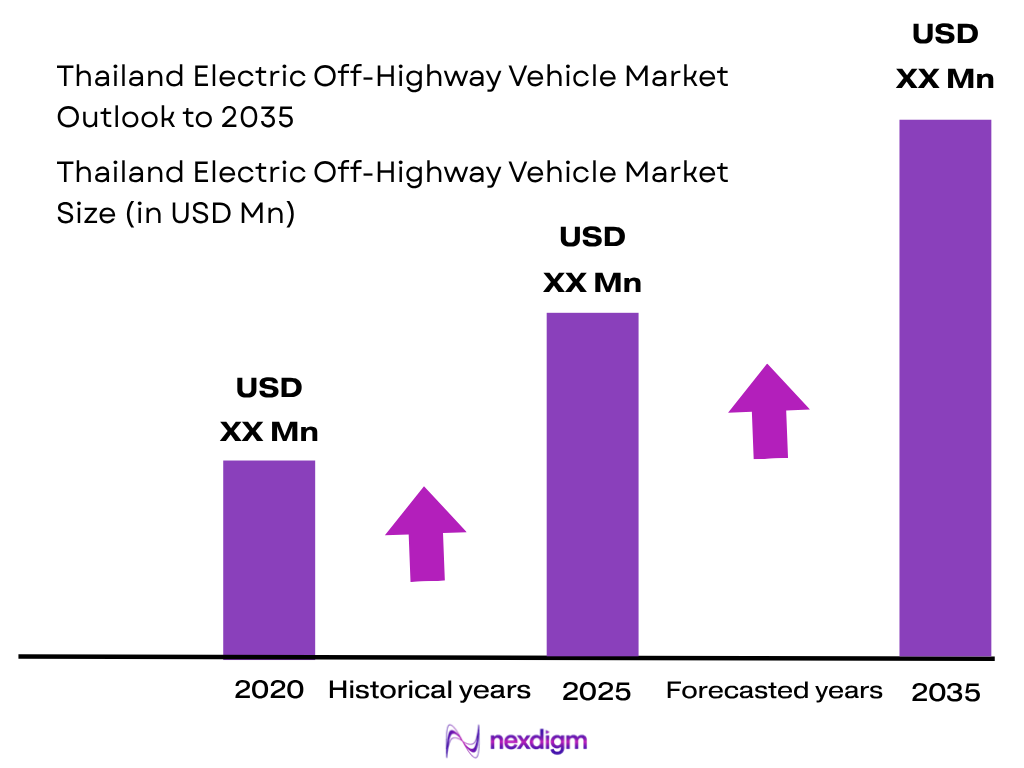
The India Electric Off-Highway Vehicle Market is supported by the country’s large agricultural, construction and mining equipment base, alongside increasing electrification of machinery used in controlled operating environments. Industry data indicates that India’s off-highway vehicle market reached approximately 1.19 million units in 2024, comprising around 1.07 million agricultural equipment units and 0.12 million construction vehicles. Electric adoption is being encouraged by decarbonization initiatives, improvements in battery technology and demand for lower-emission equipment. India’s indigenous development of electric tractors, including the CSIR-CMERI PRIMA ET11, also demonstrates growing domestic technological capability.
Agriculture represents the largest addressable equipment ecosystem because India has an extensive installed base of tractors and farm machinery, while construction and mining create concentrated opportunities for electric equipment in controlled worksites. Major industrial and infrastructure clusters across Maharashtra, Gujarat, Tamil Nadu, Karnataka, Uttar Pradesh, Rajasthan and Telangana provide strong deployment potential because of their construction activity, manufacturing concentration, mining operations and agricultural mechanization. India’s broader EV ecosystem is also geographically concentrated: FY2024 EV registrations were particularly strong in Uttar Pradesh, Maharashtra, Karnataka, Tamil Nadu and Rajasthan, demonstrating the importance of these states as established electric-mobility markets and potential early-adoption regions.
Market Segmentation
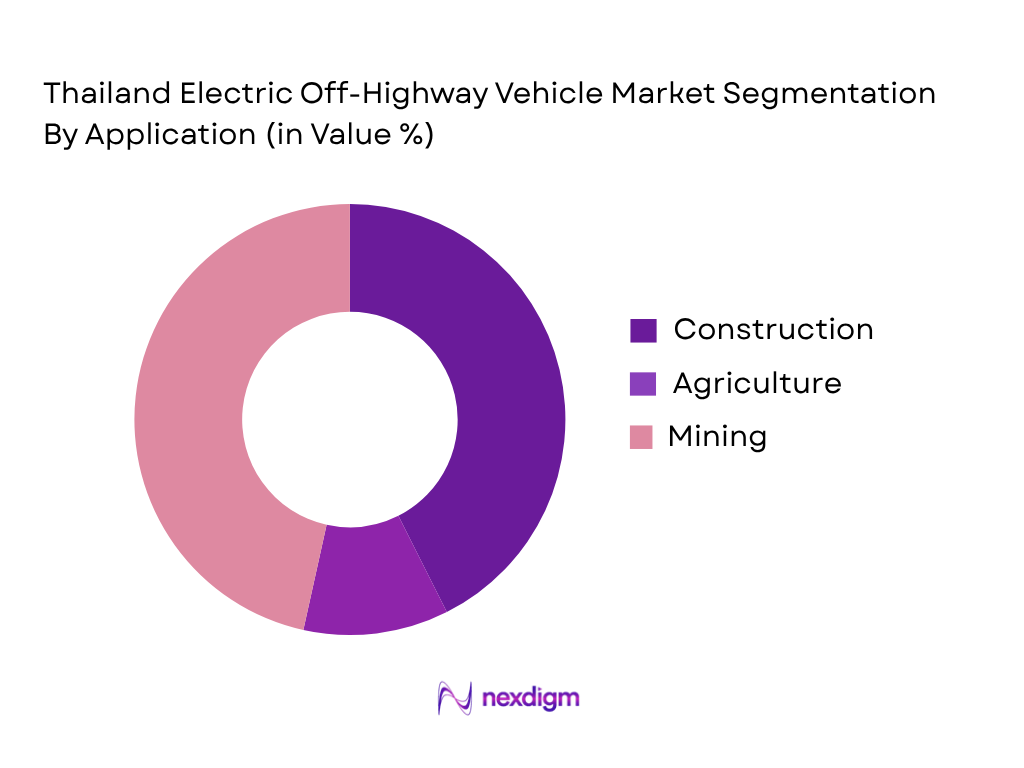
By Application
The India Electric Off-Highway Vehicle Market can be segmented by application into construction, agriculture and mining. Among these, mining represents a major electric-equipment opportunity because operating environments can be highly structured, equipment utilization is intensive and emissions reduction can be particularly valuable at enclosed or concentrated worksites. One published estimate places mining revenue at USD 81.8 million in 2024, representing 47.0% of its defined India off-highway electric vehicle market. Construction is another important segment because India’s construction-equipment fleet is expanding alongside infrastructure development. Agriculture provides a substantially larger overall off-highway equipment base and is therefore strategically important for electric tractors and compact machinery. The precise shares depend on whether the market includes electric tractors, forklifts, industrial vehicles and hybrid equipment, making scope consistency essential when comparing segment performance.
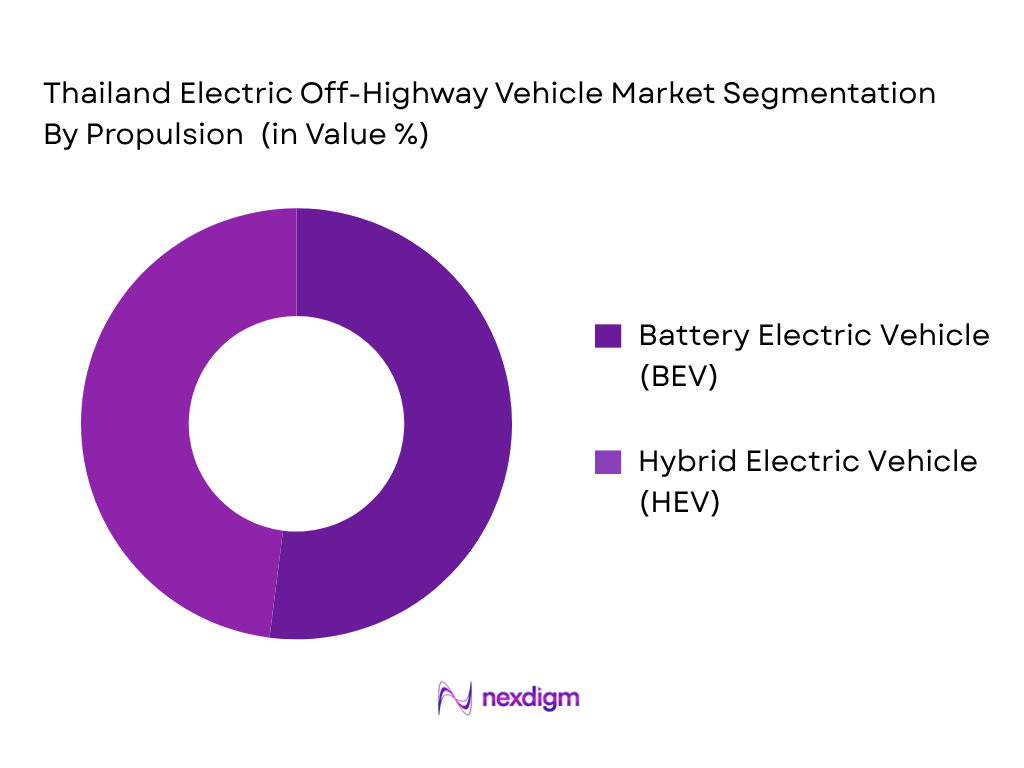
By Propulsion
The India Electric Off-Highway Vehicle Market is segmented into Battery Electric Vehicles (BEV) and Hybrid Electric Vehicles (HEV). BEVs are positioned as the leading technology because they offer zero tailpipe emissions, simpler drivetrains and suitability for applications where equipment returns to a predictable charging location. The technology is particularly relevant to compact construction equipment, mining machinery, electric tractors and material-handling applications. HEVs remain relevant where continuous operating time, high-load duty cycles or limited charging infrastructure restrict the practicality of full battery operation. India’s development of indigenous electric tractor technology demonstrates that BEV platforms are moving beyond passenger vehicles into agricultural machinery. Market studies consistently identify BEVs as the dominant propulsion category in India’s electric off-highway vehicle landscape, although the exact share varies according to the equipment categories included.
Competitive Landscape
The India Electric Off-Highway Vehicle Market includes established global construction, mining and agricultural-equipment manufacturers alongside Indian equipment and tractor manufacturers developing electric platforms. Competition is increasingly shifting from conventional equipment specifications toward battery integration, electric drivetrains, charging compatibility, uptime, telematics and after-sales support. Global OEMs such as Caterpillar, Komatsu, Volvo Construction Equipment, JCB and John Deere bring established equipment platforms and dealer networks, while Indian companies provide local manufacturing capabilities and familiarity with domestic agricultural and construction applications.
| Company | Established | Headquarters | Key Equipment Focus | Electric Technology | Primary Applications | India Presence | Key Differentiator |
| Caterpillar Inc. | 1925 | Irving, Texas, USA | ~ | ~ | ~ | ~ | ~ |
| Komatsu Ltd. | 1921 | Tokyo, Japan | ~ | ~ | ~ | ~ | ~ |
| Volvo Construction Equipment | 1832 | Gothenburg, Sweden | ~ | ~ | ~ | ~ | ~ |
| JCB | 1945 | Rocester, UK | ~ | ~ | ~ | ~ | ~ |
| Deere & Company | 1837 | Moline, Illinois, USA | ~ | ~ | ~ | ~ | ~ |
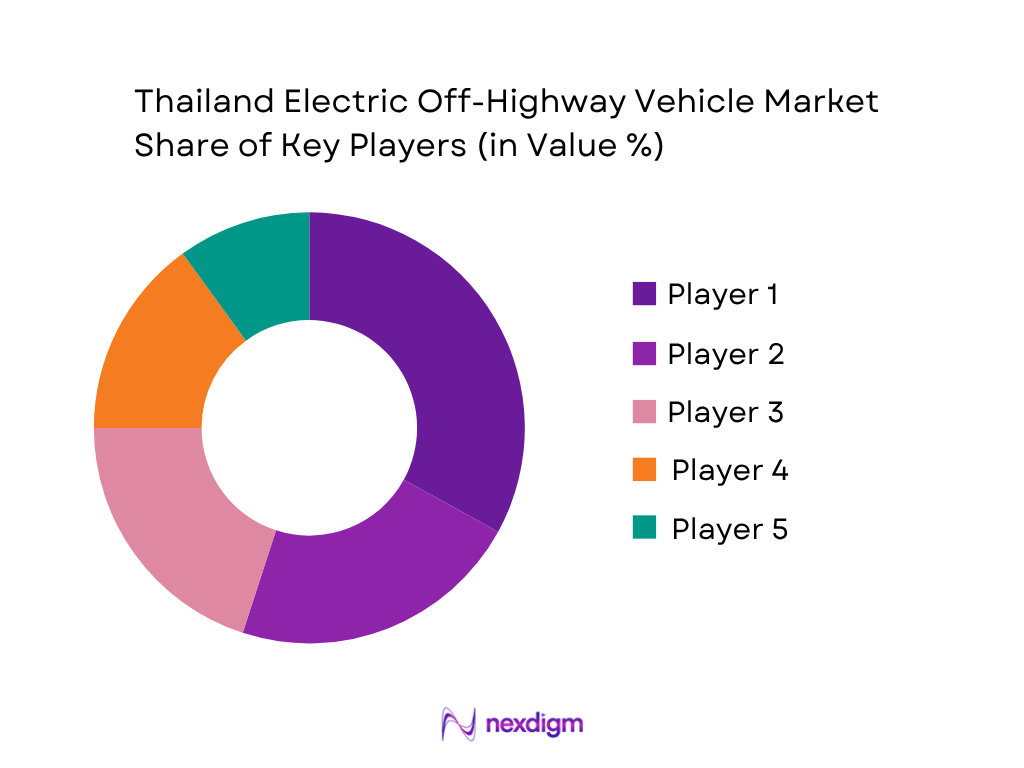
Thailand Electric Off-Highway Vehicle Market Analysis
Growth Drivers
Industrial & Logistics Expansion
India’s expanding industrial, construction and logistics ecosystem is strengthening demand for electric off-highway vehicles across factories, warehouses, ports, construction sites and farms. Construction-equipment sales reached 135,650 units in FY2024, while material-handling equipment recorded 61% growth, supporting demand for electric forklifts, warehouse vehicles and compact machinery. Infrastructure spending provides an additional demand foundation, with the Union Budget allocating ₹11,11,111 crore in capital expenditure for FY2024-25. India’s major ports had 1,630 million tonnes per annum of cargo-handling capacity by March 2024, while total port capacity reached 2,690 million tonnes per annum. Mining also represents a substantial high-utilization equipment base, with coal production reaching 997.83 million tonnes in FY2023-24 and exceeding 1,047.5 million tonnes in FY2024-25. These activity levels support applications for electric forklifts, terminal tractors, loaders, compact construction equipment and specialized mining machinery. E-commerce and organized warehousing further increase requirements for repetitive material movement where centralized charging can be integrated into operating facilities. The combination of industrial expansion, infrastructure construction, port modernization and logistics development is therefore broadening the addressable operating environment for electric off-highway vehicles beyond conventional road-transport electrification.
Fleet Electrification & Replacement
Fleet replacement and industrial decarbonization are creating an additional demand pathway as operators evaluate electric machinery for applications with predictable routes, centralized depots and high utilization. India’s construction-equipment industry reached 135,650 units in FY2024, while material-handling equipment experienced 61% growth, demonstrating the scale of equipment activity suitable for electrification. The port ecosystem provides another concentrated opportunity: major ports possessed 1,630 million tonnes per annum of handling capacity by March 2024, creating substantial operating environments for electric terminal tractors, forklifts and yard equipment. Government support is also strengthening the broader electric-mobility ecosystem. PM E-DRIVE has an outlay of ₹10,900 crore, including ₹2,000 crore for EV public-charging infrastructure and support for 5,643 e-trucks. Although these measures primarily address road-going electric mobility, they contribute to domestic battery, charging, power-electronics and drivetrain capabilities that can support adjacent off-highway applications. India’s mining sector further illustrates the potential for high-utilization electrification, with coal production exceeding 1 billion tonnes in FY2024-25. Electric equipment can be particularly attractive in enclosed or semi-enclosed mining environments because reduced exhaust emissions can improve local air quality and potentially reduce ventilation requirements. These developments encourage operators to consider electric forklifts, yard tractors, compact construction machines, mining equipment and automated warehouse vehicles as part of broader fleet-modernization programs.
Market Challenges
Investment & Charging Gaps
High equipment investment, charging infrastructure requirements and battery-related operating considerations remain important barriers to electric off-highway adoption in India. Unlike many passenger or light-commercial applications, off-highway equipment frequently operates for long periods under heavy loads, making battery capacity, charging time and machine utilization particularly important. PM E-DRIVE provides ₹2,000 crore for EV public-charging infrastructure, illustrating the continuing scale of investment required to develop India’s broader charging ecosystem. However, public charging infrastructure alone does not solve the requirements of construction sites, mines, ports and industrial facilities, where operators may require dedicated high-capacity chargers, electrical connections and charging-management systems. Mining is particularly demanding: coal production exceeded 1 billion tonnes in FY2024-25, creating a substantial equipment base operating under intensive duty cycles. Such machinery requires high availability, rapid refueling or charging and robust thermal management. The Ministry of Coal has also highlighted India’s dependence on imported high-capacity mining equipment, with imported machinery valued at approximately ₹3,500 crore, demonstrating continuing exposure to overseas equipment and component supply chains. Electric machines additionally require trained personnel for battery-management systems, power electronics and high-voltage maintenance. Financing can become more complex because purchasers must evaluate batteries, charging equipment, residual values and replacement requirements alongside the machine. These factors can make adoption more difficult for remote, continuous-duty and high-payload applications than for centralized warehouse or port operations.
Duty-Cycle & Supply Constraints
Heavy-duty operating conditions create technical and commercial constraints for electric off-highway equipment, particularly in mining, construction and agricultural applications. Machines operating in India can face high temperatures, dust, vibration, irregular terrain and extended working cycles, requiring batteries, motors, power electronics and thermal-management systems capable of maintaining productivity under demanding conditions. India’s coal sector demonstrates the scale of these requirements, with coal production exceeding 1,047.5 million tonnes in FY2024-25. The Ministry of Coal has identified approximately ₹3,500 crore of imported high-capacity mining equipment, including electric rope shovels, hydraulic shovels, dumpers, drills and loaders, highlighting the importance of specialized equipment supply chains. Import dependence can increase lead times for critical components and make fleet maintenance more exposed to international logistics disruptions. Specialist technician availability is another constraint because electric machinery requires expertise covering high-voltage systems, battery-management systems, electric motors and power electronics in addition to conventional mechanical systems. Charging infrastructure is particularly challenging for remote mines and construction projects where electrical capacity may not be readily available. Battery runtime also needs to match machine duty cycles without creating productivity losses from unplanned charging periods. Consequently, electric equipment is currently better suited to operations where routes and working schedules are predictable, while continuous heavy-duty applications require greater investment in charging, battery capacity, maintenance capability and operational planning.
Market Opportunities
Electric Material Handling & Ports
India’s expanding logistics, warehousing and port infrastructure provides strong opportunities for electric forklifts, terminal tractors, yard vehicles and automated material-handling equipment. Material-handling equipment recorded 61% growth within India’s construction-equipment industry during FY2024, while total construction-equipment sales reached 135,650 units. This creates a substantial installed equipment base where fleet operators can evaluate electric replacements, particularly for repetitive indoor and depot-based operations. Ports provide another highly suitable environment because major Indian ports had 1,630 million tonnes per annum of cargo-handling capacity by March 2024, while total port capacity reached 2,690 million tonnes per annum. The government also reported 98 port-modernization projects completed at a combined investment exceeding ₹32,000 crore, adding more than 230 million tonnes per annum of capacity. Modernized terminals can integrate electric terminal tractors, automated yard equipment, charging infrastructure and digital fleet-management systems from the outset. Construction is another opportunity, particularly for compact excavators, loaders and machinery deployed in urban infrastructure projects where lower local emissions and reduced noise can provide operational advantages. PM E-DRIVE’s ₹10,900 crore overall allocation and ₹2,000 crore charging-infrastructure provision are also strengthening India’s wider electrification ecosystem. These developments create opportunities for equipment manufacturers, charging providers, fleet-management companies, battery-leasing providers and equipment-as-a-service businesses.
Mining, Agriculture & Service Models
Opportunities are extending into specialized electric machinery for mining, agriculture and industrial operations, alongside emerging business models such as battery leasing and equipment-as-a-service. India’s coal production exceeded 1 billion tonnes in FY2024-25, creating a large equipment-intensive operating base. The Ministry of Coal has already highlighted indigenous development and deployment of battery-electric mining equipment, including Battery Electric Vehicle Load-Haul-Dump units, demonstrating a practical pathway for electrification in controlled mining environments. Agricultural mechanization provides another emerging application. Government-supported development has included an indigenous self-propelled electric agricultural tool bar capable of performing four farming operations and using a portable battery charged through a single-phase electricity supply. These developments indicate that electric off-highway technology can be adapted to smaller and specialized equipment rather than remaining concentrated in forklifts. Ports and logistics facilities offer additional opportunities because centralized operations make battery charging, maintenance and fleet monitoring easier to organize. Business-model innovation can further reduce adoption barriers: battery leasing can separate the battery investment from equipment ownership, while equipment-as-a-service can shift customers toward usage-based payments. Telematics can support predictive maintenance, battery monitoring and utilization optimization, while automated scheduling can coordinate charging with machine workloads. These models create opportunities for equipment manufacturers, fleet operators, financial institutions, charging providers and energy-service companies to participate in India’s developing electric off-highway ecosystem.
Future Outlook
Over the forecast period, the India Electric Off-Highway Vehicle Market is expected to move from pilot deployments toward wider commercial adoption. Growth will be supported by agricultural mechanization, infrastructure construction, mining modernization and increasing demand for low-emission equipment. Battery costs, charging infrastructure, equipment uptime and financing availability will remain decisive factors. The strongest early opportunities are expected in applications with predictable duty cycles, centralized depots and high equipment utilization.
Major Players
- Caterpillar Inc.
- Komatsu Ltd.
- Volvo Construction Equipment
- JCB
- Deere & Company
- CNH Industrial N.V.
- Hitachi Construction Machinery Co., Ltd.
- Epiroc AB
- Sandvik AB
- SANY Heavy Industry Co., Ltd.
- Tata Hitachi Construction Machinery Company Private Limited
- Mahindra & Mahindra Ltd.
- Escorts Kubota Limited
- TAFE – Tractors and Farm Equipment Limited
- Action Construction Equipment Limited
Key Target Audience
- Construction equipment manufacturers and OEMs
- Agricultural tractor and machinery manufacturers
- Mining equipment manufacturers and mining operators
- Equipment rental and fleet management companies
- Battery, electric drivetrain and charging infrastructure companies
- Investments and venture capitalist firms
- Government and regulatory bodies (Ministry of Heavy Industries, Ministry of Road Transport and Highways, Ministry of Agriculture & Farmers Welfare, Ministry of Mines)
- Construction, infrastructure, logistics and industrial fleet operators
Research Methodology
Step 1: Identification of Key Variables
The initial phase involves mapping India’s electric off-highway ecosystem across equipment manufacturers, component suppliers, fleet operators, mining companies, agricultural users and charging providers. Secondary research is used to establish equipment volumes, electrification activity, application structures and regulatory variables. The objective is to define the variables influencing adoption, including equipment utilization, duty cycles, battery capacity, charging requirements and fleet replacement.
Step 2: Market Analysis and Construction
Historical equipment-sales information is compiled across agriculture, construction and mining applications and reconciled with available electric-equipment deployments. A bottom-up model evaluates equipment volumes, electric penetration, equipment specifications and manufacturer-level activity, while a top-down approach benchmarks the market against India’s broader off-highway equipment ecosystem. Market values are then constructed using consistent equipment and propulsion definitions.
Step 3: Hypothesis Validation and Expert Consultation
Market hypotheses are validated through discussions with equipment manufacturers, dealers, fleet operators, mining companies, agricultural-equipment distributors and electric-powertrain specialists. Interviews focus on electric-equipment adoption, operating requirements, charging infrastructure, replacement cycles, financing and aftermarket support. Insights are cross-checked against published industry and government information to reduce inconsistencies.
Step 4: Research Synthesis and Final Output
The final stage triangulates manufacturer information, industry statistics, equipment-sales data, government publications and primary research. Segment-level estimates are reconciled across application, propulsion and equipment categories to avoid double counting. The resulting analysis provides a structured assessment of India’s electric off-highway vehicle demand, competitive positioning, adoption barriers and future commercial opportunities.

- Executive Summary
- Research Methodology (Market Definition, Electric Off-Highway Vehicle Taxonomy, Equipment Boundary, Historical Data Framework, Top-Down Market Sizing, Bottom-Up Unit Reconstruction, OEM and Distributor Validation, Fleet-Level Demand Mapping, End-User Assessment, Import and Registration Data Analysis, Equipment Utilization Analysis, Primary Interviews, Secondary Research, Data Triangulation, Forecasting Model, Adoption-Curve Assessment, Scenario Analysis, Assumptions and Limitations)

- Definition and Scope
- Evolution of Electric Off-Highway Equipment in Thailand
- Thailand Off-Highway Vehicle Ecosystem
- Electric Off-Highway Vehicle Value Chain
- Thailand Equipment Manufacturing and Industrial Base
- Construction and Infrastructure Equipment Landscape

- Growth Drivers (Industrial Manufacturing Expansion, Warehouse Automation, Port Modernization, Construction Activity, E-Commerce Fulfilment, Agricultural Mechanization, Fleet Replacement, Industrial Decarbonization)
- Market Challenges (High Initial Investment, Charging Infrastructure Gaps, Battery Runtime Constraints, Grid Capacity, Imported Equipment Dependence, Limited Specialist Technicians, Financing Constraints, Heavy-Duty Duty Cycles)
- Market Opportunities (Electric Forklifts, Electric Terminal Tractors, Port Electrification, Electric Construction Equipment, Warehouse Automation, Airport Electrification, Battery Leasing, Equipment-as-a-Service)
- Technology Trends (LFP Batteries, High-Voltage Platforms, Fast Charging, Electric Hydraulics, Regenerative Braking, Battery Swapping, Thermal Management, Modular Battery Architecture)
- Regulatory and Policy Environment (EV Incentives, BOI Investment Promotion, Industrial Estate Policies, Energy Regulations, Emission Reduction Framework, Equipment Importation, Local Manufacturing Incentives)
- Porter’s Five Forces Analysis
- PESTLE Analysis
- SWOT Analysis

- By Market Value (2020-2025)
- By Unit Sales (2020-2025)
- By Average Selling Value (2020-2025)
- By Equipment Type (2020-2025)
- By Application (2020-2025)
- By Propulsion Technology (2020-2025)

- By Equipment Type (in value %)
Electric Forklifts
Electric Reach Trucks
Electric Pallet Trucks
Electric Stackers
Electric Tow Tractors
Electric AGVs - By Application (in value %)
Warehousing and Distribution
Manufacturing and Factory Logistics
Ports and Container Terminals
Construction and Infrastructure
Agriculture and Agro-Processing
Airports and Aviation Ground Operations - By Propulsion Technology (in value %)
Battery Electric
Hybrid Electric
Plug-in Hybrid Electric
Fuel Cell Electric
Hydrogen-Based Electric
Other Electrified Powertrains - By Battery Capacity (in value %)
Below 20 kWh
20–50 kWh
51–100 kWh
101–250 kWh
251–500 kWh
Above 500 kWh - By Power Output (in value %)
Below 20 kW
20–50 kW
51–100 kW
101–200 kW
201–400 kW
Above 400 kW - By Operating Weight (in value %)
Below 2 Tons
2–5 Tons
5–10 Tons
10–20 Tons
20–40 Tons
Above 40 Tons

- Market Share of Major Players (By Revenue, Unit Sales, Equipment Type, Application, Propulsion Technology, Battery Capacity, End User and Operating Environment)
- Cross Comparison Parameters (Electric Equipment Portfolio Breadth, Electric Model Count, Battery Capacity Range, Maximum Operating Power, Operating Runtime, Charging Technology Capability, Thailand Dealer and Service Network Coverage, Telematics and Autonomous Technology Capability)
- SWOT Analysis of Major Players
- Detailed Profiles of Major Companies
Toyota Material Handling Thailand
Mitsubishi Logisnext
Jungheinrich
Crown Equipment
Hyster-Yale Materials Handling
KION Group
Komatsu
Caterpilla
Volvo Construction Equipment
SANY
Hyundai Construction Equipment
JCB
Doosan Bobcat
BYD Forklift
Hangcha

- Equipment Purchase Behavior
- Fleet Electrification Readiness
- End-User Adoption Assessment
- Equipment Application Preferences
- Duty-Cycle and Utilization Analysis
- Electric Equipment Selection Criteria
- Total Cost of Ownership Assessment
- Charging Behavior and Infrastructure Requirements

- By Market Value (2026-2035)
- By Unit Sales (2026-2035)
- By Average Selling Value (2026-2035)
- By Equipment Type (2026-2035)
- By Application (2026-2035)
- By Propulsion Technology (2026-2035)


 Request a Sample
 Ask for Customization
 Get a Quote
 Enquire Now