

 Download PDF
Market Overview
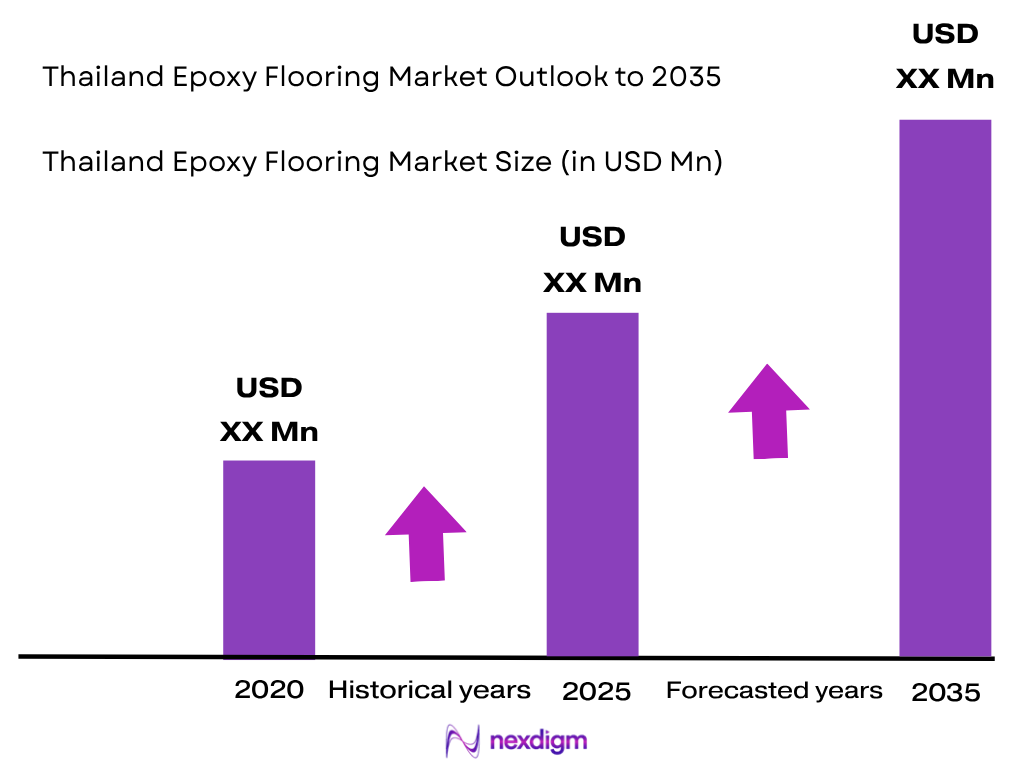
The Thailand Epoxy Flooring Market is valued at approximately ~USD XX million, supported by factories, warehouses, electronics plants, food-processing facilities, car parks and industrial refurbishment. Across the latest two comparable annual observations, registered factories increased from 72,699 to 73,710, while registered industrial investment increased from approximately THB9.02 trillion to THB9.56 trillion, enlarging the installed concrete-floor base requiring epoxy coatings, screeds, self-leveling systems and rehabilitation.
Bangkok and its surrounding provinces, together with Chonburi, Rayong and Chachoengsao, dominate the Thailand Epoxy Flooring Market because they concentrate manufacturing, electronics, logistics and industrial estates. Bangkok and its vicinities increased from 28,005 to 28,363 registered factories, while the Eastern Region increased from 12,478 to 12,791 factories. Chonburi alone increased from 5,106 to 5,220 factories, while Rayong rose from 3,132 to 3,268, supporting dense industrial flooring demand.
Market Segmentation
By Product Type
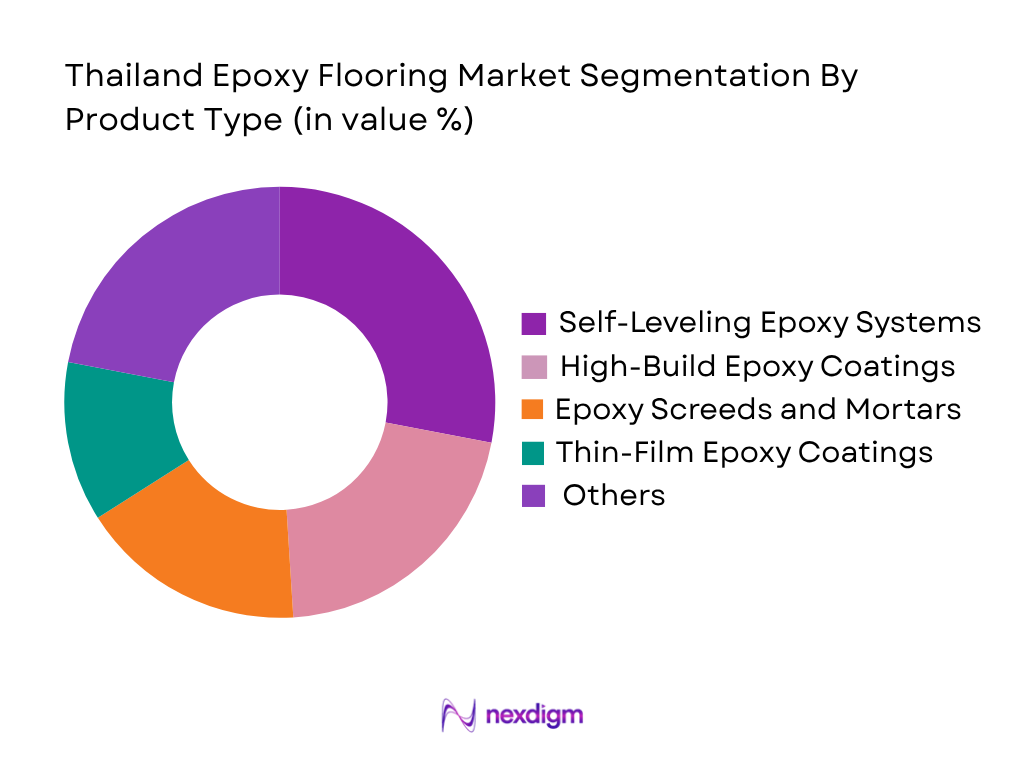
The Thailand Epoxy Flooring Market is segmented into epoxy floor coatings, self-leveling epoxy floors, high-build epoxy coatings, epoxy screeds, epoxy mortars, quartz-filled systems, ESD systems, conductive systems and chemical-resistant floors. Self-leveling epoxy systems hold the dominant market share because they provide seamless surfaces, controlled thickness, good abrasion resistance and high bond strength across factories, laboratories, hospitals, food plants and electronics facilities. Their smooth application is especially suitable for production areas where dust control, cleanability and visual floor zoning are important. Industrial systems can also combine epoxy primers, self-leveling body coats and protective topcoats to address varying mechanical loads. Thailand’s electronics and high-tech manufacturing base strengthens this segment because smooth, low-dust and easy-to-clean surfaces are commonly specified. Product portfolios available in the region also demonstrate self-leveling epoxy use for hospitals, laboratories, kitchens, factories and high-tech manufacturing facilities, supporting its central position within professional resin flooring.
By Application
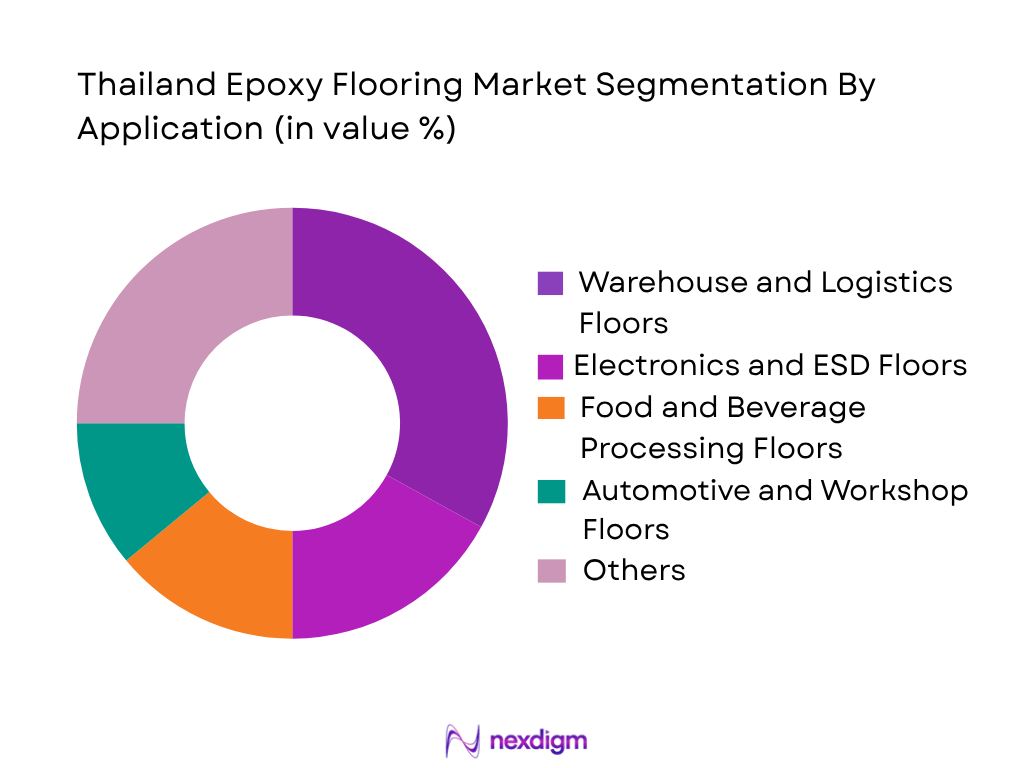
The Thailand Epoxy Flooring Market is segmented into factory production floors, warehouse floors, electronics manufacturing floors, food-processing floors, pharmaceutical and cleanroom floors, automotive facilities, data centres, laboratories and car parks. Factory production floors hold the dominant market share because Thailand operates a broad manufacturing base spanning automotive components, electronics, machinery, food processing, chemicals and industrial equipment. Manufacturing floors require resistance to forklift traffic, abrasion, oils, chemicals and localized impact, making epoxy coatings, screeds and mortar systems suitable for both new construction and refurbishment. Heavy-duty systems can also accommodate dynamic loads and repeated vehicular movement, while anti-slip aggregates improve safety in wet or process-intensive areas. Thailand had 73,710 registered factories in the latest official annual dataset, including 12,791 in the Eastern Region, which reinforces the importance of industrial production environments as the largest addressable application base for epoxy flooring.
Competitive Landscape
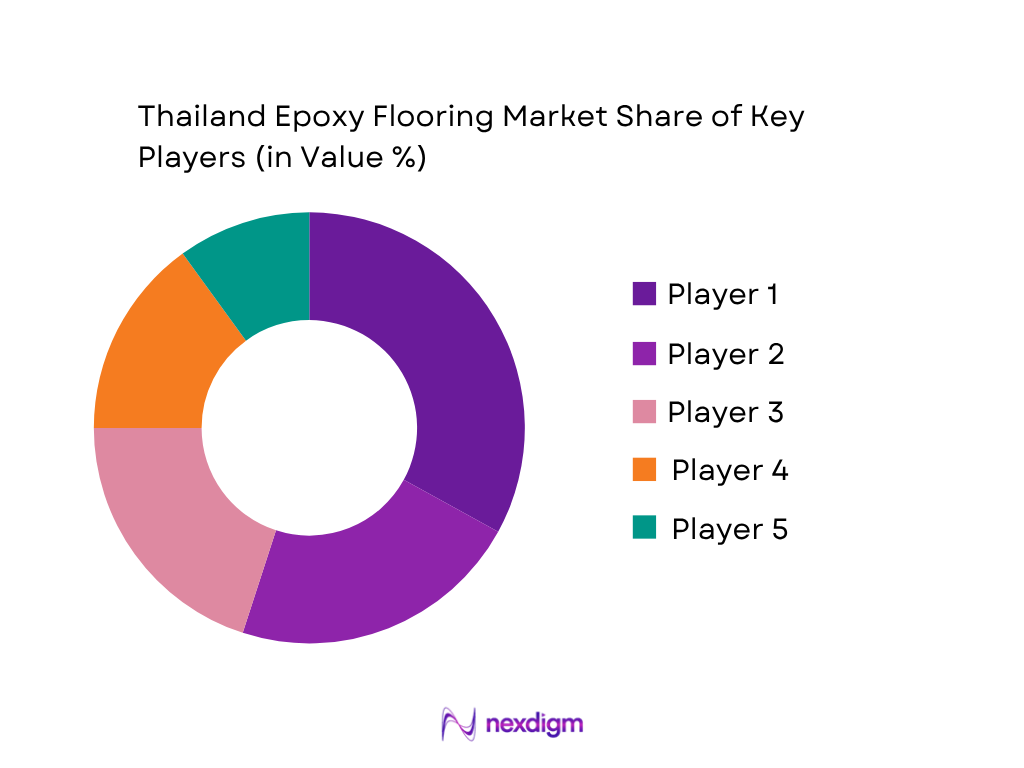
The Thailand Epoxy Flooring Market includes global construction-chemical manufacturers, coating companies and specialist resin-flooring suppliers with portfolios covering primers, self-leveling floors, heavy-duty screeds, ESD systems and chemical-resistant coatings. Competition is driven by mechanical performance, substrate preparation capability, chemical resistance, low-VOC technology, approved applicator networks and site technical support. Supplier portfolios already available in Thailand and Southeast Asia include heavy-duty epoxy screeds, low-VOC industrial coatings, moisture-barrier systems and static-dissipative floors.
| Company | Establishment Year | Headquarters | Epoxy Flooring Portfolio | Self-Leveling Capability | Heavy-Duty / Screed Capability | ESD / Conductive Capability | Chemical / Abrasion Resistance | Thailand Technical / Applicator Support |
| Sika | 1910 | Baar, Switzerland | ~ | ~ | ~ | ~ | ~ | ~ |
| Jotun | 1926 | Sandefjord, Norway | ~ | ~ | ~ | ~ | ~ | ~ |
| Fosroc | 1972 | Dubai, UAE | ~ | ~ | ~ | ~ | ~ | ~ |
| Mapei | 1937 | Milan, Italy | ~ | ~ | ~ | ~ | ~ | ~ |
| Sherwin-Williams | 1866 | Cleveland, USA | ~ | ~ | ~ | ~ | ~ | ~ |
Thailand Epoxy Flooring Market Analysis
Growth Drivers
Expansion of Industrial Manufacturing and Factory Flooring Requirements
Thailand’s large and expanding industrial base is directly increasing requirements for self-leveling epoxy floors, high-build coatings, heavy-duty epoxy screeds, anti-slip surfaces and chemical-resistant flooring. Thailand recorded 73,710 registered factories in 2024, representing registered industrial investment of approximately THB9,555,229 million. Bangkok and surrounding provinces contained 28,363 factories, while the Eastern Region contained 12,791 factories, including 5,220 in Chonburi, 3,268 in Rayong and 2,095 in Chachoengsao. New investment activity is reinforcing this installed base: investment-promotion applications reached THB1.14 trillion across 3,137 projects in 2024, including 407 electrical and electronics projects worth THB231.7 billion. These manufacturing environments require flooring capable of tolerating forklifts, pallet movement, machinery loads, oils, process chemicals and repeated cleaning. New factories create initial installation demand, while the existing factory population generates recurring resurfacing and rehabilitation requirements as concrete and coating systems deteriorate. Thailand’s macroeconomic foundation remains substantial, with 2024 GDP of USD526.52 billion and GDP per capita of USD7,346.6, supporting continued capital expenditure across industrial facilities and specification-driven flooring systems.
Electronics, Data Centre and Advanced-Technology Investment Driving Specialized Flooring
Thailand’s transition toward electronics, digital infrastructure and high-technology manufacturing is creating demand for technically advanced epoxy flooring beyond conventional factory coatings. Digital-sector investment applications reached THB243.3 billion across 150 projects in 2024, while electrical and electronics investment reached THB231.7 billion across 407 projects. The digital infrastructure pipeline expanded substantially in 2025, when Thailand received 36 data-centre projects representing more than THB728 billion across Bangkok, Chachoengsao, Chonburi, Pathum Thani, Rayong and Samut Prakan. Momentum continued in the first half of 2026, with digital investment applications reaching THB1,115,260 million across 90 projects and electrical and electronics applications reaching THB120,230 million across 179 projects. These facilities require smooth, dust-controlled and easily cleanable surfaces, while electronics production can require anti-static, ESD and conductive systems incorporating conductive primers and grounding arrangements. Data centres similarly create demand across technical rooms, service areas and equipment spaces. Thailand’s 2024 GDP of USD526.52 billion and GDP per capita of USD7,346.6 provide a strong macroeconomic base for continued investment in higher-specification industrial flooring technologies.
Market Challenges
Dependence on Imported Epoxy Raw Materials and Specialty Flooring Inputs
Thailand’s epoxy flooring industry faces supply-chain exposure because high-performance systems require epoxy resins, curing agents, reactive diluents, additives, pigments and specialized conductive or chemical-resistant components whose supply is connected to regional and international chemical value chains. Thailand imported goods worth THB10,896,480 million in 2024, including THB4,533,993 million of raw materials and intermediate products and THB2,751,095 million of capital goods. Although these national import categories are broader than flooring chemicals alone, their scale demonstrates the manufacturing economy’s dependence on externally sourced intermediate inputs. This matters for epoxy flooring because approved formulations must maintain predictable curing, adhesion, mechanical strength, electrical properties and chemical resistance across project batches. Material substitution can be especially difficult for ESD, cleanroom, food-processing and chemically resistant systems requiring documented performance. Demand-side pressure is simultaneously substantial, with Thailand operating 73,710 registered factories and registered industrial investment of approximately THB9,555,229 million in 2024. Thailand’s macroeconomic base included USD526.52 billion of GDP and USD7,346.6 GDP per capita in 2024, but the economy’s scale does not eliminate external sourcing exposure for specialty resin-flooring inputs.
Substrate Moisture, Surface Preparation and Short Industrial Shutdown Windows
Epoxy-flooring performance in Thailand is strongly dependent on concrete condition, moisture control, mechanical preparation and disciplined installation, creating a significant execution challenge in active industrial facilities. The challenge is magnified by the size of Thailand’s operating industrial base, which contained 73,710 registered factories in 2024, including 28,363 in Bangkok and surrounding provinces and 12,791 in the Eastern Region. New projects continue adding floors that must eventually be maintained: Thailand received 3,370 investment applications worth THB1,876,653 million in 2025, followed by 1,299 applications worth THB1,473,718 million during the first half of 2026. In factories and warehouses, floor rehabilitation frequently must be completed around production schedules, machinery movement and logistics operations. Inadequate grinding or shot blasting, oil contamination, weak concrete, trapped moisture, incorrect resin-hardener proportioning or premature traffic loading can cause blistering, delamination and localized failure. Short shutdown periods further increase pressure on applicators to prepare and cure systems correctly. Thailand’s 2024 GDP of USD526.52 billion and GDP per capita of USD7,346.6 underscore the economic importance of minimizing flooring-related disruption across production-intensive assets.
Market Opportunities
ESD, Conductive and Cleanroom Flooring for Digital and Electronics Facilities
Thailand’s expanding digital and electronics ecosystem creates a significant future opportunity for ESD, anti-static and electrically conductive epoxy flooring systems. Current investment provides a substantial demand foundation rather than relying on future projections. Thailand recorded 36 data-centre projects representing more than THB728 billion in 2025, distributed across Bangkok, Chachoengsao, Chonburi, Pathum Thani, Rayong and Samut Prakan. Individual projects included 2 facilities worth THB37.2 billion with a combined 120 MW IT load, alongside another Bangkok data centre valued at THB8.1 billion with 25 MW IT load. During the first half of 2026, digital-sector investment applications reached THB1,115,260 million across 90 projects, while electronics and electrical appliances generated THB120,230 million across 179 projects. These facilities expand the addressable base for seamless, low-dust surfaces and static-control systems incorporating conductive primers, grounding strips and specialist epoxy topcoats. Thailand’s 2024 GDP of USD526.52 billion and GDP per capita of USD7,346.6 support continued development of high-specification facilities where flooring performance is tied to equipment protection, cleanliness and operational reliability.
Heavy-Duty Flooring for Food, Automotive, Logistics and Factory Refurbishment
Thailand’s diversified industrial investment creates future growth potential for heavy-duty epoxy screeds, abrasion-resistant coatings, anti-slip systems, chemical-resistant floors and rapid-refurbishment products. During the first half of 2026, agriculture and food-processing investment applications reached THB61,388 million across 131 projects, logistics and high-value services reached THB40,217 million across 170 projects, automotive and components reached THB25,662 million across 122 projects, and machinery, automation and robotics reached THB13,093 million across 82 projects. These industries generate distinct flooring requirements: food plants need seamless and washable process surfaces; automotive plants require resistance to oils, vehicle movement and mechanical loads; logistics facilities create high forklift and pallet traffic; machinery facilities require impact-resistant production floors. Thailand also already operates 73,710 registered factories, creating a large refurbishment base where worn concrete and existing coatings require resurfacing during maintenance shutdowns. This supports opportunities for high-build epoxy, quartz broadcast and mortar systems capable of rapid return to service. Thailand’s USD526.52 billion GDP and USD7,346.6 GDP per capita in 2024 provide the macroeconomic foundation for sustained investment in industrial asset performance and lifecycle maintenance.
Future Outlook
The Thailand Epoxy Flooring Market is projected to expand at approximately ~XX.X% CAGR during 2026–2035, supported by manufacturing investment, data centres, electronics production, logistics facilities and factory modernization. Future demand is expected to shift toward self-leveling, ESD, conductive, chemical-resistant and low-VOC flooring systems, particularly in high-specification industrial facilities.
Investment promotion applications reached THB1.14 trillion across 3,137 projects in 2024, with the digital sector accounting for 150 projects worth THB243.3 billion. Data centres, cloud services, semiconductor activity and advanced electronics were major contributors. These investments directly expand demand for smooth, dust-controlled, conductive and technically specified floors used in production rooms, electrical spaces, laboratories and service areas.
Major Players
- Sika (Thailand) Limited
- Jotun Thailand Limited
- Fosroc Thailand
- Mapei Thailand
- Tremco CPG / Flowcrete Asia
- Master Builders Solutions Thailand
- Pidilite Bamco Limited
- TOA Paint (Thailand) Public Company Limited
- Nippon Paint Decorative Coatings Thailand
- Beger Co., Ltd.
- MC-Bauchemie Thailand
- ARDEX Thailand
- Saint-Gobain Weber Thailand
- Sherwin-Williams Thailand
- Chokwang Paint Thailand
Key Target Audience
- Epoxy Flooring and Resin System Manufacturers
- Specialist Industrial Flooring Applicators
- Industrial Facility and Factory Owners
- Electronics, Automotive and Food Processing Manufacturers
- Warehouse, Logistics and Data Centre Developers
- Construction Chemical Distributors
- Investments and Venture Capitalist Firms
- Government and Regulatory Bodies (Department of Industrial Works, Thai Industrial Standards Institute, Board of Investment of Thailand, Eastern Economic Corridor Office, Ministry of Industry)
Research Methodology
Step 1: Identification of Key Variables
The initial phase involves constructing an ecosystem map encompassing epoxy resin suppliers, floor-system manufacturers, distributors, applicators, general contractors, industrial estate developers and facility owners. Key variables include installed floor area, system thickness, resin consumption, mechanical load, chemical exposure, substrate moisture, ESD requirement and refurbishment frequency.
Step 2: Market Analysis and Construction
Historical Thailand Epoxy Flooring Market development is assessed through top-down and bottom-up analysis. The top-down framework evaluates registered factories, industrial investment, warehouse development, electronics production and data-centre activity. Bottom-up construction uses installed area, flooring thickness, resin consumption per square metre, application type and project refurbishment cycles to estimate demand.
Step 3: Hypothesis Validation and Expert Consultation
Market hypotheses are validated through CATI-based consultations with flooring manufacturers, applicators, industrial contractors, factory engineers, distributors and project specifiers. These discussions assess demand for self-leveling systems, epoxy screeds, ESD floors, anti-slip surfaces, moisture barriers, chemical resistance and contractor productivity, while also validating typical flooring-system selection criteria.
Step 4: Research Synthesis and Final Output
The final phase triangulates official industrial statistics, supplier product portfolios, primary contractor inputs and technical performance data. Top-down industrial indicators are reconciled with bottom-up installed-area calculations to establish segment shares, competitor positioning and future demand. Regional analysis separately evaluates Bangkok, the Eastern Economic Corridor and other industrial clusters because flooring intensity differs significantly by end-use industry.

- Executive Summary
- Research Methodology (Market Definitions and Assumptions, Thailand Epoxy Flooring Market Classification, Epoxy Floor Coating Assessment, Self-Leveling Epoxy Assessment, High-Build Epoxy Assessment, Epoxy Screed Assessment, Epoxy Mortar Assessment, Quartz-Filled Epoxy Assessment, Water-Based Epoxy Assessment, Solvent-Free Epoxy Assessment, High-Solids Epoxy Assessment, ESD Flooring Assessment, Anti-Static Flooring Assessment, Conductive Flooring Assessment, Chemical-Resistant Flooring Assessment, Anti-Slip Flooring Assessment, Food-Grade Flooring Assessment, Cleanroom Flooring Assessment, Pharmaceutical Flooring Assessment, Parking Deck Flooring Assessment, Moisture Barrier Assessment, Concrete Substrate Assessment, Surface Preparation Assessment, Pull-Off Adhesion Assessment, Abrasion Resistance Assessment, Impact Resistance Assessment, Chemical Resistance Assessment, Compressive Strength Assessment, Shore D Hardness Assessment, Slip Resistance Assessment, VOC Assessment, Application Thickness Assessment, Cure-Time Assessment, Substrate Moisture Assessment)

- Definition and Scope
- Thailand Epoxy Flooring Industry Evolution and Development of Conventional Epoxy Floor Paints, Two-Component Epoxy Coatings, High-Build Epoxy Floors, Self-Leveling Epoxy Systems, Epoxy Screeds, Epoxy Mortars, Quartz-Filled Epoxy Systems, Anti-Slip Epoxy Floors, Chemical-Resistant Epoxy Floors, Food and Beverage Flooring Systems, Hygienic Seamless Epoxy Floors, ESD Flooring, Anti-Static Epoxy Flooring, Conductive Epoxy Flooring, Cleanroom Floors, Pharmaceutical Flooring, Car Park Flooring, Moisture-Tolerant Epoxy Systems, Water-Based Epoxy Coatings, Solvent-Free Epoxy Systems, Low-VOC Epoxy Floors, Rapid-Cure Epoxy Systems and Heavy-Duty Industrial Flooring
- Epoxy Flooring Value Chain Analysis
- Epoxy Flooring Supply Chain Analysis
- Epoxy Resin Suppliers, Amine Hardener Suppliers, Reactive Diluent Suppliers, Silica and Quartz Aggregate Suppliers, Pigment Suppliers, Mineral Filler Suppliers, Anti-Slip Aggregate Suppliers, Conductive Filler Suppliers, Primer Manufacturers, Flooring System Manufacturers, Local Resin Blenders, Floor-Coating Formulators, Importers, Construction Chemical Distributors, Specialist Flooring Applicators, General Contractors, Industrial Contractors, Facility Management Companies, Factory Owners, Warehouse Operators and Industrial Estate Developers

- Growth Drivers (Eastern Economic Corridor Industrial Development, Electronics Manufacturing Expansion, Automotive Production Facilities, Food and Beverage Processing Growth, Data Centre Construction, Warehouse and Logistics Development, Factory Modernization, Industrial Floor Refurbishment, Cleanroom Development, Pharmaceutical Manufacturing, Heavy Forklift Traffic, Hygiene Requirements, Chemical-Resistance Requirements)
- Market Challenges (Epoxy Resin Feedstock Dependency, Substrate Moisture, Moisture Vapour Pressure, Osmotic Blistering, Poor Surface Preparation, Weak Concrete Substrates, Oil Contamination, Pinholes and Air Entrapment, Inaccurate Resin-Hardener Mixing, Pot-Life Constraints, High Ambient Temperature, Shutdown Limitations, Skilled Applicator Availability, UV Discoloration, Competitive Pricing Pressure)
- Market Opportunities (ESD and Conductive Epoxy Floors, Data Centre Flooring, Electronics Cleanroom Flooring, Food-Grade Seamless Floors, Heavy-Duty Epoxy Screeds, Chemical-Resistant Flooring, Rapid-Cure Refurbishment Systems, Low-VOC and Water-Based Epoxy, Moisture-Tolerant Epoxy Primers, Decorative Industrial Flooring, Factory Floor Rehabilitation, Logistics Warehouse Flooring, Local Resin Formulation and Blending)
- Market Trends (Solvent-Free Epoxy Adoption, Self-Leveling Systems, High-Solids Technology, Low-VOC Floors, ESD Flooring Growth, Conductive Flooring, Quartz-Broadcast Systems, Anti-Slip Aggregates, Seamless Hygienic Floors, Rapid Return-to-Service, Moisture Barrier Integration, Decorative Colour Zoning, Mechanical Surface Preparation, Lifecycle-Based Flooring Maintenance)
- Government Regulations and Standards (Thailand Factory Act Requirements, Department of Industrial Works Requirements, Thai Industrial Standards Applicable to Flooring Materials, Food Manufacturing Hygiene Requirements, GMP Facility Requirements, HACCP-Compatible Flooring Considerations, Cleanroom Requirements, Workplace Safety Requirements, VOC and Chemical Safety Requirements, ASTM D4060 Abrasion Testing, ASTM D4541 Pull-Off Adhesion, ASTM D2240 Hardness Testing, ASTM D543 Chemical Resistance, ASTM C579 Compressive Strength, EN 13813 Screed Material Classification)
- SWOT Analysis
- Porter’s Five Forces Analysis
- PESTLE Analysis
- Stakeholder Ecosystem
- Epoxy Flooring Manufacturing Applicator and Industrial Project Ecosystem

- By Market Value (2020-2025)
- By Installed Flooring Area (2020-2025)
- By Epoxy Resin Consumption (2020-2025)
- By Primer Consumption (2020-2025)
- By Self-Leveling Epoxy Consumption (2020-2025)
- By High-Build Epoxy Consumption (2020-2025)
- By Epoxy Screed Consumption (2020-2025)
- By Epoxy Mortar Consumption (2020-2025)
- By ESD and Conductive Flooring Consumption (2020-2025)
- By Chemical-Resistant Flooring Consumption (2020-2025)
- By Food and Beverage Flooring Consumption (2020-2025)
- By Cleanroom Flooring Consumption (2020-2025)
- By Industrial Flooring Consumption (2020-2025)
- By Flooring Refurbishment Consumption (2020-2025)

- By Product Type (In Value %)
Epoxy Floor Coatings
Self-Leveling Epoxy Floors
High-Build Epoxy Coatings
Epoxy Screeds
Epoxy Mortars
Quartz-Filled Epoxy Systems
Epoxy Terrazzo Systems
Water-Based Epoxy Coatings
Solvent-Free Epoxy Systems
ESD Epoxy Systems
Anti-Static Epoxy Systems
Conductive Epoxy Systems
Anti-Slip Epoxy Systems
Chemical-Resistant Epoxy Systems
Decorative Epoxy Floors
Epoxy Primers and Sealers - By Flooring System Thickness (In Value %)
Thin-Film Epoxy Coatings Below 1 mm
High-Build Epoxy Systems 1–2 mm
Self-Leveling Epoxy Systems 2–3 mm
Heavy-Duty Epoxy Systems 3–5 mm
Epoxy Screed Systems 4–6 mm
Heavy-Duty Epoxy Mortar Systems Above 6 mm
Multi-Layer Broadcast Systems
Quartz and Aggregate-Filled Systems - By Application (In Value %)
Factory Production Floors
Warehouse Floors
Electronics Manufacturing Floors
Food and Beverage Processing Floors
Pharmaceutical and Cleanroom Floors
Automotive Manufacturing Floors
Chemical and Petrochemical Plant Floors
Data Centre Floors
Laboratory Floors
Hospital and Healthcare Floors
Commercial Kitchen Floors
Car Park Floors
Aircraft Hangar Floors
Workshop Floors
Cold Storage Floors
Retail and Showroom Floors
Utility and Plant Room Floors - By Performance Requirement (In Value %)
High Abrasion Resistance
High Impact Resistance
High Compressive Strength
Chemical Resistance
Oil and Grease Resistance
Anti-Slip Performance
Anti-Static Performance
ESD Performance
Electrical Conductivity
Low-VOC Performance
Low-Odour Performance
Hygienic Seamless Finish
High Bond Strength
Moisture-Tolerant Performance
Rapid Cure
Forklift and Heavy-Traffic Resistance - By Region (In Value %)
Bangkok Metropolitan Region
Bangkok
Samut Prakan
Pathum Thani
Ayutthaya
Chonburi
Rayong
Chachoengsao
Eastern Economic Corridor
Central Thailand Industrial Corridor
Northern Thailand
Northeastern Thailand
Southern Thailand

- Market Share of Major Players (By Thailand Revenue, Installed Flooring Area, Epoxy Coating Portfolio, Self-Leveling Portfolio, High-Build Epoxy Portfolio, Epoxy Screed Portfolio, ESD and Conductive Flooring Capability, Chemical-Resistant Flooring Capability, Food and Pharmaceutical Flooring Exposure, Automotive Project Exposure, Electronics Project Exposure, Warehouse and Data Centre Exposure, Thailand Manufacturing or Blending Capacity, Approved Applicator Network, Technical Laboratory Capability)
- Cross Comparison Parameters (Epoxy Coating Self-Leveling Screed and Mortar Portfolio Breadth, ESD Anti-Static and Conductive Flooring Capability, Chemical Abrasion Impact and Heavy-Traffic Performance Capability, Food Pharmaceutical Cleanroom and Hygienic Flooring Capability, Thailand Automotive Electronics Data Centre and Industrial Project Reference Base, Moisture Barrier Surface Preparation and Concrete Repair System Capability, Thailand Manufacturing Blending Warehousing and Approved Applicator Network Reach, Specification Support Flooring Design Contractor Training and Project-Site Technical Service Capability)
- SWOT Analysis of Major Players
- Competitive Positioning Matrix
- Major Companies
Sika (Thailand) Limited
Jotun Thailand Limited
Fosroc Thailand
Mapei Thailand
Tremco CPG / Flowcrete Asia
Master Builders Solutions Thailand
Pidilite Bamco Limited
TOA Paint (Thailand) Public Company Limited
Nippon Paint Decorative Coatings Thailand
Beger Co., Ltd.
MC-Bauchemie Thailand
ARDEX Thailand
Saint-Gobain Weber Thailand
Sherwin-Williams Thailand
Chokwang Paint Thailand

- Electronics Manufacturer Requirement Assessment
- Automotive Manufacturer Requirement Assessment
- Food Processor Requirement Assessment
- Pharmaceutical Manufacturer Requirement Assessment
- Warehouse Operator Requirement Assessment
- Data Centre Developer Requirement Assessment
- Industrial Estate Operator Requirement Assessment
- Factory Owner Flooring Requirement Assessment
- Hospital and Laboratory Requirement Assessment
- Chemical and Petrochemical Facility Requirement Assessment
- General Contractor Procurement Assessment
- Facility Management Requirement Assessment
- Technical Specification and Applicator Support Requirement Assessment

- By Market Value (2026-2035)
- By Installed Flooring Area (2026-2035)
- By Epoxy Resin Consumption (2026-2035)
- By Primer Consumption (2026-2035)
- By Self-Leveling Epoxy Consumption (2026-2035)
- By High-Build Epoxy Consumption (2026-2035)
- By Epoxy Screed Consumption (2026-2035)
- By Epoxy Mortar Consumption (2026-2035)
- By ESD and Conductive Flooring Consumption (2026-2035)
- By Chemical-Resistant Flooring Consumption (2026-2035)
- By Food and Beverage Flooring Consumption (2026-2035)
- By Cleanroom Flooring Consumption (2026-2035)
- By Industrial Flooring Consumption (2026-2035)
- By Flooring Refurbishment Consumption (2026-2035)


 Request a Sample
 Ask for Customization
 Get a Quote
 Enquire Now
