
 Download PDF
Market Overview
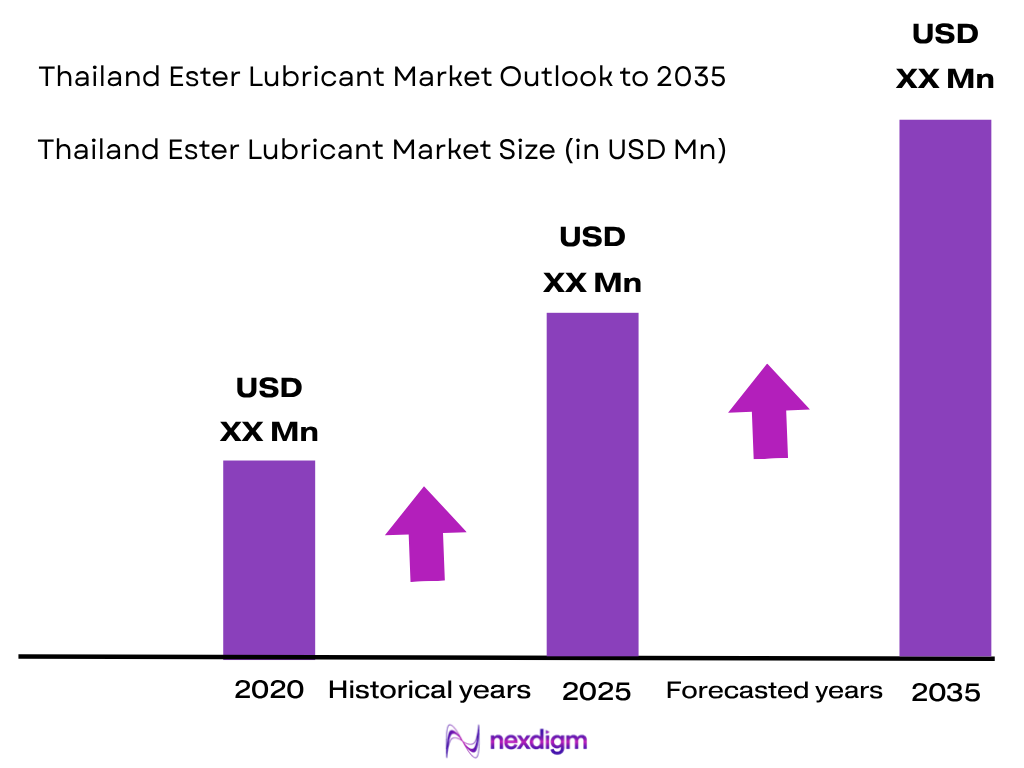
The Thailand Ester Lubricant Market is valued at approximately USD ~ million in 2024, supported by rising demand for synthetic lubricants across automotive manufacturing, industrial machinery, marine operations, and specialty applications. The market size is driven by increasing adoption of high-performance ester-based lubricants due to their superior thermal stability, biodegradability, oxidation resistance, and extended equipment protection capabilities. The market has expanded with Thailand’s growing automotive production base, industrial infrastructure development, and demand for environmentally acceptable lubrication solutions.
The Thailand Ester Lubricant Market is concentrated in major industrial regions including Bangkok Metropolitan Area, Eastern Economic Corridor (Chonburi, Rayong, and Chachoengsao), and major manufacturing clusters due to the presence of automotive OEMs, petrochemical facilities, industrial machinery manufacturers, and export-oriented production units. The Eastern Economic Corridor dominates ester lubricant consumption due to its advanced manufacturing ecosystem, automotive production facilities, petrochemical complexes, and increasing requirement for specialty industrial lubricants.
Market Segmentation
By Ester Type
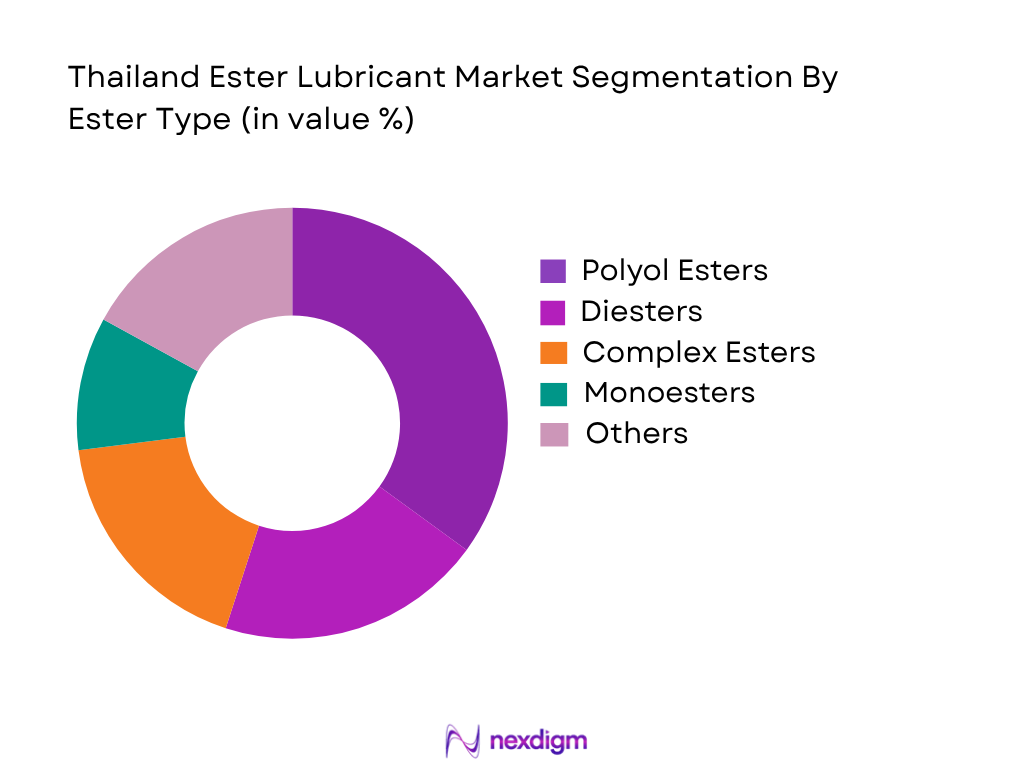
The Thailand Ester Lubricant Market is segmented by ester type into monoesters, diesters, polyol esters, complex esters, trimellitate esters, phosphate esters, neopolyol esters, and other specialty esters. Among these, polyol esters account for the dominant market share in Thailand due to their extensive utilization in high-temperature industrial applications, aviation lubrication, refrigeration systems, and advanced automotive lubricant formulations. Polyol esters provide excellent thermal stability, low volatility, oxidation resistance, and compatibility with demanding operating environments. Increasing requirements for longer lubricant service intervals and improved equipment efficiency across manufacturing industries have supported their adoption. The growth of automotive production, industrial machinery utilization, and specialty lubricant demand has further strengthened the position of polyol ester lubricants within Thailand’s ester lubricant market.
By Application
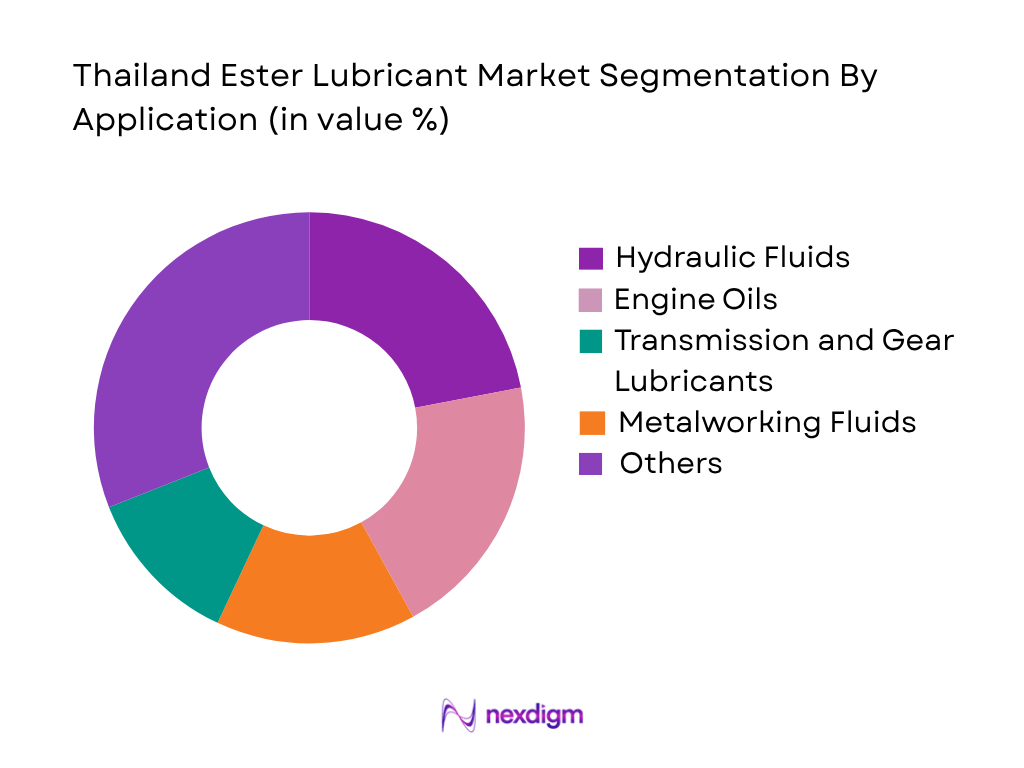
The Thailand Ester Lubricant Market is segmented by application into engine oils, transmission and gear lubricants, electric vehicle lubricants, hydraulic fluids, compressor lubricants, turbine lubricants, metalworking fluids, greases, marine lubricants, and refrigeration lubricants. Industrial hydraulic fluids and automotive lubricants represent leading application segments due to Thailand’s strong manufacturing sector and automotive production ecosystem. Ester-based hydraulic fluids are increasingly preferred in industrial applications because of their biodegradability, high performance under extreme temperatures, and improved equipment protection. Automotive applications are also expanding due to increasing demand for premium engine oils, transmission fluids, and electric vehicle-specific lubrication solutions. The presence of global automotive manufacturers and industrial equipment operators has contributed to the increasing adoption of ester lubricant technologies.
Competitive Landscape
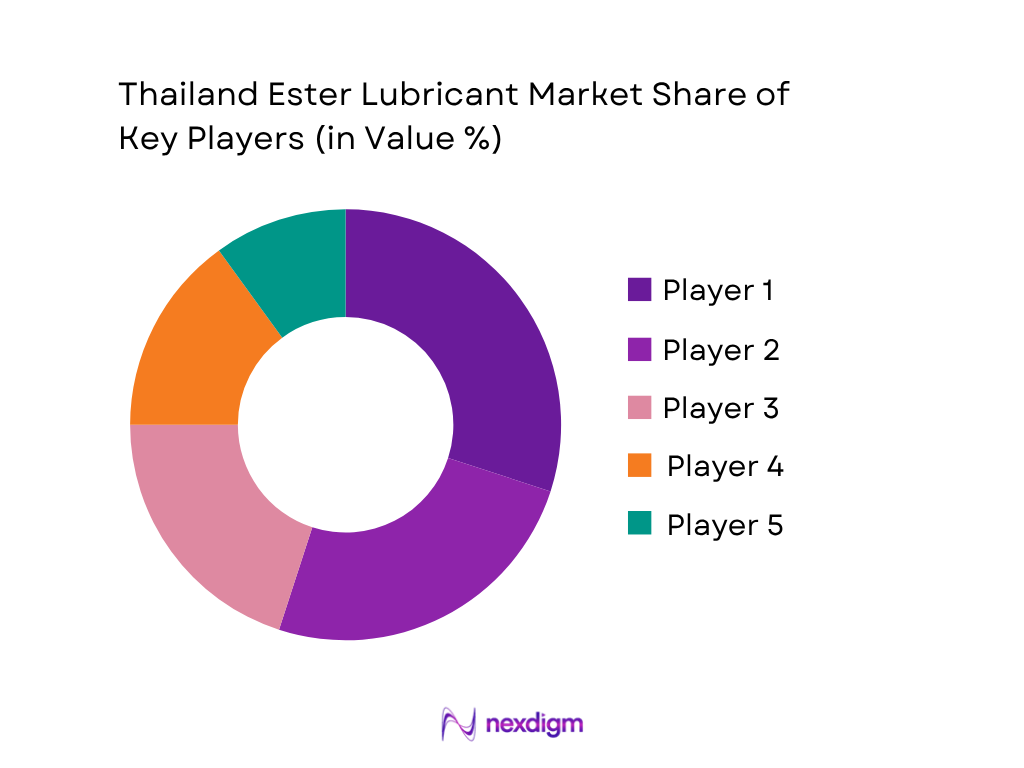
The Thailand Ester Lubricant Market is characterized by the presence of global lubricant manufacturers, specialty chemical companies, and regional lubricant suppliers. The competitive environment is influenced by ester technology capabilities, formulation expertise, OEM approvals, distribution networks, and supply chain strength. Major companies compete through advanced synthetic ester formulations, bio-based lubricant solutions, industrial application expertise, and partnerships with automotive and manufacturing companies.
| Company | Establishment Year | Headquarters | Ester Technology Portfolio | Major Applications | Thailand Market Presence | Distribution Capability | End-User Industries | Sustainability Focus |
| ExxonMobil Corporation | 1870 | USA | ~ | ~ | ~ | ~ | ~ | ~ |
| BASF Corporation | 1865 | Germany | ~ | ~ | ~ | ~ | ~ | ~ |
| Croda International Plc | 1925 | UK | ~ | ~ | ~ | ~ | ~ | ~ |
| LANXESS Corporation | 2004 | Germany | ~ | ~ | ~ | ~ | ~ | ~ |
| The Lubrizol Corporation | 1928 | USA | ~ | ~ | ~ | ~ | ~ | ~ |
Thailand Ester Lubricant Market Analysis
Growth Drivers
Expansion of Thailand’s Automotive Manufacturing Base and Electric Vehicle Production Ecosystem
Thailand’s automotive manufacturing ecosystem is supporting increased demand for ester lubricants used in advanced vehicle systems, manufacturing equipment, transmission applications, and electric vehicle components. The country produced 1,468,997 vehicles in 2024, according to the Federation of Thai Industries (FTI), demonstrating continued strength of Thailand’s automotive production infrastructure. The country exported 857,887 vehicles during the same period, highlighting the importance of automotive manufacturing within Thailand’s industrial economy. The Thailand Automotive Institute reported that the country has more than 2,000 automotive parts manufacturers, creating a broad industrial ecosystem requiring specialized lubricants for machining, assembly, testing, and maintenance operations. The expansion of battery electric vehicle production further supports demand for ester-based fluids, as Thailand recorded 227,730 newly registered battery electric vehicles in 2024 according to the Department of Land Transport. Thailand’s Eastern Economic Corridor, particularly Chonburi, Rayong, and Chachoengsao, continues to attract automotive investments due to existing manufacturing infrastructure and supply chain connectivity. According to the World Bank, Thailand’s GDP reached approximately USD 526 billion in 2024, reflecting the scale of economic activity supporting industrial lubricant consumption. These automotive and industrial developments create increasing requirements for high-performance ester lubricants with improved thermal stability, oxidation resistance, and extended operating capability.
Growth of Industrial Manufacturing and Machinery-Intensive Industries
Thailand’s industrial manufacturing sector provides significant opportunities for ester lubricant adoption due to increasing utilization of machinery, automation systems, and advanced production technologies. The World Bank reported Thailand’s manufacturing sector remained one of the major contributors to economic activity, supported by exports, electronics production, automotive manufacturing, and industrial processing industries. Thailand recorded merchandise exports exceeding USD 300 billion in 2024, according to the Ministry of Commerce, demonstrating strong manufacturing and export-oriented production capacity. Industries including petrochemicals, electronics, food processing, metal fabrication, and heavy machinery require specialized lubrication solutions such as ester-based hydraulic fluids, compressor oils, turbine lubricants, and metalworking fluids. The Eastern Economic Corridor contains more than 40 industrial estates and serves as a major manufacturing hub, according to the Eastern Economic Corridor Office, increasing demand for advanced industrial maintenance solutions. Thailand’s industrial sector also benefits from foreign direct investment inflows, with the Board of Investment approving more than 2,000 investment applications in 2024 across various industries. These manufacturing developments support ester lubricant adoption because industrial operators increasingly require lubricants capable of improving equipment reliability, reducing downtime, and supporting environmentally responsible production systems.
Market Challenges
High Dependence on Imported Specialty Ester Raw Materials and Advanced Lubricant Components
Thailand’s ester lubricant market faces supply chain challenges due to dependence on imported specialty chemicals, ester base stocks, and advanced lubricant additives required for high-performance formulations. Although Thailand has a developed petrochemical industry and strong agricultural feedstock availability, domestic production of specialized ester molecules such as polyol esters, complex esters, and aviation-grade esters remains limited. Thailand imported chemical products valued at approximately USD 56 billion in 2024, according to the Ministry of Commerce trade statistics, reflecting the country’s dependence on international chemical supply networks. The lubricant manufacturing industry mainly performs blending and formulation activities, while several advanced ester technologies rely on overseas suppliers. Global supply chain disruptions, transportation limitations, and availability fluctuations of chemical intermediates can affect supply consistency for lubricant producers. Thailand’s dependence on imported specialty chemicals is further influenced by the requirement for internationally approved formulations used in automotive, aerospace, and industrial applications. According to the International Trade Centre data, Thailand continues to maintain significant chemical import activity due to industrial demand. This dependency creates challenges related to supply security, production flexibility, and technology localization for ester lubricant manufacturers seeking to expand within Thailand.
Limited Ester Lubricant Adoption Among Small and Medium Industrial Operators
The adoption of ester lubricants in Thailand is challenged by limited technical awareness and slower technology transition among small and medium industrial enterprises. Thailand has approximately 3.2 million SMEs registered across different economic sectors, according to the Office of Small and Medium Enterprises Promotion (OSMEP), representing a significant portion of industrial and commercial activity. Many SMEs operate with cost-focused maintenance strategies and continue using conventional mineral-based lubricants due to established purchasing practices and existing equipment compatibility. Ester lubricants require application-specific selection, technical evaluation, and equipment compatibility assessment, which can increase adoption complexity for smaller industrial users. The Ministry of Industry Thailand has highlighted the importance of technology upgrading among SMEs to improve manufacturing efficiency and competitiveness. Industrial sectors such as metal processing, machinery repair, food processing, and small-scale manufacturing represent potential users but often lack dedicated lubrication engineering capabilities. The requirement for technical support, lubricant performance testing, and maintenance optimization can slow adoption among these users. Increasing distributor support, OEM recommendations, and awareness regarding benefits such as improved thermal performance and longer equipment protection remain important factors influencing future ester lubricant adoption across Thailand’s SME industrial base.
Market Opportunities
Increasing Demand for Environmentally Acceptable Lubricants in Marine and Industrial Applications
Thailand’s environmental sustainability initiatives and expanding marine activities create opportunities for ester lubricants, particularly biodegradable and environmentally acceptable lubricant solutions. Thailand operates major maritime infrastructure through ports including Laem Chabang Port, which handled more than 8 million TEUs of container throughput in 2024 according to the Port Authority of Thailand. Marine equipment, hydraulic systems, offshore machinery, and industrial applications increasingly require lubricants with reduced environmental impact and improved biodegradability. Ester-based lubricants provide advantages such as renewable feedstock compatibility, high lubricity, and improved performance under demanding operating conditions. Thailand’s agricultural sector also provides potential feedstock opportunities, with the Office of Agricultural Economics reporting palm oil production exceeding 18 million tonnes in 2024. This availability of oleochemical resources supports development of bio-based ester lubricant solutions. The country’s sustainability policies and industrial environmental regulations encourage industries to adopt technologies that reduce ecological impact. Applications including marine hydraulics, forestry equipment, agricultural machinery, and industrial systems operating near environmentally sensitive areas represent potential growth areas for ester lubricant suppliers. Increasing focus on sustainable manufacturing practices creates opportunities for manufacturers offering renewable ester formulations and environmentally acceptable lubrication technologies.
Expansion of Electric Vehicle Manufacturing and Advanced Automotive Lubrication Requirements
Thailand’s transition toward electric vehicle manufacturing is creating opportunities for ester lubricant applications in EV thermal management systems, e-axle lubrication, electric motors, and advanced automotive components. Thailand recorded 227,730 newly registered battery electric vehicles in 2024, according to the Department of Land Transport, indicating rapid development of the domestic EV ecosystem. The Board of Investment Thailand approved significant investments in electric vehicle manufacturing, battery production, and related supply chains, strengthening Thailand’s position as a regional EV production center. The Thailand Automotive Institute reported that the automotive ecosystem includes more than 2,000 parts suppliers, providing opportunities for integration of advanced lubricant technologies across manufacturing operations. Ester lubricants are increasingly relevant for EV applications due to their thermal stability, electrical compatibility, and ability to perform under high operating temperatures. The development of EV production facilities within the Eastern Economic Corridor increases demand for specialized manufacturing fluids and component lubrication solutions. Thailand’s industrial transformation toward advanced mobility technologies creates opportunities for lubricant manufacturers to develop customized ester-based solutions for electric vehicles, automotive suppliers, and next-generation mobility applications.
Future Outlook
Over the next decade, the Thailand Ester Lubricant Market is expected to experience continued expansion driven by increasing demand for sustainable lubrication solutions, growth of electric vehicle manufacturing, industrial modernization, and rising adoption of high-performance synthetic lubricants. The market is expected to benefit from advancements in ester chemistry, renewable feedstock utilization, and increasing environmental requirements across industries. The future market development will be influenced by automotive electrification, expansion of manufacturing activities within the Eastern Economic Corridor, and increasing demand for biodegradable lubricants in marine and industrial applications.
Major Players
- ExxonMobil Corporation
- Shell Thailand Limited
- BASF Corporation
- Croda International Plc
- LANXESS Corporation
- The Lubrizol Corporation
- Cargill Incorporated
- Afton Chemical Corporation
- Vantage Performance Materials
- Zschimmer & Schwarz Lubricant Components
- Quaker Houghton
- NYCO
- Valtris Specialty Chemicals
- Petronas Lubricants International
- Idemitsu Kosan Co., Ltd.
Key Target Audience
- Automotive OEMs and vehicle manufacturers
- Industrial machinery manufacturers and equipment operators
- Lubricant manufacturers and blending companies
- Specialty chemical and ester base stock producers
- Marine operators and shipping companies
- Investments and venture capitalist firms (Private equity firms, industrial investment funds, chemical sector investors)
- Government and regulatory bodies (Ministry of Industry Thailand, Department of Industrial Works, Energy Policy and Planning Office, Pollution Control Department)
- Petrochemical and oleochemical companies
Research Methodology
Step 1: Identification of Key Variables
The initial phase involves developing an ecosystem map covering all major stakeholders operating within the Thailand Ester Lubricant Market. This includes ester manufacturers, lubricant formulators, additive suppliers, automotive OEMs, industrial users, distributors, and regulatory organizations. Secondary research sources are analyzed to identify critical market variables including ester consumption patterns, application demand, supply dynamics, and industry development factors.
Step 2: Market Analysis and Construction
This phase involves compiling historical market information related to Thailand’s ester lubricant consumption, industrial applications, import dependency, and lubricant manufacturing activities. Market evaluation includes analysis of ester base stock utilization, application-level demand, end-user industries, and distribution channels. Revenue and volume assessments are developed through bottom-up and top-down market sizing approaches.
Step 3: Hypothesis Validation and Expert Consultation
Market assumptions and findings are validated through interviews with industry participants including lubricant manufacturers, ester suppliers, distributors, automotive companies, and industrial users. Computer-assisted telephone interviews (CATIs) and expert discussions provide operational insights related to pricing trends, product demand, competitive positioning, and technology adoption.
Step 4: Research Synthesis and Final Output
The final stage integrates primary and secondary research findings to create a comprehensive assessment of the Thailand Ester Lubricant Market. Data collected from manufacturers, distributors, and end users is evaluated to validate market estimates, competitive analysis, segmentation insights, and future growth opportunities.

- Executive Summary
- Research Methodology (Market Definition and Scope, Thailand Ester Lubricant Market Classification, Ester Base Stock Mapping, Ester Chemistry Assessment, Ester Molecular Structure Assessment, Monoester and Diester Evaluation, Polyol Ester Assessment, Complex Ester Assessment, Trimellitate Ester Assessment, Phosphate Ester Assessment, Synthetic and Bio-Based Ester Assessment, Viscosity Grade Mapping, Performance Property Assessment, Application-Level Demand Analysis, End-Use Industry Assessment, Lubricant Formulation Mapping, Base Oil Supply Assessment, Domestic Blending Capacity Assessment, Import and Export Trade Analysis, Raw Material Supply Assessment, Palm Oil-Based Feedstock Assessment, Petrochemical Feedstock Assessment, Demand-Side Assessment, Supply-Side Assessment, Top-Down Market Sizing, Bottom-Up Market Sizing, Primary Industry Interviews)

- Definition and Scope
- Thailand Ester Lubricant Industry Evolution and Development of Synthetic Base Oil Technology, Automotive Manufacturing Lubricant Demand, Electric Vehicle Lubrication Requirements, Industrial Machinery Lubrication, Petrochemical Industry Applications, Marine Lubrication Requirements and Bio-Based Lubricant Development
- Ester Lubricant Value Chain Analysis
- Ester Lubricant Supply Chain Analysis
- Palm Oil and Oleochemical Feedstock Suppliers, Petrochemical Feedstock Suppliers, Ester Base Stock Manufacturers, Specialty Ester Producers, Lubricant Additive Manufacturers, Lubricant Blenders, Industrial Lubricant Manufacturers, Automotive Lubricant Suppliers, Marine Lubricant Suppliers, Distributors, Automotive OEMs, Industrial OEMs and End-Use Industries
- Ester Lubricant Integration Across Automotive Engine Oils, Transmission Fluids, Electric Vehicle Fluids, Gear Lubricants, Hydraulic Fluids, Compressor Oils, Turbine Lubricants, Metalworking Fluids, Greases, Marine Lubricants, Refrigeration Lubricants and Environmentally Acceptable Lubricants

- Growth Drivers (Automotive Manufacturing Hub Expansion, Electric Vehicle Production Growth, Demand for High-Performance Synthetic Lubricants, Industrial Automation Expansion, Rising Machinery Efficiency Requirements, Growth of Environmentally Acceptable Lubricants, Expansion of Petrochemical and Manufacturing Industries, Increasing Adoption of Premium Lubricants, Demand for High Temperature Lubrication Solutions)
- Market Challenges (High Ester Lubricant Cost Compared with Mineral-Based Lubricants, Imported Ester Base Stock Dependency, Limited Domestic Ester Production Capacity, Raw Material Price Volatility, Palm Oil Feedstock Price Fluctuation, Formulation Compatibility Constraints, Limited End-User Awareness, Competition from PAO and Other Synthetic Base Stocks, Hydrolytic Stability Challenges)
- Market Opportunities (Bio-Based Ester Expansion, Electric Vehicle Thermal Management Applications, ASEAN Export Manufacturing Growth, Environmentally Acceptable Hydraulic Fluids, Marine Biodegradable Lubricants, Advanced Metalworking Fluids, Food-Grade Lubricants, Renewable Feedstock-Based Ester Development, Industrial Equipment Modernization)
- Market Trends (Shift Toward Synthetic Base Stocks, Bio-Based Lubricant Adoption, Renewable Feedstock Utilization, Low-Volatility Ester Formulations, Electric Vehicle Lubricant Development, Environmentally Sustainable Lubrication Solutions, Advanced Industrial Lubricants, Longer Drain Interval Requirements, Ester-PAO Blended Lubricant Development, Premium Automotive Lubricant Growth)
- Government Regulations and Standards (Thailand Industrial Lubricant Regulations, Department of Industrial Works Requirements, Ministry of Industry Environmental Regulations, Energy Efficiency Standards, Thai Automotive Industry Policies, ASEAN Lubricant Standards, ASTM Testing Standards, SAE Lubricant Standards, NSF Food-Grade Lubricant Requirements, Marine Environmental Compliance Requirements)
- SWOT Analysis
- Porter’s Five Forces Analysis
- PESTLE Analysis
- Stakeholder Ecosystem
- Competition Ecosystem

- By Market Value (2020-2025)
- By Market Volume (2020-2025)
- By Ester Base Stock Consumption Volume (2020-2025)
- By Synthetic Ester Consumption Volume (2020-2025)
- By Bio-Based Ester Consumption Volume (2020-2025)
- By Monoester Consumption Volume (2020-2025)
- By Diester Consumption Volume (2020-2025)
- By Polyol Ester Consumption Volume (2020-2025)

- By Ester Type (In Value %)
Monoesters
Diesters
Polyol Esters
Complex Esters
Trimellitate Esters
Phosphate Esters
Neopolyol Esters
Other Specialty Esters - By Base Stock Origin (In Value %)
Petrochemical-Based Esters
Oleochemical-Based Esters
Palm Oil-Derived Esters
Bio-Based Esters
Renewable Feedstock-Based Esters
Blended Ester Base Stocks - By Lubricant Application (In Value %)
Engine Oils
Transmission and Gear Lubricants
Electric Vehicle Lubricants
Hydraulic Fluids
Compressor Lubricants
Turbine Lubricants
Metalworking Fluids
Greases
Marine Lubricants
Refrigeration Lubricants - By End-Use Industry (In Value %)
Automotive and Transportation
Electric Vehicle Manufacturing
Industrial Manufacturing
Petrochemical Industry
Power Generation
Oil and Gas
Marine and Shipping
Food and Beverage Processing
Mining and Construction
Chemical and Pharmaceutical Manufacturing - By Distribution Channel (In Value %)
Direct OEM Supply
Industrial Lubricant Distributors
Automotive Aftermarket Channels
Specialty Lubricant Suppliers
Online B2B Distribution Platforms - By Region (In Value %)
Central Thailand
Eastern Economic Corridor (EEC)
Northern Thailand
Northeastern Thailand
Southern Thailand

- Market Share of Major Players (By Thailand Revenue, Ester Base Stock Sales Volume, Ester Chemistry Portfolio, Production Capacity, Synthetic Ester Portfolio, Bio-Based Ester Portfolio, Automotive Application Exposure, Industrial Application Coverage, Marine Lubricant Coverage, Distribution Network Coverage, Regional Presence, OEM Customer Coverage, Technical Service Capability)
- Cross Comparison Parameters (Ester Lubricant Revenue, Ester Chemistry Portfolio Breadth, Polyol Ester Technology Coverage, Diester and Monoester Capability, Bio-Based Ester Portfolio Breadth, Automotive Lubricant Application Coverage, Industrial Lubricant Technology Capability, Thailand Distribution Network Reach)
- SWOT Analysis of Major Players
- Competitive Positioning Matrix
- Ester Base Stock Product Portfolio and Application Benchmarking
- Synthetic Ester Formulation and Performance Assessment
- Automotive and Transportation Ester Lubricant Technology Assessment
- Electric Vehicle Ester Lubricant Technology Assessment
- Industrial Ester Lubricant and Metalworking Fluid Assessment
- Bio-Based and Environmentally Acceptable Ester Technology Assessment
- Detailed Profiles of Major Companies
ExxonMobil Corporation
Shell Thailand Limited
BASF Thailand Limited
Croda International Plc
LANXESS Thailand Co., Ltd.
The Lubrizol Corporation
Cargill Incorporated
Afton Chemical Corporation
Vantage Performance Materials
Zschimmer & Schwarz Lubricant Components
Quaker Houghton
NYCO
Valtris Specialty Chemicals
Petronas Lubricants International
Idemitsu Kosan Co., Ltd.

- Automotive OEM Ester Lubricant Requirement Assessment
- Electric Vehicle Manufacturer Lubricant Requirement Assessment
- Industrial Machinery Lubricant Procurement Assessment
- Petrochemical Plant Lubricant Requirement Analysis
- Metalworking Fluid Formulation Assessment
- Power Generation Lubricant Procurement Analysis
- Oil and Gas Equipment Lubrication Assessment
- Marine Lubricant Requirement Analysis
- Food Processing Lubricant Procurement Assessment
- Mining and Construction Equipment Lubricant Analysis
- Compressor and Turbine Lubricant Requirement Assessment
- Lubricant Blender Ester Base Stock Procurement Analysis
- Industrial OEM Ester Lubricant Qualification Assessment

- By Market Value (2026-2035)
- By Market Volume (2026-2035)
- By Ester Base Stock Consumption Volume (2026-2035)
- By Synthetic Ester Consumption Volume (2026-2035)
- By Bio-Based Ester Consumption Volume (2026-2035)
- By Monoester Consumption Volume (2026-2035)
- By Diester Consumption Volume (2026-2035)
- By Polyol Ester Consumption Volume (2026-2035)


 Request a Sample
 Ask for Customization
 Get a Quote
 Enquire Now