

 Download PDF
Market Overview
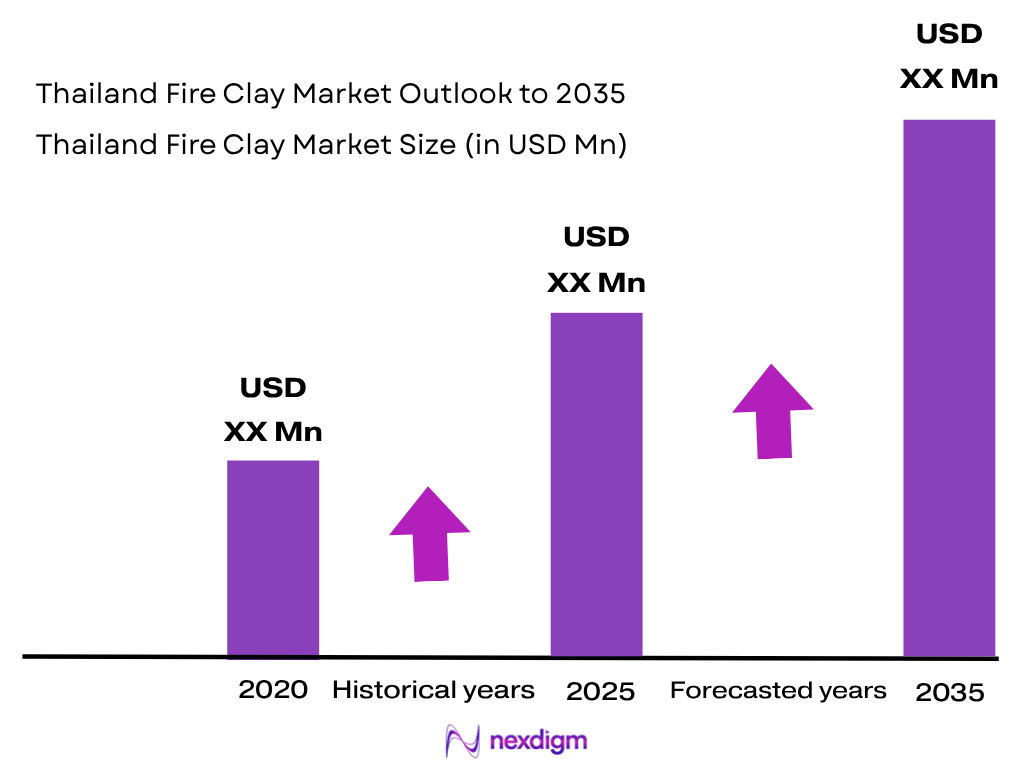
The Thailand Fire Clay Market is valued at approximately USD ~ million, based on the historical assessment of domestic refractory consumption, imported refractory raw materials, fireclay bricks, calcined clay and aluminosilicate products. The market is supported by Thailand’s cement, glass, ceramics, steel and industrial-processing sectors. Thailand produced approximately 35.6 million metric tons of cement in 2023 and around 34.7 million metric tons in 2024, sustaining kiln-lining and refractory-maintenance requirements. Fire clay remains relevant for firebricks, mortars, castables and backup linings where moderate-to-high refractory performance is required. Thailand’s manufacturing ecosystem also supports consumption through industrial furnaces, boilers, ceramic kilns and glass-processing equipment. The 2024 market value is represented as a placeholder because no authoritative public source publishes a standalone Thailand fire-clay market valuation.
Bangkok, Saraburi, Rayong, Chonburi and surrounding Central and Eastern industrial provinces represent important demand centers within the Thailand Fire Clay Market because they concentrate cement manufacturing, petrochemicals, steel processing, ceramics, glass and industrial facilities. Saraburi is particularly important to cement and mineral-processing activity, while Rayong and Chonburi benefit from the Eastern Economic Corridor’s petrochemical, manufacturing and heavy-industry concentration. Thailand’s manufacturing value added reached approximately USD 126 billion in 2023 and remained above USD 120 billion in 2024, reinforcing the scale of industries operating furnaces, boilers, kilns and other high-temperature equipment. Bangkok additionally functions as an important headquarters, distribution, specification and procurement center for refractory suppliers serving customers nationwide.
Market Segmentation
By Material Type
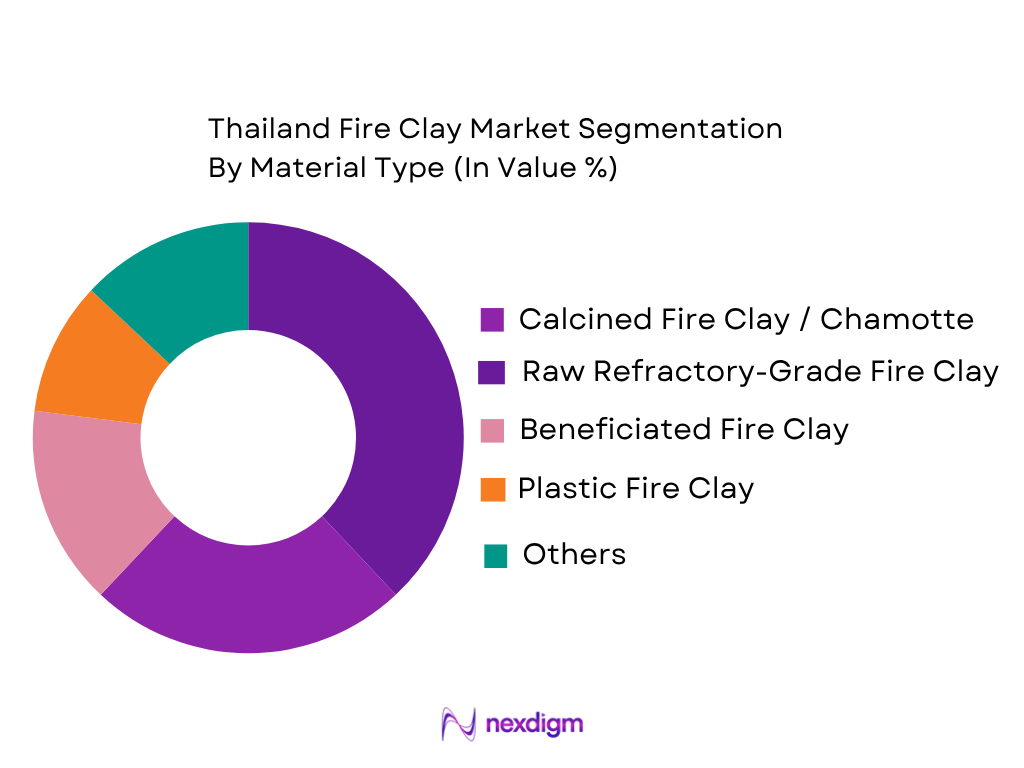
The Thailand Fire Clay Market is segmented by material type into raw refractory-grade fire clay, calcined fire clay, chamotte and grog, plastic fire clay, flint/semi-flint fire clay and beneficiated fire clay. Calcined fire clay and chamotte represent the dominant modeled segment because thermal processing removes volatile components, improves dimensional stability and provides refractory manufacturers with controlled aggregate suitable for firebricks, mortars and monolithic refractory formulations. Thailand’s substantial cement, glass, ceramic and industrial-furnace base creates recurring requirements for refractory materials capable of handling repeated heating cycles. Calcined material is particularly relevant where manufacturers require predictable shrinkage, particle-size distribution and thermal characteristics. Thailand also has an established refractory manufacturing ecosystem led by domestic and international suppliers, enabling processed aluminosilicate raw materials to move into shaped and unshaped refractory products. The segment’s importance is therefore associated with its broad applicability across kiln linings, furnace backup layers, boiler linings and general refractory maintenance rather than dependence on one industrial customer category.
By End-Use Industry
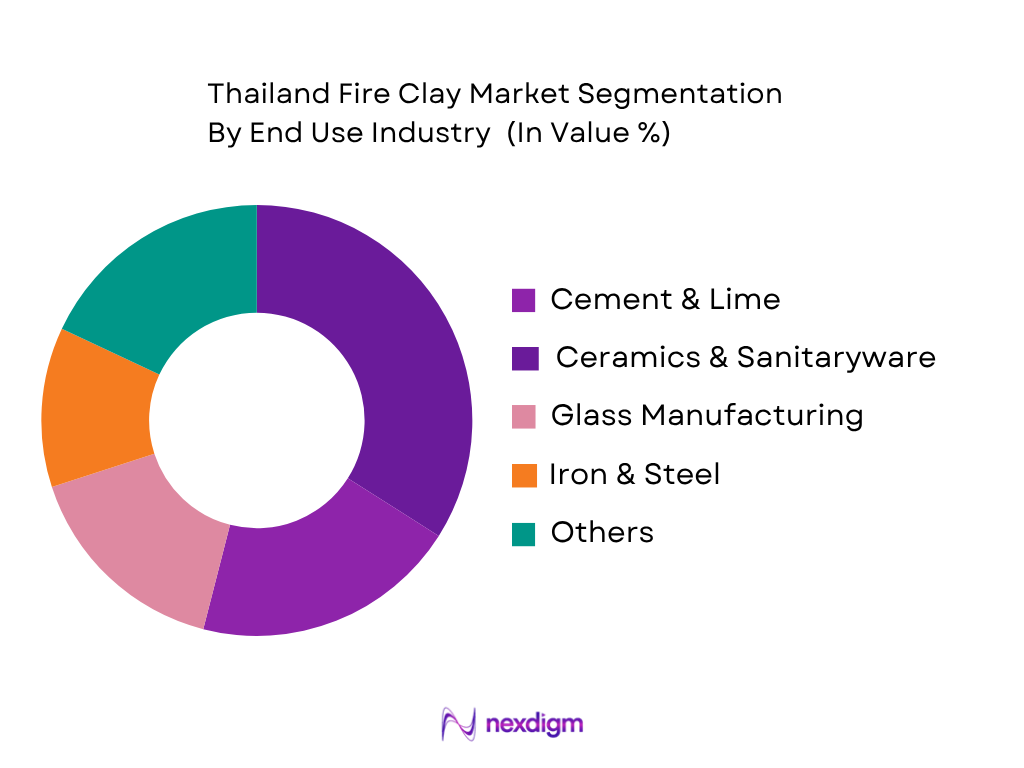
The Thailand Fire Clay Market is segmented by end-use industry into cement and lime, iron and steel, glass manufacturing, ceramics and sanitaryware, petrochemicals and refineries, industrial boilers, foundries and other high-temperature industries. Cement and lime represent the dominant modeled end-use segment because rotary kilns, preheaters, calciners, coolers and associated thermal systems require extensive refractory protection and periodic relining. Thailand’s cement output of approximately 34.7 million metric tons in 2024 illustrates the operating scale behind refractory consumption. Fireclay and aluminosilicate refractories are particularly applicable in selected kiln zones, coolers, ducts, backup linings and auxiliary thermal installations where operating conditions do not require premium basic or ultra-high-alumina refractories. The recurring nature of refractory wear also supports replacement consumption during scheduled plant shutdowns. Glass and ceramics form another important demand pool because Thailand maintains significant manufacturing activity in container glass, architectural glass, tiles, sanitaryware and ceramic products, all of which depend on kilns or furnaces requiring heat-resistant lining systems.
Competitive Landscape
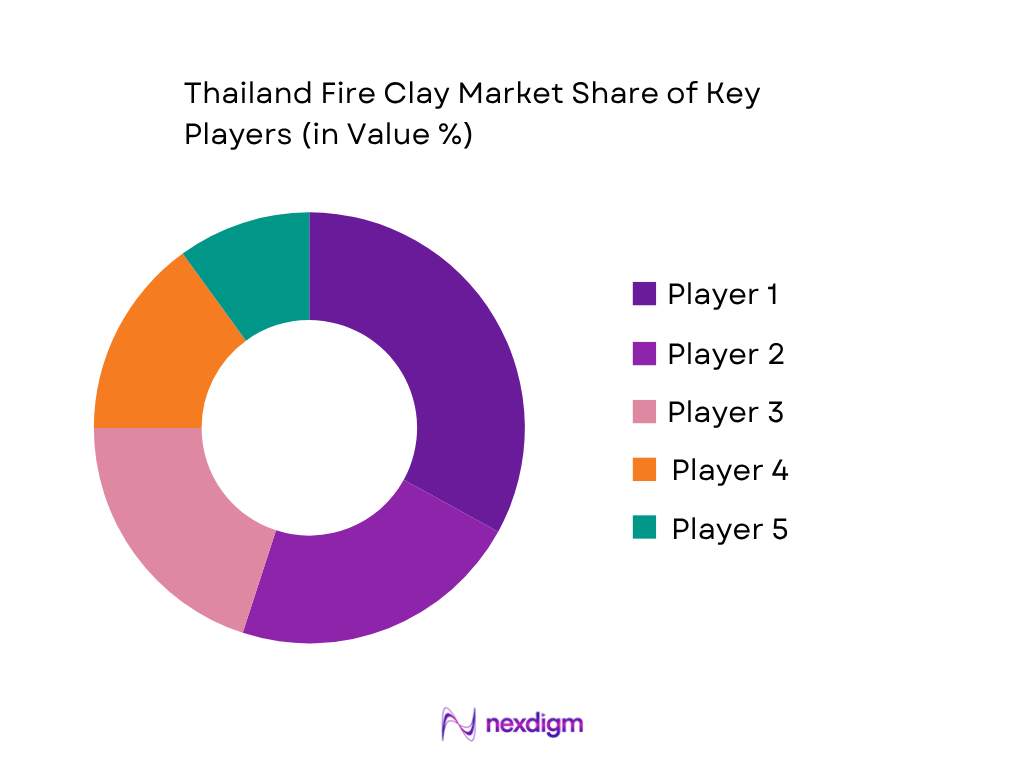
The Thailand Fire Clay Market combines a strong domestic refractory supplier with multinational refractory and advanced-ceramics groups supplying the wider Southeast Asian industrial ecosystem. Siam Refractory has a particularly relevant domestic position through local manufacturing, refractory engineering and products serving cement, steel, glass, petrochemical, ceramic and boiler applications. Global companies such as RHI Magnesita, Calderys, Vesuvius and Saint-Gobain compete through specialized refractory technologies, application engineering, monolithic products and regional distribution. Competition increasingly extends beyond fireclay bricks toward complete furnace-lining systems, installation services, shutdown support and higher-performance aluminosilicate products.
| Major Player | Establishment Year | Headquarters | Fire Clay / Aluminosilicate Capability | Shaped Refractories | Monolithic Refractories | Cement Applications | Steel Applications |
| Siam Refractory Industry Co., Ltd. | 1953 | Thailand | ~ | ~ | ~ | ~ | ~ |
| RHI Magnesita | 2017* | Austria | ~ | ~ | ~ | ~ | ~ |
| Calderys | 2005 | France | ~ | ~ | ~ | ~ | ~ |
| Vesuvius | 1704 | United Kingdom | ~ | ~ | ~ | ~ | ~ |
| Saint-Gobain | 1665 | France | ~ | ~ | ~ | ~ | ~ |
Thailand Fire Clay Market Analysis
Growth Drivers
Cement Kiln and Steel Furnace Refractory Consumption
Thailand’s large base of cement, steel and thermal-processing facilities creates recurring consumption of fire clay, fireclay bricks, aluminosilicate linings, mortars and related refractory materials. Crude steel production reached approximately 4.9 million tonnes in 2024, compared with 5.0 million tonnes in 2023, demonstrating the substantial volume of metal processed through high-temperature equipment. Steel reheating furnaces, heat-treatment installations and supporting thermal equipment require refractory inspection, repair and periodic relining. The cement industry similarly operates rotary kilns, preheaters, calciners and coolers where fireclay and aluminosilicate products can be used in selected operating zones and backup linings. Thailand’s broader industrial capacity strengthens this demand base: World Bank data put national GDP at USD 526.52 billion in 2024 and GDP per capita at USD 7,346.6. Import flows further demonstrate active refractory consumption, with Thailand receiving 5,927,270 kg of refractory bricks under HS 690290 in 2024. Together, operating furnaces, kiln maintenance and replacement cycles provide a recurring demand mechanism for Thailand’s Fire Clay Market.
Expansion of Glass, Ceramic and High-Temperature Manufacturing
Thailand’s established ceramic manufacturing ecosystem directly supports fire-clay refractory consumption because tiles, sanitaryware, tableware and technical ceramics require kilns operating continuously at elevated temperatures. The Office of Industrial Economics recorded production of 111.31 million square metres of wall and floor tiles in 2024, while domestic sales reached 139.58 million square metres. Quarterly data show another 23.69 million square metres of tile production during the final quarter alone. These manufacturing volumes create an installed kiln base requiring refractory bricks, castables, backup linings, kiln furniture and repair materials. Fire clay remains particularly applicable where aluminosilicate chemistry provides sufficient refractoriness and thermal-cycling performance without requiring higher-grade specialty refractory compositions. Thailand’s USD 526.52 billion GDP in 2024 and USD 7,346.6 GDP per capita further indicate the scale of the economy supporting industrial production and capital maintenance. The demand mechanism is replacement-oriented as well as production-oriented: kiln linings deteriorate through thermal cycling, abrasion and chemical interaction, requiring planned shutdown maintenance and creating repeat consumption for refractory suppliers.
Market Challenges
Imported Fire Clay Dependence and Raw-Material Quality Consistency
Thailand’s reliance on imported refractory-grade fire clay demonstrates the challenge of obtaining consistent alumina-silica chemistry, controlled impurities and reliable firing characteristics from domestic material alone. World Bank WITS records show that Thailand imported exactly 1,310,500 kg of fire clay in 2024. Major sources included the United Kingdom with 528,300 kg, South Africa with 300,000 kg, the United States with 151,501 kg, China with 150,634 kg, France with 126,007 kg and Japan with 48,000 kg. This diversified sourcing pattern indicates that industrial users require specialized grades sourced across multiple mineral deposits rather than interchangeable commodity clay. Fire-clay refractory performance depends heavily on alumina-silica composition, iron oxide, alkalis, particle distribution, plasticity and firing behavior. Variability can affect shrinkage, refractoriness and dimensional stability, forcing domestic producers to invest in mineral characterization, beneficiation, blending and calcination before local clay can replace established imported grades. Thailand’s USD 526.52 billion economy in 2024 supports substantial industrial demand, making consistent raw-material qualification especially important for cement, ceramic, steel and furnace operators.
Competition from High-Alumina, Basic and Advanced Refractory Materials
Fire clay faces direct substitution pressure in Thailand from high-alumina, magnesia-based and other engineered refractory products where industrial processes demand higher refractoriness, chemical resistance or longer service life. Trade data demonstrate the scale of this competitive material environment. Thailand imported 11,520,700 kg of refractory bricks containing more than 50 units of magnesium, calcium or chromium oxide under HS 690210 in 2024. Imports of refractory ceramic goods containing more than 50 units of alumina under HS 690320 reached another 1,826,930 kg, while other refractory ceramic goods under HS 690390 totaled 1,964,830 kg. This material flow demonstrates that Thai industrial operators already procure substantial volumes of alternative refractory technologies. Steel production of approximately 4.9 million tonnes in 2024 and ceramic tile production of 111.31 million square metres expose refractory linings to varied thermal and chemical environments. Conventional fire clay therefore cannot compete solely through availability; suppliers must position appropriate aluminosilicate grades according to furnace temperature, atmosphere, abrasion, thermal cycling and chemical exposure while avoiding unsuitable severe-duty zones.
Market Opportunities
Domestic Beneficiation, Calcined Fire Clay, Chamotte and Grog Localization
Thailand’s existing dependence on imported fire clay creates a clear opportunity to develop qualified domestic beneficiation and calcination capabilities. The country imported 1,310,500 kg of fire clay in 2024, including 528,300 kg from the United Kingdom, 300,000 kg from South Africa, 151,501 kg from the United States, 150,634 kg from China and 126,007 kg from France. These physical volumes provide evidence of existing demand that could potentially be addressed through domestically processed material where suitable deposits can meet refractory specifications. Opportunity areas include washing, impurity removal, particle classification, blending, controlled calcination and production of chamotte and secondary grog. Domestic qualification would need to demonstrate repeatable alumina-silica chemistry, iron and alkali control, firing shrinkage and refractoriness rather than relying solely on geological availability. Thailand’s USD 526.52 billion GDP in 2024 provides a substantial industrial economy in which such processing capability could serve cement, ceramics, glass, steel and boiler operators. Localization could subsequently support domestic firebrick, mortar and monolithic refractory production while reducing dependence on specialized overseas mineral sources.
Monolithic Refractories, Refractory Recycling and ASEAN Export Development
Thailand has an opportunity to move beyond raw fire clay toward higher-value refractory processing, including aluminosilicate castables, mortars, precast shapes and recycled grog. The scale of current material flows demonstrates an established industrial customer base: Thailand imported 61,834,900 kg of refractory cements, mortars, concretes and similar compositions in 2024, alongside 5,927,270 kg of refractory bricks under HS 690290. At the same time, Thailand already functions as an exporter of refractory products. Importing countries reported receiving Thai refractory bricks under HS 690290 in volumes including 31,740,700 kg for Myanmar, 1,604,250 kg for Saudi Arabia, 897,809 kg for Kenya, 249,601 kg for Australia and 37,091 kg for the Philippines during 2024. These flows establish an existing production and export platform that could support further development of fire-clay-based products. Recovered furnace and kiln linings can also be sorted, crushed and technically qualified as secondary grog, reducing virgin material requirements. Combining domestic beneficiation, monolithic production and refractory recycling could strengthen Thailand’s role as an ASEAN refractory manufacturing and distribution base.
Future Outlook
The Thailand Fire Clay Market is projected to expand at a placeholder CAGR of ~% during 2026-2035, supported by refractory replacement cycles, cement production, ceramics, glass manufacturing, petrochemical processing and industrial furnace maintenance. Future development is expected to shift progressively toward processed and performance-controlled fire clay rather than untreated raw clay. Domestic beneficiation and calcination could strengthen the availability of standardized aluminosilicate raw materials. Refractory producers are also expected to focus increasingly on monolithic formulations, recycled refractory aggregates, longer lining life and application-specific material engineering. Competition from high-alumina, magnesia and other advanced refractories will constrain conventional fireclay applications in severe thermal environments, but fire clay should retain relevance in general furnace construction, backup linings, kiln sections, boilers and medium-duty thermal applications.
Major Players
- Siam Refractory Industry Co., Ltd.
- RHI Magnesita
- Calderys
- Vesuvius
- Saint-Gobain Performance Ceramics & Refractories
- Shinagawa Refractories Co., Ltd.
- Krosaki Harima Corporation
- Chosun Refractories Co., Ltd.
- Imerys
- Morgan Advanced Materials
- HarbisonWalker International
- Resco Products
- IFGL Refractories
- TRL Krosaki Refractories Limited
- POSCO Future M
Key Target Audience
- Fire Clay and Refractory Raw Material Producers
- Firebrick and Shaped Refractory Manufacturers
- Monolithic Refractory Manufacturers
- Cement, Steel, Glass and Ceramic Manufacturers
- Industrial Furnace, Kiln and Boiler Operators
- Refractory Distributors and Industrial Material Importers
- Investments and Venture Capitalist Firms
- Government and Regulatory Bodies (Department of Primary Industries and Mines, Thai Industrial Standards Institute, Department of Industrial Works, Ministry of Industry)
Research Methodology
Step 1: Identification of Key Variables
The initial phase involves constructing the Thailand Fire Clay Market ecosystem across fire-clay deposits, beneficiation, calcination, chamotte production, refractory manufacturing, distribution and end-use industries. Key variables include domestic production, imports, alumina-silica grades, firebrick production, monolithic refractory demand, kiln population, furnace applications and refractory replacement cycles. These variables establish the demand and supply framework used for subsequent market construction.
Step 2: Market Analysis and Construction
Historical demand is assessed through consumption across cement, steel, ceramics, glass, petrochemical facilities, boilers and other thermal-processing industries. The bottom-up framework considers refractory usage by industrial application, replacement frequency, product mix and domestic-versus-imported sourcing. Top-down analysis evaluates industrial production, cement output, manufacturing activity, mineral processing and relevant trade flows to establish consistency between sector-level indicators and calculated fire-clay demand.
Step 3: Hypothesis Validation and Expert Consultation
Market hypotheses are validated through interviews with refractory manufacturers, fire-clay suppliers, distributors, furnace operators, cement producers, ceramic manufacturers and refractory installation specialists. Discussions focus on material specifications, alumina-silica requirements, raw-material sourcing, refractory replacement schedules, firebrick versus monolithic consumption and competitive substitution. Expert inputs are used to validate assumptions where standalone official statistics for fire-clay consumption are unavailable.
Step 4: Research Synthesis and Final Output
The final stage triangulates supply-side production and trade data with end-user refractory requirements and industry feedback. Particular attention is given to preventing double counting between raw fire clay, calcined clay, chamotte and finished refractory products. Findings are subsequently organized by material type, product form, end-use industry, application and supply source to construct the Thailand Fire Clay Market outlook and strategic assessment.

- Executive Summary
- Research Methodology (Market Definition and Scope, Fire Clay Classification, Refractory-Grade Clay Mapping, Raw Fire Clay Assessment, Calcined Fire Clay Assessment, Chamotte and Grog Assessment, Alumina-Silica Composition Mapping, Refractoriness Assessment, Pyrometric Cone Equivalent Analysis, Iron Oxide and Alkali Impurity Assessment, Domestic Clay Deposit Mapping, Import-Export Assessment, Firebrick Production Assessment, Monolithic Refractory Assessment, Cement Kiln Demand Mapping, Steel Furnace Demand Mapping, Glass and Ceramic Kiln Assessment, Supply-Side Assessment, Demand-Side Assessment, Top-Down Market Sizing, Bottom-Up Market Sizing, Primary Industry Interviews, Data Triangulation, Forecasting Framework)

- Definition and Scope
- Thailand Fire Clay Industry Evolution
- Fire Clay Industry Value Chain Analysis
- Fire Clay Supply Chain Analysis

- Growth Drivers (Cement Kiln Refractory Consumption, Steel Furnace Refractory Requirements, Expansion of Glass and Ceramic Manufacturing, Industrial Boiler Maintenance, Petrochemical Furnace Demand, Furnace and Kiln Relining Cycles, Domestic Manufacturing Activity, Demand for Aluminosilicate Linings, Refractory Replacement Demand)
- Market Challenges (Fire Clay Mineralogical Variability, Alumina-Silica Consistency Requirements, Iron Oxide and Alkali Impurity Control, Beneficiation Requirements, Competition from High-Alumina Refractories, Competition from Basic and Magnesia Refractories, Imported Chamotte Competition, Calcination Energy Requirements, Quality Consistency Requirements, Deposit Commercialization Constraints)
- Market Opportunities (Domestic Refractory-Grade Clay Development, Fire Clay Beneficiation, Calcined Fire Clay Localization, Chamotte and Grog Manufacturing, Firebrick Production Expansion, Monolithic Refractory Manufacturing, Cement Kiln Refractory Localization, Glass and Ceramic Kiln Applications, Refractory Recycling, Secondary Grog Production, ASEAN Refractory Exports)
- Market Trends (Increasing Use of Calcined Fire Clay, Growth of Monolithic Refractories, Higher Raw-Material Purity Requirements, Development of Low-Cement Castables, Increased Refractory Recycling, Longer Furnace Campaign Requirements, Customized Aluminosilicate Formulations, Carbon-Footprint-Certified Refractories, Predictive Furnace Maintenance)
- Government Regulations and Standards (Thai Industrial Standards Institute Requirements, TIS 547 Fireclay Refractory Brick Requirements, Refractory Concrete Standards, Monolithic Refractory Product Testing, Factory Act Requirements, Mineral Act Requirements, Mining and Quarrying Permits, Industrial Emission Requirements, Occupational Safety Requirements, Product Quality Certification)
- SWOT Analysis
- Porter’s Five Forces Analysis
- PESTLE Analysis

- By Market Value (2020-2025)
- By Fire Clay Consumption Volume (2020-2025)
- By Domestic Production Volume (2020-2025)
- By Import Volume (2020-2025)
- By Raw Fire Clay Consumption Volume (2020-2025)
- By Calcined Fire Clay and Chamotte Consumption Volume (2020-2025)

- By Material Type (In Value %)
Raw Refractory-Grade Fire Clay
Calcined Fire Clay
Chamotte
Refractory Grog
Plastic Fire Clay
Flint Fire Clay
Semi-Flint Fire Clay
Beneficiated Fire Clay - By Product Form (In Value %)
Fireclay Refractory Bricks
Refractory Mortars
Refractory Castables
Ramming and Gunning Mixes
Precast Refractory Shapes
Calcined Clay Aggregates
Chamotte and Grog
Refractory Ceramic Components - By Alumina Content (In Value %)
Low-Alumina Fire Clay
Standard Fire Clay
Medium-Alumina Fire Clay
High-Alumina Fire Clay
Enriched Aluminosilicate Clay
Blended Fire Clay Formulations - By End-Use Industry (In Value %)
Cement and Lime
Iron and Steel
Glass Manufacturing
Ceramics and Sanitaryware
Petrochemicals and Refineries
Industrial Boilers
Non-Ferrous Metals
Foundries
Waste-to-Energy and Incineration
Other High-Temperature Processing Industries - By Application (In Value %)
Cement Rotary Kiln Linings
Steel Reheating and Heat-Treatment Furnaces
Glass Furnace Linings
Ceramic Kiln Linings
Boiler and Combustion Chamber Linings
Petrochemical Process Furnaces
Incinerator Linings
Chimneys and Flues
Ladle and Foundry Applications
General Furnace Repair and Relining - By Supply Source (In Value %)
Domestic Mined Fire Clay
Domestic Beneficiated Fire Clay
Imported Raw Fire Clay
Imported Calcined Fire Clay
Imported Chamotte and Grog
Recycled Refractory Raw Materials

- Market Share of Major Players (By Thailand Revenue, Fire Clay and Aluminosilicate Product Portfolio, Shaped Refractory Portfolio, Monolithic Refractory Portfolio, Cement Industry Presence, Steel Industry Presence, Glass and Ceramic Industry Presence, Domestic Manufacturing Footprint, Distribution Network, Technical Service Capability, Installation Capability, Raw Material Integration, ASEAN Export Presence)
- Cross Comparison Parameters (Fire Clay and Aluminosilicate Product Breadth, Alumina-Silica Grade Capability, Shaped versus Monolithic Refractory Capability, Cement-Steel-Glass-Ceramic Application Coverage, Thailand Manufacturing and Distribution Footprint, Furnace Engineering and Installation Capability, Raw Material and Chamotte Supply Integration, Refractory Recycling and Low-Carbon Product Capability)
- SWOT Analysis of Major Players
- Detailed Profiles of Major Companies
The Siam Refractory Industry Co., Ltd.
RHI Magnesita
Calderys
Vesuvius
Saint-Gobain Performance Ceramics & Refractories
Shinagawa Refractories Co., Ltd.
Krosaki Harima Corporation
Chosun Refractories Co., Ltd.
Imerys
Morgan Advanced Materials
HarbisonWalker International
Resco Products
IFGL Refractories
TRL Krosaki Refractories Limited
Posco Future M

- Fire Clay Procurement Requirement Assessment
- Cement Industry Demand Assessment
- Iron and Steel Industry Demand Assessment
- Glass Industry Demand Assessment
- Ceramic Industry Demand Assessment
- Petrochemical and Refinery Demand Assessment

- By Market Value (2026-2035)
- By Fire Clay Consumption Volume (2026-2035)
- By Domestic Production Volume (2026-2035)
- By Import Volume (2026-2035) (2026-2035)
- By Raw Fire Clay Consumption Volume (2026-2035)
- By Calcined Fire Clay and Chamotte Consumption Volume (2026-2035)


 Request a Sample
 Ask for Customization
 Get a Quote
 Enquire Now