

 Download PDF
Market Overview
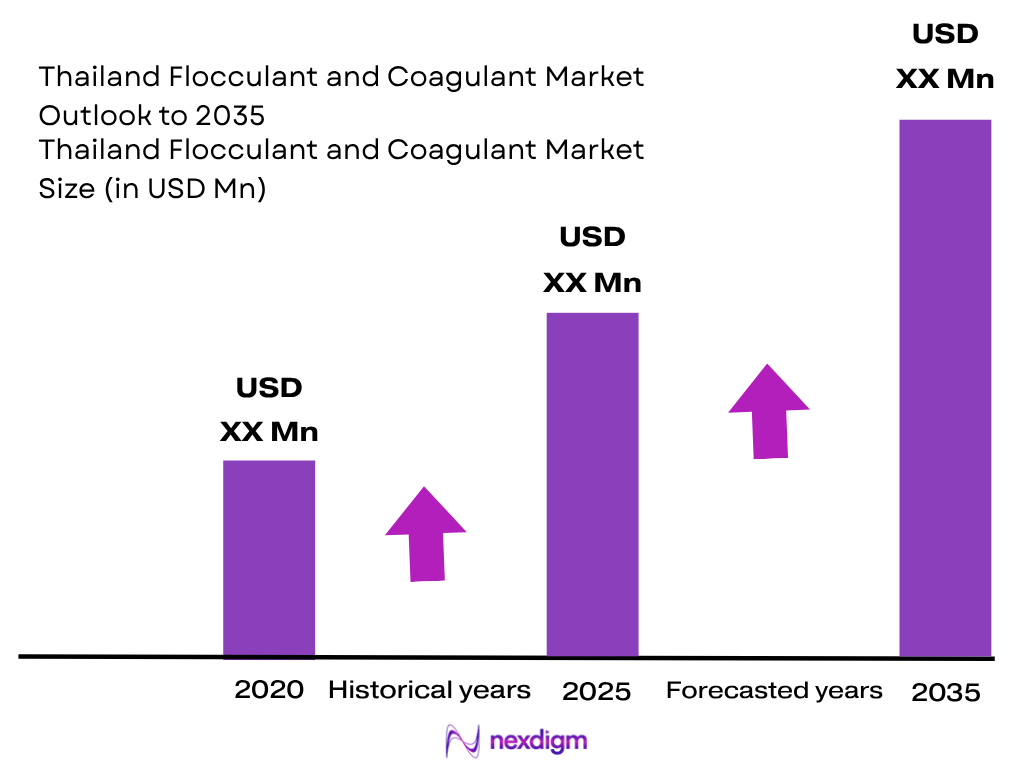
The Thailand Flocculant and Coagulant Market is estimated at ~USD ~ billion in 2024, compared with ~USD ~ billion in 2023, with demand supported by municipal water and wastewater treatment, industrial effluent management, manufacturing activity, food processing, petrochemicals, pulp and paper, mining and power generation. Thailand’s industrial base creates recurring requirements for coagulation, flocculation, clarification and sludge dewatering chemicals, while expanding wastewater-treatment infrastructure and stricter discharge-management requirements support continued chemical consumption across municipal and industrial treatment facilities.
Thailand’s flocculant and coagulant demand is concentrated around Bangkok and the surrounding metropolitan-industrial corridor, the Eastern Economic Corridor, Chonburi, Rayong, Chachoengsao and central industrial provinces, where industrial estates, manufacturing facilities, petrochemical complexes, food-processing plants and power-generation assets create substantial wastewater-treatment requirements. The country’s economic scale also supports treatment demand: Thailand recorded GDP of approximately USD 526.5 billion in 2024, while its population was approximately 71.7 million, creating a large municipal and industrial infrastructure base requiring water treatment, wastewater collection and effluent management.
Market Segmentation
By Product Type
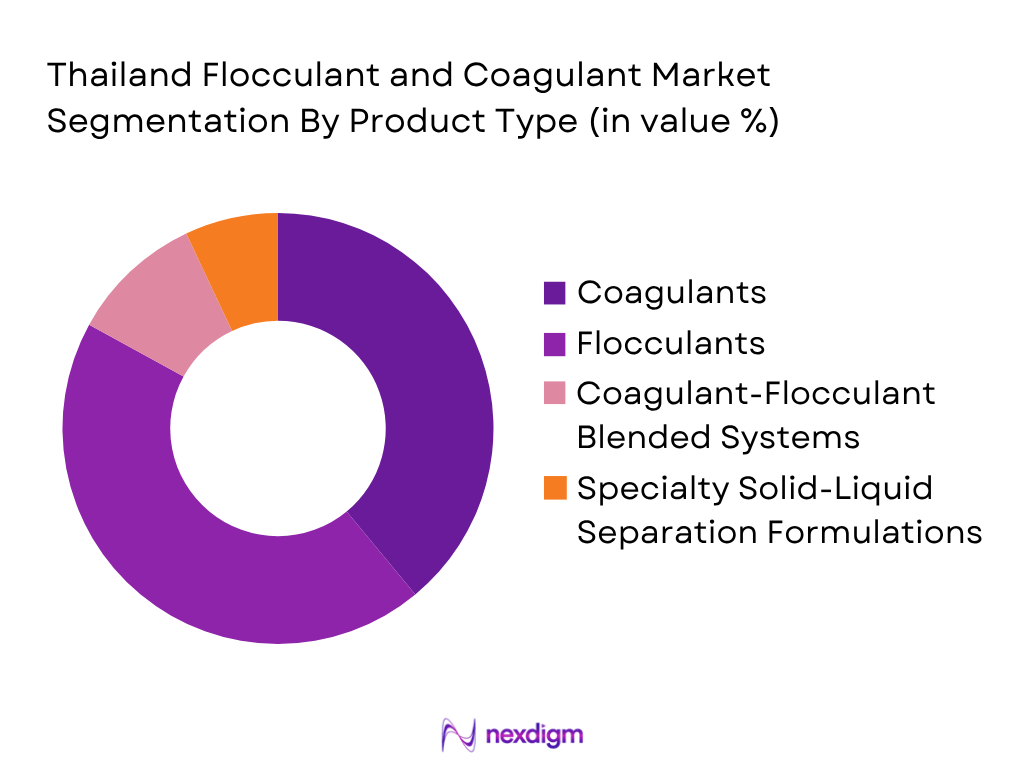
The Thailand Flocculant and Coagulant Market is segmented by product type into flocculants, coagulants, coagulant-flocculant blended systems and specialty solid-liquid separation formulations. Coagulants represent a core treatment category because they are widely used to destabilize suspended particles and colloidal matter before clarification, filtration and downstream treatment. Flocculants subsequently promote particle aggregation and improve settling or dewatering performance. Demand is particularly relevant across municipal wastewater, industrial wastewater, food processing, petrochemicals, pulp and paper, mining and power-generation applications. The diversity of Thai wastewater streams increases requirements for chemistry tailored to pH, suspended-solids loading, organic content and treatment-process configuration. Specialty blended formulations are increasingly relevant where operators seek improved settling, reduced sludge volume and more consistent treatment performance. Product selection is therefore influenced by treatment-stage requirements, contaminant characteristics, sludge-management requirements and plant operating conditions rather than by a single chemistry across all end users.
By Water Treatment Application
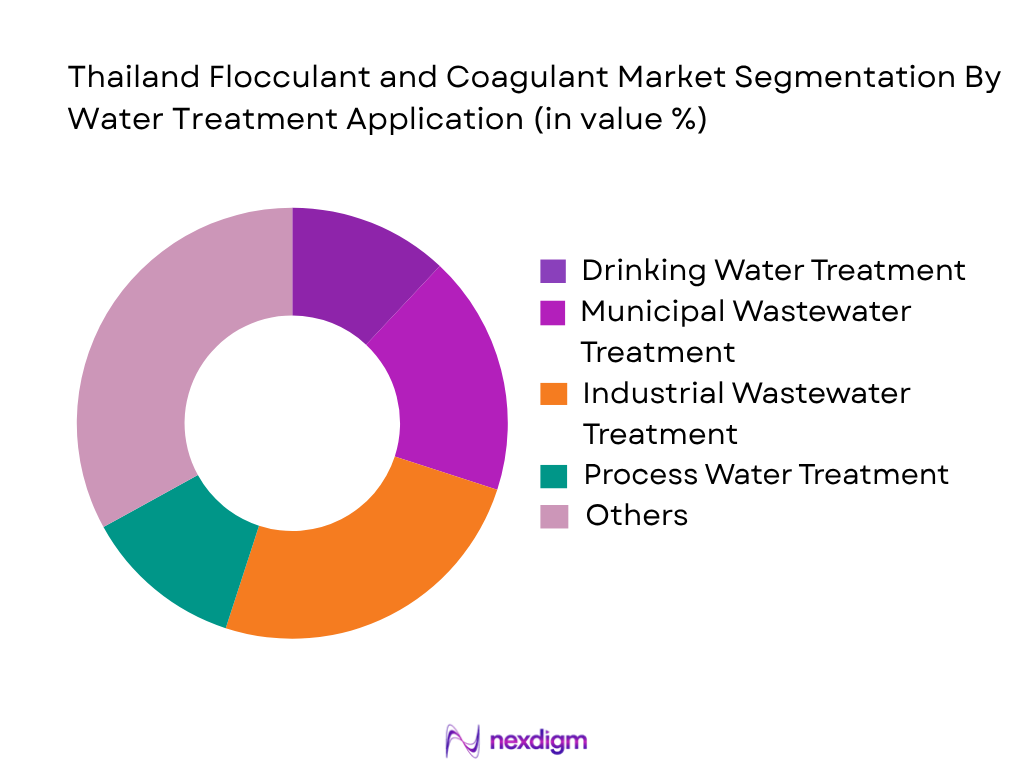
The Thailand Flocculant and Coagulant Market is segmented by water treatment application into drinking water treatment, municipal wastewater treatment, industrial wastewater treatment, process water treatment, produced water treatment, cooling water treatment, boiler water treatment, water reuse and recycling, and sludge treatment. Industrial wastewater treatment represents a structurally important application because Thailand’s manufacturing economy generates diverse effluent streams requiring chemical clarification and solids separation. The Eastern Economic Corridor further increases the relevance of industrial treatment through petrochemical, automotive, electronics, food-processing and other manufacturing activities. Municipal wastewater treatment provides another recurring demand base as urbanization and wastewater-management requirements increase. Flocculants and coagulants are also used in sludge thickening and dewatering, where efficient solid-liquid separation can improve downstream handling and disposal. Water reuse and recycling applications create additional requirements for pretreatment and clarification, particularly where industrial facilities seek to reduce freshwater withdrawals and improve process-water efficiency.
Competitive Landscape
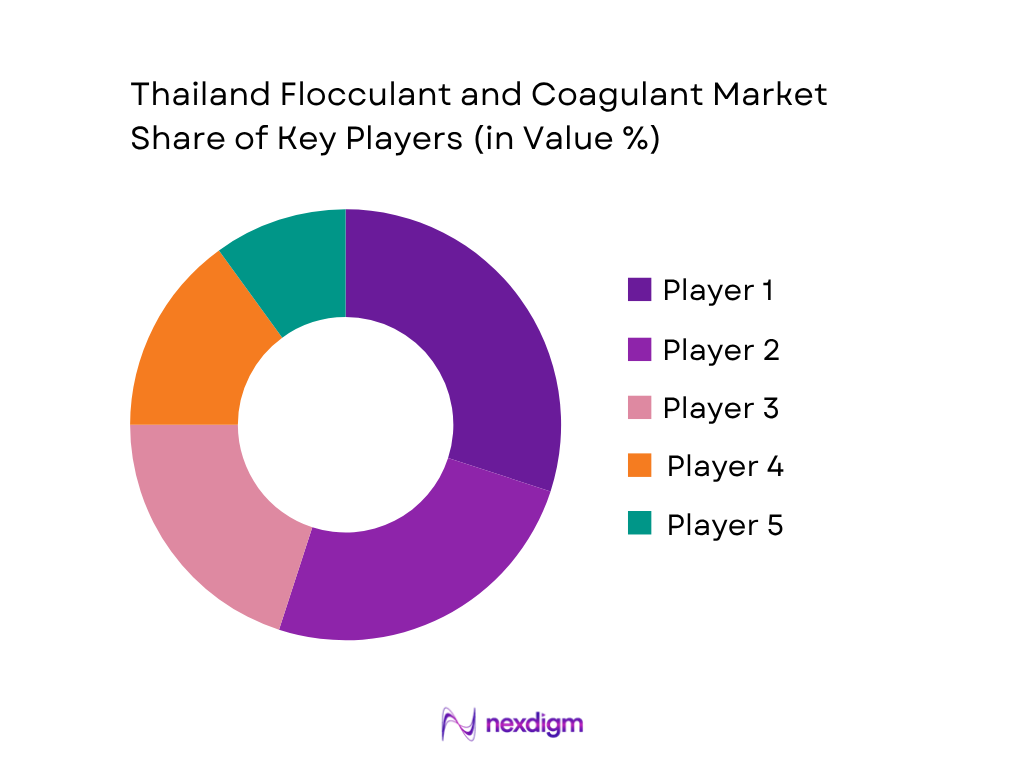
The Thailand Flocculant and Coagulant Market comprises international water-treatment chemical manufacturers, specialty chemical suppliers and treatment-service providers competing through product chemistry, application engineering, technical support, distribution networks and industrial customer coverage. Global suppliers such as Kemira, SNF, Ecolab, Solenis and Kurita participate across water-treatment applications, while Thailand’s industrial-estate ecosystem creates opportunities for suppliers capable of supporting customized chemical dosing, wastewater-treatment optimization and sludge-management requirements.
| Company | Establishment Year | Headquarters | Flocculant Portfolio | Coagulant Portfolio | Industrial Wastewater Coverage | Municipal Water Treatment | Technical Service Capability | Thailand Market Presence |
| Kemira Oyj | 1920 | Helsinki, Finland | ~ | ~ | ~ | ~ | ~ | ~ |
| SNF | 1978 | Andrézieux-Bouthéon, France | ~ | ~ | ~ | ~ | ~ | ~ |
| Ecolab Inc. | 1923 | St. Paul, USA | ~ | ~ | ~ | ~ | ~ | ~ |
| Solenis LLC | 1907 | Wilmington, USA | ~ | ~ | ~ | ~ | ~ | ~ |
| Kurita Water Industries Ltd. | 1949 | Tokyo, Japan | ~ | ~ | ~ | ~ | ~ | ~ |
Thailand Flocculant and Coagulant Market Analysis
Growth Drivers
Expansion of Industrial Activity and Wastewater Treatment Demand
Thailand’s industrial and manufacturing base provides a direct demand foundation for flocculants and coagulants because industrial facilities require clarification, suspended-solids removal, sludge conditioning and wastewater-treatment processes across multiple production stages. Thailand recorded GDP of USD 526.52 billion in 2024, while GDP per capita reached USD 7,346.6, indicating a substantial economic base supporting manufacturing, utilities and industrial infrastructure. Real GDP growth was 2.5 in 2024, demonstrating continued economic expansion despite external and domestic pressures. The country’s population stood at 71,668,011, creating simultaneous requirements for municipal water and wastewater services. Industrial wastewater treatment is particularly relevant for food processing, chemicals, petrochemicals, pulp and paper, metal processing and other manufacturing activities where wastewater characteristics vary significantly. Thailand also recorded 100.0 electricity access in 2024, supporting the operation of electrically intensive water-treatment facilities, pumping systems and industrial wastewater infrastructure. The combination of economic output, industrial activity, population scale and universal electricity availability creates a broad operating base for chemical treatment systems. These conditions support recurring requirements for coagulants and flocculants used in clarification, filtration, sludge thickening and dewatering processes across municipal and industrial treatment facilities.
Growing Water Management and Municipal Treatment Requirements
Thailand’s large population and established water-management infrastructure create sustained requirements for coagulation and flocculation across drinking-water and wastewater-treatment systems. The country had 71,668,011 people in 2024, while GDP reached USD 526.52 billion, providing a substantial economic and infrastructure base for municipal water services. The World Bank reports 27 people per 100 with safely managed sanitation services in 2024, highlighting continuing requirements for sanitation and wastewater-management improvement. Thailand also recorded 100.0 electricity access in 2024, supporting pumping, aeration, clarification, filtration and sludge-treatment infrastructure. Freshwater withdrawals represented 26 of internal freshwater resources in the latest available World Bank observation, indicating the importance of efficient water-resource management. Flocculants and coagulants are relevant because municipal and industrial treatment systems use chemical processes to destabilize colloidal particles, aggregate suspended solids and improve downstream separation. Thailand’s wastewater-system database maintained by the Pollution Control Department tracks treatment-system infrastructure across Bangkok and regional environmental offices, demonstrating the scale and geographic distribution of wastewater-management assets. Continued urban infrastructure requirements, sanitation improvement and water-resource management therefore provide a structural demand base for treatment chemicals, particularly where operators need reliable clarification and sludge-management performance.
Market Challenges
Macroeconomic Volatility and Industrial Demand Sensitivity
The Thailand Flocculant and Coagulant Market remains exposed to changes in industrial activity because a significant portion of chemical consumption originates from manufacturing and industrial wastewater treatment. Thailand’s GDP reached USD 526.52 billion in 2024, but real GDP growth was 2.5, indicating moderate economic expansion rather than rapid industrial acceleration. GDP per capita was USD 7,346.6, while consumer-price inflation was 1.4 in 2024. These indicators illustrate an environment where industrial customers may continue investing in wastewater treatment but remain attentive to operating efficiency and chemical consumption. Flocculant and coagulant requirements can vary according to factory utilization, production volumes, wastewater loading and treatment-process configuration. Manufacturing facilities may therefore adjust chemical procurement when production conditions change. The challenge is particularly relevant for suppliers serving food processing, chemicals, petrochemicals, pulp and paper, metals and other industrial sectors because each generates different wastewater characteristics. Thailand’s population of 71,668,011 provides a stable municipal demand base, but industrial demand can remain more cyclical. Suppliers therefore need flexible formulations, technical dosing support and application-specific solutions that demonstrate treatment efficiency under changing operating conditions while helping industrial customers maintain wastewater-treatment performance during periods of uneven economic activity.
Wastewater Complexity and Treatment-System Requirements
The Thailand Flocculant and Coagulant Market faces operational challenges because wastewater characteristics differ substantially across municipal and industrial treatment facilities. Thailand’s population reached 71,668,011 in 2024, while the World Bank records safely managed sanitation services for 27 people per 100, indicating continuing sanitation and wastewater-management requirements. Industrial customers introduce additional complexity because food processing, chemicals, petrochemicals, pulp and paper, metal processing and manufacturing operations produce wastewater with different suspended-solids concentrations, organic loads, pH conditions and chemical compositions. Thailand’s Pollution Control Department maintains a national wastewater-treatment-system database covering Bangkok and multiple regional environmental offices, reflecting the geographically distributed nature of treatment infrastructure. The country also had 100.0 electricity access in 2024, supporting treatment infrastructure but not eliminating the need for optimized chemical dosing and process control. Coagulants and flocculants must therefore be selected according to specific treatment objectives, including clarification, sedimentation, sludge thickening and dewatering. Incorrect chemistry or dosing can reduce separation efficiency and increase sludge-management requirements. Suppliers consequently face the challenge of providing technically differentiated products, application testing and dosing optimization rather than relying solely on standardized chemical formulations across Thailand’s diverse wastewater streams.
Market Opportunities
Expansion of Water Reuse and Resource-Efficient Treatment
Thailand’s water-management requirements create opportunities for advanced flocculant and coagulant formulations that support water reuse, recycling and improved treatment efficiency. The country recorded GDP of USD 526.52 billion in 2024 and GDP per capita of USD 7,346.6, providing a significant economic base for industrial water infrastructure and environmental-management investment. Thailand’s population of 71,668,011 also creates substantial municipal water and wastewater requirements. The World Bank reports 27 people per 100 with safely managed sanitation services in 2024, indicating continuing scope for improvements in sanitation and wastewater-management infrastructure. Freshwater withdrawals were recorded at 26 of internal freshwater resources in the latest available World Bank observation, reinforcing the importance of resource-efficient water management. These conditions create opportunities for treatment chemicals that improve clarification before filtration, membrane treatment and reuse processes. Industrial facilities can benefit from formulations that improve suspended-solids removal, reduce downstream fouling and support more consistent treatment performance. Advanced polymers, low-residual coagulants and application-specific blends can therefore address increasingly complex treatment requirements. The opportunity is particularly relevant across industrial estates, manufacturing facilities, food processing, chemicals, petrochemicals and other water-intensive industries seeking to improve water efficiency while maintaining wastewater-discharge performance.
Advanced Sludge Dewatering and Industrial Treatment Solutions
The development of higher-efficiency sludge treatment represents an opportunity for the Thailand Flocculant and Coagulant Market because municipal and industrial treatment facilities require effective separation of water from concentrated solids. Thailand’s 71,668,011 population in 2024 creates a substantial underlying municipal wastewater-management requirement, while GDP of USD 526.52 billion demonstrates the scale of the economic infrastructure supporting industrial and municipal treatment operations. Real GDP growth of 2.5 in 2024 indicates continued economic activity across sectors generating wastewater and treatment residues. Thailand also recorded 100.0 electricity access, supporting operation of pumping, dewatering and treatment equipment. Flocculants are particularly relevant to sludge thickening and dewatering because polymer selection can influence floc structure, water release and downstream solids handling. Opportunity areas therefore include high-performance cationic and anionic polymers, specialty formulations for difficult industrial sludges and customized dosing programs designed around specific wastewater characteristics. Industrial customers in food processing, chemicals, petrochemicals, pulp and paper and manufacturing can require different treatment chemistry depending on solids composition and process conditions. Suppliers capable of combining chemical formulation with application engineering, jar testing, dosing optimization and sludge-dewatering expertise can address these requirements while supporting more efficient treatment operations.
Future Outlook
Over the forecast period, the Thailand Flocculant and Coagulant Market is expected to develop alongside increasing wastewater-treatment requirements, industrial production, water-reuse initiatives and modernization of treatment infrastructure. Demand should remain closely linked to manufacturing-intensive regions and industrial estates, particularly across the Eastern Economic Corridor. The market is also positioned around higher-performance formulations that improve clarification, sludge dewatering and solid-liquid separation. Industrial customers are expected to place greater emphasis on treatment efficiency, chemical optimization, water reuse and operational consistency, supporting opportunities for application-specific polymer and coagulant solutions.
Major Players
- Kemira Oyj
- SNF
- Ecolab Inc.
- Solenis LLC
- Kurita Water Industries Ltd.
- BASF SE
- Veolia Water Technologies
- SUEZ
- Feralco Group
- Thermax Limited
- Accepta
- Buckman Laboratories
- AECI Water
- Hydrite Chemical Co.
- GEO Specialty Chemicals, Inc.
Key Target Audience
- Water Treatment Chemical Manufacturers and Formulators
- Municipal Water Supply and Wastewater Treatment Operators
- Industrial Wastewater Treatment Operators and Industrial Estates
- Petrochemical, Refining and Chemical Manufacturing Companies
- Food Processing, Beverage and Pulp & Paper Manufacturers
- Investments and Venture Capitalist Firms
- Government and Regulatory Bodies (Ministry of Industry, Ministry of Natural Resources and Environment, Pollution Control Department, Department of Industrial Works)
- Engineering, Procurement and Water-Treatment Technology Providers
Research Methodology
Step 1: Identification of Key Variables
The initial phase involves constructing a Thailand-specific ecosystem covering chemical manufacturers, distributors, municipal utilities, industrial estates, wastewater-treatment operators and end-use industries. Product variables include coagulant chemistry, polymer type, charge characteristics, formulation, dosage requirements and treatment application. Demand variables include wastewater generation, treatment capacity, industrial production activity and sludge-management requirements.
Step 2: Market Analysis and Construction
Historical market information will be compiled across flocculants, coagulants, blended systems and specialty solid-liquid separation formulations. The analysis will assess consumption across municipal water, municipal wastewater, industrial wastewater, process water, sludge treatment and reuse applications. Domestic production, imports, exports, distribution structures and end-user procurement patterns will also be evaluated to construct the Thailand market baseline.
Step 3: Hypothesis Validation and Expert Consultation
Market hypotheses will be validated through structured discussions with water-treatment chemical suppliers, wastewater-treatment operators, industrial-estate managers, chemical distributors and treatment-system specialists. Expert inputs will be used to assess product substitution, formulation preferences, application-specific consumption, procurement practices and competitive dynamics. These consultations will complement secondary data and support validation of market estimates.
Step 4: Research Synthesis and Final Output
The final research stage will integrate bottom-up demand estimates with top-down market calculations and industry-level indicators. Company-level information will be reviewed against product portfolios, Thailand operations, application coverage and distribution capabilities. The resulting analysis will provide a consolidated assessment of market structure, segmentation, competition, demand drivers, challenges, opportunities and future development.

- Executive Summary
- Research Methodology (Market Definition and Scope, Thailand Flocculant and Coagulant Market Classification, Flocculant and Coagulant Product Mapping, Chemistry-Level Assessment, Polymer-Level Assessment, Charge-Type Assessment, Form-Level Assessment, Application-Level Demand Analysis, End-Use Industry Assessment, Water Treatment Process Mapping, Production Capacity Mapping, Domestic Manufacturing Assessment, Import and Export Trade Analysis, Raw Material Supply Assessment, Municipal Demand Assessment, Industrial Demand Assessment, Industrial Estate Demand Assessment, Demand-Side Assessment, Supply-Side Assessment, Top-Down Market Sizing, Bottom-Up Market Sizing, Primary Industry Interviews, Data Triangulation, Forecasting Framework, Market Share Validation, Limitations and Future Conclusions)

- Definition and Scope
- Thailand Flocculant and Coagulant Industry Evolution and Development of Municipal Water Treatment, Industrial Wastewater Treatment, Industrial Estate Wastewater Treatment, Advanced Solid-Liquid Separation Technologies and Specialty Water Treatment Chemical Manufacturing
- Flocculant and Coagulant Value Chain Analysis
- Flocculant and Coagulant Supply Chain Analysis
- Chemical Feedstock Suppliers, Polymer Manufacturers, Coagulant Manufacturers, Flocculant Formulators, Water Treatment Chemical Suppliers, Distributors, Municipal Water Utilities, Wastewater Treatment Operators, Industrial Estate Operators, Engineering and EPC Companies, Industrial End Users, Mining Companies, Petrochemical Companies, Pulp and Paper Manufacturers, Food and Beverage Manufacturers
- Flocculant Integration Across Drinking Water Treatment, Municipal Wastewater Treatment, Industrial Effluent Treatment, Industrial Estate Wastewater Treatment, Mining and Mineral Processing, Petrochemical and Refinery Wastewater, Pulp and Paper, Food and Beverage, Chemical Processing, Pharmaceutical Manufacturing, Electronics Manufacturing and Power Generation

- Growth Drivers (Expansion of Industrial Wastewater Treatment, Industrial Estate Development, Municipal Water Infrastructure Modernization, Food and Beverage Processing Growth, Petrochemical and Chemical Manufacturing Expansion, Pulp and Paper Production, Mining and Mineral Processing, Water Recycling and Reuse, Increasing Sludge Dewatering Requirements, Tightening Industrial Effluent Treatment Requirements)
- Market Challenges (Raw Material Price Volatility, Dependence on Imported Specialty Chemicals, Energy Costs for Chemical Manufacturing, Industrial Effluent Compliance Requirements, Sludge Disposal Constraints, Chemical Storage and Handling Requirements, Product Qualification Requirements, Variable Industrial Wastewater Characteristics, Logistics Complexity Across Industrial Regions)
- Market Opportunities (Advanced Polyacrylamide Formulations, Low-Residual Coagulant Technologies, Industrial Wastewater Recycling, Industrial Estate Treatment Optimization, Bio-Based Flocculants, High-Efficiency Sludge Dewatering, Mining Tailings Treatment, Food and Beverage Wastewater Solutions, Petrochemical Wastewater Treatment, Automated Chemical Dosing Systems)
- Market Trends (High-Performance Polymer Flocculants, Water Reuse Technologies, Advanced Sludge Dewatering, Low-Residual Coagulants, Automated Chemical Dosing, Digital Water Treatment Monitoring, Specialty Industrial Wastewater Formulations, Sustainable Flocculant Development, Online Process Monitoring)
- Government Regulations and Standards (Industrial Effluent Discharge Standards, Pollution Control Department Water Quality Requirements, Ministry of Industry Wastewater Requirements, Industrial Estate Authority of Thailand Wastewater Standards, Factory Wastewater Treatment Requirements, Industrial Estate Central Wastewater Treatment Standards, Hazardous Chemical Handling Requirements, Water Quality Monitoring Requirements, Environmental Compliance and Reporting Requirements)
- SWOT Analysis
- Porter’s Five Forces Analysis
- PESTLE Analysis
- Stakeholder Ecosystem
- Competition Ecosystem

- By Market Value (2020-2025)
- By Market Volume (2020-2025)
- By Flocculant Consumption Volume (2020-2025)
- By Coagulant Consumption Volume (2020-2025)
- By Organic Flocculant Consumption Volume (2020-2025)
- By Inorganic Coagulant Consumption Volume (2020-2025)
- By Domestic Production Volume (2020-2025)
- By Import Volume (2020-2025)
- By Export Volume (2020-2025)
- By Average Selling Price (2020-2025)

- By Product Type (In Value %)
Flocculants
Coagulants
Coagulant-Flocculant Blended Systems
Specialty Solid-Liquid Separation Formulations - By Application Type (In Value %)
Coagulation
Flocculation
Clarification
Sedimentation
Sludge Thickening
Sludge Dewatering
Dissolved Air Flotation
Tailings Treatment
Solid-Liquid Separation
Water Recycling and Reuse - By End-Use Industry (In Value %)
Municipal Water and Wastewater Treatment
Industrial Manufacturing
Mining and Mineral Processing
Petrochemicals and Oil Refining
Power Generation
Chemical Manufacturing
Food and Beverage
Pulp and Paper
Pharmaceutical Manufacturing
Electronics and Semiconductor Manufacturing - By Water Treatment Application (In Value %)
Drinking Water Treatment
Municipal Wastewater Treatment
Industrial Wastewater Treatment
Industrial Estate Wastewater Treatment
Process Water Treatment
Produced Water Treatment
Cooling Water Treatment
Boiler Water Treatment
Water Reuse and Recycling
Sludge Treatment - By Distribution Channel (In Value %)
Direct Industrial Sales
Direct Municipal Utility Sales
Authorized Water Treatment Distributors
Specialty Chemical Distributors
Industrial Estate Procurement
Water Treatment Service Companies
Engineering and EPC Procurement
Industrial Supply Networks - By Region (In Value %)
Bangkok Metropolitan Region
Central Thailand
Eastern Thailand
Northern Thailand
Northeastern Thailand
Southern Thailand

- Market Share of Major Players (By Thailand Revenue, Flocculant Sales Volume, Coagulant Sales Volume, Product Chemistry Portfolio, Polymer Production Capacity, End-Use Industry Exposure, Municipal Customer Coverage, Industrial Customer Coverage, Industrial Estate Customer Coverage, Distribution Network Coverage, Regional Presence, Water Treatment Application Coverage, Technical Service Capability)
- Cross Comparison Parameters (Flocculant and Coagulant Revenue, Organic and Inorganic Product Portfolio Breadth, Polyacrylamide Technology Coverage, Municipal Water Treatment Capability, Industrial Wastewater Treatment Coverage, Sludge Dewatering Technology Capability, Mining and Petrochemical Application Coverage, Thailand Distribution Network Reach)
- SWOT Analysis of Major Players
- Competitive Positioning Matrix
- Detailed Profiles of Major Companies
SNF Holding Company
Kemira Oyj
Ecolab Inc.
Solenis LLC
BASF Thailand
Kurita-GK Chemical Co., Ltd.
Kurita Water Industries Ltd.
Veolia Water Technologies Thailand
SUEZ Thailand
Mitsubishi Chemical Group
GK Finechem Co., Ltd.
Thai Mining & Chemical Co., Ltd.
WATREAT Co., Ltd.
ECOTECH WATER Co., Ltd.
Dragonal Group

- Municipal Drinking Water Utility Procurement Assessment
- Municipal Wastewater Treatment Plant Chemical Requirement Analysis
- Industrial Wastewater Treatment Operator Assessment
- Industrial Estate Central Wastewater Treatment Procurement Analysis
- Mining and Mineral Processing Flocculant Requirement Assessment
Petrochemical and Refinery Wastewater Treatment Requirement Analysis - Power Generation Water Treatment Chemical Procurement Analysis
- Pulp and Paper Mill Coagulant Requirement Assessment
- Food and Beverage Wastewater Treatment Assessment
- Chemical Manufacturing Effluent Treatment Analysis
- Pharmaceutical Manufacturing Wastewater Treatment Assessment
- Electronics and Semiconductor Wastewater Treatment Assessment
- Sludge Dewatering Chemical Procurement Assessment
- Water Treatment Engineering and EPC Procurement Analysis

- By Market Value (2026-2035)
- By Market Volume (2026-2035)
- By Flocculant Consumption Volume (2026-2035)
- By Coagulant Consumption Volume (2026-2035)
- By Organic Flocculant Consumption Volume (2026-2035)
- By Inorganic Coagulant Consumption Volume (2026-2035)
- By Domestic Production Volume (2026-2035)
- By Import Volume (2026-2035)
- By Export Volume (2026-2035)
- By Average Selling Price (2026-2035)


 Request a Sample
 Ask for Customization
 Get a Quote
 Enquire Now