

 Download PDF
Market Overview
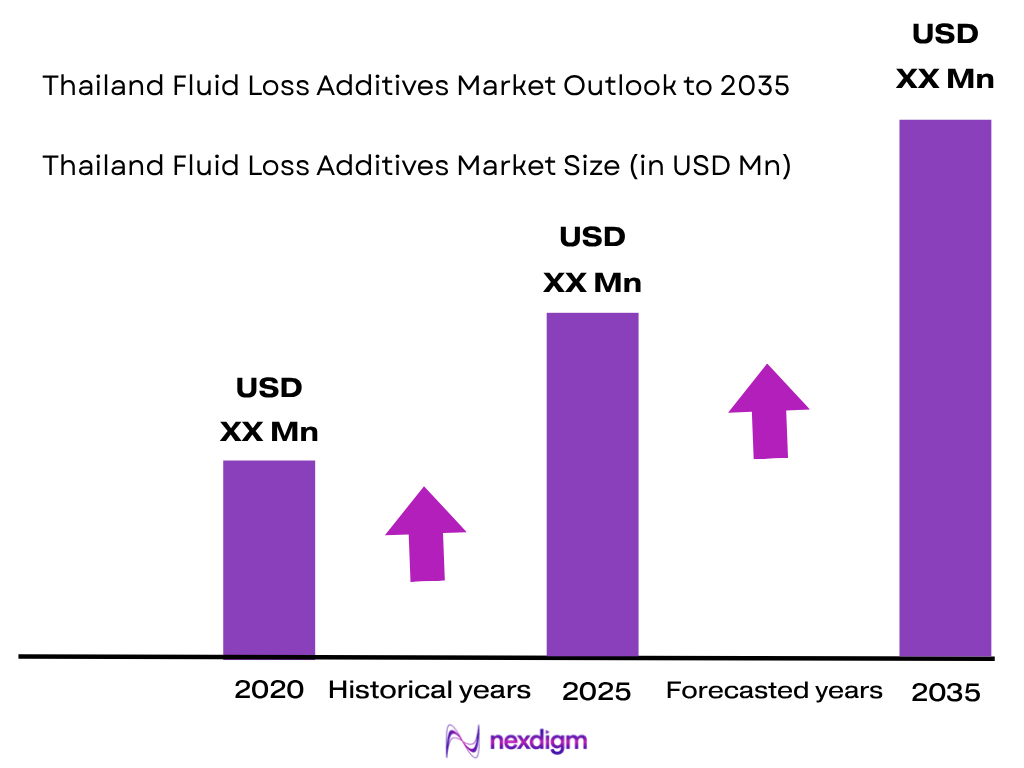
The Thailand Fluid Loss Additives Market is valued at approximately USD ~XX million, supported by sustained Gulf of Thailand production drilling and cementing activity. G1/61 production increased from 400 MMSCFD in the preceding annual operating period toward 800 MMSCFD, while the latest reported average reached 682 MMSCFD alongside 22,011 BPD of condensate. G2/61 simultaneously maintained approximately 730 MMSCFD, requiring continuous production-well drilling and supporting demand for drilling-fluid and cement fluid-loss-control chemistries.
The Gulf of Thailand dominates fluid-loss-additive consumption because Erawan, Bongkot and Arthit contain intensive offshore drilling and well-construction programs, while the S1 area remains Thailand’s principal onshore demand centre. G2/61 produced more than 825 MMSCFD in the preceding operating period and approximately 730 MMSCFD in the latest annual observation, while Arthit recorded about 292 MMSCFD of gas and 14,036 BPD of condensate. S1 spans Kamphaeng Phet, Sukhothai and Phitsanulok and remains Thailand’s largest onshore oil field.
Market Segmentation
By Application
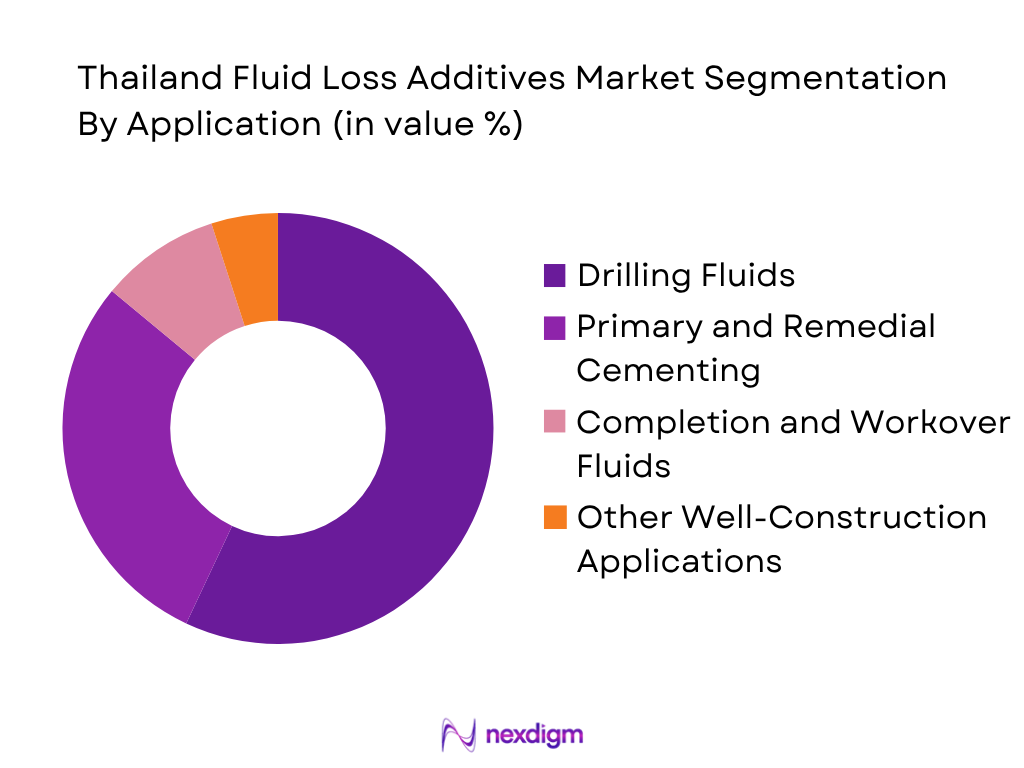
The Thailand Fluid Loss Additives Market is segmented by application into drilling fluids, primary and remedial cementing, completion and workover fluids, and other well-construction applications. Drilling fluids hold the dominant share because Gulf of Thailand fields require continuing production-well drilling to sustain gas output from mature offshore reservoirs. Fluid-loss control is essential in water-based, seawater-based and non-aqueous drilling systems because excessive filtrate invasion can destabilise formations, increase differential sticking risk and impair reservoir quality. The dominance of drilling applications is reinforced by the operating profile of G1/61, G2/61 and Arthit, where PTTEP continues production-well drilling to maintain contracted gas supply. Slim-hole offshore wells also require thin, low-permeability filter cakes because small annular clearances make excessive cake thickness particularly undesirable. Cementing is the second-largest category because every casing and liner program requires slurry filtration control for placement reliability and zonal isolation.
By Product Chemistry
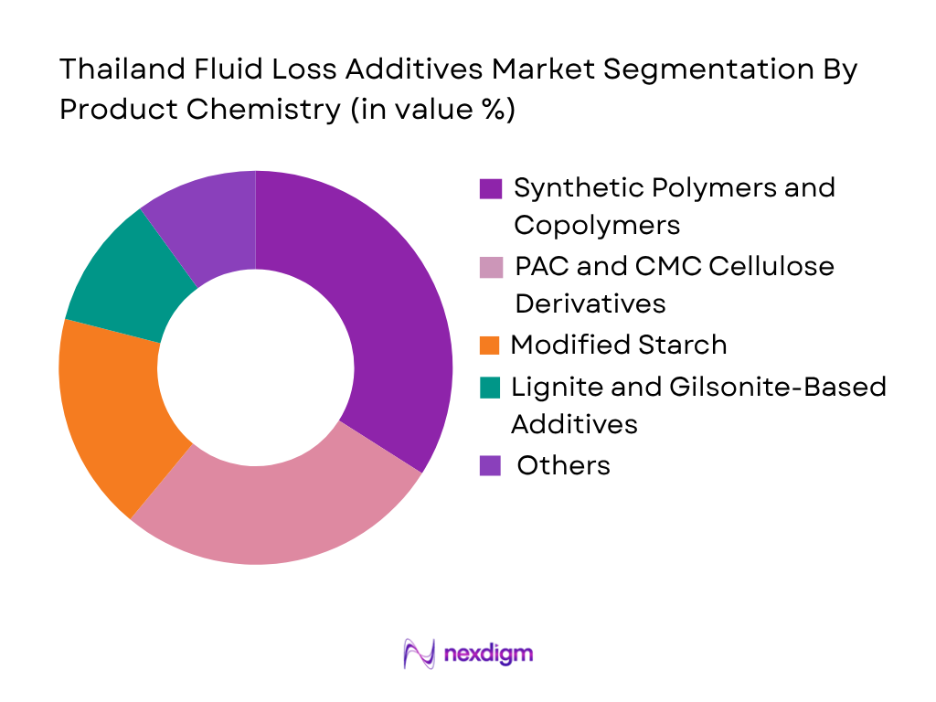
The Thailand Fluid Loss Additives Market is segmented by chemistry into synthetic polymers, PAC and CMC cellulose derivatives, modified starches, lignite and gilsonite products, latex or resin systems and other specialty formulations. Synthetic polymers represent the dominant chemistry group because Gulf of Thailand wells frequently impose elevated temperature, salinity and contamination conditions in which conventional natural polymers can lose filtration-control efficiency. Sulfonated and acrylic copolymers can provide stronger thermal stability and brine tolerance while remaining compatible with engineered drilling-fluid and cement-slurry systems. PAC and CMC remain important in conventional water-based drilling fluids because they provide combined filtration control and rheology modification, while modified starch is widely applicable where economical fluid-loss reduction is required. Latex and resin systems have greater relevance in cementing applications where filtration reduction must be balanced against thickening time, rheology and gas-migration control. The increasing technical complexity of offshore wells supports gradual migration toward higher-performance synthetic formulations.
Competitive Landscape
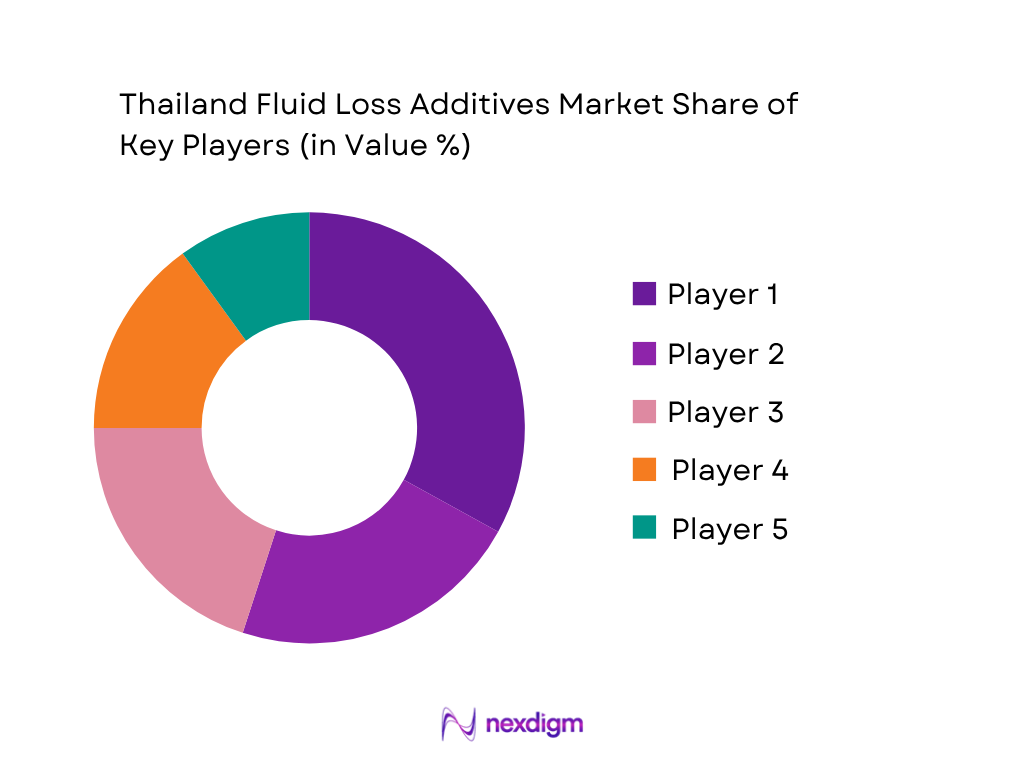
The Thailand Fluid Loss Additives Market is characterised by integrated oilfield-service companies and global specialty-chemical suppliers that compete on filtration performance, thermal stability, fluid-system compatibility, laboratory qualification and offshore field support. Halliburton and SLB are particularly influential because fluid-loss additives can be supplied as part of complete drilling-fluid or cementing packages rather than standalone chemicals. Baker Hughes provides broader well-construction and chemical technologies, while Clariant and Nouryon participate through specialty oilfield chemical portfolios and formulation support. Technical qualification with operators and service companies creates substantial entry barriers.
| Company | Establishment Year | Headquarters | Drilling Fluid Capability | Cementing Fluid-Loss Capability | HPHT / Thermal Performance | WBM / Non-Aqueous Compatibility | Technical & Laboratory Support | Asia-Pacific Field Support |
| SLB | 1926 | Houston, US / Paris, France operating presence | ~ | ~ | ~ | ~ | ~ | ~ |
| Halliburton | 1919 | Houston, Texas, US | ~ | ~ | ~ | ~ | ~ | ~ |
| Baker Hughes | 2017 current company; legacy roots earlier | Houston, Texas, US | ~ | ~ | ~ | ~ | ~ | ~ |
| Clariant | 1995 | Muttenz, Switzerland | ~ | ~ | ~ | ~ | ~ | ~ |
| Nouryon | 2018 | Amsterdam, Netherlands / Radnor, Pennsylvania, US | ~ | ~ | ~ | ~ | ~ | ~ |
Thailand Fluid Loss Additives Market Analysis
Growth Drivers
Sustained Gulf of Thailand Production Drilling Supporting Continuous Additive Consumption
Thailand’s fluid loss additives demand is strongly supported by intensive development drilling in the Gulf of Thailand, where maintaining gas production requires recurring well construction, drilling-fluid conditioning and cementing activity. PTTEP increased G1/61 gas production to 800 MMSCFD in 2024 after installing 12 wellhead platforms and drilling more than 300 producing wells. The operator also continued investment in additional wellhead platforms and production wells to sustain output, directly increasing requirements for filtration-control polymers used in water-based muds, non-aqueous systems and cement slurries. G1/61 averaged 682 MMSCFD of gas and 22,011 BPD of condensate during 2024, demonstrating the operating scale behind recurring additive consumption. Thailand’s macroeconomic base also supports continued upstream activity: World Bank data place national GDP at approximately US$526.52 billion in 2024, while GDP per capita reached US$7,346.6. For fluid loss additive suppliers, this combination of intensive offshore drilling, high well counts and sustained national energy demand creates recurring consumption rather than one-off chemical purchases, particularly for PAC, CMC, modified starch and thermally stable synthetic polymers used to maintain thin filter cakes and control filtrate invasion.
High Production Requirements Across Bongkot and Arthit Increasing Technical Fluid Demand
Production maintenance across Thailand’s other major offshore gas assets creates an additional structural driver for fluid loss additives because these fields require continuous drilling and well intervention under demanding downhole conditions. PTTEP reported that G2/61 averaged 685 MMSCFD of natural gas and 22,228 BPD of condensate in 2025, while continuous development drilling and new wellhead-platform installation were undertaken to maintain a contracted gas sales rate of 700 MMSCFD. At Arthit, the Daily Contract Quantity increased from 280 MMSCFD to 330 MMSCFD, and average gas production reached 314 MMSCFD, accompanied by 14,595 BPD of condensate. These operating levels require repeated drilling, casing, cementing and completion activity, all of which depend on reliable filtration control. Fluid loss additives are particularly important where elevated temperature, salinity and narrow hydraulic windows can reduce polymer performance or create excessive filtrate invasion. Thailand’s 2024 economy generated approximately US$526.52 billion in GDP, according to the World Bank, providing the macroeconomic scale supporting upstream infrastructure and domestic energy-security investment. The continuing intensity of offshore production therefore reinforces demand for higher-performance synthetic and cellulose-based fluid-loss chemistries.
Market Challenges
Increasing Well Complexity Raising Thermal Stability and Formulation Requirements
Thailand’s offshore operating environment creates a major technical challenge for fluid loss additive suppliers because production must be maintained across mature fields using increasingly optimized well designs, continuous infill drilling and high-performance fluid systems. G1/61 alone required more than 300 producing wells and 12 wellhead platforms before reaching 800 MMSCFD of gas production in 2024. In 2025, G2/61 continued development drilling while averaging 685 MMSCFD, and Arthit increased contracted gas delivery to 330 MMSCFD. Such intensive offshore activity places filtration-control additives under repeated exposure to temperature, salinity, cement contamination and mechanical shear. Conventional starch or cellulose systems may require reinforcement with synthetic copolymers where thermal degradation or brine contamination reduces performance. Thin filter-cake formation is also critical in narrow-hole applications because excessive deposition can increase torque, drag and differential-sticking risks. The challenge occurs within a national economy valued at approximately US$526.52 billion in 2024, according to the World Bank, meaning domestic energy supply has material macroeconomic importance. Consequently, additive suppliers must balance fluid-loss reduction with rheology, shale stability, cement compatibility and offshore operational reliability rather than competing solely on basic filtration performance.
Dependence on Reliable Specialty Chemical Supply and Offshore Logistics
Thailand’s fluid loss additives market also faces supply-chain pressure because advanced drilling and cementing systems rely on specialty polymers, cellulose derivatives and other oilfield chemicals that must be available continuously during offshore campaigns. The operating scale increases the consequences of delayed supply: G1/61 maintained 800 MMSCFD of production, while PTTEP reported average 2025 output of 685 MMSCFD from G2/61 and 314 MMSCFD from Arthit. These fields require uninterrupted drilling, cementing and completion support, leaving limited tolerance for shortages of qualified filtration-control additives. Thailand’s broader economy is highly integrated into international trade; World Bank indicators show GDP of approximately US$526.52 billion in 2024 and exports of goods and services equivalent to a very large share of domestic output, reinforcing dependence on cross-border supply networks for specialized industrial inputs. Offshore operations further require inventory buffers, compliant packaging, hazardous-material handling and reliable transport from storage and blending locations to supply bases and rigs. Product substitution is not always immediate because drilling-fluid and cementing additives typically require laboratory compatibility testing before field use. Suppliers therefore need local inventory, technical support and blending flexibility to reduce exposure to imported-product lead times and campaign disruptions.
Market Opportunities
New Onshore Exploration Acreage Expanding Future Well-Construction Demand
Thailand’s new petroleum acreage creates a future growth opportunity for fluid loss additive suppliers because additional exploration and eventual development drilling would broaden demand beyond the Gulf of Thailand. The Department of Mineral Fuels’ 25th Petroleum Bidding Round covers 9 onshore exploration blocks across the Northeast and Central Regions with a combined area of 33,444.64 square kilometres. Individual blocks range from 3,223.51 square kilometres for L1/66 to 3,966.86 square kilometres for L6/66, while four blocks contain or surround previously relinquished production areas. The Northeast region already has approximately 30,000 km of 2D seismic data, around 4,000 square kilometres of 3D seismic coverage, and 64 petroleum wells drilled, with hydrocarbon discoveries identified across multiple structures. These current exploration indicators establish a tangible geological base from which future drilling-fluid and cementing requirements could develop. Thailand’s 2024 GDP of approximately US$526.52 billion, according to the World Bank, provides the macroeconomic foundation for continued energy investment. If exploration activity progresses, fluid loss additive demand could expand into PAC, CMC, starch, synthetic polymers and cement filtration-control systems tailored for carbonate and clastic formations in onshore basins.
Mature-Field Development and CCS-Linked Well Activity Broadening Specialty Additive Applications
Thailand’s mature offshore infrastructure creates an opportunity for fluid loss additive suppliers to expand from conventional drilling applications into remedial cementing, workovers, integrity operations and emerging subsurface projects. PTTEP reported that Arthit production averaged 314 MMSCFD in 2025 after its contracted gas quantity increased to 330 MMSCFD, demonstrating continued utilization of a mature offshore asset. In the same year, the company reached final investment decision on Thailand’s first CCS project at Arthit, designed around existing offshore infrastructure and associated well and subsurface systems. Although future project statistics are not required to establish the opportunity, the current presence of producing wells, continuous drilling and existing offshore facilities provides a practical platform for additional cementing and well-integrity work. G2/61 also averaged 685 MMSCFD in 2025 while undergoing further development drilling and wellhead-platform installation. Thailand’s 2024 GDP stood at approximately US$526.52 billion, while GDP per capita was US$7,346.6, according to the World Bank. These operating and macroeconomic conditions support opportunities for high-temperature cement fluid-loss reducers, latex-polymer systems, squeeze-cementing additives and specialty filtration-control products used throughout extended well life cycles.
Future Outlook
The Thailand Fluid Loss Additives Market is expected to register approximately ~XX% CAGR during 2026-2035, driven primarily by continued offshore production drilling, mature-field redevelopment, high-temperature well construction and increasingly demanding cementing programs. The market will gradually shift from conventional low-cost filtration reducers toward engineered polymers capable of maintaining performance under higher temperature, salinity and contamination conditions.
The Gulf of Thailand will remain the principal demand centre because national energy security depends heavily on domestic natural-gas production. PTTEP continues to maintain production capacity at G1/61 and G2/61, while Arthit production capacity was subsequently increased from 280 MMSCFD to 330 MMSCFD. Maintaining these production levels requires recurring drilling, workover, cementing and integrity operations, creating continuous demand for well-construction chemicals.
Major Players
- SLB
- Halliburton
- Baker Hughes
- Weatherford International
- Newpark Fluids Systems / SCF Partners
- Clariant
- BASF
- Nouryon
- SNF
- Solvay
- The Lubrizol Corporation
- Croda International
- TETRA Technologies
- Silica Hill Co. Ltd.
- Scientia Company Limited
Key Target Audience
- Fluid Loss Additive and Oilfield Specialty Chemical Manufacturers
- Drilling Fluid and Cementing Service Providers
- Exploration and Production Operators
- Drilling Contractors and Well-Construction Companies
- Oilfield Chemical Importers, Distributors and Local Blenders
- Offshore Logistics, Mud Plant and Cementing Bulk-Plant Operators
- Investments and Venture Capitalist Firms
- Government and Regulatory Bodies (Department of Mineral Fuels, Ministry of Energy, Department of Industrial Works, Pollution Control Department)
Research Methodology
Step 1: Identification of Key Variables
The initial phase involves constructing an ecosystem map covering exploration and production operators, drilling contractors, mud companies, cementing service providers, additive manufacturers, local blenders and distributors. Key variables include well count, drilling-fluid volume, casing and cementing activity, offshore versus onshore exposure, HPHT requirements, additive dosage, import dependency and operator qualification requirements.
Step 2: Market Analysis and Construction
Historical market analysis combines petroleum drilling activity with application-level consumption modelling. The bottom-up model calculates fluid-loss-additive demand from drilling-fluid volumes, cement slurry requirements, average treatment concentrations and well-construction activity, while the top-down model evaluates Thailand’s upstream expenditure, producing-field activity and oilfield chemical demand to validate the resulting market estimates.
Step 3: Hypothesis Validation and Expert Consultation
Market hypotheses are validated through computer-assisted telephone interviews and technical discussions with drilling-fluid engineers, cementing specialists, oilfield chemical suppliers, drilling contractors and upstream procurement professionals. These consultations examine polymer selection, temperature limits, treatment rates, imported-versus-local supply, operator qualification, procurement cycles and product performance under Gulf of Thailand operating conditions.
Step 4: Research Synthesis and Final Output
Primary research is triangulated with Department of Mineral Fuels information, Ministry of Energy statistics, operator disclosures, corporate technical literature and trade information. Market estimates are reconciled using top-down and bottom-up calculations, after which forecast assumptions are applied to production drilling, mature-field development, well intervention, cementing intensity, HPHT product adoption and local blending penetration.

- Executive Summary
- Research Methodology (Market Definitions and Assumptions, Thailand Fluid Loss Additives Market Classification, Drilling Fluid Additive Scope, Cementing Additive Scope, Completion Fluid Scope, Filtration-Control Additive Mapping, Polymer Chemistry Assessment, Cellulose-Based Additive Assessment, Starch-Based Additive Assessment, Synthetic Polymer Assessment, Lignite and Gilsonite Assessment, Water-Based Mud Assessment, Oil-Based Mud Assessment, Synthetic-Based Mud Assessment, Cement Slurry Assessment, HPHT Performance Assessment, API Fluid Loss Assessment, Filter-Cake Quality Assessment, Salinity Tolerance Assessment, Thermal Stability Assessment, Formation Compatibility Assessment, Gulf of Thailand Well Assessment, Onshore Thailand Well Assessment, Top-Down Market Sizing, Bottom-Up Market Sizing, Demand-Side Assessment, Supply-Side Assessment, Operator Procurement Assessment, Primary Industry Interviews, Drilling Campaign Assessment, Import and Distribution Assessment, Data Triangulation, Forecasting Framework)

- Definition and Scope
- Evolution of Fluid Loss Additives in Thailand, Development of Drilling Fluid Filtration-Control Additives, Cement Fluid Loss Additives, Completion Fluid Loss Control Systems, Evolution from Conventional PAC, CMC and Modified Starch Systems to High-Temperature Synthetic Polymers, Sulfonated Polymers, Latex Systems and HPHT Fluid Loss Reducers, Fluid Loss Additives Industry Value Chain, Oilfield Chemical Supply Chain, Fluid Loss Additives Ecosystem Mapping
- Polymer Raw Material Suppliers, Cellulose Derivative Suppliers, Starch Derivative Suppliers, Synthetic Polymer Manufacturers, Lignite and Gilsonite Suppliers, Specialty Chemical Producers, Oilfield Chemical Blenders, Drilling Fluid Service Companies, Cementing Service Companies, Oilfield Chemical Distributors, Mud Plants, Cementing Bulk Plants, Offshore Logistics Providers, Drilling Contractors, Exploration and Production Operators, Laboratory Testing Providers, Waste Management Companies, Government Agencies

- Growth Drivers (Gulf of Thailand Production Drilling, Mature Field Infill Drilling, Erawan Production Maintenance, Bongkot Field Activity, Arthit Field Development, Slim-Hole Well Construction, High-Temperature Drilling Requirements, Increasing Well Complexity, Continuous Cementing Demand, Offshore Well Intervention, Plug and Abandonment Activity)
- Market Challenges (High-Temperature Polymer Degradation, Salinity Sensitivity, Additive Compatibility Constraints, Narrow Wellbore Geometries, Offshore Logistics Dependence, Imported Specialty Chemical Dependence, Raw Material Availability, Product Qualification Requirements, Environmental Compliance, Complex Mud-Cement Interactions, Acid Gas Exposure, Inventory Management)
- Market Opportunities (High-Temperature Synthetic Polymer Additives, Low-Dosage Fluid Loss Reducers, Seawater-Compatible Products, Cement-Through Completion Additives, Low-Solids Filtration Control Systems, Environmentally Optimised Additives, Local Blending and Formulation, Plug and Abandonment Cementing Additives, Mature Field Remedial Cementing, Digital Fluid Performance Optimisation)
- Market Trends (HPHT Polymer Adoption, High-Performance Water-Based Mud Systems, Synthetic-Based Mud Optimisation, Low-Toxicity Additives, Polymer-Latex Hybrid Cement Systems, Customized Offshore Formulations, Local Chemical Blending, Reduced Additive Dosage, Improved Filter-Cake Quality, Multi-Functional Additive Packages, Real-Time Drilling Fluid Monitoring, High-Temperature Cement Slurry Engineering)
- Government Regulations and Standards (Thailand Petroleum Act, Department of Mineral Fuels Requirements, Petroleum Production Sharing Contract Requirements, Hazardous Substance Regulations, Offshore Environmental Requirements, Chemical Import Requirements, Occupational Safety Requirements, Waste Management Requirements, API Drilling Fluid Testing Standards, API Cement Testing Standards)
- SWOT Analysis
- Porter’s Five Forces Analysis
- PESTLE Analysis
- Stakeholder Ecosystem
- Oilfield Chemical and Well Construction Project Ecosystem

- By Market Value (2020-2025)
- By Consumption Volume (2020-2025)
- By Drilling Fluid Fluid Loss Additive Consumption (2020-2025)
- By Cementing Fluid Loss Additive Consumption (2020-2025)
- By Completion Fluid Loss Control Additive Consumption (2020-2025)
- By Water-Based Mud Fluid Loss Additive Consumption (2020-2025)
- By Oil-Based and Synthetic-Based Mud Fluid Loss Additive Consumption (2020-2025)
- By Polymer-Based Fluid Loss Additive Consumption (2020-2025)
- By HPHT Fluid Loss Additive Consumption (2020-2025)
- By Offshore Fluid Loss Additive Consumption (2020-2025)
- By Onshore Fluid Loss Additive Consumption (2020-2025)
- By Imported Fluid Loss Additive Consumption (2020-2025)

- By Product Chemistry (In Value %)
Polyanionic Cellulose
Carboxymethyl Cellulose
Modified Starch
Synthetic Acrylic Polymers
Acrylamide-Based Copolymers
Sulfonated Polymers
Lignite-Based Fluid Loss Additives
Gilsonite-Based Fluid Loss Additives
Latex-Based Fluid Loss Additives
Resin-Based Fluid Loss Additives
Polymer-Latex Hybrid Systems
Biopolymer-Based Fluid Loss Additives
Other Specialty Fluid Loss Reducers - By Application (In Value %)
Drilling Fluids
Primary Cementing
Remedial Cementing
Completion Fluids
Workover Fluids
Reservoir Drill-In Fluids
Spacer and Preflush Systems
Plug and Abandonment Cementing - By Drilling Fluid System (In Value %)
Freshwater-Based Mud
Seawater-Based Mud
Saltwater Mud
Potassium Chloride Polymer Mud
High-Performance Water-Based Mud
Oil-Based Mud
Synthetic-Based Mud
Reservoir Drill-In Fluid
High-Temperature Drilling Fluid - By Well Environment (In Value %)
Conventional Offshore Wells
High-Temperature Offshore Wells
Slim-Hole Offshore Wells
Highly Deviated Wells
Mature Field Development Wells
Exploration Wells
Appraisal Wells
Onshore Oil Wells
Onshore Gas Wells
High-CO2 and H2S Wells - By Customer Type (In Value %)
Integrated Oilfield Service Companies
Drilling Fluid Service Providers
Cementing Service Providers
Exploration and Production Operators
Independent Oilfield Chemical Blenders
Oilfield Chemical Distributors
Drilling Contractors
Well Intervention and P&A Contractors - By Region (In Value %)
Gulf of Thailand
Pattani Basin
Malay Basin
North Pattani Basin
Bongkot Area
Erawan Area
Arthit Area
S1 Onshore Area
Phitsanulok Basin
Malaysia-Thailand Joint Development Area
Other Thailand Exploration Areas

- Market Share of Major Players (By Thailand Revenue, Fluid Loss Additive Volume, Drilling Fluid Portfolio, Cementing Portfolio, Offshore Project Exposure, HPHT Product Portfolio, Water-Based Mud Product Portfolio, Non-Aqueous Mud Product Portfolio, Gulf of Thailand Presence, Onshore Thailand Presence, Local Inventory, Local Blending Capability, Technical Laboratory Support, Offshore Field Service Coverage)
- Cross Comparison Parameters (Drilling Fluid Filtration-Control Portfolio Breadth, Cement Fluid Loss Additive Portfolio Breadth, HPHT Temperature Capability, Water-Based and Non-Aqueous Fluid Compatibility, Gulf of Thailand Field Experience, Local Thailand Inventory and Blending Capability, Laboratory and Technical Service Capability, Offshore Logistics and Field Support Capability)
- SWOT Analysis of Major Players
- Competitive Positioning Matrix
- Fluid Loss Additive Chemistry and Performance Benchmarking
- Major Companies
SLB
Halliburton
Baker Hughes
Weatherford International
Newpark Resources
Clariant
BASF
Nouryon
SNF
Solvay
The Lubrizol Corporation
Croda International
TETRA Technologies
Silica Hill Co. Ltd.
Scientia Company Limited

- Exploration and Production Operator Requirement Assessment
- Drilling Fluid Service Company Requirement Assessment
- Cementing Service Company Requirement Assessment
- Drilling Contractor Requirement Assessment
- Offshore Well Construction Requirement Assessment
- Onshore Well Construction Requirement Assessment
- HPHT Fluid Loss Performance Requirement Assessment
- Water-Based Mud Compatibility Assessment
- Oil-Based and Synthetic-Based Mud Compatibility Assessment
- Cement Slurry Compatibility Assessment
- Thermal Stability Requirement Assessment
- Salinity Tolerance Requirement Assessment
- Local Inventory and Supply Reliability Assessment
- Technical Service and Field Support Requirement Assessment

- By Market Value (2026-2035)
- By Consumption Volume (2026-2035)
- By Drilling Fluid Fluid Loss Additive Consumption (2026-2035)
- By Cementing Fluid Loss Additive Consumption (2026-2035)
- By Completion Fluid Loss Control Additive Consumption (2026-2035)
- By Water-Based Mud Fluid Loss Additive Consumption (2026-2035)
- By Oil-Based and Synthetic-Based Mud Fluid Loss Additive Consumption (2026-2035)
- By Polymer-Based Fluid Loss Additive Consumption (2026-2035)
- By HPHT Fluid Loss Additive Consumption (2026-2035)
- By Offshore Fluid Loss Additive Consumption (2026-2035)
- By Onshore Fluid Loss Additive Consumption (2026-2035)
- By Imported Fluid Loss Additive Consumption (2026-2035)


 Request a Sample
 Ask for Customization
 Get a Quote
 Enquire Now