
 Download PDF
Market Overview
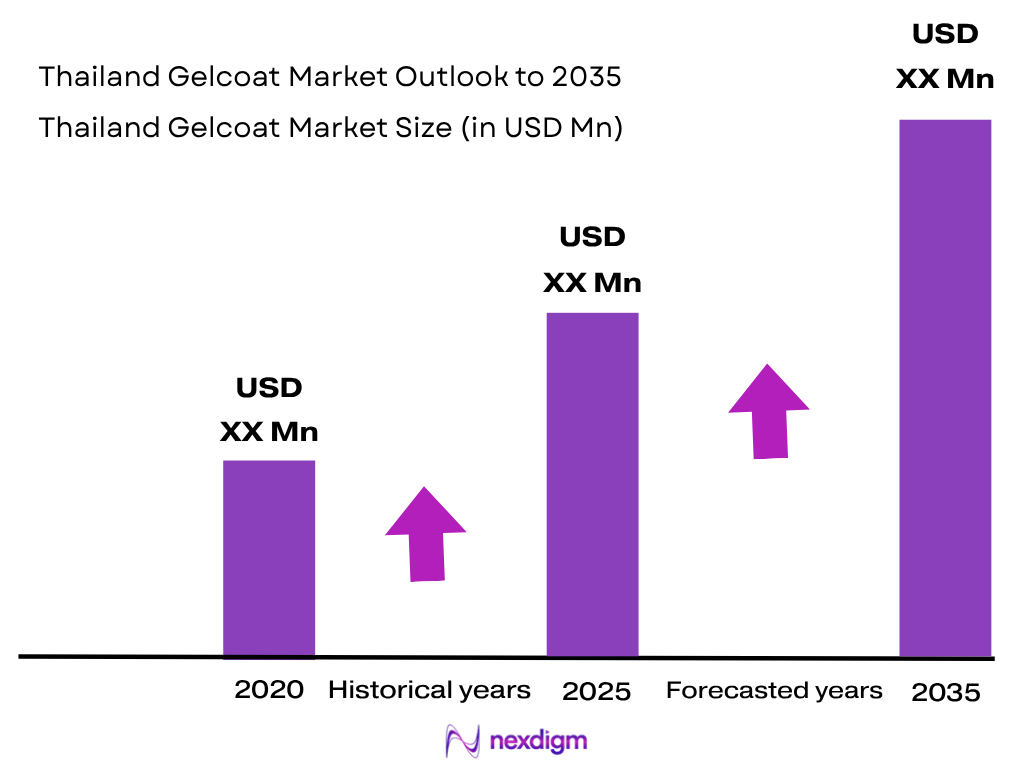
The Thailand Gelcoat Market was valued at approximately USD ~XX million in 2024 and is expected to expand at a CAGR of ~XX% during 2026-2035. Demand is closely connected with fiberglass-reinforced plastic manufacturing, particularly marine vessels, construction components, transportation parts, industrial tanks and pipes, and renewable-energy composite structures. Gelcoat provides surface protection, gloss, weather resistance, corrosion resistance and durability to FRP products, making it an important finishing material for Thailand’s composite manufacturing ecosystem. Public market assessments also identify polyester gelcoat as the leading resin category and marine as a major end-use application.
Thailand’s gelcoat consumption is concentrated around industrial and marine manufacturing clusters rather than being evenly distributed across the country. Bangkok and Samut Prakan benefit from their concentration of industrial suppliers, fabrication businesses and logistics infrastructure, while Chonburi and Rayong are supported by the Eastern Economic Corridor, automotive manufacturing, petrochemical activity and industrial production. Phuket and other southern coastal locations contribute through recreational boating, tourism-linked marine services and fiberglass boat maintenance. Thailand’s composite ecosystem therefore creates multiple demand channels for marine, transportation, construction and industrial gelcoat applications.
Market Segmentation
By Resin Type
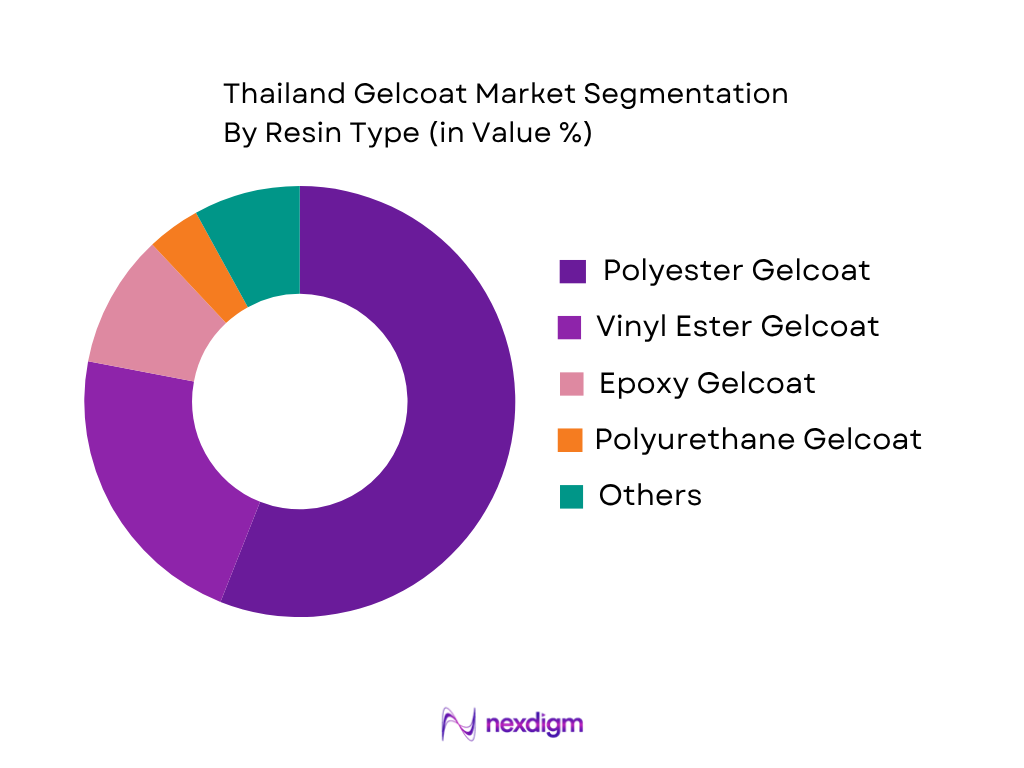
The Thailand Gelcoat Market is segmented into polyester, vinyl ester, epoxy, polyurethane, and hybrid or specialty resin systems. Polyester gelcoat is expected to represent the dominant resin category, supported by its broad compatibility with conventional fiberglass manufacturing, relatively straightforward processing characteristics and established use across marine, construction, transportation and general FRP applications. Thailand’s established composite fabrication base supports recurring consumption of conventional polyester systems for boat hulls, panels, tanks, sanitaryware and other molded products. Vinyl ester and epoxy systems serve applications requiring enhanced chemical, thermal, mechanical or corrosion resistance, particularly in higher-performance industrial and marine components. The continued presence of hand lay-up and spray-up fabrication also supports conventional polyester formulations because these processes are widely suited to standard gelcoat application. At the same time, specialty formulations are gaining relevance where fabricators require higher UV resistance, improved surface durability, low-styrene characteristics or compatibility with advanced composite processes.
By End-Use Industry
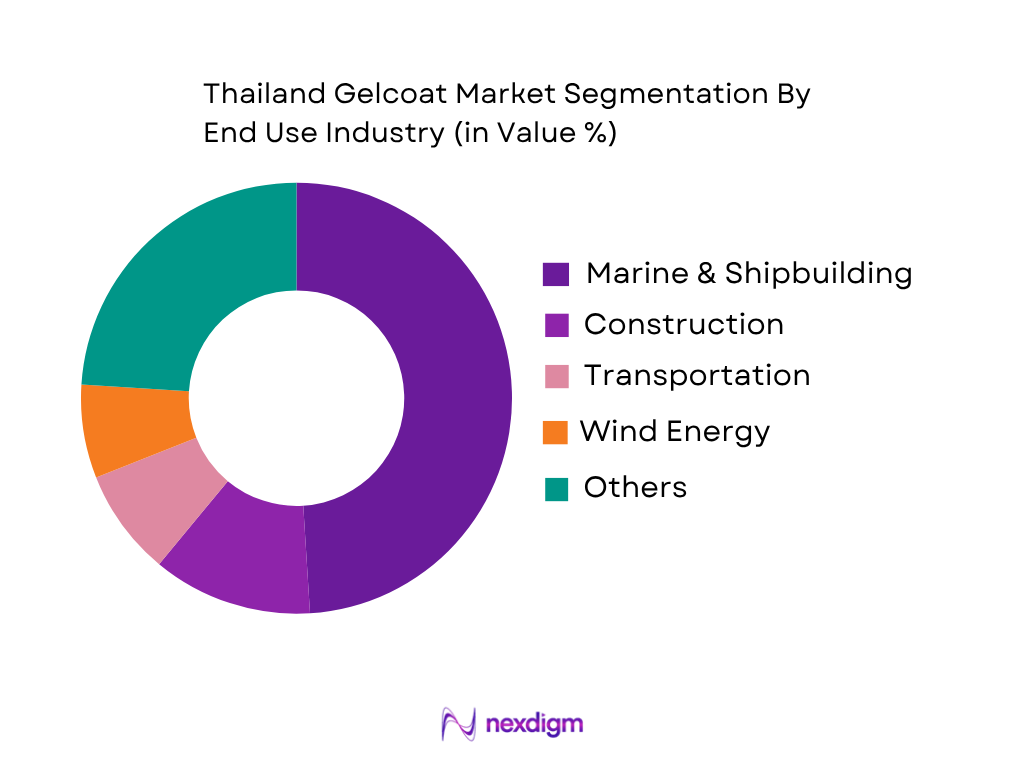
The Thailand Gelcoat Market is segmented into marine and shipbuilding, construction and infrastructure, transportation and automotive, wind energy, industrial equipment, tanks and pipes, sanitaryware, electrical and electronics, and other composite applications. Marine is expected to remain a leading end-use segment, reflecting Thailand’s established boatbuilding, recreational marine, fishing-boat and marine repair ecosystem. Gelcoat is particularly important for FRP hulls and decks because the surface layer provides protection against water exposure, ultraviolet radiation, abrasion and environmental degradation while also providing the required visual finish. Construction represents another significant consumption base through FRP panels, architectural components, sanitaryware and other molded structures. Transportation applications benefit from lightweight composite components, while industrial applications require corrosion-resistant FRP tanks, pipes and equipment. Wind energy represents a specialized opportunity because composite turbine components require protective surface systems. The diversity of these applications reduces dependence on a single downstream sector and supports demand for both standard and high-performance gelcoat products.
Competitive Landscape
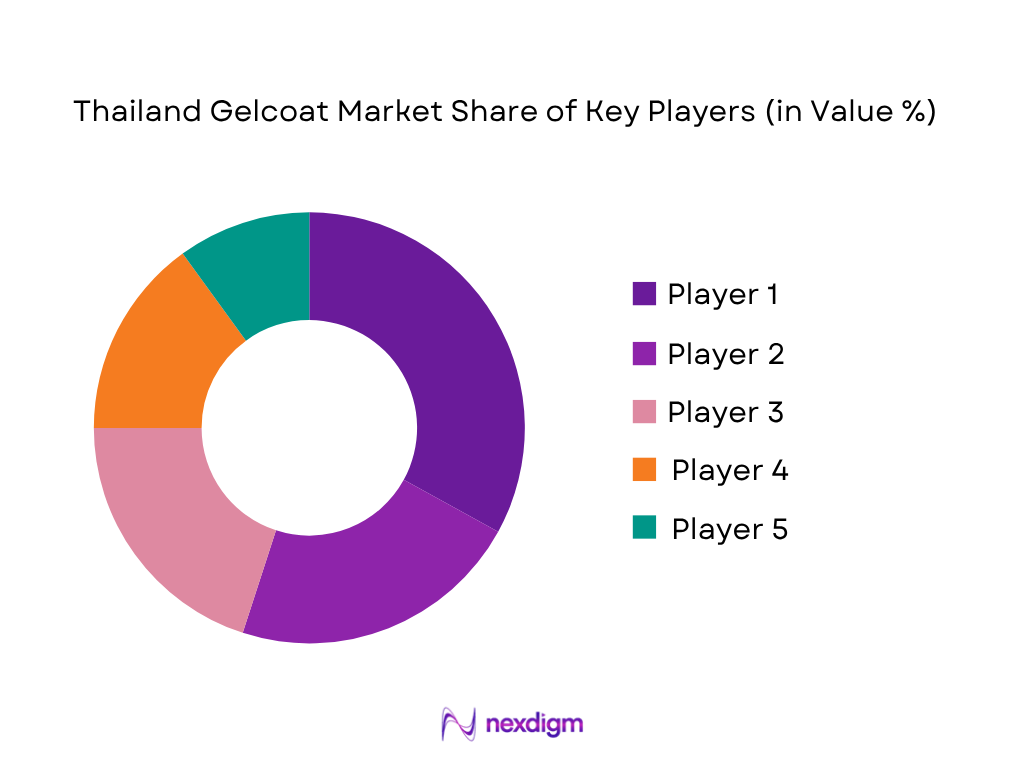
The Thailand Gelcoat Market includes global resin and composite-material suppliers alongside regional distributors and specialist composite-material companies. Competition is shaped by product breadth, resin chemistry, marine-grade performance, technical support, application assistance, distribution reach and the ability to provide customized formulations. International suppliers such as Scott Bader, Polynt, AOC, BÜFA Composite Systems, INEOS Composites, Gurit, Sika and Mäder compete alongside regional participants serving Thailand’s composite-fabrication base.
| Company | Establishment Year | Headquarters | Resin Portfolio | Marine Gelcoat Capability | Technical Support | Distribution Reach | Specialty Formulations |
| Scott Bader Company Limited | 1921 | United Kingdom | ~ | ~ | ~ | ~ | ~ |
| Polynt Group | 1955 | Italy | ~ | ~ | ~ | ~ | ~ |
| AOC | 1956 | United States | ~ | ~ | ~ | ~ | ~ |
| BÜFA Composite Systems | 1961 | Germany | ~ | ~ | ~ | ~ | ~ |
| INEOS Composites | 2021 | United States | ~ | ~ | ~ | ~ | ~ |
Thailand Gelcoat Market Analysis
Growth Drivers
Expansion of Marine and FRP Manufacturing
Thailand’s established marine ecosystem creates recurring demand for gelcoat through fiberglass boats, fishing vessels, recreational craft, marine components and repair operations. Gelcoat provides the external protective and decorative layer required by many FRP products, making its consumption closely linked with composite boat production and refurbishment. Thailand’s marine industry is supported by tourism, coastal economic activity, recreational boating and boat maintenance requirements. The broad availability of composite fabrication capabilities also supports demand for polyester-based gelcoat through hand lay-up and spray-up manufacturing. Beyond new vessels, repair and refurbishment activities create recurring replacement demand because exposed surfaces can require refinishing after prolonged UV, water and abrasion exposure. Market assessments consistently identify marine as one of Thailand’s principal gelcoat end-use industries.
Construction and Industrial FRP Applications
Gelcoat consumption is supported by Thailand’s use of FRP in construction, infrastructure, sanitaryware, industrial tanks, pipes, architectural components and other applications where corrosion resistance and surface durability are required. Construction-oriented composite components can benefit from gelcoat because the material provides a finished exterior surface while protecting the underlying laminate from environmental exposure. Industrial FRP applications create additional demand where equipment operates in humid, chemically aggressive or outdoor environments. The combination of construction, industrial manufacturing and transportation applications provides a diversified demand base. Market analyses identify construction, transportation, tanks and industrial uses alongside marine as important application areas for Thailand’s gelcoat industry.
Market Challenges
Dependence on Imported Specialty Materials
Thailand’s gelcoat ecosystem remains exposed to international resin, chemical and specialty-material supply chains, particularly for advanced formulations and specialized composite systems. Import dependence can increase procurement complexity and expose fabricators to international supply disruptions, logistics constraints, currency movements and changes in regional chemical availability. Standard polyester systems may have broader availability, while specialty grades such as high-performance, fire-retardant, low-styrene or highly chemical-resistant formulations can have a narrower supplier base. This creates a competitive disadvantage for smaller fabricators that require low-volume customized products. Maintaining adequate local inventory through distributors is therefore important for reducing production interruptions and ensuring reliable supply to marine and industrial composite manufacturers.
Environmental and Application Requirements
Gelcoat application requires appropriate handling of resin systems, catalysts, pigments and volatile components, creating environmental, occupational and process-control requirements for composite fabricators. Increasing attention to emissions and workplace exposure can encourage manufacturers to adopt low-styrene or lower-emission formulations. At the same time, application quality depends on correct catalyst levels, surface preparation, film thickness, curing conditions and spray or manual application practices. Inconsistent application can produce defects such as porosity, colour variation, poor curing or surface degradation. Smaller workshops may face challenges in maintaining standardized application procedures and technical quality, increasing the importance of supplier training and technical support.
Market Opportunities
Low-Styrene and High-Performance Gelcoats
Thailand offers an opportunity for suppliers to expand specialty gelcoat products that address increasingly demanding environmental and performance requirements. Low-styrene formulations can support fabricators seeking to reduce emissions during composite manufacturing, while high-UV, chemical-resistant and high-durability grades can address marine and industrial applications. Thailand’s exposure to intense sunlight, humidity, rainfall and coastal environments creates a practical requirement for surface systems with strong weathering performance. Marine manufacturers can also benefit from gelcoats with improved gloss retention, colour stability and blister resistance. These requirements create opportunities for suppliers to move beyond conventional standard polyester gelcoats toward differentiated formulations with stronger technical specifications.
Advanced Composite Applications
Growth in wind-energy components, lightweight transportation parts, industrial FRP equipment and advanced marine composites creates opportunities for specialty gelcoat suppliers. Composite manufacturing processes such as vacuum infusion, resin transfer molding and other controlled processes can increase demand for products engineered for specific resin systems and production conditions. Suppliers can strengthen their market position by providing formulation support, colour matching, process optimization and application training to Thai fabricators. Opportunities also exist for local distribution partnerships and regional supply arrangements that reduce lead times. The development of advanced composite manufacturing in Thailand can therefore increase demand for higher-performance gelcoat systems across multiple downstream industries.
Future Outlook
The Thailand Gelcoat Market is expected to maintain a positive long-term trajectory as composite materials gain application across marine, construction, transportation, industrial and renewable-energy sectors. Demand is likely to shift gradually toward higher-performance and application-specific gelcoat systems rather than remaining concentrated entirely in standard grades. Marine manufacturing and refurbishment should continue providing an important consumption base, while industrial FRP, transportation lightweighting and renewable-energy applications provide additional avenues for expansion. Low-emission formulations, improved UV resistance, specialty colour systems and resin-compatible products are expected to become increasingly important competitive differentiators.
Major Players
- Scott Bader Company Limited
- Polynt Group
- AOC
- Interplastic Corporation
- BÜFA Composite Systems
- Allnex
- Gurit
- Mäder Group
- Ashland
- Sika AG
- INEOS Composites
- Neotech Composite Co., Ltd.
- Benquin Triple 8 Chemicals, Inc.
- SEA Olympus Marketing, Inc. / Polyklear Fiberglass + Resin
- BFG Philippines / Thailand Regional Supply Network
Key Target Audience
- Gelcoat and Composite Resin Manufacturers
- Marine and Fiberglass Boat Manufacturers
- Composite Fabrication Companies
- Construction and FRP Component Manufacturers
- Industrial Tank, Pipe and Equipment Manufacturers
- Investments and Venture Capitalist Firms
- Government and Regulatory Bodies (Ministry of Industry, Pollution Control Department, Board of Investment of Thailand)
- Automotive, Transportation and Renewable-Energy Component Manufacturers
Research Methodology
Step 1: Identification of Key Variables
The initial phase involves mapping Thailand’s gelcoat ecosystem across resin manufacturers, distributors, composite fabricators, marine manufacturers, construction companies, industrial FRP producers and downstream end users. The research establishes variables covering resin chemistry, product grade, application method, end-use industry, domestic supply, imports and consumption volumes.
Step 2: Market Analysis and Construction
Historical market information is compiled through secondary research and supply-chain analysis covering gelcoat consumption, import flows, resin categories and end-use applications. A bottom-up framework evaluates demand from marine, construction, transportation, wind-energy and industrial composite applications, while a top-down assessment validates the overall market structure.
Step 3: Hypothesis Validation and Expert Consultation
Market hypotheses are validated through discussions with gelcoat distributors, composite-material suppliers, marine fabricators and industrial FRP manufacturers. Interviews focus on resin preferences, application practices, purchasing criteria, supplier selection, product availability, technical requirements and changing demand for specialty gelcoat systems.
Step 4: Research Synthesis and Final Output
The final stage reconciles demand-side and supply-side findings and validates market estimates against import-export information and industry indicators. Segment-level analysis is then constructed across resin type, product type, application method, end-use industry and composite manufacturing process to produce a consistent Thailand Gelcoat Market outlook.

- Executive Summary
- Research Methodology (Market Definition and Scope, Product Boundary, Market Sizing Framework, Top-Down Market Assessment, Bottom-Up Market Assessment, Demand-Side Analysis, Supply-Side Analysis, Import-Export Reconciliation, Primary Research, Distributor Interviews, Composite Fabricator Interviews, Marine Manufacturer Interviews, End-User Validation, Data Triangulation, Forecasting Framework, Scenario Analysis, Research Limitations)

- Definition and Scope
- Gelcoat Composition, Resin Chemistry and Functional Characteristics
- Role of Gelcoat in Fiberglass-Reinforced Plastic and Composite Manufacturing
- Thailand Gelcoat Industry Evolution and Development Path
Gelcoat Industry Value Chain - Thailand Gelcoat Supply Chain Architecture

- Growth Drivers (Expansion of Marine and Boatbuilding Activity, Growth of Fiberglass-Reinforced Plastic Manufacturing, Construction and Infrastructure Development, Expansion of Transportation Composite Applications, Growth of Industrial FRP Components, Increasing Demand for Corrosion-Resistant Surfaces, Expansion of Wind Energy Components, Growth of Composite Repair and Refurbishment)
- Market Challenges (Dependence on Imported Specialty Gelcoat Systems, Raw Material and Resin Feedstock Volatility, Limited Local Specialty Formulation Capacity, International Polymer Supply Exposure, Skilled Composite Application Requirements, Styrene and VOC Compliance Requirements, Product Quality Variation Across Suppliers, Fragmented Distributor and Fabricator Network)
- Market Opportunities (Low-Styrene and Low-Emission Gelcoats, High-Performance Marine Gelcoats, Fire-Retardant Composite Surface Systems, Advanced Tooling Gelcoats, Wind Energy Composite Applications, Sustainable Resin-Based Gelcoats, Local Colour-Matching and Formulation Services, Composite Repair Applications, Export-Oriented Gelcoat Distribution)
- Market Trends (Low-Emission Formulations, Sustainable Composite Materials, Premium Marine Finishes, Spray Application Adoption, Lightweight FRP Structures, Vacuum Infusion Adoption, Higher UV Resistance, Fire-Retardant Surface Systems, Specialty Resin Compatibility, Advanced Composite Manufacturing)
- Government Regulations (Chemical and Hazardous Substance Controls, Industrial Emission Requirements, Workplace Chemical Safety, Environmental Compliance, Import and Customs Requirements, Industrial Product Standards, Waste Management Requirements)
- SWOT Analysis
- Porter’s Five Forces Analysis
- PESTLE Analysis

- By Market Value (2020-2025)
- By Consumption Volume (2020-2025)
- By Domestic Production Volume (2020-2025)
- By Imported Gelcoat Volume(2020-2025)
- By Export Volume (2020-2025)

- By Resin Type (In Value %)
Polyester Gelcoat
Vinyl Ester Gelcoat
Epoxy Gelcoat
Polyurethane Gelcoat
Hybrid and Specialty Resin Gelcoat - By Product Type (In Value %)
Standard Gelcoat
Marine Gelcoat
Tooling Gelcoat
Pigmented Gelcoat
Clear Gelcoat
Fire-Retardant Gelcoat
UV-Resistant Gelcoat
Chemical-Resistant Gelcoat
Low-Styrene Gelcoat
High-Performance Gelcoat - By Application Method (In Value %)
Hand Application
Brush Application
Roller Application
Spray Application
In-Mould Application - By End-Use Industry (In Value %)
Marine and Shipbuilding
Construction and Infrastructure
Transportation and Automotive
Wind Energy
Industrial Equipment
Tanks and Pipes
Oil and Gas and Offshore
Electrical and Electronics
Sanitaryware and Recreational Products
Other Composite Applications - By Application (In Value %)
Boat Hulls and Decks
Passenger and Fishing Boats
Yachts and Recreational Boats
Marine Components and Interiors
Ship Repair and Refurbishment
Wind Turbine Components
Construction Panels and Architectural Components
Automotive and Transportation Components
Industrial Tanks and Pipes
Sanitaryware and Bathing Products
Other FRP Components - By Composite Manufacturing Process (In Value %)
Hand Lay-Up
Spray-Up
Vacuum Infusion
Resin Transfer Molding
Light Resin Transfer Molding
Compression Molding
Filament Winding
Other Composite Processes

- Market Share Analysis of Major Players (By Resin Type, Product Type, Application Method, End-Use Industry, Application, Domestic Supply, Imported Supply)
- Cross Comparison Parameters (Gelcoat Product Portfolio Breadth, Polyester and Vinyl Ester Formulation Capability, Marine-Grade Product Coverage, Low-Styrene Product Availability, Fire-Retardant Gelcoat Capability, Technical Application Support, Colour Customization Capability, Thailand and Southeast Asia Distribution Reach)
- SWOT Analysis of Major Players
- Detailed Profiles of Major Companies and Market Participants
Scott Bader Company Limited
Polynt Group
AOC
Interplastic Corporation
BÜFA Composite Systems
Allnex
Gurit
Mäder Group
Ashland
Sika AG
INEOS Composites
Neotech Composite Co., Ltd.
Benquin Triple 8 Chemicals, Inc.
SEA Olympus Marketing, Inc. / Polyklear Fiberglass + Resin
BFG Philippines / Thailand Regional Supply Network

- End-User Consumption Behavior
- Customer Segmentation by End-Use
- Geographic Consumption Concentration
- Purchase Decision Factors
- Application-Specific Product Requirements
- Emerging Customer Requirements

- By Market Value (2026-2035)
- By Consumption Volume (2026-2035)
- By Domestic Production Volume (2026-2035)
- By Imported Gelcoat Volume (2026-2035)
- By Export Volume (2026-2035)


 Request a Sample
 Ask for Customization
 Get a Quote
 Enquire Now