
 Download PDF
Market Overview
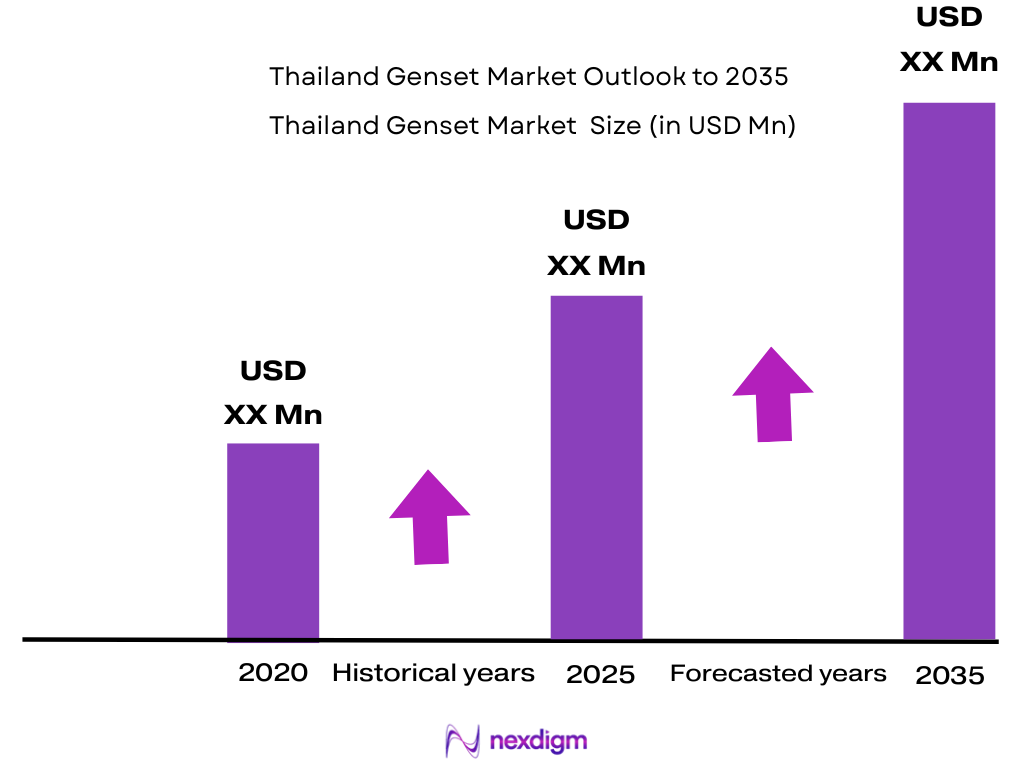
The Thailand Genset Market is valued at approximately USD ~ million, compared with USD ~ million in the preceding annual period, supported by an automotive manufacturing base that produced approximately 1.47 million vehicles versus around 1.84 million vehicles previously. Demand originates from assembly plants, component factories, paint shops, powertrain facilities, battery plants and supporting logistics infrastructure requiring emergency and standby electricity. The broader Thailand DG-set market provides an established industrial power-generation supply base for these automotive applications. Dominant Manufacturing Locations: Rayong, Chonburi, Chachoengsao and the wider Eastern Economic Corridor dominate Thailand Genset Market demand, supported by dense concentrations of automotive OEMs, parts manufacturers, EV plants, logistics facilities and industrial estates. The Eastern Economic Corridor extends across more than 13,000 square kilometres and is specifically positioned for next-generation automotive and advanced manufacturing investment. Samut Prakan and Bangkok additionally support component production, headquarters, distribution, engineering services and generator servicing activities linked with Thailand’s automotive supply chain. The Thailand Genset Market represents generator sets sold or deployed for backup, emergency, prime and temporary power within vehicle manufacturing and the associated automotive supply chain. Major addressable users include passenger-car factories, pickup and commercial-vehicle plants, motorcycle factories, Tier-1 and Tier-2 component manufacturers, powertrain plants, tyre factories, automotive electronics facilities, battery plants and EV assembly operations.
Market Segmentation
By Power Rating
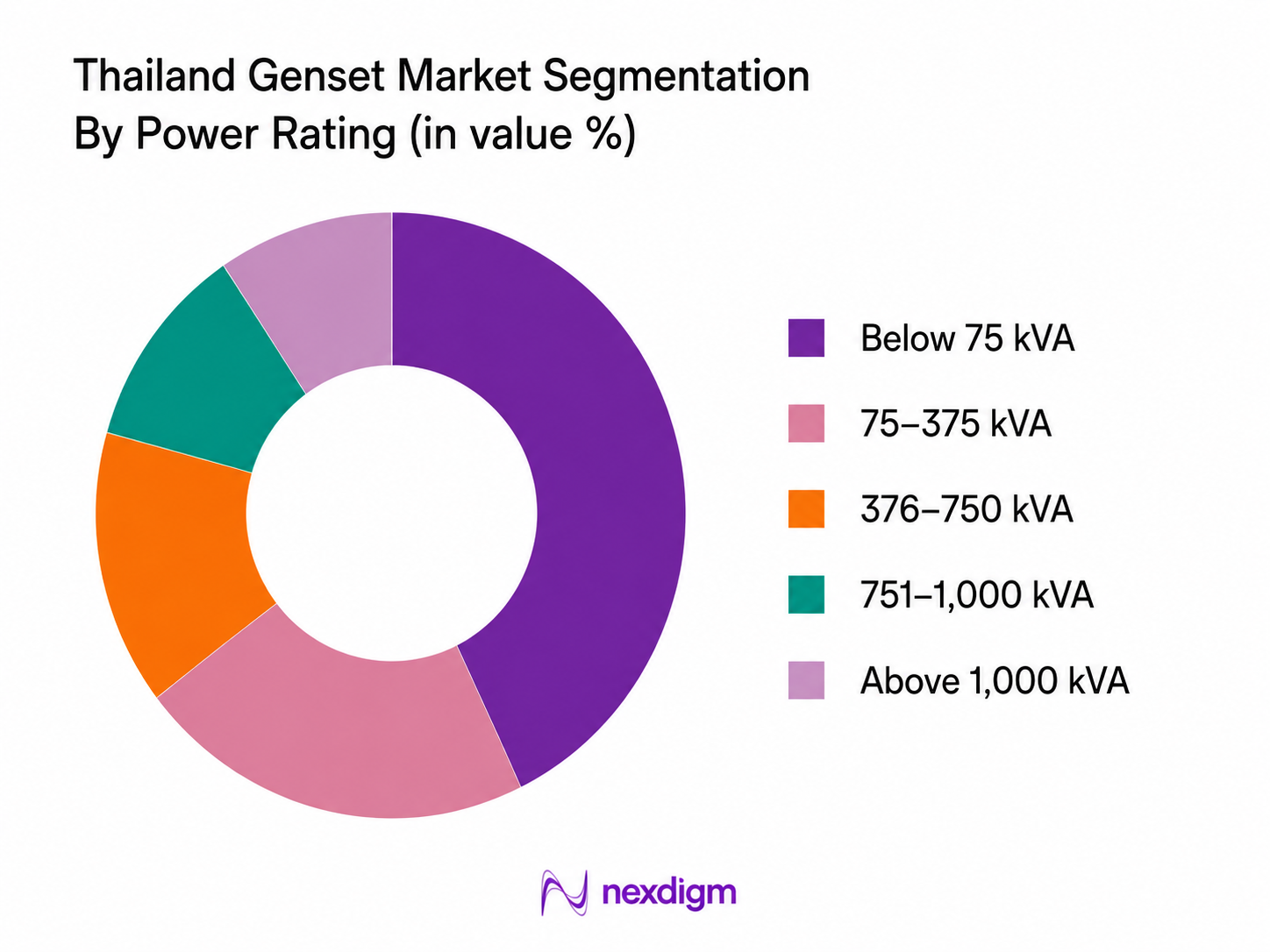
The Thailand Genset Market is segmented by power rating into below 75 kVA, 75–375 kVA, 376–750 kVA, 751–1,000 kVA and above 1,000 kVA. Above 1,000 kVA is the dominant value segment, owing to the substantial critical electrical loads found in large vehicle assembly, paint, powertrain, battery and integrated component-production facilities. Automotive manufacturers frequently require redundancy and parallel generator configurations rather than a single small genset. Large diesel systems are particularly suitable for centralized emergency-power architecture supporting production utilities, factory IT, safety equipment, HVAC and essential manufacturing processes. Thailand also has access to global generator portfolios extending well into multi-megawatt applications; Cummins, for example, markets diesel gensets up to 3,750 kVA. Smaller capacities remain relevant for warehouses, workshops, dealerships, individual production buildings and distributed backup applications.
By Automotive Facility Type
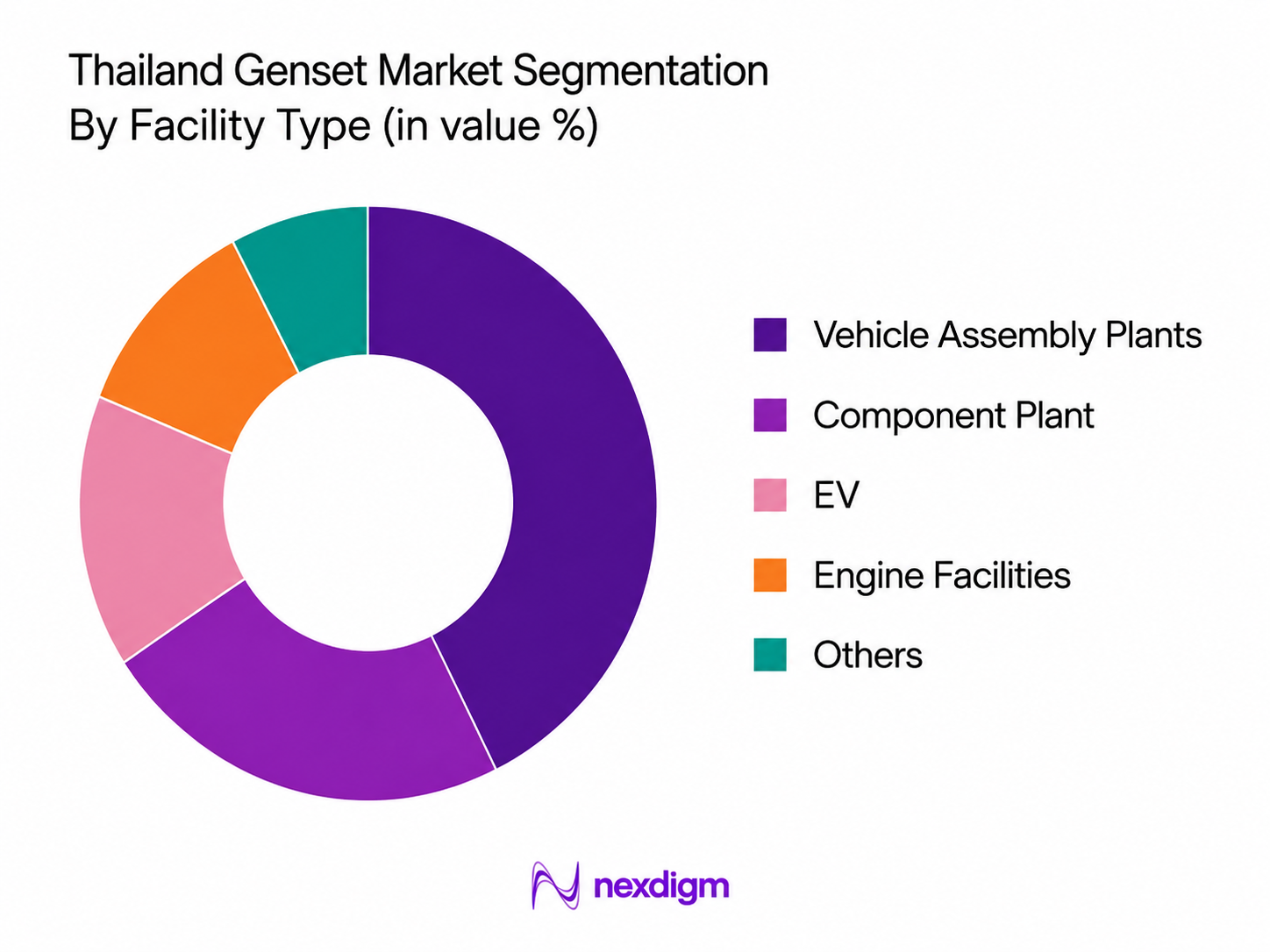
The Thailand Genset Market is segmented by automotive facility type into vehicle assembly plants, automotive component plants, EV and battery manufacturing facilities, powertrain and engine facilities, and automotive logistics/service facilities. Vehicle assembly plants account for the dominant market share, reflecting their large physical footprint, high connected loads and requirement for reliable standby electricity across multiple production buildings. Major assembly complexes typically contain stamping, body welding, paint, final assembly, testing, compressed air, chilled-water infrastructure and extensive digital production-control systems. Component facilities represent another significant opportunity because Thailand has developed a deep automotive supplier ecosystem surrounding its vehicle-manufacturing clusters. EV and battery facilities are increasingly important as new investments introduce electricity-intensive environmental control, battery assembly, testing and high-precision electronics requirements into the automotive power-continuity market. Thailand’s policy framework explicitly identifies next-generation automotive as an EEC strategic cluster.
Competitive Landscape
The Thailand Genset Market has a combination of global power-generation OEMs, Japanese industrial-equipment brands, authorized Thai distributors and local generator assemblers. Competition is determined less by the generator engine alone and increasingly by complete project capability: sizing, synchronization, ATS integration, acoustic engineering, commissioning, spare-parts availability and rapid after-sales support. Cummins provides integrated engine, alternator and control solutions, Caterpillar operates through Metro Machinery in Thailand, while Denyo maintains multiple Thailand distribution relationships.
| Company | Established | Headquarters | Genset Technology | Relevant Capacity Position | Fuel Offering | Thailand Route-to-Market | Automotive Suitability | Key Competitive Strength |
| Cummins | 1919 | Columbus, USA | ~ | ~ | ~ | ~ | ~ | ~ |
| Caterpillar | 1925 | Irving, USA | ~ | ~ | ~ | ~ | ~ | ~ |
| Denyo | 1948 | Tokyo, Japan | ~ | ~ | ~ | ~ | ~ | ~ |
| Yanmar | 1912 | Osaka, Japan | ~ | ~ | ~ | ~ | ~ | ~ |
| Atlas Copco | 1873 | Stockholm, Sweden | ~ | ~ | ~ | ~ | ~ | ~ |
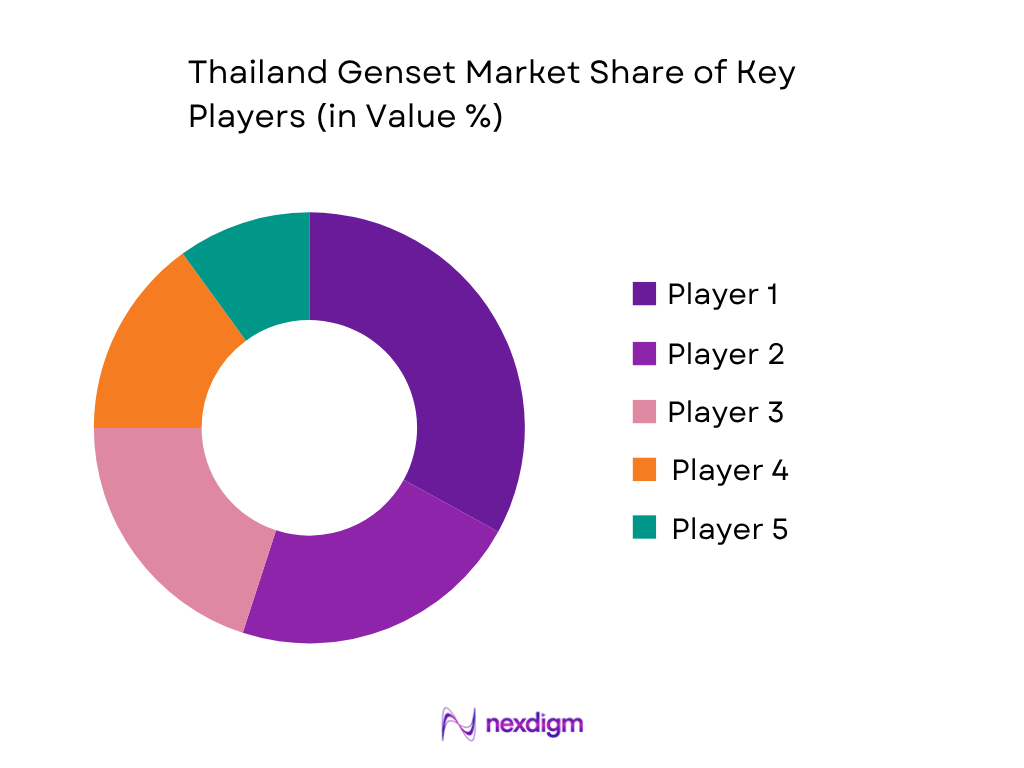
Thailand Genset Market Analysis
Growth Drivers
Expansion and Electrification of Thailand’s Automotive Manufacturing Base
Thailand’s established vehicle-production ecosystem is a primary structural driver for automotive gensets because assembly plants, component factories, battery facilities, paint shops, stamping operations, robotic welding lines, machining units, industrial HVAC, compressed-air systems and factory-control infrastructure require dependable emergency electricity. Thailand produced 1,468,997 motor vehicles in 2024, of which 1,019,213 vehicles were produced for export-oriented demand, demonstrating the scale of industrial assets requiring power-continuity infrastructure. The manufacturing transition is simultaneously increasing the number and technical complexity of electrically intensive facilities. The Thailand Board of Investment reported that approved/promoted EV manufacturing activities included 21 BEV-production projects with combined annual capacity of 386,000 vehicles, alongside 53 battery-production projects and 42 projects for critical EV components such as traction motors, battery-management systems, drive-control units and onboard chargers. These projects widen the genset addressable application base beyond traditional vehicle assembly into battery production, automotive electronics and electrified powertrain manufacturing, where interruption of ventilation, environmental-control, process automation or production-management systems can have substantial operational consequences. EV-supporting infrastructure has also expanded, with 29 promoted charging-station projects designed for 20,080 charging points, including 7,360 DC chargers. Macroeconomic conditions provide additional support to industrial capital formation: the World Bank reported that Thailand’s economy expanded by 2.5% in 2024, supported partly by stronger goods exports, while BOI received 1.14 trillion baht across investment-promotion applications in 2024, illustrating continued capital deployment into productive assets. For genset suppliers, the key implication is not simply an increase in vehicle output but the proliferation of higher-specification industrial facilities requiring standby generators, synchronized multi-set installations, automatic transfer systems, remote controls and lifecycle service support. Electrification therefore broadens the potential automotive genset customer universe while increasing requirements for power reliability and electrical-system integration.
Government-Backed Localization and Industrial Investment Requirements
Thailand’s policy-driven localization of electric and hybrid vehicle production is reinforcing demand for industrial utility and backup-power equipment because incentive beneficiaries must establish or expand physical manufacturing capacity inside the country rather than rely only on imported finished vehicles. The EV 3.5 package, which entered into force in 2024, requires participating manufacturers in 2026 to locally produce two vehicles for every vehicle imported under the program, while 26 manufacturers had applied to the relevant EV incentive schemes. This localization requirement is directly relevant to genset demand because incremental assembly capacity must be supported by utilities, emergency power, transfer systems, switchgear and maintenance infrastructure. The EV Board has also established localization-oriented conditions for mild hybrids: qualifying manufacturers and affiliates are required to undertake at least 1 billion baht of new investment by 2026, while eligible vehicles must incorporate designated locally produced components and meet specified technical conditions. Beyond vehicle assembly, BOI records show a substantial physical EV supply chain already under development, including 386,000 units of annual BEV-production capacity, 810,000 units of annual battery-electric motorcycle capacity, 4,800 units of annual electric bus and truck capacity, and dozens of battery and electronic-component projects. These investments support demand for gensets across a diversified collection of factories rather than a handful of final-assembly sites. The wider investment environment reinforces this industrialization process: BOI recorded 407 electronics and electrical-appliance projects in 2024, an adjacent manufacturing category relevant to increasingly electronics-intensive automotive supply chains. At the macroeconomic level, World Bank reporting indicates 2.5% real economic growth in 2024, while the IMF subsequently estimated growth at 2.1% in 2025, showing continued economic expansion despite a softer manufacturing cycle. For automotive gensets, government localization policy therefore provides a durable demand mechanism: every newly localized production line, battery operation, component facility or supporting industrial utility increases the installed infrastructure that may require standby power, synchronization, emergency-transfer systems and scheduled genset servicing.
Market Challenges
Weakness in Conventional Vehicle Production and Uneven Factory Capacity Utilization
A major challenge for the Thailand Genset Market is that the country’s transition toward electrified manufacturing is occurring while conventional automotive production remains under pressure, limiting the pace at which established OEMs and suppliers approve discretionary plant-expansion and backup-power projects. Thailand produced 1,468,997 vehicles in 2024, while domestic vehicle sales stood at 572,675 units and export-related vehicle output at 1,019,213 units. The weakness persisted into the following period: vehicle production was only 107,103 units in January 2025, compared with 142,102 units in the corresponding month of 2024; domestic sales were 48,092 units, while exports were 62,321 units. By the first eight months of 2025, cumulative vehicle production stood at 949,140 units, illustrating that factory activity remained below earlier operating levels. More recent Office of Industrial Economics data also show continuing manufacturing volatility: Thailand’s Manufacturing Production Index was 94.99 in June 2026, while automotive production recorded a year-on-year contraction of 12.59% in that month. Such conditions are market-specific constraints for genset vendors because automotive manufacturers facing underutilized lines commonly prioritize maintenance, productivity improvements and utilization of existing installed equipment before authorizing large greenfield utility packages. Suppliers serving conventional pickup, ICE passenger-car and export-oriented plants may therefore encounter delayed generator replacements, smaller capacity additions or extended service lives for installed units. Macroeconomic momentum also became less supportive: the IMF estimated Thailand’s GDP growth slowed from 2.5% in 2024 to 2.1% in 2025 and expected further moderation to 1.6% in 2026. The challenge is consequently one of demand bifurcation. Genset opportunities are growing within EV, battery and advanced component facilities, but suppliers cannot assume this growth fully offsets weaker capital expenditure among legacy automotive manufacturers. Winning business increasingly requires targeting replacement-critical equipment, EV projects and facilities where production continuity justifies investment even under weaker utilization conditions.
Improving Grid Reliability and Rising Competition from Alternative Critical-Power Architectures
Genset suppliers face a more technical challenge as Thailand improves electricity-system reliability while industrial customers increasingly evaluate batteries, renewable generation and energy-management systems alongside conventional diesel standby equipment. Metropolitan Electricity Authority reporting on its 2024 distribution-system performance states that electrical-system reliability improved, reinforcing the fact that automotive plants in well-developed industrial areas cannot justify gensets simply on the basis of frequent grid outages; the investment case increasingly depends on the financial consequence of even a rare interruption, the criticality of individual production processes and the need for redundancy during utility or facility maintenance. At the national level, Thailand also operates a substantial diversified electricity system. EGAT reports 9,319.875 MW of contracted Small Power Producer capacity, including 6,050 MW of cogeneration capacity, of which 5,772 MW is classified as firm. This industrial electricity ecosystem is particularly relevant to automotive clusters where factories may already receive relatively resilient utility supply. Meanwhile, energy-efficiency measures supported by EGAT have reduced peak electricity demand by 388.14 MW and electricity consumption by 2,427 GWh, demonstrating continued institutional efforts to manage load without adding conventional generation. For genset suppliers, this means equipment must compete with a widening range of resilience and energy-management approaches rather than serve as the automatic first choice for every application. Battery energy storage can cover short interruptions and power-quality events, while solar-plus-storage systems can reduce daytime grid dependence; generators remain better suited to extended-duration emergency supply and high-power industrial loads, but customers increasingly evaluate integrated architectures combining all three. This transition occurs against a macroeconomic environment in which the World Bank recorded 2.5% economic growth in 2024, while slower subsequent growth places additional scrutiny on industrial capital expenditure. The market challenge is therefore to move beyond selling standalone generator hardware. Suppliers increasingly need ATS expertise, paralleling controls, remote monitoring, BESS compatibility, black-start design and lifecycle maintenance capabilities to demonstrate why gensets remain an essential layer of automotive plant resilience even as Thailand’s underlying grid and distributed-energy infrastructure improve.
Market Opportunities
Greenfield EV, Battery and Automotive-Electronics Facilities as New Critical-Power Demand Pools
The clearest future opportunity for the Thailand Genset Market lies in converting the country’s existing EV investment pipeline into generator, switchgear, synchronization and maintenance contracts. Current installed and approved industrial activity already provides a substantial foundation without relying on speculative future volumes. BOI records identify 21 BEV manufacturing projects with combined production capacity of 386,000 units per year, 16 electric-motorcycle projects with capacity of 810,000 units, and 3 electric bus and truck projects capable of producing 4,800 units annually. More importantly for genset demand, the ecosystem extends far beyond assembly: 53 battery-production projects cover module and cell manufacturing, while 42 additional projects encompass traction motors, battery-management systems, drive-control units and onboard chargers. These plants contain power-sensitive process equipment, factory automation, dry-room or environmental-control infrastructure, testing systems, compressed-air utilities, digital manufacturing platforms and safety equipment that can justify dedicated standby capacity. The associated charging ecosystem is also becoming industrially significant, with 29 promoted charging projects targeting 20,080 charging stations, of which 7,360 are DC units. This creates opportunities for generators not only inside production buildings but also for commissioning, temporary-power, facility expansion and resilience requirements associated with charging and test infrastructure. The wider investment pipeline strengthens the opportunity: BOI received applications worth 1.14 trillion baht in 2024, including 407 electronics and electrical-appliance projects, a sector increasingly interconnected with EV component manufacturing. World Bank data show Thailand’s economy expanded 2.5% in 2024, providing the macroeconomic base against which this capital formation occurred. The most attractive strategic approach for genset vendors is therefore to engage EV investors at the engineering and construction stage rather than after factory completion. Specification influence with EPC contractors, MEP engineers and industrial-estate developers can position suppliers for generator packages, ATS systems, synchronized multi-genset solutions, acoustic enclosures, fuel systems, commissioning and long-term maintenance agreements across an expanding generation of electrified automotive plants.
Replacement, Hybridization and Lifecycle Services Across Thailand’s Existing Automotive Factory Base
A second major opportunity is the modernization of the large installed automotive manufacturing base rather than dependence solely on new factory construction. Thailand’s production of 1,468,997 motor vehicles in 2024 confirms that the country retains substantial operational manufacturing infrastructure even during a weaker automotive cycle. These plants contain installed generators, automatic transfer switches, synchronization panels, fuel-storage equipment, controllers and electrical distribution systems that require recurring inspection, overhaul, testing and eventual replacement. Replacement demand can remain commercially relevant even when total vehicle production slows because emergency-power systems are safety- and continuity-critical assets whose reliability cannot simply track factory utilization. The opportunity is also being reshaped by electrification. BOI records show 26 manufacturers participating in Thailand’s EV incentive frameworks, while EV 3.5 requires a two-for-one domestic production obligation in 2026 for qualifying imported vehicles. Existing manufacturers therefore have incentives to reconfigure plants, add lines, expand utilities or establish localized component operations. For genset companies, these modifications create openings to replace aging mechanical controls with digital controllers, retrofit automatic transfer equipment, add synchronization capability, upgrade emissions and acoustic systems, install remote telemetry and integrate battery storage to reduce diesel runtime while retaining long-duration emergency capability. This service-led opportunity is especially important because automotive factories demand short response times and predictable restoration during power-system failures; consequently, local spare-parts inventory, field-engineer availability and preventive-maintenance execution can be as commercially important as generator specifications. The macroeconomic environment strengthens the case for lifecycle offerings: Thailand’s economy expanded 2.5% in 2024, but the IMF’s subsequent 2.1% growth estimate for 2025 indicates customers are likely to prioritize productivity and asset optimization alongside expansion. Suppliers able to extend generator life, increase reliability and integrate existing assets with batteries or factory energy-management systems can therefore capture opportunities without requiring an entirely new plant. The future growth path is likely to combine greenfield EV projects with recurring modernization of Thailand’s mature automotive power-continuity infrastructure.
Future Outlook
The Thailand Genset Market is expected to expand at a forecast CAGR of approximately ~XX% during the forecast period, supported by continuing investment in automotive electrification, factory modernization and replacement of aging standby-power systems. Growth will increasingly originate from EV assembly, battery production, automotive electronics and high-value component manufacturing rather than conventional vehicle capacity expansion alone. Greenfield EV and battery manufacturing projects will create new generator installations, while established ICE and hybrid manufacturing plants will continue generating replacement and capacity-upgrade opportunities. Thailand’s government continues to use investment policy to maintain the country’s position as a regional automotive production hub, including incentives targeting hybrid and electric vehicle manufacturing. The market will also undergo a technological change. Diesel gensets should remain central to high-capacity emergency power because of their high power density, rapid start capability and mature service ecosystem. However, customers are likely to increasingly assess HVO-compatible generators, gas units, battery energy storage and hybrid genset-BESS configurations to reduce generator runtime, fuel consumption and emissions. Cummins already identifies HVO capability across its generator-set range and is developing integrated battery and microgrid power solutions, illustrating the broader direction of critical-power technology. The strongest geographic opportunity should remain in the EEC, particularly Rayong, Chonburi and Chachoengsao. These provinces benefit from integrated industrial estates, automotive supply chains, ports and infrastructure, while next-generation automotive is one of the development area’s designated strategic industries. Replacement demand should become another important growth pillar as existing automotive factories upgrade older mechanical gensets, controllers, synchronization panels and ATS systems. This creates opportunities beyond equipment sales for annual maintenance contracts, remote monitoring, load-bank testing, retrofits and complete lifecycle service.
Major Players
- Cummins Inc. / Cummins Thailand
- Caterpillar Inc. / Metro Machinery
- Denyo Co., Ltd.
- Yanmar Holdings Co., Ltd. / Yanmar Thailand
- Atlas Copco Group
- Mitsubishi Heavy Industries Group
- FG Wilson
- Hokuetsu Industries Co., Ltd. – AIRMAN
- Yuchai Group / Yuchai Thailand
- Changzhou ITC Power Equipment Manufacturing Co., Ltd.
- Thai Generator Sales & Services Co., Ltd.
- DEL Generation Co., Ltd.
- Tender Co., Ltd.
- NDT (Thailand) Co., Ltd.
- Metro Machinery Co., Ltd.
Key Target Audience
- Automotive OEM Manufacturers
- Automotive Tier-1, Tier-2 and Tier-3 Component Manufacturers
- Electric Vehicle and Battery Manufacturers
- Generator Set Manufacturers, Assemblers and Authorized Distributors
- EPC, Electrical and MEP Infrastructure Companies
- Industrial Estate Developers and Automotive Manufacturing Park Operators
- Investments and Venture Capitalist Firms
- Government and Regulatory Bodies (Thailand Board of Investment, Eastern Economic Corridor Office, Ministry of Industry, Department of Industrial Works, Thai Industrial Standards Institute and Thailand Automotive Institute)
Research Methodology
Step 1: Identification of Key Variables
The initial phase involves constructing a detailed ecosystem map of the Thailand Genset Market, covering generator OEMs, distributors, engine manufacturers, automotive OEM plants, Tier suppliers, EV manufacturers, battery plants and industrial estates. Secondary research is used to identify key variables including genset capacity, installed base, replacement cycle, plant type, automotive production footprint, average selling price and critical-power configuration.
Step 2: Market Analysis and Construction
Historical generator demand is analyzed through both top-down and bottom-up approaches. The top-down process evaluates the Thailand generator and diesel-genset industry and isolates automotive manufacturing applications. The bottom-up process maps major vehicle, component, battery and EV facilities and assesses generator installations, typical kVA requirements, replacement demand, new projects, pricing and aftermarket expenditure. The model also considers automotive manufacturing activity, geographic plant concentration, industrial-estate development and power-continuity requirements. Published Thailand generator-market benchmarks, automotive-industry statistics and investment announcements are triangulated to prevent the automotive genset opportunity from being overstated relative to the broader national generator market.
Step 3: Hypothesis Validation and Expert Consultation
Market hypotheses are validated through computer-assisted telephone interviews and structured discussions with genset distributors, automotive plant utility managers, EPC contractors, electrical engineers, generator service companies and industrial equipment suppliers. Interviews assess equipment procurement, average capacities, brand selection, operating mode, utilization, replacement periods, maintenance requirements, pricing structures and customer pain points. Primary discussions also validate competitive positioning, distributor reach, service-response capability and differences between greenfield EV plants and established ICE automotive manufacturing sites. Information from multiple respondent categories is cross-checked to minimize supplier-side or customer-side bias.
Step 4: Research Synthesis and Final Output
The final phase triangulates secondary findings, primary interviews and facility-level bottom-up calculations. Generator sales, installed kVA, automotive facility counts, equipment replacement, market pricing and service revenues are reconciled to produce the final market model. Forecasting incorporates automotive investment, EV and battery capacity additions, replacement cycles, technology shifts, generator pricing and potential substitution from BESS. Multiple scenarios are subsequently reviewed to create a commercially relevant outlook and identify addressable opportunities by power rating, automotive facility type, geography and supplier category.

- Executive Summary
- Research Methodology (Market Definitions and Assumptions, Automotive Genset Market Boundary, Abbreviations, Market Sizing Approach, Top-Down Market Assessment, Bottom-Up Installed-Base Assessment, Automotive Plant Mapping, OEM and Tier Supplier Mapping, Generator Shipment Estimation, Replacement Demand Assessment, Demand-Side Interviews, Supply-Side Interviews, Distributor and Dealer Interviews, Automotive Industrial Estate Assessment, Import Shipment Analysis, Price Benchmarking, Data Triangulation, Forecasting Framework, Scenario Analysis, Limitations and Future Conclusions)

- Definition and Scope
- Market Evolution and Industry Genesis
- Evolution of Standby Power Requirements in Thailand’s Automotive Manufacturing Sector
- Thailand Automotive Manufacturing Ecosystem Overview
- Automotive OEM Manufacturing Footprint

- Growth Drivers (Automotive Manufacturing Expansion, EV Factory Investments, Automotive Component Localization, Production Automation, Critical Power Requirements, Industrial Capacity Additions)
- Market Challenges (Diesel Fuel Cost, Emissions Compliance, Generator CAPEX, Maintenance Cost, Grid Reliability Improvement, Alternative Backup Technologies)
- Market Opportunities (EV Plants, Battery Plants, Replacement Market, Hybrid Backup Systems, Remote Monitoring, Service Contracts, High-kVA Systems)
- Market Trends (Digital Controls, Remote Monitoring, Parallel Operation, Fuel Efficiency, Low Emissions, Hybridization, Predictive Maintenance)
- SWOT Analysis
- Porter’s Five Forces Analysis
- PESTLE Analysis

- By Market Value (2020-2025)
- By Units Sold (2020-2025)
- By Installed Genset Base (2020-2025)

- By Power Rating (In Value %)
Below 75 kVA
75–375 kVA
376–750 kVA
751–1,000 kVA
Above 1,000 kVA - By Automotive Facility Type (In Value %)
Passenger Vehicle Assembly Plants
Pickup Truck and Commercial Vehicle Plants
Motorcycle Manufacturing Plants
Automotive Tier-1 Component Plants
Automotive Tier-2 and Tier-3 Component Plants - By Genset Configuration (In Value %)
Open-Type Generator Sets
Soundproof/Silent Generator Sets
Weather-Protected Canopy Generator Sets
Containerized Generator Sets
Indoor Generator Rooms - By Region (In Value %)
Eastern Thailand
Bangkok Metropolitan Region
Central Thailand
Western Thailand
Northern Thailand

- Market Share of Major Players by Market Value
- Cross Comparison of Major Competitors (kVA Portfolio Coverage, Automotive Installed References, Fuel and Technology Offering, Local Assembly and Customization Capability, Thailand Service Network Coverage, Spare Parts Availability and Lead Time, Genset Pricing and Total Cost of Ownership, Warranty–AMC–Emergency Response Capability)
- SWOT Analysis of Major Players
- Detailed Profiles of Major Companies
Cummins Inc. / Cummins DKSH (Thailand)
Caterpillar Inc. / Metro Machinery
Denyo Co., Ltd. / NDT (Thailand)
Yanmar Holdings Co., Ltd. / Yanmar S.P. Co., Ltd.
Atlas Copco Group
Mitsubishi Heavy Industries Group
FG Wilson
Hokuetsu Industries Co., Ltd. – AIRMAN
Yuchai Group / Yuchai Thailand
Changzhou ITC Power Equipment Manufacturing Co., Ltd.
Thai Generator Sales & Services Co., Ltd.
DEL Generation Co., Ltd.
Tender Co., Ltd.
NDT (Thailand) Co., Ltd.
Metro Machinery Co., Ltd.

- Demand and Utilization Assessment
- Installed Generator Fleet Assessment
- Average Installed Capacity by Automotive Facility
- Average Genset Age
- Annual Operating Hours

- By Market Value (2026-2035)
- By Units Sold (2026-2035)
- By Installed Genset Base (2026-2035)


 Request a Sample
 Ask for Customization
 Get a Quote
 Enquire Now