

 Download PDF
Market Overview
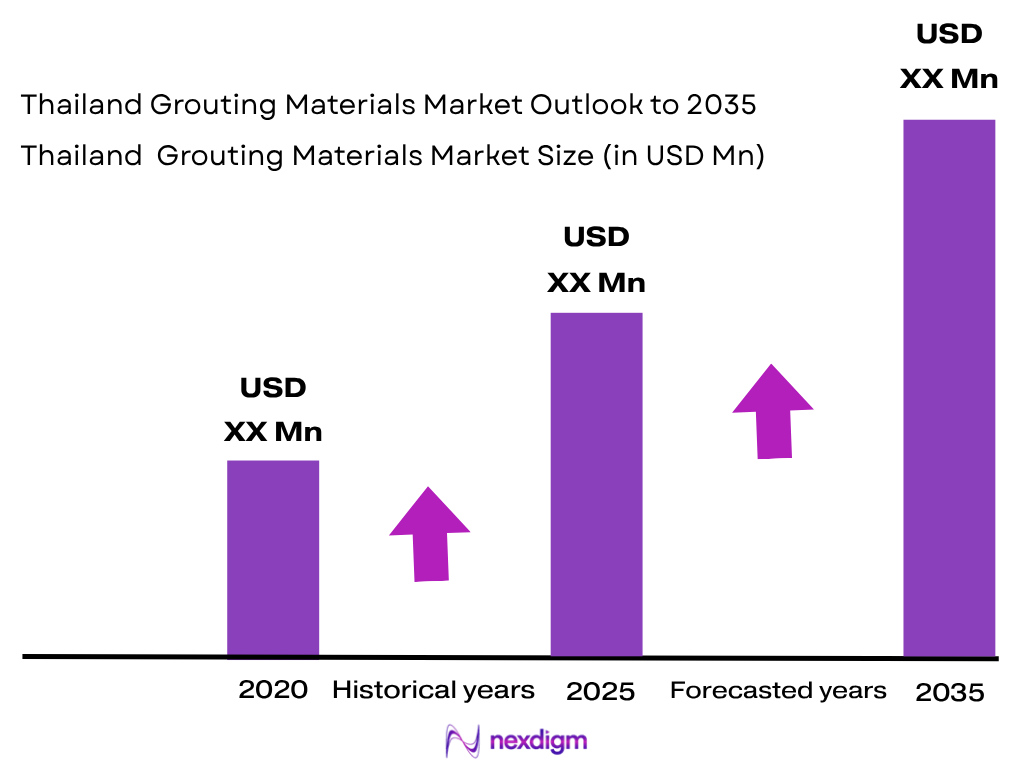
The Thailand Grouting Materials Market is valued at approximately ~USD XX million, supported by industrial investment, equipment installation, transport infrastructure and structural construction. BOI investment applications increased from 2,307 projects worth THB848.3 billion in the preceding period to 3,137 projects worth THB1.14 trillion in the latest period. This expanding project base supports non-shrink cementitious grouts, precision epoxy systems, anchoring materials, precast connection grouts and injection products.
Bangkok Metropolitan Region and the Eastern Economic Corridor, particularly Chonburi, Rayong and Chachoengsao, dominate Thailand Grouting Materials demand because they combine mass-transit projects, factories, logistics facilities and heavy industrial installations. The EEC attracted THB460.5 billion of investment pledges in the preceding period, while national applications subsequently reached THB722.5 billion across 2,195 projects within nine months, with electronics, data centres and automotive manufacturing prominent.
Market Segmentation
By Product Type
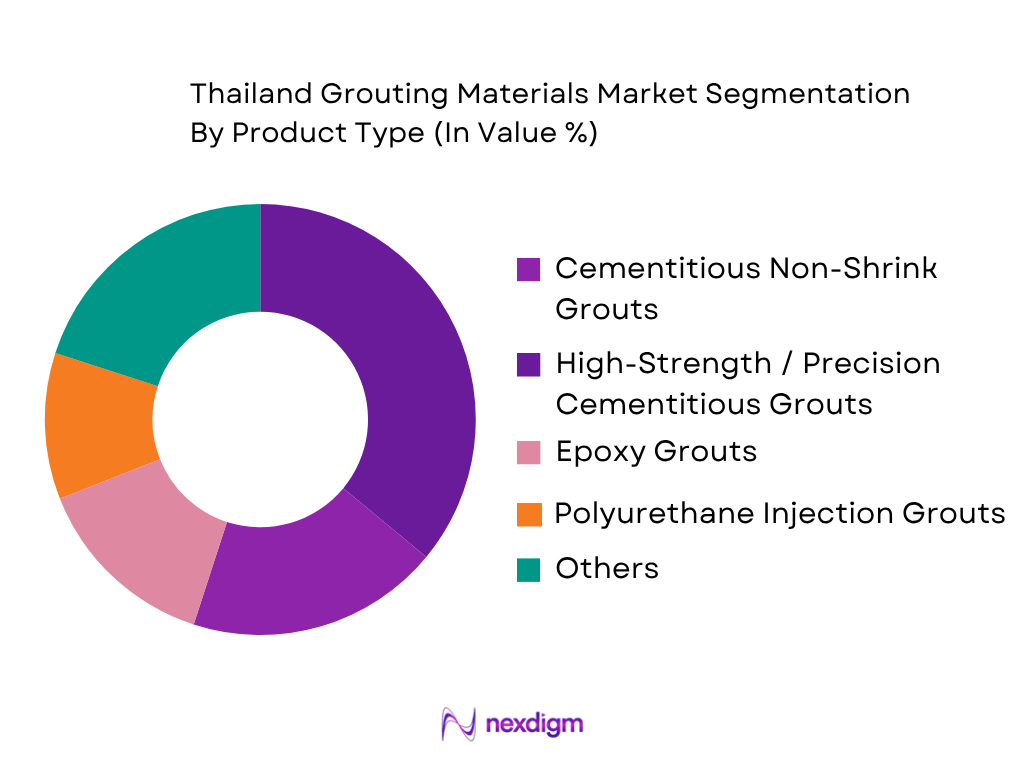
The Thailand Grouting Materials Market is segmented into general-purpose non-shrink cementitious grouts, high-strength precision cementitious grouts, epoxy grouts, injection grouts, anchoring grouts, precast connection grouts and bridge or rail specialty grouts. Non-shrink cementitious grouts hold the dominant market position because they address the widest range of machine foundations, steel baseplates, precast columns, bridge bearings and structural gaps. Thailand also has a mature domestic production base; General Engineering has manufactured and distributed non-shrink grout in the country since 1977, supporting broad contractor familiarity and supply availability. Industrial investment reinforces this segment: BOI recorded 407 electronics and electrical projects worth THB231.7 billion, 309 automotive projects worth THB102.4 billion and 235 petrochemical and chemical projects worth THB49.1 billion in the latest full-year investment cycle. These sectors require extensive equipment foundations and precision alignment, while epoxy grouts serve higher-vibration and chemical-resistance applications.
By Application
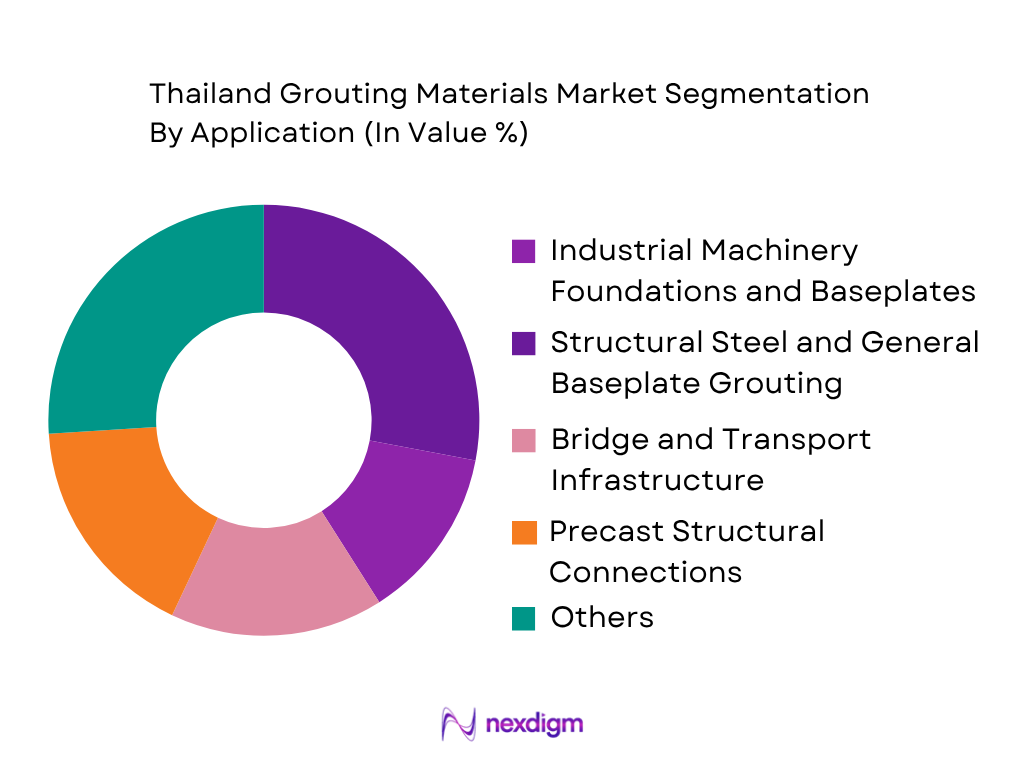
The Thailand Grouting Materials Market is segmented into machine foundations and equipment baseplates, precast structural connections, bridge and transport infrastructure, anchoring, underground injection, water-cutoff works and other structural applications. Machine foundations and baseplates represent the dominant segment because Thailand remains a major automotive, electronics, petrochemical and industrial-production base. BOI recorded 3,137 investment applications worth THB1.14 trillion, including 407 electronics and electrical projects, 309 automotive projects and major digital infrastructure developments. The EEC concentrates a large proportion of these investments in Chonburi, Rayong and Chachoengsao, creating demand around production lines, pumps, compressors, steel columns, utility skids and automated logistics equipment. Transport construction provides an additional structural-grout application base. The Orange Line alone represents a 35.9-kilometre urban rail investment of THB109.2 billion, supporting bearing, plinth, baseplate, void-filling and underground injection applications.
Competitive Landscape
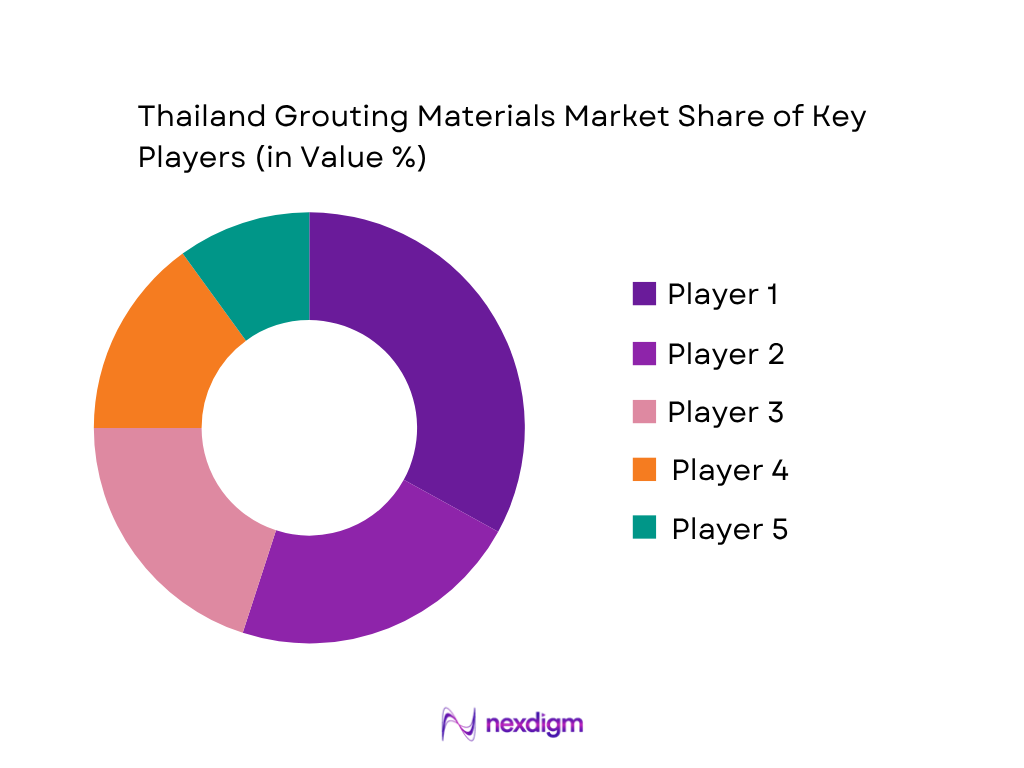
The Thailand Grouting Materials Market includes multinational construction-chemical suppliers alongside established domestic producers. Competition is driven by ASTM C1107-compliant non-shrink grout performance, high-flow characteristics, early compressive strength, epoxy precision-grouting capability, injection technology, local manufacturing and contractor technical support. Domestic manufacturing is a meaningful competitive factor: GEL has produced special cement and non-shrink grout locally since 1977, while global suppliers compete through integrated industrial, infrastructure and injection-grouting portfolios.
| Major Player | Establishment Year | Headquarters | Non-Shrink / Precision Grouts | Epoxy Grouting | Injection Capability | Industrial Exposure | Thailand Manufacturing / Supply | Technical Support |
| Sika | 1910 | Baar, Switzerland | ||||||
| Fosroc | 1972 | Dubai, UAE regional base | ||||||
| MAPEI | 1937 | Milan, Italy | ||||||
| General Engineering PCL / GEL | 1962 | Bangkok, Thailand | ||||||
| TOA Construction Chemicals | 1964 | Bangkok, Thailand |
Thailand Grouting Materials Market Analysis
Growth Drivers
Eastern Economic Corridor and Advanced Manufacturing Expansion Are Increasing Precision Grouting Requirements
Thailand’s Grouting Materials Market is being supported by large-scale manufacturing investment, particularly in electronics, electrical equipment, automotive production and digital infrastructure, where machinery foundations and structural baseplates require engineered non-shrink and precision grouts. Thailand Board of Investment data show 3,137 investment-promotion applications worth THB1.14 trillion in 2024. Electronics and electrical appliances accounted for 407 projects worth THB231.7 billion, while automotive and parts generated 309 projects worth THB102.4 billion. The digital sector added 150 projects worth THB243.3 billion, including hyperscale data centres containing substantial electrical, cooling, mechanical and structural equipment. These installations create requirements for high-flow cementitious grout beneath steel columns, generators, pumps, chillers, transformers and precision machinery, while epoxy grouts address vibration-sensitive equipment and low-creep applications. Chonburi, Rayong and Chachoengsao remain especially relevant because the Eastern Economic Corridor concentrates industrial estates and advanced manufacturing assets. World Bank data record Thailand’s nominal GDP at USD526.52 billion in 2024 and GDP per capita at USD7,346.6, supporting continued industrial capital formation and higher specification of engineered grouting products.
Rail, Highway and Public Infrastructure Investment Is Broadening Structural Grout Consumption
Transport and public-infrastructure construction forms another major growth driver for the Thailand Grouting Materials Market because bridges, viaducts, rail systems, tunnels and utility structures use grout for bearings, plinths, anchors, structural voids and underground stabilization. NESDC reported that disbursements for 14 major state-enterprise projects reached THB69.0 billion in 2024. Active works included the first phase of the Thai-Chinese high-speed railway, the Laem Chabang Port Development Phase 3, the MRT Purple Line and major road-network projects. For 2025, NESDC identified capital-disbursement limits of THB14.7227 billion for the Thai-Chinese high-speed railway, THB12.3937 billion for the MRT Purple Line and THB7.8409 billion for the MRT Orange Line. MRTA also reported deployment of 7 tunnel-boring machines on the Purple Line extension, demonstrating the engineering scale of Bangkok underground construction. Such assets require high-strength bearing grout, rail and plinth grout, microfine cement injection and water-cutoff systems. World Bank data place Thailand’s nominal GDP at USD526.52 billion in 2024 and GDP per capita at USD7,346.6, providing the macroeconomic base supporting these infrastructure programs.
Market Challenges
Tropical Rainfall and Saturated Site Conditions Complicate Grout Placement and Curing
Thailand’s tropical climate creates a distinct technical challenge for the Grouting Materials Market because cementitious and resin grouts are sensitive to moisture conditions, water addition, curing, substrate saturation and groundwater movement. Thai Meteorological Department records show severe rainfall variability during 2024. In November, rainfall on the southern east coast was 386.1 mm above normal, while July rainfall in the eastern region was 155.2 mm above normal, accompanied by heavy to extremely heavy rainfall and flooding in several areas. Such conditions are particularly relevant in Bangkok, Chonburi, Rayong and southern infrastructure projects where foundations, tunnels, basements and below-grade structures can remain saturated. Excess uncontrolled water can alter cementitious grout consistency, while moving groundwater can interfere with microfine cement injection and require polyurethane water-cutoff systems before structural grouting proceeds. Underground transport construction intensifies these conditions; the Purple Line extension employed 7 tunnel-boring machines through Bangkok’s soft-soil environment. World Bank data record Thailand’s nominal GDP at USD526.52 billion in 2024 and GDP per capita at USD7,346.6. Consequently, moisture management, sealed formwork, accurate mix-water control and specialist injection capability remain critical execution requirements.
High-Specification Industrial and Underground Projects Increase Application and Quality-Control Complexity
The Thailand Grouting Materials Market faces increasing workmanship and specification complexity as demand shifts toward high-value electronics plants, data centres, rail systems and precision manufacturing facilities. BOI data show 407 electronics and electrical projects worth THB231.7 billion and 150 digital projects worth THB243.3 billion were submitted in 2024, while the automotive sector contributed another 309 projects worth THB102.4 billion. These facilities contain machinery and utility equipment that require controlled grout flow, full baseplate contact and reliable early strength rather than conventional site-mixed mortar. Underground infrastructure presents an additional challenge. The MRT Purple Line extension uses 7 tunnel-boring machines, while NESDC allocated THB12.3937 billion in 2025 state-enterprise capital disbursement to the project and THB7.8409 billion to the MRT Orange Line. Incorrect grout-water ratios, inadequate substrate preparation, leaking formwork or incomplete filling beneath baseplates can undermine load transfer in these high-specification applications. World Bank data record Thailand’s nominal GDP at USD526.52 billion in 2024 and GDP per capita at USD7,346.6. This increasingly sophisticated project mix raises the importance of trained applicators, field testing and manufacturer technical support.
Market Opportunities
Data Centres and Advanced Electronics Create Scope for High-Strength and Precision Epoxy Grouts
Thailand’s fast-growing digital and advanced-electronics investment pipeline creates a substantial future opportunity for high-flow non-shrink grouts and precision epoxy systems. Thailand Board of Investment data show the digital sector generated 150 investment applications worth THB243.3 billion in 2024, while electronics and electrical appliances generated 407 projects worth THB231.7 billion. Momentum strengthened further in the first half of 2025, when data-centre activity alone attracted 28 projects worth THB521.2 billion. A separately approved Rayong Tier 3 data-centre project involved THB23.7 billion of investment and approximately 203 MW of IT load. Data centres and semiconductor facilities contain generators, chillers, electrical switchgear, transformers, pumps and precision process equipment requiring stable foundations and accurate alignment. High-flow cementitious grouts can provide complete baseplate filling for static equipment, while low-creep epoxy systems are suited to installations involving vibration, concentrated loading and chemical exposure. World Bank data record Thailand’s nominal GDP at USD526.52 billion in 2024 and GDP per capita at USD7,346.6. These existing investment volumes provide a strong base for future expansion of higher-performance equipment-foundation grouting solutions.
Rail, Tunnel and Water Infrastructure Can Expand Specialty Injection and Bearing-Grout Demand
Rail and underground infrastructure offers a strong future growth avenue for bridge-bearing grouts, rapid-setting systems, microfine cement injection and polyurethane water-cutoff materials. NESDC’s 2025 state-enterprise project program allocated THB14.7227 billion to the first phase of the Thai-Chinese high-speed railway, THB12.3937 billion to the MRT Purple Line, THB7.8409 billion to the MRT Orange Line and THB3.974 billion to the Den Chai–Chiang Rai–Chiang Khong railway project. Water infrastructure adds another specialist application base, with THB6.6815 billion allocated to the ninth waterworks-improvement master plan. Underground rail construction requires void filling, soil and rock injection, water control and structural-interface grouting, while elevated sections require bearing and plinth materials capable of transferring cyclic rail loads. Waterworks can use non-shrink grout around pumps, supports and equipment foundations as well as injection systems for leakage and structural joints. World Bank data record Thailand’s nominal GDP at USD526.52 billion in 2024 and GDP per capita at USD7,346.6. These current infrastructure commitments support future demand for specialized grouts beyond conventional construction applications.
Future Outlook
The Thailand Grouting Materials Market is expected to expand at approximately ~X.X% CAGR during 2026–2035, supported by large-scale manufacturing investment, expansion of advanced electronics and automotive facilities, and continued transport-infrastructure construction. Demand is likely to move progressively toward higher-strength, higher-flow and application-specific grouts rather than conventional site-batched mixes.
Major Players
- Sika Thailand
- Fosroc Thailand
- MAPEI Thailand
- Master Builders Solutions Thailand
- General Engineering Public Company Limited / GEL
- Denka / GEL Construction Chemicals
- TOA Paint Thailand / TOA Construction Chemicals
- Crocodile Corporation Limited
- Saint-Gobain Weber Thailand
- LATICRETE Thailand
- MC-Bauchemie Thailand / Regional Solutions
- Hilti Thailand
- Bostik Thailand / Arkema
- Penetron Thailand / Regional Solutions
- Kryton International / Thailand Distribution
Key Target Audience
- Grouting Material and Construction Chemical Manufacturers
- Automotive, EV and Electronics Manufacturing Facility Owners
- Industrial Equipment Installation and EPC Contractors
- Precast, Bridge, Rail and Metro Contractors
- Geotechnical and Injection Grouting Contractors
- Investments and Venture Capitalist Firms
- Government and Regulatory Bodies (Thailand Board of Investment, Eastern Economic Corridor Office, Department of Highways, Mass Rapid Transit Authority of Thailand, State Railway of Thailand, Thai Industrial Standards Institute)
- Construction Chemical Distributors and Industrial Supply Companies
Research Methodology
Step 1: Identification of Key Variables
The initial phase involves constructing an ecosystem map covering grout manufacturers, cement and resin suppliers, distributors, industrial contractors, precast companies, transport-infrastructure contractors and geotechnical specialists. Secondary and proprietary research identifies the product and performance variables shaping demand. Key parameters include compressive strength, flowability, expansion, grout-gap thickness, equipment loading, injection viscosity, installation method and project category.
Step 2: Market Analysis and Construction
Historical demand is assessed using industrial investment, public construction, transport infrastructure and manufacturing activity. The top-down method estimates total addressable grout consumption across industrial and infrastructure assets, while bottom-up analysis evaluates manufacturer sales, distributor throughput and project-level material usage. Results are reconciled across cementitious non-shrink, precision, epoxy, injection, anchoring, precast and specialty transport grouts.
Step 3: Hypothesis Validation and Expert Consultation
Market hypotheses are validated through computer-assisted telephone interviews with grout manufacturers, industrial equipment installers, EPC contractors, precast companies, bridge and rail contractors, structural engineers and distributors. Interviews assess strength requirements, working time, flow retention, substrate conditions, application thickness and procurement practices. The findings refine category shares and differentiate general construction grouting from technically demanding precision and injection applications.
Step 4: Research Synthesis and Final Output
The final phase triangulates BOI investment statistics, NESDC construction indicators, infrastructure-project data, supplier technical specifications and primary interviews. Demand is validated across product type, application, end-user and region. Forecasting incorporates EEC manufacturing expansion, data-centre development, rail infrastructure, automotive and electronics investment, precast construction, underground works and adoption of higher-performance grouting technologies.

- Executive Summary
- Research Methodology (Market Definitions and Assumptions, Thailand Grouting Materials Market Classification, Cementitious Grout Assessment, Non-Shrink Grout Assessment, High-Strength Precision Grout Assessment, High-Flow Grout Assessment, Rapid-Setting Grout Assessment, Epoxy Foundation Grout Assessment, Chemical-Resistant Epoxy Grout Assessment, Cementitious Injection Grout Assessment, Microfine Cement Grout Assessment, Polyurethane Injection Grout Assessment, Anchoring Grout Assessment, Precast Sleeve Grout Assessment, Bridge Bearing Grout Assessment, Rail and Track Grout Assessment, Machinery Baseplate Grout Assessment, Cable Duct Grout Assessment, Void Filling Assessment, Ground Stabilization Assessment, Water Cut-Off Grout Assessment, ASTM C1107 Assessment, ASTM C109 Compressive Strength Assessment, ASTM C827 Expansion Assessment, EN 447 Cable Grout Assessment, Flowability Assessment, Bleeding Assessment, Shrinkage Compensation Assessment, Early Strength Assessment, Dynamic Load Assessment, Tropical Temperature Workability Assessment, High-Humidity Application Assessment, Flood and Groundwater Exposure Assessment, Thai Industrial Standards Assessment, State Railway and Transport Infrastructure Specification Assessment, Top-Down Market Sizing, Bottom-Up Market Sizing, Primary Contractor Interviews, Distributor Mapping, Project Specification Analysis, Data Triangulation, Forecasting Framework)

- Definition and Scope
- Thailand Grouting Materials Industry Evolution and Development of Conventional Cement-Sand Grouting, Factory-Formulated Non-Shrink Cementitious Grouts, High-Strength Precision Grouts, Flowable Baseplate Grouts, Rapid-Hardening Grouts, Epoxy Foundation Grouts, Chemical-Resistant Epoxy Grouts, Cementitious Injection Grouts, Microfine Cement Grouts, Polyurethane Water Cut-Off Grouts, Precast Sleeve Grouts, Bridge Bearing Grouts, Rail-Bed Grouts, Machinery Foundation Grouts, Cable Duct Grouts, Anchor Grouts, Ground Stabilization Systems and Tropical-Climate Grouting Technologies
- Grouting Materials Value Chain Analysis
- Grouting Materials Supply Chain Analysis
- Portland Cement Suppliers, Specialty Cement Suppliers, Microfine Cement Suppliers, Graded Aggregate Suppliers, Silica Fume Suppliers, Mineral Filler Suppliers, Expansive Additive Suppliers, Superplasticizer Suppliers, Epoxy Resin Suppliers, Polyurethane Resin Suppliers, Polymer Modifier Suppliers, Grout Manufacturers, Thai Dry-Mix Producers, Importers, Construction Chemical Distributors, EPC Contractors, Industrial Grouting Contractors, Precast Contractors, Bridge Contractors, Rail Contractors, Manufacturing Plant Contractors, Geotechnical Contractors, Developers and Government Infrastructure Agencies

- Growth Drivers (Eastern Economic Corridor Investment, Automotive and EV Manufacturing Expansion, Electronics and Electrical Investment, Data Centre Construction, Industrial Estate Development, Rail and Metro Infrastructure, Bridge and Expressway Construction, Airport Infrastructure, Precast Construction Adoption, Machinery Installation, Industrial Plant Expansion, Water and Underground Infrastructure)
- Market Challenges (Cement and Specialty Resin Input Dependence, Incorrect Water Addition, Grout Segregation, Bleeding, Tropical Heat, High-Humidity Curing, Heavy Rainfall Exposure, Inadequate Formwork, Poor Substrate Saturation, Voids Beneath Baseplates, Skilled Applicator Variation, Injection Equipment Requirements, Specification Awareness, Product Substitution)
- Market Opportunities (ASTM C1107 High-Strength Grouts, High-Flow Non-Shrink Grouts, Precision Epoxy Grouts, Rapid-Setting Grouts, Precast Sleeve Grouts, Bridge Bearing Grouts, Rail and Metro Grouts, Microfine Injection Grouts, PU Water Cut-Off Grouts, EV and Electronics Facility Grouts, Data Centre Equipment Grouts, Low-Carbon Cementitious Grouts)
- Market Trends (Factory-Prepacked Grouts, Shrinkage Compensation, High Early Strength, High-Flow Pumpable Grouts, Extended Tropical Working Time, Precision Epoxy Systems, Precast Sleeve Grouting, ASTM C1107 Specification, Cable Duct Grouting, Microfine Cement Injection, Mechanized Pump Placement, Project-Specific Grout Design, Local Manufacturing, Low-Carbon Binder Systems)
- Government Regulations and Standards (Thai Industrial Standards Requirements, Building Control Act Requirements, Factory Act Requirements, ASTM C1107 Non-Shrink Grout Specifications, ASTM C109 Compressive Strength Requirements, ASTM C827 Expansion Requirements, EN 447 Cable Grouting Requirements, State Railway of Thailand Specifications, Mass Rapid Transit Authority Specifications, Department of Highways Material Requirements, Occupational Safety Requirements, EEC Industrial Development Requirements)
- SWOT Analysis
- Porter’s Five Forces Analysis
- PESTLE Analysis

- By Market Value (2020-2025)
- By Grouting Material Consumption Volume (2020-2025)
- By Cementitious Grout Consumption (2020-2025)
- By Non-Shrink Grout Consumption (2020-2025)
- By Precision Grout Consumption (2020-2025)
- By High-Strength Grout Consumption (2020-2025)

- By Material Chemistry (In Value %)
Cementitious Grouts
Polymer-Modified Cementitious Grouts
Epoxy Resin Grouts
Polyurethane Injection Grouts
Microfine Cement Grouts
Acrylic and Specialty Chemical Injection Grouts
Hybrid Specialty Grouting Systems - By Product Type (In Value %)
General-Purpose Non-Shrink Grouts
High-Strength Non-Shrink Grouts
Precision Grouts
Rapid-Setting Grouts
High-Flow Cementitious Grouts
Chemical-Resistant Epoxy Grouts
Anchor Grouts
Precast Sleeve Grouts
Bridge Bearing Grouts
Rail and Track Grouts
Machine Base Grouts
Cable Duct Grouts
Injection Grouts
Void-Filling Grouts
Ground Stabilization Grouts - By Application (In Value %)
Machine Foundations
Equipment Baseplates
Steel Column Baseplates
Anchor Bolts
Precast Column Connections
Precast Wall and Beam Connections
Bridge Bearings
Bridge Pier and Abutment Grouting
Rail Track and Plinth Grouting
Cable Duct Grouting
Structural Voids and Cavities
Tunnel Injection
Rock Fissure Grouting
Soil Consolidation Grouting
Water Cut-Off Grouting
Industrial Equipment Re-Grouting - By Performance Requirement (In Value %)
Shrinkage Compensation
High Early Strength
High Ultimate Strength
High Flowability
Low Bleeding
Zero Segregation
High Dynamic Load Resistance
Chemical Resistance
Microfine Penetration
Rapid Return to Service
High Bond Strength
High-Humidity Compatibility
Tropical Temperature Workability
Seismic Load Transfer Capability - By End-Use Sector (In Value %)
Residential and Commercial Buildings
Industrial Plants
Automotive Manufacturing
Electronics and Electrical Manufacturing
Data Centres
Warehouses and Logistics Facilities
Petrochemical and Chemical Facilities
Power Plants
Renewable Energy Facilities
Highways and Bridges
Rail and Metro Infrastructure
Airports
Ports and Marine Infrastructure
Water and Wastewater Infrastructure
Mining and Geotechnical Projects - By Installation Method (In Value %)
Gravity Pouring
Pump Grouting
Dry-Packing
Flowable Placement
Pressure Injection
Low-Pressure Injection
High-Pressure Injection
Tremie Grouting
Preplaced Aggregate Grouting
Cable Duct Injection

- Market Share of Major Players (By Thailand Revenue, Cementitious Grout Volume, Non-Shrink Grout Portfolio, Precision Grout Portfolio, Epoxy Grout Portfolio, Injection Grout Portfolio, Anchoring Portfolio, Precast Exposure, Automotive and Electronics Exposure, Bridge and Rail Exposure, EEC Industrial Exposure, Local Manufacturing Capacity, Warehouse Presence, Distributor Network, Technical Specification Support)
- Cross Comparison Parameters (ASTM C1107 Non-Shrink High-Strength and High-Flow Cementitious Grout Portfolio Breadth, Precision Epoxy Low-Creep and Dynamic-Load Machinery Grouting Capability, Microfine Cement PU and Water Cut-Off Injection Technology Capability, Precast Sleeve Anchor Bolt Bridge Bearing and Rail Grouting Capability, Automotive Electronics EEC Industrial Rail and Heavy-Equipment Project Reference Base, Thailand Manufacturing Warehousing and Construction Distribution Network Reach, Tropical Heat High-Humidity Flow-Retention Early-Strength and Shrinkage-Control Performance, Structural Engineer EPC Contractor Training Field Testing and Technical Site-Support Capability)
- SWOT Analysis of Major Players
- Major Companies
Sika Thailand
Fosroc Thailand
MAPEI Thailand
Master Builders Solutions Thailand
General Engineering Public Company Limited / GEL
Denka / GEL Construction Chemicals
TOA Paint Thailand / TOA Construction Chemicals
Crocodile Corporation Limited
Saint-Gobain Weber Thailand
LATICRETE Thailand
MC-Bauchemie Thailand / Regional Solutions
Hilti Thailand
Bostik Thailand / Arkema
Penetron Thailand / Regional Solutions
Kryton International / Thailand Distribution

- Industrial Grouting Contractor Requirement Assessment
- Automotive Plant Contractor Requirement Assessment
- Electronics Facility Contractor Requirement Assessment
- Precast Contractor Requirement Assessment
- Bridge Contractor Requirement Assessment
- Rail and Metro Contractor Requirement Assessment
- Geotechnical Contractor Requirement Assessment

- By Market Value (2026-2035)
- By Grouting Material Consumption Volume (2026-2035)
- By Cementitious Grout Consumption (2026-2035)
- By Non-Shrink Grout Consumption (2026-2035)
- By Precision Grout Consumption (2026-2035)
- By High-Strength Grout Consumption (2026-2035)


 Request a Sample
 Ask for Customization
 Get a Quote
 Enquire Now
