
 Download PDF
Market Overview
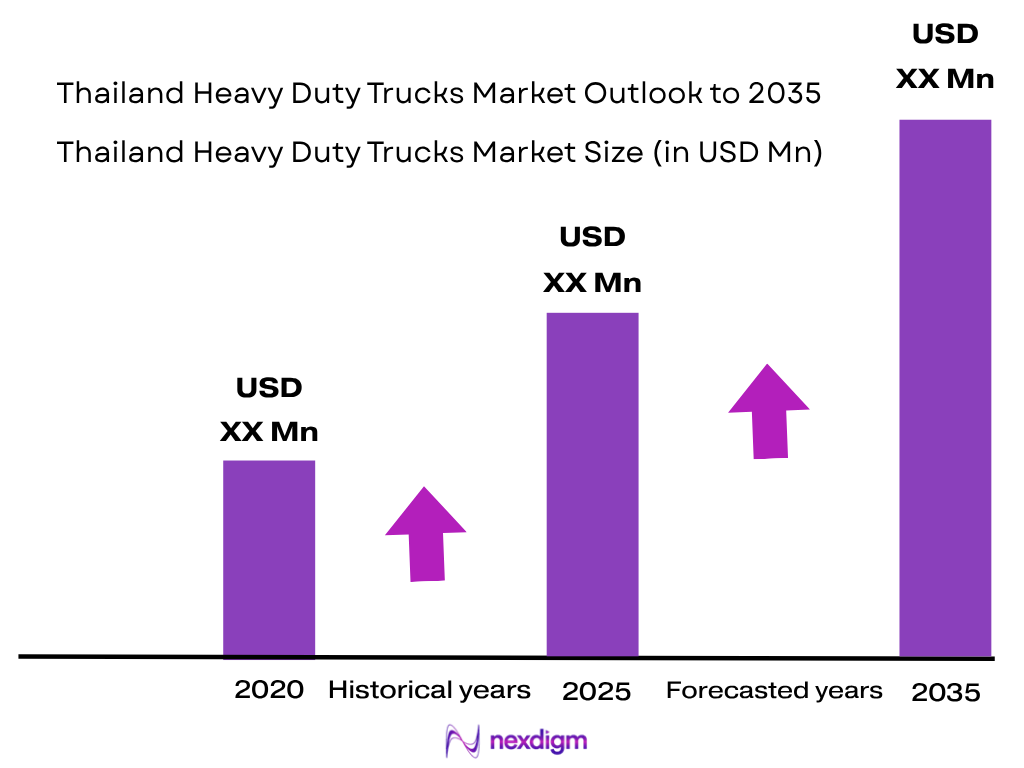
The Thailand Heavy Duty Trucks Market is estimated at ~USD XX billion, with a forecast CAGR of ~XX% during 2026–2035. Demand is closely linked to Thailand’s manufacturing, logistics, construction and agricultural freight ecosystem. World Bank data records Thailand’s GDP at USD 526.52 billion, GDP per capita at USD 7,346.6, real GDP growth of 2.5, and inflation of 1.4. Thailand also produced 1,468,997 motor vehicles, compared with 1,834,986 units previously, illustrating the scale of its automotive manufacturing base.
Bangkok and the surrounding Central region remain important because they concentrate distribution centers, manufacturing, warehousing and national freight flows. The Eastern Economic Corridor, particularly Chonburi and Rayong, is critical because of automotive manufacturing, industrial estates and Laem Chabang Port. Laem Chabang handled 8.419 million TEUs and 90.445 million tonnes of cargo in the referenced port operating period, demonstrating the importance of containerized and industrial freight movements. Thailand’s automotive ecosystem further reinforces demand, with commercial-vehicle manufacturing and component production distributed across major industrial clusters.
Market Segmentation
By Vehicle Class
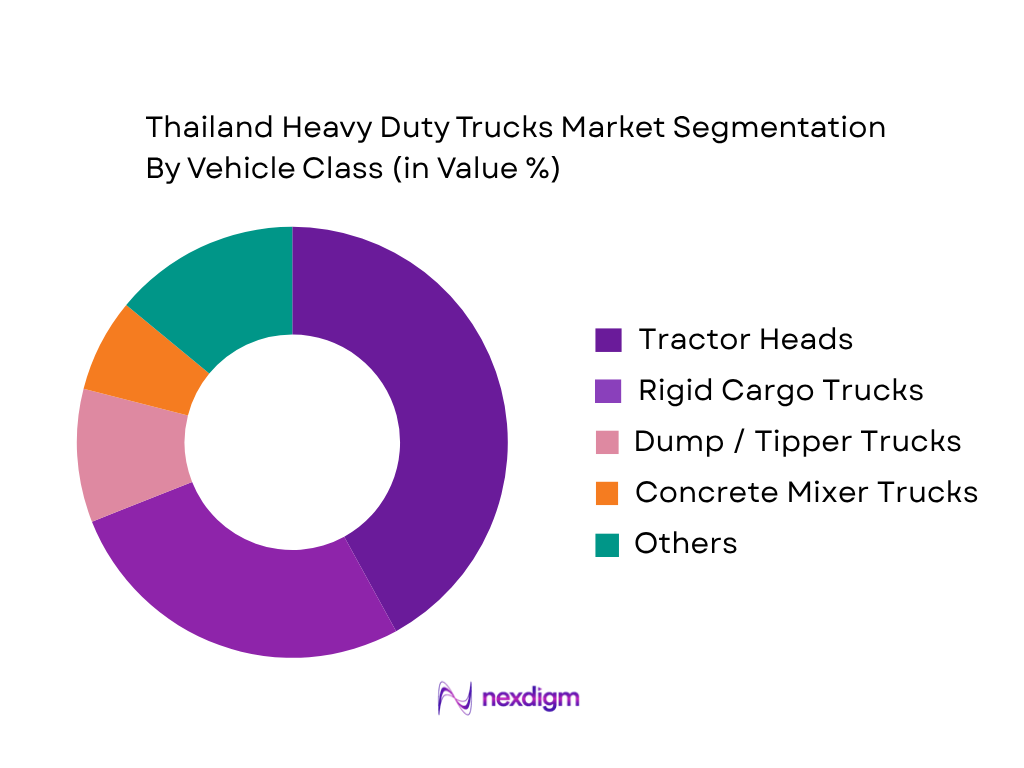
Thailand Heavy Duty Trucks Market is segmented by vehicle class into heavy rigid trucks, tractor trucks, heavy-haulage trucks, multi-axle trucks, tipper and dump trucks, tanker trucks and specialized heavy trucks. Tractor trucks are expected to represent the dominant segment because Thailand combines extensive road freight with major ports, industrial estates and cross-border ASEAN trade corridors. Tractor units are particularly suited to containerized cargo and long-distance trailer operations connecting Laem Chabang with warehouses and manufacturing clusters. The country’s automotive production ecosystem also creates recurring movements of components, finished vehicles and industrial materials. Local manufacturing capability strengthens availability of heavy commercial vehicles and supporting services; Isuzu’s Thai operation, for example, reported 164,000 vehicles produced and annual capacity of 280,000 units, while Hino maintains dedicated Thai truck manufacturing operations. These conditions support tractor-truck utilization in logistics fleets, while rigid and specialized configurations remain important for construction, agriculture and industrial applications.
By Application
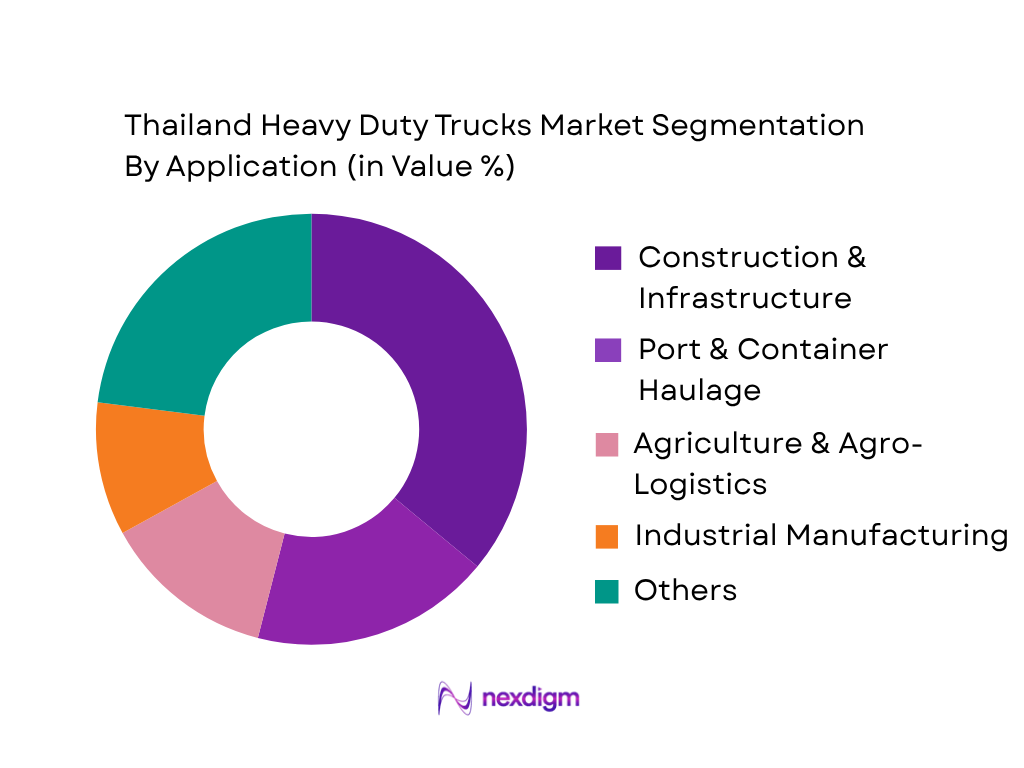
Thailand Heavy Duty Trucks Market is segmented by application into general freight and logistics, construction and infrastructure, port and container haulage, mining and quarrying, oil and gas, agriculture and agro-logistics, food and beverage distribution, industrial manufacturing, waste management and specialized heavy haulage. General freight and logistics is expected to maintain the dominant position because Thailand’s industrial economy requires continuous movement of manufactured goods, components, consumer products and intermediate materials between factories, warehouses, ports and distribution centers. The country produced 1,468,997 motor vehicles in the latest OICA dataset, while its commercial-vehicle production base has historically represented a substantial portion of total automotive output. Port activity provides an additional freight requirement, with Laem Chabang handling 8.419 million TEUs and 90.445 million tonnes of cargo in the cited operating period. These flows support tractor-trailer combinations, container carriers and heavy rigid vehicles. Construction, agricultural freight and cross-border transportation provide additional utilization across regional routes.
Competitive Landscape
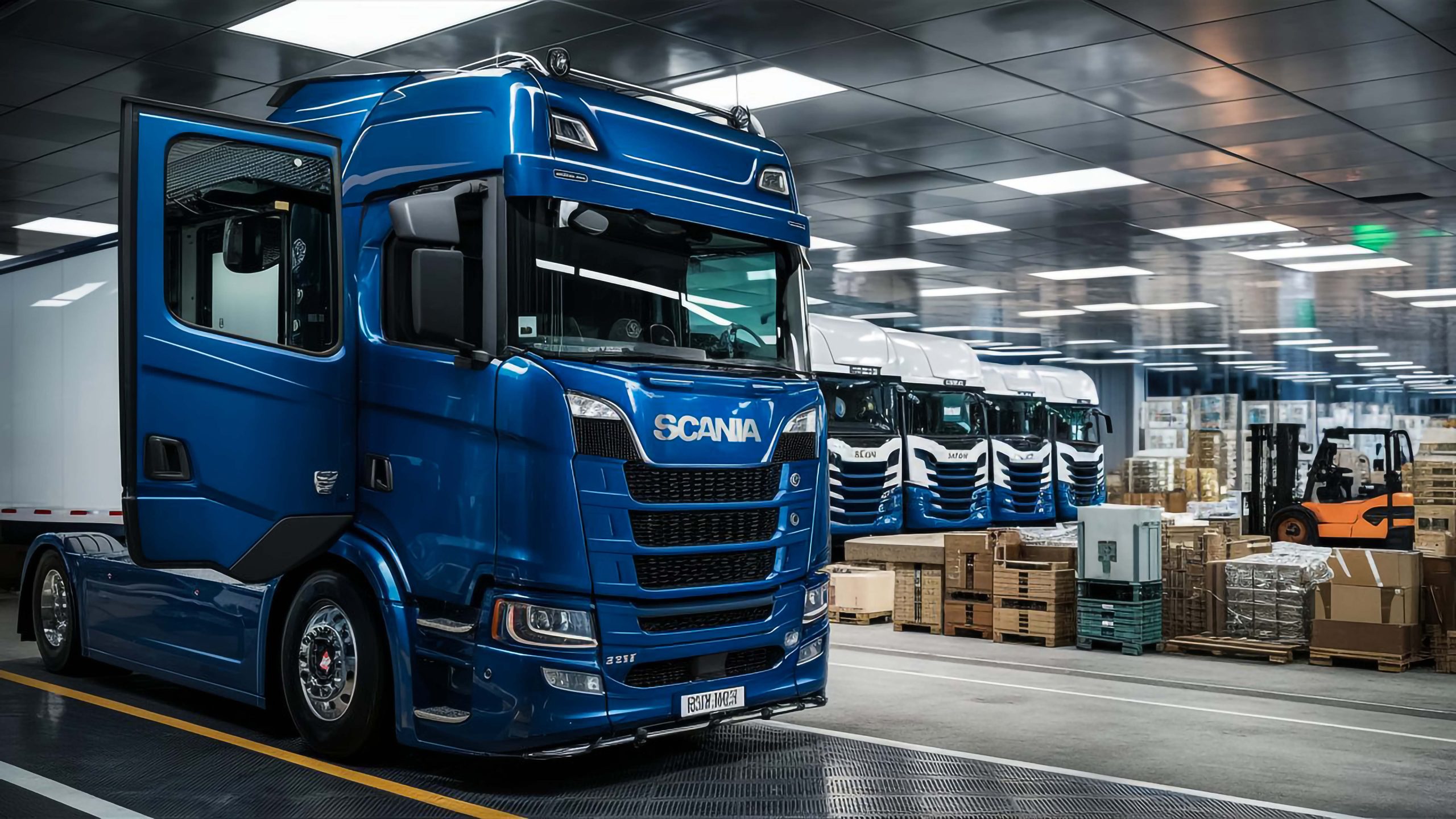
Thailand’s heavy-duty truck market combines established Japanese manufacturers with European and emerging Asian commercial-vehicle brands. Isuzu and Hino have particularly deep local manufacturing and distribution footprints, while FUSO, UD Trucks, Volvo and Scania compete through heavy-duty products, fleet services and specialized applications. Isuzu’s Thai operation was established in 1966 and has two assembly plants, while Hino’s Thai sales operation dates to 1962 and its manufacturing subsidiary to 2003. This combination of local production, dealer coverage, engineering capabilities and established fleet relationships creates substantial competitive barriers.
| Major Player | Establishment in Thailand | Headquarters | Heavy-Truck Portfolio | Local Manufacturing | Dealer / Service Network | Powertrain Focus | Fleet Solutions |
| Isuzu Motors Co. (Thailand) | 1966 | Samut Prakan | ~ | ~ | ~ | ~ | ~ |
| Hino Motors Thailand | 1962 sales / 2003 manufacturing | Bangkok / Samut Prakan | ~ | ~ | ~ | ~ | ~ |
| FUSO Commercial Vehicles Thailand | Established local operation | Bangkok | ~ | ~ | ~ | ~ | ~ |
| UD Trucks Thailand | Local operations | Bangkok | ~ | ~ | ~ | ~ | ~ |
| Scania Siam | Local operation | Bangkok | ~ | ~ | ~ | ~ | ~ |
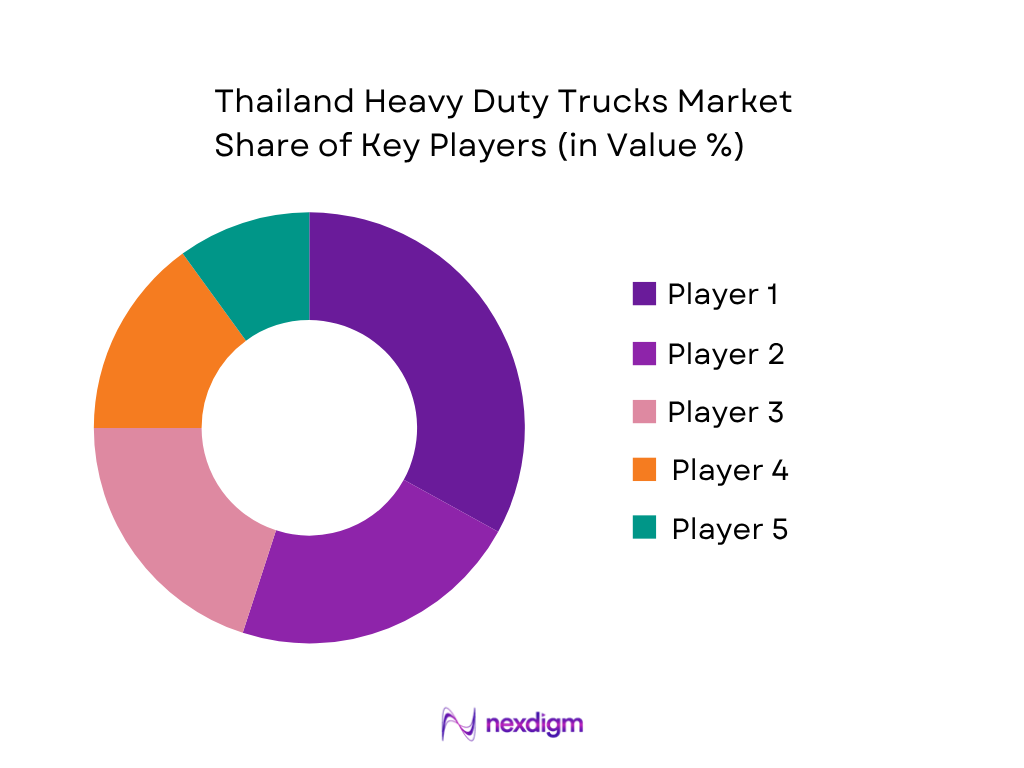
Thailand Heavy Duty Trucks Market Analysis
Growth Drivers
Logistics & Port Freight
Thailand’s trade-intensive economy provides a broad operating base for heavy-duty trucks. World Bank data records Thailand’s 2024 exports at US$300.76 billion and imports at US$307.56 billion, generating total merchandise trade of US$608.32 billion. Laem Chabang Port handled 8.419 million TEUs and 90.445 million tonnes of cargo, reinforcing demand for tractor-trailers, container haulers and heavy rigid trucks connecting ports with industrial estates and distribution centres. Thailand’s real GDP expanded 2.5%, while manufacturing production remained a major industrial activity despite a 1.2-unit annual decline in the manufacturing production index. Construction, industrial logistics and agricultural distribution add diversified heavy-truck utilization beyond container freight. The country’s extensive ASEAN trade relationships also support cross-border road movements toward Malaysia, Cambodia, Laos and Myanmar. E-commerce fulfillment is another structural demand channel because parcel distribution requires feeder movements between warehouses, regional hubs and urban delivery networks. The combination of port cargo, international merchandise trade, manufacturing activity and domestic distribution creates recurring requirements for high-payload tractor units, rigid trucks, dump trucks and specialized configurations. Fleet modernization is increasingly relevant as operators seek greater uptime, improved fuel efficiency, telematics and higher payload utilization from replacement vehicles.
ASEAN Cross-Border Trade and Fleet Modernization:
Thailand’s geographic position within mainland Southeast Asia strengthens demand for heavy trucks operating across domestic and regional freight corridors. Merchandise exports reached US$300.76 billion and imports reached US$307.56 billion, giving Thailand a substantial trade flow that requires movement between production centres, border checkpoints, ports and distribution facilities. Laem Chabang alone processed 8.419 million TEUs and 90.445 million tonnes of cargo, creating sustained requirements for container tractors and heavy road-haulage equipment. Manufacturing remains an important source of freight generation, with the World Bank recording a 59.0 capacity-utilization level for Thailand’s manufacturing sector during 2024 and a manufacturing production index decline of 1.2 units year on year. This industrial base encompasses automotive, electronics, food processing, chemicals and machinery, all of which require inbound and outbound heavy freight. Fleet modernization therefore has relevance even when industrial output fluctuates because operators must maintain vehicle availability across long-distance routes and high-utilization applications. Thailand’s 2.5% real GDP growth also indicates continued economic activity supporting road transportation. Replacement demand is particularly relevant for operators seeking trucks equipped with automated transmissions, advanced braking systems, telematics, fuel-management technology and improved driver-assistance functions. The resulting opportunity extends beyond new vehicle sales into connected fleet services, maintenance contracts and specialized bodies.
Market Challenges
Financing & Operating Constraints
Heavy-duty trucking in Thailand faces capital and operating constraints despite the country’s large freight economy. Thailand’s nominal GDP reached US$527 billion in 2024, while real GDP growth was 2.5%, indicating a substantial but comparatively moderate economic expansion environment. Financing conditions can therefore materially influence replacement decisions, particularly for small and medium-sized fleet operators that depend on vehicle loans and high utilization to generate returns. Diesel exposure remains important because conventional heavy trucks continue to depend on diesel-intensive long-haul and heavy-load operations, making fuel consumption a major consideration in route economics. Road congestion creates additional operational inefficiency around Bangkok, industrial estates, ports and major freight corridors, reducing effective vehicle utilization. Axle-load and road-weight restrictions can also limit payload flexibility and influence the selection of 6×4, 8×4 and multi-axle configurations. Thailand’s international supply-chain exposure adds another challenge merchandise imports reached US$307.56 billion in 2024, demonstrating the scale of external sourcing across the economy. Truck manufacturers and distributors consequently remain exposed to overseas engines, transmissions, electronic components and replacement parts. Operators must balance acquisition affordability, financing availability, fuel efficiency, maintenance support and residual value when replacing heavy-duty assets.
Driver Availability, Road Congestion, Imported Component Dependence and Aftermarket Parts Availability
Operational reliability is particularly important in Thailand because heavy-duty trucks support ports, manufacturing plants, agricultural supply chains and cross-border freight corridors where delays can affect multiple downstream activities. Laem Chabang handled 8.419 million TEUs and 90.445 million tonnes of cargo, creating a substantial pool of high-frequency truck movements between maritime terminals and inland logistics facilities. Bangkok Port additionally handled 1.438 million TEUs and 21.185 million tonnes of cargo, illustrating that freight demand is distributed across multiple major gateways. Congestion around ports and industrial clusters can reduce productive driving time and increase vehicle idling, while axle and weight restrictions constrain route and payload planning. Driver availability represents another operational bottleneck because heavy trucks require appropriately licensed drivers capable of managing long-distance, container, tanker, construction and specialized-haulage operations. Imported-component exposure further increases the importance of aftermarket inventory. Thailand’s 2024 imports reached US$307.56 billion, confirming the economy’s extensive dependence on international goods flows. Heavy-truck operators therefore require dependable access to engines, transmissions, electronic control units, braking components, tires and specialized replacement parts. Any interruption can extend vehicle downtime and reduce fleet utilization. These conditions increase the importance of manufacturer service networks, regional parts warehouses, preventive maintenance programs and predictive diagnostics.
Market Opportunities
Electrification & Connected Fleets
Thailand’s established freight infrastructure creates practical deployment opportunities for connected and lower-emission heavy trucks, particularly in predictable operating environments. Laem Chabang processed 8.419 million TEUs and 90.445 million tonnes of cargo, providing a concentrated logistics environment where electric tractors, terminal-support vehicles, telematics and automated fleet-management systems can be deployed on defined routes. Thailand’s 2024 merchandise trade reached US$608.32 billion in combined exports and imports, reinforcing the need for highly utilized freight assets and digital tools capable of improving route planning, vehicle utilization and maintenance scheduling. The country’s manufacturing sector also provides potential applications for connected trucks serving industrial estates, where fixed routes and scheduled loading cycles can support predictive-maintenance systems and driver-assistance technologies. Fleet telematics can monitor fuel consumption, engine diagnostics, driver behaviour, payload utilization and vehicle location, enabling operators to identify inefficient routes and maintenance requirements. Electrification is particularly relevant for short-haul port and depot operations where charging can be centralized and daily mileage is predictable. Alternative powertrains can similarly target specific freight corridors and industrial applications rather than immediately replacing every long-haul diesel vehicle. Specialized heavy-haul trucks remain attractive for infrastructure, machinery, industrial equipment and project logistics, allowing manufacturers to differentiate through payload capability, driveline engineering and application-specific configurations.
Smart Logistics & Specialized Haulage
Thailand’s combination of major ports, manufacturing clusters and cross-border logistics corridors creates a strong foundation for integrated fleet solutions. Laem Chabang’s 8.419 million TEUs of container throughput and 90.445 million tonnes of cargo provide a concentrated use case for connected tractors, fleet telematics, automated dispatching and predictive-maintenance platforms. Bangkok Port adds another 1.438 million TEUs and 21.185 million tonnes of cargo, creating additional opportunities for digitally managed heavy-truck operations. Predictive maintenance can reduce unplanned downtime by using vehicle diagnostic information to identify developing engine, transmission, braking and electrical-system problems before failure. Connected trucks can also integrate GPS positioning, fuel monitoring, route optimization and driver-assistance functions, particularly valuable for fleets operating between ports, warehouses and industrial estates. Alternative powertrains have an identifiable entry point in controlled-duty cycles where vehicles return regularly to a depot or terminal and charging infrastructure can be concentrated. Thailand’s manufacturing base provides another pathway for specialized heavy-haul vehicles transporting machinery, components and industrial equipment. With exports of US$300.76 billion and imports of US$307.56 billion, the country’s industrial and trading ecosystem generates continuing requirements for high-capacity freight movement. The opportunity therefore extends beyond vehicle replacement into software-enabled fleet management, charging infrastructure, maintenance services, specialized body construction and integrated logistics solutions.
Future Outlook
The Thailand Heavy Duty Trucks Market is expected to develop through a combination of freight growth, fleet replacement, infrastructure investment and technology transition. Thailand’s USD 526.52 billion economy and 1,468,997-unit automotive production base provide a substantial industrial foundation for commercial transportation.
Over the outlook period, fleet operators are likely to place greater emphasis on fuel efficiency, vehicle uptime, connected fleet management and predictive maintenance. Port logistics, cross-border ASEAN freight and industrial distribution should remain important demand channels. Electrification is likely to progress first in predictable, high-utilization routes where charging infrastructure can be concentrated.
Major Players
- Isuzu Motors Co. (Thailand)
- Hino Motors Thailand
- FUSO Commercial Vehicles Thailand
- UD Trucks Thailand
- Volvo Trucks Thailand
- Scania Siam
- Tata Motors Thailand
- Foton Thailand
- MAN Truck & Bus
- Mercedes-Benz Trucks
- Sinotruk Thailand
- Shacman
- JAC Motors Thailand
- Hyundai Commercial Vehicles
- Dongfeng Commercial Vehicles
Key Target Audience
- Heavy-duty truck manufacturers and commercial-vehicle OEMs
- Commercial-vehicle component and powertrain manufacturers
- Fleet operators and third-party logistics companies
- Port, terminal and container-haulage operators
- Construction, mining and infrastructure companies
- Investments and venture capitalist firms
- Government and regulatory bodies (Department of Land Transport, Ministry of Transport, Board of Investment of Thailand)
- Commercial-vehicle financing, leasing and fleet-management companies
Research Methodology
Step 1: Identification of Key Variables
The study begins by mapping Thailand’s heavy-duty truck ecosystem, covering OEMs, assembly plants, dealers, fleet operators, logistics companies, ports, construction companies, financing providers and aftermarket participants. Key variables include unit registrations, vehicle classes, GVW, applications, powertrains, fleet utilization and replacement demand.
Step 2: Market Analysis and Construction
Historical market information is consolidated from vehicle registration data, automotive-production statistics, trade data, company disclosures and transportation indicators. Bottom-up calculations connect truck registrations and fleet requirements with applications such as freight, construction, port haulage, agriculture and industrial logistics.
Step 3: Hypothesis Validation and Expert Consultation
Market hypotheses are validated through structured discussions with OEM representatives, fleet operators, commercial-vehicle dealers, logistics companies, component suppliers and financing providers. These inputs are used to assess fleet replacement cycles, purchasing criteria, technology adoption and application-specific demand.
Step 4: Research Synthesis and Final Output
The final dataset is triangulated against official production, registration, trade and macroeconomic indicators. OICA reports Thailand’s vehicle-production statistics, while the Department of Land Transport maintains registration datasets covering newly registered vehicles. Company-level production and capacity information is additionally used to validate the supply-side assessment.

- Executive Summary
- Research Methodology (Market Definition, Heavy-Duty Truck Classification, Market Sizing Framework, Unit-Sales Assessment, Revenue Assessment, Top-Down Analysis, Bottom-Up Analysis, Fleet-Demand Assessment, OEM and Dealer Assessment, Registration Data Validation, Import-Export Analysis, Primary Interviews, Data Triangulation, Forecasting Framework, Assumptions and Limitations)

- Definition and Scope
- Evolution of Thailand’s Heavy-Duty Truck Industry
- Thailand Heavy-Duty Truck Ecosystem
- Heavy-Duty Truck Value Chain Analysis
- Domestic Manufacturing and Assembly Landscape
- Truck Import and Export Structure
- Commercial Vehicle Industrial Base

- Growth Drivers (Logistics and Freight Volumes, Port Expansion, Construction Activity, Manufacturing Output, Agricultural Freight, E-Commerce Fulfillment, ASEAN Cross-Border Trade, Fleet Modernization)
- Market Challenges (High Acquisition Requirements, Financing Constraints, Diesel Exposure, Driver Shortages, Road Congestion, Axle and Weight Restrictions, Imported Component Dependence, Aftermarket Parts Availability)
- Market Opportunities (Fleet Electrification, Connected Heavy Trucks, Fleet Telematics, Advanced Driver Assistance Systems, Predictive Maintenance, Port Logistics Modernization, Alternative Powertrains, Specialized Heavy-Haul Vehicles)
- Emerging Market Trends (Euro 5 Adoption, Electrification, Connected Fleets, Fuel-Efficiency Technologies, Automated Transmission, Safety Systems, Fleet Digitization, Low-Emission Transport)
- Government Policy and Regulatory Environment (Department of Land Transport Requirements, Vehicle Registration, Weight Limits, Emission Standards, Safety Requirements, Alternative-Fuel Regulations)
- SWOT Analysis
- Porter’s Five Forces Analysis
- PESTLE Analysis

- By Market Value (2020-2025)
- By Unit Sales (2020-2025)
- By Average Selling Value (2020-2025)
- By Domestic Production and Sales (2020-2025)
- By Imported and Locally Produced Trucks (2020-2025)
- By New Truck Sales and Fleet Replacement (2020-2025)
- By Freight and Commercial Transport Demand (2020-2025)

- By Vehicle Class (in value %)
Heavy Rigid Trucks
Tractor Trucks
Heavy Haulage Trucks
Multi-Axle Trucks
Tipper and Dump Trucks
Tanker Trucks
Specialized Heavy Trucks - By Gross Vehicle Weight (in value %)
10–15 Ton
15–20 Ton
20–30 Ton
30–40 Ton
Above 40 Ton - By Application (in value %)
General Freight and Logistics
Construction and Infrastructure
Port and Container Haulage
Mining and Quarrying
Oil and Gas
Agriculture and Agro-Logistics
Food and Beverage Distribution
Industrial Manufacturing
Waste Management
Specialized Heavy Haulage - By Powertrain (in value %)
Diesel
Battery Electric
Hybrid
Natural Gas
Alternative-Fuel Heavy Trucks - By Drive Configuration (in value %)
4×2
6×2
6×4
8×4
8×8
Other Multi-Axle Configurations - By Truck Body Type (in value %)
Curtain-Sider
Box Truck
Tipper
Tanker
Refrigerated Truck
Container Carrier
Concrete Mixer
Low-Bed Trailer Tractor

- Market Share of Major Players (By Unit Sales, Market Value, Vehicle Class, GVW, Application, Powertrain, Customer Type and Geography)
- Cross Comparison Parameters (Heavy-Truck Product Portfolio, Local Manufacturing Capacity, Engine and Powertrain Technology, Dealer Network Coverage, After-Sales Service Reach, Fleet and Financing Solutions, Telematics and Connected-Truck Capability, Alternative-Powertrain Portfolio)
- Detailed Profiles of Major Companies
Isuzu Motors Co., (Thailand) Ltd.
Hino Motors Manufacturing (Thailand) Ltd.
Fuso Commercial Vehicles (Thailand) Ltd.
UD Trucks Corporation (Thailand) Co., Ltd.
Volvo Trucks Thailand
Scania Siam Co., Ltd.
Tata Motors Thailand
Foton CP Motor Co., Ltd.
MAN Truck & Bus Thailand
Mercedes-Benz Trucks
Sinotruk Thailand
Shacman Thailand
JAC Motors Thailand
Hyundai Commercial Vehicles Thailand
Dongfeng Commercial Vehicles

- Logistics and Freight Operators
- Construction and Infrastructure Operators
- Port and Terminal Operators
- Manufacturing Companies
- Agricultural and Food Logistics Operators
- Fleet Procurement Criteria
- Fleet Ownership Models

- By Market Value (2026-2035)
- By Unit Sales (2026-2035)
- By Average Selling Value (2026-2035)
- By Domestic Production and Sales (2026-2035)
- By Imported and Locally Produced Trucks (2026-2035)
- By New Truck Sales and Fleet Replacement (2026-2035)
- By Freight and Commercial Transport Demand (2026-2035)


 Request a Sample
 Ask for Customization
 Get a Quote
 Enquire Now