
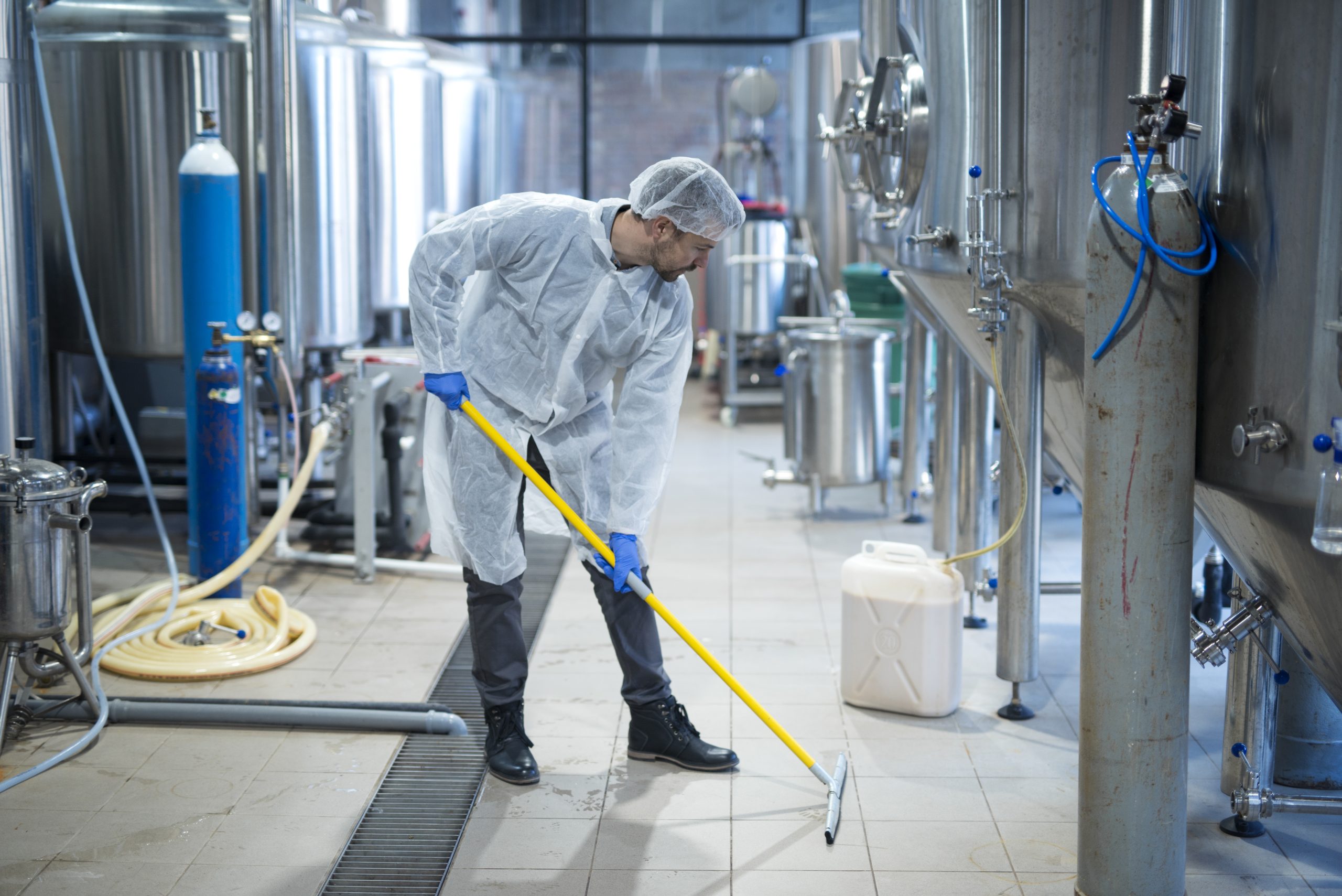
 Download PDF
Market Overview
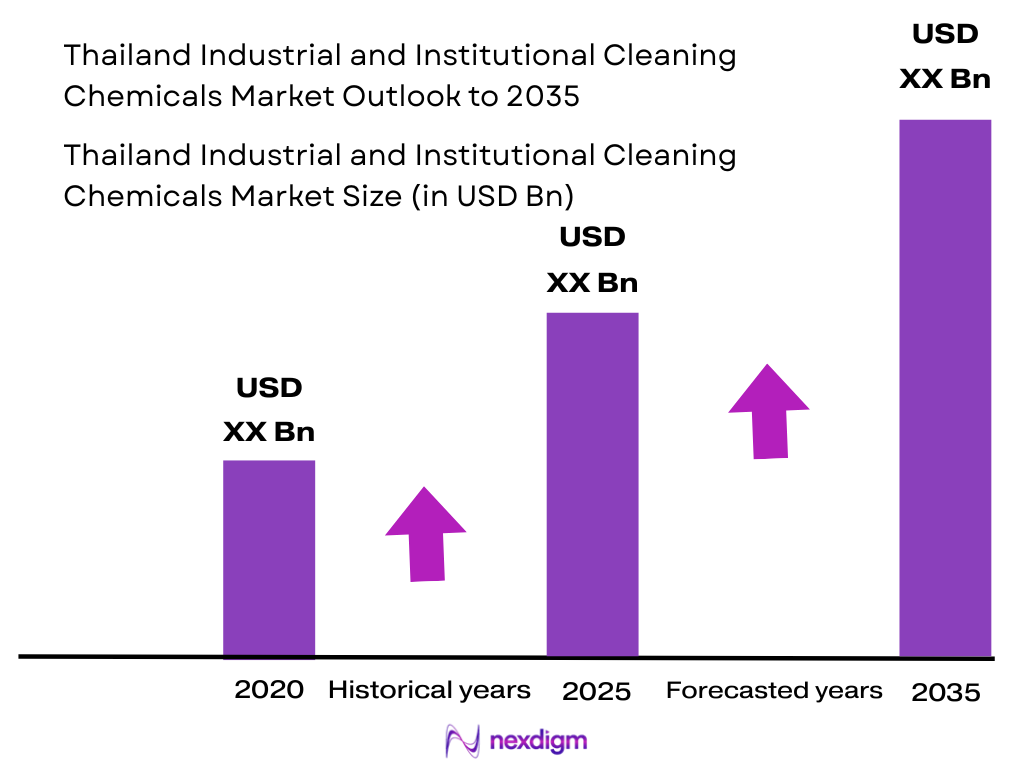
The Thailand Industrial and Institutional Cleaning Chemicals Market is valued at ~USD XX million, with demand supported by industrial production, healthcare facilities, hospitality, food processing, commercial buildings and outsourced facility management. Thailand’s GDP increased from USD 459.50 billion in 2023 to USD 471.18 billion in 2024 in constant-price World Bank data, while real GDP growth reached 2.9 in 2024. These economic conditions support recurring demand for professional surface cleaners, disinfectants, degreasers, laundry chemicals, warewashing products and specialized industrial formulations.
Bangkok and the surrounding metropolitan area remain the principal institutional demand centre because of the concentration of hospitals, hotels, offices, retail complexes, restaurants and government facilities. Chonburi and Rayong are important industrial consumption centres because of manufacturing, petrochemical and Eastern Economic Corridor activity, while Ayutthaya and Pathum Thani support manufacturing and logistics-related cleaning demand. Phuket and Chiang Mai add hospitality-driven consumption. The World Bank identifies Thailand’s secondary cities as increasingly important economic centres alongside Bangkok.
Market Segmentation
By Product Type
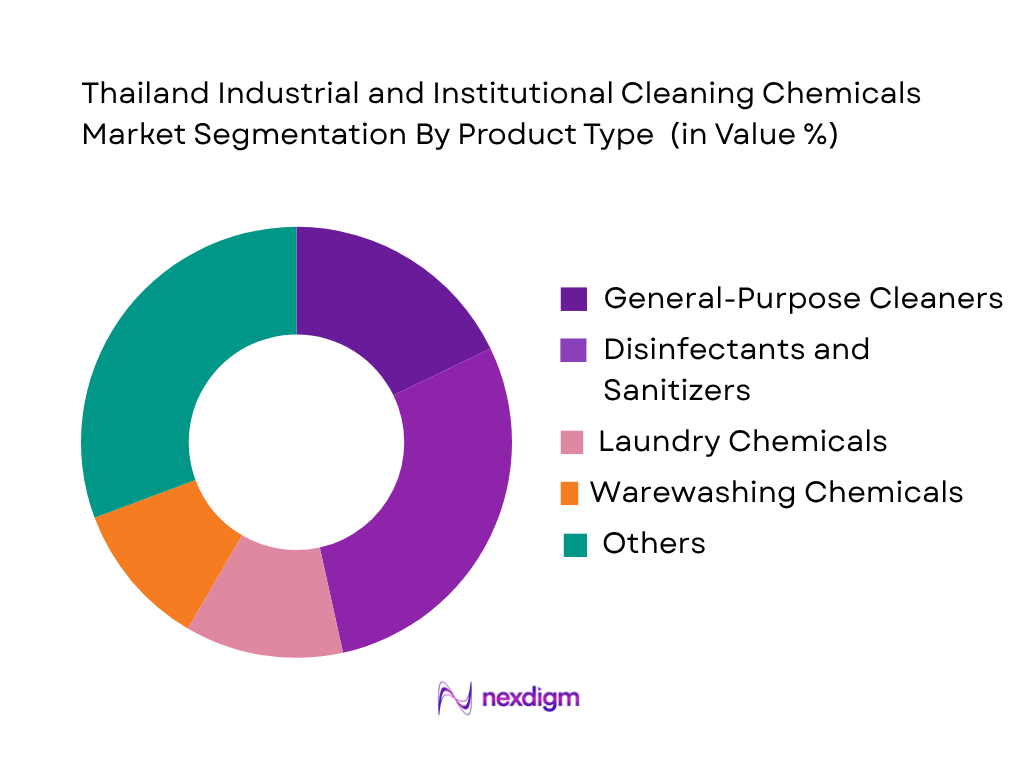
The Thailand Industrial and Institutional Cleaning Chemicals Market is segmented by product type into general-purpose cleaners, disinfectants and sanitizers, laundry chemicals, warewashing chemicals, floor-care chemicals, industrial degreasers, kitchen and food-service cleaners, glass and surface cleaners, restroom cleaners and specialty industrial cleaners. General-purpose cleaners are expected to represent the dominant sub-segment, supported by their broad applicability across offices, hotels, hospitals, retail facilities, schools, restaurants and manufacturing premises. Their use across routine floor, surface, restroom and equipment-cleaning activities creates recurring consumption across multiple facility types rather than dependence on a single industry. Disinfectants and sanitizers remain highly important in healthcare and food-service environments, while industrial degreasers serve machinery-intensive manufacturing operations. Thailand’s USD 471.18 billion GDP in 2024, together with real GDP growth of 2.9, reflects an economy containing a broad base of commercial and industrial facilities requiring routine professional cleaning.
By End-Use Industry
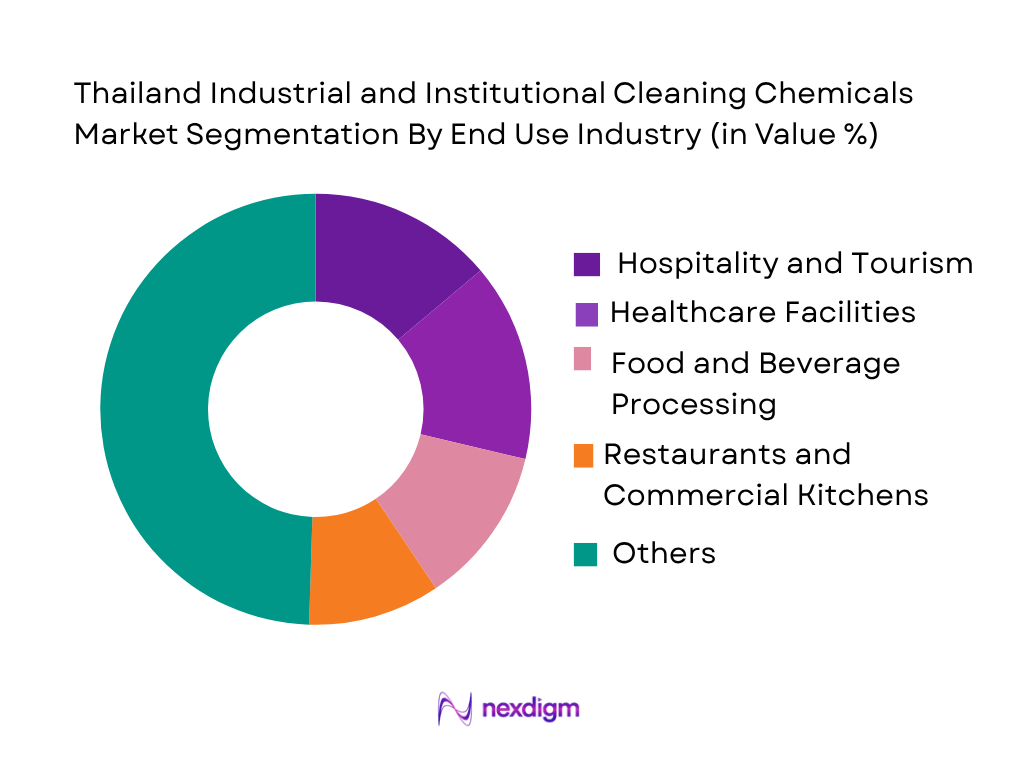
The Thailand Industrial and Institutional Cleaning Chemicals Market is segmented by end-use industry into healthcare, hospitality, food and beverage processing, restaurants and commercial kitchens, pharmaceutical manufacturing, electronics and semiconductor manufacturing, automotive and engineering, oil and gas and petrochemicals, general manufacturing, commercial offices, retail, education, airports and transportation, ports and marine facilities, and government institutions. Hospitality and tourism-related facilities constitute a major consumption segment because hotels, resorts and tourism-oriented establishments require continuous housekeeping, laundry, kitchen sanitation, restroom cleaning and public-area maintenance. Thailand’s tourism recovery further strengthens this demand channel; the World Bank identified tourism recovery as one of the factors supporting economic activity. Thailand’s GDP per capita reached USD 7,346.6 in 2024, supporting a substantial commercial-service economy in which professional hygiene requirements extend beyond industrial plants into hotels, restaurants, offices and institutional facilities.
Competitive Landscape
The Thailand Industrial and Institutional Cleaning Chemicals Market comprises global professional-hygiene suppliers, specialty chemical manufacturers, local formulators, distributors and facility-management-linked suppliers. Competition is shaped by product portfolio breadth, technical formulation capabilities, distribution coverage, application expertise and the ability to supply standardized chemistry to large multi-site customers. Major suppliers compete across healthcare, hospitality, food processing, manufacturing and commercial cleaning applications, while specialized players differentiate through concentrated formulations, disinfection systems, industrial cleaners and sustainable chemistry.
| Company | Establishment Year | Headquarters | Product Portfolio | Key I&I Applications | Formulation Capability | Distribution Reach | Technology Focus | Sustainability Positioning |
| Ecolab Inc. | 1923 | St. Paul, USA | ~ | ~ | ~ | ~ | ~ | ~ |
| Diversey Holdings | 1923 | Fort Mill, USA | ~ | ~ | ~ | ~ | ~ | ~ |
| SC Johnson Professional | 1886 | Racine, USA | ~ | ~ | ~ | ~ | ~ | ~ |
| P&G Professional | 1837 | Cincinnati, USA | ~ | ~ | ~ | ~ | ~ | ~ |
| Reckitt Professional | 1823 | Slough, UK | ~ | ~ | ~ | ~ | ~ | ~ |
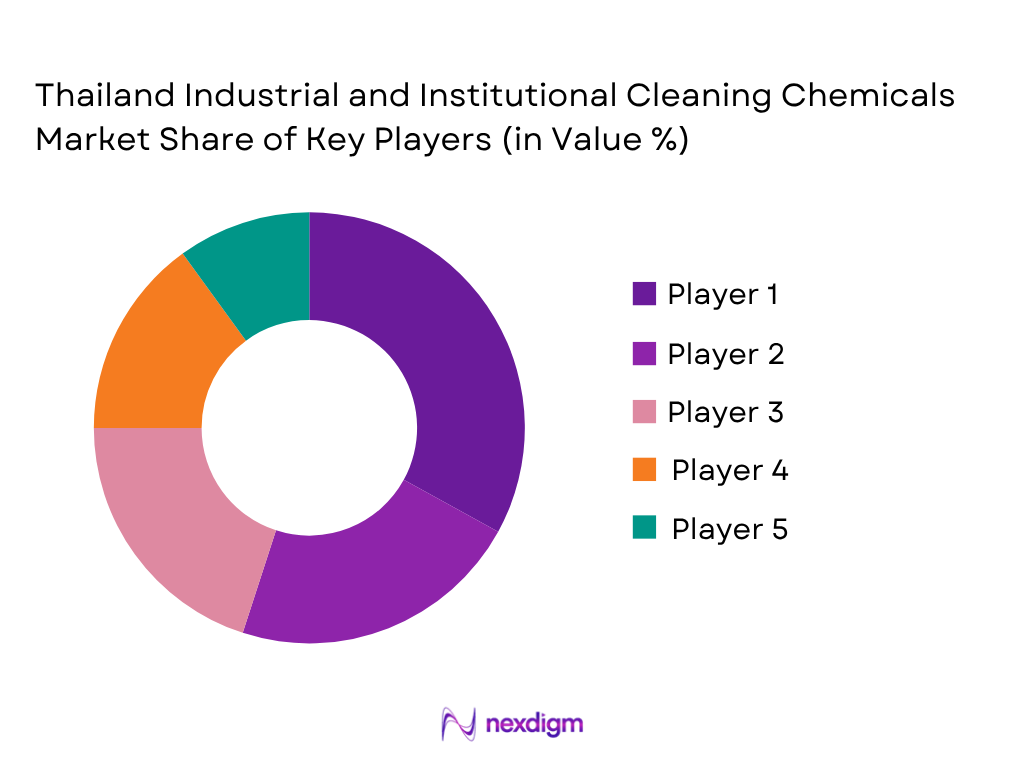
Thailand Industrial and Institutional Cleaning Chemicals Market Analysis
Growth Drivers
Manufacturing Production
Thailand’s large industrial operating base creates a recurring requirement for industrial and institutional cleaning chemicals across production floors, processing equipment, utilities, warehouses, employee facilities, and maintenance operations. The Thailand State of Pollution Report records 73,710 operating industrial factories in 2024, compared with 72,699 in 2023, providing a substantial installed base for recurring cleaning, degreasing, sanitation, and hygiene applications. The industrial ecosystem is also attracting new capital: the Thailand Board of Investment recorded 3,137 investment-promotion applications in 2024, compared with 2,235 in 2023, with combined proposed investment reaching THB 1.14 trillion. Electronics and electrical appliances alone represented 407 applications worth THB 231.7 billion, while chemicals and related industries remained among the targeted investment areas. This expansion supports demand for specialized cleaners capable of removing oils, fluxes, residues, scale, food soils, and process contaminants without damaging sensitive equipment. Thailand’s overall economy generated US$526.52 billion of GDP in 2024, with real GDP expanding 2.5, reinforcing the underlying economic activity supporting commercial and industrial facilities. The Office of Industrial Economics also maintains production, shipment, inventory, labor, and capacity-utilization indicators across 75 industrial sectors, allowing cleaning-chemical demand to be linked directly with factory operating intensity rather than treated as a generic chemical-consumption market.
Hotel Occupancy and Tourism Activity
Thailand’s recovery in international tourism is strengthening demand for institutional cleaning chemicals across hotels, resorts, restaurants, commercial kitchens, laundries, public washrooms, spas, and guest-service facilities. The National Statistical Office records 35,545,714 international tourist arrivals in 2024, compared with 28,150,016 in 2023, while arrivals from China reached 6,733,200, Malaysia 4,952,078, and India 2,129,100. The scale of visitor activity creates repeated consumption requirements for laundry detergents, warewashing formulations, bathroom cleaners, disinfectants, glass cleaners, floor-care chemicals, and surface sanitizers. The National Economic and Social Development Council reported that accommodation and food-service activities expanded 9.8% during the first half of 2024, while the average hotel occupancy rate reached 69.92% during the second quarter. Tourism receipts reached THB 577 billion during that quarter, including THB 245 billion from domestic tourism. These operating indicators are directly relevant to I&I chemical demand because higher room occupancy increases linen turnover, restroom utilization, housekeeping cycles, kitchen throughput, and common-area cleaning frequency. Thailand’s US$7,346.6 GDP per capita and 2.5% real GDP growth in 2024 further indicate an economy with sufficient commercial activity to support professional facility-management and hygiene services. As tourism normalizes, chemical suppliers therefore have opportunities to move customers toward concentrated, application-specific and automated dosing systems rather than relying solely on conventional general-purpose formulations.
Market Challenges
Imported Specialty Chemistry Dependency
Thailand’s I&I cleaning-chemical industry faces exposure to imported chemical inputs and specialty formulations because sophisticated surfactants, functional additives, enzymes, specialty solvents, disinfectant actives, and performance-enhancing ingredients are integrated into many higher-value formulations. The scale of Thailand’s chemical trade demonstrates the importance of this external supply chain: Bank of Thailand trade statistics record US$83.35 billion of chemical imports in 2024, while imports classified as chemicals and petrochemical products reached US$66.46 billion under the corresponding economic-classification series. The country’s total GDP was US$526.52 billion in 2024, making chemical import flows economically significant within the industrial input structure. At the same time, Thailand’s industrial base is broad, with 73,710 operating factories in 2024, meaning disruption in imported raw materials can potentially affect numerous downstream formulation and distribution channels. The challenge is particularly relevant for specialty I&I products where qualification requirements can restrict rapid substitution between suppliers. Foreign-exchange movements, shipping disruptions, regional feedstock constraints, and changing international chemical regulations can also influence availability. The problem is not limited to finished cleaning products: domestic formulators may depend on imported surfactants, biocides, chelating agents, enzymes, solvents, fragrances, polymers, and specialty additives. Thailand’s investment pipeline nevertheless offers a route toward greater localization, with BOI reporting THB 1.14 trillion in total investment applications in 2024 and chemicals among the targeted sectors. Building local production and regional sourcing capabilities therefore becomes strategically important for suppliers seeking more resilient I&I chemical supply chains.
Hazardous Substance Compliance and Wastewater Management
Regulatory compliance creates a material operational challenge because industrial and institutional cleaning products can involve hazardous substances, concentrated chemicals, disinfecting agents, corrosive formulations, solvents, and substances requiring controlled storage, handling, labeling, transport, and disposal. Thailand’s Department of Industrial Works operates the Hazardous Substance Single Submission (HSSS-2024) system for relevant hazardous-substance permissions and maintains requirements covering import, export, production, possession, and registration. Environmental compliance adds another layer: Thai industrial regulations apply wastewater controls covering parameters such as pH, BOD, COD, suspended solids, oil, and grease. The Department of Industrial Works has identified facilities discharging 500 cubic meters of wastewater per day or more for continuous monitoring requirements, while its national monitoring framework has covered 287 factories across 40 provinces under the applicable high-discharge criteria. The scale of the underlying industrial base is substantial, with 73,710 operating factories in 2024. Consequently, customers increasingly need cleaning programs that achieve soil removal while limiting chemical loading and downstream treatment requirements. Thailand’s US$526.52 billion GDP in 2024 and 2.5% real GDP growth indicate continued economic activity that sustains industrial operations, but compliance costs can become more complex as facilities adopt tighter environmental controls. For suppliers, this creates a challenge when conventional high-strength formulations produce higher wastewater burdens or require additional neutralization and treatment. Product selection must therefore increasingly account for chemical concentration, biodegradability, rinse requirements, effluent characteristics, worker exposure, storage classification, and documentation under Thailand’s hazardous-substance framework.
Market Opportunities
Concentrated Formulations and Water-Efficient Cleaning
Concentrated formulations represent an important opportunity because Thailand combines a large industrial customer base with substantial hospitality, food-service, healthcare, and commercial-facility activity. The country had 73,710 operating industrial factories in 2024, while international tourist arrivals reached 35,545,714, generating recurring requirements for housekeeping, laundry, kitchen sanitation, industrial cleaning, and facility maintenance. Concentrates can reduce the amount of product that must be transported, stored, dispensed, and packaged while enabling customers to control dilution at the point of use. This is particularly relevant where facilities have high cleaning frequency and multiple application areas requiring different dilution ratios. Thailand’s tourism-linked accommodation and food-service sector expanded 9.8% during the first half of 2024, while the average occupancy rate reached 69.92% in the second quarter, strengthening the operating case for efficient chemical utilization in hotels and food-service facilities. The wider economy recorded US$526.52 billion GDP and 2.5% real GDP growth in 2024, supporting continued commercial and industrial activity. Water efficiency is also increasingly relevant to manufacturing customers because cleaning operations generate wastewater and may require treatment before discharge. Thailand’s industrial wastewater framework includes facilities discharging at least 500 cubic meters per day under continuous-monitoring requirements, illustrating the regulatory importance of wastewater management. Suppliers can therefore differentiate through high-active concentrates, low-rinse chemistry, controlled dilution, enzyme-assisted cleaning, and formulations designed to maintain cleaning performance with lower water consumption.
Automated Chemical Dosing and Smart Dispensing
Automated dosing and smart dispensing systems provide an opportunity to improve chemical-use consistency across Thailand’s high-throughput hospitality, healthcare, food-processing, manufacturing, and commercial-facility segments. The opportunity is supported by the scale and modernization of the industrial base: Thailand recorded 3,137 investment-promotion applications in 2024, representing THB 1.14 trillion in proposed investment, while electronics and electrical appliances alone accounted for 407 projects worth THB 231.7 billion. These investments increase the number of facilities where standardized operating procedures, controlled chemical consumption, equipment protection, and process monitoring can become purchasing criteria. Tourism provides an additional demand pool, with 35,545,714 international arrivals in 2024 and accommodation and food-service activity expanding 9.8% in the first half of the year. Automated dispensing can support consistent dilution for laundry, warewashing, housekeeping, restroom sanitation, and food-service applications while reducing manual handling and improving chemical traceability. It can also connect chemical consumption with equipment operating schedules and maintenance records, creating opportunities for suppliers to shift from product-only sales toward integrated chemical-management contracts. Thailand’s GDP reached US$526.52 billion in 2024, while the IMF reported 2.5% real GDP growth, indicating a substantial economic base for technology-enabled facility operations. The regulatory environment further supports controlled dispensing because Thailand’s hazardous-substance framework requires structured handling and authorization for applicable substances. Smart systems can therefore combine dosing accuracy, worker-safety controls, inventory alerts, dilution verification, usage monitoring, and wastewater-oriented optimization, creating a differentiated route for suppliers competing beyond conventional chemical performance.
Future Outlook
Over the forecast period, the Thailand Industrial and Institutional Cleaning Chemicals Market is expected to expand through continued industrial activity, hospitality recovery, healthcare requirements and professional facility management. Demand is likely to shift toward concentrated formulations, automated dosing, sustainable chemistry and application-specific cleaning systems. Food processing, pharmaceutical manufacturing and electronics facilities should create demand for higher-specification cleaning chemistry. The market is also positioned to benefit from the increasing professionalization of cleaning operations and greater emphasis on chemical-use control, worker safety and environmental performance.
Major Players
- Ecolab Inc.
- Diversey Holdings
- SC Johnson Professional
- P&G Professional
- Reckitt Professional
- Unilever Professional
- Henkel AG & Co. KGaA
- BASF SE
- 3M Company
- CloroxPro
- Kärcher
- Christeyns NV
- Spartan Chemical Company
- Zep Inc.
- Kao Corporation
Key Target Audience
- Industrial and Institutional Cleaning Chemical Manufacturers
- Professional Hygiene and Janitorial Product Distributors
- Facility Management and Contract Cleaning Companies
- Healthcare and Hospital Procurement Organizations
- Food Processing and Foodservice Operators
- Hospitality Groups and Hotel Operators
- Investments and Venture Capitalist Firms
- Government and Regulatory Bodies (Thai Food and Drug Administration, Department of Industrial Works, Ministry of Public Health)
Research Methodology
Step 1: Identification of Key Variables
The initial stage maps Thailand’s industrial and institutional cleaning-chemical ecosystem across manufacturers, formulators, importers, distributors, facility-management companies and end users. Product categories, chemistry types, application areas, facility types and procurement channels are identified to establish the market taxonomy and define the measurable demand variables.
Step 2: Market Analysis and Construction
Historical market information is compiled across professional cleaning products, industrial cleaners, disinfectants, laundry chemicals, warewashing products, degreasers and specialty formulations. Demand is assessed by end-use industry, facility type, application intensity and distribution channel, with macroeconomic indicators used to contextualize industrial and institutional activity.
Step 3: Hypothesis Validation and Expert Consultation
Market hypotheses are validated through interviews with manufacturers, distributors, facility-management companies, industrial cleaning contractors and major end users. Discussions focus on product selection, consumption intensity, procurement practices, formulation preferences, regulatory requirements and technology adoption.
Step 4: Research Synthesis and Final Output
The final analysis triangulates demand-side and supply-side findings with company information, industry databases, trade information and official economic statistics. Bottom-up estimates are reconciled with top-down market calculations to establish the market structure, competitive environment, segmentation and forward-looking assessment.

- Executive Summary
- Research Methodology (Market Definition, Product Inclusion and Exclusion Criteria, Market Taxonomy, Top-Down Market Sizing, Bottom-Up Market Sizing, Volume-to-Value Conversion, Supply-Side Mapping, Demand-Side Assessment, Import-Export Validation, Distributor Mapping, End-User Consumption Analysis, Facility-Level Demand Mapping, Primary Interviews, Expert Validation, Data Triangulation, Forecasting Framework, Scenario Analysis, Assumptions and Limitations)

- Definition and Scope
- Industrial Cleaning vs Institutional Cleaning Ecosystem
- Evolution of Professional Cleaning and Hygiene Chemistry in Thailand
- Thailand Industrial and Institutional Cleaning Chemicals Value Chain
- Raw Material-to-Formulation Value Chain
- Domestic Blending, Formulation and Manufacturing Landscape

- Growth Drivers (Manufacturing Production, Eastern Economic Corridor Expansion, Healthcare Infrastructure, Hotel Occupancy and Tourism Activity, Food Processing Output, Pharmaceutical Manufacturing, Facility Management Outsourcing, Industrial Hygiene Requirements)
- Market Challenges (Imported Specialty Chemistry Dependency, Raw Material Supply Exposure, Hazardous Substance Compliance, Wastewater Management, Chemical Handling Requirements, Fragmented Local Formulation Base, Skilled Workforce Availability, Price Competition)
- Market Opportunities (Concentrated Formulations, Water-Efficient Cleaning, Enzyme-Based Chemistry, Bio-Based Surfactants, Low-VOC Formulations, Automated Chemical Dosing, Smart Dispensing, Food-Processing Sanitation, Healthcare Hygiene, Local Specialty-Chemical Manufacturing)
- Market Trends (Concentrated Chemistry, Sustainable Cleaning Formulations, Enzymatic Cleaning, Low-Residue Disinfection, Automated Dosing, Smart Chemical Dispensing, Water-Efficient Cleaning, Sustainable Packaging, Digital Facility Management, Contract Cleaning Integration)
- Government and Regulatory Framework (Thai FDA Hazardous Substance Requirements, Hazardous Substance Act, Department of Industrial Works Requirements, Ministry of Public Health Requirements, GHS Classification and Labelling, Chemical Registration, Workplace Chemical Safety, Environmental Compliance, Wastewater Discharge, Food Hygiene)
- SWOT Analysis
- Porter’s Five Forces Analysis
- PESTLE Analysis

- By Market Value (2020-2025)
- By Volume Consumption (2020-2025)
- By Product Category (2020-2025)
- By Chemistry Type (2020-2025)
- By Formulation Type (2020-2025)
- By Cleaning Application (2020-2025)
- By End-Use Industry (2020-2025)

- By Product Type (In Value %)
General-Purpose Cleaners
Disinfectants and Sanitizers
Laundry Chemicals
Warewashing and Dishwashing Chemicals
Floor Care Chemicals
Industrial Degreasers
Kitchen and Food-Service Cleaners
Restroom and Washroom Cleaners
Carpet and Upholstery Cleaners
Vehicle Wash Chemicals
Specialty Industrial Cleaners
Cleanroom Cleaning Chemicals
Metal and Parts Cleaners - By Raw Material and Chemistry Type (In Value %)
Surfactants
Chlor-Alkali-Based Chemistry
Acids
Alkalis
Solvents
Biocides
Enzymes
Phosphates and Builders
Chelating Agents
Oxidizing Agents
Specialty Additives
Bio-Based Cleaning Ingredients
Low-VOC Cleaning Chemistry - By Formulation Type (In Value %)
Ready-to-Use Liquids
Concentrated Liquids
Super-Concentrates
Powders
Gels
Foams
Tablets and Solid Doses
Wipes
Low-Foam Formulations
High-Foam Formulations
Dilutable Professional Formulations - By End-Use Industry (In Value %)
Healthcare Facilities
Hotels and Resorts
Restaurants and Commercial Kitchens
Pharmaceutical Manufacturing
Electronics and Semiconductor Manufacturing
Automotive and Engineering Manufacturing
Oil and Gas and Petrochemicals
General Manufacturing
Commercial Offices
Education and Institutional Facilities
Airports and Transportation
Ports and Marine Facilities
Government and Public Facilities - By Cleaning Application (In Value %)
Hard-Surface Cleaning
Floor Cleaning and Maintenance
Equipment and Machinery Cleaning
Clean-in-Place Cleaning
Open-Plant Cleaning
Industrial Degreasing
Parts and Component Cleaning
Manual Warewashing
Automatic Warewashing
Laundry Cleaning
Restroom Sanitation
High-Touch Surface Disinfection
Cleanroom Cleaning
Precision and Specialty Cleaning - By Facility Type (In Value %)
Hospitals and Medical Centres
Hotels and Resorts
Food Processing Plants
Commercial Kitchens
Pharmaceutical Facilities
Electronics and Semiconductor Plants
Automotive Manufacturing Plants
Industrial Manufacturing Facilities
Oil Refineries and Petrochemical Plants
Ports and Marine Facilities
Airports and Aviation Facilities
Shopping Malls and Retail Complexes

- Market Share Analysis of Major Players (By Value, Product Category, Chemistry Type, Formulation Type, End-Use Industry, Cleaning Application, Customer Type, Distribution Channel)
- Cross Comparison Parameters (Product Portfolio Breadth, Professional Cleaning SKU Coverage, Domestic Formulation Footprint, Specialty Chemistry Capability, Sustainable Chemistry Portfolio, Automated Dosing Capability, Distribution Network Reach, End-User Industry Coverage)
- Major Player SWOT Analysis
- Detailed Profiles of Major Companies
SC Johnson Professional
Diversey Holdings
Ecolab Inc.
Reckitt Benckiser Group plc
Unilever PLC
P&G Professional
Henkel AG & Co. KGaA
BASF SE
3M Company
Clorox Professional Products Company
Kärcher
Christeyns NV
Spartan Chemical Company
Zep Inc.

- Procurement and Consumption Behaviour
- End-User Purchase Drivers
- Purchase Frequency and Chemical Consumption Intensity
- Buyer Segmentation by Facility Type
- Procurement Channel Preferences

- By Market Value (2026-2035)
- By Volume Consumption (2026-2035)
- By Product Category (2026-2035)
- By Chemistry Type (2026-2035)
- By Formulation Type (2026-2035)
- By Cleaning Application (2026-2035)
- By End-Use Industry (2026-2035)


 Request a Sample
 Ask for Customization
 Get a Quote
 Enquire Now