
 Download PDF
Market Overview
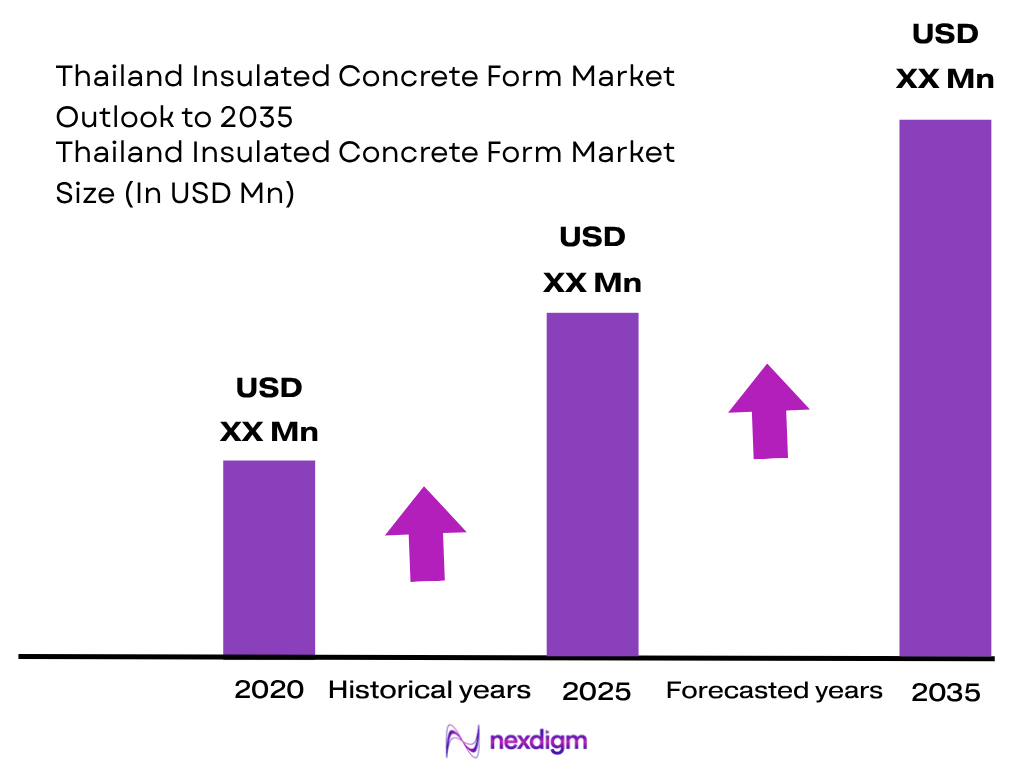
The Thailand Insulated Concrete Form Market is valued at approximately USD ~ million, based on the historical market assessment. Its addressable construction base remains substantial, with national new-building construction area moving from 60.85 million sq. m. to 58.86 million sq. m., while new housing registrations in Bangkok and surrounding provinces moved from 99,370 units to 97,129 units. Demand is supported by low-rise housing, permanent insulation requirements, resort construction and reinforced-concrete building practices.
Bangkok Metropolitan Region, the Central and Eastern development corridors, and major southern tourism provinces represent Thailand’s most important ICF addressable locations because of their concentration of housing, industrial and hospitality construction. New-building area in Bangkok and its vicinities shifted from about 18.64 million sq. m. to 15.87 million sq. m., while Central Thailand increased from 19.54 million sq. m. to 21.68 million sq. m. The EEC additionally concentrates promoted investment across Chonburi, Rayong and Chachoengsao.
Market Segmentation
By ICF System Type
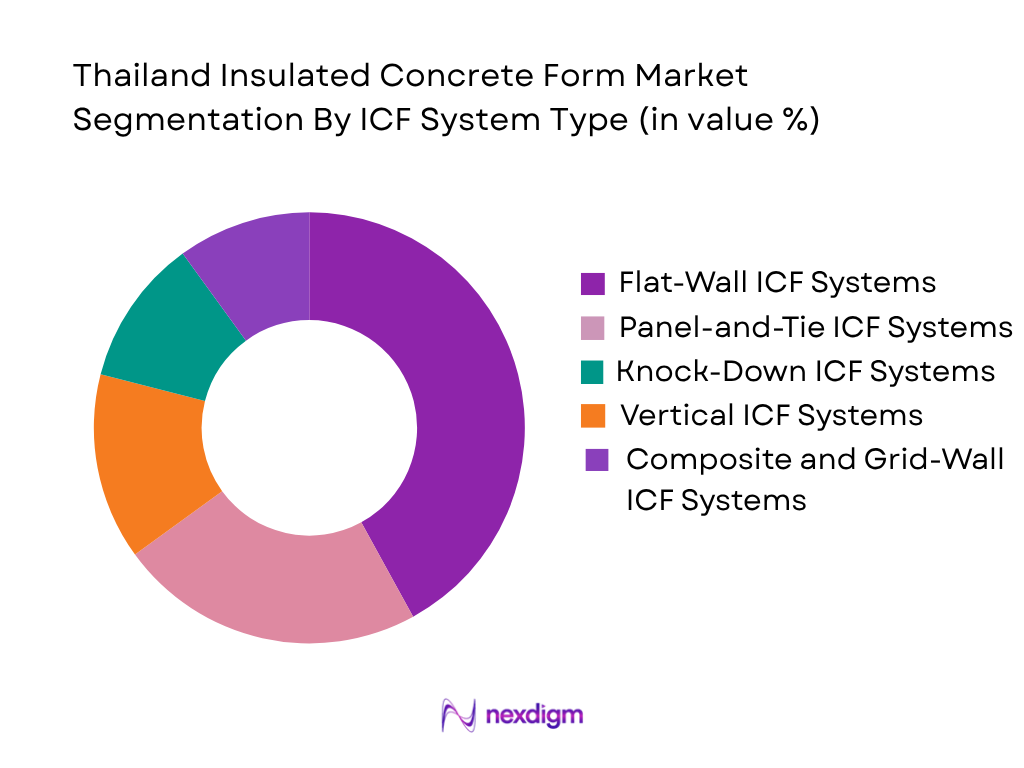
The Thailand Insulated Concrete Form Market is segmented into flat-wall ICF systems, panel-and-tie systems, knock-down systems, vertical ICF systems and composite or grid-wall systems. Flat-wall ICF systems hold the dominant share in the report model because they align closely with Thailand’s extensive use of reinforced concrete in detached housing, villas, commercial buildings and specialized structures. The flat concrete core permits relatively straightforward structural engineering, reinforcement placement and integration with locally available ready-mix concrete. Permanent EPS layers on both sides also provide continuous insulation, which can be valuable in Thailand’s cooling-intensive tropical environment. The system is particularly relevant for low-rise housing, luxury villas, resort buildings, basement walls and projects where monolithic structural continuity is important. Thailand recorded approximately 58.86 million sq. m. of new-building construction area, including substantial residential, commercial, hotel and industrial activity, providing a sizeable technical application base. Nevertheless, flat-wall ICF must compete with AAC masonry, precast concrete and conventional reinforced-concrete formwork that already have mature contractor ecosystems.
By End-Use Construction
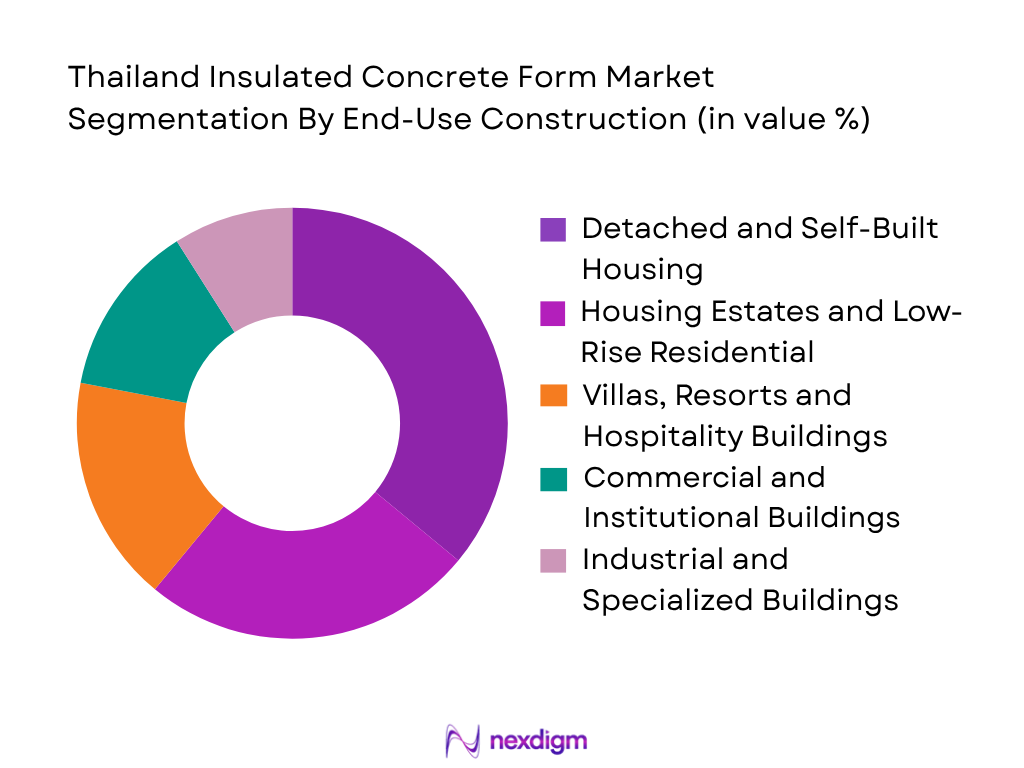
The Thailand Insulated Concrete Form Market is segmented into detached and self-built housing, housing estates and low-rise residential developments, villas and hospitality properties, commercial and institutional buildings, and industrial or specialized structures. Detached and low-rise residential construction holds the dominant share in the report model because ICF technology is more readily incorporated into individual houses and low-rise projects than into high-volume developments standardized around precast concrete or conventional masonry. Thailand recorded 238,025 permitted residential buildings, while Bangkok and its surrounding region accounted for 44,316 residential buildings within the national construction dataset. Bangkok and surrounding provinces also registered 97,129 new housing units, including 25,106 self-built houses, illustrating the continuing relevance of individually designed low-rise construction. These projects provide ICF suppliers with opportunities to combine structural reinforced concrete, permanent EPS insulation, acoustic separation and simplified wall-forming within one assembly. Villas and resort developments provide an additional niche because differentiated envelope performance and customized structural layouts are more readily specified.
Competitive Landscape
The Thailand Insulated Concrete Form Market has a fragmented competitive structure characterized more by imported technology, international ICF brands and adjacent local building-system suppliers than by a large domestic base of dedicated ICF manufacturers. Fox Blocks, BuildBlock, Nudura, Amvic Building System and Quad-Lock represent major international technology benchmarks. Their competitive differentiation centers on form architecture, insulation configuration, concrete-core flexibility, installer training, engineering support and product-system breadth. Thailand therefore offers potential for distributors, EPS processors and construction partners capable of localizing established international ICF technologies.
| Major Player | Establishment Year | Headquarters | ICF Architecture | Concrete Core Capability | Insulation Configuration | Product-System Breadth | Installer/Design Support | Thailand Market Relevance |
| Fox Blocks | 2005 | Omaha, Nebraska, USA | ~ | ~ | ~ | ~ | ~ | ~ |
| BuildBlock Building Systems | 2004 | Oklahoma City, Oklahoma, USA | ~ | ~ | ~ | ~ | ~ | ~ |
| Nudura | 2001 | Beachwood, Ohio, USA | ~ | ~ | ~ | ~ | ~ | ~ |
| Amvic Building System | 1997 | Toronto, Ontario, Canada | ~ | ~ | ~ | ~ | ~ | ~ |
| Quad-Lock Building Systems | 1994 | Surrey, British Columbia, Canada | ~ | ~ | ~ | ~ | ~ | ~ |
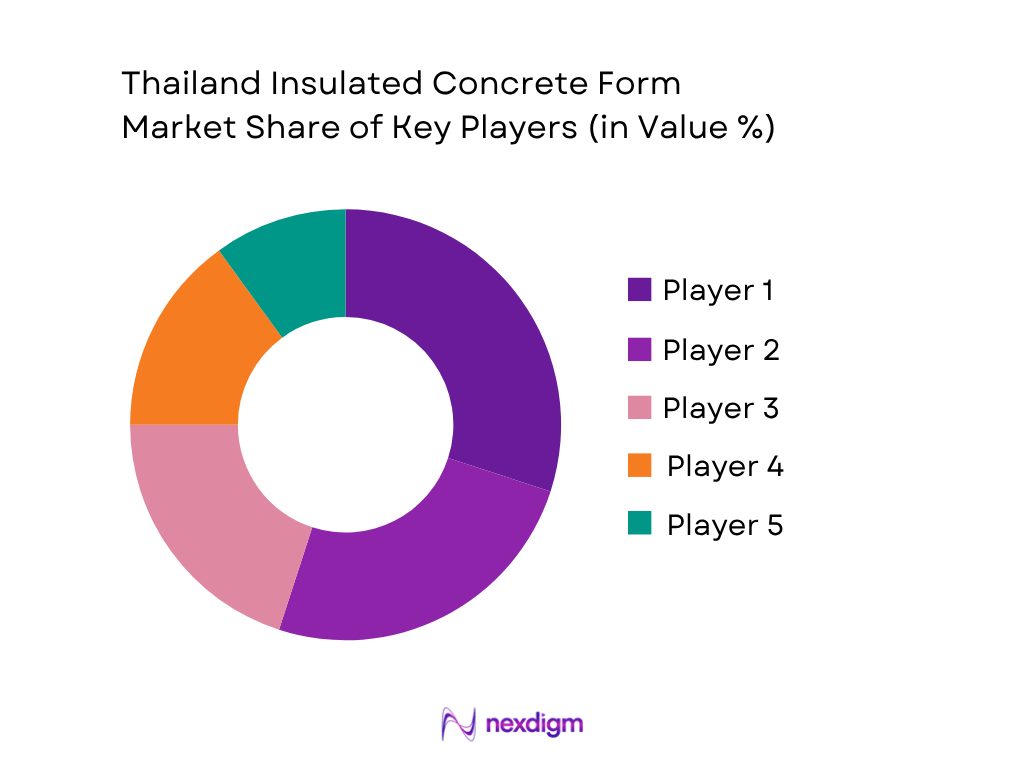
Thailand Insulated Concrete Form Market Analysis
Growth Drivers
Expansion of Residential and Low-Rise Construction Supports ICF Adoption
Thailand’s large residential construction base creates a direct demand foundation for insulated concrete form systems, particularly across detached houses, housing estates, villas, basements and other low-rise reinforced-concrete applications. The National Statistical Office recorded 256,994 new building constructions and 52.10 million square metres of new building area in 2024, while 238,025 residential buildings received construction permits during the same period. Residential construction therefore remains the largest building category and provides a substantial addressable project pool for ICF systems that combine permanent EPS formwork, insulation and reinforced concrete within a single wall assembly. Bangkok and its surrounding provinces alone accounted for 44,316 permitted residential buildings, demonstrating a concentrated market where distributors and specialist installers can build scale. Thailand’s macroeconomic base also supports continuing construction investment: World Bank data place national GDP at USD 526.52 billion in 2024, GDP per capita at USD 7,346.6, and population at 71,668,011. These indicators support continued demand for housing and building improvements, while ICF suppliers can specifically target projects requiring monolithic structural walls, reduced temporary formwork, thermal insulation and construction-system integration.
Building Energy Efficiency Requirements Increase the Relevance of Insulated Wall Systems
Thailand’s policy focus on reducing building energy consumption strengthens the technical relevance of insulated concrete forms because ICF walls incorporate continuous insulation around a reinforced-concrete core rather than treating insulation as a separate installation stage. The Department of Alternative Energy Development and Efficiency maintains Thailand’s Building Energy Code framework covering building-envelope performance and energy conservation requirements, creating a regulatory environment in which wall thermal performance becomes increasingly important for applicable developments. This is particularly significant in a construction market where the National Statistical Office recorded 52.10 million square metres of new building area in 2024, including residential, commercial, hotel, office and industrial buildings. Southern Thailand alone registered 8.47 million square metres of building construction area, including 514,701 square metres of hotel and restaurant construction, highlighting the relevance of cooling-intensive hospitality buildings in warm-climate locations. Thailand’s broader economic capacity provides additional support, with World Bank data reporting USD 526.52 billion of GDP and USD 7,346.6 GDP per capita in 2024. These conditions create a specific pathway for ICF adoption in villas, hotels, institutional buildings and premium residences where continuous EPS insulation, concrete thermal mass and reduction of thermal bridging can contribute to better envelope performance.
Market Challenges
Contraction in New Building Activity Restricts Near-Term ICF Project Conversion
A major challenge for the Thailand Insulated Concrete Form Market is the contraction in overall new-building activity, which reduces the immediate pool of projects available for an alternative wall technology that still requires specification conversion and contractor familiarization. National Statistical Office data show new building construction area declined from 60.85 million square metres in 2023 to 52.10 million square metres in 2024, while the number of construction permits declined from 208,741 to 188,461. New construction units also stood at 256,994 in 2024, demonstrating that activity remained substantial but below the preceding period. This matters for ICF because conventional reinforced concrete, AAC masonry and precast systems already have mature procurement channels, meaning fewer project starts can intensify competition for specification. Residential permits nevertheless remained substantial at 238,025 buildings, but ICF suppliers must convert developers and contractors within that existing construction base rather than rely on a rapidly expanding project pipeline. World Bank data indicate Thailand’s economy generated USD 526.52 billion in GDP in 2024, with GDP per capita of USD 7,346.6 and a population of 71,668,011. The economic base remains sizeable, but softer construction activity increases the importance of targeted applications such as villas, basements, resorts and high-performance residential projects.
Established Precast, Masonry and Industrialized Construction Systems Raise Adoption Barriers
Thailand’s ICF market faces strong structural competition from conventional reinforced-concrete construction, precast components, masonry walls and insulated panel systems that already have established contractor knowledge, manufacturing capacity and procurement relationships. The scale of Thailand’s existing industrial construction ecosystem is evident in National Statistical Office data showing 5,369 permitted industrial and factory buildings in 2024, alongside 10,402 permitted commercial buildings, 2,208 hotels, and 1,424 office buildings. These applications are typically served by familiar building systems, so ICF suppliers must demonstrate a clear advantage in thermal performance, installation integration, structural continuity or project-specific geometry to displace incumbent methods. Competition is also reinforced by Thailand’s investment in advanced industrial facilities. The Board of Investment recorded 3,137 investment-promotion applications in 2024, including 407 electrical and electronics projects, 309 automotive projects, and 235 petrochemical and chemical projects, supporting demand for established industrial construction supply chains. At the macroeconomic level, World Bank data record USD 526.52 billion of GDP and 71,668,011 residents in 2024. Consequently, the challenge is not the absence of construction demand, but persuading a technically mature construction ecosystem to adopt a comparatively less-established ICF installation model.
Market Opportunities
Eastern Economic Corridor Development Creates a High-Value Application Pipeline for ICF
The Eastern Economic Corridor offers a significant future opportunity for the Thailand Insulated Concrete Form Market because Chonburi, Rayong and Chachoengsao continue attracting large industrial, digital and supporting real-estate developments that require commercial, utility, residential and ancillary buildings. The Board of Investment approved a THB 32.8 billion hyperscale data centre project in Chonburi, another THB 28.0 billion data centre project in Chonburi, and a THB 6.15 billion electronics-material manufacturing project in Chachoengsao during the current investment cycle. Thailand received 3,137 investment-promotion applications in 2024, while total applications reached 1.14 trillion baht, demonstrating the scale of projects entering the industrial and infrastructure pipeline. The first half of 2025 subsequently recorded 1.06 trillion baht across investment-promotion applications, including 28 data-centre projects representing 521.2 billion baht. ICF suppliers can target support buildings, offices, utility structures, low-rise worker accommodation, controlled-environment buildings and specialized reinforced-concrete enclosures associated with this investment expansion. Thailand’s 2024 macroeconomic base of USD 526.52 billion GDP, USD 7,346.6 GDP per capita, and 71,668,011 population provides further context for sustained capital formation and urban development around these investment corridors.
Domestic EPS Processing and Localization Can Expand Future ICF Accessibility
Localization of ICF form production represents a major future-growth opportunity because Thailand already has a sizeable construction-material and polymer-processing ecosystem, while dedicated ICF availability remains comparatively limited. Instead of relying solely on fully imported systems, international technology owners can partner with local EPS processors, moulders, concrete suppliers and contractors to manufacture permanent forms domestically and develop Thailand-specific installation support. The opportunity is supported by the size of the underlying construction base: the National Statistical Office recorded 256,994 new buildings and 52.10 million square metres of new construction area in 2024, including 238,025 permitted residential buildings. Central and Eastern Thailand together accounted for substantial volumes of construction activity, creating concentrated zones where regional production and distribution can be developed. Investment conditions also support manufacturing localization. The Board of Investment received 3,137 project applications during 2024, while the first nine months of 2025 recorded 2,622 applications and 1.37 trillion baht of proposed investment, demonstrating continued expansion of Thailand’s industrial base. World Bank data place 2024 GDP at USD 526.52 billion and population at 71,668,011. These current indicators support future ICF growth through local moulding, shorter supply chains, contractor training, engineering adaptation and integration with domestically available concrete and reinforcement systems.
Future Outlook
The Thailand Insulated Concrete Form Market is forecast to expand at approximately ~XX.X% CAGR during 2026–2035, supported by gradual adoption of energy-efficient wall assemblies, low-rise residential development, premium villa construction, hospitality projects and increasing interest in industrialized building techniques. The market is expected to remain specialized rather than displace conventional masonry and precast concrete on a broad scale. Growth prospects are strongest where ICF can solve project-specific requirements involving permanent insulation, reinforced structural walls, acoustic performance and simplified formwork. Detached residences, resort villas, basement construction, retaining walls and specialized institutional buildings provide particularly relevant application areas.
Thailand’s large domestic EPS processing, concrete and construction-material ecosystem also creates opportunities for localization. Partnerships between international ICF technology owners and domestic EPS moulders could reduce import dependence while improving availability of forms, accessories, bracing equipment and contractor training.
Major Players
- Fox Blocks
- BuildBlock Building Systems
- Nudura
- Amvic Building System
- Quad-Lock Building Systems
- SuperForm Products
- IntegraSpec
- Element ICF / Logix Brands
- RASTRA
- Sunforest Constech
- IXL Co., Ltd.
- Greatwall Insulation Co., Ltd.
- Metecno Pannelli (Thailand) Co., Ltd.
- General Engineering Public Company Limited
- ALPI South East Asia Co., Ltd.
Key Target Audience
- Insulated Concrete Form Manufacturers and Technology Suppliers
- EPS and Building Insulation Manufacturers
- Residential, Villa and Hospitality Property Developers
- Main Contractors and Specialist Reinforced-Concrete Contractors
- Ready-Mix Concrete, Reinforcement and Construction Material Suppliers
- Investments and Venture Capitalist Firms
- Government and Regulatory Bodies (Department of Alternative Energy Development and Efficiency, Department of Public Works and Town & Country Planning, Thai Industrial Standards Institute, Eastern Economic Corridor Office of Thailand)
- Architects, Structural Engineering Firms and Building-Envelope Design Companies
Research Methodology
Step 1: Identification of Key Variables
The initial phase involves constructing a detailed ecosystem map of the Thailand Insulated Concrete Form Market covering ICF technology providers, EPS manufacturers, concrete producers, distributors, contractors, developers and regulatory stakeholders. Secondary and proprietary databases are analyzed to identify the variables influencing market demand, including installed wall area, construction activity, form consumption, import dependence, building applications, insulation requirements and competing construction systems.
Step 2: Market Analysis and Construction
Historical construction and housing indicators are integrated with supplier-level information to construct the Thailand Insulated Concrete Form Market model. The top-down approach evaluates residential, hospitality, commercial, institutional and industrial construction activity, while the bottom-up approach assesses ICF forms, wall area, project applications and potential supplier revenues. Both approaches are reconciled to minimize overlap and identify realistic addressable applications.
Step 3: Hypothesis Validation and Expert Consultation
Market hypotheses are validated through computer-assisted telephone interviews with ICF suppliers, EPS processors, contractors, ready-mix concrete producers, architects, structural engineers and property developers. Discussions focus on system selection, concrete-core specifications, installation practices, contractor familiarity, product availability and substitution from AAC, precast and conventional reinforced-concrete walls. These findings are used to refine segmentation assumptions and competitive positioning.
Step 4: Research Synthesis and Final Output
The final phase combines supplier-side, construction-side, application-side and regulatory findings into a unified Thailand Insulated Concrete Form Market framework. Primary information is cross-checked against secondary indicators and project-level evidence to validate assumptions. The completed model supports historical analysis, segmentation, competitive benchmarking and the forecast while identifying realistic pathways for domestic manufacturing, distribution expansion and contractor adoption.

- Executive Summary
- Research Methodology (Market Definition and Scope, Thailand Insulated Concrete Form Market Classification, EPS and Composite ICF Demand Assessment, Insulated Concrete Form Consumption Mapping, Domestic EPS Moulding Capacity Assessment, Import Dependency Analysis, EPS Resin and Polymer Feedstock Assessment, ICF Block and Panel Manufacturing Technology Mapping, Application-Level Demand Assessment, End-Use Construction Demand Mapping, Primary Industry Interviews, Top-Down Market Sizing, Bottom-Up Company Revenue and Installation Volume Assessment, Import Flow Analysis, Data Triangulation, Pricing Assessment, Forecasting Framework)

- Definition and Scope
- Thailand Insulated Concrete Form Industry Evolution and Development of Permanent EPS Formwork, Reinforced Concrete Wall Systems and Energy-Efficient Building Ecosystem
- ICF Block, Panel, EPS Moulding, Reinforcement, Ready-Mix Concrete, Bracing and Installation Industry Structure
- Thailand Insulated Concrete Form Value Chain Analysis
- Thailand Insulated Concrete Form Supply Chain Analysis
- EPS Resin Supplier, Foam Processor, ICF System Manufacturer, Importer, Distributor, Ready-Mix Concrete Producer, Reinforcement Supplier, Specialist Installer, Main Contractor, Property Developer and End-User Ecosystem Analysis
- ICF Construction Integration Across Detached Housing, Housing Estates, Luxury Villas, Resorts, Hospitality Buildings, Commercial Buildings, Institutional Facilities and Industrial Applications

- Growth Drivers (Expansion of Low-Rise Residential Construction, Demand for Energy-Efficient Housing, High Air-Conditioning Requirements, Growth of Resort and Villa Construction, Need for Faster Wall Construction, Skilled Construction Labour Constraints, Expansion of EPS Manufacturing Capabilities, Reinforced Concrete Construction Familiarity, Increasing Green Building Adoption)
- Market Challenges (Limited Dedicated Domestic ICF Manufacturing, Low Contractor Familiarity, Dependence on Imported ICF Systems and Accessories, Strong AAC Block Penetration, Established Precast Concrete Ecosystem, Specialized Concrete Placement Requirements, ICF Bracing and Alignment Expertise Gap, Tropical Moisture Detailing Requirements, Product Certification and Fire Performance Requirements, Limited ICF-Specific Distribution Network)
- Market Opportunities (Domestic EPS-to-ICF Manufacturing Localization, Energy-Efficient Detached Housing, Luxury Villa Construction, Resort and Hospitality Projects, Eastern Economic Corridor Developments, ICF for Basements and Retaining Walls, Hybrid ICF-Precast Buildings, Installer Certification Programs, Low-Carbon Concrete Integration, High-Acoustic-Performance Buildings, Regional ASEAN ICF Export Potential)
- Market Trends (Permanent EPS Formwork Adoption, Panel-Based ICF Development, Reversible Interlocking Forms, Higher Thermal Resistance EPS, Integrated Reinforcement Supports, BIM-Based Wall Design, Low-Carbon Ready-Mix Concrete Compatibility, Reduced Temporary Formwork Requirement, Digital Quantity Take-Off, Contractor Training and System-Based Construction)
- Regulatory and Standards Landscape (Thailand Building Control Act, Building Energy Code Requirements, Ministry of Energy Building Efficiency Requirements, Department of Alternative Energy Development and Efficiency Requirements, Thai Industrial Standards for EPS and Construction Materials, Fire Safety Requirements, Reinforced Concrete Structural Standards, Environmental Requirements for Foam Processing, Green Building Evaluation Criteria)
- SWOT Analysis
- Porter’s Five Forces Analysis
- PESTLE Analysis
- Stakeholder Ecosystem
- Competition Ecosystem

- By Market Value (2020-2025)
- By ICF Form Consumption Volume (2020-2025)
- By Installed ICF Wall Area (2020-2025)
- By Domestic ICF Form Production Volume (2020-2025)
- By Imported ICF Form Value (2020-2025)
- By Imported ICF Form Volume (2020-2025)
- By EPS Consumption in ICF Applications (2020-2025)
- By Average Selling Price (2020-2025)

- By ICF System Type (In Value %)
Flat-Wall ICF Systems
Panel-and-Tie ICF Systems
Knock-Down ICF Systems
Post-and-Beam ICF Systems
Grid-Wall ICF Systems
Screen-Grid ICF Systems
Vertical ICF Systems
Composite ICF Systems - By Insulating Form Material (In Value %)
Expanded Polystyrene ICF
Graphite-Enhanced Expanded Polystyrene ICF
Polyurethane-Based ICF
Cement-Bonded EPS Composite ICF
Cement-Bonded Fibre ICF
Recycled EPS Composite ICF
Hybrid Foam-Concrete Forms
Other Permanent Insulated Form Systems - By Application Type (In Value %)
External Load-Bearing Walls
External Non-Load-Bearing Walls
Internal Structural Walls
Foundation Walls
Basement Walls
Retaining Walls
Swimming Pools and Water Structures
Lift and Service Core Structures
Insulated Concrete Floor and Roof Applications
Specialized Reinforced Concrete Structures - By End-Use Construction (In Value %)
Detached Houses and Self-Built Housing
Housing Estates and Low-Rise Residential Developments
Luxury Villas
Resorts and Hospitality Buildings
Commercial and Retail Buildings
Healthcare Facilities
Schools and Educational Buildings
Government and Institutional Buildings
Industrial and Specialized Buildings
Agricultural and Utility Structures - By Geographic Market (In Value %)
Bangkok Metropolitan Region
Central Thailand
Eastern Economic Corridor
Northern Thailand
Northeastern Thailand
Southern Thailand
Major Tourism and Resort Provinces

- Market Share of Major Players (By Thailand Revenue, ICF Form Sales Volume, Installed ICF Wall Area, ICF System Portfolio, End-Use Application, Product Technology, Thailand Import and Distribution Footprint, Contractor Technical Support Capability)
- Cross Comparison Parameters (Thailand ICF Revenue, ICF Block and Panel System Portfolio Breadth, Available Concrete Core Thickness Range, EPS Thermal Insulation and Tropical Climate Performance Capability, Thailand Import-Distribution and Local Product Availability Footprint, Residential-Villa-Resort-Commercial Application Coverage, Installer Training and Contractor Technical Support Capability, Structural Design-BIM and Engineering Service Capability)
- SWOT Analysis of Major Players
- Competitive Positioning Matrix
- ICF Block, Panel and Wall-System Portfolio Benchmarking
- Pricing and ICF Product Category Benchmarking
- Concrete Core, Reinforcement and Thermal Performance Assessment
- EPS Moulding, Form Interlock and ICF Installation Technology Assessment
- End-Use Construction and Customer Application Exposure Assessment
- Imported ICF Systems Versus Domestic Manufacturing Positioning
- Detailed Profiles of Major Companies
Fox Blocks
BuildBlock Building Systems
Nudura
Amvic Building System
Quad-Lock Building Systems
SuperForm Products
IntegraSpec
Element ICF / Logix Brands
RASTRA
Sunforest Constech
IXL Co., Ltd.
Greatwall Insulation Co., Ltd.
Metecno Pannelli (Thailand) Co., Ltd.
General Engineering Public Company Limited
ALPI South East Asia Co., Ltd.

- Detached Housing Developer ICF Adoption Assessment
- Housing Estate Developer Construction System Assessment
- Private Villa Developer Wall System Requirement Analysis
- Resort and Hospitality Developer ICF Application Assessment
- Commercial Developer Building Envelope Requirement Analysis
- Industrial Developer Insulated Wall Requirement Analysis
- Main Contractor ICF Construction Capability Assessment
- Architect ICF Specification Assessment
- Structural Engineer Concrete Core Design Assessment
- Specialist Contractor Installation Capability Assessment

- By Market Value (2026-2035)
- By ICF Form Consumption Volume (2026-2035)
- By Installed ICF Wall Area (2026-2035)
- By Domestic ICF Form Production Volume (2026-2035)
- By Imported ICF Form Value (2026-2035)
- By Imported ICF Form Volume (2026-2035)
- By EPS Consumption in ICF Applications (2026-2035)
- By Average Selling Price (2026-2035)


 Request a Sample
 Ask for Customization
 Get a Quote
 Enquire Now