
 Download PDF
Market Overview
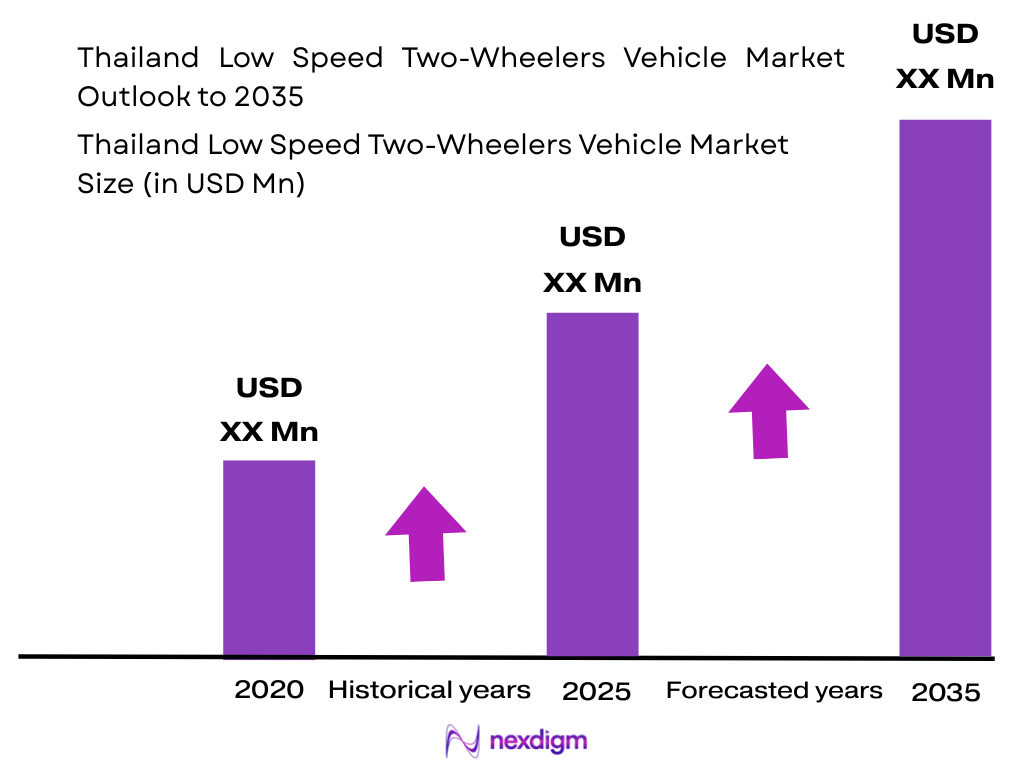
Market Size and Demand Drivers: The Thailand Low Speed Two-Wheelers Vehicle Market is valued at ~USD XX million, based on the requested placeholder market-sizing convention. Underlying two-wheeler demand remains substantial: national motorcycle sales moved from 1,856,814 units in the preceding annual period to 1,683,239 units in the subsequent period. Electric motorcycle registrations had already reached 21,904 units before the latest period, demonstrating a meaningful addressable base despite slower electrification than passenger cars.
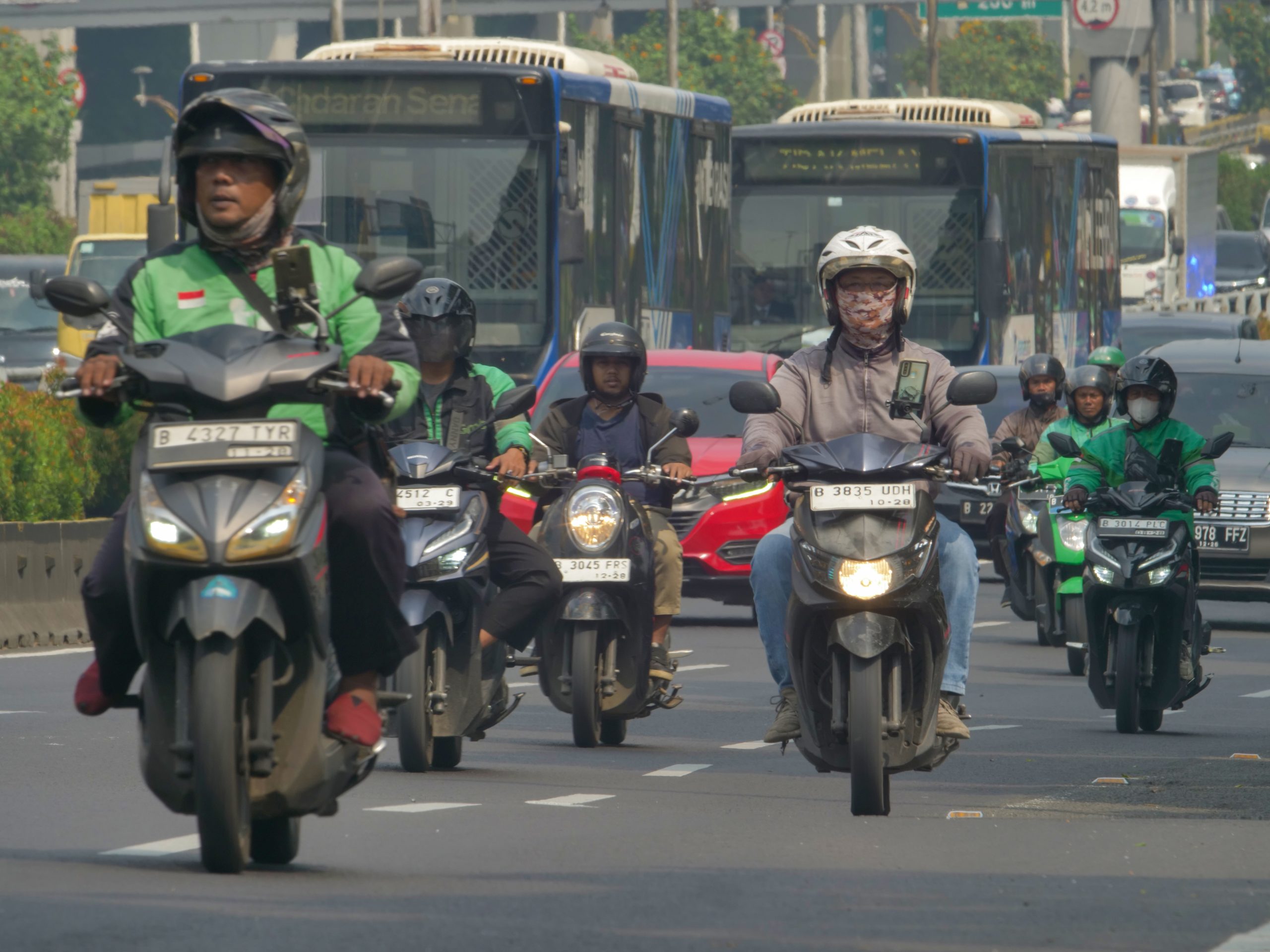
Dominant Cities and Demand Clusters: Bangkok and the surrounding Bangkok Metropolitan Region form Thailand’s primary low-speed electric two-wheeler demand cluster because of dense short-distance travel, motorcycle-taxi operations, food delivery, ride-hailing activity, dealer concentration and battery-swapping infrastructure. Bangkok has more than 4 million registered motorcycles, while the subsequent Bangkok International Motor Show generated 5,173 motorcycle bookings. Electrified motorcycle registrations are also disproportionately concentrated around Bangkok because charging and swapping infrastructure is substantially more developed there than in provincial markets.
Market Segmentation
By Vehicle Type
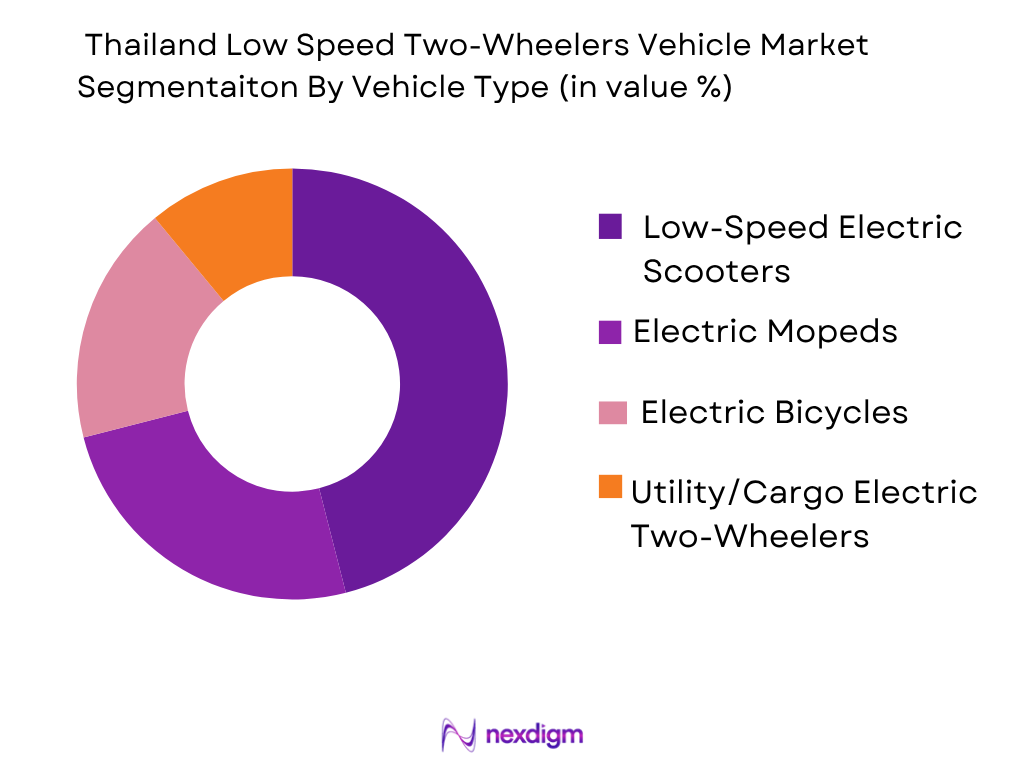
The Thailand Low Speed Two-Wheelers Vehicle Market is segmented by vehicle type into low-speed electric scooters, electric mopeds, electric bicycles and utility/cargo electric two-wheelers. Low-speed electric scooters are the dominant sub-segment because their step-through configuration, automatic electric drivetrain and compact dimensions closely match how Thai consumers already use commuter motorcycles. They are suitable for neighborhood travel, university commuting, food delivery and short urban journeys while requiring substantially less energy than full-performance motorcycles. The category also receives greater manufacturer attention, with domestic brands offering multiple scooter-style models incorporating removable lithium batteries, practical storage and urban-oriented range. Thailand’s incumbent motorcycle ecosystem further favors scooter-format adoption because consumers are already familiar with dealer-based vehicle purchasing, servicing and financing. Competition is consequently moving toward combinations of usable range, battery portability, lower monthly ownership cost and reliable service access rather than outright performance.
By End User
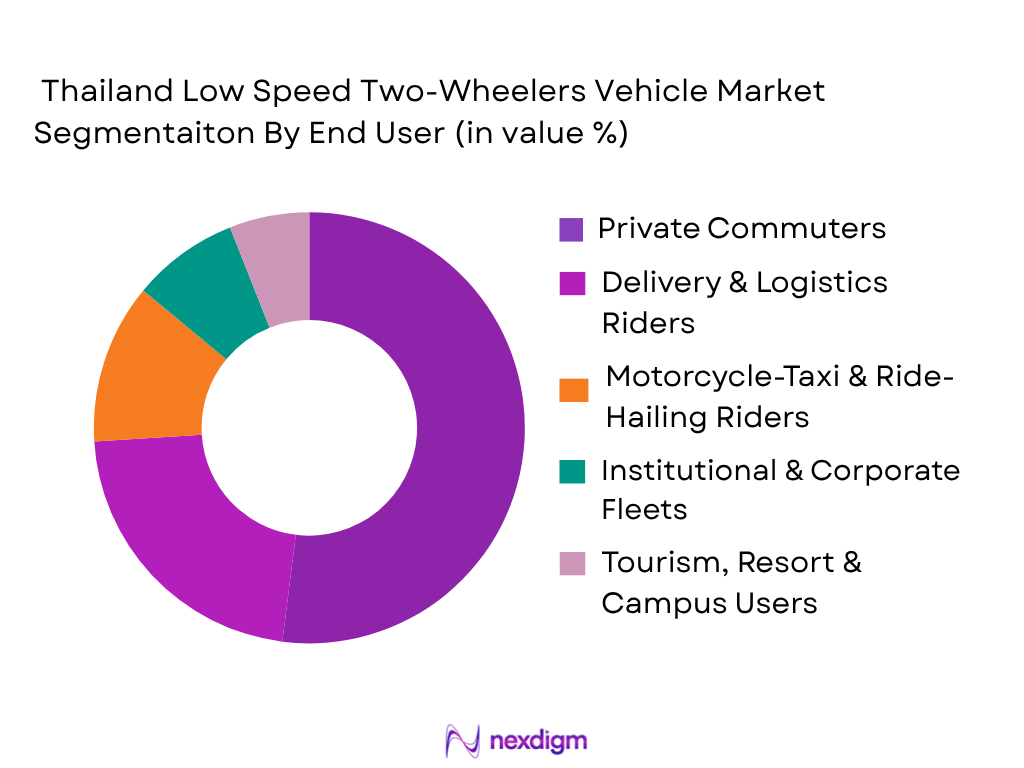
The Thailand Low Speed Two-Wheelers Vehicle Market is segmented by end user into private commuters, delivery/logistics riders, motorcycle-taxi and ride-hailing riders, institutional/corporate fleets, and tourism/campus users. Private commuters represent the dominant demand pool because Thailand already has an exceptionally large installed motorcycle base and two-wheelers remain a practical solution for short urban and suburban travel. Private buyers also have greater flexibility to charge removable batteries at home, reducing dependence on public infrastructure. However, delivery and commercial riders are strategically important because their higher daily mileage makes electricity savings more visible and improves the potential payback from switching away from petrol motorcycles. Bangkok is particularly relevant to commercial adoption because ride-hailing, motorcycle taxis and delivery services are concentrated there. Battery-swapping availability can further improve utilization by reducing charging downtime for high-mileage riders.
Competitive Landscape
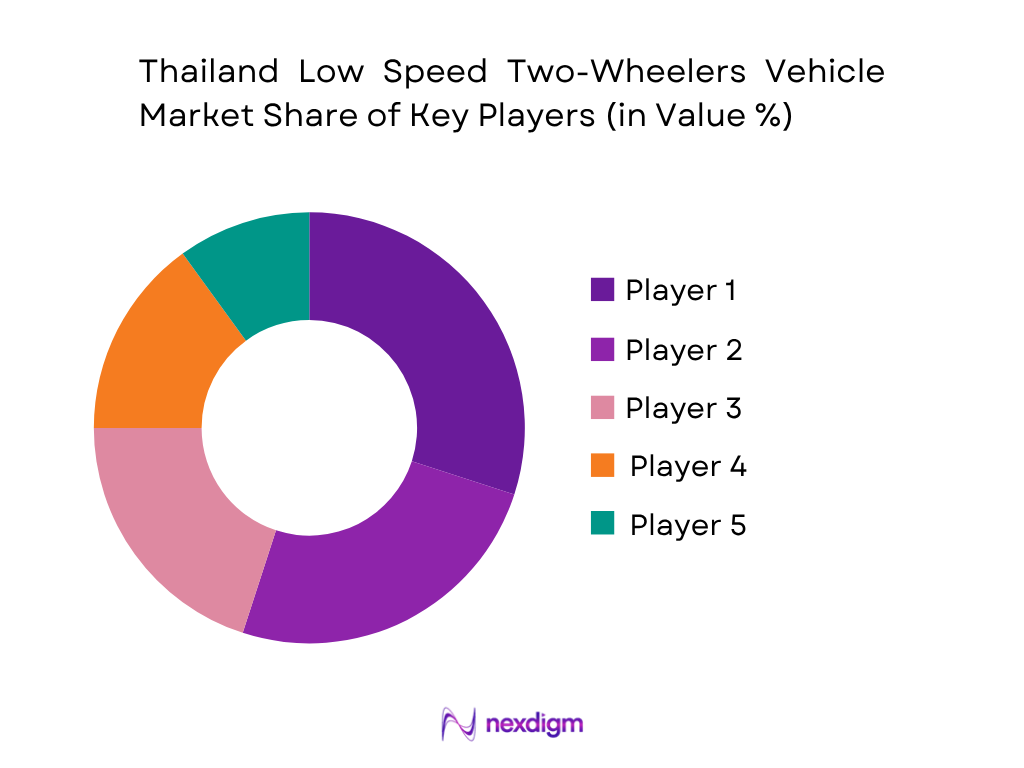
Thailand’s low-speed electric two-wheeler industry is fragmented between established motorcycle manufacturers and specialized Thai EV companies rather than being controlled by one established electric-motorcycle incumbent. Domestic specialists such as DECO, H SEM, SLEEK EV and STROM compete through locally relevant vehicle configurations, pricing and service models, while Thai Honda brings a substantially larger motorcycle manufacturing, distribution and brand ecosystem. Entry of established manufacturers can raise customer expectations for battery safety, financing, warranties and after-sales coverage.
| Player | Establishment | Headquarters |
Electric Two-Wheeler Focus
|
Battery Architecture
|
Low-Speed/Urban Relevance
|
Thailand Manufacturing
|
Distribution/Service Position
|
Commercial/Fleet Relevance
|
| Thai Honda Co., Ltd. | 2021 current entity; motorcycle production heritage since 1967 | Bangkok | ~
|
~
|
~
|
~
|
~
|
~
|
| DECO Green Energy Co., Ltd. | 2018 | Nakhon Pathom | ~
|
~
|
~
|
~
|
~
|
~
|
| H SEM Motor Co., Ltd. | 2016 | Ayutthaya | ~
|
~
|
~
|
~
|
~
|
~
|
| SLEEK EV | 2019 | Bangkok | ~
|
~
|
~
|
~
|
~
|
~
|
| STROM (Thailand) Co., Ltd. | 2015 operating history | Bangkok | ~
|
~
|
~
|
~
|
Thailand Low Speed Two-Wheelers Vehicle Market Analysis
Growth Drivers
Large Motorcycle Mobility Base Supporting Conversion to Low-Speed Electric Two-Wheelers
Thailand’s entrenched dependence on motorcycles creates a substantial operating base from which low-speed electric scooters, electric mopeds and other urban electric two-wheelers can gain adoption. The Federation of Thai Industries reported 1,683,239 motorcycles sold domestically in 2024, while national motorcycle production reached 1,887,208 units and completely built motorcycle exports reached 399,603 units. These figures demonstrate that two-wheelers are not a niche mobility category but an established part of Thailand’s transport and manufacturing ecosystem.
Expansion of the Electric-Mobility Ecosystem and Battery Infrastructure
Development of Thailand’s broader electric-vehicle ecosystem is strengthening the operating environment for low-speed electric two-wheelers by increasing access to batteries, charging infrastructure, manufacturing capability, technical expertise and electric-mobility services. The Thailand Board of Investment reported that the country had 71,900 electric motorcycles already operating on the road in its 2025 EV-sector update, alongside 203,000 battery-electric passenger cars, 3,800 electric buses and trucks, and 1,000 electric three-wheelers. This installed electric-vehicle base is important because infrastructure and supply-chain investments made for one electric vehicle category can support adjacent segments through battery technology development, electronics supply, technician training, charging-site development and greater familiarity with electric drivetrains. BOI reported 3,720 EV charging stations operating nationwide as of March 2025, containing 11,622 installed chargers, including 6,524 DC fast chargers. Electric motorcycles do not necessarily depend on automotive fast chargers because many low-speed vehicles use domestic charging, removable batteries or dedicated swapping systems; nevertheless, the scale of this infrastructure indicates that Thailand’s energy and mobility ecosystem is increasingly prepared for electric transport.
Market Challenges
Limited Electric Penetration within Thailand’s Very Large Conventional Motorcycle Base
The principal structural challenge for Thailand’s low-speed electric two-wheeler market is not the absence of motorcycle demand but the continued scale and familiarity of internal-combustion motorcycles. Department of Land Transport data reported by the Federation of Thai Industries show that 25,020 battery-electric motorcycles were newly registered in 2024, while the overall motorcycle ecosystem operates at a fundamentally different scale: the Federation of Thai Industries recorded 1,683,239 domestic motorcycle sales and 1,887,208 motorcycles produced during 2024. The imbalance remains visible in more recent monthly registrations. In January 2025, Thailand recorded 175,384 motorcycle registrations, of which 173,043 were internal-combustion motorcycles, compared with 2,263 battery-electric motorcycles and 78 hybrids. These absolute figures demonstrate the depth of the incumbent vehicle ecosystem that electric two-wheeler manufacturers must displace. Conventional motorcycles benefit from established consumer familiarity, dense servicing capabilities, readily available parts, mature dealer relationships and recognized vehicle-use patterns, whereas newer electric brands must establish confidence in battery reliability, after-sales continuity, replacement-part availability and long-term operational support. The broader economic environment makes these factors particularly significant. The IMF recorded Thailand’s population at 71.67 million, GDP per capita at USD 7,347 and the exchange rate at 35.29 baht per US dollar in 2024. The World Bank placed national GDP at USD 526.52 billion and GDP per capita at USD 7,346.6. These indicators describe a large consumer economy, but they also underline the importance of affordability, financing access and durable transportation assets for households and self-employed riders.
Infrastructure Concentration and the Need for a Dedicated Two-Wheeler Energy Network
Thailand’s electric-vehicle infrastructure is expanding, but low-speed two-wheelers face a distinct challenge because infrastructure designed primarily for passenger cars does not automatically solve the operating requirements of electric motorcycles and scooters. The Thailand Board of Investment reported 3,720 charging stations and 11,622 chargers operating nationwide as of March 2025, including 6,524 DC fast chargers. These numbers demonstrate substantial progress in national EV infrastructure, yet low-speed two-wheelers frequently rely on different charging architectures, including lower-power household charging, proprietary removable batteries and motorcycle-specific swap cabinets. Dedicated motorcycle infrastructure remains materially smaller: BOI identified 5 battery-swapping projects planned to establish 555 motorcycle battery-swapping stations. The difference between 11,622 general EV chargers and 555 planned motorcycle swap stations illustrates why two-wheeler electrification requires its own infrastructure planning rather than assuming that passenger-car charging deployment will provide universal coverage. This issue becomes more important as the electric motorcycle parc expands. BOI reported 71,900 electric motorcycles operating in Thailand in its 2025 sector update, while Department of Land Transport data recorded 25,020 new battery-electric motorcycle registrations during 2024 and another 2,263 in January 2025.
Market Opportunities
Electrification of Delivery, Ride-Hailing and Motorcycle-Taxi Mobility
Commercial urban mobility represents a strong future opportunity for Thailand’s low-speed two-wheeler market because electric motorcycles can be deployed into an already large two-wheeler transport ecosystem without requiring customers to adopt an entirely new mobility format. Thailand recorded 1,683,239 domestic motorcycle sales in 2024, while the Department of Land Transport recorded 25,020 new battery-electric motorcycle registrations during the same period. By the first month of 2025, another 2,263 battery-electric motorcycles were registered, confirming an active flow of electric vehicles into the road fleet. The commercial opportunity is strengthened by dedicated infrastructure development. The Thailand Board of Investment identified 5 motorcycle battery-swapping projects covering 555 planned stations, while the country already had 71,900 electric motorcycles on the road in BOI’s 2025 update. For delivery riders and motorcycle-taxi operators, swapping infrastructure can remove one of the operational constraints associated with plug-in charging because the energy system can be designed around repeated battery exchanges during a working day. Government action is becoming more explicitly aligned with this use case. The Bangkok Metropolitan Administration launched its “EV for Motorcycle Taxi Drivers” initiative in 2026, creating a public-sector pathway for demonstrating electric motorcycles under real commercial operating conditions. This is strategically important because motorcycle taxis and app-based riders operate in precisely the urban environment where low-speed electric vehicles are strongest: frequent short journeys, dense traffic, repeated stop-start operation and high vehicle utilization. Thailand’s macroeconomic profile reinforces the scale of the addressable mobility base. The IMF recorded a national population of 71.67 million, GDP per capita of USD 7,347, net foreign direct investment of USD 6.95 billion and an exchange rate of 35.29 baht per US dollar in 2024. The World Bank recorded national GDP at USD 526.52 billion. These indicators point to a sizeable economy with concentrated metropolitan commerce, logistics and service activity capable of supporting specialized two-wheeler fleets.
Localization of Electric Two-Wheeler Manufacturing, Batteries and Component Supply
Thailand’s established motorcycle manufacturing base creates an important opportunity to build low-speed electric two-wheelers domestically and deepen local production of batteries, power electronics, motors, chargers and vehicle components. The Federation of Thai Industries reported total motorcycle production of 1,887,208 units in 2024, together with 399,603 completely built motorcycle exports, demonstrating that Thailand already possesses manufacturing, assembly, quality-control, component-sourcing and export capabilities at substantial scale. The transition to electric two-wheelers can leverage this industrial foundation rather than developing a completely independent manufacturing ecosystem. Thailand’s Board of Investment stated in its 2025 EV-sector update that 27 companies participated in the EV3 program, including 11 electric motorcycle manufacturers and 16 manufacturers of electric passenger cars and pickup trucks.
Future Outlook
The Thailand Low Speed Two-Wheelers Vehicle Market is forecast to expand at approximately ~XX% CAGR during the forecast period specified for this report. Growth should progressively shift from early-adopter retail purchases toward mainstream commuter applications, last-mile delivery, motorcycle taxis and fleet procurement. The market’s trajectory will depend on purchase-price parity with internal-combustion motorcycles, wider financing availability, greater consumer confidence in battery life, localization of components and the density of charging and battery-swapping networks.
Major Players
- Thai Honda Co., Ltd.
- Thai Yamaha Motor Co., Ltd.
- H SEM Motor Co., Ltd.
- DECO Green Energy Co., Ltd.
- ETRAN Group
- SLEEK EV
- STROM Thailand
- Star 8 Thailand
- EM Motor Co., Ltd.
- i-Motor Manufacturing Co., Ltd.
- Toyotron Motor Co., Ltd.
- NIU Technologies
- Yadea Group Holdings Ltd.
- SUNRA
- Vmoto / Super Soco
Key Target Audience
- Electric Motorcycle, Electric Scooter and Electric Bicycle Manufacturers
- Two-Wheeler Distributors, Dealers and After-Sales Service Networks
- Battery Manufacturers, Battery-Pack Integrators and Battery-Swapping Operators
- Last-Mile Delivery, Ride-Hailing and Motorcycle-Taxi Fleet Operators
- Banks, Vehicle-Financing Companies, Leasing Companies and Insurers
- Investments and Venture Capitalist Firms
- Government and Regulatory Bodies (Department of Land Transport, Ministry of Transport; Thailand Board of Investment; Excise Department; Thai Industrial Standards Institute; National Electric Vehicle Policy Committee)
- Electric Motors, Controllers, Chargers, Telematics and Two-Wheeler Component Manufacturers
Research Methodology
Step 1: Identification of Key Variables
The research begins with construction of the Thailand Low Speed Two-Wheelers Vehicle Market ecosystem, covering OEMs, importers, assemblers, dealers, battery manufacturers, swapping operators, financiers, delivery platforms and regulatory bodies. Secondary research is used to identify critical variables including registrations, vehicle pricing, speed class, motor output, battery capacity, range, local production, charging architecture and geographic demand concentration.
Step 2: Market Analysis and Construction
Historical market performance is reconstructed using Department of Land Transport registrations, Federation of Thai Industries motorcycle statistics, government EV-program documentation and company-level information. A top-down approach narrows Thailand’s motorcycle market into the addressable electric and low-speed universe, while a bottom-up approach aggregates model availability, registration volumes, average selling prices, channel presence and fleet procurement to construct the market value and volume framework.
Step 3: Hypothesis Validation and Expert Consultation
Market hypotheses are validated through structured interviews with electric two-wheeler OEMs, dealers, fleet operators, battery suppliers, financing companies and battery-swapping providers. CATI and direct expert interviews are used to test assumptions surrounding vehicle utilization, achievable transaction prices, battery replacement cycles, range requirements, financing rejection rates, dealer throughput and commercial rider economics. Differences between registration data and actual retail activity are reconciled during this stage.
Step 4: Research Synthesis and Final Output
The final stage triangulates supply-side interviews with demand-side observations and official statistics. Brand- and model-level findings are reconciled against registrations, manufacturing activity, dealer checks, prices and fleet deployments. Forecast assumptions are then developed around electrification penetration, vehicle replacement, battery-cost evolution, financing availability, policy support, swapping infrastructure and commercial-fleet conversion, producing base, conservative and accelerated market-development scenarios.

- Executive Summary
- Research Methodology (Market Definition & Scope, Low-Speed Vehicle Classification, Electric Bicycle vs Electric Moped vs Electric Scooter Boundary, Top-Speed Bands, Motor-Power Bands, Registration Status, DLT Registration Data, OEM Sales Data, Dealer Checks, Import Data, Primary Interviews, Fleet Operator Interviews, Top-Down Market Sizing, Bottom-Up OEM/Model Build-Up, Vehicle Parc Reconciliation, ASP Build-Up, Demand-Side Assessment, Supply-Side Assessment, Data Triangulation, Forecasting Framework, Scenario Modelling, Limitations)

- Definition and Scope
- Market Evolution and Industry Genesis
- Evolution from Conventional Motorcycles and Bicycles to Low-Speed Electric Mobility
- Industry Development Milestones
- Low-Speed Two-Wheeler Ecosystem
- Industry Value Chain
- Supply Chain Structure
- Domestic Assembly and Import Dependency
- Role of Thailand in the ASEAN Electric Two-Wheeler Manufacturing Ecosystem
- Low-Speed Two-Wheeler vs Conventional ICE Motorcycle Positioning

- Growth Drivers (High Motorcycle Dependency, Urban Congestion, Short-Distance Commuting, Lower Electric Running Cost, Growth of Delivery Platforms, EV Incentives, Battery-Swap Expansion, Domestic EV Manufacturing)
- Market Challenges (Vehicle Purchase-Price Gap, Battery Replacement Cost, Limited Residual-Value History, Consumer Credit Constraints, Charging Coverage, Battery-Swap Fragmentation, Brand Longevity Concerns, Spare-Parts Availability)
- Market Opportunities (Delivery Fleet Electrification, Motorcycle-Taxi Electrification, Affordable Urban Scooters, Battery-as-a-Service, Interoperable Swapping, Local Component Manufacturing, Fleet Leasing, Tourism and Campus Mobility)
- Market Trends (Removable Lithium Batteries, Smart Connected Scooters, Battery Swapping, Subscription Models, Fleet-Oriented Vehicles, Local Assembly, Longer Range, Connected Fleet Management)
- SWOT Analysis
- Porter’s Five Forces Analysis
- PESTLE Analysis
- Stakeholder Ecosystem
- Competition Ecosystem

- By Market Value (2020-2025)
- By New Vehicle Sales Volume (2020-2025)
- By Registered Vehicle Volume (2020-2025)
- By Estimated Non-Registered Low-Speed Vehicle Volume (2020-2025)
- By Installed Vehicle Parc (2020-2025)
- By Average Selling Price (2020-2025)

- By Vehicle Type (In Value %)
Pedal-Assisted Electric Bicycles
Throttle Electric Bicycles
Low-Speed Electric Mopeds
Low-Speed Electric Scooters
Utility and Cargo Electric Two-Wheelers
Delivery-Oriented Electric Two-Wheelers - By Maximum Speed Band (In Value %)
Up to 25 km/h
26–35 km/h
36–45 km/h
46–60 km/h - By Motor Power Band (In Value %)
Up to 0.25 kW
Above 0.25 kW–1 kW
Above 1 kW–2 kW
Above 2 kW–3 kW
Above 3 kW - By Price Band (In Value %)
Entry-Level
Mass-Market
Mid-Premium
Premium - By End User (In Value %)
Private Commuters
Students and Young Riders
Household / Neighborhood Mobility Users
Food Delivery Riders
Parcel and E-Commerce Delivery Riders
Motorcycle-Taxi/Passenger Mobility Riders
Corporate and Institutional Fleets
Tourism, Resort and Hospitality Operators - By Geographic Market (In Value %)
Bangkok Metropolitan Region
Central Thailand
Eastern Thailand and Eastern Economic Corridor
Northern Thailand
Northeastern Thailand
Southern Thailand

- Market Share of Major Players
- Market Share by Vehicle Type (Electric Bicycle, Low-Speed Moped, Electric Scooter, Utility/Delivery Two-Wheeler)
- Competitive Positioning Matrix (Price, Range, Motor Power, Brand Strength, Distribution Reach)
- Cross Comparison Parameters (Product & Speed-Class Coverage, Rated/Peak Motor Power, Battery Chemistry & Usable Capacity, Real-World/Claimed Range, Charging & Battery-Swap Architecture, Ex-Showroom Price & Monthly Financing, Dealer & Service Network Reach, Fleet/B2B Capability)
- Pricing Benchmarking (Entry Price, Median Price, Flagship Price, Financing)
- Detailed Profiles of Major Companies
Thai Honda Co., Ltd.
Thai Yamaha Motor Co., Ltd.
H SEM Motor Co., Ltd.
Deco Green Energy Co., Ltd.
ETRAN Group
SLEEK EV
STROM Thailand
Star 8 Thailand
EM Motor Co., Ltd.
i-Motor Manufacturing Co., Ltd.
Toyotron Motor Co., Ltd.
NIU Technologies
Yadea Group Holdings Ltd.
SUNRA
Vmoto / Super Soco

- Buyer Demographic Analysis
- Purchase Decision Criteria
- Purchase Budget and Willingness-to-Pay
- Range Requirement Assessment
- Charging Behaviour
- Brand Awareness and Consideration Funnel
- Purchase Channel Behaviour
- Consumer Pain Points
- Product Attribute Preference
- Brand Loyalty and Switching Behaviour

- By Market Value (2026-2035)
- By New Vehicle Sales Volume (2026-2035)
- By Registered Vehicle Volume (2026-2035)
- By Estimated Non-Registered Low-Speed Vehicle Volume (2026-2035)
- By Installed Vehicle Parc (2026-2035)
- By Average Selling Price (2026-2035)


 Request a Sample
 Ask for Customization
 Get a Quote
 Enquire Now