

 Download PDF
Market Overview
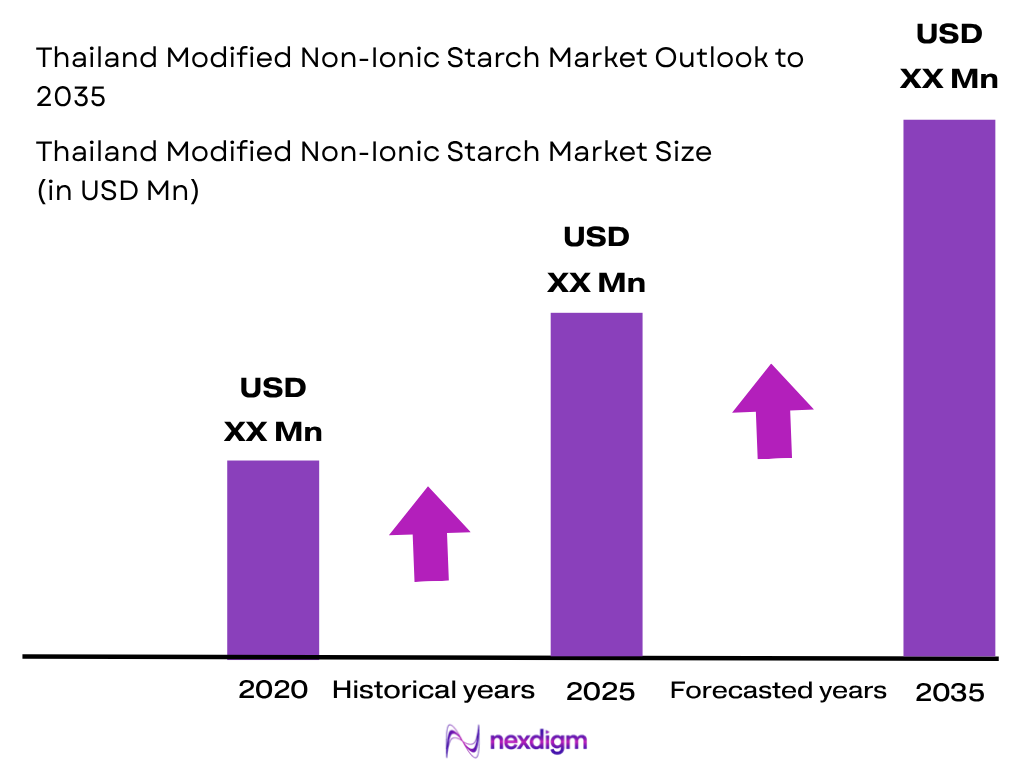
The Thailand Modified Non-Ionic Starch Market is valued at ~USD XX billion, supported by the country’s strong cassava-based starch ecosystem, expanding food processing sector, and rising demand for functional ingredients. The market growth is driven by applications across instant foods, bakery products, sauces, dairy products, pharmaceuticals, and industrial adhesives. Thailand produced approximately XX million tons of cassava in 2023 and maintained its position as one of the largest cassava producers globally. The expansion of processed food exports and specialty ingredient applications continues to support modified starch adoption among manufacturers.
Thailand’s modified non-ionic starch industry is concentrated around cassava-producing and industrial processing regions including Nakhon Ratchasima, Kamphaeng Phet, Chaiyaphum, and Bangkok. Nakhon Ratchasima and Chaiyaphum dominate due to their strong cassava cultivation base and availability of starch processing facilities, while Bangkok acts as the primary commercial hub due to its concentration of food manufacturers, pharmaceutical companies, exporters, and industrial users. Thailand maintains global importance in starch production because of its developed agricultural supply chain, export-oriented food manufacturing industry, and established tapioca processing infrastructure.
Market Segmentation
By Raw Material Source
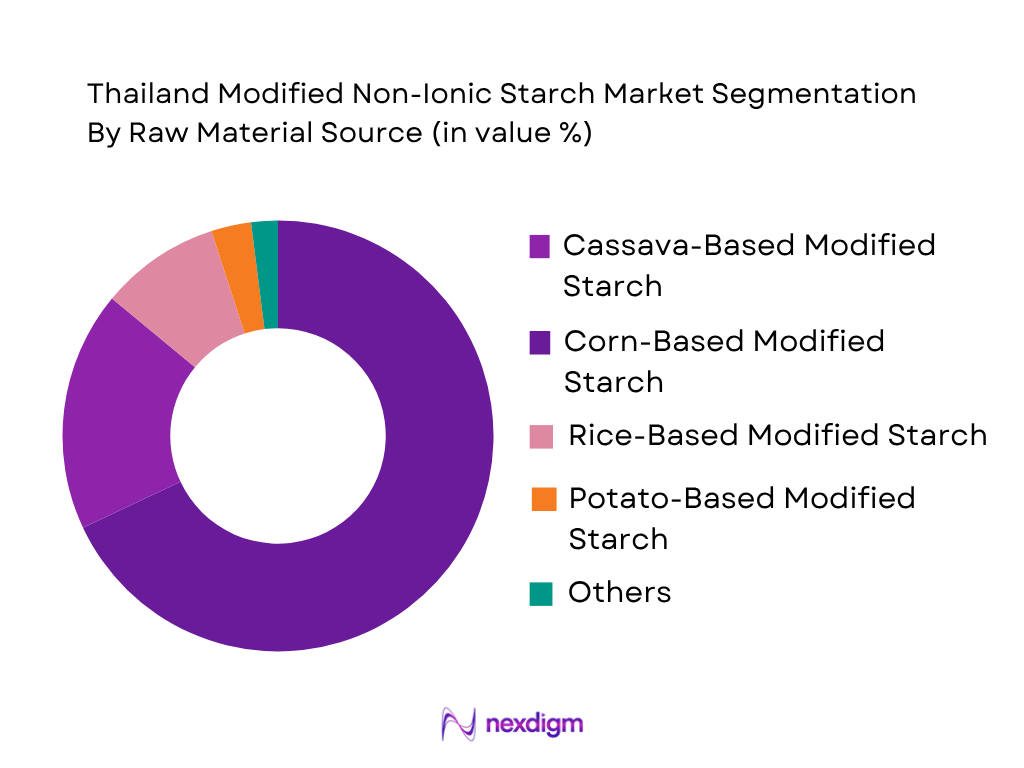
Thailand Modified Non-Ionic Starch Market is segmented by raw material source into cassava-based modified starch, corn-based modified starch, rice-based modified starch, potato-based modified starch, and other agricultural sources. Cassava-based modified starch holds a dominant market share due to Thailand’s established cassava cultivation ecosystem, large-scale tapioca processing capacity, and strong availability of cassava starch feedstock. Thailand is among the leading global producers and exporters of cassava products, providing manufacturers with a reliable raw material base for modified starch production. Cassava starch offers desirable characteristics including high viscosity, neutral flavor, and processing flexibility, making it suitable for food, pharmaceutical, and industrial applications. The availability of integrated cassava farming, starch extraction facilities, and export infrastructure further strengthens the dominance of cassava-based modified starch in the Thailand market.
By Application Industry
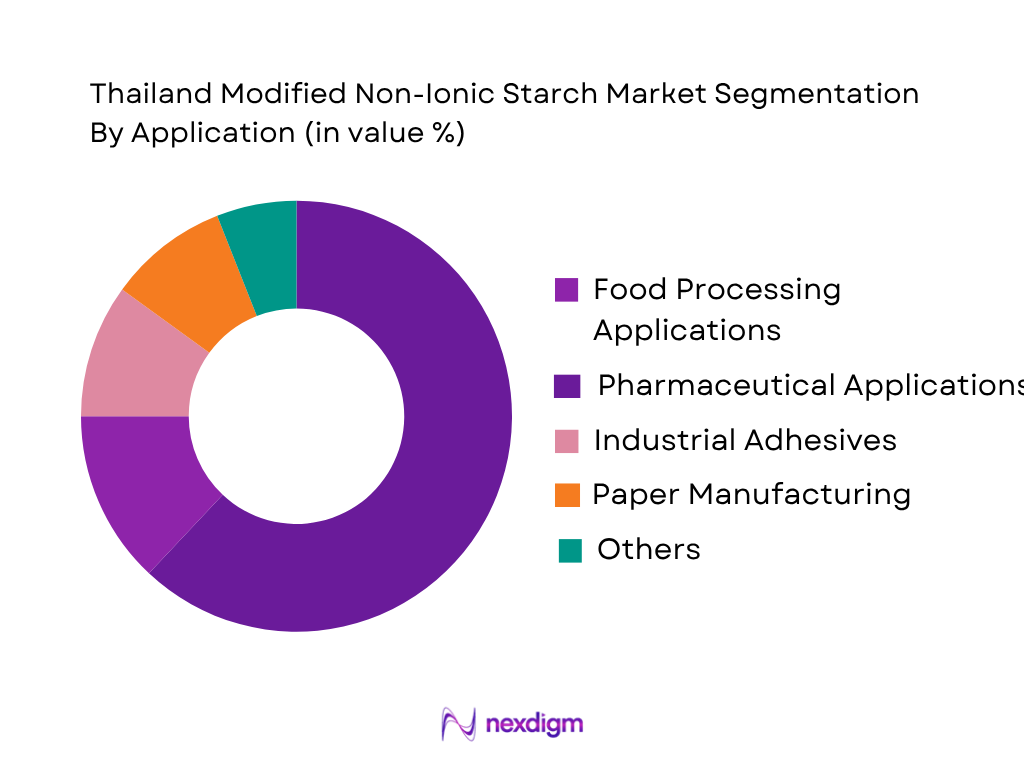
Thailand Modified Non-Ionic Starch Market is segmented by application industry into food and beverage processing, pharmaceutical applications, industrial adhesives, paper manufacturing, and textile processing. Food and beverage processing represents the dominant segment due to Thailand’s extensive processed food manufacturing industry and high consumption of convenience foods. Modified starch is widely used in sauces, instant noodles, bakery products, frozen foods, and dairy applications because of its ability to improve stability, texture, and shelf life. Thailand’s export-oriented food manufacturing sector has increased demand for functional ingredients that enhance product quality during transportation and storage. The growth of ready-to-eat meals, processed seafood, confectionery products, and beverage formulations has further supported modified starch adoption among food manufacturers.
Competitive Landscape
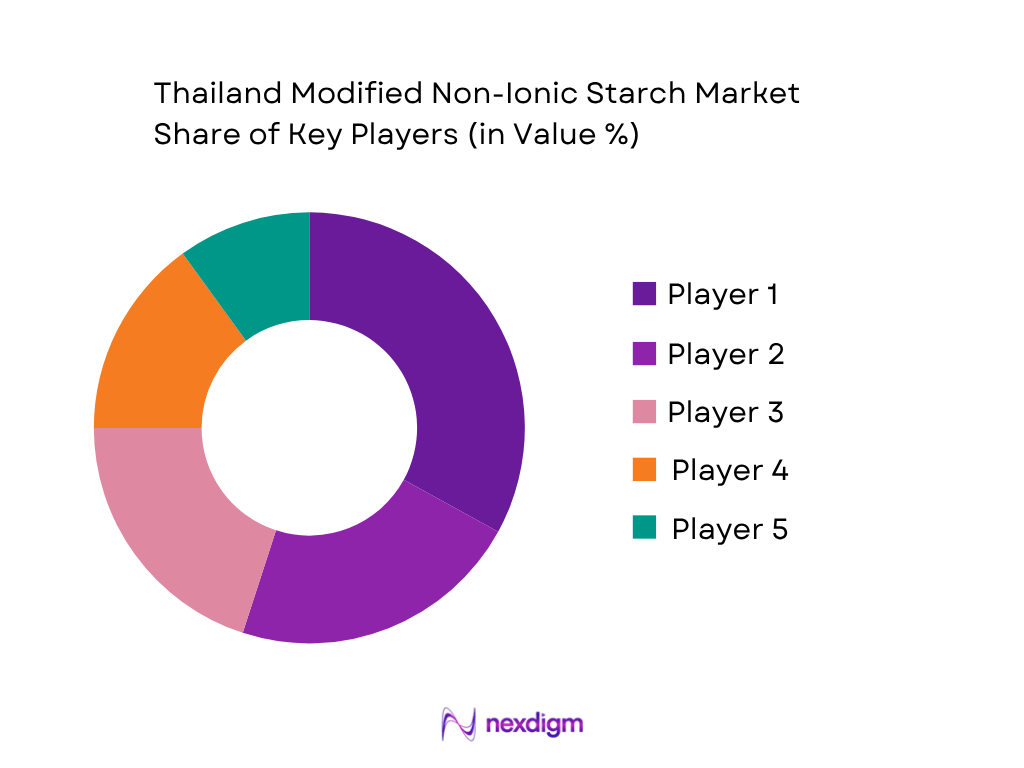
The Thailand Modified Non-Ionic Starch Market is characterized by the presence of global ingredient manufacturers, regional starch processors, and domestic cassava-based producers. The competitive environment includes companies focusing on specialty starch development, customized formulation solutions, food-grade applications, and export-oriented production. Major players compete through product innovation, processing technology, raw material integration, application expertise, and supply chain capabilities.
| Company | Establishment Year | Headquarters | Cassava Processing Capability | Product Portfolio | Major Applications | Export Presence | R&D Capability |
| Thai Wah Public Company Limited | 1947 | Thailand | ~ | ~ | ~ | ~ | ~ |
| Asia Modified Starch Co., Ltd. | 1985 | Thailand | ~ | ~ | ~ | ~ | ~ |
| Ingredion Incorporated | 1906 | USA | ~ | ~ | ~ | ~ | ~ |
| Cargill Incorporated | 1865 | USA | ~ | ~ | ~ | ~ | ~ |
| Roquette | 1933 | France | ~ | ~ | ~ | ~ | ~ |
Thailand Modified Non-Ionic Starch Market Analysis
Growth Drivers
Expansion of Cassava Processing Industry
The Thailand Modified Non-Ionic Starch Market is strongly supported by the country’s established cassava processing industry, which provides a reliable agricultural base for specialty starch manufacturing. Thailand produced approximately 30 million metric tons of cassava roots in 2024, according to agricultural production data from the Thai Office of Agricultural Economics, supporting domestic starch extraction and value-added processing activities. The country remains one of the world’s largest exporters of cassava products, with cassava chips, pellets, and starch contributing significantly to agricultural trade. The World Bank reported that Thailand’s agriculture sector continues to play an important role in rural employment and economic activity, supporting industries connected with agricultural processing. Cassava-based modified starch manufacturers benefit from established farmer networks, processing facilities, and export infrastructure concentrated in provinces such as Nakhon Ratchasima, Kamphaeng Phet, and Chaiyaphum. Increasing demand from food manufacturers for stabilizers, thickeners, and texture-enhancing ingredients is encouraging processors to shift from conventional starch production toward higher-value modified starch applications. The expansion of cassava utilization in food, pharmaceutical, and industrial formulations is strengthening the position of Thailand as a regional starch processing hub.
Growth of Food Processing Manufacturing
The Thailand Modified Non-Ionic Starch Market is driven by the continued expansion of the country’s food processing manufacturing sector, where modified starch is widely used in processed foods, beverages, bakery products, sauces, and convenience foods. Thailand’s food industry benefits from its position as a major food exporter, supported by extensive agricultural resources and developed manufacturing infrastructure. The World Bank reported that Thailand’s GDP reached approximately USD 526 billion in 2023, reflecting the scale of economic activity supporting industrial sectors, including food manufacturing. The Ministry of Industry of Thailand has identified food processing as a key manufacturing sector due to its contribution to exports and domestic consumption. Modified starch adoption is increasing among manufacturers producing instant noodles, frozen foods, dairy products, and ready-to-eat meals because of its ability to improve stability, texture, and shelf-life performance. Thailand exported agricultural and food products valued at more than USD 40 billion in 2024, highlighting strong demand for ingredients that improve product quality during transportation and storage. Growth in processed food manufacturing is expected to continue supporting demand for advanced starch solutions.
Market Challenges
Dependence on Agricultural Feedstock Availability
The Thailand Modified Non-Ionic Starch Market faces challenges associated with dependence on agricultural feedstock availability, particularly cassava supply fluctuations caused by climate conditions, farming cycles, and competing agricultural demand. Thailand’s cassava industry depends heavily on seasonal cultivation patterns, with production affected by rainfall conditions and agricultural input availability. The Thai Office of Agricultural Economics reported cassava cultivation across millions of rai of agricultural land, making the crop an important component of Thailand’s agricultural economy. However, weather variability and changing agricultural conditions can influence root quality, starch content, and processing efficiency. The World Bank has highlighted climate-related risks affecting agricultural productivity across Southeast Asia, including Thailand, where extreme weather events can impact crop output. For modified starch manufacturers, fluctuations in cassava availability create challenges in maintaining consistent raw material quality and production planning. Higher competition between food, animal feed, and industrial applications for agricultural resources can also affect procurement strategies. Manufacturers increasingly require diversified sourcing networks, improved farmer relationships, and advanced inventory management systems to reduce supply uncertainty and maintain consistent modified starch production.
Dependence on Imported Modification Technologies
The Thailand Modified Non-Ionic Starch Market experiences challenges due to dependence on advanced modification technologies, specialized equipment, and technical expertise required for producing high-performance starch products. While Thailand has a strong conventional starch processing industry, advanced modification processes involving cross-linking, esterification, and functional enhancement require specialized technology and continuous research capabilities. The World Intellectual Property Organization reported that Thailand recorded more than 10,000 patent applications annually in recent years, but advanced industrial food technology development remains concentrated among larger companies and international technology providers. Modified starch manufacturers must invest in specialized processing equipment, quality control systems, and technical expertise to meet requirements from food, pharmaceutical, and industrial customers. Regulatory requirements from the Thai Food and Drug Administration and international export markets also increase compliance complexity. Smaller processors face barriers in adopting advanced modification technologies due to capital requirements and limited technical resources. Dependence on imported technology solutions can influence production flexibility and slow the development of customized starch products for emerging applications.
Market Opportunities
Cassava-Based Specialty Modified Starch Development
The Thailand Modified Non-Ionic Starch Market has significant opportunities through the development of cassava-based specialty modified starch products targeting high-value applications. Thailand’s strong cassava production ecosystem provides manufacturers with access to locally available raw materials for developing customized starch solutions for food, pharmaceutical, and industrial users. The Thai Office of Agricultural Economics reported cassava production of approximately 30 million metric tons in 2024, creating a substantial feedstock base for value-added starch processing. Specialty cassava starch products can support growing demand for clean-label ingredients, gluten-free formulations, and plant-based food solutions. Thailand’s food export industry, which recorded agricultural and food product exports exceeding USD 40 billion in 2024, creates opportunities for ingredient manufacturers supplying domestic processors and international markets. Modified cassava starch can improve texture, stability, and processing performance in products such as sauces, instant foods, beverages, and bakery items. Investment in advanced modification facilities and application-focused research can help Thailand move from conventional starch production toward specialty ingredient manufacturing, strengthening export competitiveness and supporting future demand from regional food manufacturers.
Plant-Based Food Applications
The Thailand Modified Non-Ionic Starch Market can benefit from increasing adoption of plant-based food applications, where starch ingredients play an important role in improving texture, stability, and product performance. Growth in plant-based foods, alternative proteins, and functional food products is encouraging manufacturers to seek renewable ingredient solutions derived from agricultural sources. Thailand’s agricultural sector provides access to plant-based raw materials, including cassava, rice, and corn, supporting ingredient innovation. The World Bank reported that Thailand’s population exceeded 71 million people in 2024, creating a substantial domestic consumer base for evolving food categories. Food manufacturers are increasingly developing products requiring improved mouthfeel, binding properties, and processing stability, creating opportunities for modified starch applications. Plant-based starch solutions are particularly relevant for dairy alternatives, gluten-free products, vegetarian foods, and functional beverages. Thailand’s established food manufacturing infrastructure and export-oriented production capabilities provide opportunities for local ingredient suppliers to develop specialized starch formulations aligned with international food trends. Sustainable processing methods and renewable agricultural sourcing can further strengthen demand for advanced modified starch solutions across domestic and export markets.
Future Outlook
Over the next decade, the Thailand Modified Non-Ionic Starch Market is expected to experience steady expansion driven by increasing demand for functional food ingredients, growth of processed food exports, and rising adoption of sustainable starch solutions. The market will benefit from Thailand’s strong cassava production base, development of specialty starch technologies, and increasing applications across food, pharmaceutical, and industrial sectors. Manufacturers are expected to focus on clean-label ingredients, customized starch formulations, and advanced modification technologies to meet evolving end-user requirements.
Major Players
- Thai Wah Public Company Limited
- Asia Modified Starch Co., Ltd.
- Ingredion Incorporated
- Cargill Incorporated
- Roquette
- Tate & Lyle PLC
- Archer Daniels Midland Company
- Avebe
- Emsland Group
- KMC Ingredients
- Global Bio-Chem Technology Group
- SPAC Starch Products (Thailand)
- Chol Charoen Group
- PT Sorini Agro Asia Corporindo
- National Starch and Chemical Company
Key Target Audience
- Food and beverage manufacturers
- Pharmaceutical ingredient manufacturers
- Industrial adhesive producers
- Paper and textile processing companies
- Starch processing and agricultural companies
- Investments and venture capitalist firms
- Government and regulatory bodies (Thai Food and Drug Administration, Ministry of Agriculture and Cooperatives, Ministry of Industry Thailand)
- Ingredient distributors and specialty chemical suppliers
Research Methodology
Step 1: Identification of Key Variables
The initial phase involves developing an ecosystem map covering cassava producers, starch processors, food manufacturers, pharmaceutical companies, industrial users, and distribution partners operating within the Thailand Modified Non-Ionic Starch Market. Extensive secondary research is conducted to identify market drivers, supply chain structures, application segments, and industry variables influencing market development.
Step 2: Market Analysis and Construction
This stage focuses on analyzing historical market patterns, production trends, consumption behaviour, application demand, and trade dynamics related to modified starch products. Supply-side evaluation includes assessment of starch manufacturers, processing capabilities, raw material availability, and end-user adoption across industries.
Step 3: Hypothesis Validation and Expert Consultation
Market assumptions are validated through discussions with industry participants including starch manufacturers, food processors, pharmaceutical companies, and industrial users. These consultations provide operational insights regarding product demand, technology adoption, customer preferences, and competitive developments.
Step 4: Research Synthesis and Final Output
The final phase integrates quantitative and qualitative findings from primary and secondary research. Data validation is performed through triangulation of supply-side information, demand-side analysis, industry interviews, and application-level assessments to provide a comprehensive Thailand Modified Non-Ionic Starch Market outlook.

- Executive Summary
- Research Methodology (Market Definitions and Scope, Market Segmentation Framework, Market Sizing Approach, Top-Down Analysis, Bottom-Up Analysis, Demand-Side Assessment, Supply-Side Assessment, Primary Industry Interviews, Value Chain Mapping, Data Validation Framework, Forecasting Methodology, Market Limitations and Assumptions)

- Definition and Scope
- Market Evolution and Development of Modified Starch Industry
- Historical Development of Thailand Starch Processing Industry
- Major Industry Milestones and Technological Advancements
- Modified Non-Ionic Starch Manufacturing Ecosystem
- Thailand Modified Starch Value Chain Analysis

- Growth Drivers (Expansion of Cassava Processing Industry, Growth of Food Processing Manufacturing, Increasing Demand for Functional Food Ingredients, Expansion of Instant Food Production, Rising Bakery and Confectionery Manufacturing, Growth of Pharmaceutical Production, Increasing Export-Oriented Food Manufacturing, Demand for Clean Label Ingredients, Rising Industrial Adhesive Consumption)
- Market Challenges (Dependence on Agricultural Feedstock Availability, Cassava Supply Fluctuation, Competition from Native Starch Products, Dependence on Imported Modification Technologies, Regulatory Compliance Requirements, Processing Technology Constraints, Raw Material Quality Variation, Supply Chain Disruptions)
- Market Opportunities (Cassava-Based Specialty Modified Starch Development, Clean Label Ingredient Innovation, Plant-Based Food Applications, Pharmaceutical Excipient Expansion, Gluten-Free Food Development, Sustainable Starch Processing, Functional Beverage Applications, Export-Oriented Ingredient Manufacturing, Specialty Industrial Adhesive Applications)
- Market Trends (Clean Label Starch Solutions, Increasing Cassava-Based Ingredient Adoption, Plant-Based Food Formulation Growth, Functional Food Ingredient Innovation, Sustainable Processing Technologies, Customized Modified Starch Development, Advanced Food Texture Engineering, High-Performance Industrial Starch Applications)
- Government Regulations (Thai Food and Drug Administration Food Ingredient Regulations, Food Additive Standards, Import and Export Compliance Requirements, Agricultural Product Quality Standards, Industrial Manufacturing Regulations, Pharmaceutical Excipient Requirements, Food Safety Management Standards)
- SWOT Analysis
- Porter’s Five Forces Analysis
- PESTLE Analysis

- By Market Value (2020-2025)
- By Consumption Volume (2020-2025)
- By Production Volume (2020-2025)
- By Domestic Consumption (2020-2025)
- By Import and Export Volume (2020-2025)
- By Average Selling Price (2020-2025)

- By Modification Type (In Value %)
Hydroxypropyl Starch
Acetylated Starch
Cross-Linked Starch
Oxidized Starch
Pregelatinized Starch
Cationic Starch
Dual Modified Starch
Other Specialty Modified Starch - By Raw Material Source (In Value %)
Cassava-Based Modified Starch
Corn-Based Modified Starch
Rice-Based Modified Starch
Potato-Based Modified Starch
Other Agricultural Feedstock-Based Starch - By Application Industry (In Value %)
Food and Beverage Industry
Bakery and Confectionery Applications
Instant Noodles and Convenience Foods
Sauces, Dressings and Processed Foods
Dairy and Frozen Food Applications
Pharmaceutical Applications
Industrial Adhesive Applications
Paper Manufacturing Applications
Textile Processing Applications - By Functional Property (In Value %)
Thickening Agents
Stabilizers
Emulsification Agents
Texture Enhancers
Binding Agents
Film-Forming Agents
Moisture Retention Solutions - By Distribution Channel (In Value %)
Direct Industrial Sales
Ingredient Distributors
Food Processing Suppliers
Pharmaceutical Ingredient Suppliers
Online B2B Platforms

- Market Share Analysis of Major Players (By Revenue, Product Category, Application Segment, Customer Industry, Distribution Channel)
- Cross Comparison Parameters (Product Portfolio Breadth, Modified Starch Product Range, Cassava Processing Capability, Production Capacity, Application-Specific Solutions, Export Market Presence, Research and Development Capability, Customer Industry Coverage)
- Detailed Profiles of Major Companies
Roquette
Cargill
Ingredion
Tate & Lyle
Archer Daniels Midland Company
Asia Modified Starch Co., Ltd.
Thai Wah Public Company Limited
Chol Charoen Group
Sunshine Biotech International
Emsland Group
Avebe
KMC Ingredients
Global Bio-Chem Technology Group
PT Sorini Agro Asia Corporindo
SPAC Starch Products (Thailand)

- Food Processing Industry Assessment
- Bakery and Confectionery Industry Analysis
- Instant Food Manufacturing Assessment
- Pharmaceutical Industry Assessment
- Industrial User Analysis
- Purchasing Decision Analysis

- By Market Value (2026-2035)
- By Consumption Volume (2026-2035)
- By Production Volume (2026-2035)
- By Domestic Consumption (2026-2035)
- By Import and Export Volume (2026-2035)
- By Average Selling Price (2026-2035)


 Request a Sample
 Ask for Customization
 Get a Quote
 Enquire Now