
 Download PDF
Market Overview
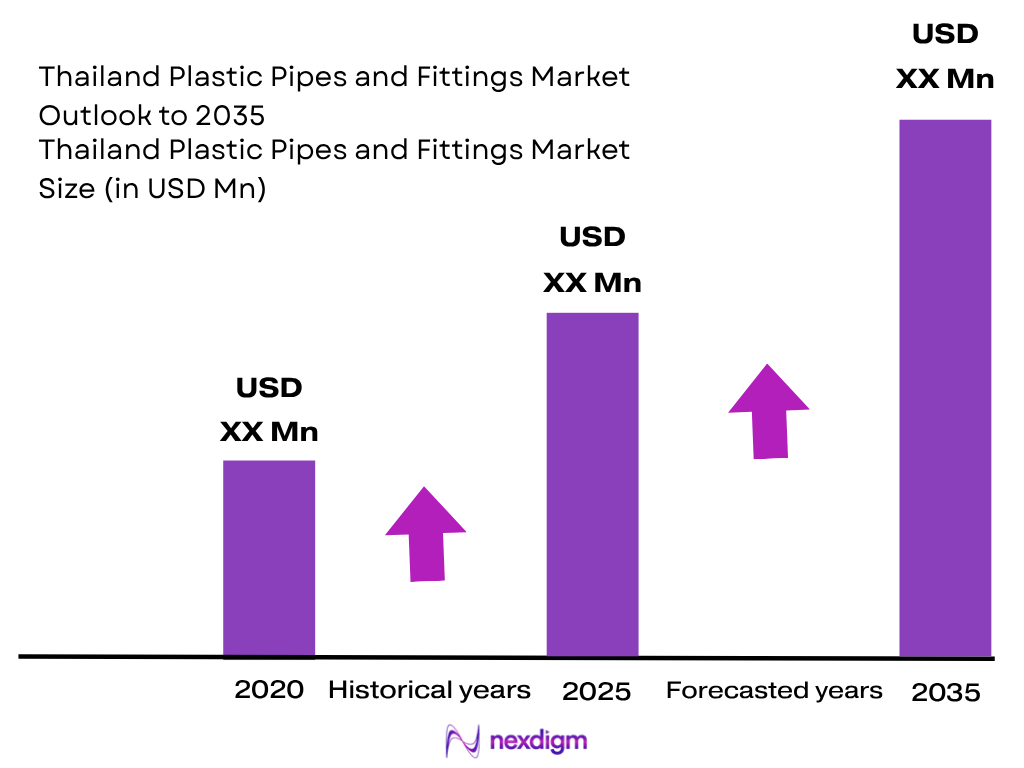
The Thailand Plastic Pipes and Fittings Market is valued at approximately USD ~ billion in 2024, supported by continuous demand from residential construction, municipal water management, industrial infrastructure, irrigation networks, and replacement of traditional metal piping systems. The market expansion is driven by increasing adoption of PVC, HDPE, PPR, and CPVC piping solutions due to their corrosion resistance, lightweight characteristics, longer service life, and installation efficiency. Thailand’s construction sector remains a major demand contributor, with the country recording construction investment of approximately THB ~ trillion, supported by infrastructure development, urban housing projects, and industrial expansion.
The Thailand Plastic Pipes and Fittings Market is concentrated around major economic and industrial regions including Bangkok, Chonburi, Rayong, Samut Prakan, and Chiang Mai due to their high construction activity, industrial development, and infrastructure modernization requirements. Bangkok remains a major consumption center because of extensive residential buildings, commercial complexes, water supply networks, and urban redevelopment projects. Eastern Economic Corridor (EEC) provinces such as Chonburi and Rayong contribute significantly due to industrial estates, petrochemical facilities, manufacturing plants, and logistics infrastructure requiring advanced piping systems. Agricultural provinces also generate demand through irrigation and water management applications.
Market Segmentation
By Material Type
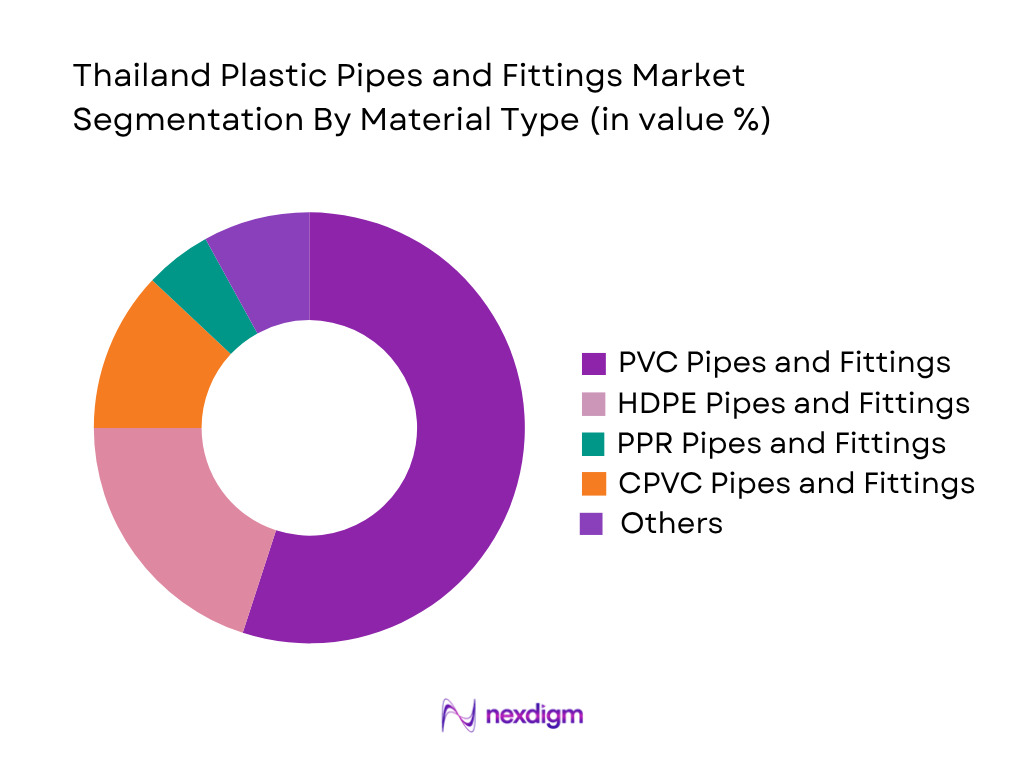
Thailand Plastic Pipes and Fittings Market is segmented by material type into PVC Pipes and Fittings, HDPE Pipes and Fittings, PPR Pipes and Fittings, CPVC Pipes and Fittings, PEX Pipes and Fittings, ABS Pipes and Fittings, and Specialty Thermoplastic Pipes. Among these, PVC Pipes and Fittings represent the dominant segment due to extensive utilization across residential plumbing, municipal water distribution, drainage systems, and construction applications. PVC systems are preferred because of their cost efficiency, availability of domestic manufacturing capacity, compatibility with Thailand’s tropical climate conditions, and established contractor familiarity. HDPE is gaining adoption in infrastructure projects, industrial applications, and water transmission systems due to its flexibility and durability, while PPR continues expanding in residential and commercial hot-water plumbing installations.
By Application Type
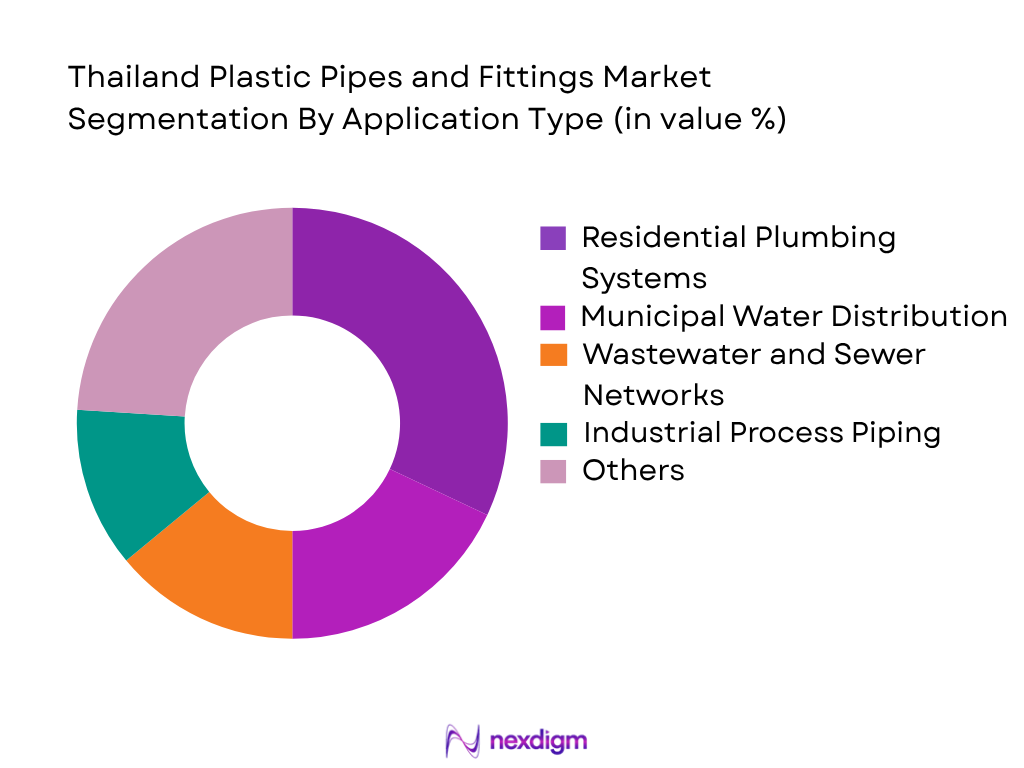
Thailand Plastic Pipes and Fittings Market is segmented by application into Residential Plumbing Systems, Municipal Water Distribution, Wastewater and Sewer Networks, Industrial Process Piping, Agricultural Irrigation Systems, Commercial Buildings, Electrical Conduit Systems, Telecommunication Ducting, and Fire Protection Systems. The residential plumbing segment dominates the market due to continuous housing development, urban migration, renovation activities, and replacement of conventional metal piping systems. Thailand’s growing urban population and expansion of condominium projects, housing estates, and commercial developments support demand for reliable plumbing solutions. Municipal water and wastewater applications remain another significant segment due to government focus on improving water infrastructure and expanding utility networks. Industrial applications are supported by manufacturing zones, petrochemical facilities, food processing industries, and electronics production centers requiring specialized plastic piping solutions.
Competitive Landscape
The Thailand Plastic Pipes and Fittings Market consists of domestic manufacturers and international companies supplying PVC, HDPE, PPR, and specialty piping solutions. Competition is influenced by manufacturing capacity, product certification, distribution reach, contractor relationships, and ability to supply large infrastructure projects. Domestic companies maintain strong positions through established dealer networks and localized production capabilities, while global manufacturers compete through advanced piping technologies and specialized industrial solutions.
| Company | Establishment Year | Headquarters | PVC Pipe Portfolio | HDPE Capability | Manufacturing Presence | Distribution Network | Infrastructure Project Exposure | Product Certification |
| Thai Pipe Industry Co., Ltd. | 1972 | Thailand | ~ | ~ | ~ | ~ | ~ | ~ |
| SCG Chemicals | 1983 | Thailand | ~ | ~ | ~ | ~ | ~ | ~ |
| Nawaplastic Industries | 1970 | Thailand | ~ | ~ | ~ | ~ | ~ | ~ |
| PTT Global Chemical | 2011 | Thailand | ~ | ~ | ~ | ~ | ~ | ~ |
| Finolex Industries | 1981 | India | ~ | ~ | ~ | ~ | ~ | ~ |
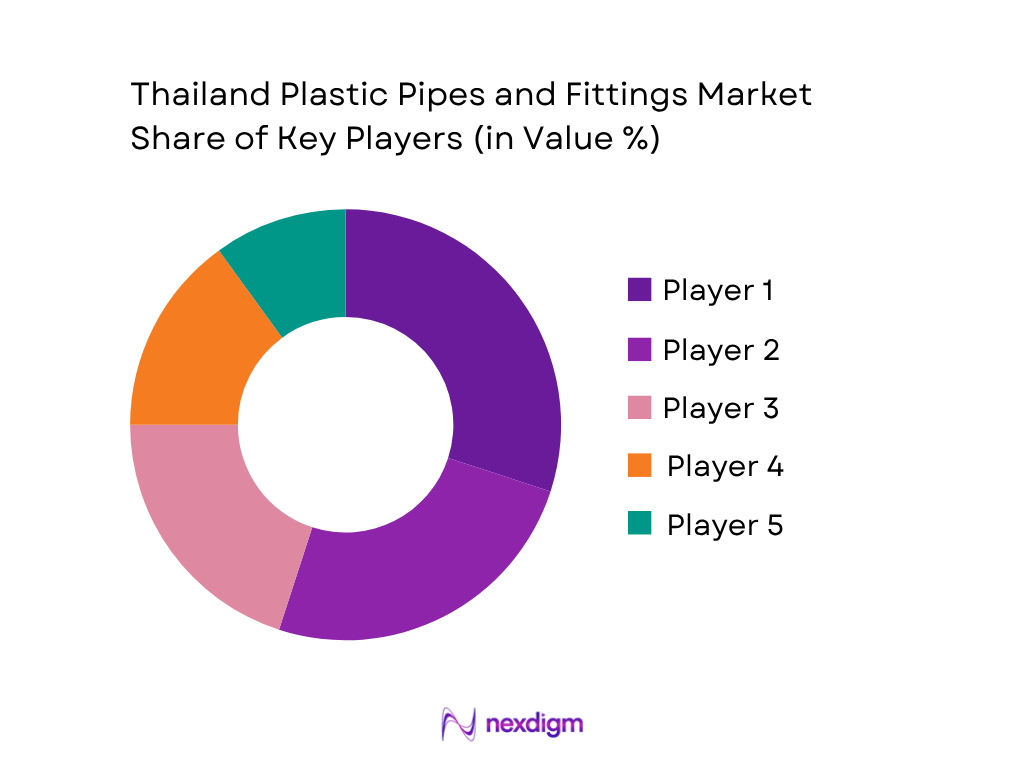
Thailand Plastic Pipes and Fittings Market Analysis
Growth Drivers
Expansion of Water Infrastructure and Urban Development Projects
The Thailand Plastic Pipes and Fittings Market is supported by continuous investment in water supply infrastructure, urban development projects, and modernization of municipal pipeline networks. Demand for PVC, HDPE, and PPR piping systems is increasing due to the requirement for durable, corrosion-resistant, and low-maintenance solutions across residential, commercial, and public infrastructure applications. Thailand’s urban infrastructure development remains concentrated around Bangkok Metropolitan Region and economic corridors, where water distribution, drainage, and wastewater networks require continuous expansion and rehabilitation. According to the World Bank, Thailand’s urban population reached approximately 36 million people, creating sustained demand for efficient water management infrastructure. The country’s total population was approximately 71.7 million, increasing pressure on municipal water systems and utility networks. The Metropolitan Waterworks Authority (MWA) manages more than 37,000 kilometers of water distribution pipelines, while the Provincial Waterworks Authority (PWA) operates extensive regional water supply networks, creating long-term demand for plastic pipeline replacement and expansion. Government infrastructure programs focusing on water security, flood management, and wastewater treatment are increasing the adoption of thermoplastic piping systems. Plastic pipes are increasingly preferred over traditional metal alternatives because of their resistance to corrosion, lightweight characteristics, and suitability for Thailand’s humid tropical environment.
Industrial Estate Expansion and Growth of Manufacturing Infrastructure
The Thailand Plastic Pipes and Fittings Market is benefiting from industrial expansion, particularly in manufacturing zones, petrochemical clusters, electronics facilities, and the Eastern Economic Corridor (EEC). Industrial facilities require advanced piping systems for process water, chemical handling, cooling systems, wastewater management, and utility infrastructure. According to Thailand’s Board of Investment (BOI), Thailand continues attracting investments in targeted industries including electronics, automotive manufacturing, petrochemicals, and digital infrastructure. The Eastern Economic Corridor covers Chonburi, Rayong, and Chachoengsao provinces, where industrial estates require extensive pipeline networks for manufacturing operations. Thailand’s manufacturing sector contributes approximately 27% of GDP, according to World Bank economic indicators, demonstrating the importance of industrial activity in supporting infrastructure demand. The country’s electronics manufacturing sector, supported by more than 2,000 electronics-related companies, generates demand for specialized piping systems used in semiconductor and industrial facilities. Plastic pipes such as HDPE, PPR, and specialty thermoplastic systems are increasingly utilized due to chemical resistance, durability, and operational reliability. Expansion of industrial parks, renewable energy facilities, and logistics infrastructure continues creating opportunities for plastic pipe manufacturers supplying industrial-grade solutions.
Market Challenges
Raw Material Price Volatility and Dependence on Petrochemical Supply Chains
The Thailand Plastic Pipes and Fittings Market faces challenges due to fluctuations in polymer raw material availability and dependence on petrochemical feedstocks. Plastic pipe manufacturing relies heavily on PVC resin, polyethylene, polypropylene, and other polymer materials, making manufacturers sensitive to changes in global energy markets and petrochemical supply conditions. Thailand has a significant petrochemical industry, particularly through industrial clusters located in Rayong and Map Ta Phut, but raw material prices remain influenced by international crude oil and natural gas markets. According to the Energy Policy and Planning Office (EPPO), Thailand imports a substantial portion of its energy requirements, exposing downstream industries to global energy fluctuations. The country consumed approximately 1.5 million barrels per day of petroleum products, increasing exposure to international energy price movements. Plastic pipe producers must manage procurement risks while maintaining competitive pricing and product quality. Additionally, imported specialty polymers used in advanced piping applications create additional supply chain dependencies. Manufacturers are increasingly required to improve operational efficiency, diversify suppliers, and adopt recycled polymer technologies to reduce exposure to raw material fluctuations.
Competition from Alternative Materials and Regulatory Compliance Requirements
The Thailand Plastic Pipes and Fittings Market faces competitive pressure from alternative materials including steel, copper, ductile iron, and concrete piping systems, particularly in industrial and large infrastructure applications. While plastic pipes provide advantages in corrosion resistance and installation efficiency, certain high-pressure and heavy-duty applications continue utilizing traditional materials. Infrastructure projects in Thailand require compliance with standards established by agencies such as the Thai Industrial Standards Institute (TISI), Metropolitan Waterworks Authority (MWA), Provincial Waterworks Authority (PWA), and construction regulatory bodies. According to the Thai Ministry of Industry, thousands of industrial establishments operate under regulated manufacturing frameworks requiring compliance with product quality and safety requirements. The construction industry also faces increasing sustainability requirements, encouraging manufacturers to improve recycling capabilities and reduce environmental impact. Thailand generated approximately 27 million tonnes of municipal solid waste annually, according to government environmental data, increasing attention toward plastic waste management. Plastic pipe manufacturers must therefore invest in sustainable production practices, certification capabilities, and environmentally responsible material management to remain competitive.
Market Opportunities
Modernization of Water Networks and Smart Infrastructure Development
The Thailand Plastic Pipes and Fittings Market presents significant opportunities from modernization of aging water infrastructure, smart water management systems, and expansion of municipal utility networks. Thailand’s increasing focus on improving water efficiency, reducing leakage, and strengthening urban water resilience supports demand for advanced plastic piping systems. The Metropolitan Waterworks Authority serves millions of consumers in Bangkok and surrounding provinces through extensive water distribution networks, creating continuous requirements for pipeline rehabilitation and replacement. Thailand’s National Water Resources Strategy emphasizes improving water management efficiency across urban, agricultural, and industrial sectors. According to the Office of National Water Resources, Thailand manages more than 25 major river basins, requiring integrated water infrastructure development. HDPE and advanced polyethylene pipes are gaining attention for water transmission projects due to flexibility, durability, and suitability for underground installation. Expansion of smart monitoring systems, automated water management technologies, and wastewater recycling infrastructure creates opportunities for manufacturers supplying high-performance piping solutions. Increasing urbanization, infrastructure renewal programs, and demand for efficient water distribution systems are expected to support future adoption of plastic pipe technologies.
Growth of Industrial Infrastructure and Sustainable Plastic Piping Solutions
The Thailand Plastic Pipes and Fittings Market has opportunities from industrial infrastructure expansion, sustainable construction practices, and increasing demand for specialized piping solutions. Thailand’s industrial development strategy focuses on advanced manufacturing, electric vehicles, electronics, biotechnology, and digital infrastructure, creating demand for reliable industrial piping networks. According to the Thailand Board of Investment, investment applications continued expanding in targeted industries, including smart electronics, automotive technologies, and industrial automation. Industrial facilities require plastic piping systems for cooling water, chemical transportation, wastewater treatment, and utility applications. The country’s Eastern Economic Corridor continues attracting manufacturing investment, increasing demand for industrial-grade HDPE and specialty thermoplastic pipes. Sustainability initiatives also create opportunities for recycled polymer adoption and low-carbon pipe manufacturing. Thailand’s greenhouse gas reduction commitments under national climate policies are encouraging industries to improve resource efficiency and adopt environmentally responsible materials. Plastic pipes with longer service life, lower maintenance requirements, and recyclable material options are positioned to benefit from these sustainability trends. Expansion of industrial parks, renewable energy projects, and green building developments will continue creating demand opportunities for advanced plastic piping solutions.
Future Outlook
The Thailand Plastic Pipes and Fittings Market is expected to witness continued expansion supported by infrastructure modernization, residential construction growth, industrial investment, and increasing replacement demand for aging piping networks. Future market development will be influenced by adoption of high-performance HDPE systems, sustainable plastic materials, advanced joining technologies, and smart water management infrastructure. Expansion of industrial corridors, renewable energy projects, and urban infrastructure upgrades will continue generating opportunities for manufacturers and distributors.
Major Players
- SCG Chemicals
- Thai Pipe Industry Co., Ltd.
- Nawaplastic Industries Co., Ltd.
- PTT Global Chemical Public Company Limited
- Thai Asia Pacific Brewery Pipe Manufacturers
- Saha Union Public Company Limited
- Finolex Industries Limited
- Sekisui Chemical Co., Ltd.
- Georg Fischer AG
- Uponor Corporation
- Aliaxis Group
- Pipelife International
- Wavin Group
- Advanced Drainage Systems
- REHAU Group
Key Target Audience
- Plastic Pipe Manufacturers and Fittings Producers
- Construction and Real Estate Development Companies
- Water Utility Operators and Infrastructure Developers
- Industrial Manufacturing Facilities and Process Industries
- Oil, Gas, and Petrochemical Companies
- Investments and Venture Capitalist Firms (Infrastructure Investment Funds, Private Equity Firms, Industrial Investment Groups)
- Government and Regulatory Bodies (Ministry of Industry Thailand, Provincial Waterworks Authority, Metropolitan Waterworks Authority, Department of Public Works and Town & Country Planning)
Plumbing Contractors, Engineering Procurement Construction Companies, and Distribution Networks
Research Methodology
Step 1: Identification of Key Variables
The initial phase involves developing a comprehensive ecosystem map covering resin suppliers, pipe manufacturers, fittings producers, distributors, contractors, utilities, and end-use industries operating within the Thailand Plastic Pipes and Fittings Market. Secondary research is conducted to identify critical demand variables including construction activity, infrastructure development, material consumption patterns, and application-specific requirements. Key market drivers, supply chain dynamics, and regulatory factors are analyzed to establish the foundation for market assessment.
Step 2: Market Analysis and Construction
This phase focuses on compiling historical industry information related to plastic pipe production, consumption volume, application demand, and material adoption patterns. The analysis evaluates PVC, HDPE, PPR, CPVC, and specialty thermoplastic pipe demand across residential, commercial, industrial, agricultural, and municipal applications. Supply-side assessment includes manufacturing capacity, distribution networks, and competitive positioning of major market participants.
Step 3: Hypothesis Validation and Expert Consultation
Market assumptions are validated through discussions with industry stakeholders including manufacturers, distributors, contractors, and infrastructure participants. Expert consultations help evaluate operational trends, material preference shifts, procurement behavior, and technology adoption. These insights are integrated with secondary findings to improve accuracy and reliability of market conclusions.
Step 4: Research Synthesis and Final Output
The final stage involves consolidating market findings through data triangulation, combining demand-side analysis, supply-side evaluation, and stakeholder insights. The research output presents market size assessment, segmentation analysis, competitive landscape, growth opportunities, and future outlook for the Thailand Plastic Pipes and Fittings Market.

- Executive Summary
- Research Methodology (Market Definition and Scope, Thailand Plastic Pipes and Fittings Market Classification, Thermoplastic Pipe Demand Assessment, Plastic Pipe Production Volume Analysis, Plastic Fittings Consumption Mapping, PVC Pipe Demand Assessment, HDPE Pipe Consumption Analysis, PPR Plumbing System Adoption Assessment, CPVC Pipe Demand Evaluation, Metropolitan Waterworks Authority (MWA) Water Infrastructure Pipe Requirement Analysis, Provincial Waterworks Authority (PWA) Pipeline Demand Assessment, Residential Plumbing Pipe Consumption Mapping, Commercial Construction Plumbing Demand Assessment, Industrial Estate Pipeline Requirement Analysis, Agricultural Irrigation Pipe Demand Assessment, Oil and Gas Pipeline Requirement Analysis, Wastewater and Sewerage Infrastructure Pipe Assessment, Electrical Conduit and Telecom Duct Demand Assessment)

- Definition and Scope
- Thailand Plastic Pipes and Fittings Industry Evolution and Development of Thermoplastic Piping Infrastructure
- PVC Pressure Pipes, PVC Drainage Pipes, CPVC Pipes, HDPE Pipes, MDPE Pipes, PPR Pipes, PE Pipes, PP-RCT Pipes, Specialty Thermoplastic Pipes
- Thailand Plastic Pipes and Fittings Value Chain Analysis
- Thailand Plastic Pipes and Fittings Supply Chain Analysis
- Plastic Resin Supplier, Polymer Compound Manufacturer, Pipe Extruder, Fittings Manufacturer, Distributor, Contractor, Real Estate Developer, Utility End User
- Plastic Pipe Integration Across Metropolitan Waterworks Authority Networks, Provincial Waterworks Authority Networks, Residential Plumbing Systems, Commercial Buildings, Industrial Estates, Agricultural Irrigation Systems, Oil and Gas Facilities, Wastewater Infrastructure, Electrical and Telecom Networks

- Growth Drivers (Expansion of MWA and PWA Water Networks, Residential Construction Growth, Eastern Economic Corridor (EEC) Infrastructure Development, Industrial Estate Expansion, Agricultural Irrigation Modernization, Wastewater Treatment Infrastructure Development, Increasing HDPE Pipe Adoption, Petrochemical Industry Expansion, Urbanization Growth, Replacement of Aging Metal Pipeline Systems)
- Market Challenges (Volatility in PVC and Polyethylene Resin Prices, Dependence on Petrochemical Feedstocks, Intense Competition Among Domestic Pipe Manufacturers, Construction Sector Fluctuations, Product Standardization Requirements, Installation Quality Challenges, Competition from Steel and Concrete Pipes, Environmental Concerns Related to Plastic Waste Management, Fragmented Distribution Network)
- Market Opportunities (Water Infrastructure Rehabilitation Projects, Smart Water Management Systems, Eastern Economic Corridor Industrial Development, Large Diameter HDPE Pipeline Applications, Agricultural Water Management Expansion, Wastewater Recycling Infrastructure, Sustainable Plastic Pipe Solutions, Recycled Polymer Adoption, Industrial Fluid Handling Applications, Advanced Fusion Technology Adoption)
- Market Trends (HDPE Fusion Technology Expansion, Growth of PPR Plumbing Systems, Smart Water Infrastructure Development, Industrial Estate Pipeline Modernization, Sustainable Pipe Manufacturing, Prefabricated Plumbing Systems, Digital Pipe Design Integration, Large Diameter Plastic Pipeline Adoption, Advanced Joining Technologies, Green Building Material Adoption)
- Regulatory and Standards Landscape (Thai Industrial Standards Institute (TISI) Plastic Pipe Standards, Metropolitan Waterworks Authority Specifications, Provincial Waterworks Authority Requirements, Department of Public Works and Town & Country Planning Regulations, Building Control Regulations, Industrial Estate Authority of Thailand Requirements, Environmental Protection Regulations, Construction Material Certification Standards)
- SWOT Analysis
- Porter’s Five Forces Analysis
- PESTLE Analysis
- Stakeholder Ecosystem
- Competition Ecosystem

- By Market Value (2020-2025)
- By Plastic Pipe Consumption Volume (2020-2025)
- By Plastic Fittings Consumption Volume (2020-2025)
- By PVC Pipe Consumption Volume (2020-2025)
- By HDPE Pipe Consumption Volume (2020-2025)
- By PPR Pipe Consumption Volume (2020-2025)
- By CPVC Pipe Consumption Volume (2020-2025)

- By Material Type (In Value %)
PVC Pipes and Fittings
CPVC Pipes and Fittings
HDPE Pipes and Fittings
MDPE Pipes and Fittings
PPR Pipes and Fittings
Polyethylene Pipes and Fittings
PP-RCT Pipes and Fittings
Composite Plastic Pipes and Fittings
PVDF and Specialty Thermoplastic Pipes - By Product Type (In Value %)
Pressure Pipes
Non-Pressure Pipes
Water Supply Pipes
Drainage Pipes
Sewerage Pipes
Agricultural Irrigation Pipes
Corrugated Pipes
Solid Wall Pipes
Flexible Pipes and Tubing
Conduit Pipes
Telecom Ducts
Injection Molded Fittings
Electrofusion Fittings
Mechanical Connection Fittings - By Application Type (In Value %)
Metropolitan Waterworks Authority (MWA) Water Distribution Systems
Provincial Waterworks Authority (PWA) Water Supply Networks
Wastewater and Sewer Systems
Residential Plumbing Systems
Commercial Building Plumbing Systems
Industrial Estate Process Piping Systems
Agricultural Irrigation Systems
Aquaculture Water Management Systems
Oil and Gas Utility Applications
Electrical Conduit Systems
Telecommunication Fiber Optic Duct Systems
Fire Protection Systems
Data Center Cooling Systems - By End-Use Industry (In Value %)
Municipal Water Utilities
Wastewater Treatment Facilities
Residential Construction
Commercial Construction
Industrial Manufacturing Facilities
Petrochemical and Oil & Gas Industry
Agriculture Sector
Food Processing Industry
Automotive Manufacturing Industry
Electronics and Semiconductor Industry
Healthcare Facilities
Hospitality Industry
Government Infrastructure Projects
Telecommunication Infrastructure - By Demand Type (In Value %)
New Infrastructure Installation
Water Network Expansion Projects
Residential Construction Projects
Industrial Estate Development Projects
Agricultural Irrigation Expansion
Replacement and Rehabilitation Projects
Repair and Maintenance Demand - By Region (In Value %)
Central Thailand
Bangkok Metropolitan Region
Eastern Thailand
Northern Thailand
Northeastern Thailand
Southern Thailand
Western Thailand

- Market Share of Major Players (By Thailand Revenue, Plastic Pipe Sales Volume, Plastic Fittings Sales Volume, PVC Pipe Sales Volume, HDPE Pipe Sales Volume, PPR Pipe Sales Volume, Water Infrastructure Exposure, Residential Construction Exposure, Industrial Project Exposure, Manufacturing Footprint, Distribution Network Coverage, Product Portfolio Breadth, Certification Coverage)
- Cross Comparison Parameters (Thailand Plastic Pipe and Fittings Revenue, Material Portfolio Breadth Across PVC-HDPE-PPR-CPVC, Pipe Extrusion and Fittings Manufacturing Capacity, Large Diameter Pipe Production Capability, MWA-PWA Infrastructure Project Exposure, Industrial Estate Application Capability, Distribution Network and Contractor Reach, TISI and International Certification Coverage)
- SWOT Analysis of Major Players
- Competitive Positioning Matrix
- Detailed Profiles of Major Companies
SCG Chemicals
Thai Pipe Industry Co., Ltd.
Thai Nam Plastic Co., Ltd.
Nawarat Pipe Industry
Vinythai
Wavin
Aliaxis
Uponor
Sekisui Chemical
Georg Fischer
Astral Limited
Supreme Industries Limited
Finolex Industries Limited
Prince Pipes and Fittings Limited
Hepworth PME

- Metropolitan Waterworks Authority Plastic Pipe Procurement Assessment
- Provincial Waterworks Authority Pipeline Requirement Analysis
- Residential Developer Plumbing System Material Selection Assessment
- Commercial Building Plumbing Specification Analysis
- Industrial Estate Plastic Pipe Requirement Assessment
- Petrochemical Facility Process Piping Requirement Analysis
- Agricultural Irrigation Contractor Procurement Assessment
- Aquaculture Infrastructure Pipe Requirement Analysis
- Electrical Contractor Conduit Procurement Assessment
- Telecommunication Fiber Duct Installation Requirement Analysis
- Government Infrastructure Project Procurement Assessment
- Plumbing Contractor Material Preference Assessment
- Distributor Inventory and Procurement Assessment

- By Market Value (2026-2035)
- By Plastic Pipe Consumption Volume (2026-2035)
- By Plastic Fittings Consumption Volume (2026-2035)
- By PVC Pipe Consumption Volume (2026-2035)
- By HDPE Pipe Consumption Volume (2026-2035)
- By PPR Pipe Consumption Volume (2026-2035)
- By CPVC Pipe Consumption Volume (2026-2035)


 Request a Sample
 Ask for Customization
 Get a Quote
 Enquire Now