

 Download PDF
Market Overview
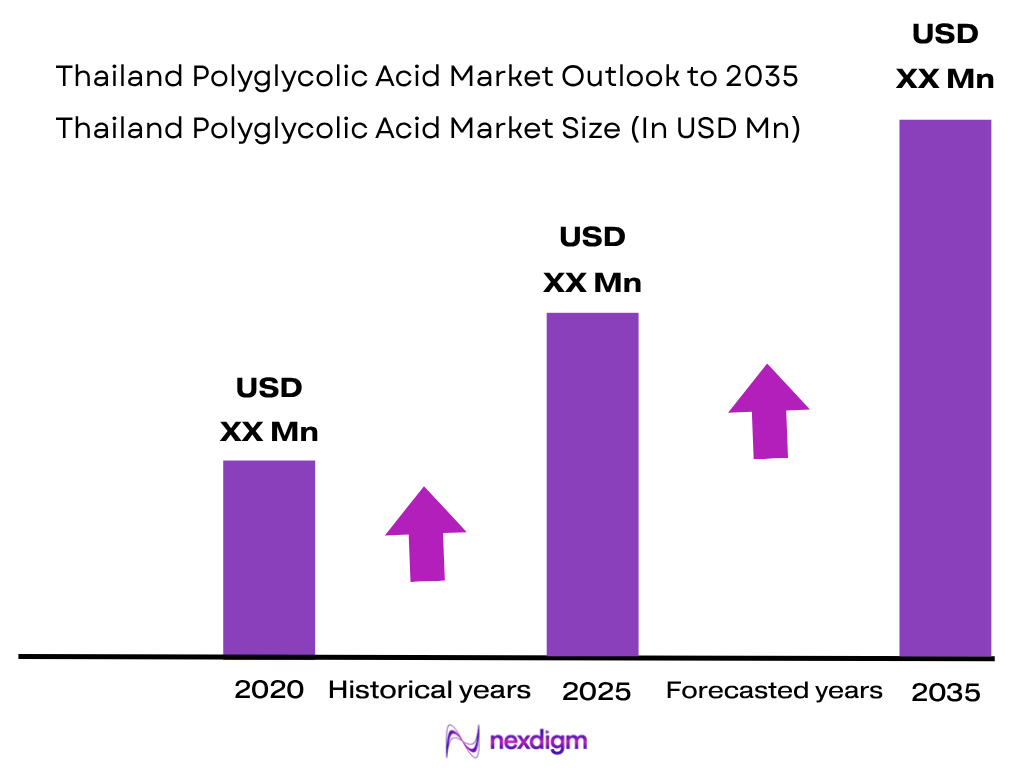
The Thailand Polyglycolic Acid Market is valued at approximately USD ~XX million, based on historical demand analysis. Demand is concentrated in absorbable sutures, bioresorbable medical materials, specialty polymer applications and high-barrier packaging. Thailand’s medical-device exports increased from approximately THB115 billion to THB130 billion, while imports increased from approximately THB90 billion to THB98 billion across the latest two reported periods, strengthening the downstream ecosystem for PGA-based medical applications.
Bangkok Metropolitan Region and the Eastern Economic Corridor, particularly Rayong and Chonburi, are strategically important to Thailand’s PGA opportunity. Bangkok concentrates hospitals, medical-device procurement, distributors and regulatory activities, while the eastern provinces host Thailand’s advanced petrochemical and biopolymer ecosystem. Thailand has approximately 95,000 tonnes of annual bioplastics production capacity, while Rayong already hosts a 75,000-tonne PLA facility, providing polymer-processing expertise relevant to future PGA compounding, conversion and sustainable packaging applications.
Market Segmentation
By Application Type
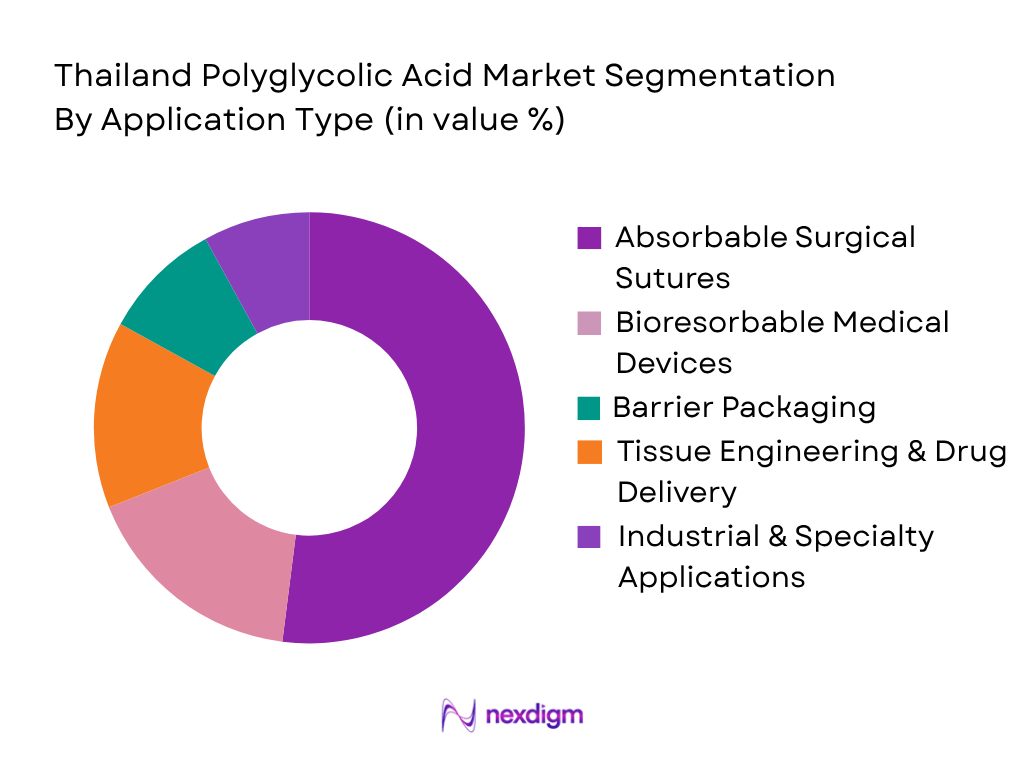
The Thailand Polyglycolic Acid Market is segmented into absorbable surgical sutures, bioresorbable medical devices, tissue-engineering and drug-delivery applications, barrier packaging, and industrial/specialty applications. Absorbable surgical sutures dominate the application segmentation, supported by PGA’s established clinical use, hydrolytic degradation behavior, mechanical strength and suitability for temporary wound closure. Thailand has a substantial medical-device manufacturing and healthcare ecosystem, while single-use products constitute the principal category of medical-device exports. PGA sutures are commercially available in Thailand through medical-device distribution channels, confirming an established domestic application base. Compared with emerging PGA barrier packaging and specialty industrial applications, sutures benefit from mature clinical acceptance, recurring hospital procurement and clearly defined product specifications. PGA’s ability to retain useful tensile strength during initial wound healing and subsequently undergo absorption makes it particularly suitable for internal tissue approximation. Barrier packaging nevertheless represents an important developing application as Thailand expands its bioplastics and sustainable-packaging manufacturing ecosystem.
By Grade
The Thailand Polyglycolic Acid Market is segmented into medical-grade PGA, industrial-grade PGA, high-purity specialty PGA and research-grade PGA. Recently, medical-grade PGA has held the dominant position, primarily because Thailand’s most commercially established PGA application is absorbable surgical material. Medical-grade PGA requires controlled molecular weight, predictable degradation, biocompatibility, purity and compatibility with sterilization and medical-device manufacturing processes. Thailand’s healthcare and medical-device supply chain provides an established procurement environment for such products, whereas industrial PGA remains comparatively specialized. Medical-device exports reached THB130 billion, and single-use medical products accounted for the overwhelming majority of export activity, demonstrating the scale of the adjacent manufacturing ecosystem supporting PGA medical applications. Industrial-grade PGA is expected to become increasingly relevant for high-barrier packaging and polymer blends because PGA offers strong gas-barrier characteristics. Thailand’s existing biopolymer manufacturing capabilities also provide a foundation for future industrial-grade PGA conversion, blending and multilayer packaging development.
Competitive Landscape
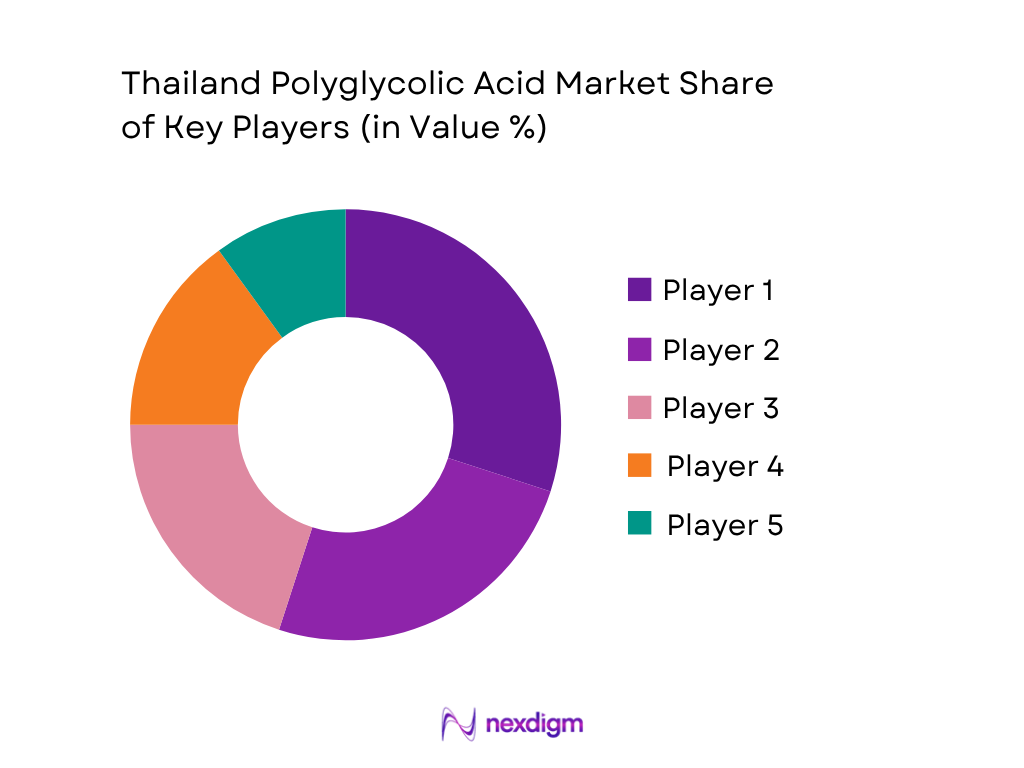
The Thailand Polyglycolic Acid Market remains highly specialized and import-dependent, with competition occurring across PGA resin, medical biomaterials, absorbable sutures and specialty polymer applications rather than through a large domestic PGA manufacturing base. Kureha is particularly significant in industrial PGA through its Kuredux platform, while Corbion and Evonik participate in the broader bioresorbable-polymer ecosystem. Medical-product companies compete through clinical performance, regulatory approvals, degradation profiles, sterilization compatibility, distribution relationships and hospital procurement access.
| Major Player | Establishment Year | Headquarters | Core PGA Position | Major PGA/Application Focus | Medical-Grade Capability | Industrial/Packaging Capability | Thailand/Asia Market Relevance | Technical Differentiation |
| Kureha Corporation | 1944 | Tokyo, Japan | ~ | ~ | ~ | ~ | ~ | ~ |
| Corbion N.V. | 1919 | Amsterdam, Netherlands | ~ | ~ | ~ | ~ | ~ | ~ |
| Evonik Industries AG | 2007 | Essen, Germany | ~ | ~ | ~ | ~ | ~ | ~ |
| Meta Biomed Co., Ltd. | 1990 | Cheongju, South Korea | ~ | ~ | ~ | ~ | ~ | ~ |
| Samyang Biopharmaceuticals Corporation | 2011 | Seongnam, South Korea | ~ | ~ | ~ | ~ | ~ | ~ |
Thailand Polyglycolic Acid Market Analysis
Growth Drivers
Expansion of Medical Device Manufacturing and Bioresorbable Applications
Thailand’s expanding medical-device manufacturing ecosystem is strengthening the commercial foundation for polyglycolic acid used in absorbable sutures, resorbable components and specialized biomedical products. Investment applications related to medical equipment reached 83 projects valued at USD652 million in 2024, demonstrating continued capital deployment into production capabilities relevant to advanced medical materials. During the first nine months of 2025, another 33 medical-equipment projects valued at USD261 million entered the investment pipeline, indicating continuing manufacturing activity. PGA benefits from this ecosystem because controlled hydrolytic degradation, high initial tensile strength and established surgical use make it relevant to absorbable wound-closure products and temporary biomedical structures. Thailand’s broader healthcare infrastructure further supports recurring utilization of surgical materials, while specialized healthcare investment continued with a THB3.5 billion cancer medical-center project approved in 2025. Macroeconomic conditions provide additional industrial depth: Thailand recorded USD526.52 billion in GDP, USD7,346.6 GDP per capita and a population of 71,668,011 in 2024. Net foreign direct investment amounted to USD6.95 billion, supporting Thailand’s ability to attract technologies, equipment and advanced materials required for development of higher-specification PGA medical applications.
Established Biopolymer Processing Base Supporting PGA Commercialization
Thailand’s established biopolymer processing infrastructure creates an important demand driver for future PGA compounding, film conversion and biodegradable polymer applications. Rayong already hosts a commercial PLA production facility with 75,000 tonnes of annual capacity, providing industrial experience in handling biodegradable polymers, polymerization operations, resin logistics and downstream conversion. The same industrial cluster integrates biochemical feedstock production with polymer manufacturing, creating technical capabilities that can eventually support PGA blends and multilayer structures. Thailand has also promoted 24 bioplastics manufacturing projects representing more than THB37 billion of cumulative investment, demonstrating an established ecosystem of resin producers, converters and downstream manufacturers. This infrastructure is particularly relevant for PGA because the polymer can be combined with other biodegradable materials or incorporated as a barrier layer where strong oxygen and gas resistance is required. Thailand’s macroeconomic base supports continued industrial deployment, with GDP reaching USD526.52 billion, GDP per capita at USD7,346.6, and population at 71,668,011 in 2024. The country also attracted USD6.95 billion in net foreign direct investment, providing an additional foundation for importing advanced polymer technology and establishing specialty-material production partnerships.
Market Challenges
Dependence on Imported High-Purity PGA and Specialized Polymer Technology
Thailand’s PGA industry remains constrained by limited domestic production of high-molecular-weight, medical-grade and industrial-grade polyglycolic acid, making downstream users dependent on overseas resin suppliers, technical documentation and specialized processing support. This dependence is important because PGA applications in sutures, implants and barrier structures require strict control over molecular weight, residual monomers, moisture exposure and processing conditions. Thailand’s broader investment statistics demonstrate that domestic capabilities are still being developed: medical-equipment-related investment applications covered 83 projects valued at USD652 million in 2024, while only 33 projects valued at USD261 million were recorded during the first nine months of 2025. These investments strengthen downstream medical manufacturing but do not establish a comparable large-scale domestic PGA resin industry. The challenge is amplified by Thailand’s reliance on imported technology and specialized raw materials for advanced manufacturing. Macroeconomic data show GDP of USD526.52 billion, GDP per capita of USD7,346.6, and a population of 71,668,011 in 2024, while the average exchange rate stood at THB35.29 per USD. Consequently, PGA processors remain exposed to foreign-currency procurement, international logistics, long qualification cycles and supplier concentration when securing medical or high-performance grades.
Technical Processing Complexity and Medical Qualification Requirements
PGA presents greater conversion complexity than conventional commodity polymers because it is highly sensitive to moisture and can undergo hydrolytic degradation during storage, drying and melt processing. Thailand therefore requires specialized drying systems, controlled processing environments and technically capable converters before PGA can achieve broader adoption beyond established surgical applications. Medical-grade use introduces additional hurdles because absorbable sutures and implantable components require consistent degradation behavior, sterilization compatibility, biocompatibility documentation and regulatory approval. Thailand’s healthcare system provides meaningful end-use scale, but it also demands reliable quality: a 2024 national health-resource assessment records hospitals, medical establishments with beds, ICU infrastructure and high-cost medical equipment throughout the country, indicating the breadth of institutions requiring standardized medical products. Investment activity is expanding this environment; a THB3.5 billion specialized cancer medical-center project received approval in 2025, while an Indian pharmaceutical and medical-equipment manufacturing company established a Rayong facility involving more than THB2.1 billion of investment. Thailand’s macroeconomic capacity remains substantial, with USD526.52 billion GDP, USD7,346.6 GDP per capita and 71,668,011 residents in 2024. These conditions create demand, but they also raise expectations for traceable, clinically qualified and consistently processed PGA materials.
Market Opportunities
Localization of PGA-Based Medical Devices and Absorbable Surgical Products
Thailand has a credible opportunity to localize production of PGA-based absorbable sutures, temporary medical components and other bioresorbable devices by leveraging its growing medical-manufacturing ecosystem. Medical-equipment investment applications reached 83 projects representing USD652 million in 2024, while the first nine months of 2025 recorded 33 additional projects representing USD261 million. These investments expand Thailand’s pool of manufacturers, clean-room capabilities, regulatory expertise and medical-material processing capacity that could support PGA conversion without requiring immediate domestic polymerization of the resin itself. Thailand is also attracting advanced healthcare manufacturing from overseas. In 2025, a pharmaceutical and medical-products manufacturer operating in Rayong had already invested more than THB2.1 billion, while investment authorities engaged 15 major Indian companies across medical, electric-vehicle and semiconductor sectors to encourage additional localization. Current macroeconomic conditions strengthen this opportunity: Thailand recorded GDP of USD526.52 billion, GDP per capita of USD7,346.6, population of 71,668,011, and net foreign direct investment of USD6.95 billion in 2024. These indicators support future partnerships between PGA resin suppliers, Thai medical-device manufacturers and regional distributors targeting higher-value absorbable medical products.
Development of PGA-Based High-Barrier and Biodegradable Packaging Solutions
Thailand’s mature bioplastics and packaging ecosystem creates a future opportunity for PGA in high-barrier multilayer packaging, biodegradable polymer blends and specialty film applications. PGA offers strong gas-barrier characteristics, making it suitable as a functional layer where food, pharmaceutical or specialty packaging requires enhanced oxygen protection while reducing reliance on conventional barrier polymers. Thailand already possesses relevant processing infrastructure: a Rayong PLA facility operates at 75,000 tonnes of annual capacity, while investment promotion has supported 24 bioplastics projects with more than THB37 billion committed across the value chain. This existing base gives Thai converters experience in biodegradable resin handling, extrusion, film production and application development that can be adapted to PGA-containing structures. The country’s economic scale also supports downstream commercialization. Thailand recorded USD526.52 billion in GDP, USD7,346.6 GDP per capita and 71,668,011 residents in 2024, while net foreign direct investment reached USD6.95 billion. A 2025 investment pipeline also included 33 medical-equipment projects valued at USD261 million, creating additional demand for specialized protective and sterile packaging. These current capabilities provide a practical platform for future PGA-based barrier structures serving food, healthcare and specialty industrial applications.
Future Outlook
The Thailand Polyglycolic Acid Market is expected to record an indicative ~XX% CAGR during 2026-2035, supported by medical-device manufacturing, bioresorbable materials and advanced sustainable packaging applications. Future development is likely to shift PGA beyond its established surgical-suture base toward multilayer barrier films, biodegradable polymer blends and specialized biomedical products. Thailand’s established bioplastics ecosystem provides a relevant foundation for this transition. BOI information identifies the country as a major bioplastics production location, supported by petrochemical infrastructure, agricultural feedstocks and polymer-processing expertise.
Medical applications should remain strategically important as manufacturers develop resorbable implants, drug-delivery systems, tissue-engineering structures and specialized wound-closure products. PGA’s predictable hydrolysis and temporary mechanical performance make the material particularly relevant where permanent polymers are undesirable.
Major Players
- Kureha Corporation
- Corbion N.V.
- Evonik Industries AG
- BMG Incorporated
- Teleflex Incorporated
- Samyang Biopharmaceuticals Corporation
- Meta Biomed Co., Ltd.
- Shanghai Pujing Chemical Technology Co., Ltd.
- Shenzhen Polymtek Biomaterial Co., Ltd.
- Huizhou Foryou Medical Devices Co., Ltd.
- Danhua Chemical Technology Co., Ltd.
- CHN Energy Shaanxi
- eSUNMed
- Suzhou Qihang Biomaterial Co., Ltd.
- Polysciences, Inc.
Key Target Audience
- Polyglycolic Acid Resin and Specialty Polymer Producers
- Medical Device and Absorbable Suture Manufacturers
- Biodegradable Polymer and Specialty Compound Manufacturers
- Flexible and High-Barrier Packaging Manufacturers
- Pharmaceutical and Bioresorbable Biomaterial Companies
- Investments and Venture Capitalist Firms
- Polymer Importers, Distributors and Specialty Chemical Suppliers
- Government and Regulatory Bodies (Thailand Board of Investment, Thai Food and Drug Administration, Thai Industrial Standards Institute, Department of Medical Sciences, Pollution Control Department)
Research Methodology
Step 1: Identification of Key Variables
The initial phase involves constructing an ecosystem map covering PGA producers, glycolide suppliers, polymer distributors, medical-device manufacturers, packaging converters, biomaterial companies and healthcare procurement channels. Secondary and proprietary databases are assessed to identify variables including PGA grade, consumption volume, application mix, import dependency, processing technology, degradation profile and regulatory requirements.
Step 2: Market Analysis and Construction
Historical information for the Thailand Polyglycolic Acid Market is analyzed through top-down and bottom-up approaches. The top-down model assesses Thailand’s medical-device, specialty polymer, bioplastics and packaging industries, while the bottom-up model evaluates PGA requirements across sutures, bioresorbable medical products, barrier packaging and specialty applications. Supply-side availability is reconciled with application-level consumption to construct the market model.
Step 3: Hypothesis Validation and Expert Consultation
Market hypotheses are validated through computer-assisted telephone interviews with specialty polymer distributors, medical-device companies, surgical-product suppliers, packaging converters and biomaterial specialists. Discussions focus on PGA procurement, grade requirements, application qualification, import dependency, processing limitations and customer adoption. Primary findings are triangulated against trade information, regulatory documentation, industry disclosures and supplier technical information.
Step 4: Research Synthesis and Final Output
The final phase integrates demand-side, supply-side and competitive findings into a consolidated Thailand Polyglycolic Acid Market assessment. Medical-grade and industrial-grade consumption is reconciled with end-use applications and distribution channels. Competitive positioning is subsequently assessed using PGA portfolios, medical capabilities, polymer-processing expertise, application development, regional availability and technical support to establish the long-term strategic outlook.

- Executive Summary
- Research Methodology (Market Definition and Scope, Thailand Polyglycolic Acid Classification, Glycolide-to-PGA Value Chain Mapping, Medical-Grade and Industrial-Grade Assessment, Demand-Side Consumption Analysis, Supply-Side PGA Availability Assessment, Import and Distribution Mapping, Application-Level Consumption Assessment, Primary Industry Interviews, Top-Down Market Sizing, Bottom-Up Demand Validation, Data Triangulation, Forecasting Framework, Regulatory Assessment, Limitations and Future Conclusions)

- Definition and Scope
- Thailand Polyglycolic Acid Industry Evolution and Development of Biodegradable and Bioresorbable Polymer Ecosystem
- Polyglycolic Acid Chemistry, Polymerization Pathway and Material Performance Structure
- Thailand Polyglycolic Acid Value Chain Analysis
- Thailand Polyglycolic Acid Supply Chain Analysis
- Glycolic Acid, Glycolide Feedstock, PGA Resin, Specialty Compounder, Medical Biomaterial Supplier and Packaging Converter Ecosystem Analysis

- Growth Drivers (Expansion of Thailand Medical Device Manufacturing, Adoption of Bioresorbable Surgical Materials, Demand for High-Oxygen-Barrier Packaging, Development of Biodegradable Plastic Manufacturing, Growth of Advanced Healthcare Applications, Increasing Specialty Polymer Utilization)
- Market Challenges (High PGA Processing Temperature Sensitivity, Moisture-Induced Hydrolysis, Limited Domestic PGA Resin Production, Dependence on Imported High-Purity Polymer, Restricted Processing Window, Specialized Storage Requirements, Medical-Grade Qualification Requirements)
- Market Opportunities (PGA-Based Medical Device Localization, High-Barrier Sustainable Food Packaging, PGA/PLA Biodegradable Polymer Blends, Advanced Drug Delivery Systems, Tissue Engineering Materials, Specialty Polymer Compounding, Local PGA Conversion Capability)
- Market Trends (Medical-Grade PGA Adoption, Multilayer Barrier Film Development, PGA-Based Biodegradable Blends, Resorbable Implant Innovation, Material Lightweighting, High-Barrier Packaging Optimization, Sustainable Polymer R&D)
- Technology Assessment (Ring-Opening Polymerization of Glycolide, High-Molecular-Weight PGA Production, Melt Processing Optimization, Fiber Spinning Technology, Multilayer Co-Extrusion, Hydrolysis Control, Polymer Blending Technology)
- Raw Material Assessment (Glycolic Acid Availability, Glycolide Purity, Catalyst Requirements, Polymerization Additives, Specialty Compound Components, Imported Intermediate Dependency)
- Import Dependency Analysis (PGA Resin Origin, Medical-Grade Material Imports, Industrial-Grade Material Imports, Supplier Concentration, Import Lead Time, Storage and Handling Requirements)
- Regulatory and Standards Landscape (Thailand FDA Medical Device Requirements, Thai Industrial Standards Institute Requirements, Board of Investment Bioplastics Promotion, Pollution Control Department Plastic Waste Framework, Food-Contact Packaging Requirements, Medical Device Act Compliance)
- Sustainability Assessment (Biodegradability, Hydrolytic Degradation, Material Reduction, Fossil Plastic Substitution, Barrier-Enabled Shelf-Life Extension, Circular Packaging Compatibility)
- SWOT Analysis
- Porter’s Five Forces Analysis
- PESTLE Analysis
- Stakeholder Ecosystem
- Competition Ecosystem

- By Market Value (2020-2025)
- By PGA Consumption Volume (2020-2025)
- By Medical-Grade PGA Consumption Volume (2020-2025)
- By Industrial-Grade PGA Consumption Volume (2020-2025)
- By Imported PGA Resin Volume (2020-2025)
- By Domestic PGA Conversion Volume (2020-2025)
- By PGA-Based Medical and Packaging Application Volume (2020-2025)

- By Grade (In Value %)
Medical Grade PGA
Industrial Grade PGA
High-Purity PGA
Research and Specialty Grade PGA - By Product Form (In Value %)
PGA Pellets and Granules
PGA Powder
PGA Fibers and Filaments
PGA Films and Sheets
PGA-Based Compounds and Blends
PGA Preforms and Semi-Finished Materials - By Application Type (In Value %)
Absorbable Surgical Sutures
Bioresorbable Medical Devices
Tissue Engineering Scaffolds
Drug Delivery Systems
Barrier Packaging Films
Multilayer Food Packaging
Industrial Films and Specialty Packaging
Dissolvable Oil and Gas Components
Biodegradable Polymer Reinforcement
Specialty Fibers and Technical Applications - By End-Use Industry (In Value %)
Medical Devices and Healthcare
Pharmaceutical and Drug Delivery
Food and Beverage Packaging
Flexible Packaging
Petrochemical and Oilfield Services
Industrial Manufacturing
Biotechnology and Biomaterials
Specialty Polymer Compounding
Research and Product Development - By Region (In Value %)
Bangkok Metropolitan Region
Eastern Economic Corridor
Central Thailand
Northern Thailand
Northeastern Thailand
Southern Thailand

- Market Share of Major Players (By Revenue, PGA Supply Volume, Medical-Grade Portfolio, Industrial-Grade Portfolio, Application Coverage, Thailand Distribution Presence, End-Use Industry, Customer Segment Distribution)
- Cross Comparison Parameters (PGA Grade Portfolio Breadth, High-Molecular-Weight PGA Capability, Medical-Grade and Biocompatibility Capability, Industrial and Barrier Packaging Application Coverage, Production Capacity and Supply Reliability, Thailand and ASEAN Distribution Reach, Polymer Processing and Technical Support Capability, Biodegradable Polymer Innovation and Application Development)
- SWOT Analysis of Major Players
- Competitive Positioning Matrix
- Product and PGA Grade Portfolio Benchmarking
- Pricing and PGA Grade Category Benchmarking
- Manufacturing and Polymerization Capability Assessment
- Thailand Distribution and Application Development Assessment
- Detailed Profiles of Major Companies
Kureha Corporation
Corbion N.V.
Evonik Industries AG
BMG Incorporated
Teleflex Incorporated
Samyang Biopharmaceuticals Corporation
Meta Biomed Co., Ltd.
Shanghai Pujing Chemical Technology Co., Ltd.
Shenzhen Polymtek Biomaterial Co., Ltd.
Huizhou Foryou Medical Devices Co., Ltd.
Danhua Chemical Technology Co., Ltd.
CHN Energy Shaanxi
eSUNMed
Suzhou Qihang Biomaterial Co., Ltd
Polysciences, Inc.

- Medical Device Manufacturer Procurement Assessment
- Packaging Converter Requirement Assessment
- Polymer Compounder Demand Assessment
- Healthcare Application Requirement Analysis
- Food Packaging Requirement Analysis
- PGA Supplier Selection Criteria
- Virgin PGA versus PGA Blend Adoption Assessment
- Customer Pain Point Analysis
- Application Qualification and Technical Approval Assessment

- By Market Value (2026-2035)
- By PGA Consumption Volume (2026-2035)
- By Medical-Grade PGA Consumption Volume (2026-2035)
- By Industrial-Grade PGA Consumption Volume (2026-2035)
- By Domestic PGA Conversion Volume (2026-2035)
- By PGA-Based Medical and Packaging Application Volume (2026-2035)
- By Imported PGA Resin Volume (2026-2035)


 Request a Sample
 Ask for Customization
 Get a Quote
 Enquire Now