
 Download PDF
Market Overview
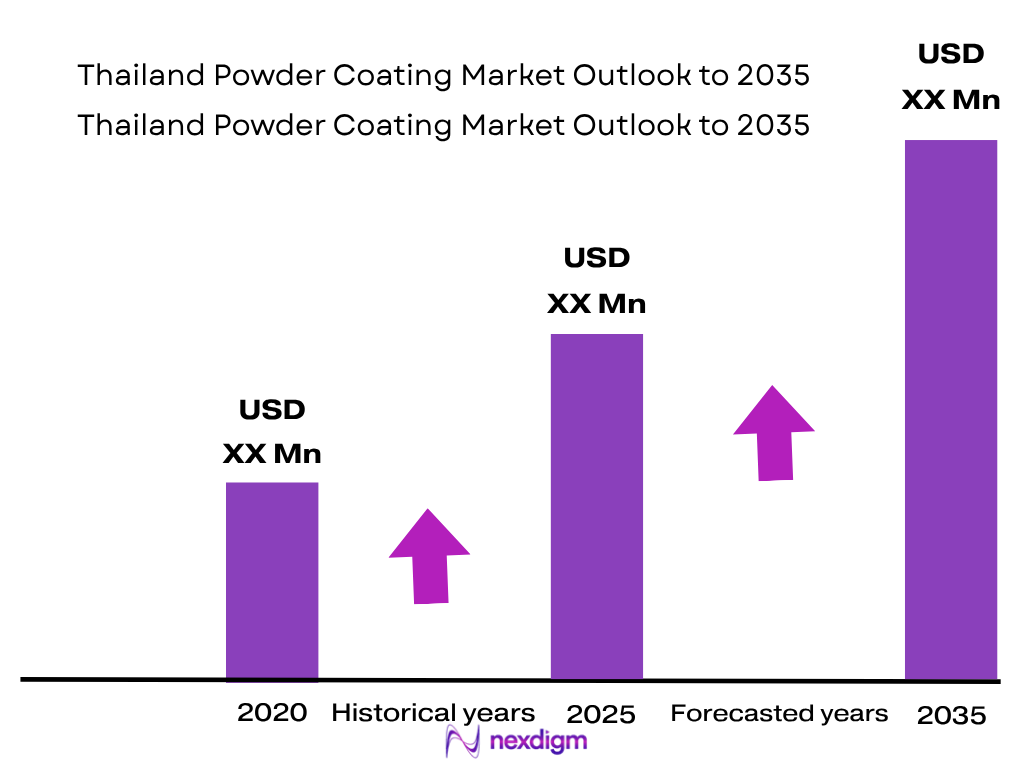
The Thailand Powder Coating Market is valued at USD~ million, compared with ~USD 210 million in the preceding annual period, with these market-size figures retained as placeholders as requested. For external validation, Grand View Research reports Thailand powder-coating revenue of USD 242.7 million in the following published base period, while MarketsandMarkets places the subsequent market at USD 314.8 million. Demand is anchored by automotive components, appliances, architectural aluminium, furniture and industrial metal fabrication.
Chonburi, Rayong, Chachoengsao and Samut Prakan form the principal demand centers because powder-consuming automotive, auto-component, appliance, metal-processing and industrial manufacturing facilities are concentrated around Thailand’s Eastern Seaboard. Vehicle production moved from 1,841,663 units in the preceding annual period to approximately 1.47 million units in the latest period, illustrating the scale of the downstream automotive base despite cyclical weakness. The EEC formally covers Chonburi, Rayong and Chachoengsao and prioritizes advanced industrial development.
Market Segmentation
By Resin Chemistry
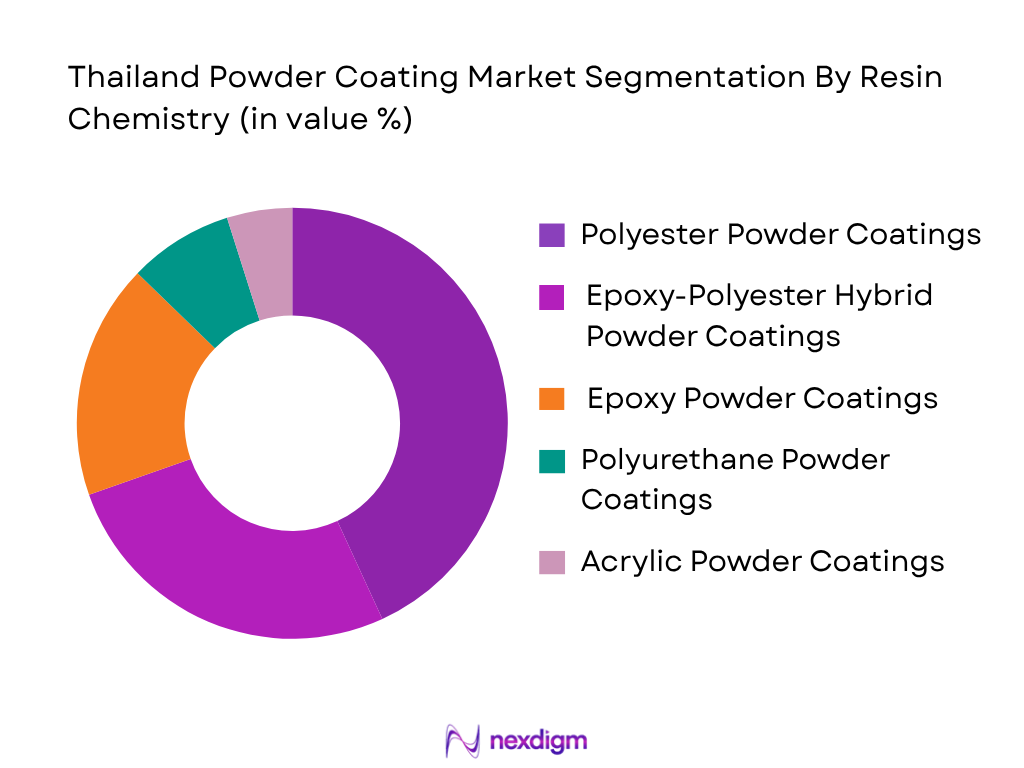
The Thailand Powder Coating Market is segmented by resin chemistry into polyester, epoxy-polyester hybrid, epoxy, polyurethane and acrylic powder coatings. Polyester powder coatings dominate this segmentation, supported by their extensive use on automotive components, architectural aluminium, appliances, outdoor furniture and fabricated metal products. Polyester systems offer a commercially attractive balance of exterior durability, UV stability, color retention, application efficiency and cost. Thailand’s tropical climate further raises the importance of weatherability for exterior applications. Standard-durable and super-durable polyester technologies are particularly relevant to architectural components. Grand View Research independently identifies polyester as Thailand’s largest revenue-generating resin category, while epoxy-polyester hybrid is positioned as the fastest-growing chemistry in its country outlook. Polyester’s compatibility with decorative finishes, metallic effects, low-bake formulations and automated electrostatic application also enables suppliers to address numerous OEM and job-coating applications with a common chemistry platform.
By End-Use Industry
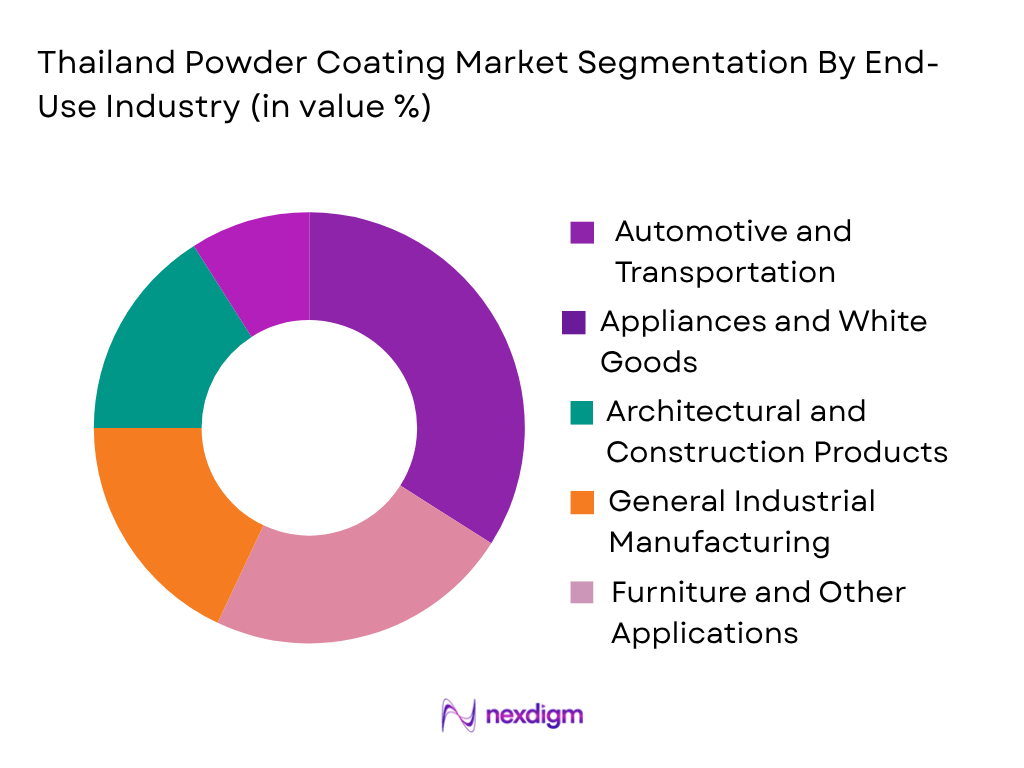
The Thailand Powder Coating Market is segmented by end-use industry into automotive and transportation, appliances, architectural and construction products, general industrial manufacturing, and furniture and other applications. Automotive and transportation represent the dominant end-use segment, supported by Thailand’s established position as a major Southeast Asian vehicle and component manufacturing base. Powder coatings are used on wheels, springs, seat structures, underbody components, brackets, engine-bay parts, battery components and other metal assemblies because of their corrosion resistance, mechanical durability and efficient overspray recovery. Although vehicle production recently experienced cyclical weakness, Thailand continues to host extensive OEM and Tier-1/Tier-2 manufacturing infrastructure and remains an important export production base. Growth in localized EV manufacturing expands the addressable coating opportunity toward battery enclosures and electrified powertrain components. Appliances provide another substantial demand pool, particularly air-conditioning equipment, refrigeration products and white goods.
Competitive Landscape
The Thailand Powder Coating Market combines multinational coatings groups with established Thai industrial-coating suppliers and regional specialists. AkzoNobel, Jotun, Nippon Paint, TOA Performance Coating and TIGER are strategically important because they combine broad resin technologies, industrial customer relationships, architectural or automotive systems, technical support and regional supply capabilities. Competition increasingly extends beyond price per kilogram toward applied cost, curing efficiency, powder mileage, finish consistency, corrosion performance, rapid color matching and OEM qualification. AkzoNobel operates a Thailand coatings presence in Samut Sakhon, Jotun has a dedicated powder-coatings entity in Chonburi, and TOA Performance Coating manufactures industrial coatings from Chonburi.
| Company | Establishment | Headquarters | Key Powder Technology | Thailand / Regional Position | Principal End Uses | Architectural Capability | Automotive / Industrial Capability | Sustainability & Process Capability |
| AkzoNobel – Interpon | 1792 heritage | Amsterdam, Netherlands | ~ | ~ | ~ | ~ | ~ | ~ |
| Jotun Powder Coatings | 1926 | Sandefjord, Norway | ~ | ~ | ~ | ~ | ~ | ~ |
| TOA Performance Coating Corporation | 2010 | Samut Prakan, Thailand | ~ | ~ | ~ | ~ | ~ | ~ |
| Nippon Paint Holdings | 1881 | Tokyo / Osaka, Japan | ~ | ~ | ~ | ~ | ~ | ~ |
| TIGER Coatings / TIGER Drylac | 1930 | Wels, Austria | ~ | ~ | ~ | ~ | ~ | ~ |
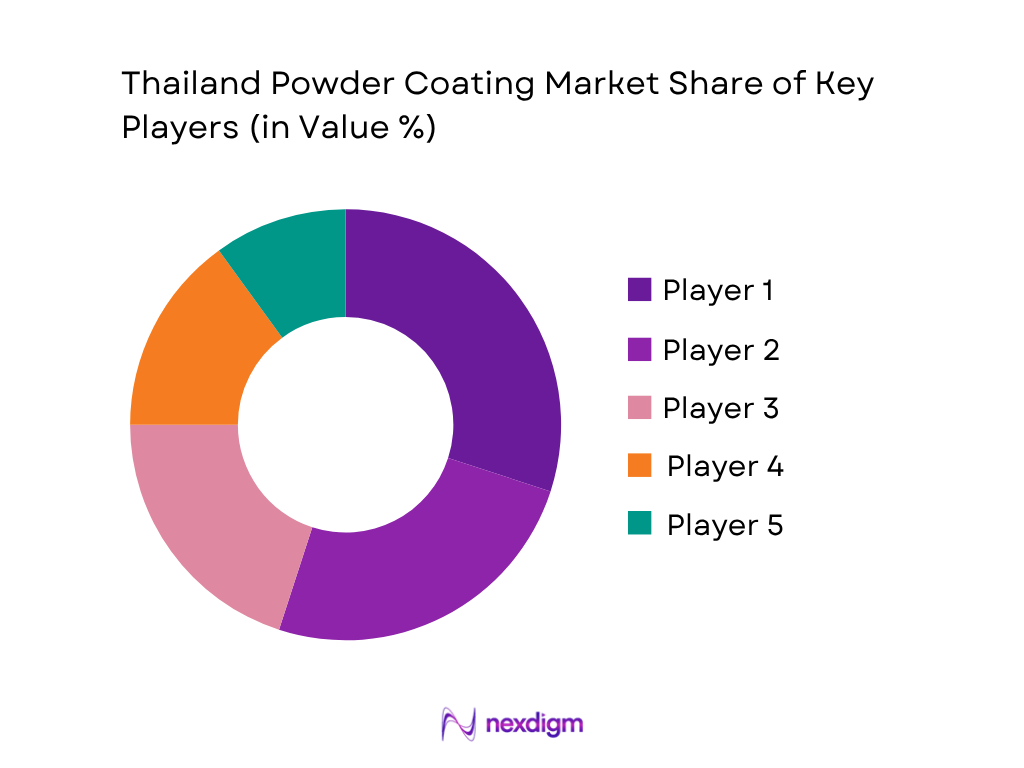
Thailand Powder Coating Market Analysis
Growth Drivers
Expansion of Automotive and EV Manufacturing
Thailand’s automotive manufacturing ecosystem remains one of the strongest structural demand drivers for powder coatings because vehicle production requires durable finishes for wheels, suspension components, seat structures, brackets, battery enclosures, underbody components and other fabricated metal parts. The Office of Industrial Economics reported 1,468,997 vehicles produced in 2024, including 1,009,141 units manufactured for export and 459,856 units for domestic supply. Thailand’s EV industrial base is also becoming increasingly relevant to powder-coating demand. Government investment-promotion data released in 2025 recorded 21 approved battery-electric passenger vehicle projects with combined annual capacity of 386,000 vehicles, alongside 53 battery manufacturing projects and 42 projects for key EV parts such as traction motors, battery-management systems and onboard chargers. These projects widen the potential coated-component base beyond conventional internal-combustion vehicle parts. The broader economic environment supports this industrial foundation: World Bank data place Thailand’s 2024 GDP at USD 526.52 billion and GDP per capita at USD 7,346.6. The combination of large-scale vehicle assembly, component localization and expanding electrified-vehicle production provides sustained application opportunities for polyester, epoxy, hybrid, corrosion-resistant and functional powder-coating systems.
Electrical Appliance and Advanced Manufacturing Base
Thailand’s large electrical-appliance and electronics manufacturing ecosystem supports powder-coating consumption across air-conditioner cabinets, refrigerator panels, washing-machine bodies, compressors, motors, control enclosures and other fabricated metal assemblies. The Office of Industrial Economics recorded domestic sales of approximately 907,600 air conditioners, 1,359,400 compressors, 481,300 washing machines and 148,300 refrigerators during the fourth quarter of 2024 alone, demonstrating the physical scale of powder-coatable appliance output. The Board of Investment received 407 electronics and electrical-appliance project applications worth THB 231.7 billion in 2024, while its first-half data included 181 E&E applications and 31 printed-circuit-board projects. Industrial capacity is continuing to deepen: an appliance manufacturing facility inaugurated in Chonburi in 2025 was designed for output exceeding 6 million air conditioners annually. This production ecosystem operates within an economy where the World Bank records THB 4,521,214 million of manufacturing value added in 2024 and national GDP of USD 526.52 billion. For powder suppliers, the scale of appliance assembly and supporting metal-component fabrication sustains demand for polyester, hybrid, low-bake, thin-film and decorative powder technologies optimized for repetitive, high-throughput production lines.
Market Challenges
Automotive Production Weakness and Lower Coating-Line Utilization
Thailand’s powder-coating market remains exposed to fluctuations in automotive production because vehicle and component factories represent a major pool of coated metal demand. The Office of Industrial Economics reported total automobile production of 1,468,997 units in 2024, of which only 459,856 units were produced for domestic distribution, while domestic vehicle sales stood at 572,675 units. The National Economic and Social Development Council reported that Thailand’s manufacturing production index stood at 97.2 in 2024, compared with an industrial capacity-utilization indicator of 59.0, reflecting underused manufacturing capacity, particularly in automotive-related activity. For powder-coating formulators and applicators, weaker assembly throughput affects coating-line operating hours, batch requirements, inventory rotation and demand for automotive-grade polyester, epoxy and hybrid systems. The challenge is important because automotive finishing involves extensive upstream qualification, making volumes difficult to replace quickly with unrelated applications. At the macroeconomic level, the World Bank recorded Thailand’s 2024 GDP at USD 526.52 billion, while the IMF reported nominal economic output of approximately THB 18,582.7 billion in its updated Thailand economic tables. Consequently, powder suppliers must manage exposure to automotive cycles while expanding toward appliances, architecture and general industrial fabrication.
Imported Inputs and Supply-Chain Exposure
Powder-coating manufacturing in Thailand depends on reliable availability of polyester and epoxy resins, curing agents, titanium dioxide, pigments, fillers and specialty additives, making the industry sensitive to imported chemical inputs and regional supply-chain disruptions. Thailand’s broader external-sector position illustrates the importance of international material flows: IMF data place the country’s 2024 external debt at approximately USD 202.4 billion, while nominal GDP was approximately USD 526.5 billion in the same period. The Bank of Thailand also records substantial physical trade in powder-coating-intensive downstream products; its manufacturing export statistics show 85,067.15 thousand units of electrical appliances in a recent 2024–2026 reporting series, including 21,831.04 thousand air-conditioning machines, 5,586.68 thousand refrigerators and 22,017.46 thousand units of electrical-appliance parts in the corresponding reported period. Such export-oriented production requires stable availability of qualified coating materials and consistent batch performance. Any interruption in resin, pigment or specialty-additive supply can therefore affect production scheduling and color consistency for OEM programs. For Thai powder manufacturers, strengthening regional sourcing, safety stocks, formulation flexibility and local raw-material qualification remains critical to protecting delivery reliability across automotive, appliance, architectural and general-industrial customers.
Market Opportunities
EV Supply-Chain Localization and Functional Coating Applications
Thailand’s expanding EV manufacturing ecosystem creates an opportunity for powder coatings to move beyond decorative finishing into corrosion protection, electrical insulation, thermal-management support and durable protection for battery and drivetrain components. Government data released in 2025 show 21 promoted BEV production projects with combined annual capacity of 386,000 vehicles, 16 electric-motorcycle projects with capacity of 810,000 units, 53 battery projects, and 42 projects producing critical EV components such as traction motors, battery-management systems, drive-control units and onboard chargers. The same government dataset records 29 promoted charging-station projects involving 20,080 charging points, including 7,360 DC chargers, broadening the addressable metal-enclosure and infrastructure-coating ecosystem. Thailand’s macroeconomic base provides scale for this transition: World Bank data record USD 526.52 billion of GDP in 2024, while manufacturing value added reached THB 4,521,214 million. These current indicators support future powder demand without relying on forecast statistics. Suppliers capable of developing electrically insulating powders, corrosion-resistant primers, durable polyester systems, low-temperature-cure technologies and coatings suitable for aluminium battery structures can target a broader set of specifications as Thailand localizes more EV components and shifts manufacturing capabilities toward higher-value electrified platforms.
Eastern Economic Corridor and New Industrial Capacity
Continued industrial development in Chonburi, Rayong and Chachoengsao creates a significant future opportunity for powder-coating manufacturers, distributors and independent applicators because the Eastern Economic Corridor concentrates automotive, electrical equipment, metal fabrication and advanced manufacturing facilities within a tightly connected industrial geography. Eastern Economic Corridor Office data show 32 industrial-estate-type Special Economic Promotion Zones currently supporting target industries. During the first quarter of 2024, 111 new factories began operating across the EEC, including 60 in Chonburi, 36 in Rayong and 15 in Chachoengsao, with the new facilities creating 5,867 jobs; government reporting indicates that metal and plastics industries represented a major part of these openings. Between January 2023 and September 2024, the EEC Office engaged 139 investors, with 35 investors submitting interest across 36 projects and 12 projects progressing to formal incentive proposals. Nationally, the Board of Investment received 3,137 investment-promotion applications in 2024, including 309 automotive and parts projects and 407 electrical-appliance and electronics projects. Against Thailand’s USD 526.52 billion 2024 GDP, this concentration of new manufacturing assets provides future addressable demand for architectural, automotive, appliance, machinery and functional powder-coating technologies.
Future Outlook
The Thailand Powder Coating Market is expected to expand steadily through the forecast period, with an indicative 2026–2035 CAGR of ~6.5%, retained as a placeholder in accordance with the requested methodology. Published benchmarks support a mid-single-digit growth direction: Grand View Research forecasts a 6.7% CAGR for Thailand over its available forecast window, while MarketsandMarkets reports 6.01% over its own country forecast period. Growth will increasingly be shaped by the composition rather than merely the volume of powder consumption. Super-durable polyester, low-temperature-cure systems, thin-film formulations, high-mileage products, specialty metallic finishes and functional powders should capture increasing attention as applicators seek to lower total coating cost while improving durability.
Automotive demand should progressively incorporate EV-specific requirements, including battery trays, battery bottom plates, aluminium structures and electrically relevant components. AkzoNobel’s development of specialized powder protection for EV battery bottom plates illustrates how powder suppliers are expanding beyond conventional decorative automotive finishing toward durability-critical electric vehicle applications. Architectural coating demand is also moving toward enhanced weatherability and lower-energy processing. Current powder technology can cure at temperatures as low as 150°C, with AkzoNobel reporting meaningful energy and cycle-time benefits from its low-energy architectural technology. This type of innovation is particularly relevant to Thai applicators exposed to electricity and fuel costs while serving exterior aluminium applications.
Major Players
- AkzoNobel – Interpon
- Jotun Powder Coatings (Thailand) Ltd.
- TOA Performance Coating Corporation Co., Ltd.
- Nippon Paint Thailand
- TIGER Coatings & Inks (Thailand) Co., Ltd.
- Axalta Coating Systems
- PPG Industries
- The Sherwin-Williams Company
- Kansai Paint
- KCC Corporation
- TOAGOSEI (Thailand) Co., Ltd. – Aron Powder
- Karawa (Thailand) Corp., Ltd.
- IFS Coatings
- RPM International Inc. – TCI Powder Coatings
- Dai Nippon Toryo Co., Ltd.
Key Target Audience
- Powder Coating Manufacturers and Formulators
- Automotive, EV and Auto-Component OEMs
- Electrical Appliance and White-Goods Manufacturers
- Architectural Aluminium Extruders, Fabricators and Powder Applicators
- Industrial Metal Fabricators and Independent Job Coaters
- Powder Resin, Pigment, Additive and Surface-Pretreatment Suppliers
- Investments and Venture Capitalist Firms
- Government and Regulatory Bodies (Thailand Board of Investment, Eastern Economic Corridor Office, Thai Industrial Standards Institute, Department of Industrial Works, Ministry of Industry)
Research Methodology
Step 1: Identification of Key Variables
The first stage involves constructing the Thailand Powder Coating Market ecosystem covering powder formulators, resin and additive suppliers, distributors, electrostatic equipment suppliers, job coaters, aluminium extruders, automotive component manufacturers, appliance OEMs and industrial fabricators. Secondary research is used to identify critical variables such as resin mix, powder consumption, application throughput, film thickness, curing technology, powder recovery and customer-industry concentration.
Step 2: Market Analysis and Construction
Historical market development is analyzed using both top-down and bottom-up approaches. The top-down model evaluates Thailand’s paints and coatings industry, relevant industrial production and downstream manufacturing activity, while the bottom-up model assesses powder consumption across automotive components, appliances, architectural aluminium, general industrial fabrication and furniture. Import dependence, domestic supply, average selling prices and applicator utilization are triangulated to construct the market.
Step 3: Hypothesis Validation and Expert Consultation
Initial hypotheses concerning resin consumption, end-use demand, pricing, application economics and competitive positioning are validated through structured primary interviews and CATIs with powder manufacturers, distributors, raw-material suppliers, OEM procurement teams, independent applicators and surface-finishing specialists. These discussions are used to test assumptions surrounding polyester dominance, OEM qualification processes, batch sizes, custom-color demand, cure temperatures, powder-reclaim practices and supplier switching behaviour.
Step 4: Research Synthesis and Final Output
The final stage reconciles primary findings with company disclosures, industrial statistics, trade information and secondary databases. Supply-side estimates from powder manufacturers are compared with demand-side consumption from major coating applications to minimize double counting. Market shares, competitive benchmarks and forecast assumptions are subsequently reviewed through data triangulation, producing a consistent assessment of Thailand’s powder coating market and its future commercial opportunities.

- Executive Summary
- Research Methodology (Market Definition and Scope, Thailand Powder Coating Taxonomy, Thermoset and Thermoplastic Powder Classification, Resin Chemistry Mapping, Decorative and Functional Powder Classification, Substrate Mapping, Surface Pretreatment Assessment, Electrostatic Application Technology Assessment, Cure Technology Assessment, Film Thickness Assessment, Powder Recovery and Reclaim Assessment, Market Sizing Framework)

- Definition and Scope
- Thailand Powder Coating Industry Evolution and Technology Development
- Powder Coating Manufacturing and Formulation Process
- Powder Coating Value Chain Analysis
- Thailand Powder Coating Supply Chain Analysis
- Resin, Pigment, Additive and Filler Ecosystem Analysis
- Thailand Powder Coating Import Dependency and Regional Supply Hub Assessment
- OEM Powder Coating Application Architecture and Job-Coater Solution Framework

- Growth Drivers (Automotive and Auto-Component Manufacturing, Electric Vehicle Localization, Electrical Appliance and White Goods Manufacturing, Architectural Aluminum Demand, Eastern Economic Corridor Industrial Expansion, Liquid-to-Powder Conversion, Export-Oriented Manufacturing, High Powder Recovery and Material Utilization)
- Market Challenges (Imported Resin and Raw Material Dependence, Epoxy and Polyester Resin Price Volatility, Industrial Electricity and Oven-Curing Costs, Stringent Automotive OEM Qualification, Frequent Small-Batch Color Changes, Regional Supplier Competition, Pretreatment Quality Variability, Skilled Applicator Constraints)
- Market Opportunities (Low-Temperature Cure Powders, EV Battery and Automotive Component Coatings, Super-Durable Architectural Systems, High-Corrosion Industrial Powders, Powder Coating for Heat-Sensitive Substrates, Automated Powder Application Systems, Functional Electrical Insulation Powders, Thailand-Based ASEAN Manufacturing and Distribution Hub)
- Market Trends (Low-Bake Fast-Cure Systems, Super-Durable Architectural Powders, Functional Powder Coatings, Precision Thin-Film Applications, Robotic Powder Application, Dense-Phase Powder Delivery, Bonded Metallic and Specialty Finishes, Sustainable Solvent-Free Finishing)
Regulatory and Standards Landscape (Thai Industrial Standards Institute Powder Coating Standards, TIS Requirements for Powder Coatings on Aluminum and Aluminum Alloys, Factory Act Requirements, Hazardous Substance Act Requirements, Industrial Waste Management Requirements, Workplace Safety Requirements, QUALICOAT Architectural Performance Requirements, AAMA and ISO Powder Coating Test Standards) - SWOT Analysis
- Porter’s Five Forces Analysis
- PESTLE Analysis
- Stakeholder Ecosystem
- Competition Ecosystem

- By Market Value (2020-2025)
- By Powder Coating Consumption Volume (2020-2025)
- By Coated Surface Area (2020-2025)
- By Domestic Application Volume (2020-2025)
- By Import Volume (2020-2025)
- By Export Volume (2020-2025)
- By Average Selling Price (2020-2025)
- By Thermoset Powder Consumption (2020-2025)
- By Thermoplastic Powder Consumption (2020-2025)

- By Resin Chemistry (In Value %)
Pure Polyester Powder Coatings
TGIC Polyester Powder Coatings
TGIC-Free Polyester Powder Coatings
Super-Durable Polyester Powder Coatings
Hyper-Durable Polyester Powder Coatings
Epoxy Powder Coatings
Epoxy-Polyester Hybrid Powder Coatings
Polyurethane Powder Coatings
Acrylic Powder Coatings
Fluoropolymer Powder Coatings
Silicone Polyester Powder Coatings
Nylon Powder Coatings
Polyethylene Powder Coatings - By Coating Technology (In Value %)
Thermosetting Powder Coatings
Thermoplastic Powder Coatings
Low-Temperature Cure Powder Coatings
Low-Bake Fast-Cure Powder Coatings
Ultra-Low-Bake Powder Coatings
UV-Curable Powder Coatings
Thin-Film Powder Coatings
High-Temperature Resistant Powder Coatings - By Functional Performance (In Value %)
Decorative Powder Coatings
Corrosion-Resistant Powder Coatings
Super-Durable Architectural Powders
Hyper-Durable Architectural Powders
High-Temperature Powder Coatings
Electrical Insulation and Dielectric Powders
Thermally Conductive Powder Coatings
Antimicrobial Powder Coatings
Anti-Graffiti Powder Coatings
Scratch-Resistant Powder Coatings
Chemical-Resistant Powder Coatings
Automotive Corrosion-Protection Powders
Fire-Retardant Powder Coatings
Electrostatic Dissipative Powder Coatings
Zinc-Rich and Zinc-Free Powder Primers - By End-Use Industry (In Value %)
Automotive and Transportation Components
Electric Vehicle and Battery Components
Electrical Appliances and White Goods
Architectural Aluminum and Building Products
General Industrial Manufacturing
Electrical Equipment and Control Panels
Electronics and Precision Components
Metal Furniture and Commercial Fixtures
HVAC and Refrigeration Equipment
Agricultural and Construction Equipment
Motorcycle Components
Material Handling and Warehousing Equipment
Renewable Energy Equipment
Infrastructure and Structural Metal Components
Consumer Durable Products
Industrial Machinery and Equipment - By Distribution Channel (In Value %)
Direct Powder Manufacturer-to-OEM Sales
Direct Manufacturer-to-Applicator Sales
Authorized Powder Coating Distributors
Industrial Coatings Distributors
Regional ASEAN Supply Hubs
Local Stocking Warehouses
Dealer and Reseller Networks
Equipment and Powder Bundled Distribution
Project-Specific Supply Contracts
Custom Color and Small-Batch Channels - By Region (In Value %)
Bangkok Metropolitan Region
Samut Prakan Industrial Cluster
Chonburi Industrial Cluster
Rayong Industrial Cluster
Eastern Economic Corridor
Ayutthaya Industrial Cluster
Pathum Thani Industrial Cluster
Chachoengsao Industrial Cluster
Prachinburi Industrial Cluster
Samut Sakhon Industrial Cluster
Nakhon Ratchasima Industrial Cluster
Other Industrial Provinces

- Market Share of Major Players (By Revenue, Volume, Resin Chemistry, Powder Technology, End-Use Industry, Application Type, Market Type, Distribution Channel)
- Cross Comparison Parameters (Resin Chemistry and Powder Technology Breadth, Thailand and ASEAN Manufacturing and Supply Footprint, Low-Temperature and Fast-Cure Technology Capability, Automotive and EV Powder Coating Portfolio Strength, Super-Durable Architectural Powder Portfolio Strength, Electrical and Functional Powder Capability, Custom Color Matching and Technical Application Support, Sustainable and TGIC-Free Low-Energy Powder Portfolio)
- SWOT Analysis of Major Players
- Competitive Positioning Matrix
- Pricing and Distribution Network Benchmarking
- Detailed Profiles of Major Companies
AkzoNobel – Interpon
Jotun Powder Coatings (Thailand) Ltd.
TOA Performance Coating Corporation Co., Ltd.
Nippon Paint Thailand
TIGER Coatings & Inks (Thailand) Co., Ltd.
Axalta Coating Systems
PPG Industries
The Sherwin-Williams Company
Kansai Paint
KCC Corporation
TOAGOSEI (Thailand) Co., Ltd. – Aron Powder
Karawa (Thailand) Corp., Ltd.
IFS Coatings
RPM International Inc. – TCI Powder Coatings
Dai Nippon Toryo Co., Ltd.

- Buyer Segmentation
- OEM Procurement Behaviour
- Supplier Selection Criteria
- Buyer Pain Points
- Technology Adoption Assessment
- Replacement and Repurchase Behaviour

- By Market Value (2026-2035)
- By Powder Coating Consumption Volume (2026-2035)
- By Coated Surface Area (2026-2035)
- By Domestic Application Volume (2026-2035)
- By Import Volume (2026-2035)
- By Export Volume (2026-2035)
- By Average Selling Price (2026-2035)
- By Thermoset Powder Consumption (2026-2035)
- By Thermoplastic Powder Consumption (2026-2035)


 Request a Sample
 Ask for Customization
 Get a Quote
 Enquire Now