
 Download PDF
Market Overview
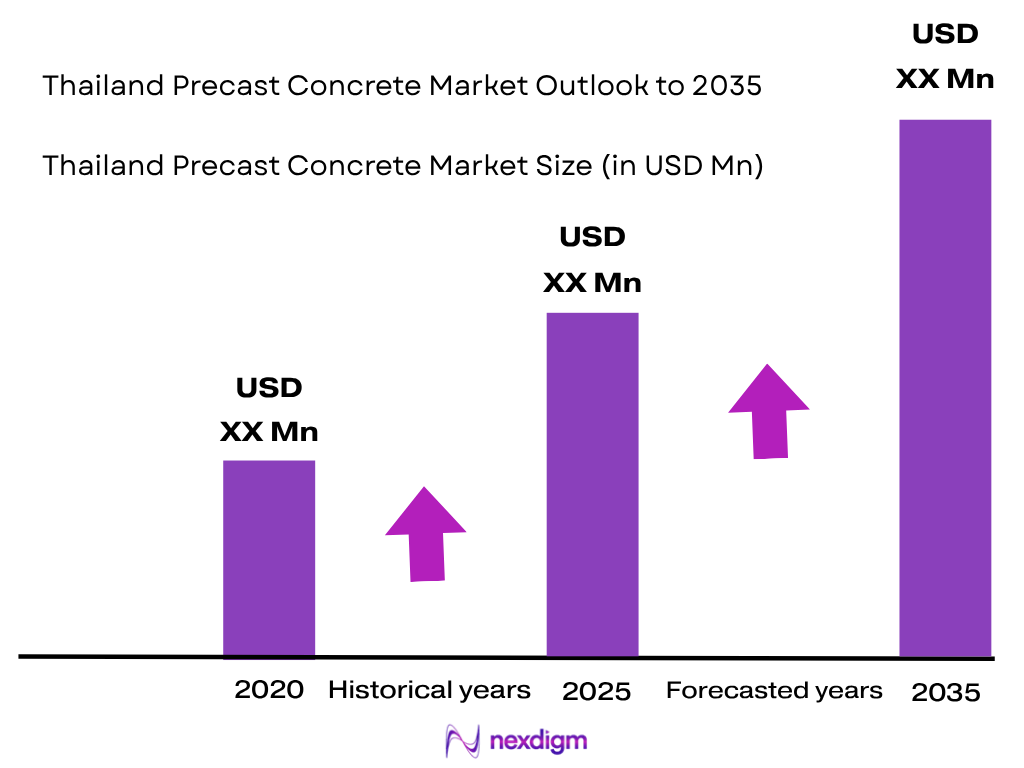
The Thailand Precast Concrete Market is valued at approximately USD ~XX billion, with the market supported by the country’s substantial construction activity, infrastructure investment and continued adoption of industrialized construction methods. Thailand’s construction sector generated THB 438.5 billion in gross value in the latest published national accounts, compared with THB 437.6 billion in the preceding period. Public construction investment reached THB 280.8 billion in one quarter, while total public investment reached THB 806.8 billion during the first nine months of the latest reported year. These conditions support demand for standardized precast structural components, bridge elements, drainage products, piles and building systems.
Bangkok and the surrounding metropolitan provinces remain the principal demand centre for Thailand Precast Concrete Market because they combine high-density residential construction, commercial development, transport infrastructure and large-scale public projects. The Eastern Economic Corridor, particularly Chonburi, Rayong and Chachoengsao, represents another important construction cluster because industrial estates, manufacturing facilities, logistics assets and digital infrastructure are attracting large investment commitments. Thailand recorded 3,137 investment-promotion applications with a combined value of THB 1.14 trillion, while data-center and cloud projects alone accounted for THB 243.3 billion, strengthening demand for industrial and infrastructure-oriented precast systems.
Market Segmentation
By Product Type
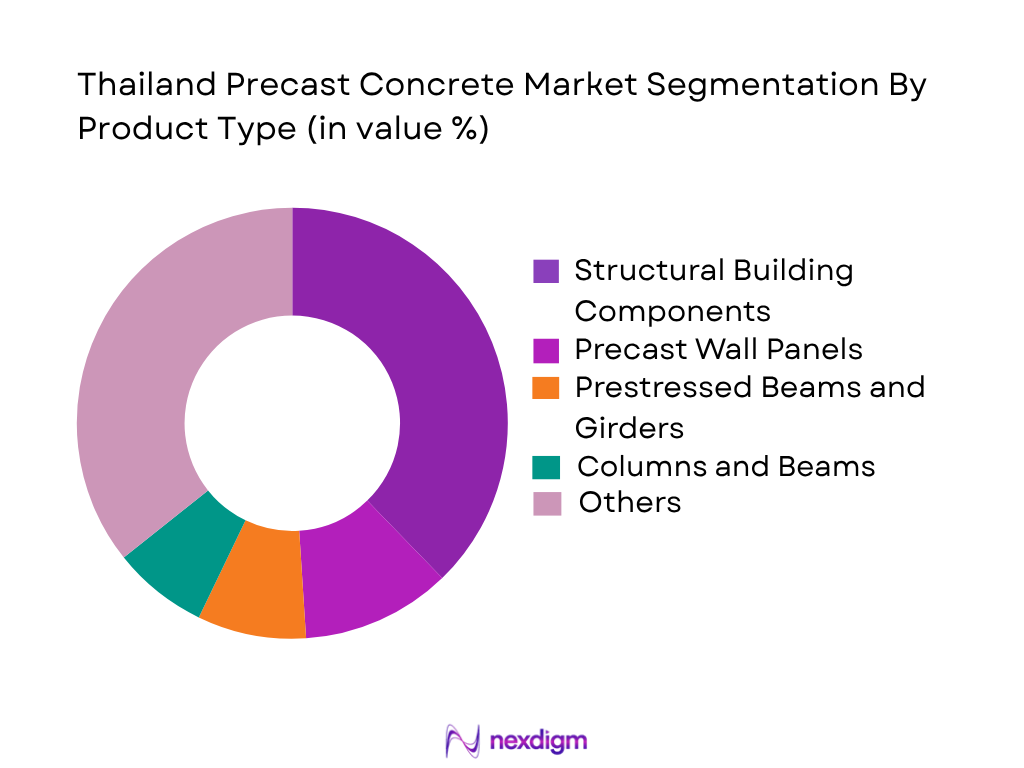
Thailand Precast Concrete Market is segmented by product type into structural building components, precast wall panels, prestressed beams and girders, columns and beams, hollow-core slabs, precast floor and roof systems, precast staircases and landings, architectural precast components, precast concrete pipes, box culverts, manholes and utility chambers, drainage structures, bridge components, railway and metro segments, and precast foundations and piles. Structural building components are expected to hold the leading position because beams, columns, slabs and wall panels are extensively incorporated into residential, commercial, industrial and institutional construction. Their standardized dimensions support factory-controlled manufacturing, repetitive production and faster site assembly. Thailand’s established industrialized construction ecosystem further supports demand for prefabricated structural elements. Pruksa’s precast operations, for example, have developed automated production and integrated manufacturing and installation capabilities, with reported annual capacity of up to 5.2 million square meters. Demand is also supported by high-rise housing, industrial facilities and infrastructure projects where standardized structural elements can reduce site labour requirements and construction duration.
By Application
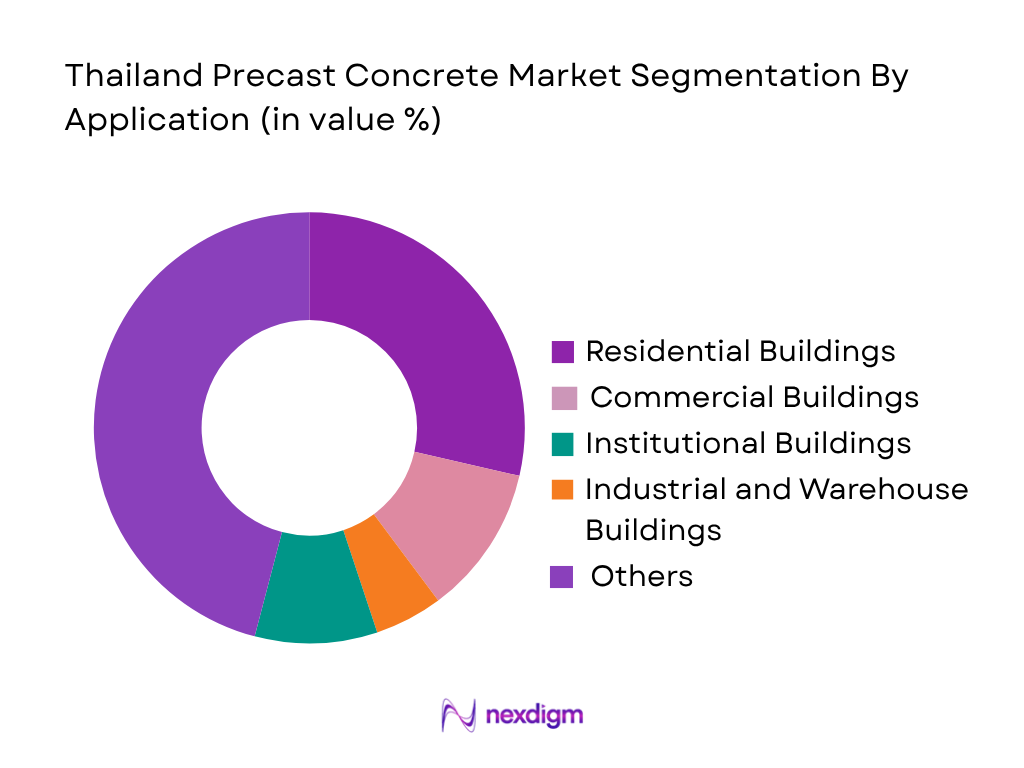
Thailand Precast Concrete Market is segmented by application into residential buildings, commercial buildings, institutional buildings, industrial and warehouse buildings, hotels and hospitality facilities, data centers, manufacturing facilities, bridges and transportation infrastructure, railway and metro infrastructure, roads and highways, water and wastewater infrastructure, utility infrastructure, energy infrastructure, marine and port infrastructure, and government and public facilities. Residential buildings are expected to remain a leading application because Thailand has an established market for standardized housing, condominiums and townhouses where precast wall panels, slabs, beams and columns can improve construction productivity. Industrial and infrastructure applications are also becoming increasingly important. Investment-promotion applications reached THB 1.14 trillion, with digital infrastructure receiving THB 243.3 billion of pledged investment. Large infrastructure projects, industrial estates and data centers require durable structural and utility components that can be manufactured off-site and installed rapidly.
Competitive Landscape
The Thailand Precast Concrete Market is characterized by established construction-material manufacturers, vertically integrated property developers, specialist precast producers and engineering contractors. Major participants compete through manufacturing capacity, standardized product portfolios, automated production, engineering support, transportation and erection capabilities. Pruksa’s Inno Precast has positioned itself as an integrated producer and installer, while CPAC benefits from the broader construction-material ecosystem of SCG. Siam City Cement also supplies specialized cement products designed for precast and prestressed applications, including high-early-strength and lower-carbon cement solutions.
| Company | Establishment | Headquarters | Production / Capacity Indicator | Core Product Capability | Infrastructure Capability | Geographic Coverage | Engineering / Installation |
| Pruksa / Inno Precast | 1993 / 2023 | Bangkok | ~ | ~ | ~ | ~ | ~ |
| CPAC | 1952 | Bangkok | ~ | ~ | ~ | ~ | ~ |
| Siam City Cement | 1969 | Bangkok | ~ | ~ | ~ | ~ | ~ |
| Sino-Thai Engineering & Construction | 1962 | Bangkok | ~ | ~ | ~ | ~ | ~ |
| Italian-Thai Development | 1958 | Bangkok | ~ | ~ | ~ | ~ | ~ |
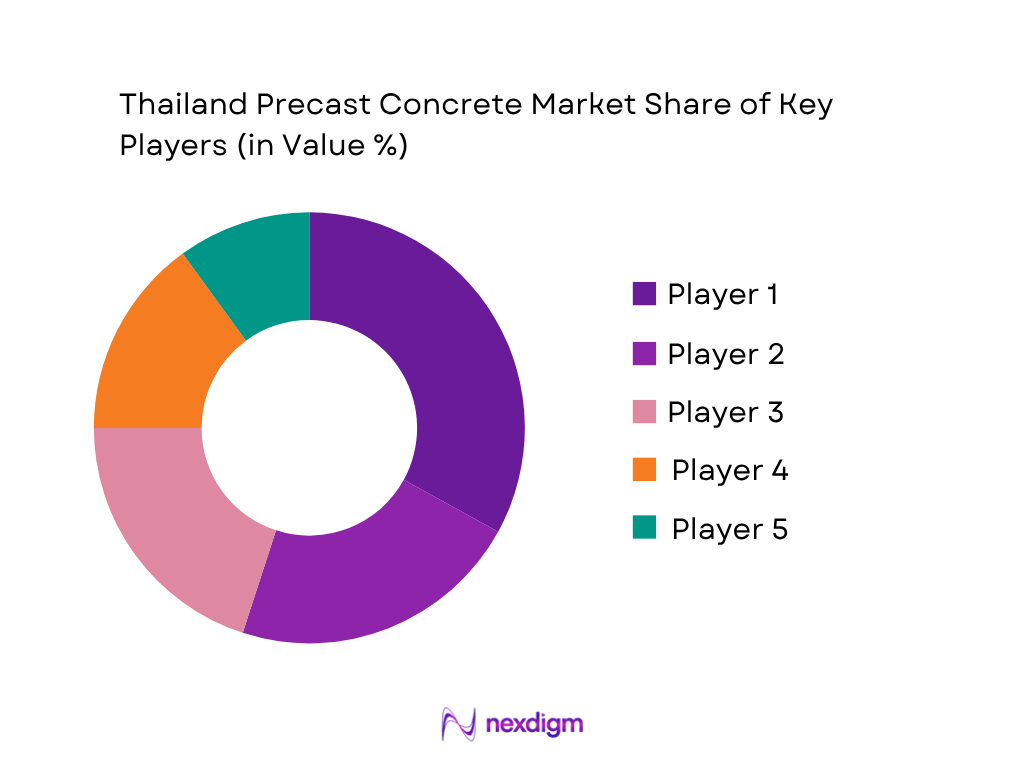
Thailand Precast Concrete Market Analysis
Growth Drivers
Expansion of Construction and Infrastructure Investment
Thailand Precast Concrete Market is supported by continued construction activity and public infrastructure investment, creating demand for standardized structural components, bridge elements, drainage products, piles and transportation structures. Thailand’s construction sector grew by 1.3 in 2024 after declining 0.6 in 2023, indicating a return to expansion in a major downstream market for precast products. Public investment was THB 347.8 billion in Q3 2024, including THB 280.8 billion in public construction investment, while public construction investment reached THB 631.8 billion during the first nine months. The National Statistical Office also recorded 188,461 building-construction permits in 2024, compared with 208,741 in 2023, demonstrating a substantial pipeline for building-related material demand. These conditions support precast applications where standardized manufacturing can serve repetitive residential, institutional and infrastructure requirements. The IMF reported Thailand’s real GDP growth at 2.7 in 2024, providing a broader macroeconomic base for construction activity. Continued public investment, transportation development and building activity therefore create a favorable environment for factory-produced concrete components.
Industrial, Data Center and Advanced Manufacturing Expansion
Thailand Precast Concrete Market is gaining additional demand opportunities from industrial facilities, logistics assets, manufacturing plants and data centers that require standardized structural systems, foundations, utility structures and other concrete components. Thailand’s Board of Investment recorded 3,137 investment-promotion applications during 2024, with combined proposed investment of THB 1.14 trillion. The digital sector alone accounted for 150 projects valued at THB 243.3 billion, led by data-center and cloud-service investments. Electronics and electrical appliances generated 407 applications valued at THB 231.7 billion, while automotive and parts remained another important investment category. The BOI also reported that FDI represented 73 of total application value, demonstrating substantial international participation in Thailand’s industrial development pipeline. These projects can create demand for precast columns, beams, floor systems, wall panels, foundations and infrastructure components because industrial facilities generally require rapid construction and repeatable structural layouts. The Eastern Economic Corridor is particularly relevant because industrial and advanced-technology investments are concentrated around major manufacturing clusters. The combination of industrial investment, digital infrastructure and factory development therefore broadens the addressable demand base beyond conventional residential construction and supports greater adoption of engineered precast systems.
Market Challenges
Construction Labor Availability and Productivity Constraints
Thailand Precast Concrete Market faces challenges associated with construction labor availability, workforce composition and the need for specialized installation capabilities. The National Statistical Office reported approximately 2.47 million people employed in Thailand’s construction sector during Q1 2024, compared with 2.36 million during Q1 2023. Although employment increased by approximately 110,000 people, construction remained a relatively specialized employment base compared with Thailand’s broader workforce of approximately 39.58 million employed persons. Precast construction does not eliminate labor requirements because manufacturing, reinforcement placement, quality control, transportation, crane operation, connection work and site erection require trained personnel. National Statistical Office data also show that construction represented 5.4 of employed persons in Q3 2024, while the female participation component within construction remained comparatively limited. These workforce characteristics create operational requirements for manufacturers and contractors to maintain skilled plant and erection teams. Precast projects require coordination between factories, transportation providers, crane operators, structural engineers and site contractors, meaning shortages in any one specialized activity can affect project schedules. The challenge is particularly relevant for projects involving large beams, bridge segments, piles and complex structural connections where installation accuracy and sequencing are critical.
Project Coordination, Transportation and Uneven Construction Demand
Thailand Precast Concrete Market faces operational challenges because precast components require close coordination between manufacturing schedules, project designs, transportation and site erection. The issue is amplified by uneven construction activity across building categories. NESDC data show that private construction declined 3.9 in Q4 2024, following a 6.0 decline in the preceding quarter, while dwelling construction declined 7.8 in Q4. At the same time, industrial construction continued to expand, creating a more uneven demand profile across end-use segments. The National Statistical Office recorded 188,461 building permits during 2024, compared with 208,741 during 2023, indicating a lower number of permitted projects even while selected industrial and infrastructure segments remained active. This creates capacity-planning challenges for precast manufacturers because plants require significant fixed production infrastructure, molds, reinforcement systems and specialized equipment. Components also need to be produced according to project-specific dimensions and delivered within defined installation sequences. Delays in design approval, site readiness or transportation can therefore disrupt production schedules and plant utilization. Manufacturers must balance standardized production with project-specific engineering while maintaining sufficient capacity for large infrastructure contracts without creating excessive idle manufacturing resources.
Market Opportunities
Data Centers, Industrial Facilities and Digital Infrastructure
Thailand Precast Concrete Market has an emerging opportunity in data centers and digitally enabled industrial infrastructure because these projects require large-scale structural, utility and site-development components and typically involve tightly controlled construction schedules. Thailand’s Board of Investment recorded 150 digital-sector investment applications worth THB 243.3 billion in 2024, making digital infrastructure the largest sector by proposed investment value. BOI data also show that data-center and cloud-service applications during 2022-2024 reached 27 projects with combined proposed investment of THB 290 billion. Within the 2024 digital-sector pipeline, major international technology companies submitted applications for large data-center projects, strengthening the requirement for specialized construction supply chains. Precast manufacturers can address this opportunity through columns, beams, floor systems, wall panels, utility structures, equipment bases, drainage systems and other standardized components suited to data-center construction. Industrial buildings associated with electronics, automotive and advanced manufacturing provide another addressable application. BOI recorded 407 electronics and electrical-appliance investment applications worth THB 231.7 billion during 2024, reinforcing the scale of Thailand’s industrial development pipeline. These projects create opportunities for suppliers capable of providing engineered products, rapid manufacturing, reliable dimensional control and integrated delivery and installation services.
Industrialized Building Systems, Modular Construction and Low-Carbon Precast
Thailand Precast Concrete Market has an opportunity to expand through industrialized building systems, modular construction and lower-carbon concrete solutions as developers and contractors seek more controlled construction processes. Thailand’s construction sector grew by 1.3 in 2024, while public construction investment reached THB 631.8 billion during the first nine months of the year, providing a substantial project base for prefabricated structural solutions. The National Statistical Office recorded 256,994 building constructions in 2024, demonstrating the scale of the building environment in which standardized concrete components can be deployed. Precast manufacturers can use this demand base to expand from individual components into integrated systems combining wall panels, beams, columns, slabs, staircases and foundations. Digital design coordination and factory production can further improve dimensional consistency and installation sequencing. Low-carbon products represent another opportunity because large infrastructure and building programs create substantial recurring concrete demand, allowing manufacturers to introduce supplementary cementitious materials, optimized mix designs and resource-efficient production methods across larger production volumes. Public infrastructure, residential development and industrial facilities therefore provide multiple channels for expanding higher-value precast solutions without relying solely on conventional cast-in-place construction.
Future Outlook
Over the next decade, the Thailand Precast Concrete Market is expected to benefit from increasing adoption of industrialized construction, continued infrastructure development and demand for shorter construction schedules. Data-center investment, industrial expansion and transportation infrastructure are creating additional applications for standardized structural components. The market is also expected to move toward automated manufacturing, BIM-enabled design coordination, low-carbon concrete and integrated design-to-installation services. Public investment will remain an important demand contributor, while private developers are likely to increasingly adopt precast systems to address construction productivity and labour requirements.
Thailand’s investment environment provides a substantial pipeline for future construction-related demand. Investment-promotion applications reached THB 1.14 trillion, while digital-sector applications alone reached THB 243.3 billion. Data-center and cloud-service investment applications across the latest three-year period totaled 27 projects and THB 290 billion, reinforcing the potential for specialist structural precast applications in digital infrastructure.
Major Players
- Pruksa Holding / Inno Precast
- CPAC
- Siam City Cement Public Company Limited
- Sino-Thai Engineering & Construction PCL
- Italian-Thai Development PCL
- SCG Heim Co., Ltd.
- Thai-German Precast Co., Ltd.
- Thai Precast Concrete Co., Ltd.
- Thai Prefab Co., Ltd.
- PCM Construction Materials Co., Ltd.
- AM Precast Co., Ltd.
- Seacon Construction Systems
- Toyo-Thai Corporation PCL
- Christiani & Nielsen (Thai) PCL
- STP&I Public Company Limited
Key Target Audience
- Real Estate Developers and Residential Property Developers
- Industrial Estate Developers and Industrial Facility Operators
- Precast Concrete Manufacturers and Construction-Material Producers
- General Contractors and Engineering, Procurement and Construction Companies
- Infrastructure Developers and Transportation Project Operators
- Investments and Venture Capitalist Firms
- Government and Regulatory Bodies (Ministry of Industry, Ministry of Transport, Department of Public Works and Town & Country Planning, Department of Highways, State Railway of Thailand, Mass Rapid Transit Authority of Thailand)
- Construction Equipment, Automation and Precast Technology Suppliers
Research Methodology
Step 1: Identification of Key Variables
The initial phase involves constructing a Thailand Precast Concrete Market ecosystem covering cement suppliers, aggregate producers, precast manufacturers, developers, contractors, infrastructure agencies and installation providers. Product variables include structural precast, prestressed components, wall panels, slabs, pipes, piles, bridge elements and modular systems. Demand variables are mapped across residential, commercial, industrial and infrastructure construction.
Step 2: Market Analysis and Construction
Historical market information is compiled using construction-sector output, public investment, infrastructure expenditure, property development activity and company-level production indicators. The assessment separates structural building demand from infrastructure demand and evaluates manufacturing capacity, utilization, product mix, transportation requirements and installation activity to construct the market baseline.
Step 3: Hypothesis Validation and Expert Consultation
Market hypotheses are validated through interviews with precast manufacturers, construction contractors, developers, structural engineers and infrastructure participants. Discussions focus on production capacity, project pipelines, product specifications, procurement practices, plant utilization, transportation limitations and installation requirements. Company-level information is cross-checked against publicly available financial and operational disclosures.
Step 4: Research Synthesis and Final Output
The final analysis integrates top-down construction expenditure assessment with bottom-up company, product and project analysis. Data are triangulated across official statistics, company disclosures, investment announcements and construction-sector information. The resulting framework is used to establish historical market estimates, segmentation structures, competitive assessments and the long-term market outlook.

- Executive Summary
- Research Methodology (Market Definitions and Assumptions, Thailand Precast Concrete Market Classification, Precast and Prestressed Concrete Scope, Product Mapping, Structural Component Mapping, Infrastructure Product Mapping, Architectural Precast Assessment, Structural Precast Assessment, Prestressed Concrete Assessment, Precast Pipe Assessment, Utility Structure Assessment, Bridge Component Assessment, Railway and Metro Segment Assessment, Hollow-Core Slab Assessment, Precast Wall Panel Assessment, Precast Beam and Column Assessment, Precast Pile Assessment, Production Capacity Assessment, Plant Utilization Assessment, Precast Manufacturing Facility Mapping, Industrialized Building System Assessment, Supply-Side Assessment, Demand-Side Assessment, Top-Down Market Sizing, Bottom-Up Market Sizing, Primary Industry Interviews, Construction and Infrastructure Project Pipeline Assessment, Data Triangulation, Forecasting Framework)

- Definition and Scope
- Thailand Precast Concrete Industry Evolution and Development of Structural Precast Systems, Prestressed Concrete Systems, Architectural Precast, Industrialized Building Systems, Precast Residential Buildings, Precast Wall Panels, Hollow-Core Slabs, Precast Beams and Girders, Precast Columns, Precast Concrete Pipes, Box Culverts, Utility Chambers, Bridge Components, Railway and Metro Components, Precast Piles, Modular Precast Systems, High-Performance Concrete, Automated Casting Technologies, Low-Carbon Precast Concrete
- Precast Concrete Value Chain Analysis
- Precast Concrete Supply Chain Analysis
- Cement Suppliers, Aggregate Producers, Supplementary Cementitious Material Suppliers, Reinforcing Steel Suppliers, Prestressing Strand Suppliers, Admixture Suppliers, Formwork and Mold Providers, Precast Manufacturing Plants, Prestressing Facilities, Engineering and Design Companies, Heavy-Haul Transportation Providers, Crane and Erection Contractors, General Contractors, Real Estate Developers, Industrial Estate Developers, Government Construction Agencies, Provincial Authorities, Infrastructure Authorities, Utility Providers, Certification and Testing Organizations

- Growth Drivers (Residential Construction Expansion, Industrialized Building System Adoption, Eastern Economic Corridor Development, Infrastructure Investment, High-Rise Residential Construction, Industrial and Logistics Expansion, Data Center Construction, Railway and Metro Development, Road and Highway Infrastructure, Construction Productivity Requirements, Faster Project Execution, Factory-Controlled Quality)
- Market Challenges (Heavy Component Transportation Constraints, Crane and Erection Requirements, Cement and Aggregate Supply Constraints, Skilled Plant Labor Requirements, Connection Engineering Complexity, Regional Manufacturing Coverage, Freight Radius Limitations, Project-Specific Mold Requirements, Capital-Intensive Manufacturing Plants, Construction Cycle Volatility, Late-Stage Design Modification Constraints, Manufacturing and Site Coordination Complexity)
- Market Opportunities (Industrialized Building System Precast, DfMA Precast Construction, Modular Building Systems, High-Rise Residential Precast, Data Center Structural Systems, Industrial and Logistics Facilities, Eastern Economic Corridor Projects, Infrastructure Precast Components, Railway and Metro Components, Bridge and Highway Precast, Precast Drainage Systems, Sustainable Precast Concrete, Low-Carbon Concrete, Prefabricated Volumetric Construction, Precast Retrofit and Replacement Components)
- Market Trends (Industrialized Building System Adoption, Total Precast Construction, Design-Assist Procurement, Prefabrication and Off-Site Manufacturing, High-Performance Concrete, Self-Consolidating Concrete, Digital Production Planning, BIM-to-Fabrication Integration, Automated Reinforcement Placement, Modular Construction)
- Government Regulations and Standards (Thai Industrial Standards for Precast Concrete Products, Building Control Act Requirements, Engineering Institute of Thailand Standards, Department of Public Works and Town & Country Planning Requirements, Department of Highways Specifications, State Railway of Thailand Specifications, Mass Rapid Transit Authority Requirements)
- SWOT Analysis
- Porter’s Five Forces Analysis
- PESTLE Analysis
- Stakeholder Ecosystem
- Precast Concrete Production and Construction Ecosystem

- By Market Value (2020-2025)
- By Precast Concrete Production Volume (2020-2025)
- By Precast and Prestressed Concrete Shipment Volume (2020-2025)
- By Structural Precast Production Volume (2020-2025)
- By Architectural Precast Production Volume (2020-2025)
- By Infrastructure Precast Production Volume (2020-2025)
- By Precast Concrete Pipe Production Volume (2020-2025)
- By Precast Wall Panel Production Volume (2020-2025)
- By Hollow-Core Slab Production Volume (2020-2025)
- By Precast Beam and Column Production Volume (2020-2025)
- By Precast Pile Production Volume (2020-2025)
- By Bridge Component Production Volume (2020-2025)

- By Product Type (In Value %)
Structural Building Components
Architectural Precast Panels
Precast Wall Panels
Prestressed Beams and Girders
Columns and Beams
Hollow-Core Slabs
Precast Floor and Roof Systems
Precast Staircases and Landings
Precast Concrete Pipes
Box Culverts
Manholes and Utility Chambers
Drainage Structures
Bridge Components
Railway and Metro Segments
Precast Foundations and Piles - By Construction System (In Value %)
Structural Precast Systems
Prestressed Concrete Systems
Total Precast Building Systems
Architectural Precast Systems
Precast Envelope Systems
Industrialized Building System Precast
Hybrid Precast-Steel Systems
Hybrid Precast-Cast-in-Place Systems
Modular Precast Concrete Systems - By Application (In Value %)
Residential Buildings
Commercial Buildings
Institutional Buildings
Industrial and Warehouse Buildings
Hotels and Hospitality Facilities
Data Centers
Manufacturing Facilities
Bridges and Transportation Infrastructure
Railways and Metro Infrastructure
Roads and Highways
Water and Wastewater Infrastructure
Utility Infrastructure
Energy Infrastructure
Marine and Port Infrastructure
Government and Public Facilities - By Manufacturing Technology (In Value %)
Conventional Wet-Cast Precast
Prestressed Precast
Dry-Cast Concrete
Self-Consolidating Concrete Precast
High-Performance Concrete Precast
Automated Precast Production
Mechanized Reinforcement Production
Modular and Volumetric Precast
Low-Carbon Precast Concrete - By Region (In Value %)
Bangkok Metropolitan Region
Central Thailand
Eastern Economic Corridor
Northern Thailand
Northeastern Thailand
Southern Thailand
Western Thailand

- Market Share of Major Players (By Thailand Revenue, Precast Production Capacity, Number of Manufacturing Plants, Structural Precast Capacity, Prestressed Concrete Capacity, Architectural Precast Capability, Infrastructure Product Portfolio, Industrialized Building System Capability, Geographic Coverage, Engineering and Design-Assist Capability, Heavy-Haul Capability, Erection Capability, Major Residential Project Portfolio, Major Infrastructure Project Portfolio)
- Cross Comparison Parameters (Annual Precast Production Capacity, Manufacturing Plant Network, Structural and Prestressed Product Breadth, Infrastructure Product Portfolio, Residential Precast Capability, Industrialized Building System Capability, Engineering and Design-Assist Capability, Heavy-Haul and Erection Capability)
- SWOT Analysis of Major Players
- Competitive Positioning Matrix
- Major Companies
Siam Cement Group
CPAC Concrete Products and Aggregate Co., Ltd.
Siam City Cement Public Company Limited
Yong Concrete Public Company Limited
Thai-German Precast Co., Ltd.
Pruksa Precast Co., Ltd.
SCG Heim Co., Ltd.
Siam Precast Concrete Co., Ltd.
Thai Precast Concrete Co., Ltd.
Thai Prefab Co., Ltd.
AM Precast Co., Ltd.
Boonthavorn Precast
Seacon Construction Systems
Sino-Thai Engineering and Construction PCL
Italian-Thai Development PCL

- Real Estate Developer Precast Requirement Assessment
- General Contractor Procurement Assessment
- Precast Erection Contractor Requirement Analysis
- Structural Engineer Specification Assessment
- Industrial Estate Developer Precast Requirement Assessment
- Residential High-Rise Precast Requirement Assessment
- Commercial Building Precast Requirement Assessment
- Industrial and Warehouse Precast Requirement Assessment
- Data Center Precast Requirement Assessment
- Bridge and Transportation Precast Assessment

- By Market Value (2026-2035)
- By Precast Concrete Production Volume (2026-2035)
- By Structural Precast Production Volume (2026-2035)
- By Prestressed Concrete Production Volume (2026-2035)
- By Architectural Precast Production Volume (2026-2035)
- By Infrastructure Precast Production Volume (2026-2035)
- By Precast Concrete Pipe Production Volume (2026-2035)
- By Bridge Component Production Volume (2026-2035)
- By Railway and Metro Precast Demand (2026-2035)
- By Residential Precast Demand (2026-2035)
- By Industrial and Logistics Precast Demand (2026-2035)
- By Data Center Precast Demand (2026-2035)
- By Water and Wastewater Precast Demand (2026-2035)
- By Total Precast Building System Demand (2026-2035)
- By Low-Carbon Precast Concrete Demand (2026-2035)


 Request a Sample
 Ask for Customization
 Get a Quote
 Enquire Now
