
 Download PDF
Market Overview
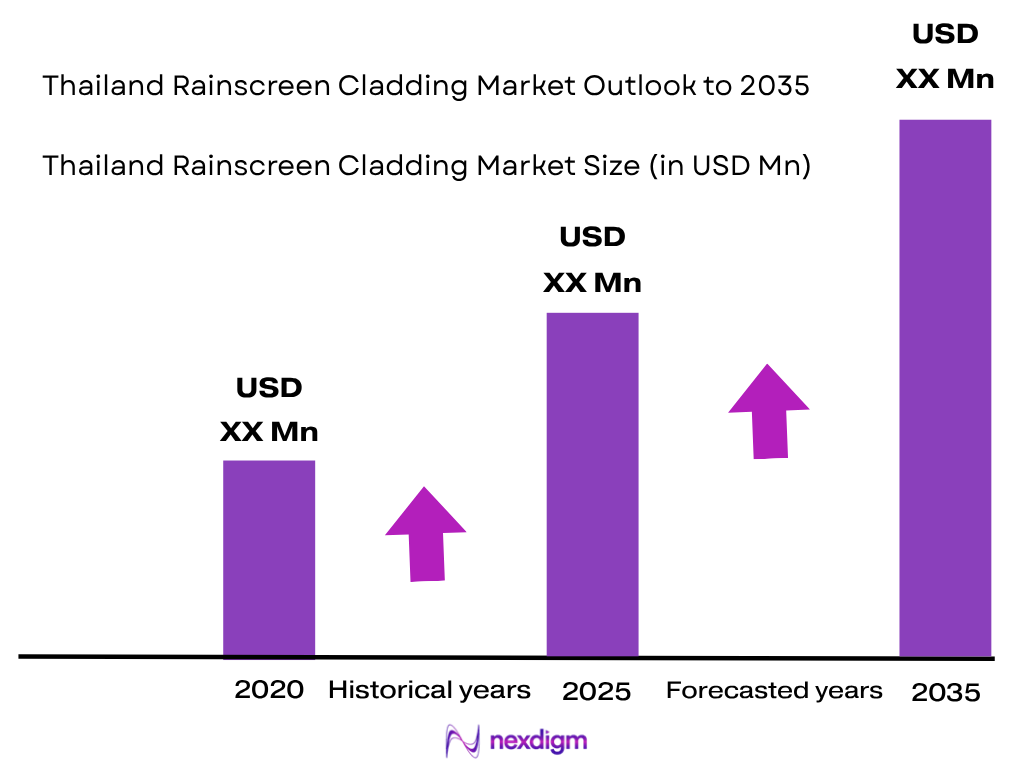
The Thailand Rainscreen Cladding Market is valued at approximately ~USD XX million, compared with ~USD XX million in the preceding reporting period. Thailand recorded 60,851,513 sq. m. of permitted new-building construction area in one reporting period and 58,862,540 sq. m. in the following period, providing a substantial addressable building-envelope base. Demand is supported by commercial redevelopment, premium residential construction, hospitality projects, energy-efficient envelopes, lightweight façade systems, and building refurbishment activity.
Bangkok and its surrounding metropolitan provinces form the principal rainscreen-cladding demand centre, supported by approximately 18,644,216 sq. m. of new-building construction across Bangkok and its vicinities in the earlier reporting period and approximately 15,871,698 sq. m. subsequently. Chonburi and Rayong are increasingly important because of Eastern Economic Corridor infrastructure and industrial investment, while Phuket benefits from hotel and resort development requiring durable, corrosion-resistant and architecturally differentiated façades.
Market Segmentation
By Material Type
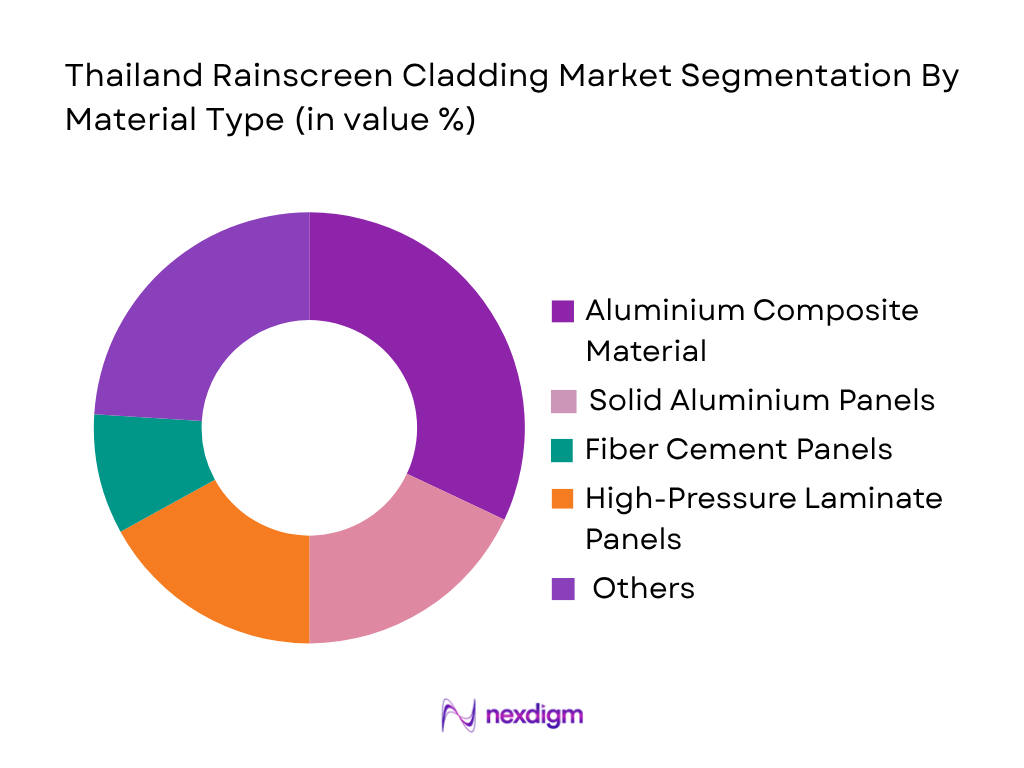
The Thailand Rainscreen Cladding Market is segmented by material type into aluminium composite material, solid aluminium panels, fibre cement panels, high-pressure laminates, terracotta and ceramic panels, natural stone, other metal panels and specialty façade materials. Aluminium composite material is treated as the dominant sub-segment in the working market model, owing to its established use in Thailand’s commercial façades, relatively low panel weight, fabrication flexibility, broad colour and coating availability, and suitability for complex architectural geometries. Aluminium composite panels can be fabricated into cassette-type façades and integrated with rail-and-bracket systems, enabling contractors to achieve relatively fast installation. Their established distributor and fabricator ecosystem also supports procurement for retail, mixed-use, office and hospitality projects. Premium projects are increasingly evaluating mineral-core composite panels or solid aluminium alternatives where enhanced fire performance is required. Solid aluminium and fibre cement are consequently positioned as important growth categories as designers place greater emphasis on non-combustibility, durability and lifecycle performance.
By Building Type
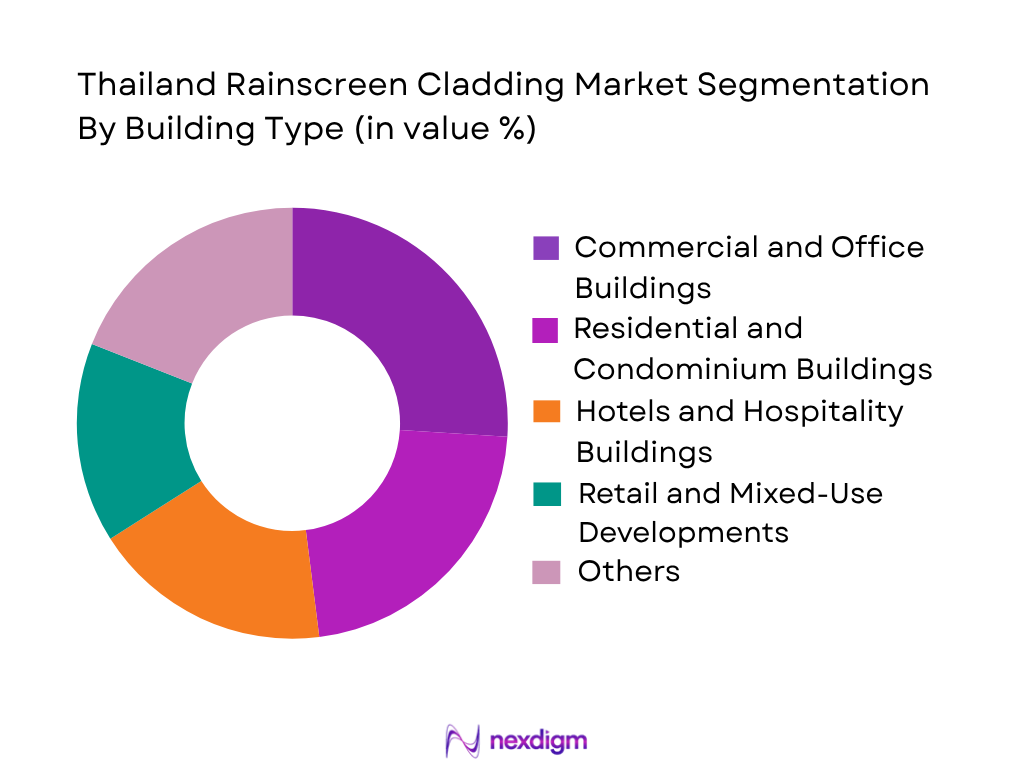
The Thailand Rainscreen Cladding Market is segmented by building type into commercial buildings, residential developments, hospitality properties, retail and mixed-use projects, institutional facilities, industrial and logistics properties, data centres and transportation infrastructure. Commercial buildings are treated as the leading sub-segment in the working market model, supported by Bangkok’s concentration of offices, premium mixed-use developments and asset-upgrade projects. Commercial owners place considerable importance on façade appearance because exterior design influences asset positioning, tenant perception and long-term property value. Rainscreen assemblies also provide opportunities to combine architectural finishes with drainage cavities, insulation and façade refurbishment without fully replacing the underlying structural wall. Grade-A office and mixed-use developments typically involve specialist architects and façade consultants, creating greater opportunity for engineered systems, premium coatings, concealed fixings and detailed performance specifications. Hospitality and premium residential developments represent another important demand pool, particularly in Bangkok, Phuket, Pattaya and other tourism-oriented markets.
Competitive Landscape
The Thailand Rainscreen Cladding Market combines domestic building-material groups, specialist fibre-cement producers and international façade-system suppliers. Local companies benefit from manufacturing capacity, distribution access and relationships with contractors, whereas international participants generally compete through premium façade materials, technical performance, architectural specifications and engineered fixing systems. Competition therefore extends beyond panel pricing to fire performance, coatings, system engineering, substructure compatibility, fabrication support, architect engagement, product availability and installation assistance. SCG was founded in Thailand in 1913, while SHERA traces its operations to 1974 and maintains manufacturing and distribution facilities in Thailand.
| Major Player | Establishment Year | Headquarters | Key Rainscreen Offering | Primary Material / Technology | Fire & Performance Capability | Thailand Supply Capability | Target Applications | Specification & Technical Support |
| SCG D’COR / SCG Smart Living | 1913 | Bangkok, Thailand | ~ | ~ | ~ | ~ | ~ | ~ |
| SHERA Public Company Limited | 1974 | Bangkok, Thailand | ~ | ~ | ~ | ~ | ~ | ~ |
| Etex Group – EQUITONE | 1905 | Zaventem, Belgium | ~ | ~ | ~ | ~ | ~ | ~ |
| 3A Composites – ALUCOBOND / ALUCOLUX | 2010 under 3A Composites identity | Singen, Germany / Osnabrück, Germany | ~ | ~ | ~ | ~ | ~ | ~ |
| Hilti Thailand | 1941 | Schaan, Liechtenstein | ~ | ~ | ~ | ~ | ~ | ~ |
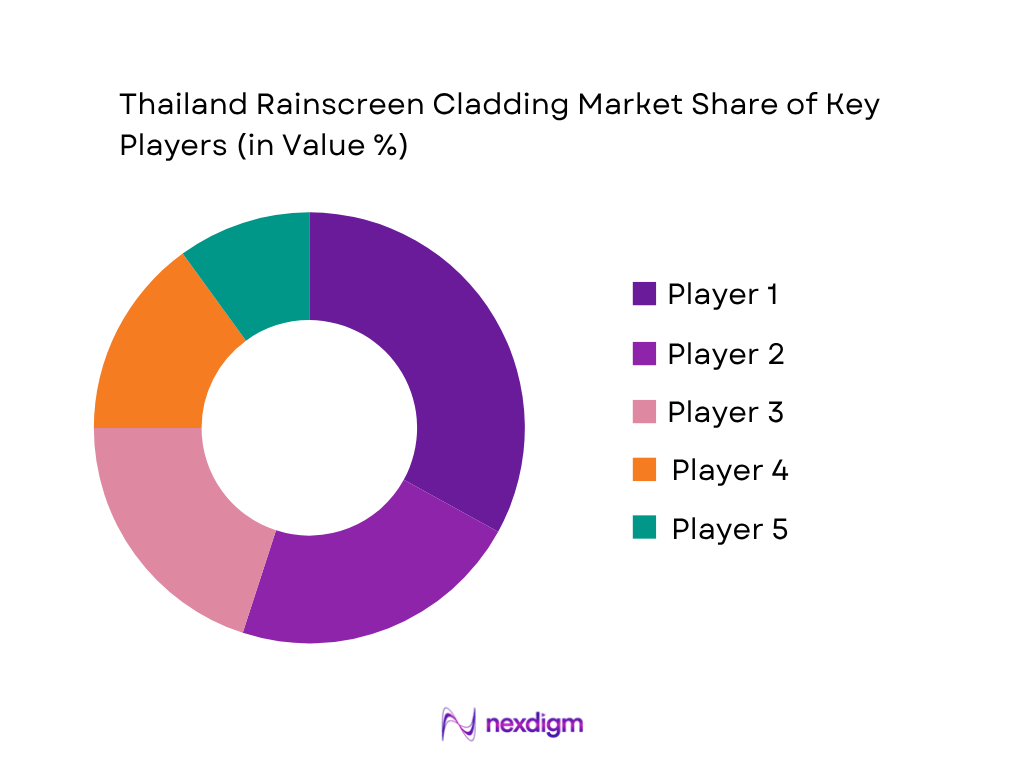
Thailand Rainscreen Cladding Market Analysis
Growth Drivers
Expanding Commercial, High-Rise and Metropolitan Construction Base
Thailand’s rainscreen cladding demand is being supported by a large, geographically concentrated pipeline of buildings that can use lightweight ventilated façades, aluminium panels, fibre-cement boards, metal rainscreens and other engineered exterior-wall systems. National construction data show that 58,862,540 sq. m. of new building area was permitted across Thailand in 2024, creating a substantial underlying addressable envelope for façade materials. Bangkok alone recorded 3,654,628 sq. m., while the surrounding metropolitan provinces recorded another 12,217,070 sq. m., giving Bangkok and its vicinities a combined 15,871,698 sq. m. of permitted new-building area. The Central Region recorded 21,677,863 sq. m., reinforcing the concentration of construction activity around Thailand’s principal commercial and industrial corridors. Thailand’s nominal GDP stood at USD 526.5 billion and GDP per capita at USD 7,346.6 in 2024, indicating a large economic base capable of supporting commercial property, hospitality, mixed-use and industrial development. Rainscreen suppliers particularly benefit from projects where architectural differentiation, weather protection, façade longevity and lightweight construction are important. Bangkok’s concentration of office towers, malls, hotels, condominiums and mixed-use properties makes it especially relevant for mechanically fixed panel systems and ventilated cavities. Outside the capital, Chonburi, Rayong and adjoining industrial areas provide another important demand pool through factories, logistics facilities, commercial buildings and industrial estates. Consequently, Thailand’s construction footprint creates a building mix that is well suited to engineered rainscreen systems.
Investment in Data Centres, Advanced Industry and Building-Envelope Performance
Investment in high-specification industrial and digital infrastructure is strengthening the addressable project base for Thailand’s rainscreen cladding suppliers because these facilities increasingly require durable, maintainable and performance-oriented external envelopes. Thailand recorded 1.14 trillion baht of investment-promotion applications in 2024, while the digital sector accounted for 150 projects representing 243.3 billion baht in pledged investment. Data-centre and cloud projects were major contributors, alongside semiconductor and advanced-electronics developments. Such facilities create demand for non-residential façades where moisture control, panel durability, corrosion resistance, fire performance and rapid installation become important specification criteria. Thailand’s nominal GDP stood at about USD 526.5 billion, merchandise exports reached USD 297.3 billion, net foreign direct investment was USD 6.95 billion, official reserves stood at USD 237.0 billion, and the average exchange rate was approximately 35.29 baht per U.S. dollar in 2024. These indicators underline Thailand’s position as a major manufacturing and investment base rather than a construction market driven only by local housing. Thailand’s Building Energy Code also applies energy-performance requirements to qualifying buildings with a combined floor area of at least 2,000 sq. m. across 9 specified building categories. The framework includes Overall Thermal Transfer Value and Roof Thermal Transfer Value assessments, making façade composition, insulation and heat transfer relevant at the design stage. This supports rainscreen solutions integrating ventilated cavities, mineral-wool insulation, thermal breaks and high-performance exterior panels.
Market Challenges
Weakness in New-Build Construction Volumes and Uneven Private Construction Activity
The principal near-term challenge for Thailand’s rainscreen cladding market is that the underlying construction pipeline has not expanded uniformly, limiting the number of projects immediately available to façade-system suppliers. National construction data show 58,862,540 sq. m. of permitted new-building area in 2024, compared with 60,851,513 sq. m. in the previous annual dataset, demonstrating that the overall project base softened rather than expanding. Bangkok’s permitted new-building area stood at 3,654,628 sq. m., while metropolitan vicinities contributed 12,217,070 sq. m.. Although these figures remain substantial, the geographic concentration makes rainscreen suppliers dependent on a comparatively narrow set of large urban and premium projects. Separate economic-indicator data recorded 188,461 construction permit recipients and around 52.1 million sq. m. under a harmonized annual construction indicator series for 2024, again illustrating a weaker nationwide construction environment depending on the statistical classification used. The four-month moving average of construction area permitted stood at 5,860.9 thousand sq. m. in December 2024, compared with 6,084.9 thousand sq. m. in September, while the construction-material sales index was 93.1 in December. This is particularly significant for rainscreen cladding because these systems are generally installed late in a project cycle, meaning delays in permits, financing, structural works or main-contract awards can push façade procurement well beyond original schedules. Suppliers therefore face uneven factory utilization, tender uncertainty and dependence on a smaller number of landmark projects.
Tight Credit Conditions and High Dependence on Imported Façade Components
Financing conditions and Thailand’s reliance on internationally sourced façade materials create another significant constraint for the rainscreen cladding industry. Thailand had approximately USD 161.5 billion of private-sector external debt in 2024, while short-term external liabilities including portfolio flows were approximately USD 86.3 billion. The average exchange rate was about 35.29 baht per U.S. dollar, meaning imported aluminium sheets, specialist composite panels, European high-pressure laminates, terracotta panels, façade brackets, anchors, membranes and fire-barrier products remain exposed to currency movements even when project contracts are denominated in baht. Imported capital goods at constant prices were about USD 4,867.6 million in December 2024, demonstrating the broader economy’s continuing dependence on imported equipment and components. This matters for rainscreen projects because premium façade systems frequently combine materials sourced from several countries, making lead-time management and specification continuity more complex than for locally produced cementitious wall products. Thailand’s sophisticated façade projects also require compatible substructures, anchors, insulation, coatings and tested panel assemblies, and substitution of one component can require additional engineering review or mock-up testing. External debt reached approximately USD 210.8 billion in the subsequent reporting period, reinforcing broader financing sensitivity. For developers and main contractors, tighter financing tends to increase scrutiny of non-structural building elements and encourages value engineering during tendering. Premium rainscreen systems therefore compete not only with other panel materials but also with rendered walls, direct-fixed cladding and simpler external finishes.
Market Opportunities
Energy-Efficient Recladding and Building-Envelope Upgrade Opportunity
Thailand’s existing building stock creates a material future opportunity for rainscreen cladding because ventilated systems can be used not only in new construction but also for façade replacement, energy upgrades and asset repositioning. National construction data recorded approximately 2,818,557 sq. m. of building addition and alteration area in 2024, demonstrating that a sizeable volume of construction activity already occurs outside completely new buildings. This installed-building base is particularly relevant to Bangkok, its surrounding provinces and mature tourism markets, where commercial buildings, hotels, retail properties and condominiums periodically require exterior rehabilitation. Thailand’s Building Energy Code applies to qualifying newly constructed or modified buildings with combined floor areas starting at 2,000 sq. m., covering 9 categories of buildings. The regulation evaluates the building envelope through metrics including Overall Thermal Transfer Value and Roof Thermal Transfer Value. This creates a pathway for rainscreen assemblies that incorporate insulation, ventilated cavities and thermally improved attachment systems to be specified as part of envelope upgrades rather than simply as aesthetic finishes. Thailand’s national output stood at USD 526.5 billion and GDP per capita at USD 7,346.6 in 2024, supporting a sizeable stock of income-producing real estate that owners have incentives to maintain and reposition. Future opportunity is therefore likely to extend beyond greenfield development toward offices seeking tenant upgrades, hotels requiring refurbishment, aging retail centres requiring façade modernization and institutional properties improving envelope performance. Rainscreen systems are suited to this activity because a new exterior skin can often be installed over an existing wall while creating space for insulation and moisture drainage.
Data Centres, EEC Industrial Development and High-Performance Non-Residential Facades
Thailand’s expanding digital and advanced-industrial investment base represents one of the strongest future opportunities for rainscreen cladding because these projects require large, durable and technically coordinated building envelopes. Thailand recorded 1.14 trillion baht of investment-promotion applications in 2024, with the digital sector comprising 150 projects and 243.3 billion baht of pledged investment. Large data-centre applications from international operators were among the projects highlighted, while semiconductor and advanced-electronics investment also contributed to the pipeline. This development supports façade demand across data halls, utility buildings, offices, laboratories, support buildings and associated industrial facilities, particularly where fast dry construction, non-combustible materials, maintainable panel modules and corrosion-resistant substructures are preferred. Thailand also recorded USD 6.95 billion of net foreign direct investment, USD 297.3 billion of merchandise exports and USD 237.0 billion of official reserves in 2024. The Eastern Economic Corridor adds a spatial focus to this investment trend through development areas in Chonburi, Rayong and Chachoengsao and their links to ports, airports, industrial estates and transportation infrastructure. National construction statistics already demonstrate the scale of Thailand’s Central-region development base, with 21,677,863 sq. m. of permitted new-building area recorded in 2024. For rainscreen suppliers, the opportunity is therefore not limited to decorative premium towers. Industrial, logistics and digital infrastructure can support demand for solid aluminium, coated metal, fibre cement, insulated cavity walls, mineral wool, engineered brackets and mechanically fixed panel systems where reliability and speed of replacement are important.
Future Outlook
The Thailand Rainscreen Cladding Market is forecast to expand at approximately ~X.X% CAGR during 2026-2035, supported by continued urban construction, premium commercial projects, tourism-related developments and greater attention to building-envelope performance. Building renovation and façade modernization should create an additional addressable market beyond new construction. Bangkok will remain the principal specification centre, while the Eastern Economic Corridor and tourism-oriented provinces are expected to create additional project opportunities.
Thailand’s Building Energy Code strengthens the strategic importance of building-envelope performance. The framework covers envelope requirements through Overall Thermal Transfer Value (OTTV) and Roof Thermal Transfer Value (RTTV) and applies energy-performance requirements to specified building categories and larger buildings. This supports greater consideration of insulation, thermal bridging, solar heat transfer and façade-envelope design during specification.
Major Players
- SCG D’COR / SCG Smart Living
- SHERA Public Company Limited
- Etex Group – EQUITONE
- 3A Composites – ALUCOBOND / ALUCOLUX
- Hunter Douglas Architectural Thailand
- Sika Thailand Limited
- Hilti Thailand
- ROCKWOOL Group
- Schüco Thailand
- FunderMax
- Trespa International B.V.
- Swisspearl Group
- KMEW / KUBOTA Matsushitadenko Exterior Works
- Permasteelisa Thailand
- Clad & Craft Creation Co., Ltd.
Key Target Audience
- Rainscreen Cladding and Exterior Façade Material Manufacturers
- Façade Contractors, Fabricators and Installation Companies
- Building Material Importers, Distributors and System Suppliers
- Real Estate Developers, Property Owners and Asset Management Companies
- Main Construction Contractors and EPC Companies
- Investments and Venture Capitalist Firms
- Government and Regulatory Bodies (Department of Alternative Energy Development and Efficiency, Department of Public Works and Town & Country Planning, Bangkok Metropolitan Administration, Eastern Economic Corridor Office)
- Commercial, Hospitality, Industrial, Logistics and Data Centre Property Operators
Research Methodology
Step 1: Identification of Key Variables
The initial phase involves creating a complete Thailand Rainscreen Cladding Market ecosystem covering panel manufacturers, importers, distributors, façade contractors, fabricators, developers, architects and system suppliers. Secondary research is used to identify major material categories, building applications, installed-area indicators, regulatory influences and construction clusters. Key variables include façade area, material type, installed cost, project pipeline, rainscreen penetration and building type.
Step 2: Market Analysis and Construction
Historical construction activity is evaluated alongside building permits, exterior-wall requirements, project completions, supplier activity and façade-material demand. A top-down model converts relevant construction activity into addressable external-wall area and rainscreen penetration, while a bottom-up model aggregates material suppliers, distributors, façade contractors and project-level installations. The two approaches are reconciled to develop the market value and installed-area framework.
Step 3: Hypothesis Validation and Expert Consultation
Initial market hypotheses are validated through structured interviews and computer-assisted telephone interviews with material manufacturers, façade contractors, architects, developers, distributors and technical specialists. Interviews assess prevailing panel preferences, installed prices, contractor margins, material substitution, fire requirements, import dependency, project specifications and buying criteria. Expert feedback is used to challenge assumptions developed from secondary datasets and project databases.
Step 4: Research Synthesis and Final Output
The final stage combines supplier-side information with demand-side project analysis and macro construction indicators. Market estimates are triangulated using installed square metres, average material pricing, supply-and-install pricing, company activity and construction pipeline information. Forecast scenarios incorporate new construction, retrofit potential, BEC-driven envelope requirements, material substitution, premium façade adoption and geographic expansion to produce a validated long-term outlook.

- Executive Summary
- Research Methodology (Market Definitions and Assumptions, Thailand Rainscreen Cladding Market Classification, Ventilated Facade Scope, Drained-and-Back-Ventilated Rainscreen Assessment, Pressure-Equalized Rainscreen Assessment, Open-Joint Rainscreen Assessment, Closed-Joint Rainscreen Assessment, Aluminium Composite Material Assessment, Solid Aluminium Panel Assessment, Fibre Cement Panel Assessment, High-Pressure Laminate Panel Assessment, Terracotta and Ceramic Panel Assessment, Natural Stone Rainscreen Assessment, Metal Panel Assessment, Rainscreen Substructure Assessment, Aluminium Rail and Bracket Assessment, Mechanical Fixing Assessment, Concealed Fixing Assessment, Thermal Insulation Assessment, Cavity Barrier Assessment, Fire Performance Assessment, Wind-Load Assessment, Water-Drainage Assessment, Moisture Resistance Assessment)

- Definition and Scope
- Thailand Building-Envelope Industry Evolution and Development of Ventilated Rainscreen Systems, Drained-and-Back-Ventilated Facades, Pressure-Equalized Rainscreens, Open-Joint Facades, Closed-Joint Facades, Aluminium Composite Cladding, Solid Aluminium Cladding, Fibre Cement Rainscreens, HPL Facades, Terracotta Facades, Ceramic Cladding, Natural Stone Rainscreens, Metal Panel Facades, Insulated Rainscreen Systems, Lightweight Building Envelopes, Prefabricated Facade Assemblies, Concealed-Fixing Systems, Non-Combustible Facade Systems, Energy-Efficient Building Envelope Technologies
- Rainscreen Cladding Value Chain Analysis
- Rainscreen Cladding Supply Chain Analysis
- Aluminium Sheet and Coil Suppliers, Aluminium Composite Panel Manufacturers, Solid Aluminium Panel Manufacturers, Fibre Cement Manufacturers, HPL Panel Manufacturers, Terracotta and Ceramic Panel Suppliers, Natural Stone Suppliers, Insulation Material Suppliers, Aluminium Rail and Bracket Suppliers, Fastener and Fixing Suppliers, Fire Barrier Suppliers, Sealant and Membrane Suppliers, Rainscreen System Providers, Facade Engineering Companies, Facade Contractors, Panel Fabrication Facilities, Installation Contractors, Main Contractors, Real Estate Developers, Architects, Facade Consultants, Building Material Distributors, Testing and Certification Providers, Facility Management Companies

- Growth Drivers (High-Rise Urban Development, Premium Commercial Construction, Mixed-Use Development, Hospitality and Resort Expansion, Eastern Economic Corridor Construction, Building Energy-Efficiency Requirements, OTTV Compliance, Ventilated Facade Adoption, Lightweight Building Envelope Demand)
- Market Challenges (High Installed Cost, Specialist Rainscreen Installer Requirements, Imported Premium Panel Dependency, Foreign-Exchange Exposure, Long Lead Times for Custom Finishes, Specification Substitution During Tendering, Complex High-Rise Installation, Tropical Moisture Exposure, Coastal Corrosion Risk)
- Market Opportunities (Non-Combustible Rainscreen Systems, Solid Aluminium Facades, Architectural Fibre Cement Panels, Terracotta and Ceramic Rainscreens, High-Rise Recladding, Energy-Efficient Facade Retrofits, Grade-A Office Repositioning, Hotel Renovation, Data Centre Facades, Prefabricated Rainscreen Components, Localized Substructure Manufacturing)
- Market Trends (Ventilated Facade Adoption, Open-Joint Rainscreen Design, Concealed Mechanical Fixings, Large-Format Panels, Non-Combustible Material Adoption, Solid Aluminium Substitution, Through-Coloured Fibre Cement, Wood-Look Exterior Panels, Textured Architectural Finishes, BIM-Based Facade Coordination, CNC Panel Fabrication)
- Government Regulations and Standards (Thailand Building Control Regulations, Building Energy Code Requirements, OTTV Requirements, RTTV Requirements, High-Rise Building Requirements, Fire-Safety Requirements, Structural Wind-Load Requirements, Exterior Wall Material Requirements, Moisture and Weather-Resistance Requirements, Green Building Requirements, TREES Certification Considerations, Product Testing and Certification Requirements)
- SWOT Analysis
- Porter’s Five Forces Analysis
- PESTLE Analysis
- Stakeholder Ecosystem
- Construction and Facade Project Ecosystem

- By Market Value (2020-2025)
- By Rainscreen Cladding Installation Area (2020-2025)
- By Aluminium Composite Rainscreen Installation Area (2020-2025)
- By Solid Aluminium Rainscreen Installation Area (2020-2025)
- By Fibre Cement Rainscreen Installation Area (2020-2025)
- By HPL Rainscreen Installation Area (2020-2025)
- By Terracotta and Ceramic Rainscreen Installation Area (2020-2025)
- By Metal Rainscreen Installation Area (2020-2025)
- By Natural Stone Rainscreen Installation Area (2020-2025)
- By New-Build Rainscreen Installation Area (2020-2025)
- By Recladding and Refurbishment Installation Area (2020-2025)

- By Material Type (In Value %)
Aluminium Composite Material
Solid Aluminium Panels
Fibre Cement Panels
High-Pressure Laminate Panels
Terracotta Panels
Ceramic and Porcelain Panels
Zinc and Other Metal Panels
Stainless Steel Panels
Natural Stone Panels
Engineered Stone Panels
Glass-Fibre-Reinforced Concrete Panels
Wood and Wood-Composite Facade Panels - By System Type (In Value %)
Ventilated Rainscreen Systems
Drained-and-Back-Ventilated Rainscreen Systems
Pressure-Equalized Rainscreen Systems
Open-Joint Rainscreen Systems
Closed-Joint Rainscreen Systems
Cassette Panel Systems
Plank and Lap Cladding Systems
Tile and Panel Carrier Systems
Insulated Rainscreen Systems
Non-Insulated Ventilated Cavity Systems - By Fixing and Substructure Type (In Value %)
Aluminium Rail and Bracket Systems
Galvanized Steel Substructures
Stainless Steel Substructures
Visible Mechanical Fixing Systems
Concealed Mechanical Fixing Systems
Riveted Rainscreen Systems
Clip and Hook Fixing Systems
Undercut Anchor Systems
Adhesive-Bonded Panel Systems
Hybrid Mechanical-Adhesive Fixing Systems - By Application (In Value %)
New Building Construction
Facade Replacement and Refurbishment
Building Recladding
Energy-Efficiency Retrofit
Thermal Insulation Upgrades
Architectural Feature Facades
Weatherproofing and Moisture-Control Upgrades
Building Repositioning and Asset Enhancement
Fire-Safety Facade Upgrades
Premium Exterior Modernization - By Building Type (In Value %)
High-Rise Residential Buildings
Private Condominiums
Luxury Residential Buildings
Commercial Buildings
Grade-A Office Buildings
Retail and Shopping Centres
Hotels and Hospitality Buildings
Resorts
Healthcare Facilities
Educational Buildings
Industrial and Logistics Buildings
Data Centres
Airports and Transportation Buildings
Government and Institutional Buildings
Mixed-Use Developments - By Region (In Value %)
Bangkok Metropolitan Region
Eastern Economic Corridor
Central Thailand
Northern Thailand
Northeastern Thailand
Southern Thailand
Bangkok
Chonburi
Rayong
Phuket
Chiang Mai
Rest of Thailand

- Market Share of Major Players (By Thailand Revenue, Rainscreen Project Value, Installed Rainscreen Area, Aluminium Composite Panel Portfolio, Solid Aluminium Panel Portfolio, Fibre Cement Panel Portfolio, HPL Panel Portfolio, Terracotta and Ceramic Portfolio, Rainscreen Substructure Capability, Fire-Performance Capability, High-Rise Project Portfolio, Architect and Facade Consultant Specification Reach, Distribution Network, Local Stock Availability, Fabrication Capability, Installation Support, Technical Service Capability)
- Cross Comparison Parameters (Thailand Rainscreen Project Reference Portfolio, Material and System Portfolio Breadth, Fire and Non-Combustibility Credentials, Rainscreen Substructure and Fixing Capability, Local Stock and Lead-Time Capability, Architect and Facade Consultant Specification Reach, Installed Cost Competitiveness, Technical Support and Installation Network)
- SWOT Analysis of Major Players
- Competitive Positioning Matrix
- Major Companies
SCG D’COR / SCG Smart Living
SHERA Public Company Limited
Etex Group – EQUITONE
3A Composites – ALUCOBOND / ALUCOLUX
Hunter Douglas Architectural Thailand
Sika Thailand Limited
Hilti Thailand
ROCKWOOL Group
Schüco Thailand
FunderMax
Trespa International B.V.
Swisspearl Group
KMEW / KUBOTA Matsushitadenko Exterior Works
Permasteelisa Thailand
Clad & Craft Creation Co., Ltd.

- Real Estate Developer Rainscreen Requirement Assessment
- Main Contractor Procurement Assessment
- Facade Contractor Project Requirement Analysis
- Architect and Design Specification Assessment
- Facade Consultant Technical Requirement Assessment
- Commercial Building Rainscreen Requirement Assessment
- Residential High-Rise Rainscreen Requirement Assessment
- Hospitality and Resort Facade Requirement Assessment
- Retail and Mixed-Use Facade Requirement Assessment
- Data Centre Rainscreen Requirement Assessment
- Healthcare and Institutional Facade Requirement Assessment
- Infrastructure and Transportation Facade Assessment

- By Market Value (2026-2035)
- By Rainscreen Cladding Installation Area (2026-2035)
- By Aluminium Composite Rainscreen Installation Area (2026-2035)
- By Solid Aluminium Rainscreen Installation Area (2026-2035)
- By Fibre Cement Rainscreen Installation Area (2026-2035)
- By HPL Rainscreen Installation Area (2026-2035)
- By Terracotta and Ceramic Rainscreen Installation Area (2026-2035)
- By Metal Rainscreen Installation Area (2026-2035)
- By Natural Stone Rainscreen Installation Area (2026-2035)
- By New-Build Rainscreen Installation Area (2026-2035)
- By Recladding and Refurbishment Installation Area (2026-2035)


 Request a Sample
 Ask for Customization
 Get a Quote
 Enquire Now