
 Download PDF
Market Overview
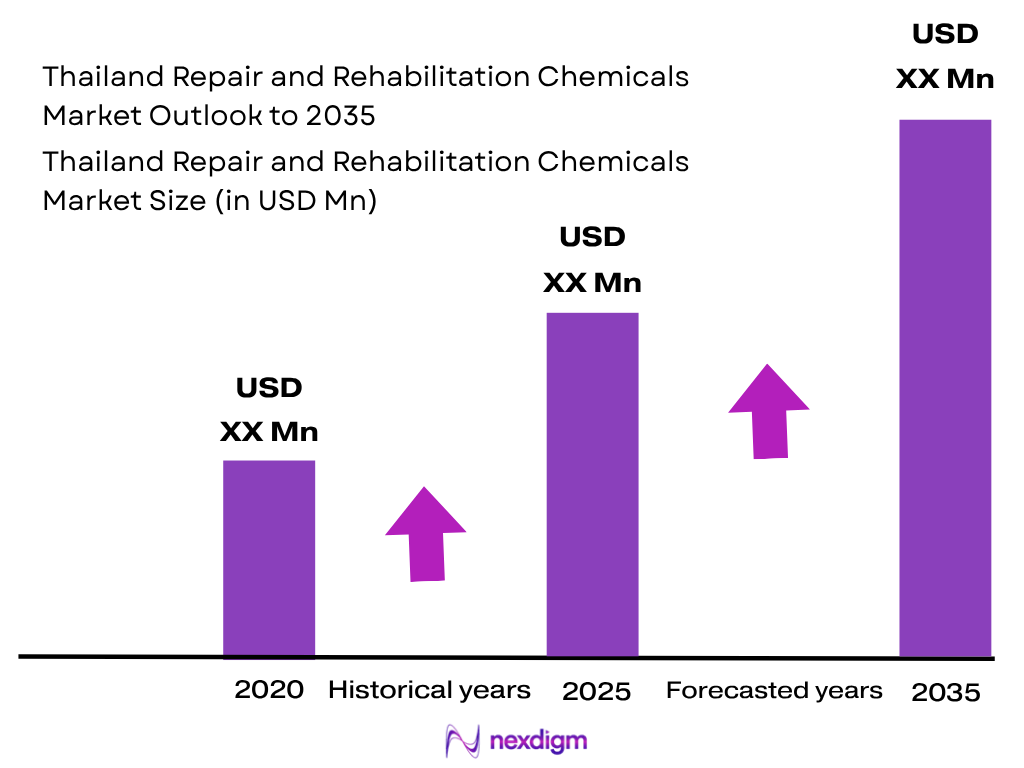
The Thailand Repair and Rehabilitation Chemicals Market is valued at approximately ~USD XX million, supported by concrete deterioration, infrastructure maintenance, industrial rehabilitation and building refurbishment. Across the latest two comparable annual observations, permitted new-building area increased from 58.86 million square metres to 60.85 million square metres, enlarging the future installed base requiring crack repair, corrosion protection, structural mortars, injection resins, grouts and protective coatings over the asset lifecycle.
Bangkok, its surrounding metropolitan provinces and the Eastern Economic Corridor dominate demand because they concentrate aging buildings, expressways, industrial estates, factories, warehouses and infrastructure. Bangkok’s permitted building area increased from 3.65 million to 4.90 million square metres, while surrounding provinces increased from 12.22 million to 13.75 million square metres across the latest two annual observations. Chonburi, Rayong and Chachoengsao add substantial industrial-maintenance and concrete-rehabilitation requirements.
Market Segmentation
By Product Type
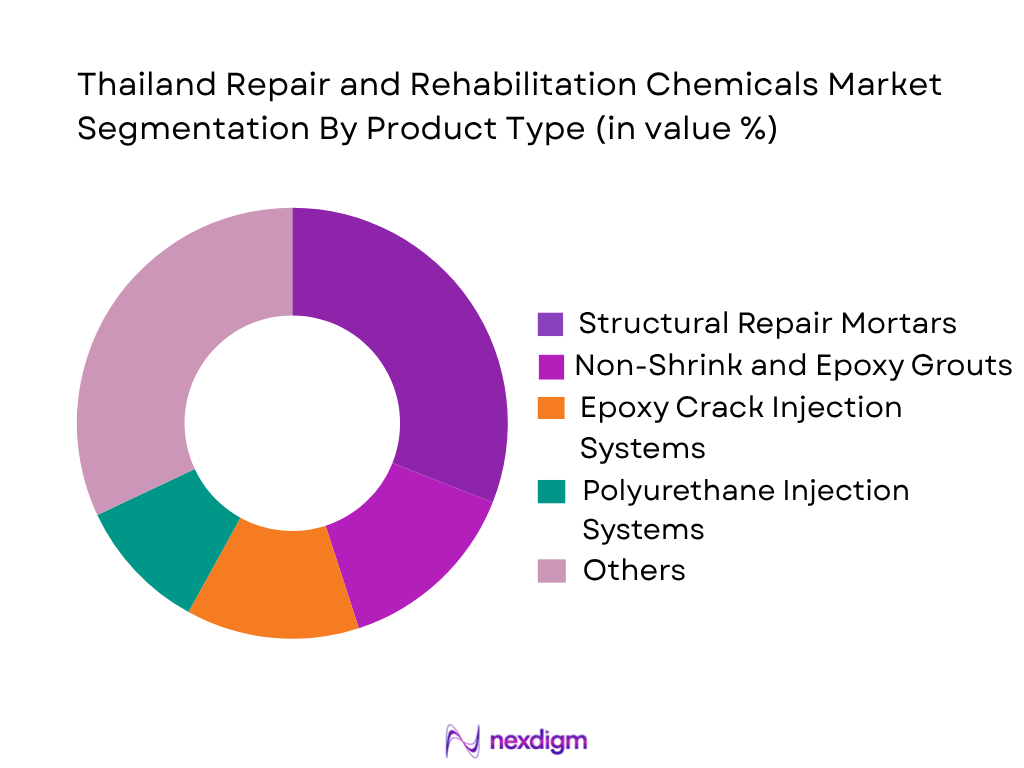
The Thailand Repair and Rehabilitation Chemicals Market is segmented into structural repair mortars, cosmetic repair mortars, microconcrete, non-shrink grouts, epoxy injection resins, polyurethane injection systems, corrosion-protection materials, protective coatings and structural-strengthening chemicals. Structural repair mortars hold the dominant market share because concrete spalling, honeycombing, reinforcement exposure and section loss occur across buildings, bridges, factories, parking structures and transport infrastructure. Polymer-modified and fibre-reinforced mortars can restore damaged cover concrete, rebuild beam and column sections and provide improved adhesion and shrinkage control compared with conventional site-mixed materials. Their application range is broader than specialized injection resins or FRP systems because repair mortars are used during both localized rehabilitation and large-area structural restoration. Thailand’s extensive reinforced-concrete building and infrastructure stock therefore creates recurring demand for vertical, overhead, high-build, rapid-setting and high-strength repair grades.
By Application
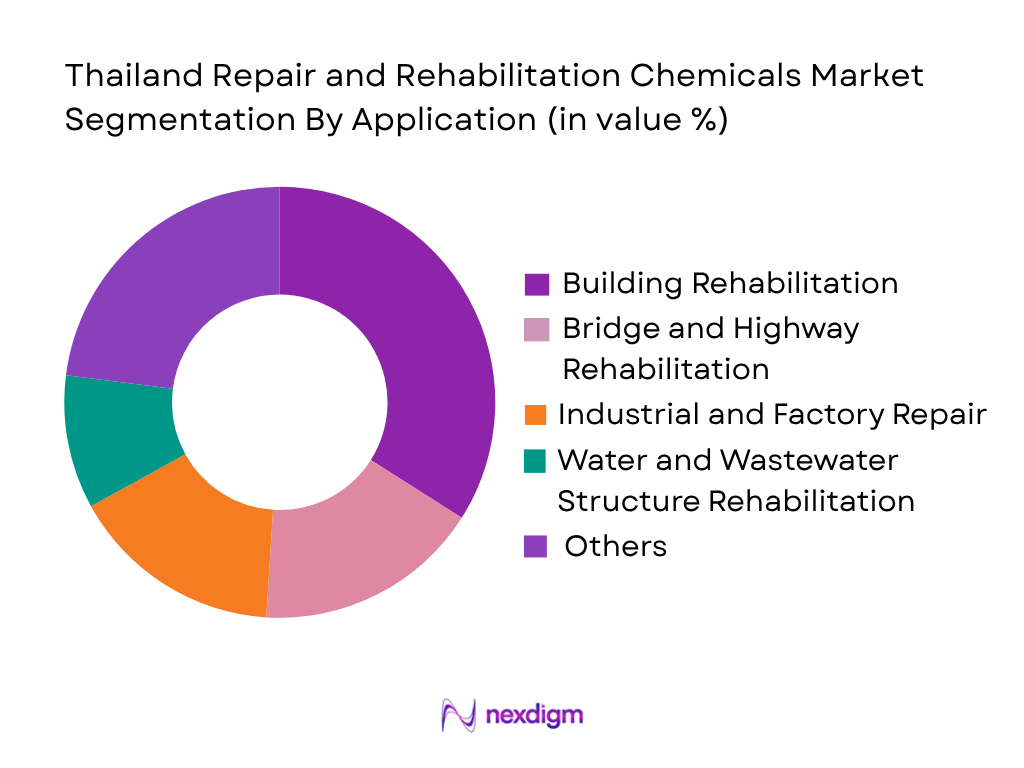
The Thailand Repair and Rehabilitation Chemicals Market is segmented into building rehabilitation, bridge and highway repair, industrial repair, water and wastewater structure rehabilitation, rail and metro rehabilitation, marine structures and other infrastructure applications. Building rehabilitation holds the dominant market share because Thailand has a large installed base of condominiums, commercial properties, hotels, hospitals, parking structures and institutional buildings requiring periodic crack treatment, concrete patching, corrosion repair and waterproofing restoration. Bangkok and surrounding metropolitan provinces are particularly important because dense reinforced-concrete development increases the volume of aging slabs, balconies, columns, façades and parking structures requiring maintenance. Building repair also involves a wider product spectrum than individual infrastructure applications, including polymer-modified mortars, injection resin, bonding agents, non-shrink grout, anti-carbonation coatings and anchoring adhesives. Infrastructure applications remain technically intensive, but building rehabilitation generates a larger number of geographically dispersed repair interventions and recurring maintenance cycles.
Competitive Landscape
The Thailand Repair and Rehabilitation Chemicals Market is characterized by multinational construction-chemical companies, specialist underground and concrete-repair suppliers, and established local building-material producers. Sika, Fosroc, Mapei, MC-Bauchemie and Normet compete through structural repair mortars, epoxy and polyurethane injection systems, non-shrink grouts, corrosion protection, protective coatings and strengthening technologies. Competitive differentiation increasingly depends on EN 1504-aligned repair capability, project references, local manufacturing, technical diagnostics, applicator training and on-site support.
| Company | Establishment Year | Headquarters | Structural Repair Mortar Capability | Crack Injection Capability | Corrosion Protection Capability | Grouting Capability | Structural Strengthening Capability | Thailand Technical / Distribution Presence |
| Sika | 1910 | Baar, Switzerland | ~ | ~ | ~ | ~ | ~ | ~ |
| Fosroc | 1972 | Dubai, UAE | ~ | ~ | ~ | ~ | ~ | ~ |
| Mapei | 1937 | Milan, Italy | ~ | ~ | ~ | ~ | ~ | ~ |
| MC-Bauchemie | 1961 | Bottrop, Germany | ~ | ~ | ~ | ~ | ~ | ~ |
| Normet | 1962 | Espoo, Finland | ~ | ~ | ~ | ~ | ~ | ~ |
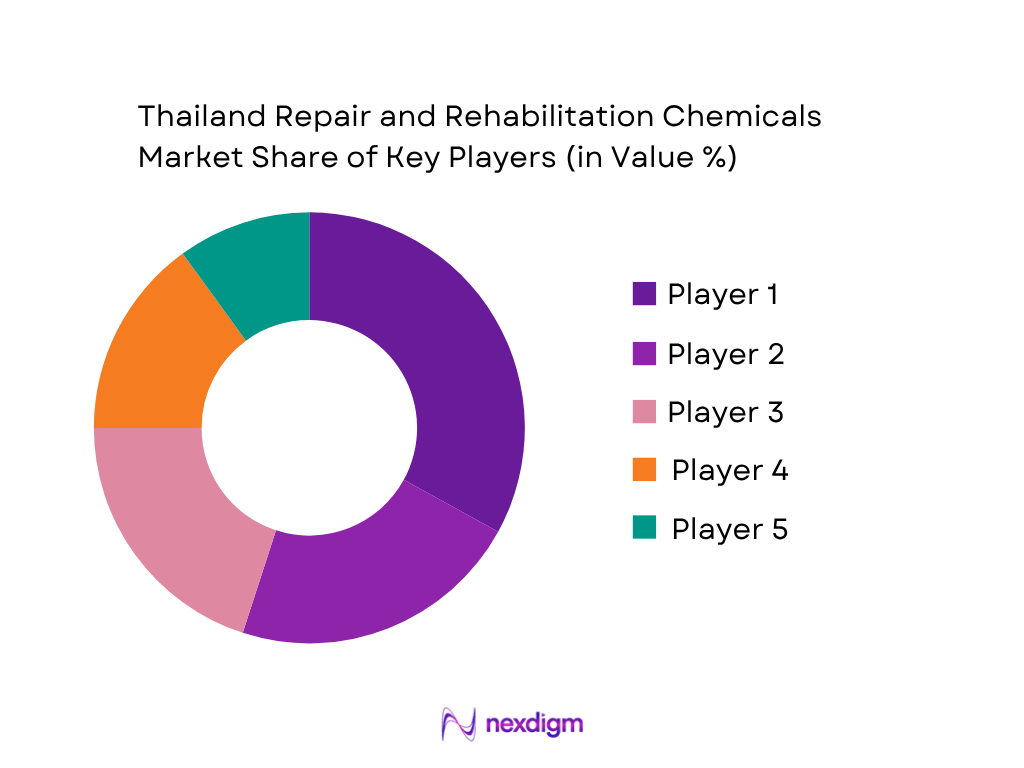
Thailand Repair and Rehabilitation Chemicals Market Analysis
Growth Drivers
Expansion of the Existing Concrete Asset Base and Building Rehabilitation Requirements
Thailand’s expanding stock of reinforced-concrete buildings is creating a larger long-term base for structural repair mortars, crack-injection resins, bonding agents, corrosion-protection materials and protective coatings. New permitted building construction covered 60,851,513 square metres in 2024, including 4,897,773 square metres in Bangkok, 13,746,443 square metres in surrounding metropolitan provinces and 19,538,592 square metres in the Central Region. The same official dataset recorded 2,872,821 square metres of additions and alterations, directly demonstrating active modification and rehabilitation of existing buildings. Bangkok alone accounted for 117,842 square metres of addition and alteration work, while its surrounding provinces recorded 1,296,788 square metres. These existing and newly created assets progressively require concrete spall repair, crack treatment, rebar corrosion protection, balcony rehabilitation, parking-deck restoration and waterproofing repair as they age. Thailand’s macroeconomic base supports this maintenance cycle, with 2024 GDP of USD526.52 billion and GDP per capita of USD7,346.6. The scale of the installed concrete stock therefore supports sustained demand for polymer-modified mortars, epoxy injection and lifecycle-oriented durability systems.
Industrial, Digital and Infrastructure Investment Expanding Future Rehabilitation Demand
Thailand’s investment pipeline is rapidly expanding the volume of industrial, data-centre, utility and high-specification assets that will require repair and rehabilitation chemicals throughout their operating life. Investment applications reached THB1.876653 trillion across 3,370 projects in 2025, while the first half of 2026 generated another THB1.473718 trillion across 1,299 projects. Digital-sector applications alone reached THB1.115260 trillion across 90 projects in the first six months of 2026, while electronics and electrical appliances accounted for THB120.230 billion across 179 projects, energy and utilities THB39.461 billion across 221 projects, and chemicals and petrochemicals THB16.533 billion across 110 projects. Such facilities contain heavily loaded floors, machine foundations, precast elements, water-retaining structures and concrete service areas where epoxy grouts, non-shrink grouts, rapid repair mortars and crack-injection systems become recurring maintenance requirements. Projects approved in H1 2026 are also expected to create more than 82,000 jobs, reinforcing industrial operating intensity. Thailand’s 2024 GDP stood at USD526.52 billion, with GDP per capita at USD7,346.6, supporting continued investment in technically demanding assets requiring lifecycle rehabilitation.
Market Challenges
Imported Epoxy, Polymer and Specialty Additive Dependency
The Thailand Repair and Rehabilitation Chemicals Market faces supply-chain exposure because advanced epoxy injection resins, polyurethane systems, redispersible polymers, silanes, corrosion inhibitors and specialty additives depend significantly on imported chemical and intermediate inputs. Thailand’s total merchandise imports reached THB10,896,480 million in 2024, including THB4,533,993 million of raw materials and intermediate products and THB2,751,095 million of capital goods. For manufacturers and formulators of structural mortars, epoxy grouts, PU injection products and protective coatings, this creates exposure to international logistics, feedstock availability and formulation-consistency requirements. The challenge becomes more important when products are specified for bridges, factories, tunnels or water-retaining structures, where substituting an approved resin or additive can require technical requalification. At the same time, Thailand had 60,851,513 square metres of newly permitted building area and 3,037,264 square metres of new civil-engineering construction measured by area in 2024, sustaining a broad repairable asset base. Thailand’s macroeconomic scale remains substantial at USD526.52 billion of GDP and USD7,346.6 GDP per capita in 2024, but this domestic scale does not remove dependence on imported specialty chemical inputs for high-performance rehabilitation systems.
Complex Diagnosis, Substrate Preparation and Repair Execution Requirements
Concrete rehabilitation is technically demanding because visible damage often does not reveal the complete deterioration mechanism, making condition assessment and site execution critical challenges for Thailand’s repair-chemical suppliers and contractors. Official construction records show 20,067 new civil-engineering structures measured by length in 2024, alongside 4,979 structures measured by area, creating an extensive national base of roads, bridges, drainage structures, retaining elements and related civil assets exposed to water penetration, cracking and reinforcement corrosion. Thailand also recorded 60,851,513 square metres of permitted new-building construction, including 13,746,443 square metres in Bangkok’s surrounding provinces, where dense concrete development increases future rehabilitation complexity. Repairs can fail when carbonation depth, chloride contamination, crack activity or reinforcement loss is not properly diagnosed, or when substrates are inadequately cleaned and saturated before mortar application. Epoxy injection further requires correct crack width assessment and resin viscosity, while PU injection depends on controlling active water flow. The Department of Highways separately maintains dedicated procedures for bridge inspection, structural-capacity assessment, bridge strengthening and maintenance. Thailand’s 2024 GDP of USD526.52 billion and GDP per capita of USD7,346.6 underscore the economic value of assets where unsuccessful rehabilitation can generate repeated intervention.
Market Opportunities
Rapid-Setting Structural Repair, Grouting and Short-Shutdown Rehabilitation Systems
Thailand’s expanding industrial and infrastructure base creates a significant future opportunity for high-early-strength repair mortars, rapid-setting microconcrete, non-shrink grouts, epoxy grouts and fast-curing injection systems designed for short shutdown windows. Current industrial investment provides the demand foundation: 3,370 investment applications worth THB1.876653 trillion were submitted in 2025, followed by 1,299 applications worth THB1.473718 trillion in H1 2026. Within the latter period, electronics and electrical projects represented THB120.230 billion, energy and utilities THB39.461 billion, machinery and automation THB13.093 billion, and chemicals and petrochemicals THB16.533 billion. Such assets cannot tolerate lengthy shutdowns when repairing factory floors, foundations, loading areas or production structures, favouring materials that develop strength rapidly and minimize return-to-service time. The opportunity also extends to transport infrastructure, with 20,067 civil-engineering structures measured by length and 4,979 measured by area recorded in 2024. Thailand’s 2024 GDP of USD526.52 billion and GDP per capita of USD7,346.6 support continued operation and maintenance of these high-value assets, providing a strong base for specification-driven rapid rehabilitation technologies.
Corrosion Protection, Crack Injection and Preventive Concrete Durability Systems
Thailand’s growing concrete asset base creates future opportunity for rehabilitation strategies that move beyond reactive patching toward corrosion management, crack injection, hydrophobic impregnation, anti-carbonation coatings and preventive surface protection. In 2024, Thailand recorded 60,851,513 square metres of new permitted building area and another 2,872,821 square metres of addition and alteration work, continuously enlarging the stock of concrete that will require lifecycle protection. Civil-engineering construction added 3,037,264 square metres of area-based work, while official records included roads, bridges, dams, drainage structures and parking facilities that are exposed to water, chlorides, carbonation and repeated loading. For suppliers, this supports broader adoption of migrating corrosion inhibitors, reinforcement coatings, low-viscosity epoxy injection, flexible PU injection and silane-based protection before concrete deterioration progresses to major section loss. Preventive systems are particularly relevant for bridges, parking structures, wastewater facilities, industrial plants and coastal assets where moisture ingress accelerates reinforcement corrosion. Thailand’s 2024 GDP of USD526.52 billion and GDP per capita of USD7,346.6 provide the macroeconomic foundation for greater spending on asset-life extension rather than full structural replacement.
Future Outlook
The Thailand Repair and Rehabilitation Chemicals Market is projected to expand at approximately ~XX.X% CAGR during 2026–2035. Growth will increasingly be driven by lifecycle maintenance rather than new construction alone, particularly across Bangkok buildings, expressways, bridges, industrial estates and water infrastructure. The market is expected to shift toward pre-bagged R3/R4 repair mortars, low-viscosity injection resins, corrosion-management systems, FRP strengthening and rapid-return-to-service products.
Thailand’s continuing industrial investment will enlarge the future rehabilitation base. Investment promotion applications reached THB1.14 trillion across 3,137 projects in 2024, including major digital, electronics and manufacturing developments, while the Eastern Economic Corridor remains Thailand’s primary industrial concentration. New industrial and technology assets will progressively create demand for floor repair, machine-foundation grouting, crack injection, chemical-resistant rehabilitation and preventive concrete protection as facilities enter maintenance cycles.
Major Players
- Sika (Thailand) Limited
- Fosroc Thailand
- Mapei Thailand
- Master Builders Solutions Thailand
- MC-Bauchemie Thailand
- Normet Thailand
- Cormix International Limited
- Jorakay Corporation Co., Ltd.
- Saint-Gobain Weber Thailand
- TOA Paint (Thailand) Public Company Limited
- Penetron Thailand
- Kryton International / CLPI Thailand
- Euclid Chemical
- Cementaid Thailand
- Denka Construction Solutions
Key Target Audience
- Repair and Rehabilitation Chemical Manufacturers
- Structural Repair and Injection Contractors
- Infrastructure and Civil Engineering Contractors
- Industrial Asset Owners and Maintenance Contractors
- Property Developers and Facility Management Companies
- Construction Chemical Distributors and Specialist Applicators
- Investments and Venture Capitalist Firms
- Government and Regulatory Bodies (Department of Highways, Expressway Authority of Thailand, Mass Rapid Transit Authority of Thailand, State Railway of Thailand, Department of Public Works and Town & Country Planning, Thai Industrial Standards Institute)
Research Methodology
Step 1: Identification of Key Variables
The initial phase involves constructing an ecosystem map covering repair-chemical manufacturers, raw-material suppliers, distributors, repair contractors, injection specialists, strengthening contractors, infrastructure agencies and asset owners. Key variables include repair area, deterioration mechanism, repair depth, crack width, chemistry, bond strength, compressive strength, corrosion exposure and application environment.
Step 2: Market Analysis and Construction
Historical market development is evaluated using top-down and bottom-up approaches. Top-down analysis incorporates building stock, construction activity, infrastructure networks, industrial facilities and rehabilitation programmes. Bottom-up analysis estimates product consumption from typical repair thickness, treated area, injection volume, grout volume and protective-coating coverage across individual repair applications.
Step 3: Hypothesis Validation and Expert Consultation
Market hypotheses are validated through structured CATI-based discussions with repair-chemical producers, structural repair contractors, injection specialists, infrastructure contractors, industrial maintenance companies and distributors. Interviews assess product consumption, repair-method selection, R3/R4 mortar adoption, epoxy versus PU injection usage, corrosion-treatment practices, project specifications and technical-support requirements.
Step 4: Research Synthesis and Final Output
The final phase triangulates official construction and infrastructure indicators with supplier portfolios, application benchmarks and primary industry feedback. Bottom-up product-use calculations are reconciled with top-down asset and rehabilitation indicators to establish segment shares, competitive positioning and future market direction. The methodology separately considers buildings, industrial facilities, transport assets and water infrastructure because repair intensity differs materially across these applications.

- Executive Summary
- Research Methodology (Market Definitions and Assumptions, Thailand Repair and Rehabilitation Chemicals Market Classification, Structural Repair Mortar Scope, Cosmetic Repair Mortar Assessment, Microconcrete Assessment, Non-Shrink Grout Assessment, Epoxy Grout Assessment, Epoxy Crack Injection Assessment, Polyurethane Injection Assessment, Acrylic Injection Assessment, Cementitious Injection Assessment, Structural Epoxy Bonding Assessment, Reinforcement Corrosion Protection Assessment, Migrating Corrosion Inhibitor Assessment, Protective Coating Assessment, Hydrophobic Impregnation Assessment, Anti-Carbonation Coating Assessment, Crystalline Repair Assessment, Waterproofing Rehabilitation Assessment, Rebar Anchoring Assessment, FRP Strengthening Assessment, Shotcrete Repair Assessment, Industrial Floor Rehabilitation Assessment, Bridge Rehabilitation Assessment, Tunnel Rehabilitation Assessment, Marine Concrete Repair Assessment, Water and Wastewater Structure Repair Assessment, EN 1504 Repair Principle Mapping, ASTM C882 Bond Strength Assessment, ASTM C109 Compressive Strength Assessment, Crack Width Assessment, Repair Depth Assessment, Chloride Exposure Assessment, Carbonation Depth Assessment, Substrate Condition Assessment)

- Definition and Scope
- Thailand Repair and Rehabilitation Chemicals Industry Evolution and Development of Conventional Cement Patching, Polymer-Modified Repair Mortars, Fibre-Reinforced Structural Repair Mortars, High-Build Vertical Repair Mortars, Overhead Repair Mortars, Microconcrete, Flowable Repair Materials, Non-Shrink Cementitious Grouts, Epoxy Grouts, Low-Viscosity Epoxy Injection Resins, Polyurethane Leakage Injection Systems, Acrylic Injection Gels, Structural Epoxy Bonding Agents, Reinforcement Corrosion Protection Materials, Migrating Corrosion Inhibitors, Anti-Carbonation Coatings, Hydrophobic Silane Treatments, Crystalline Repair Systems, Protective Coatings, FRP Strengthening Systems, Anchoring Adhesives, Rapid-Setting Pavement Repair Materials and Integrated Repair-and-Protection Systems
- Repair and Rehabilitation Chemicals Value Chain Analysis
- Repair and Rehabilitation Chemicals Supply Chain Analysis
- Cement and Specialty Binder Suppliers, Redispersible Polymer Powder Suppliers, Epoxy Resin Suppliers, Polyurethane Raw Material Suppliers, Acrylic Polymer Suppliers, Corrosion Inhibitor Suppliers, Microsilica Suppliers, Fibre Suppliers, Specialty Additive Suppliers, Repair Chemical Manufacturers, Local Dry-Mix Producers, Local Resin Blenders, Importers, Construction Chemical Distributors, Structural Repair Contractors, Injection Contractors, Waterproofing Contractors, Strengthening Contractors, Industrial Maintenance Contractors, Infrastructure Contractors, Asset Owners and Testing Laboratories

- Growth Drivers (Aging Bangkok Building Stock, Bridge and Expressway Maintenance, Eastern Economic Corridor Industrial Asset Expansion, Metro and Rail Rehabilitation, Factory Maintenance, Water and Wastewater Infrastructure Rehabilitation, Coastal and Marine Concrete Exposure, Parking Structure Repair, Building Renovation, Data Centre Asset Maintenance, Structural Safety Upgrading, Lifecycle Extension of Existing Concrete Assets)
- Market Challenges (Incomplete Concrete Condition Assessment, Hidden Reinforcement Corrosion, Chloride Contamination, Carbonation Depth, High Substrate Moisture, Crack Recurrence, Incorrect Repair Material Selection, Weak Surface Preparation, Repair Mortar Debonding, Imported Epoxy and Specialty Raw Material Dependency, Skilled Injection Contractor Availability, Structural Shutdown Constraints, Specification Fragmentation, Quality Control of Site Application)
- Market Opportunities (R3 and R4 Structural Repair Mortars, High-Early-Strength Rapid Repair, Epoxy Crack Injection, PU Leakage Injection, Corrosion Inhibitors, Anti-Carbonation Coatings, Hydrophobic Impregnation, FRP Strengthening, Marine Repair Systems, Wastewater Chemical-Resistant Repair, Industrial Floor Rehabilitation, Bridge Deck Repair, Rapid Airport Pavement Repair, Crystalline Rehabilitation Systems, Preventive Concrete Protection)
- Market Trends (Pre-Bagged Polymer-Modified Repair Mortars, Fibre-Reinforced Repair Systems, EN 1504-Based Specification, Low-Shrinkage Repair Mortars, Spray-Applied Structural Repair, Low-Viscosity Epoxy Injection, Fast-Curing PU Injection, Integrated Repair-and-Protection Systems, Corrosion Management, FRP Strengthening, Low-Carbon Repair Mortars, Rapid Return-to-Service Materials, Preventive Rehabilitation, Asset-Life Extension)
- Government Regulations and Standards (Thailand Building Control Requirements, Department of Public Works and Town & Country Planning Specifications, Department of Highways Maintenance Specifications, Expressway Authority of Thailand Requirements, Mass Rapid Transit Authority Requirements, State Railway of Thailand Infrastructure Requirements)
- SWOT Analysis
- Porter’s Five Forces Analysis
- PESTLE Analysis
- Stakeholder Ecosystem
- Repair Chemical Manufacturing Contractor and Asset Rehabilitation Ecosystem

- By Market Value (2020-2025)
- By Repair Chemical Consumption Volume (2020-2025)
- By Structural Repair Mortar Consumption (2020-2025)
- By Cosmetic Repair Mortar Consumption (2020-2025)
- By Microconcrete Consumption (2020-2025)
- By Epoxy Injection Consumption (2020-2025)
- By Polyurethane Injection Consumption (2020-2025)
- By Non-Shrink Grout Consumption (2020-2025)
- By Epoxy Grout Consumption (2020-2025)
- By Corrosion Protection Material Consumption (2020-2025)
- By Protective Coating Consumption (2020-2025)
- By Structural Strengthening Chemical Consumption (2020-2025)
- By Building Rehabilitation Chemical Consumption (2020-2025)
- By Bridge and Infrastructure Repair Chemical Consumption (2020-2025)

- By Product Type (In Value %)
Structural Repair Mortars
Cosmetic and Surface Repair Mortars
Microconcrete and Flowable Repair Materials
Non-Shrink Cementitious Grouts
Epoxy Grouts
Epoxy Injection Resins
Polyurethane Injection Resins
Acrylic Injection Systems
Structural Epoxy Bonding Agents
Reinforcement Corrosion Protection Materials
Migrating Corrosion Inhibitors
Protective Coatings
Hydrophobic Impregnation Systems
Crystalline Repair Materials
FRP Strengthening Resins and Adhesives
Anchoring and Rebar Fixing Adhesives
Rapid-Setting Repair Materials
Specialty Rehabilitation Chemicals - By Repair Chemistry (In Value %)
Polymer-Modified Cementitious Systems
Epoxy Resin Systems
Polyurethane Systems
Acrylic Polymer Systems
Crystalline Cementitious Systems
Silane and Siloxane Systems
Corrosion-Inhibiting Chemistries
Vinyl-Ester and Specialty Resin Systems
Hybrid Polymer-Cement Systems
Other Specialty Chemistries - By Application (In Value %)
Concrete Spall Repair
Honeycomb Repair
Crack Injection
Water Leakage Injection
Reinforcement Corrosion Repair
Carbonation-Damaged Concrete Repair
Chloride-Damaged Concrete Repair
Structural Section Restoration
Beam and Column Repair
Slab and Deck Repair
Bridge Deck Rehabilitation
Pier and Abutment Repair
Tunnel Lining Repair
Industrial Floor Repair
Marine and Coastal Concrete Repair
Water Tank and Reservoir Repair
Wastewater Structure Rehabilitation
Road and Airport Pavement Repair - By Performance Requirement (In Value %)
High Compressive Strength
High Bond Strength
Low Shrinkage
High Early Strength
Rapid Return-to-Service
High Flexural Strength
High Tensile Strength
Overhead Application Capability
High Build Thickness
Sulfate Resistance
Chloride Resistance
Carbonation Resistance
Chemical Resistance
Water Immersion Resistance
Crack Bridging
Corrosion Protection
Low Permeability
Structural Load Transfer - By Region (In Value %)
Bangkok Metropolitan Region
Bangkok
Samut Prakan
Pathum Thani
Nonthaburi
Chonburi
Rayong
Chachoengsao
Eastern Economic Corridor
Central Thailand
Northern Thailand
Northeastern Thailand

- Market Share of Major Players (By Thailand Revenue, Repair Chemical Consumption Volume, Structural Repair Mortar Portfolio, Epoxy Injection Portfolio, Polyurethane Injection Portfolio, Grout Portfolio, Corrosion Protection Capability, Protective Coating Capability, Waterproofing Rehabilitation Exposure, FRP Strengthening Exposure, Bridge and Infrastructure Project Exposure, Industrial Rehabilitation Exposure, Thailand Manufacturing or Blending Capacity, Distributor Network, Technical Laboratory Capability)
- Cross Comparison Parameters (Structural Repair Mortar R3 and R4 Portfolio Breadth, Epoxy PU Acrylic and Cementitious Crack Injection Capability, Reinforcement Corrosion Protection and Concrete Durability Technology Capability, Structural Strengthening FRP Anchoring and Epoxy Bonding Capability, Bridge Tunnel Industrial and Water Infrastructure Rehabilitation Project Reference Base, Rapid-Setting High-Early-Strength and Shutdown-Sensitive Repair Capability, Thailand Manufacturing Blending Warehousing and Nationwide Distribution Network Reach, Condition Assessment Specification Support Contractor Training and Project-Site Technical Service Capability)
- SWOT Analysis of Major Players
- Competitive Positioning Matrix
- Major Companies
Sika (Thailand) Limited
Fosroc Thailand
Mapei Thailand
Master Builders Solutions Thailand
MC-Bauchemie Thailand
Normet Thailand
Cormix International Limited
Jorakay Corporation Co., Ltd.
Saint-Gobain Weber Thailand
TOA Paint (Thailand) Public Company Limited
Penetron Thailand
Kryton International / CLPI Thailand
Euclid Chemical
Cementaid Thailand
Denka Construction Solutions

- Structural Repair Contractor Requirement Assessment
- Infrastructure Contractor Requirement Assessment
- Industrial Maintenance Contractor Requirement Assessment
- Injection Contractor Requirement Assessment
- Waterproofing Contractor Requirement Assessment
- Structural Strengthening Contractor Requirement Assessment
- Property Developer Rehabilitation Requirement Assessment
- Asset Owner Rehabilitation Requirement Assessment
- Facility Management Requirement Assessment
- Bridge Maintenance Requirement Assessment
- Industrial Estate Operator Requirement Assessment
- Water and Wastewater Operator Requirement Assessment
- Technical Laboratory and Site Support Requirement Assessment

- By Market Value (2026-2035)
- By Repair Chemical Consumption Volume (2026-2035)
- By Structural Repair Mortar Consumption (2026-2035)
- By Cosmetic Repair Mortar Consumption (2026-2035)
- By Microconcrete Consumption (2026-2035)
- By Epoxy Injection Consumption (2026-2035)
- By Polyurethane Injection Consumption (2026-2035)
- By Non-Shrink Grout Consumption (2026-2035)
- By Epoxy Grout Consumption (2026-2035)
- By Corrosion Protection Material Consumption (2026-2035)
- By Protective Coating Consumption (2026-2035)
- By Structural Strengthening Chemical Consumption (2026-2035)
- By Building Rehabilitation Chemical Consumption (2026-2035)
- By Bridge and Infrastructure Repair Chemical Consumption (2026-2035)


 Request a Sample
 Ask for Customization
 Get a Quote
 Enquire Now
