

 Download PDF
Market Overview
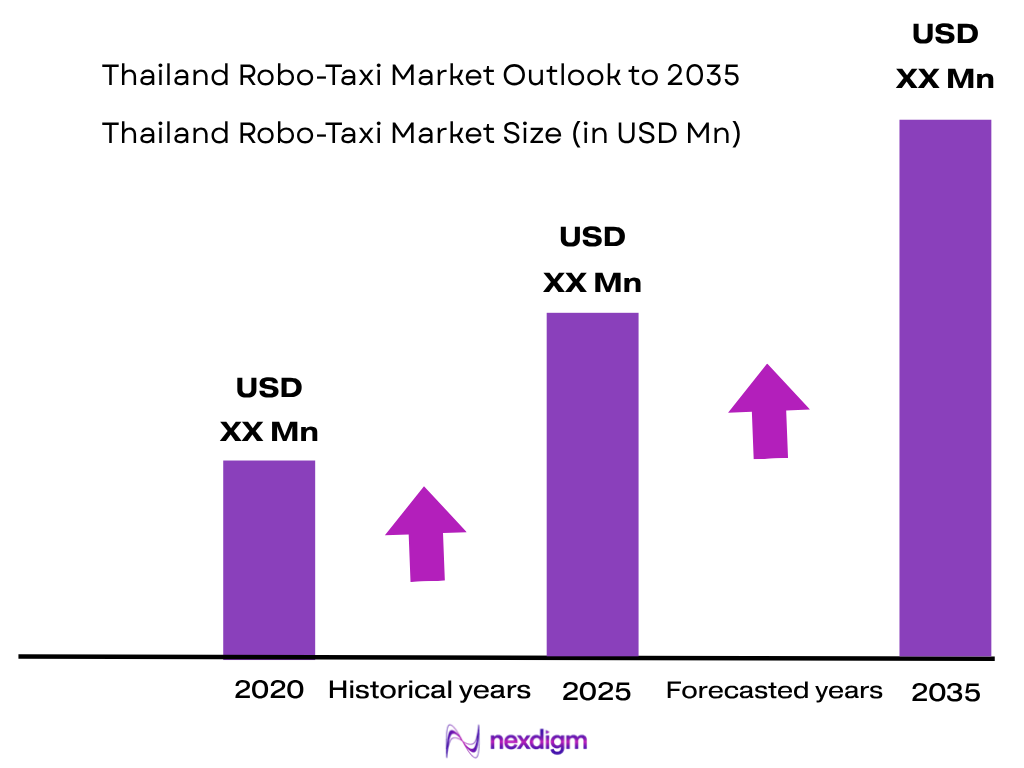
The Thailand Robo-Taxi Market is valued at ~USD XX million, supported by increasing investments in autonomous mobility technologies, urban transportation modernization, and government-led smart mobility initiatives. The market development is driven by Thailand’s transition toward intelligent transportation systems, rising congestion in metropolitan areas, and increasing adoption of electric mobility platforms. Thailand recorded approximately 2.7 million registered passenger vehicles in Bangkok alone, creating demand for alternative mobility solutions. Government initiatives under Thailand 4.0 and smart city programs are encouraging autonomous vehicle testing, digital infrastructure development, and connected transportation ecosystems.
Bangkok dominates the Thailand Robo-Taxi Market due to its high population density, severe traffic congestion, developed road infrastructure, and concentration of technology adoption initiatives. The Bangkok Metropolitan Region accommodates more than 10 million residents, creating strong demand for efficient urban mobility solutions. Other emerging locations including Chiang Mai, Phuket, Pattaya, and Eastern Economic Corridor (EEC) areas are gaining importance due to tourism activity, industrial development, and smart city initiatives. Phuket is particularly significant because of its tourism-driven transport requirements and autonomous mobility pilot opportunities.
Market Segmentation
By Automation Level
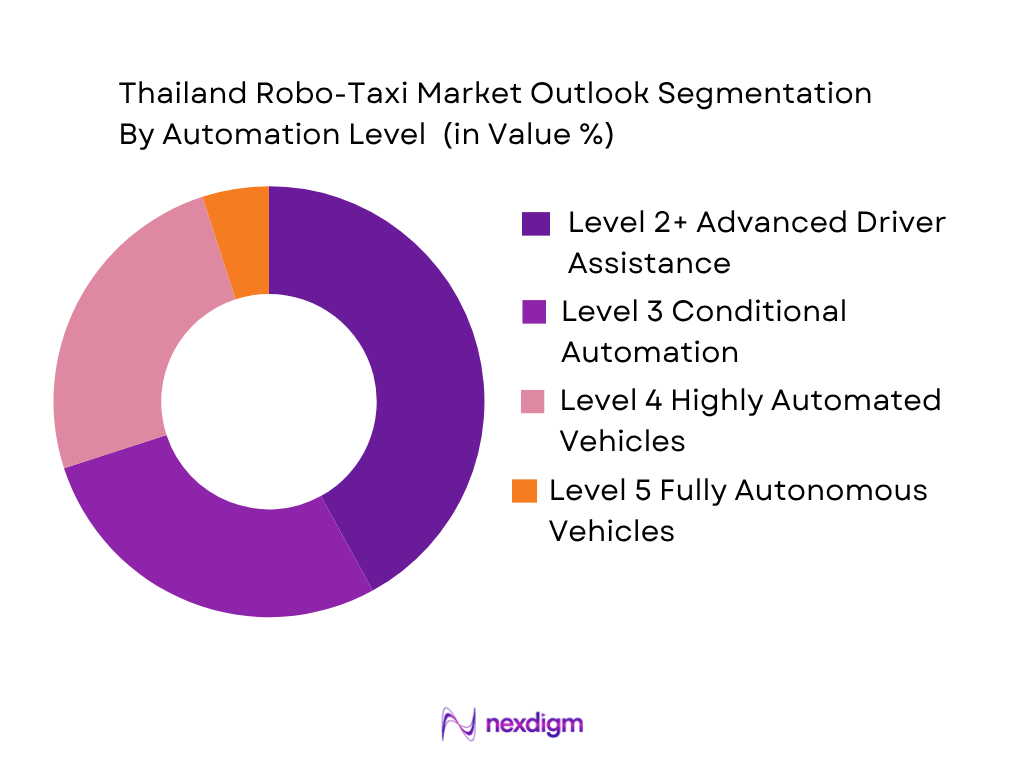
The Thailand Robo-Taxi Market is segmented into Level 2+ Advanced Driver Assistance Systems, Level 3 Conditional Automation, Level 4 Highly Automated Vehicles, and Level 5 Fully Autonomous Vehicles. Level 4 Highly Automated Vehicles are expected to represent the dominant segment due to their suitability for controlled operating environments such as airports, industrial zones, smart city districts, and dedicated mobility corridors. Thailand’s autonomous mobility development is currently focused on controlled testing environments where vehicles can operate with limited human intervention while maintaining safety validation. Increasing collaboration between technology providers, automotive manufacturers, and transportation authorities is supporting Level 4 deployment. The expansion of electric autonomous shuttle trials and smart mobility projects in Bangkok and tourism destinations is further strengthening demand for highly automated systems compared with fully autonomous Level 5 vehicles, which require more advanced regulatory frameworks and infrastructure readiness.
By Vehicle Type
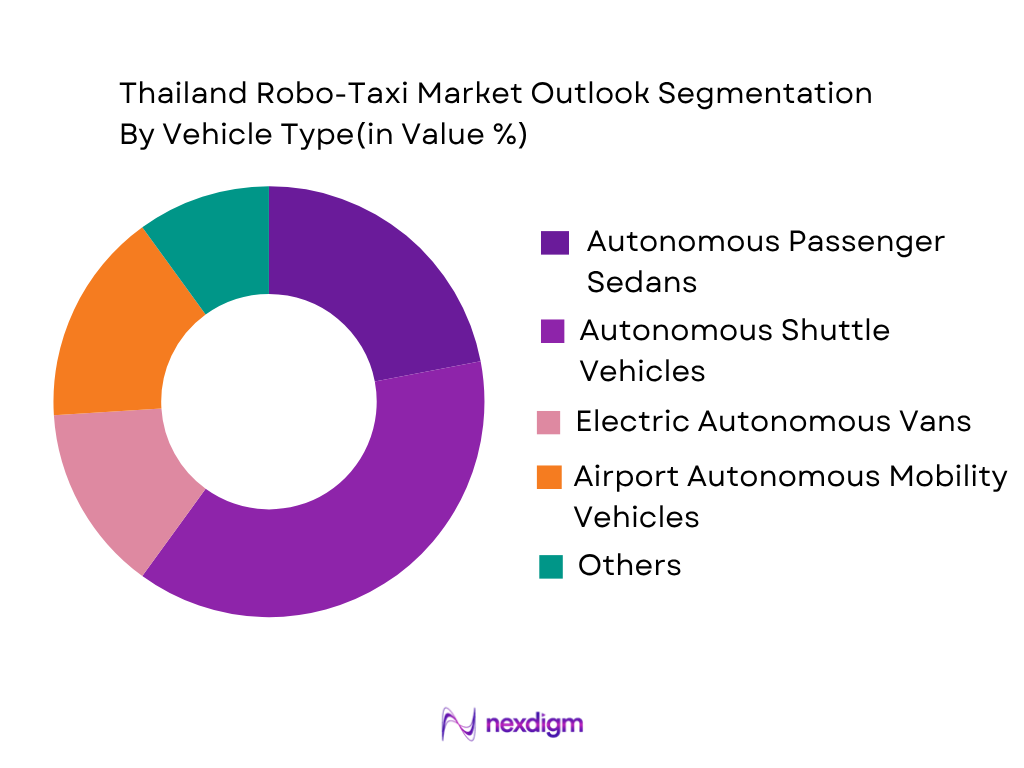
The Thailand Robo-Taxi Market is segmented into autonomous passenger sedans, autonomous shuttle vehicles, electric autonomous vans, airport autonomous mobility vehicles, and autonomous ride-hailing vehicles. Autonomous shuttle vehicles represent the leading segment due to their suitability for short-distance urban routes, business parks, airports, and tourism zones. Thailand’s compact urban infrastructure and high passenger movement in controlled areas create favourable conditions for shuttle-based autonomous mobility. Airports, industrial estates, and smart city developments require predictable transportation routes, making autonomous shuttles easier to deploy compared with fully commercial robo-taxi fleets operating across mixed traffic conditions. Additionally, electric autonomous shuttles align with Thailand’s electric vehicle promotion strategy and sustainability goals, increasing adoption potential among public transport operators and private mobility providers.
Competitive Landscape
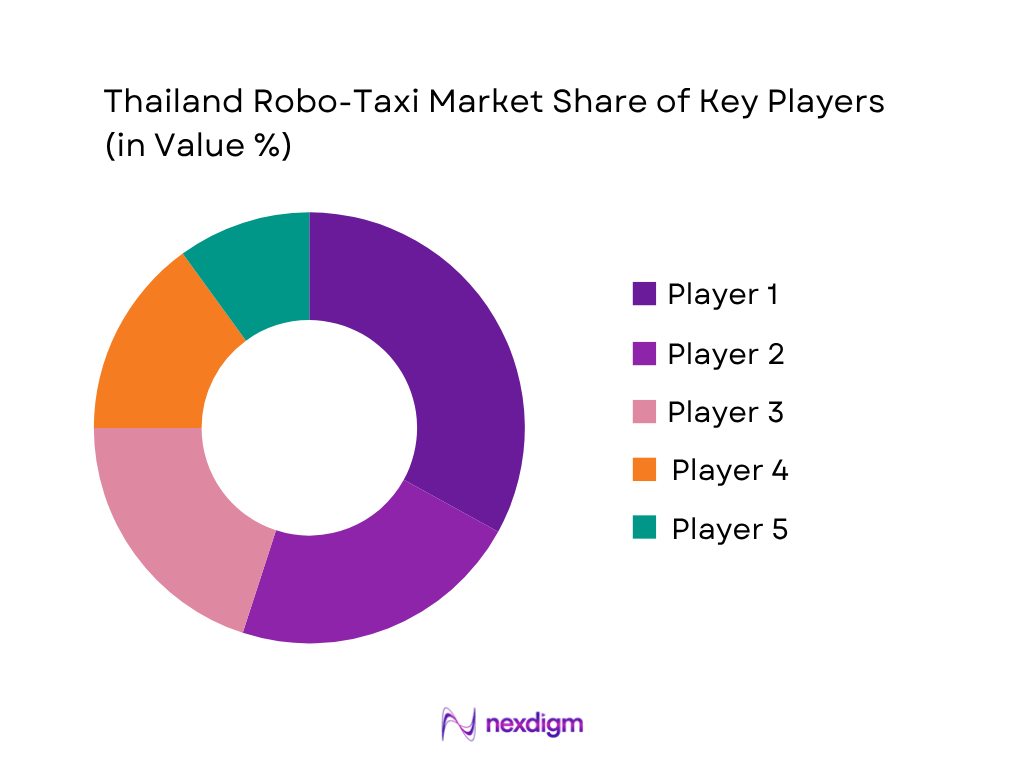
The Thailand Robo-Taxi Market remains an emerging technology market with participation from global autonomous driving technology companies, automotive manufacturers, mobility service providers, and local smart mobility stakeholders. Competition is influenced by autonomous driving capabilities, AI software development, electric vehicle integration, fleet management platforms, and partnerships with transportation authorities.
| Company | Establishment Year | Headquarters | Autonomous Technology | EV Integration | Mobility Platform | Thailand Presence | Key Partnerships |
| Waymo | 2009 | USA | ~ | ~ | ~ | ~ | ~ |
| Tesla | 2003 | USA | ~ | ~ | ~ | ~ | ~ |
| Cruise | 2013 | USA | ~ | ~ | ~ | ~ | ~ |
| Baidu Apollo | 2017 | China | ~ | ~ | ~ | ~ | ~ |
| Toyota | 1937 | Japan | ~ | ~ | ~ | ~ | ~ |
Thailand’s Robo-Taxi Market Analysis
Growth Drivers
Expansion of Autonomous Vehicle Trials
Thailand’s Robo-Taxi Market is supported by increasing autonomous vehicle experimentation across controlled environments, smart cities, and mobility innovation zones. The country’s transportation ecosystem is undergoing digital transformation, with Thailand’s registered vehicle population exceeding 44 million units, creating demand for intelligent mobility solutions that can improve traffic efficiency. Bangkok, which has a population exceeding 10 million residents in its metropolitan area, represents a major testing environment due to high traffic density and daily commuting challenges. The development of autonomous mobility trials is also supported by Thailand’s Eastern Economic Corridor (EEC), where advanced technology investments and industrial automation projects are being promoted. Thailand recorded real GDP growth of approximately USD 500 billion in 2024 according to World Bank data, reflecting continued economic capacity for technology infrastructure investment. Autonomous vehicle trials enable companies to evaluate AI-based navigation, vehicle-to-infrastructure communication, and electric autonomous fleet operations under local road conditions. These trials are essential for understanding tropical weather conditions, traffic behaviour, and regulatory requirements before large-scale robo-taxi deployment.
Smart City Development Programs
Smart city development initiatives are accelerating demand for autonomous mobility solutions in Thailand by creating integrated digital transportation ecosystems. Thailand’s National Smart City initiative has identified multiple cities for digital transformation, focusing on intelligent transportation, connectivity, and sustainable urban development. Bangkok, Phuket, Chiang Mai, and cities within the Eastern Economic Corridor are key locations where smart mobility solutions are being explored. Thailand’s urban population exceeded 36 million people, according to World Bank urban development indicators, increasing pressure on existing transportation infrastructure and creating demand for efficient mobility alternatives. The country’s digital economy expansion is supported by internet connectivity, with more than 61 million internet users reported by national digital statistics agencies, enabling connected mobility services and app-based transportation platforms. Robo-taxis can complement existing public transport networks by providing automated first-mile and last-mile connectivity. Integration with smart traffic systems, digital payment platforms, and electric vehicle charging networks can support future autonomous transportation deployment. These developments position smart cities as important platforms for testing and commercializing autonomous mobility services.
Market Challenges
Regulatory Approval Requirements
Regulatory uncertainty remains a major challenge for Thailand’s Robo-Taxi Market as autonomous vehicles require specific approval frameworks covering safety standards, operational responsibility, and road usage regulations. Thailand currently follows conventional vehicle regulations, while fully autonomous mobility requires additional frameworks related to artificial intelligence decision-making, cybersecurity, and passenger safety. The country has more than 39 million registered motorcycles and passenger vehicles combined, creating complex mixed-traffic conditions that require extensive regulatory evaluation before autonomous vehicles can operate commercially. Thailand’s Ministry of Transport and Department of Land Transport are required to establish operational guidelines for autonomous vehicle testing and deployment. The country’s transportation sector contributes significantly to economic activity, with logistics and mobility infrastructure supporting a GDP of approximately USD 500 billion in 2024 according to World Bank indicators. Regulatory development must address liability allocation between manufacturers, software providers, fleet operators, and passengers. Without clear approval pathways, companies may delay commercial deployment despite technological readiness. Establishing testing permits, safety certification procedures, and autonomous driving standards will be critical for market expansion.
Autonomous Driving Safety Validation
Safety validation is a significant challenge for Thailand’s Robo-Taxi Market due to complex road environments, unpredictable traffic behaviour, and tropical climate conditions. Autonomous vehicles must demonstrate reliable performance across urban roads, highways, congested intersections, and mixed traffic conditions involving cars, motorcycles, pedestrians, and commercial vehicles. Thailand recorded more than 20 million registered motorcycles, creating additional complexity for autonomous driving algorithms that must accurately detect and predict two-wheel vehicle movements. Heavy rainfall and seasonal flooding also create operational challenges for sensors, cameras, and navigation systems. Thailand experiences annual rainfall exceeding 1,400 millimetres in many regions, requiring autonomous platforms to be adapted for wet-road conditions and reduced visibility scenarios. Safety validation requires extensive testing of artificial intelligence systems, LiDAR sensors, radar technology, and vehicle communication systems. The development of reliable autonomous systems is also dependent on high-quality mapping data and road infrastructure information. These factors increase testing requirements before robo-taxis can achieve widespread passenger acceptance and regulatory approval.
Market Opportunities
Autonomous Mobility-as-a-Service Integration
Thailand’s growing digital mobility ecosystem creates opportunities for integrating robo-taxis with Mobility-as-a-Service (MaaS) platforms. The country has a strong digital transportation environment supported by widespread smartphone adoption and online service usage. Thailand’s internet user base exceeded 61 million users, enabling demand for app-based transportation, digital payments, and connected mobility platforms. Robo-taxi integration with existing ride-hailing applications can provide automated transportation services while improving fleet utilization and reducing dependence on traditional driver-operated vehicles. Bangkok’s dense urban environment, combined with daily commuter demand, provides a suitable ecosystem for autonomous shared mobility services. Public transportation networks including rail systems, buses, and airport connections require efficient first-mile and last-mile solutions, where autonomous vehicles can provide additional connectivity. Thailand’s service economy contributes significantly to national economic activity, with tourism and urban mobility representing important sectors. MaaS integration can combine autonomous vehicles, electric charging infrastructure, route optimization systems, and digital payment solutions into a unified transportation platform. This creates opportunities for technology providers, fleet operators, and mobility companies to develop next-generation transportation services.
Airport and Tourism Mobility Deployment
Thailand’s tourism sector provides significant opportunities for robo-taxi deployment in airports, resorts, and high-frequency passenger corridors. Thailand welcomed approximately 35 million international tourist arrivals in 2024, according to tourism authorities, generating strong demand for efficient transportation solutions in major destinations. Airports such as Suvarnabhumi International Airport, Don Mueang International Airport, Phuket International Airport, and Chiang Mai International Airport represent controlled environments suitable for autonomous mobility applications. Robo-taxis can support passenger transfers, terminal connectivity, and short-distance transportation services within airport zones. Phuket, one of Thailand’s major tourism destinations, has increasing requirements for sustainable mobility solutions due to high visitor movement and road congestion. Electric autonomous fleets can support Thailand’s carbon reduction objectives while improving transportation efficiency in tourism areas. Government initiatives promoting smart tourism and digital infrastructure development further support autonomous mobility applications. Controlled operating environments such as airports and resort areas allow companies to validate autonomous technology before expanding into complex urban road networks. This creates a practical pathway for commercial robo-taxi adoption in Thailand’s mobility ecosystem.
Future Outlook
The Thailand Robo-Taxi Market is expected to experience significant development driven by smart city expansion, autonomous vehicle testing programs, electric mobility adoption, and increasing demand for efficient urban transportation. Government initiatives supporting digital infrastructure, connected vehicles, and intelligent transportation systems will create opportunities for autonomous mobility providers. The integration of robo-taxis with public transportation networks, airports, tourism destinations, and mobility-as-a-service platforms will accelerate commercial adoption.
Major Players
- Waymo
- Tesla
- Cruise
- Baidu Apollo
- Toyota Motor Corporation
- Hyundai Motor Group
- Honda Motor Co.
- Nissan Motor Corporation
- Mobileye
- Zoox
- Aurora Innovation
- May Mobility
- Pony.ai
- WeRide
- Grab Holdings
Key Target Audience
- Automotive OEMs and Autonomous Vehicle Manufacturers
- Ride-Hailing and Mobility Service Providers
- Investments and Venture Capitalist Firms
- Government and Regulatory Bodies (Ministry of Transport Thailand, Department of Land Transport Thailand, Office of Transport and Traffic Policy and Planning)
- Smart City Development Authorities
- Electric Vehicle Infrastructure Providers
- Fleet Operators and Logistics Mobility Companies
- Technology Companies Developing AI, Sensors, and Autonomous Driving Platforms
Research Methodology
Step 1: Identification of Key Variables
The research process begins with defining the Thailand Robo-Taxi ecosystem, including autonomous vehicle manufacturers, technology providers, mobility operators, infrastructure developers, and regulatory stakeholders. Secondary research is conducted through government databases, transportation statistics, automotive registrations, and smart mobility initiatives to identify critical market variables.
Step 2: Market Analysis and Construction
Historical industry information is analysed through demand-side and supply-side assessment frameworks. The study evaluates autonomous vehicle deployment trends, mobility infrastructure development, technology adoption patterns, and commercial application areas to construct a comprehensive market model.
Step 3: Hypothesis Validation and Expert Consultation
Market assumptions are validated through discussions with industry stakeholders including autonomous technology developers, automotive companies, mobility operators, and transportation authorities. These consultations provide insights regarding regulatory progress, deployment challenges, and commercialization timelines.
Step 4: Research Synthesis and Final Output
The final analysis combines primary research findings with secondary data validation. Information from autonomous mobility companies, vehicle manufacturers, and ecosystem participants is integrated to develop a detailed assessment of Thailand’s robo-taxi market potential.

- Executive Summary
- Research Methodology (Market Definitions and Scope, Autonomous Mobility Ecosystem Mapping, Robo-Taxi Market Sizing Framework, Revenue Estimation Approach, Top-Down Market Assessment, Bottom-Up Market Assessment, Demand-Side Analysis, Supply-Side Analysis, Primary Interviews with Autonomous Mobility Stakeholders, Data Validation Framework, Forecasting Methodology, Assumptions and Limitations)

- Definition and Scope
- Evolution of Autonomous Mobility and Robo-Taxi Development Landscape
- Thailand Smart Mobility Transformation Timeline
- Key Industry Developments in Autonomous Transportation Ecosystem
- Thailand Robo-Taxi Value Chain Analysis

- Growth Drivers (Expansion of Autonomous Vehicle Trials, Smart City Development Programs, Urban Congestion Management, Electric Vehicle Ecosystem Growth, First-Mile and Last-Mile Transportation Demand, Digital Mobility Platform Expansion)
- Market Challenges (Regulatory Approval Requirements, Autonomous Driving Safety Validation, High Technology Development Costs, Limited Autonomous Testing Infrastructure, Cybersecurity Vulnerabilities, Tropical Weather Adaptation Requirements)
- Market Opportunities (Autonomous Mobility-as-a-Service Integration, Airport and Tourism Mobility Deployment, Electric Autonomous Fleet Expansion, Public Transport Network Integration, AI-Based Traffic Management Solutions, Smart City Transportation Programs)
- Market Trends (AI-Based Autonomous Navigation, Connected Vehicle Ecosystem Development, Electric Robo-Taxi Fleet Deployment, Autonomous Shuttle Expansion, Shared Mobility Integration, Cloud-Based Fleet Management)
- Government Regulations and Policy Framework (Thailand Electric Vehicle Promotion Policy, Autonomous Vehicle Testing Guidelines, Smart City Development Framework, Transport Ministry Regulations, Data Protection Requirements, Road Safety Standards)
- SWOT Analysis
- Porter’s Five Forces Analysis
- PESTLE Analysis
- Stakeholder Ecosystem Analysis
- Competition Ecosystem Analysis

- By Market Value (2020-2025)
- By Fleet Deployment Volume (2020-2025)
- By Number of Autonomous Vehicles Operated (2020-2025)
- By Passenger Trips Generated (2020-2025)
- By Average Revenue Per Autonomous Vehicle (2020-2025)
- By Operational Area Coverage (2020-2025)

- By Automation Level (In Value %)
Level 2+ Advanced Driver Assistance Robo-Taxi Systems
Level 3 Conditional Automation Robo-Taxi Systems
Level 4 Highly Automated Robo-Taxi Services
Level 5 Fully Autonomous Robo-Taxi Deployment - By Vehicle Type (In Value %)
Autonomous Passenger Sedans
Autonomous Electric Shuttle Vehicles
Autonomous Ride-Hailing Vehicles
Autonomous Airport Mobility Vehicles
Autonomous Electric Vans
Autonomous Commercial Mobility Vehicles - By Service Application (In Value %)
Urban Point-to-Point Mobility
First-Mile and Last-Mile Connectivity
Airport Transportation Services
Tourism and Hospitality Mobility
Business District Transportation
Public Transport Integration Services - By Operating Environment (In Value %)
Smart City Zones
Dedicated Autonomous Testing Areas
Airport and Transit Hubs
Industrial Parks and Economic Zones
Tourism Destinations
Residential Communities - By Powertrain Type (In Value %)
Battery Electric Robo-Taxis
Hybrid Autonomous Vehicles
Fuel Cell Autonomous Vehicles
Internal Combustion Engine Autonomous Vehicles

- Market Share Analysis of Major Players (By Autonomous Technology Capability, Fleet Deployment, Vehicle Type, Application Segment, Geographic Presence)
- Cross Comparison Parameters (Autonomous Driving Technology Capability, AI Navigation System Integration, LiDAR and Sensor Technology Deployment, Electric Vehicle Fleet Capability, Autonomous Testing Experience, Mobility Platform Integration, Fleet Management Technology, Strategic Partnerships with Government and Transport Operators)
- SWOT Analysis of Major Players
- Detailed Profiles of Major Companies
Waymo
Tesla
Cruise
Baidu Apollo
Pony.ai
WeRide
Zoox
Motional
May Mobility
Nuro
Toyota Motor Corporation
Honda Motor Co.
Hyundai Motor Company
Grab Holdings
CP Group

- Passenger Adoption Assessment
- Urban Mobility Behaviour Analysis
- Demographic Mobility Analysis
- Consumer Trust and Safety Perception Analysis
- Passenger Experience Preference Analysis
- Robo-Taxi Usage Intent Analysis
- Pricing Sensitivity Analysis
- Digital Mobility Platform Adoption Analysis

- By Market Value (2026-2035)
- By Fleet Deployment Volume (2026-2035)
- By Number of Autonomous Vehicles Operated (2026-2035)
- By Passenger Trips Generated (2026-2035)
- By Average Revenue Per Autonomous Vehicle (2026-2035)
- By Operational Area Coverage (2026-2035)


 Request a Sample
 Ask for Customization
 Get a Quote
 Enquire Now