

 Download PDF
 Download PDF
Market Overview
Thailand Semiconductor Infrastructure Market is valued at approximately USD ~ billion based on a recent historical assessment, supported by sustained capital inflows into wafer fabrication facilities, advanced packaging plants, and electronics manufacturing clusters reported by Thailand Board of Investment and national industry agencies. Expansion is driven by foreign direct investment in back-end semiconductor processes, government tax incentives for electronics supply chains, and regional demand for automotive and industrial chips that require localized assembly, testing, and materials infrastructure across Thailand’s manufacturing ecosystem.
Bangkok metropolitan region and Eastern Economic Corridor provinces such as Chonburi and Rayong dominate Thailand Semiconductor Infrastructure Market due to proximity to deep-sea ports, established electronics manufacturing zones, and government-supported high-technology parks. Presence of multinational semiconductor packaging firms, automotive electronics supply chains, and advanced logistics infrastructure enables efficient semiconductor equipment importation and component exportation. These regions also benefit from skilled technical labor pools, research partnerships with Thai universities, and direct policy incentives encouraging semiconductor cluster development.
Market Segmentation
By Product Type
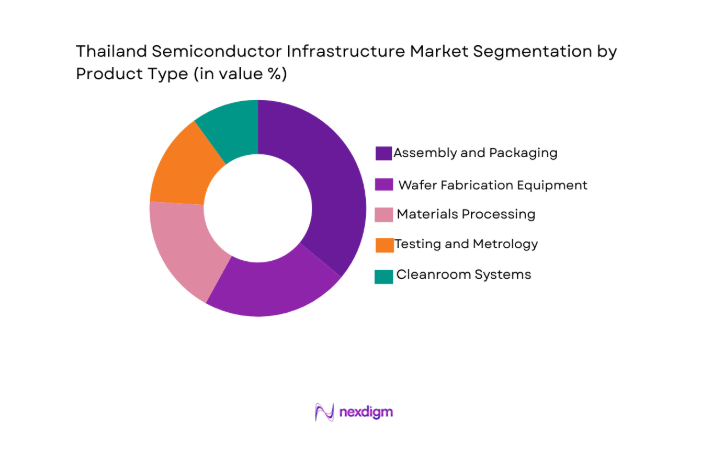
Thailand Semiconductor Infrastructure Market is segmented by product type into assembly and packaging infrastructure, wafer fabrication equipment infrastructure, semiconductor materials processing infrastructure, testing and metrology infrastructure, and cleanroom and facility systems. Recently, assembly and packaging infrastructure has a dominant market share due to Thailand’s strong outsourced semiconductor assembly ecosystem, concentration of multinational OSAT facilities, and sustained investment in automotive and power semiconductor back-end manufacturing lines. Established supplier networks for substrates and packaging materials further reinforce segment leadership.
By Platform Type
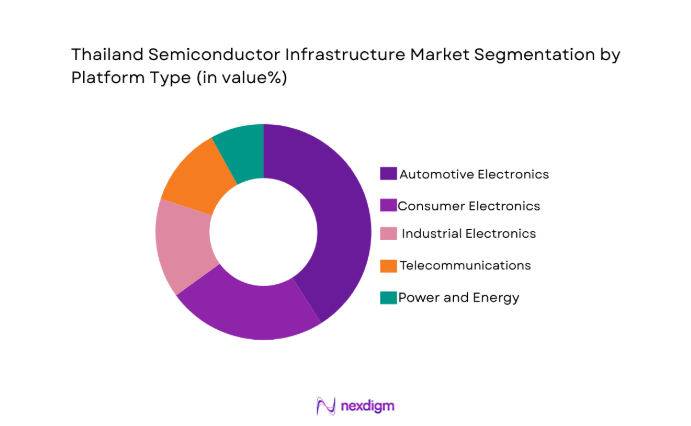
Thailand Semiconductor Infrastructure Market is segmented by platform type into automotive electronics platforms, consumer electronics platforms, industrial electronics platforms, telecommunications platforms, and power and energy platforms. Recently, automotive electronics platforms have a dominant market share due to Thailand’s role as a major regional automotive manufacturing hub and increasing semiconductor integration in vehicles produced domestically. Demand for automotive-grade chips, sensors, and power devices drives investment in localized semiconductor assembly, testing, and reliability infrastructure dedicated to automotive supply chains.
Competitive Landscape
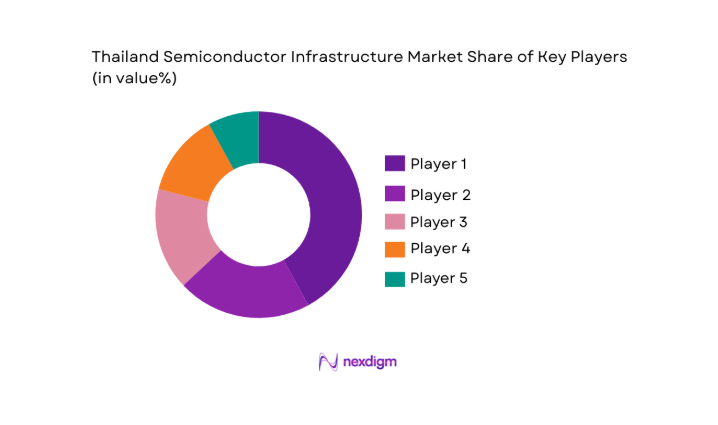
Thailand Semiconductor Infrastructure Market shows moderate consolidation led by global semiconductor equipment and assembly technology providers with regional operations supporting Thailand’s packaging and electronics clusters. Multinational firms dominate advanced infrastructure supply through technology leadership, long-term equipment agreements, and localized engineering support, while Japanese and US vendors maintain strong presence across wafer processing, packaging, and testing infrastructure deployed in Thailand’s semiconductor facilities.
| Company Name | Establishment Year | Headquarters | Technology Focus | Market Reach | Key Products | Revenue (USD) | Thailand Presence |
| ASMPT | 1975 | Singapore | ~ | ~ | ~ | ~ | ~ |
| Kulicke & Soffa | 1951 | USA | ~ | ~ | ~ | ~ | ~ |
| Applied Materials | 1967 | USA | ~ | ~ | ~ | ~ | ~ |
| Tokyo Electron | 1963 | Japan | ~ | ~ | ~ | ~ | ~ |
| DISCO Corporation | 1937 | Japan | ~ | ~ | ~ | ~ | ~ |
Thailand Semiconductor Infrastructure Market Analysis
Growth Drivers
Foreign Direct Investment Expansion in Semiconductor Back-End Manufacturing
Thailand Semiconductor Infrastructure Market benefits substantially from sustained inflows of foreign direct investment directed toward assembly, packaging, and testing facilities, driven by multinational semiconductor firms seeking geographic diversification of supply chains and cost-efficient manufacturing bases in Southeast Asia. Government investment promotion policies provide tax holidays, import duty exemptions, and land incentives for semiconductor infrastructure projects, encouraging global OSAT and electronics firms to expand Thai operations. These investments necessitate procurement of packaging equipment, cleanroom systems, and materials processing infrastructure, creating consistent demand for infrastructure providers. Thailand’s established electronics manufacturing base and export logistics capabilities reduce operational risks for investors compared to emerging semiconductor locations. Automotive and industrial semiconductor supply chains anchored in Thailand generate stable downstream demand for back-end manufacturing capacity. Infrastructure vendors benefit from long-term equipment supply agreements tied to facility expansion programs. Cluster development within industrial corridors amplifies economies of scale and shared infrastructure utilization. Continuous reinvestment cycles occur as facilities upgrade to advanced packaging technologies and higher reliability standards. These structural investment dynamics reinforce durable growth in semiconductor infrastructure demand across Thailand.
Regional Automotive Electronics Manufacturing Hub Integration
Thailand Semiconductor Infrastructure Market growth is strongly linked to the country’s status as a leading regional automotive production center, where rising semiconductor intensity in vehicles requires localized assembly and testing capacity aligned with automotive quality certifications. Automotive manufacturers operating in Thailand demand reliable supply of microcontrollers, sensors, and power devices assembled and tested domestically to reduce supply chain risk and lead times. This stimulates investment in automotive-grade packaging lines, reliability testing systems, and advanced facility infrastructure compliant with stringent automotive standards. Electric mobility adoption increases semiconductor complexity per vehicle, expanding infrastructure requirements in power semiconductor packaging and thermal management systems. Collaboration between automotive OEM suppliers and semiconductor packaging firms promotes co-located infrastructure clusters. Government initiatives promoting electric vehicle production indirectly accelerate semiconductor infrastructure investment. Export-oriented automotive manufacturing amplifies demand for certified semiconductor processing infrastructure. Infrastructure providers respond by deploying specialized automotive-qualified equipment and facility solutions. The interdependence between automotive manufacturing and semiconductor infrastructure sustains long-term growth momentum in Thailand.
Market Challenges
Limited Domestic Wafer Fabrication Capability and Technology Depth
Thailand Semiconductor Infrastructure Market faces structural constraints due to limited domestic wafer fabrication capacity and absence of advanced front-end semiconductor manufacturing ecosystems, which restricts demand for high-value fabrication infrastructure and concentrates activity primarily in back-end operations. Without substantial local wafer production, infrastructure demand is skewed toward packaging and testing rather than full semiconductor manufacturing chains. This imbalance reduces opportunities for suppliers of lithography, deposition, and etching infrastructure to establish large-scale operations in Thailand. Dependence on imported wafers constrains integration of complete semiconductor supply chains domestically. Technology transfer into advanced fabrication processes remains limited compared with regional semiconductor leaders. Investment attractiveness for leading-edge fabs is moderated by workforce skill gaps and ecosystem maturity considerations. Infrastructure firms encounter market size limitations for high-end front-end equipment. National semiconductor strategies are still evolving toward deeper value-chain participation. These structural gaps moderate Thailand’s potential to expand into full semiconductor infrastructure breadth.
Skilled Workforce Shortage in Advanced Semiconductor Engineering
Thailand Semiconductor Infrastructure Market growth is challenged by shortages of highly specialized semiconductor engineers and technicians required for installation, calibration, and operation of advanced semiconductor manufacturing infrastructure, particularly in emerging packaging and reliability technologies. Semiconductor equipment vendors require personnel skilled in precision mechanics, materials science, and microelectronics process control, which remain limited in domestic labor pools. Training pipelines for semiconductor process engineering lag behind rapidly evolving technology requirements. Firms must rely on expatriate specialists or overseas training programs, increasing operational costs and project timelines. Workforce constraints slow deployment of sophisticated infrastructure systems and facility upgrades. Expansion into advanced packaging technologies requires new skill sets not widely available locally. Competition for technical talent with other electronics sectors intensifies shortages. Limited academic-industry collaboration in semiconductor engineering reduces talent development speed. These human capital challenges constrain infrastructure scaling and technological advancement within Thailand.
Opportunities
Advanced Packaging and Heterogeneous Integration Infrastructure Development
Thailand Semiconductor Infrastructure Market has significant opportunity in expansion of advanced semiconductor packaging infrastructure such as wafer-level packaging, system-in-package integration, and heterogeneous integration platforms, as global semiconductor supply chains increasingly shift toward advanced back-end technologies to enhance performance and miniaturization. Thailand’s existing OSAT base provides a strong foundation for upgrading into advanced packaging capabilities. Global semiconductor firms seek diversified advanced packaging locations beyond traditional hubs, positioning Thailand as an attractive destination. Government incentives for high-technology manufacturing support capital investment in next-generation packaging infrastructure. Demand from automotive, industrial, and telecommunications sectors for high-reliability integrated semiconductor modules accelerates adoption of advanced packaging processes. Infrastructure providers can supply bonding, encapsulation, and precision facility systems tailored to advanced packaging lines. Collaborative research initiatives between industry and Thai institutions can accelerate technology adoption. Regional supply chain integration encourages co-location of substrate and packaging material infrastructure. These trends create sustained opportunity for infrastructure vendors in Thailand.
Power Semiconductor Manufacturing Ecosystem Expansion
Thailand Semiconductor Infrastructure Market can benefit from expanding power semiconductor manufacturing and packaging infrastructure aligned with growth in electric mobility, renewable energy systems, and industrial power electronics across Southeast Asia, where demand for power devices such as IGBT and silicon carbide modules is rising. Thailand’s automotive and energy equipment industries create strong downstream demand for power semiconductor assembly and testing. Establishment of specialized power device packaging lines and reliability testing infrastructure can enhance domestic semiconductor value addition. Government support for electric vehicle and energy transition industries indirectly promotes power semiconductor infrastructure investment. Regional supply chains seek geographically diversified power device manufacturing bases. Infrastructure providers can develop thermal management, high-voltage testing, and ruggedized packaging systems suited to power electronics. Integration with existing automotive electronics clusters strengthens ecosystem viability. Export opportunities for packaged power devices support infrastructure utilization. These structural factors present significant opportunity for Thailand’s semiconductor infrastructure expansion.
Future Outlook
Thailand Semiconductor Infrastructure Market is expected to strengthen over the next five years as semiconductor supply chains diversify geographically and Southeast Asia gains importance in back-end manufacturing. Continued government incentives, automotive electronics demand, and advanced packaging adoption will support infrastructure investment. Technology upgrades toward heterogeneous integration and power semiconductor packaging will drive equipment modernization. Regional electronics manufacturing growth and export orientation will sustain infrastructure utilization and expansion.
Major Players
- ASMPT
- Kulicke & Soffa
- Applied Materials
- Tokyo Electron
- DISCO Corporation
- Advantest
- Teradyne
- SCREEN Holdings
- Hitachi High-Tech
- Shinkawa
- Besi
- Canon Machinery
- KLA Corporation
- Lam Research
- SUSSMicroTec
Key Target Audience
- Semiconductor manufacturing companies
- Automotive electronics manufacturers
- Power electronics producers
- Electronics OEM firms
- Industrial automation manufacturers
- Investments and venture capitalist firms
- Government and regulatory bodies
- Semiconductor equipment distributors
Research Methodology
Step 1: Identification of Key Variables
Key semiconductor infrastructure components, investment drivers, regional clusters, and end-use demand sectors were identified through industry databases, policy documents, and semiconductor supply chain mapping. Variables included facility investment, packaging capacity, equipment demand, and sectoral consumption patterns.
Step 2: Market Analysis and Construction
Market structure was constructed by mapping Thailand’s semiconductor value chain, infrastructure categories, and industry clusters. Secondary data from government agencies, industry associations, and corporate disclosures supported segmentation and competitive assessment.
Step 3: Hypothesis Validation and Expert Consultation
Industry experts from semiconductor equipment firms, packaging companies, and electronics manufacturers were consulted to validate infrastructure demand trends, investment drivers, and technology shifts influencing Thailand’s semiconductor ecosystem.
Step 4: Research Synthesis and Final Output
Quantitative and qualitative insights were synthesized into market estimates, segmentation shares, and strategic analysis. Findings were cross-checked with policy frameworks and industry benchmarks to ensure consistency and reliability.

- Executive Summary
- Research Methodology (Definitions, Scope, Industry Assumptions, Market Sizing Approach, Primary & Secondary Research Framework, Data Collection & Verification Protocol, Analytic Models & Forecast Methodology, Limitations & Research Validity Checks)

- Market Definition and Scope
- Value Chain & Stakeholder Ecosystem
- Regulatory / Certification Landscape
- Sector Dynamics Affecting Demand
- Strategic Initiatives & Infrastructure Growth

- Growth Drivers
Government semiconductor incentive programs under Thailand 4.0 industrial policy
Rising regional demand for advanced packaging and automotive semiconductor capacity
Strategic diversification of global semiconductor supply chains into Southeast Asia - Market Challenges
High capital intensity and long payback cycles for semiconductor fabs
Dependence on imported semiconductor equipment and materials
Skilled workforce shortages in semiconductor engineering and process integration - Market Opportunities
Expansion of OSAT and advanced packaging infrastructure for EV and electronics sectors
Development of specialty semiconductor and compound semiconductor fabs
Regional hub positioning for ASEAN semiconductor manufacturing supply chains - Trends
Shift toward advanced packaging and heterogeneous integration facilities
Increasing automation and smart fab infrastructure deployment
Growth of environmentally sustainable and energy efficient fab utilities - Government Regulations & Defense Policy
Thailand Board of Investment incentives for semiconductor manufacturing facilities
Environmental and industrial estate compliance requirements for fabs
Technology transfer and foreign investment regulations in high tech manufacturing - Swot Analysis
Strength in established electronics manufacturing base and export logistics
Weakness in limited domestic semiconductor equipment ecosystem
Opportunity in regional supply chain diversification and packaging demand - Porters 5 forces
Moderate supplier power due to specialized semiconductor equipment vendors
High entry barriers from capital and technology requirements
Increasing competitive rivalry among ASEAN semiconductor locations

- By Market Value 2020-2025
- By Installed Units 2020-2025
- By Average System Price 2020-2025
- By System Complexity Tier 2020-2025

- By System Type (In Value%)
Wafer Fabrication Plant Infrastructure
Semiconductor Assembly and Test Facilities
Cleanroom and Contamination Control Systems
Semiconductor Utilities and Chemical Handling Systems
Process Equipment Installation and Integration - By Platform Type (In Value%)
Front-end Fabrication Facilities
Back-end Assembly and Packaging Facilities
Integrated Device Manufacturing Campuses
Foundry Service Facilities
R&D and Pilot Line Facilities - By Fitment Type (In Value%)
New Greenfield Semiconductor Fabs
Brownfield Fab Expansion Projects
Modular Cleanroom Installations
Utility Retrofit and Upgrade Projects
Turnkey Fab Construction Contracts - By End User Segment (In Value%)
Integrated Device Manufacturers
Outsourced Semiconductor Assembly and Test Providers
Foundry Operators
Electronics Manufacturing Services Firms
Government and Research Institutes - By Procurement Channel (In Value%)
EPC and Turnkey Contractors
Direct OEM Procurement
Government Incentive-linked Procurement
Consortium-based Fab Development
Public Private Partnership Projects

- Market structure and competitive positioning
Market share snapshot of major players - Cross Comparison Parameters (Project Scale, Technology Node Capability, Cleanroom Class Expertise, EPC Integration Capability, Regional Presence)
- SWOT Analysis of Key Competitors
- Pricing & Procurement Analysis
- Key Players
TTCL Public Company Limited
Italian Thai Development Public Company Limited
Samsung Engineering Thailand
M+W Group Thailand
Jacobs Solutions Thailand
Fluor Daniel Thailand
Chiyoda Thailand
Toyo Engineering Thailand
Daifuku Thailand
ULVAC Thailand
Murata Machinery Thailand
Shimizu Thailand
Takenaka Corporation Thailand
Linde Engineering Thailand
Air Liquide Engineering Southeast Asia

- Integrated device manufacturers investing in localized Southeast Asia capacity diversification
- OSAT providers expanding advanced packaging lines for automotive and power electronics
- Foundry operators assessing specialty and mature node fab opportunities in Thailand
- Government and research institutes supporting pilot lines and workforce development

- Forecast Market Value 2026-2035
- Forecast Installed Units 2026-2035
- Price Forecast by System Tier 2026-2035
- Future Demand by Platform 2026-2035


 Request a Sample
 Ask for Customization
 Get a Quote
 Enquire Now