
 Download PDF
Market Overview
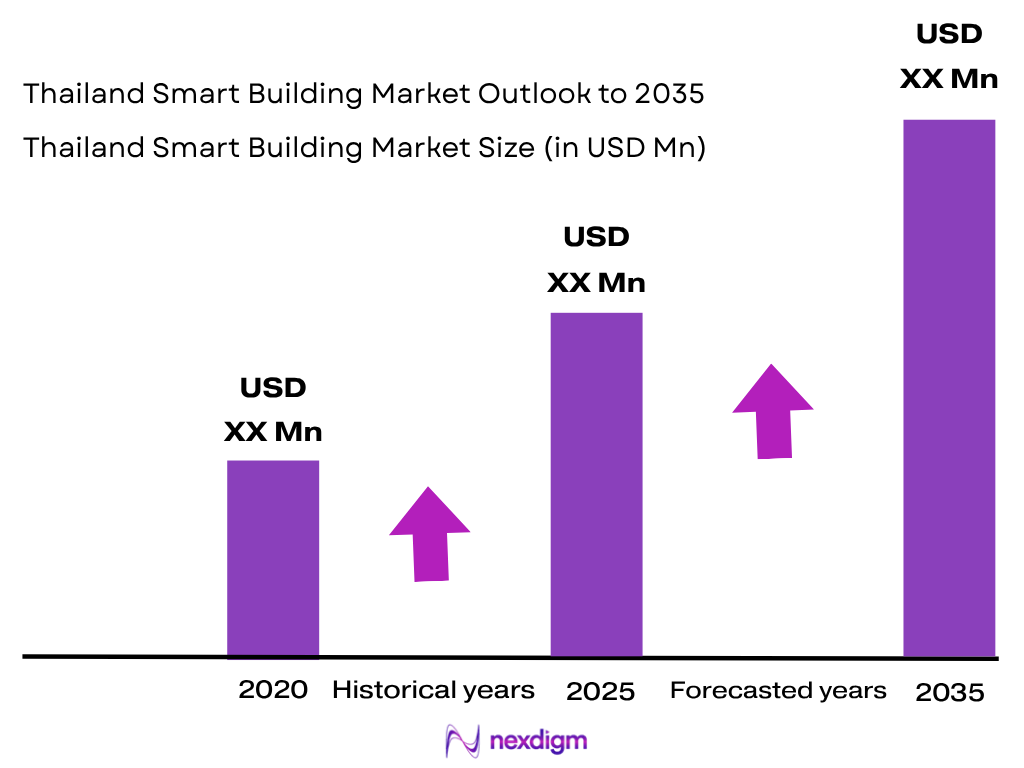
The Thailand Smart Building Market is supported by the expansion of commercial real estate, data centers, hospitality properties, industrial facilities, and government-led digital infrastructure initiatives. Thailand’s economy recorded real GDP growth of 2.5% in 2024, according to the World Bank, while the country’s digital economy and technology infrastructure continue to expand. Building owners are increasingly adopting building management systems, intelligent HVAC controls, smart lighting, energy-management platforms, connected security, and IoT monitoring to improve operational visibility and energy performance. The Thailand Smart Building Market is valued at ~USD XX billion in 2024, with a forecast CAGR of ~XX% during 2026-2035.
Bangkok represents the principal concentration of smart-building activity because it combines Thailand’s largest concentration of offices, retail complexes, hotels, mixed-use developments, hospitals, transportation facilities, and government buildings. The Bangkok Metropolitan Region also provides a dense installed base of buildings suitable for both new-build automation and retrofit projects. Chon Buri and the Eastern Economic Corridor are important secondary markets because of industrial estates, logistics facilities, manufacturing plants, commercial development, and technology-intensive infrastructure. Thailand recorded over 71 million international tourist arrivals in 2024, according to the Ministry of Tourism and Sports, strengthening demand for connected hospitality facilities, while industrial and digital infrastructure investment supports smart-building deployment beyond Bangkok.
Market Segmentation
By solution type
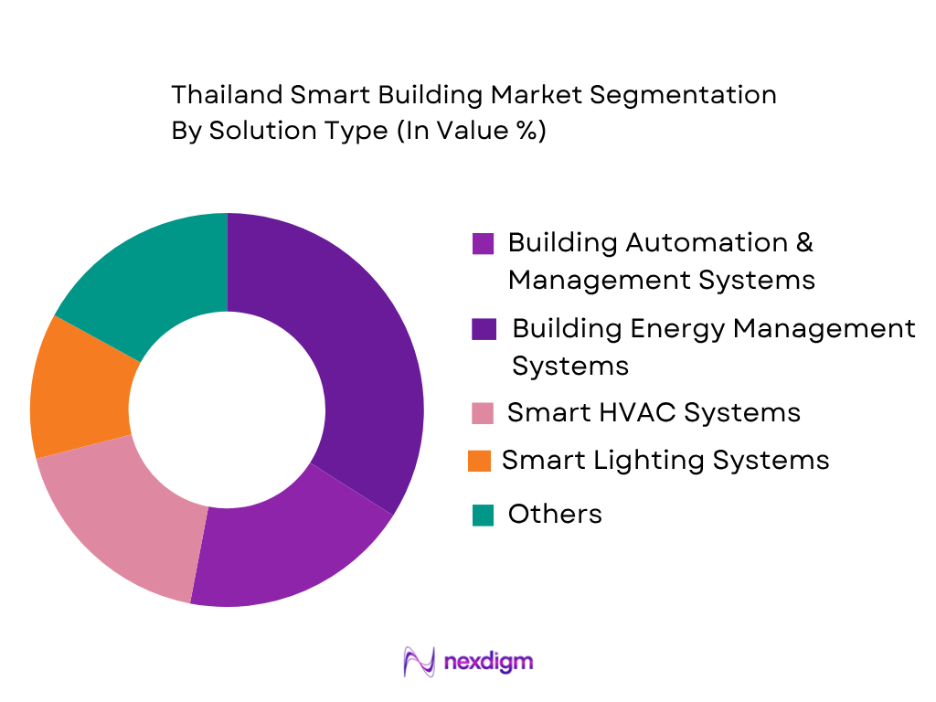
Thailand Smart Building Market is segmented by solution type into building automation systems, building energy management systems, smart HVAC systems, smart lighting systems, intelligent security and access control, and smart fire and life-safety systems. Building automation and management systems represent the dominant segment because they provide the central integration layer connecting HVAC, power, lighting, fire protection, security, metering and sensors. Thailand’s Building Energy Code creates an additional structural requirement for energy-conscious building design. Modern BMS platforms increasingly support BACnet, Modbus, MQTT and IP-based integration, allowing property owners to consolidate previously independent systems. This capability is particularly relevant to Bangkok offices, hotels, hospitals, malls, industrial buildings and data centers where centralized monitoring can improve equipment visibility and operational control. Expansion of cloud connectivity, analytics and AI is also transforming conventional BMS installations into broader digital-building platforms capable of predictive maintenance, remote supervision, energy optimization and occupancy-responsive operation.
By Building Type
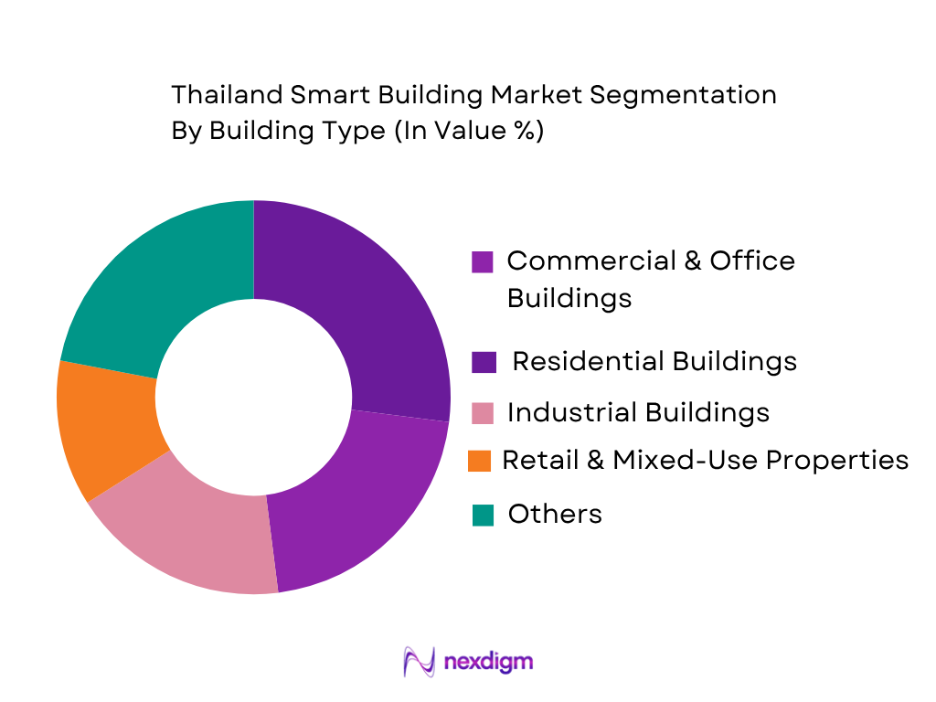
Thailand Smart Building Market is segmented by building type into commercial offices, residential buildings, industrial and manufacturing facilities, hospitality buildings, retail and mixed-use developments, healthcare facilities, and data centers and other mission-critical facilities. Commercial offices represent the leading placeholder segment because premium office assets require integrated HVAC controls, lighting management, access systems, energy monitoring, occupancy management and centralized BMS platforms. Bangkok’s concentration of Grade-A offices and mixed-use properties supports sophisticated building-control specifications, while energy regulations strengthen attention to building performance. Industrial facilities constitute another strategically important application as Thailand’s manufacturing ecosystem requires utility monitoring, environmental controls and automated energy management. Data centers are emerging as an increasingly technology-intensive opportunity: Thailand’s Board of Investment approved a THB 32.8 billion hyperscale data-center investment in Chonburi, demonstrating the development of facilities requiring sophisticated cooling, power monitoring, access control and environmental management. Smart-building suppliers can consequently address both conventional property automation and high-availability digital infrastructure.
Competitive Landscape
The Thailand Smart Building Market comprises global building-technology companies, automation specialists, electrical-equipment providers, HVAC technology suppliers, security-system companies, and local system integrators. Competition is differentiated by building management platforms, HVAC automation capabilities, energy-management solutions, IoT connectivity, cybersecurity, system interoperability, installation capabilities, and after-sales technical support. Large international suppliers typically participate across several technology categories, while specialized companies compete through particular automation, electrical, HVAC, security, or facility-management capabilities.
| Company | Establishment Year | Headquarters | BMS Capability | HVAC Automation | Energy Management | IoT & Analytics | Security Integration | Thailand Presence |
| Siemens AG | 1847 | Munich, Germany | ||||||
| Schneider Electric SE | 1836 | Rueil-Malmaison, France | ||||||
| Honeywell International Inc. | 1906 | Charlotte, USA | ||||||
| Johnson Controls International plc | 1885 | Cork, Ireland | ||||||
| ABB Ltd. | 1988 | Zurich, Switzerland |
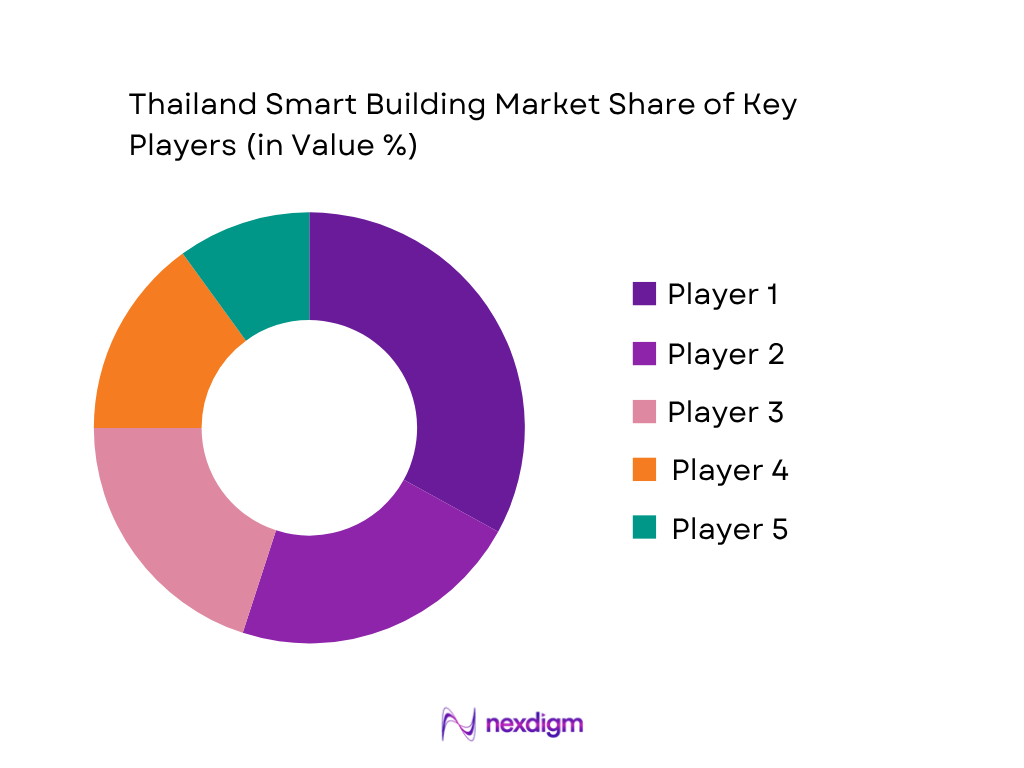
Thailand Smart Building Market Analysis
Growth Drivers
Thailand Building Energy Code Adoption
Thailand’s Building Energy Code provides a direct regulatory foundation for smart-building technologies by requiring energy-conscious design for 9 building categories, including hospitals, educational facilities, offices, condominiums, hotels, service establishments, and department stores. The requirements apply to buildings with a combined floor area of at least 2,000 sq. m., covering building envelopes, lighting, air-conditioning, hot-water systems, total building energy use, and renewable energy. The BEC database currently records 11,736 buildings, including 2,235 buildings below 2,000 sq. m., 2,919 buildings between 2,001 and 5,000 sq. m., 2,624 buildings between 5,001 and 10,000 sq. m., 2,215 buildings between 10,001 and 20,000 sq. m., and 1,743 buildings above 20,001 sq. m. This regulatory structure creates direct application areas for automated HVAC controls, smart lighting, energy meters, BEMS, sensors, and centralized building-management platforms. DEDE also states that BEC-compliant building design can achieve electricity savings of more than 10%, reinforcing the operational relevance of energy-management technologies. The implementation environment is continuing to receive institutional attention, with DEDE conducting BEC implementation seminars in 2024, 2025, and 2026, supporting local authorities and relevant construction-permit personnel in applying the requirements.
Commercial Real Estate, Data Center and Digital Infrastructure Development
Thailand’s commercial and technology infrastructure pipeline is creating additional deployment requirements for smart-building systems. The Bank of Thailand reported 5,860.9 thousand sq. m. of nationwide permitted construction area on a 4-month moving-average basis in December 2024, while Bangkok Metropolitan Region and vicinity accounted for 1,200.69 thousand sq. m. in the same property-indicator dataset. At the same time, Thailand’s Board of Investment recorded 1.14 trillion baht of investment-promotion applications in 2024, with the digital sector, including data centers and cloud services, attracting 150 projects worth 243.3 billion baht. The digital investment pipeline is particularly relevant to smart-building demand because data centers require continuous HVAC optimization, environmental monitoring, electrical monitoring, access control, fire protection, predictive maintenance, and centralized facility management. Momentum continued into 2025: first-quarter investment applications reached 431.2 billion baht, while digital-sector applications reached 94.75 billion baht, including 94.23 billion baht across 5 data-center projects. By the first half of 2025, data-center projects alone represented 521.2 billion baht across 28 projects. These developments expand the addressable base for automation, energy management, connected equipment, and facility analytics across technology-intensive facilities.
Market Challenges
High System Integration Complexity
The Thailand Smart Building Market faces integration challenges because modern facilities frequently combine HVAC, lighting, access control, fire safety, electrical monitoring, elevators, IoT sensors, and energy-management platforms from multiple technology generations and suppliers. The regulatory environment itself demonstrates the breadth of systems that must be coordinated: Thailand’s BEC framework addresses 6 major energy-related systems, while the regulations apply across 9 building categories for buildings with floor areas of at least 2,000 sq. m. The national BEC database contains 11,736 buildings, creating a large installed base in which technology configurations can vary substantially. Retrofit projects are particularly complex because existing buildings may contain equipment that was not designed for modern IP connectivity or centralized analytics. The Bank of Thailand recorded 5,860.9 thousand sq. m. of permitted construction area on a four-month moving-average basis in December 2024, demonstrating the continuing scale of construction activity alongside the existing building stock. Smart-building integrators therefore need to accommodate different communication protocols, controllers, meters, sensors, and equipment interfaces rather than relying on a single standardized architecture. This increases commissioning requirements and creates demand for specialist engineering, gateway technologies, middleware, and lifecycle technical support.
Cybersecurity and Data Governance Requirements
Increasing connectivity creates a specific challenge for Thailand’s smart-building ecosystem because building systems are progressively linked to networks, cloud platforms, remote-management tools, and IoT devices. Thailand had 91% of its population using the internet in 2024, according to World Bank data, demonstrating the country’s high level of digital connectivity. The cybersecurity dimension is particularly relevant for buildings containing connected access-control systems, surveillance infrastructure, HVAC controllers, energy-management platforms, and operational technology. Thailand’s National Cyber Security Agency reported 206 incidents detected by its Special Operations Center involving mobile-banking trojan applications during 2024, with 15,091,953 baht in prevented losses; although these incidents were not building-specific, they illustrate the broader cyber-risk environment in which connected digital infrastructure operates. The rapid development of data centers adds another layer of operational-security requirements. BOI recorded 28 data-center projects with 521.2 billion baht of combined investment during the first half of 2025, making secure building automation increasingly relevant to technology-intensive facilities. Building operators consequently need stronger authentication, network segmentation, access management, monitoring, incident response, and data-governance practices when connecting building-management and IoT infrastructure.
Market Opportunities
Smart Building Retrofit Programs and AI-Based Energy Optimization
Thailand’s existing building base creates an opportunity for retrofit-oriented smart-building deployment, particularly where owners can upgrade controls and monitoring without undertaking complete structural redevelopment. The national BEC database records 11,736 buildings, including 1,743 buildings above 20,001 sq. m. and 2,215 buildings between 10,001 and 20,000 sq. m., providing a substantial pool of larger facilities where centralized energy monitoring, automated HVAC control, smart meters, occupancy sensing, and analytics can be integrated. BEC specifically covers air-conditioning, lighting, overall building energy consumption, and renewable-energy use, making these systems natural entry points for digital optimization. Thailand’s digital infrastructure expansion provides an additional technology foundation: BOI reported 150 digital-sector investment applications worth 243.3 billion baht in 2024. Internet usage also reached 91% of the population, according to World Bank data, supporting a digitally connected operating environment. AI-based optimization can build on this infrastructure by analyzing equipment behavior, occupancy information, temperature conditions, and energy consumption to identify operational inefficiencies. Retrofit suppliers can therefore position integrated platforms around measurable building-system performance rather than isolated equipment replacement, particularly across offices, hotels, hospitals, retail properties, educational facilities, and large mixed-use developments.
Connected Hospitality, Data Center Automation and Predictive Maintenance
Thailand’s expanding tourism and technology infrastructure provides multiple opportunities for connected building solutions. The World Bank reported that Thailand was expected to receive 36.1 million tourist arrivals in 2024, compared with 28.2 million in 2023, supporting continued activity across hotels, resorts, airports, retail destinations, and other tourism-related facilities. These properties require continuous HVAC operation, room-level controls, energy monitoring, access management, fire and life-safety systems, and facility analytics, creating opportunities for integrated hospitality platforms. Data centers provide another high-value application because their operating environments require continuous cooling, power monitoring, environmental sensing, physical security, and predictive maintenance. BOI recorded 521.2 billion baht of investment across 28 data-center projects in the first half of 2025, while the projects are distributed across Bangkok, Chachoengsao, Chonburi, Pathum Thani, Rayong, and Samut Prakan. Thailand’s smart-city ecosystem is also expanding, with depa reporting 37 officially designated smart cities and 227 smart-city plan proposals as of January 2026. These developments create opportunities for building-as-a-service models, connected facility-management platforms, occupancy analytics, predictive maintenance, intelligent water management, and AI-enabled building operations across hospitality, commercial, industrial, and digital infrastructure facilities.
Future Outlook
Over the coming decade, the Thailand Smart Building Market is expected to be shaped by increasing building automation, energy optimization, IoT connectivity, data-center development, and modernization of existing commercial properties. Demand is expected to extend beyond conventional BMS toward AI-enabled analytics, predictive maintenance, digital twins, connected HVAC, and integrated energy-management platforms. Bangkok is expected to remain a major deployment center, while the Eastern Economic Corridor and major tourism destinations create additional opportunities. Retrofit projects are also expected to become increasingly relevant as building owners seek technology upgrades without undertaking complete structural redevelopment.
Major Players
- Siemens AG
- Schneider Electric SE
- Honeywell International Inc.
- Johnson Controls International plc
- ABB Ltd.
- Mitsubishi Electric Corporation
- Delta Electronics (Thailand) PCL.
- Yokogawa Electric Corporation
- Azbil Corporation
- Legrand SA
- Robert Bosch GmbH
- KONE Corporation
- Signify N.V.
- Huawei Technologies
- Hitachi Ltd.
Key Target Audience
- Commercial Real Estate Developers and Property Owners
- Data Center Operators and Infrastructure Developers
- Hospitality Groups and Hotel Property Owners
- Industrial Estate Developers and Manufacturing Facility Operators
- Building Automation and HVAC System Integrators
- Investments and Venture Capitalist Firms
- Government and Regulatory Bodies (Ministry of Energy, Department of Alternative Energy Development and Efficiency, Ministry of Industry, Digital Economy and Society)
- Facility Management and Building Operations Companies
Research Methodology
Step 1: Identification of Key Variables
The initial phase involves constructing a Thailand Smart Building Market ecosystem map covering technology manufacturers, system integrators, property developers, building owners, facility managers, contractors, utilities, and technology providers. The assessment identifies variables including connected building floor area, automation penetration, HVAC control deployment, energy-management adoption, retrofit activity, IoT installation, and technology expenditure.
Step 2: Market Analysis and Construction
In this phase, historical information concerning Thailand’s commercial construction, building modernization, data-center development, hospitality infrastructure, industrial facilities, and smart-building technology adoption is compiled. Top-down assessment is combined with bottom-up analysis of hardware deployments, software platforms, integration services, installed systems, and building-level technology requirements to construct the market database.
Step 3: Hypothesis Validation and Expert Consultation
Market hypotheses are validated through discussions with building-automation providers, HVAC specialists, electrical-system suppliers, system integrators, facility managers, developers, contractors, and building operators. Expert inputs are used to assess technology adoption, deployment patterns, retrofit requirements, integration challenges, purchasing criteria, and competitive positioning across major Thai building categories.
Step 4: Research Synthesis and Final Output
The final stage integrates primary insights with secondary information from government agencies, regulatory bodies, industry associations, corporate disclosures, construction statistics, energy-related publications, and technology documentation. Data are triangulated across supply-side and demand-side indicators to establish market segmentation, competitive analysis, growth drivers, challenges, opportunities, and the long-term outlook for the Thailand Smart Building Market.

- Executive Summary
- Research Methodology (Market Definitions and Assumptions, Thailand Smart Building Classification, Smart Building Technology Mapping, Building Automation System Assessment, Building Management System Assessment, IoT Connectivity Assessment, Energy Management Assessment, HVAC Automation Assessment, Security and Access Control Assessment, Smart Lighting Assessment, Fire and Life Safety Assessment, Digital Twin and Building Analytics Assessment, Top-Down Analysis, Bottom-Up Analysis, Demand-Side Assessment, Supply-Side Assessment, Primary Industry Interviews, Technology Validation, Data Triangulation, Forecasting Framework, Research Limitations)

- Definition and Scope
- Thailand Smart Building Industry Evolution and Development of Building Management Systems, Building Automation, IoT-Enabled Buildings, Intelligent HVAC, Energy Management Systems, Smart Lighting, Connected Security, Fire and Life Safety, Digital Facility Management, Building Analytics, Digital Twins, Predictive Maintenance, Smart Metering, Cloud-Based Building Platforms
- Thailand Smart Building Value Chain Analysis (Smart Building Technology Manufacturers, HVAC Automation Suppliers, Sensor Manufacturers, Building Management Software Providers, IoT Platform Providers, Security Technology Suppliers, Lighting Control Manufacturers, System Integrators, Facility Management Companies, Property Developers, Construction Contractors, Architects, Building Owners and Operators)
- Thailand Smart Building Supply Chain Analysis (HVAC Equipment, Sensors, Controllers, Actuators, Smart Meters, IoT Gateways, Networking Equipment, Access Control Hardware, Surveillance Systems, Lighting Controls, Fire Detection Equipment, BMS Software, Cloud Platforms, System Integration, Installation, Commissioning and Maintenance Services)

- Growth Drivers (Thailand Building Energy Code Adoption, Commercial Real Estate Development, Data Center Infrastructure Expansion, Smart City Development, Energy Efficiency Requirements, HVAC Optimization Demand, Digital Facility Management Adoption, IoT Connectivity Expansion, Hospitality Infrastructure Development, Industrial Estate Modernization)
- Market Challenges (High System Integration Complexity, Legacy Building-System Interoperability, Fragmented Communication Protocols, Cybersecurity Requirements, Specialized Engineering Skills, Retrofit Constraints, Multi-Vendor Integration, High HVAC Dependence, Data Governance Requirements, Long Building Equipment Replacement Cycles)
- Market Opportunities (Smart Building Retrofit Programs, AI-Based Energy Optimization, Digital Twin Deployment, Predictive Maintenance, Smart HVAC Optimization, Integrated Energy Management Platforms, Connected Hospitality Infrastructure, Data Center Automation, Smart Building Cybersecurity, IoT-Based Occupancy Analytics, Intelligent Water Management, Smart Building-as-a-Service, Net-Zero Building Management)
- Market Trends (AI-Enabled Building Analytics, Cloud-Based Building Management, IoT Sensor Deployment, Smart Metering, Occupancy-Based Automation, Integrated HVAC Controls, Digital Twin Adoption, Predictive Maintenance, Connected Facility Management, Energy Performance Monitoring)
- Government Regulations and Standards (Building Energy Code, Energy Conservation Promotion Act, Building Control Act, Energy-Efficient HVAC Requirements, Lighting Efficiency Requirements, Building Energy Performance Requirements, Fire Safety Requirements, Electrical Safety Standards, Personal Data Protection Requirements, Cybersecurity Requirements)
- SWOT Analysis
- Porter’s Five Forces Analysis
- PESTLE Analysis
- Stakeholder Ecosystem
- Competition Ecosystem

- By Market Value (2020-2025)
- By Installed Smart Building Technology Systems (2020-2025)
- By Connected Building Floor Area (2020-2025)
- By Building Automation System Installations (2020-2025)
- By Building Management System Deployments (2020-2025)
- By Smart HVAC System Installations (2020-2025)
- By Energy Management System Deployments (2020-2025)
- By IoT Sensor and Building Monitoring Deployments (2020-2025)

- By Solution Type (In Value %)
Building Automation Systems
Integrated Building Management Systems
Building Energy Management Systems
Smart HVAC and Climate Control Systems
Smart Lighting and Lighting Controls
Smart Access Control and Security Systems
Fire and Life-Safety Integration Systems
Occupancy and Space Management Systems
Indoor Air Quality and Environmental Monitoring Systems
Smart Metering and Utility Management Systems
Digital Twin and Building Analytics Platforms - By Building Technology (In Value %)
Building Management Systems and Building Automation
HVAC and Smart Climate Control
Energy Management and Building Energy Management Systems
Security and Access Control Systems
Smart Lighting and Lighting Controls
Fire and Life Safety Systems
IoT Sensors and Environmental Monitoring
Digital Twin and Building Analytics Platforms - By Building Type (In Value %)
Commercial Office Buildings
Residential Buildings and Condominiums
Retail and Shopping Centres
Hotels and Hospitality Buildings
Industrial and Manufacturing Facilities
Healthcare Facilities
Educational Buildings
Government and Institutional Buildings
Logistics and Warehousing Facilities
Airports and Transportation Buildings
Data Centres
Mixed-Use Developments - By Deployment Mode (In Value %)
New Construction
Building Retrofit
System Expansion and Upgrade - By Application (In Value %)
Energy Management
HVAC Optimization
Occupancy and Space Management
Security and Access Control
Lighting Automation
Fire and Life Safety
Indoor Environmental Monitoring
Predictive Maintenance
Integrated Facility Management
Intelligent Water Management - By Region (In Value %)
Bangkok
Chon Buri
Nonthaburi
Pathum Thani
Samut Prakan
Phuket
Chiang Mai
Rayong
Rest of Thailand

- Market Share of Major Players (By Revenue, Component, Building Technology, Building Type, Application, Deployment Mode)
- Cross Comparison Parameters (Building Management System Capability, HVAC Automation Portfolio, Energy Management Capability, IoT Sensor Ecosystem, Cybersecurity and Data Integration Capability, Cloud-Based Building Platform Capability, System Integration and Interoperability, Thailand Installation and Technical Support Network)
- SWOT Analysis of Major Players
- Detailed Profiles of Major Companies
Siemens AG
Schneider Electric SE
Honeywell International Inc.
Johnson Controls International plc
ABB Ltd.
Mitsubishi Electric Corporation
Delta Electronics (Thailand) PCL.
Yokogawa Electric Corporation
Azbil Corporation
Legrand SA
Robert Bosch GmbH
KONE Corporation
Signify N.V.
Huawei Technologies
Hitachi Ltd.

- Building Owner Technology Adoption Assessment
- Commercial Real Estate Technology Requirements
- Hospitality Smart Building Requirements
- Data Center Smart Infrastructure Requirements
- Industrial Facility Smart Building Requirements
- Government Building Digitization Requirements

- By Market Value (2026-2035)
- By Installed Smart Building Technology Systems (2026-2035)
- By Connected Building Floor Area (2026-2035)
- By Building Automation System Installations (2026-2035)
- By Building Management System Deployments (2026-2035)
- By Smart HVAC System Installations (2026-2035)
- By Energy Management System Deployments (2026-2035)
- By IoT Sensor and Building Monitoring Deployments (2026-2035)


 Request a Sample
 Ask for Customization
 Get a Quote
 Enquire Now
