

 Download PDF
Market Overview
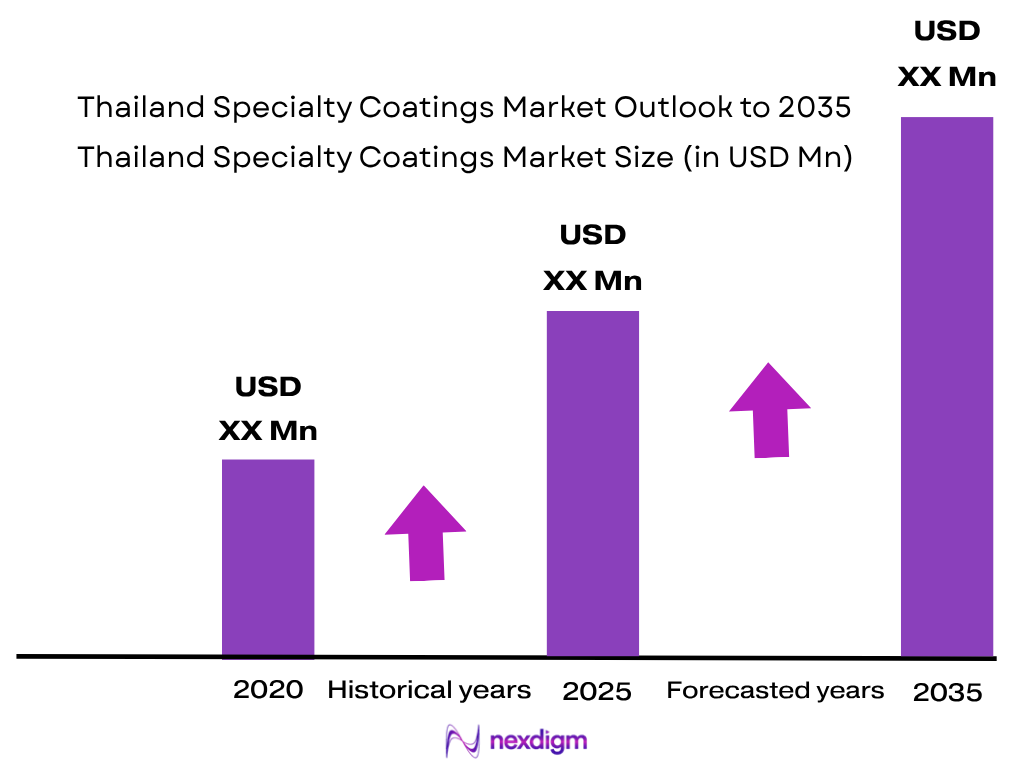
The Thailand Specialty Coatings Market is valued at approximately USD ~0.XX billion, supported by automotive, electronics, industrial equipment, marine, petrochemical and infrastructure applications. Thailand’s vehicle production moved from 1.83 million units to 1.47 million units, maintaining a substantial coatings-consumption base despite weaker automotive output. Electronics exports simultaneously increased from USD 45.68 billion to USD 52.20 billion, strengthening demand for conformal, dielectric, protective and other functional coatings.
Dominant Industrial Locations: Chonburi, Rayong, Samut Prakan and the Bangkok Metropolitan Region dominate specialty-coatings demand because they concentrate automotive assembly, component manufacturing, petrochemical facilities, ports, electronics production and coating plants. Thailand recorded THB 1.09 trillion of motor vehicles, parts and accessories exports, while total national exports reached THB 10.90 trillion, demonstrating the scale of downstream manufacturing. Chonburi also hosts manufacturing operations for major suppliers including Jotun and AkzoNobel.
Market Segmentation
By Resin Chemistry
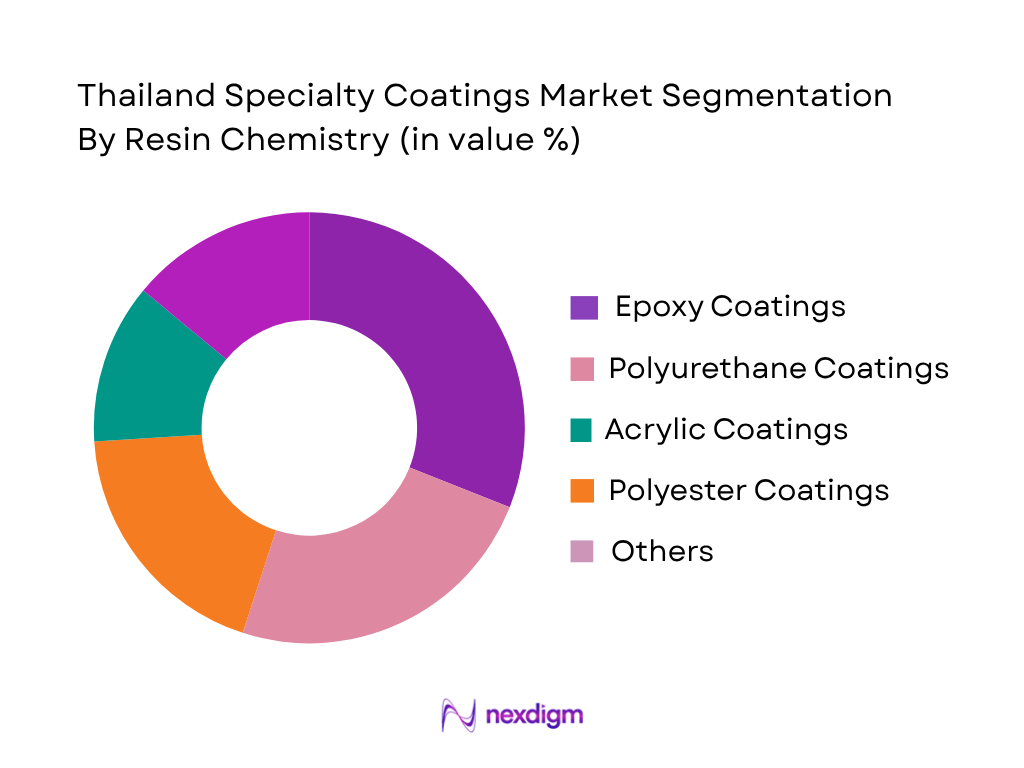
Thailand Specialty Coatings Market is segmented by resin chemistry into epoxy, polyurethane, acrylic, polyester, fluoropolymer, and silicone & specialty resin systems. Epoxy coatings hold the dominant position because of their extensive utilization in protective coatings, industrial equipment, steel structures, petrochemical facilities, storage tanks, pipelines, marine infrastructure and heavy-duty maintenance. Their strong adhesion, chemical resistance, corrosion protection and compatibility with high-build formulations make epoxy systems particularly suitable for Thailand’s humid and coastal operating environment. Industrial clusters in Chonburi and Rayong contain petrochemical, manufacturing and marine assets requiring long-duration corrosion protection. Polyurethane coatings represent another major category, particularly as durable topcoats where UV resistance, appearance and gloss retention are important. Acrylic systems benefit from automotive, plastics and general industrial applications, while fluoropolymer and silicone systems remain higher-value specialty categories where exceptional weatherability, chemical stability, thermal resistance or long service life justify premium pricing.
By Application
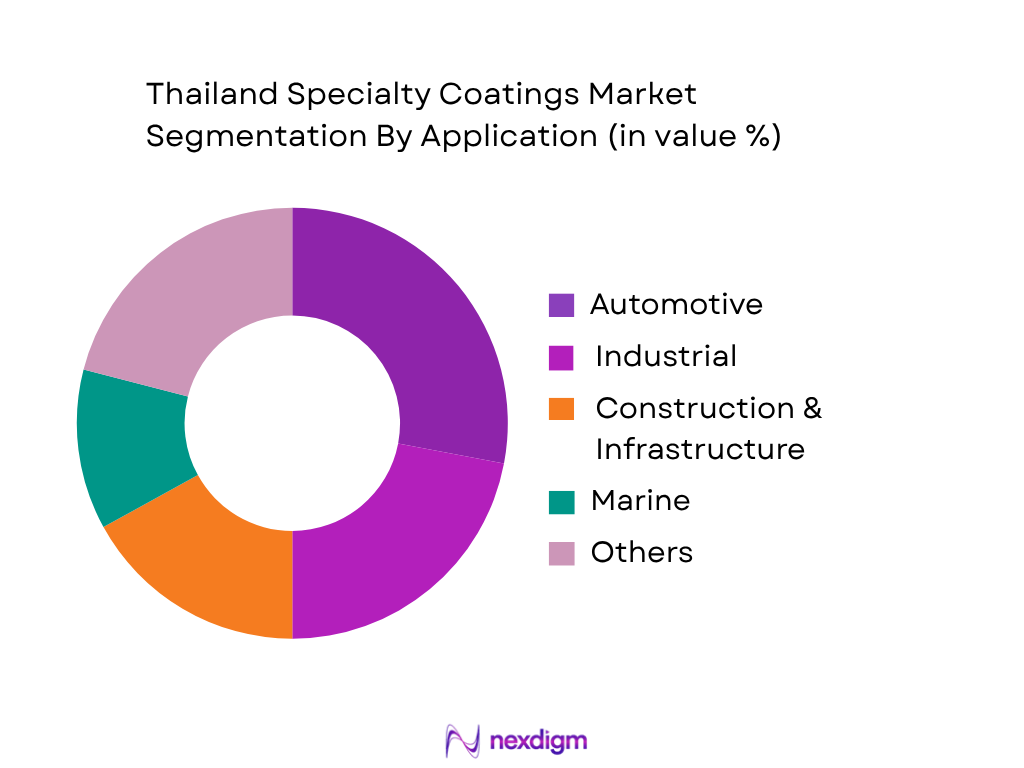
Thailand Specialty Coatings Market is segmented by application into automotive, industrial, construction & infrastructure, marine, electronics, and packaging applications. Automotive represents the dominant application because Thailand maintains one of Southeast Asia’s most developed automotive manufacturing ecosystems, supported by vehicle assemblers, component suppliers, coating lines and export-oriented production. Specialty coatings are consumed across primers, basecoats, clearcoats, plastic components, underbody systems, corrosion protection and increasingly EV-specific components. PPG’s establishment of a 2,000-ton annual-capacity waterborne automotive coatings plant in Samut Prakan further demonstrates supplier investment in this demand base. Industrial applications remain substantial because specialty systems protect machinery, fabricated metals and chemical-processing assets. Marine coatings benefit from ports and coastal operations, while electronics demand is increasingly supported by Thailand’s large electronics manufacturing and export ecosystem.
Competitive Landscape
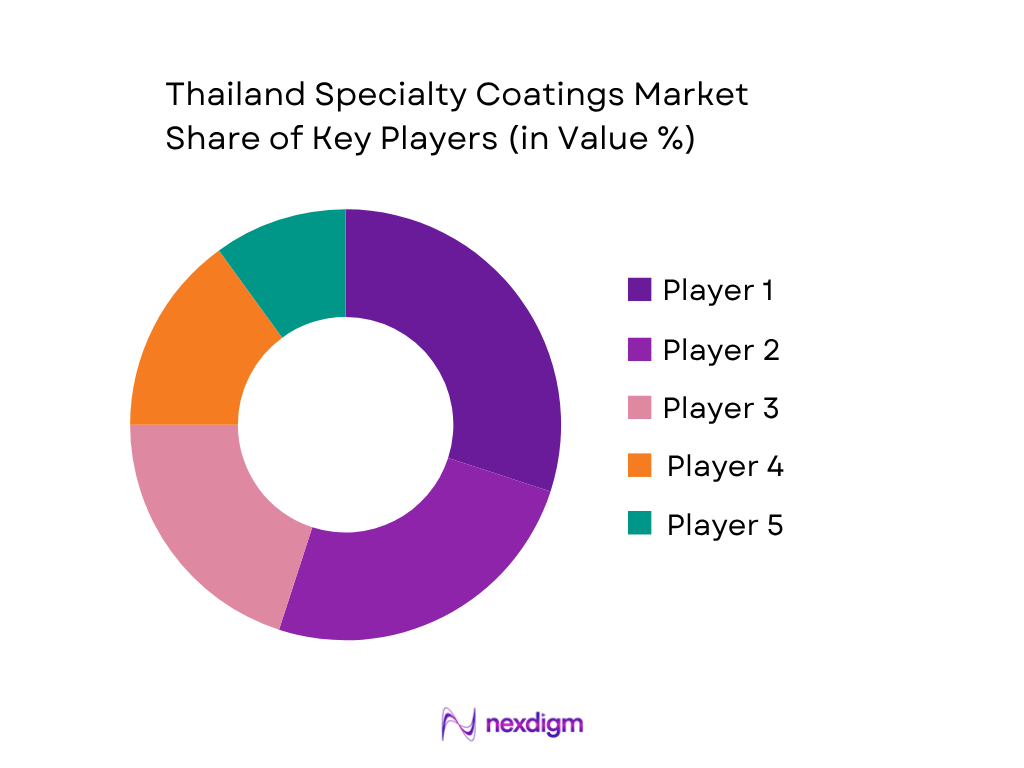
The Thailand Specialty Coatings Market combines established domestic manufacturers with multinational coating companies possessing global OEM relationships, proprietary formulation technologies and specialized application expertise. Competition is particularly intensive in automotive OEM, marine, protective, powder and high-performance industrial coatings. TOA Paint, AkzoNobel, PPG, Nippon Paint and Jotun represent prominent participants, while Axalta, Kansai Paint, Hempel, Chugoku Marine Paints and Sherwin-Williams strengthen competition across specialized end uses. Market positioning increasingly depends on local manufacturing, technical support, OEM approvals, application engineering and environmentally improved coating technologies.
| Major Player | Established | Headquarters | Thailand Specialty Focus | Key Resin/Technology Capability | Major End Uses | Thailand Manufacturing / Presence | Sustainability & Advanced Technology | Technical-Service Capability |
| TOA Paint | 1964 | Samut Prakan, Thailand | ~ | ~ | ~ | ~ | ~ | ~ |
| AkzoNobel | 1792 | Amsterdam, Netherlands | ~ | ~ | ~ | ~ | ~ | ~ |
| PPG | 1883 | Pittsburgh, United States | ~ | ~ | ~ | ~ | ~ | ~ |
| Nippon Paint | 1881 | Tokyo, Japan | ~ | ~ | ~ | ~ | ~ | ~ |
| Jotun | 1926 | Sandefjord, Norway | ~ | ~ | ~ | ~ |
Thailand Specialty Coatings Market Analysis
Growth Drivers
Automotive, EV and Component Manufacturing Base
Thailand’s automotive manufacturing ecosystem is a major demand driver for specialty coatings used across vehicle bodies, chassis, plastic components, wheels, battery housings and electronic assemblies. Thailand recorded 1,468,997 vehicles produced in 2024, including 190,837 hybrid-electric vehicles and 9,688 battery-electric vehicles, while 1,019,213 completely built vehicles were exported. These production volumes support consumption of electrocoat primers, corrosion-resistant epoxies, polyurethane topcoats, waterborne basecoats and heat-resistant systems. Thailand also recorded 309 automotive and parts investment applications worth THB 102.4 billion in 2024. Motor vehicles, parts and accessories generated THB 1.09 trillion in exports, demonstrating the depth of the downstream component ecosystem. Thailand’s wider industrial economy provides a substantial demand platform, with USD 526.52 billion in GDP and approximately THB 4.52 trillion in manufacturing value added in 2024. EV localization additionally creates applications for dielectric, battery-protection, thermal-management and flame-resistant specialty coatings.
Electronics, PCB and Advanced Manufacturing Expansion
Thailand’s electronics manufacturing expansion is increasing demand for conformal, dielectric, moisture-resistant, thermally conductive and other functional specialty coatings. The country recorded 407 electronics and electrical-appliance investment applications worth THB 231.7 billion in 2024, while electronics exports reached THB 1.86 trillion and semiconductor exports totaled THB 436 billion. Electronics exports reached USD 11.55 billion in the first quarter, USD 13.29 billion in the second, USD 13.84 billion in the third and USD 14.20 billion in the fourth quarter of 2024. Investment is increasingly extending into printed circuit boards and advanced electronics. Thailand recorded 517 semiconductor and advanced-electronics investment applications valued above THB 700 billion from 2022 through June 2025, including 180 PCB-related projects exceeding THB 200 billion. With approximately THB 4.52 trillion in manufacturing value added in 2024, Thailand provides a substantial industrial base for coatings offering electrical insulation, humidity protection, thermal management and contamination resistance.
Market Challenges
Automotive Production Volatility
Thailand’s specialty coatings industry is exposed to fluctuations in automotive output because OEMs and component manufacturers consume electrocoat, primers, basecoats, clearcoats, powder coatings and protective systems. Thailand manufactured 1,468,997 vehicles in 2024, compared with domestic sales of 572,675 units, while completely built vehicle exports reached 1,019,213 units. This export-oriented structure makes coating consumption sensitive to domestic and international vehicle demand. Lower assembly-plant utilization can reduce paint-shop throughput and affect Tier-1 and Tier-2 suppliers producing coated wheels, fabricated metals, plastics and other components. Nevertheless, motor vehicles, parts and accessories generated THB 1.09 trillion in exports in 2024. Thailand also received 309 automotive and parts investment applications worth THB 102.4 billion in 2024 and 229 applications worth THB 71 billion during the first nine months of 2025. With national GDP reaching USD 526.52 billion in 2024, automotive manufacturing remains economically significant, requiring coating suppliers to diversify across automotive, electronics, marine and industrial applications.
Dependence on Imported Specialty Inputs
High-performance coating formulations in Thailand continue to depend on internationally traded specialty resins, curing agents, pigments, additives and functional fillers, creating exposure to global supply-chain disruptions. Thailand recorded THB 10.90 trillion of merchandise imports in 2024, compared with THB 10.55 trillion of exports. Major industrial imports included THB 869.15 billion of electronic integrated circuits, THB 770.19 billion of electrical machinery and parts, and THB 780.14 billion of machinery and components, illustrating the international integration of Thailand’s manufacturing supply chain. Specialty coating manufacturers face similar dependencies where fluoropolymers, silicones, performance additives or functional materials cannot readily be substituted without formulation changes and customer requalification. This is particularly important for automotive and electronics coatings requiring consistent adhesion, corrosion resistance and electrical performance. Domestic chemical investment is expanding, with 235 petrochemical and chemical investment applications worth THB 49.1 billion in 2024, but specialized coating inputs can remain dependent on international supply chains.
Market Opportunities
EV Battery and Advanced Mobility Coatings
Thailand’s transition toward electric-vehicle manufacturing creates opportunities for specialty coatings designed for electrical insulation, thermal management, battery protection and lightweight materials. The country manufactured 190,837 hybrid-electric vehicles and 9,688 battery-electric vehicles in 2024. Thailand also recorded 309 automotive and parts investment applications worth THB 102.4 billion in 2024, followed by 229 applications worth THB 71 billion during the first nine months of 2025. Localized EV manufacturing expands applications for dielectric coatings, battery-tray corrosion protection, flame-resistant systems, thermally conductive coatings and electrical insulation for power electronics. The opportunity extends through the component supply chain, with motor vehicles, parts and accessories generating THB 1.09 trillion in exports in 2024. Thailand’s approximately THB 4.52 trillion of manufacturing value added provides an established industrial foundation from which coating suppliers can target EV assemblers, battery manufacturers, electrical-component producers and Tier-1 suppliers requiring increasingly specialized functional coating technologies.
Advanced Electronics and PCB Functional Coatings
Thailand’s growing advanced-electronics and PCB ecosystem creates opportunities for conformal coatings, dielectric systems, thermal-management materials, conductive coatings and EMI-shielding technologies. Thailand recorded 407 electronics and electrical-appliance investment applications worth THB 231.7 billion in 2024, alongside THB 1.86 trillion of electronics exports and THB 436 billion of semiconductor exports. By June 2025, the semiconductor and advanced-electronics investment pipeline included 517 applications valued above THB 700 billion, of which 180 PCB projects represented more than THB 200 billion. Electronics and electrical-appliance applications subsequently reached 470 projects worth THB 277.65 billion during 2025. Electronics exports also reached USD 14.20 billion during the fourth quarter of 2024, demonstrating substantial manufacturing throughput. As advanced electronics production expands, specialty-coating suppliers offering high-purity formulations, humidity resistance, electrical insulation, thermal control and contamination protection can address increasingly sophisticated PCB, semiconductor-related and electronic-component applications.
Future Outlook
The Thailand Specialty Coatings Market is forecast to expand at a ~X.X% CAGR during the forecast period, supported by the transition toward higher-performance, lower-emission and application-specific coating technologies. Automotive electrification, electronics manufacturing, infrastructure maintenance, petrochemical asset protection and marine applications will remain important demand engines. Waterborne, powder, high-solids, conformal, dielectric and advanced corrosion-resistant systems are expected to gain strategic importance as manufacturers seek higher productivity, longer asset life and improved environmental performance. The automotive coatings landscape is likely to move progressively toward waterborne primers and basecoats, automated spray systems and specialized coatings for EV components. PPG’s recently established Samut Prakan facility provides an example of capacity localization intended to address regional demand for sustainably advantaged automotive coatings.
Electronics represents another attractive specialty opportunity. Thailand’s electronics manufacturing base creates demand for conformal coatings, dielectric systems, moisture barriers, thermal-management materials and conductive or shielding coatings. Increasing sophistication in printed circuits, data-storage products and electronic assemblies can raise the value of coating consumed per manufactured component even where physical coating volumes remain comparatively small.
Major Players
- TOA Paint (Thailand) Public Company Limited
- Akzo Nobel Paints (Thailand)
- PPG Coatings (Thailand)
- Nippon Paint (Thailand)
- Jotun Thailand
- Kansai Paint
- Axalta Coating Systems
- The Sherwin-Williams Company
- Hempel
- Chugoku Marine Paints
- Sika Thailand
- BASF Coatings
- RPM International / Carboline
- TOA-Union Paint (Thailand)
- Beger Company Limited
Key Target Audience
- Specialty Coatings Manufacturers
- Automotive OEMs and Tier-1 Component Manufacturers
- Electronics, PCB and Electrical Equipment Manufacturers
- Marine, Petrochemical and Industrial Asset Owners
- Specialty Chemical, Resin, Pigment and Additive Suppliers
- Coatings Distributors and Industrial Applicators
- Investments and Venture Capitalist Firms
- Government and Regulatory Bodies (Thai Industrial Standards Institute, Department of Industrial Works, Thailand Board of Investment, Industrial Estate Authority of Thailand, Pollution Control Department)
Research Methodology
Step 1: Identification of Key Variables
The initial phase involves constructing the complete Thailand Specialty Coatings Market ecosystem, including coating formulators, resin manufacturers, additive suppliers, distributors, applicators, automotive OEMs, electronics manufacturers, shipyards and industrial asset owners. Secondary research and industry databases are used to identify variables such as resin consumption, coating intensity, application technology, production capacity, import dependence and end-user demand.
Step 2: Market Analysis and Construction
Historical market development is analyzed using both top-down and bottom-up frameworks. The top-down approach evaluates Thailand’s broader coatings industry and isolates specialty applications, while the bottom-up model assesses manufacturer revenues, coating consumption by end-use industry, production activity, import-export flows, average selling prices and application intensity to construct the market structure.
Step 3: Hypothesis Validation and Expert Consultation
Market hypotheses are validated through computer-assisted telephone interviews and structured discussions with coating manufacturers, distributors, raw-material suppliers, industrial applicators, automotive suppliers and technical specialists. These interviews help validate demand patterns, product pricing, resin preferences, technology adoption, supplier positioning and purchasing criteria while identifying differences between reported industry information and actual operating conditions.
Step 4: Research Synthesis and Final Output
The final phase triangulates manufacturer-level findings, downstream manufacturing indicators, trade statistics and primary-industry inputs. Information from automotive, electronics, marine, petrochemical and industrial customers is cross-validated against supply-side information to refine market segmentation and competitive positioning. The resulting framework integrates quantitative market sizing with qualitative analysis of technology adoption, customer procurement behavior and future demand opportunities.

- Executive Summary
- Research Methodology (Market Definition and Scope, Thailand Specialty Coatings Taxonomy, Coating Chemistry Classification, Functional Performance Mapping, Market Sizing Framework, Top-Down Analysis, Bottom-Up Analysis, Domestic Supply Assessment, Import Dependency Assessment, Demand-Side Assessment, Supply-Side Assessment, Application Mapping, Industrial End-Use Assessment, Primary Industry Interviews, Trade-Flow Validation, Data Triangulation, Forecasting Framework, Scenario Analysis, Assumptions and Limitations)

- Definition and Scope
- Thailand Specialty Coatings Industry Evolution and Technology Development
- Specialty Coatings Manufacturing and Formulation Process
- Specialty Coatings Value Chain Analysis
- Thailand Specialty Coatings Supply Chain Analysis
- Thailand Specialty Coatings Raw Material and Feedstock Ecosystem
- Thailand Specialty Coatings Technology and Application Landscape
- Thailand Specialty Coatings Manufacturing and Demand Cluster Analysis

- Growth Drivers (Expansion of Automotive and EV Manufacturing, Electronics and PCB Production, Eastern Economic Corridor Industrial Development, Petrochemical and Refining Activity, Marine and Port Infrastructure, Demand for Corrosion Protection, High-Performance Industrial Coatings, Sustainable Coating Technologies)
- Market Challenges (Imported Specialty Resin Dependency, Raw-Material Price Volatility, High Technical Qualification Requirements, Long OEM Approval Cycles, Skilled Applicator Constraints, VOC Compliance Costs, Price Competition, Application and Curing Complexity)
- Market Opportunities (EV Battery and Dielectric Coatings, PCB Conformal Coatings, Advanced Marine Coatings, High-Temperature Protective Coatings, Waterborne Automotive Systems, Low-VOC Industrial Coatings, Sustainable Packaging Coatings, Smart and Functional Coatings, Import Substitution)
- Market Trends (Waterborne Coating Conversion, Powder Coating Adoption, High-Solids Technology, Low-Temperature Curing, Smart and Self-Healing Coatings, Nanotechnology-Enabled Coatings, Thermal Management Coatings, Bio-Based Resin Systems)
- Regulatory and Standards Landscape (Thai Industrial Standards Institute, Hazardous Substance Regulations, VOC and Solvent Management, Industrial Chemical Safety, Environmental Regulations, Automotive OEM Specifications, Marine Coating Standards, Food-Contact Coating Requirements)
- SWOT Analysis
- Porter’s Five Forces Analysis
- PESTLE Analysis

- By Market Value (2020-2025)
- By Coatings Consumption Volume (2020-2025)
- By Domestic Production Volume (2020-2025)
- By Import Volume (2020-2025)
- By Export Volume (2020-2025)
- By Replacement and Maintenance Coatings Volume (2020-2025)
- By High-Performance Coatings Volume (2020-2025)
- By Average Realized Selling Price (2020-2025)
- By Application Revenue (2020-2025)

- By Coating Type (In Value %)
Protective and Anti-Corrosion Coatings
Marine and Anti-Fouling Coatings
Automotive Specialty Coatings
Electronics and Conformal Coatings
High-Temperature and Heat-Resistant Coatings
Functional and Smart Coatings - By Application (In Value %)
Automotive OEM and Components
Marine and Shipbuilding
Electronics and Printed Circuit Boards
Oil, Gas and Petrochemicals
Industrial Machinery and Metal Fabrication
Construction and Infrastructure
Packaging
Power Generation and Renewable Energy
Aerospace and Transportation
Industrial Maintenance and Repair - By End-Use Industry (In Value %)
Automotive and Electric Vehicles
Electronics and Electrical Equipment
Marine and Offshore
Petrochemical and Chemical Processing
Industrial Manufacturing
Construction and Infrastructure
Packaging and Food Processing - By Resin Chemistry (In Value %)
Epoxy Coatings
Polyurethane Coatings
Acrylic Coatings
Polyester Coatings
Fluoropolymer Coatings
Silicone and Specialty Resin Coatings - By Technology (In Value %)
Waterborne Coatings
Solventborne Coatings
Powder Coatings
High-Solids Coatings
UV-Cured Coatings
Specialty Low-VOC and 100% Solids Coatings - By Application Method (In Value %)
Air and Airless Spray Coating
Electrostatic Spray Coating
Powder Coating Application
Electrocoat and Dip Coating
Roll and Coil Coating
Brush, Roller and Specialty Application

- Market Share of Major Players (By Revenue, Volume, Coating Type, Application, End-Use Industry, Resin Chemistry, Distribution Channel)
- Cross Comparison Parameters (Thailand Specialty Coatings Revenue, Local Manufacturing Capacity, Specialty Coatings Portfolio Breadth, Automotive and EV Coating Capability, Marine and Protective Coating Capability, Electronics and PCB Coating Capability, Low-VOC Waterborne and Powder Technology Capability, Technical Support and Application-Engineering Capability)
- SWOT Analysis of Major Players
- Competitive Positioning Matrix (By Product Performance, Technology Capability, Price Positioning, Local Manufacturing Presence, Technical Service)
- Product and Technology Portfolio Benchmarking (By Resin Chemistry, Functional Coating Type, Application Technology, End-Use Coverage, Sustainability Portfolio)
- Manufacturing and Distribution Footprint Benchmarking (By Production Facility, Capacity, Geographic Reach, Distribution Network, Local Technical Support)
- Detailed Profiles of Major Companies
TOA Paint (Thailand)
Akzo Nobel Paints (Thailand)
PPG Coatings (Thailand)
Nippon Paint (Thailand)
Jotun Thailand
Kansai Paint
Axalta Coating Systems
The Sherwin-Williams Company
Hempel
Chugoku Marine Paints
Sika Thailand
BASF Coatings
RPM International / Carboline
TOA-Union Paint (Thailand)
Beger Company Limited

- Buyer Segmentation
- Procurement Behaviour
- Supplier Selection Criteria
- Buyer Pain Points
- Technology Adoption Assessment
- Replacement and Repurchase Behaviour

- By Market Value (2026-2035)
- By Coatings Consumption Volume (2026-2035)
- By Domestic Production Volume (2026-2035)
- By Import Volume (2026-2035)
- By Export Volume (2026-2035)
- By Replacement and Maintenance Coatings Volume (2026-2035)
- By High-Performance Coatings Volume (2026-2035)
- By Average Realized Selling Price (2026-2035)
- By Application Revenue (2026-2035)


 Request a Sample
 Ask for Customization
 Get a Quote
 Enquire Now