
 Download PDF
Market Overview
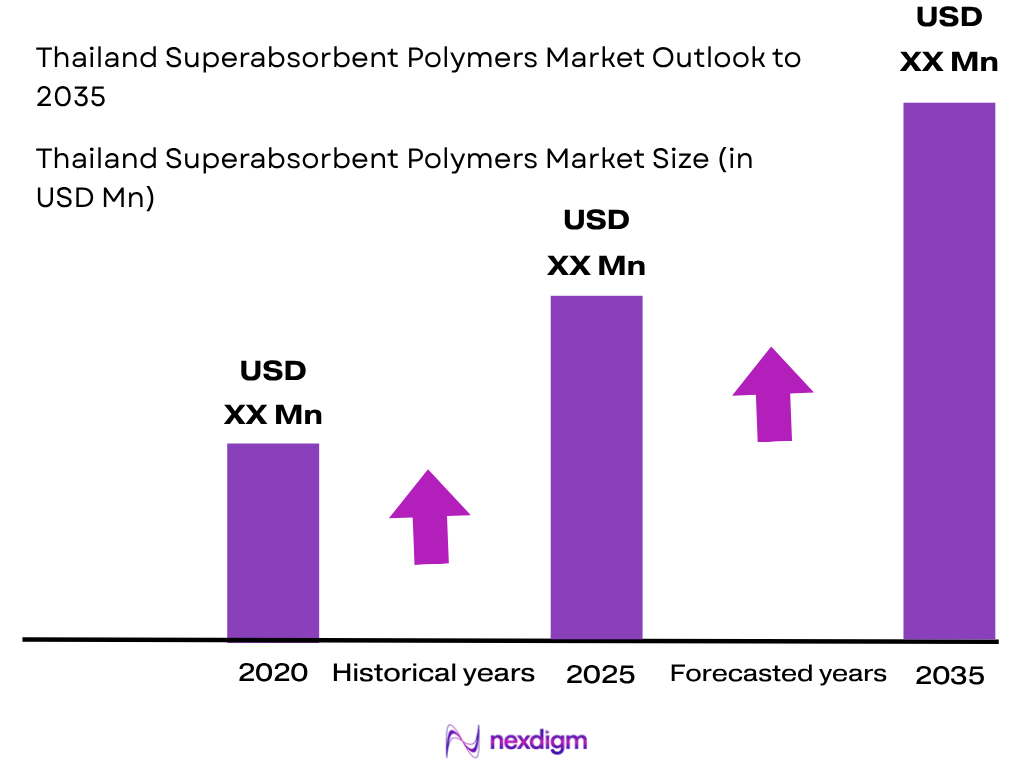
The Thailand Superabsorbent Polymers Market is supported by demand from disposable diapers, feminine hygiene products, adult incontinence products, medical absorbents and selected agricultural applications. Thailand also has an established petrochemical and polymer manufacturing ecosystem: Bank of Thailand production statistics separately track upstream, intermediate and downstream petrochemical output, while chemical imports provide additional industrial inputs. Thailand’s chemical imports reached THB 89,988.60 million in the referenced annual series, demonstrating the scale of chemical trade supporting downstream polymer applications.
The Thailand Superabsorbent Polymers Market is concentrated around Bangkok and the Eastern Economic Corridor, particularly Chonburi, Rayong and Chachoengsao, because these locations combine manufacturing infrastructure, petrochemical facilities, ports and industrial estates. Rayong is particularly relevant because Thailand has historically hosted SAP manufacturing infrastructure there, including a BOI-supported sodium polyacrylate facility designed to supply diaper and sanitary-napkin producers across Asia. Thailand’s chemical and petrochemical ecosystem remains substantial, with Bank of Thailand data separately tracking upstream, intermediate and downstream petrochemical production.
Market Segmentation
By Product Type
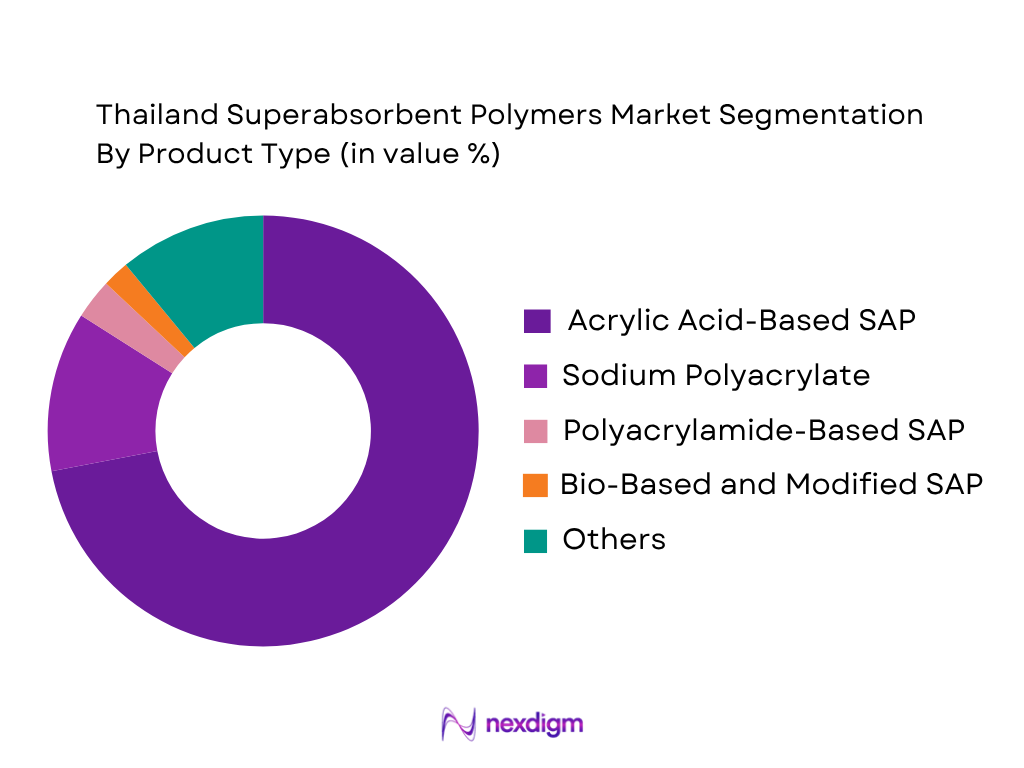
The Thailand Superabsorbent Polymers Market is segmented by product type into acrylic acid-based SAP, sodium polyacrylate, polyacrylate/polyacrylamide copolymers, polyacrylamide-based SAP, bio-based and modified SAP, and other specialty SAP grades. Acrylic acid-based SAP represents the principal product category because modern hygiene products require polymers capable of rapidly absorbing aqueous liquids and retaining them under pressure. Sodium polyacrylate chemistry is particularly relevant because SAP production in Thailand has historically included sodium polyacrylate manufacturing. The country’s petrochemical infrastructure provides an important upstream foundation for polymer manufacturing, while Bank of Thailand statistics track significant production across upstream, intermediate and downstream petrochemicals. Chemical imports also provide supplementary feedstocks and specialty materials. This combination supports continued use of conventional acrylic-acid-derived SAP in diapers and feminine hygiene products while creating a pathway toward higher-performance surface-crosslinked and specialty grades.
By Application
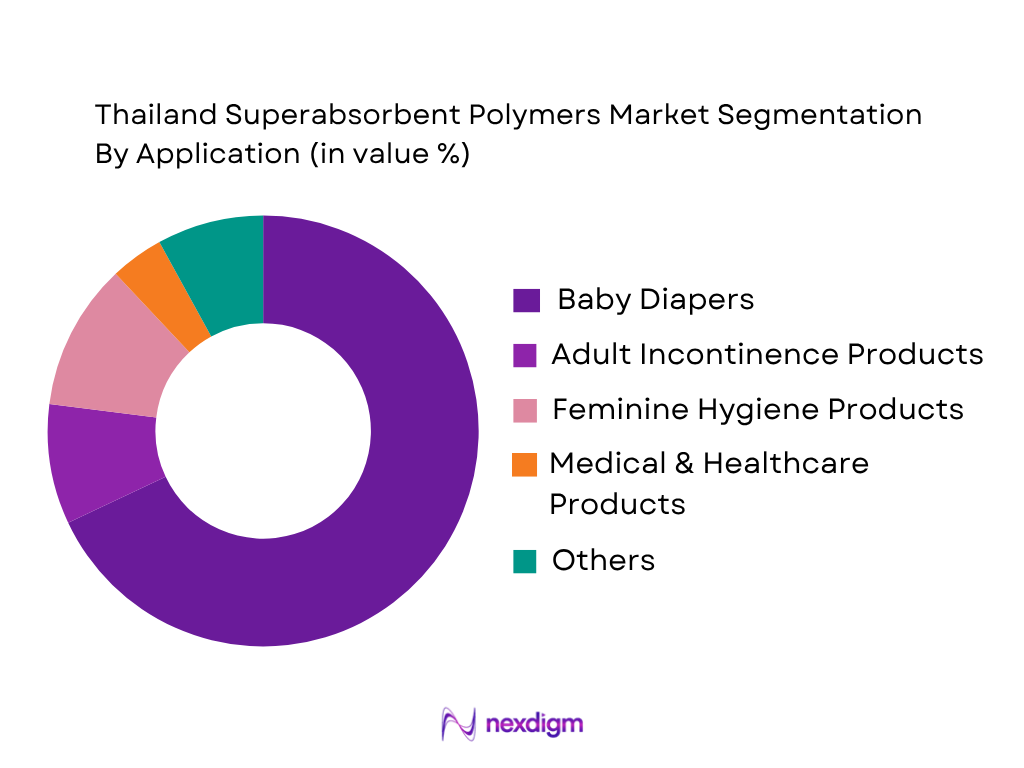
The Thailand Superabsorbent Polymers Market is segmented by application into baby diapers, adult incontinence products, feminine hygiene products, medical absorbent products, agriculture and horticulture, industrial absorbent applications, and other specialty applications. Baby diapers represent the leading application because SAP is a core absorbent material in modern disposable diaper designs, providing high liquid uptake, retention and leakage protection. Thailand also possesses a mature hygiene-product manufacturing ecosystem serving domestic and regional markets. Historical Thai investment documentation specifically identified SAP demand from diaper and sanitary-napkin manufacturing and positioned domestic production to supply regional Asian markets. Current manufacturing statistics further demonstrate activity across chemical and downstream industrial sectors, while Bank of Thailand data show continuing chemical-product and petrochemical production. These factors make hygiene manufacturing the principal demand channel, with adult care, feminine hygiene and medical applications providing additional opportunities for higher-performance absorbent grades.
Competitive Landscape
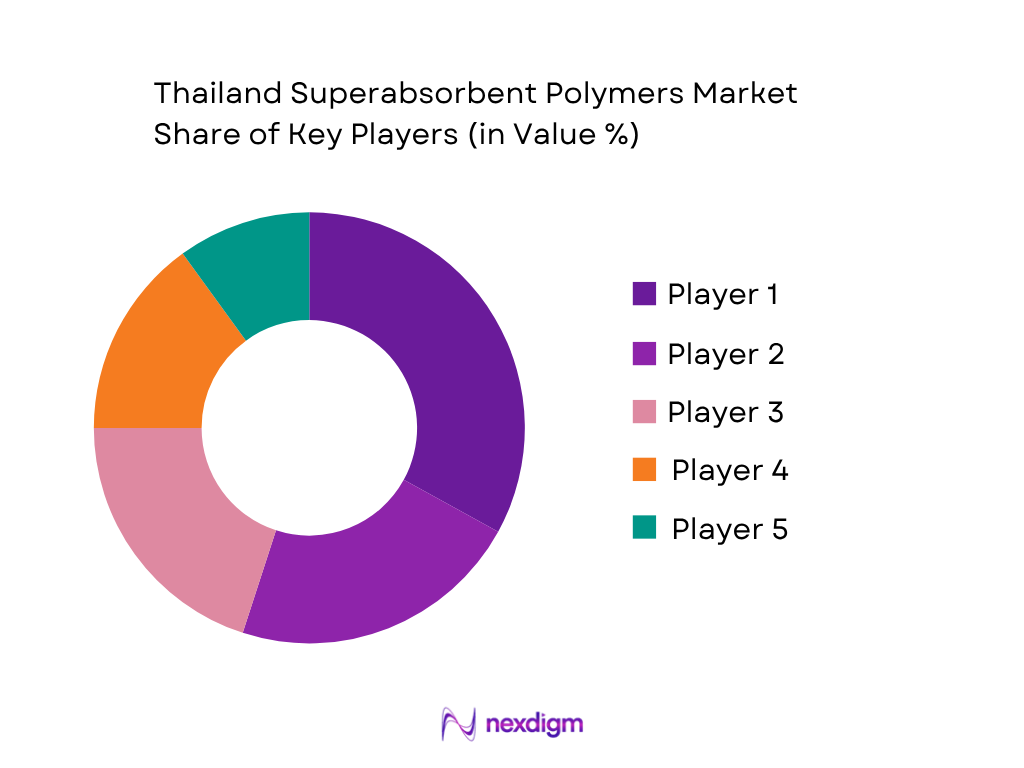
The Thailand Superabsorbent Polymers Market includes global SAP producers, specialty chemical companies and regional suppliers serving hygiene-product manufacturers. Competitive differentiation is centered on absorption capacity, absorption under load, retention, particle-size distribution, gel strength, hygiene-grade consistency, technical support and supply reliability. Thailand’s established petrochemical base provides a supporting industrial ecosystem, while chemical imports remain important to manufacturing. Bank of Thailand statistics show THB 89,988.60 million of chemical imports in the referenced annual series and separately track production of upstream, intermediate and downstream petrochemicals.
| Company | Established | Headquarters | SAP Portfolio | Core Application | Manufacturing Capability | Grade Capability | Regional Supply |
| Nippon Shokubai Co., Ltd. | 1918 | Osaka, Japan | ~ | ~ | ~ | ~ | ~ |
| Sumitomo Seika Chemicals Co., Ltd. | 1944 | Osaka, Japan | ~ | ~ | ~ | ~ | ~ |
| BASF SE | 1865 | Ludwigshafen, Germany | ~ | ~ | ~ | ~ | ~ |
| Evonik Industries AG | 2007 | Essen, Germany | ~ | ~ | ~ | ~ | ~ |
| Sanyo Chemical Industries, Ltd. | 1949 | Kyoto, Japan | ~ | ~ | ~ | ~ | ~ |
Thailand Superabsorbent Polymers Market Analysis
Growth Drivers
Disposable Diaper Manufacturing Expansion
Thailand’s disposable hygiene manufacturing base provides a direct demand channel for superabsorbent polymers because SAP is a functional component of modern diaper absorbent cores. The macroeconomic backdrop supports continued industrial activity: the IMF records Thailand’s population at 71.67 million and GDP per capita at USD 7,347 for 2024, while real GDP expanded by 2.5 in 2024. Thailand’s export-oriented industrial structure is particularly relevant because the country is integrated into regional hygiene-product supply chains. IMF data show merchandise exports of USD 297.3 billion in 2024, compared with USD 280.7 billion in 2023, indicating a large external manufacturing and trade platform. This environment supports SAP consumption by diaper producers seeking reliable absorbent-core materials, including conventional acrylic-acid-based grades and higher-retention grades. Demand is also supported by the broader need for compact absorbent structures that reduce product thickness while maintaining liquid uptake and retention. The country’s chemical manufacturing infrastructure further strengthens the connection between polymer inputs and downstream hygiene production. Consequently, expansion of disposable diaper manufacturing remains closely linked to SAP demand through both domestic consumption and Thailand’s role in regional production and export networks. Source: IMF 2025 Article IV Consultation and IMF Thailand economic indicators.
Rising Hygiene Product Consumption
Increasing consumption of feminine hygiene, adult incontinence and other disposable absorbent products creates additional demand for SAP beyond infant diapers. Thailand’s demographic structure is particularly relevant: World Bank data record a population of 71,668,011 and life expectancy of 77 years in 2024, while population growth was approximately 0. These indicators point toward a mature demographic environment in which adult-care and healthcare-related absorbent products can become increasingly relevant alongside infant hygiene. The IMF reports private consumption growth of 4.0 in 2024, providing a macroeconomic basis for continued household demand for consumer and healthcare products. Thailand also recorded USD 6.95 billion in net foreign direct investment in 2024, according to the IMF, supporting industrial investment and manufacturing capacity. For SAP suppliers, this combination matters because feminine hygiene products require rapid absorption and liquid retention, while adult incontinence products increasingly require high absorption under load, gel strength and controlled swelling. Medical absorbent products add another specialized demand channel. The resulting application mix can encourage manufacturers to qualify multiple SAP grades rather than relying exclusively on a single commodity specification. Source: World Bank Thailand Data and IMF 2025 Article IV Consultation.
Market Challenges
Dependence on Imported SAP Grades
Thailand’s SAP supply chain can remain exposed to international sourcing because advanced hygiene-grade polymers, specialty grades and certain upstream inputs may originate outside the country. The IMF reports Thailand’s merchandise imports at USD 275.9 billion in 2024, compared with USD 261.6 billion in 2023, illustrating the scale of the country’s dependence on internationally traded industrial inputs. Imports therefore remain an important channel for specialty chemical availability even where domestic chemical manufacturing capabilities exist. The challenge is particularly relevant to SAP because hygiene manufacturers require tightly controlled characteristics such as particle-size distribution, absorption capacity, absorption under load, centrifuge retention capacity and gel strength. Qualification of a replacement SAP grade can require formulation and production-line testing, making sudden supplier changes difficult. Thailand’s 2024 current-account surplus reached USD 11.6 billion, according to the IMF, but this does not eliminate exposure to disruptions affecting specific chemical inputs. Logistics interruptions, regional plant outages, shipping constraints or changes in supplier allocation can therefore affect availability even when overall national trade conditions remain stable. Import dependence consequently creates a procurement risk for Thai hygiene manufacturers requiring consistent SAP specifications and delivery schedules.
Acrylic Acid Feedstock Exposure
Conventional SAP production depends on acrylic-acid-based chemistry, connecting polymer availability to upstream petrochemical and chemical feedstock conditions. Thailand has a substantial trade-oriented industrial economy, but the country’s chemical supply chain remains exposed to international commodity and energy conditions. IMF data show merchandise imports of USD 275.9 billion and exports of USD 297.3 billion in 2024, demonstrating the extensive international integration of Thailand’s manufacturing system. The IMF also reports gross fixed investment at 21.6 of GDP in 2024, indicating a substantial industrial investment base but also highlighting the importance of maintaining competitive production economics. For SAP producers and downstream hygiene manufacturers, feedstock exposure can affect procurement planning, inventory requirements and supplier selection. Acrylic-acid availability is especially important because conventional SAP relies on polymerized acrylic-acid derivatives to achieve the high swelling and liquid-retention characteristics required in diapers and other absorbent products. Thailand’s chemical ecosystem can provide infrastructure advantages, but regional supply disruptions or changes in upstream operating rates can still transmit into downstream SAP availability. This challenge encourages manufacturers to strengthen sourcing diversification, maintain qualified alternative suppliers and evaluate specialty SAP formulations that reduce vulnerability to individual upstream feedstock channels. Source: IMF 2025 Article IV Consultation.
Market Opportunities
High-Performance Hygiene-Grade SAP
Thailand provides an opportunity for suppliers and manufacturers to move toward higher-performance SAP grades as hygiene products increasingly emphasize thinner absorbent cores, improved liquid distribution and stronger retention under pressure. The country’s established industrial base provides a platform for such development: the IMF records USD 6.95 billion of net FDI in 2024 and merchandise exports of USD 297.3 billion, reflecting substantial integration with international manufacturing networks. High-performance SAP can serve baby diapers, feminine hygiene products, adult incontinence products and medical absorbents where absorption under load and retention are important performance requirements. Thailand’s population of 71.67 million in 2024, combined with life expectancy of 77 years, also provides a demographic basis for maintaining diverse hygiene and healthcare applications. The opportunity is therefore not limited to increasing polymer volumes; it includes upgrading the specification mix toward surface-crosslinked, high-retention and application-specific grades. Suppliers that can provide consistent particle-size distributions, rapid absorption, high centrifuge retention and strong gel performance can address manufacturers seeking improved absorbent-core efficiency. Thailand’s export-oriented manufacturing position also creates a potential platform for supplying qualified SAP grades to neighboring Southeast Asian hygiene-product production networks. Source: IMF 2026 Thailand Article IV Consultation and World Bank Thailand Data.
Sustainable and Bio-Based SAP
Sustainable and bio-based SAP development presents an opportunity to address environmental considerations associated with conventional petroleum-derived absorbent polymers while using Thailand’s established industrial and investment infrastructure to support material innovation. Thailand attracted USD 6.95 billion in net FDI in 2024, according to the IMF, while the country’s GDP reached approximately USD 526.5 billion, according to World Bank data. These indicators demonstrate an industrial economy with substantial capacity for investment in advanced materials and manufacturing. The opportunity is particularly relevant to hygiene products because SAP is embedded in disposable absorbent structures, making material efficiency, polymer loading and end-of-life characteristics important development considerations. Bio-based or partially bio-derived feedstocks, modified polymer structures and lower-material-use formulations could be developed alongside conventional SAP rather than replacing it immediately. Agricultural applications provide another pathway because Thailand has a significant agricultural economy and recurring requirements for efficient water use. Specialty SAP designed for soil moisture retention could therefore complement hygiene-grade applications. The country’s regional trade position also provides a route for sustainable SAP technologies to be tested within ASEAN supply chains before broader commercial deployment. Source: IMF 2026 Thailand Article IV Consultation and World Bank Thailand Data.
Future Outlook
The Thailand Superabsorbent Polymers Market is expected to develop around continued demand for disposable hygiene products, adult incontinence materials, feminine hygiene, medical absorbents and specialized water-retention applications. Thailand’s established petrochemical ecosystem provides an important upstream platform, while its geographic position supports supply to Southeast Asian hygiene-product manufacturers. Bank of Thailand data show ongoing production across upstream, intermediate and downstream petrochemical categories.
Future development is likely to emphasize high-retention SAP, surface-crosslinked polymers, thinner absorbent cores, improved absorption under load and specialty grades. Thailand’s historical SAP manufacturing investment also demonstrates the country’s potential as a regional supply base: a BOI-supported Rayong facility was designed with annual SAP production capacity of 85,000 tonnes, with approximately 90% planned for export.
Major Players
- Nippon Shokubai Co., Ltd.
- Sumitomo Seika Chemicals Co., Ltd.
- BASF SE
- Evonik Industries AG
- Sanyo Chemical Industries, Ltd.
- LG Chem Ltd.
- Formosa Plastics Corporation
- Kao Corporation
- Mitsubishi Chemical Group Corporation
- SNF Group
- Wanhua Chemical Group Co., Ltd.
- Shandong Nuoer Biological Technology Co., Ltd.
- Yixing Danson Technology Co., Ltd.
- Songwon Industrial Group
- Unicharm Corporation
Key Target Audience
- Baby Diaper and Infant Hygiene Product Manufacturers
- Feminine Hygiene Product Manufacturers
- Adult Incontinence and Elderly Care Product Manufacturers
- Medical Absorbent Product Manufacturers
- Agricultural Water-Retention Product Manufacturers
- Specialty Chemical Importers and Distributors
- Investments and Venture Capitalist Firms (Advanced Materials, Specialty Chemicals, Hygiene Manufacturing)
- Government and Regulatory Bodies (Thailand Board of Investment, Department of Industrial Works, Thai Food and Drug Administration, Ministry of Natural Resources and Environment)
Research Methodology
Step 1: Identification of Key Variables
The initial phase involves mapping Thailand’s SAP ecosystem across producers, importers, distributors, hygiene manufacturers, healthcare users, agricultural users and industrial consumers. The assessment identifies polymer chemistry, grade, application, production capacity, import dependency, downstream hygiene production and regional distribution as the principal market variables.
Step 2: Market Analysis and Construction
Historical information is compiled across product type, absorption performance, application, end-use industry, distribution channel and region. Domestic production, imports, exports and apparent consumption are assessed alongside petrochemical production and downstream manufacturing indicators to construct a supply-demand framework.
Step 3: Hypothesis Validation and Expert Consultation
Market hypotheses are validated through industry discussions covering SAP producers, chemical distributors, diaper manufacturers, feminine hygiene producers and specialty-material users. Consultation focuses on grade qualification, absorption requirements, procurement practices, supplier switching, technical specifications and supply reliability.
Step 4: Research Synthesis and Final Output
The final stage combines top-down economic and industrial analysis with bottom-up assessment of SAP applications and end-use demand. Production, trade and downstream indicators are triangulated with industry inputs before finalizing market segmentation, competitive assessment, forecasts and strategic conclusions.

- Executive Summary
- Research Methodology (Market Definition and Scope, Thailand Superabsorbent Polymers Market Classification, SAP Chemistry Assessment, Hygiene-Grade and Specialty-Grade Evaluation, Domestic Manufacturing and Import Assessment, Acrylic Acid Feedstock Mapping, Production Capacity Mapping, SAP Consumption Analysis, Downstream Hygiene Product Assessment, Demand-Side Assessment, Supply-Side Assessment, Application-Level Demand Mapping, End-Use Industry Assessment, Trade Flow Analysis, Import Dependency Assessment, Procurement and Supplier Benchmarking, Primary Industry Interviews, Data Triangulation, Market Sizing Approach, Top-Down Analysis, Bottom-Up Analysis, Forecasting Framework, Limitations and Future Conclusions)

- Thailand Superabsorbent Polymers Industry Evolution
- Thailand Superabsorbent Polymers Value Chain Analysis
- Thailand Superabsorbent Polymers Supply Chain Analysis
- Thailand Superabsorbent Polymers Manufacturing Ecosystem
- Thailand Superabsorbent Polymers Import and Distribution Ecosystem

- Growth Drivers (Disposable Diaper Manufacturing Expansion, Rising Hygiene Product Consumption, Adult Incontinence Demand, Feminine Hygiene Product Expansion, Healthcare Product Manufacturing Growth, Aging Population Requirements, Agricultural Water-Retention Applications, Modern Retail and Urban Consumer Expansion, Increasing Demand for High-Performance Absorbent Materials)
- Market Challenges (Dependence on Imported SAP Grades, Acrylic Acid Feedstock Exposure, Petrochemical Raw Material Volatility, Limited Domestic SAP Production, Import Logistics Dependency, Environmental and End-of-Life Concerns, Recycling Limitations for SAP-Containing Hygiene Products, Product Qualification Requirements, Competition from Alternative Absorbent Materials)
- Market Opportunities (High-Performance Hygiene-Grade SAP, Adult Incontinence Applications, Sustainable and Bio-Based SAP, Surface-Crosslinked High-Retention SAP, Agricultural Water-Retention Applications, Medical Absorbent Materials, Specialty Industrial Absorbents, Local SAP Compounding and Conversion, Regional SAP Distribution and Re-Export, Advanced Hygiene Product Manufacturing)
- Market Trends (Thinner Absorbent-Core Development, High-Absorption Under Load SAP, Fast-Absorption Polymer Adoption, Surface-Crosslinked SAP Development, Premium Diaper Product Innovation, Adult Incontinence Product Development, Sustainable Polymer Research, Specialty SAP Grade Development, Application-Specific Polymer Formulation)
- Government Regulations (Thai Food and Drug Administration Requirements, Industrial Chemical Regulations, Department of Industrial Works Requirements, Hazardous Substance Controls, Environmental Protection Requirements, Waste Management Regulations, Chemical Import and Customs Requirements, Occupational Health and Safety Standards, Product and Packaging Requirements)
- SWOT Analysis
- Porter’s Five Forces Analysis
- PESTLE Analysis

- By Market Value (2020-2025)
- By Superabsorbent Polymer Consumption Volume (2020-2025)
- By Domestic Production Volume (2020-2025)
- By Import Volume (2020-2025)
- By Export Volume (2020-2025)

- By Product Type (In Value %)
Acrylic Acid-Based SAP
Sodium Polyacrylate
Polyacrylate / Polyacrylamide Copolymers
Polyacrylamide-Based SAP
Bio-Based and Modified SAP
Other Specialty SAP Grades - By Absorption Performance (In Value %)
Standard Absorption SAP
High-Absorption SAP
High Absorption Under Load SAP
Fast-Absorption SAP
High-Retention SAP
Surface-Crosslinked SAP - By Application (In Value %)
Baby Diapers
Adult Incontinence Products
Feminine Hygiene Products
Medical Absorbent Products
Agriculture and Horticulture
Industrial Absorbent Applications
Pet Care and Specialty Absorbent Products - By End-Use Industry (In Value %)
Baby Hygiene Products Industry
Feminine Hygiene Industry
Adult Incontinence and Elderly Care Industry
Healthcare and Medical Products Industry
Industrial Absorbent Materials Industry - By Distribution Channel (In Value %)
Direct Manufacturer Supply
Direct Import Supply
Chemical Distributors
Specialty Polymer Distributors
Hygiene Raw Material Suppliers
Industrial Chemical Trading Companies
Regional Importers and Stockists
Online B2B Chemical Distribution - By Region (In Value %)
Central Thailand
Eastern Thailand
Bangkok Metropolitan Region
Northern Thailand
Northeastern Thailand
Southern Thailand
Eastern Economic Corridor

- Market Share of Major Players (By Thailand Revenue, SAP Sales Volume, Product Grade, Application, Hygiene-Grade Sales, Specialty-Grade Sales, Import Volume, Domestic Supply, Production Capacity, Distribution Network Coverage, Customer Industry Coverage, Regional Supply Capability)
- Cross Comparison Parameters (SAP Production Capacity, Hygiene-Grade SAP Portfolio, Specialty-Grade SAP Portfolio, Absorption Under Load Performance, Surface-Crosslinked SAP Capability, Acrylic Acid Integration, Thailand Distribution Network Reach, Southeast Asian Supply Coverage)
- SWOT Analysis of Major Players
- Detailed Profiles of Major Companies
Nippon Shokubai Co., Ltd.
Sumitomo Seika Chemicals Co., Ltd.
BASF SE
Evonik Industries AG
LG Chem Ltd.
Sanyo Chemical Industries, Ltd.
Formosa Plastics Corporation
Kao Corporation
Mitsubishi Chemical Group Corporation
SNF Group
Wanhua Chemical Group Co., Ltd.
Shandong Nuoer Biological Technology Co., Ltd.
Yixing Danson Technology Co., Ltd.
Songwon Industrial Group
Unicharm Corporation

- Hygiene Industry Consumption Assessment
- Demographic Consumption Trends
- Agricultural Application Analysis
- Industrial Application Assessment
- Purchasing Decision Analysis
- Sustainability Preference Analysis

- By Market Value (2026-2035)
- By Superabsorbent Polymer Consumption Volume (2026-2035)
- By Domestic Production Volume (2026-2035)
- By Import Volume (2026-2035)
- By Export Volume (2026-2035)
- By Apparent Consumption (2026-2035)
- By Hygiene-Grade SAP Consumption (2026-2035)
- By Specialty-Grade SAP Consumption (2026-2035)


 Request a Sample
 Ask for Customization
 Get a Quote
 Enquire Now