
 Download PDF
Market Overview
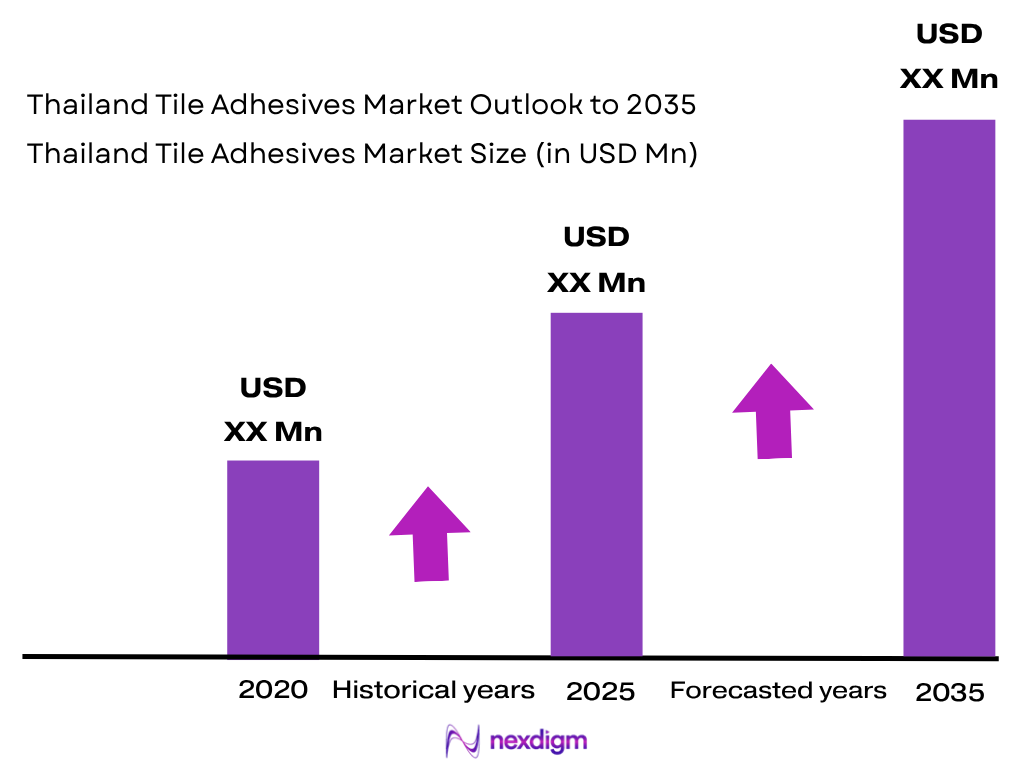
The Thailand Tile Adhesives Market is valued at approximately ~USD XX million, supported by residential construction, renovation, hospitality and commercial tiling. New-construction permits moved from 208,741 to 188,461, while permitted new-building area moved from 60.85 million square metres to 52.10 million square metres across the latest two observations. Packaged polymer-modified adhesives continue replacing conventional cement-sand installation where porcelain, wet-area and larger tile formats require higher bond reliability.
Bangkok, the surrounding metropolitan provinces, Central Thailand and the Eastern industrial corridor are the dominant demand centres because they combine condominiums, hotels, retail, industrial estates and renovation activity. Bangkok and surrounding provinces recorded approximately 18.64 million square metres of permitted building area in the preceding observation, while Central Thailand contributed 19.54 million square metres. Their concentration of professional contractors and premium tile specifications supports stronger adoption of C2, flexible and large-format adhesive systems.
Market Segmentation
By Adhesive Technology
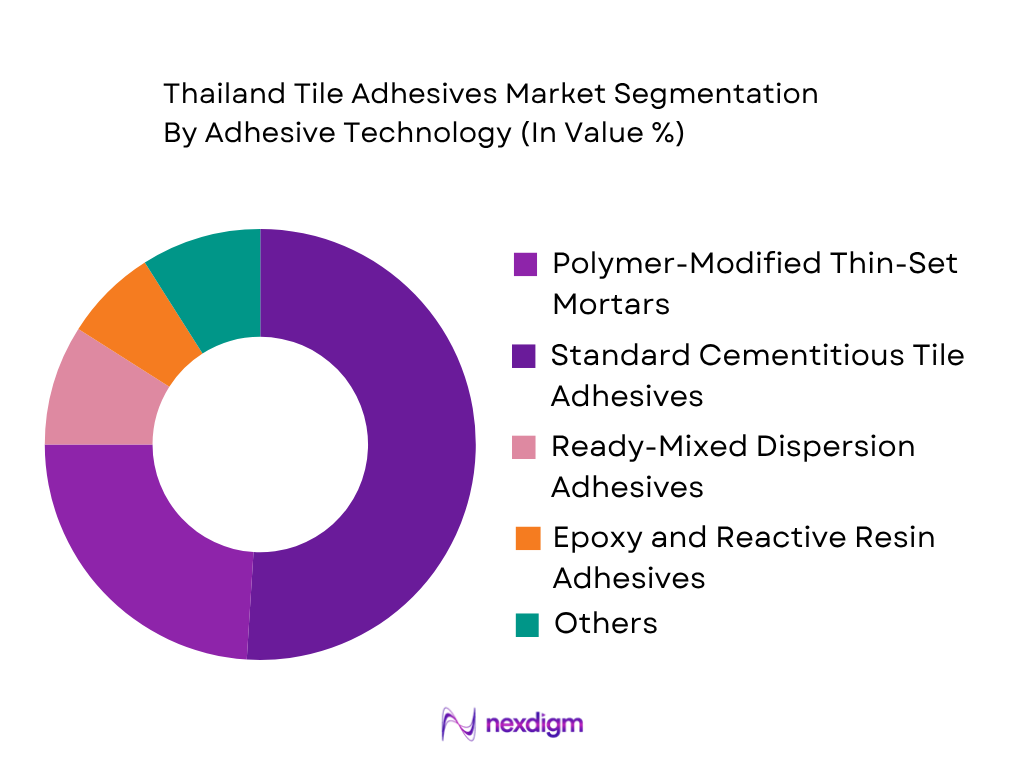
The Thailand Tile Adhesives Market is segmented into cementitious polymer-modified adhesives, standard cementitious adhesives, ready-mixed dispersion adhesives, epoxy and reactive resin adhesives, and specialty systems. Polymer-modified cementitious adhesives hold the dominant modeled share because they combine the familiar handling characteristics of dry cement mortar with enhanced bond strength, open time and slip resistance. Thailand has an established dry-mix manufacturing ecosystem, making bagged cementitious adhesives practical for nationwide dealer distribution and project use. The technology is also adaptable across ordinary ceramic tiles, low-absorption porcelain, exterior installations and large-format products through different polymer dosages and performance classes. Thailand’s updated TIS 2703-2566 framework for cement adhesives has strengthened attention to formal performance requirements, while major suppliers increasingly differentiate portfolios into standard, high-performance and flexible products. This supports continued migration away from site-mixed cement-sand bedding toward factory-controlled formulations with more predictable installation performance.
By Application
The Thailand Tile Adhesives Market is segmented into ceramic and porcelain installation, large-format tile and slab installation, bathrooms and wet areas, swimming pools, natural stone, tile-on-tile renovation, exterior tiling and specialty commercial applications. Ceramic and porcelain tile installation holds the dominant modeled market share because these finishes are widely used across Thai houses, condominiums, hotels, shopping centres, restaurants and commercial buildings. Porcelain products particularly encourage movement from ordinary cement mortars toward polymer-modified adhesives because lower tile absorption requires stronger mechanical and chemical bonding. Thailand’s extensive hospitality stock further broadens the installed base requiring tile adhesives in guestrooms, bathrooms, pools and common areas. The country recorded 21,090 accommodation establishments, including 6,859 hotels, creating significant recurring refurbishment demand alongside new construction. Increasing large-format tile use is also raising demand for higher adhesion, extended open time, non-sag properties and flexible installation systems.
Competitive Landscape
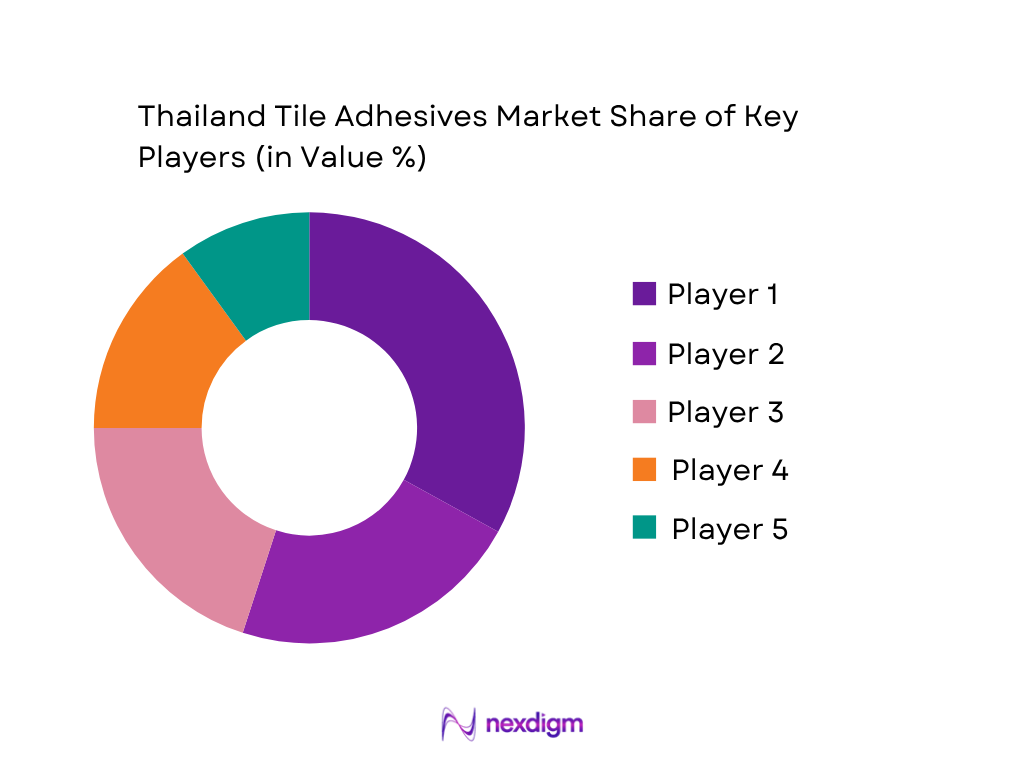
The Thailand Tile Adhesives Market combines strong domestic brands with multinational dry-mix and construction-chemical manufacturers. Jorakay/Crocodile, Saint-Gobain Weber, Sika/LANKO, Bostik and MAPEI compete across standard tile adhesives, higher-performance polymer-modified products, flexible systems, large-format tile solutions and installation accessories. Competitive strength depends increasingly on recognized performance classes, domestic production, nationwide dealer access, installer education and the ability to supply complete tiling systems covering substrate preparation, waterproofing, adhesives and grouts.
| Major Player | Establishment Year | Headquarters | Cementitious Adhesive Portfolio | C2 / Flexible Capability | Large-Format & Porcelain Capability | Local Manufacturing / Presence | Distribution Reach | Technical / Installer Support |
| Jorakay Corporation / Crocodile | 1992 | Bangkok, Thailand | ~ | ~ | ~ | ~ | ~ | ~ |
| Saint-Gobain Weber Thailand | 1986* | Bangkok, Thailand | ~ | ~ | ~ | ~ | ~ | ~ |
| Sika Thailand / LANKO | 1989** | Chonburi, Thailand | ~ | ~ | ~ | ~ | ~ | ~ |
| Bostik Thailand / Arkema | 1889*** | Colombes, France | ~ | ~ | ~ | ~ | ~ | ~ |
| MAPEI | 1937 | Milan, Italy | ~ | ~ | ~ | ~ | ~ | ~ |
Thailand Tile Adhesives Market Analysis
Growth Drivers
Residential and Metropolitan Construction Sustains Core Tile Adhesive Consumption
Thailand’s active building pipeline continues to support demand for cementitious and polymer-modified tile adhesives used across residential floors, bathrooms, kitchens, balconies and common areas. National Statistical Office data show 188,461 new-construction permits and 256,994 new building constructions in 2024, creating a substantial installation base for ceramic and porcelain tiles. Construction activity remained active into 2025, with 41,466 new-construction permits in Q1, following 53,246 permits in Q1 2024, while Bangkok and surrounding metropolitan provinces continue to concentrate condominium, housing and commercial development. This scale directly supports demand for standard C1 products as well as C2 adhesives where low-absorption porcelain tiles and larger formats require stronger bonding than conventional cement-sand bedding. Thailand’s macroeconomic base reinforces this construction demand: World Bank data record 2024 GDP at USD 526.5 billion, GDP per capita at USD 7,346.6, and population at 71,668,011. The IMF separately records nominal GDP of approximately THB 18,603.0 billion in 2024. These indicators support a sizeable urban construction and household improvement economy in which factory-controlled tile adhesives can increasingly replace variable site-mixed installation methods.
Hotel and Resort Activity Drives Wet-Area, Renovation and Premium Tile Adhesive Demand
Thailand’s tourism and hospitality infrastructure creates a particularly strong demand base for higher-performance tile adhesives used in hotel guestrooms, bathrooms, lobbies, kitchens, swimming pools and resort common areas. National Statistical Office data identify 21,090 accommodation facilities in 2024, comprising 6,859 hotels, 8,852 resorts and other accommodation formats, with a total of 794,514 rooms. Hotels alone accounted for 446,943 rooms, while resorts contained 238,940 rooms, creating an extensive installed base requiring both initial tile installation and recurring refurbishment. International tourist arrivals increased from 28,150,000 visitors in 2023 to 35,545,700 visitors in 2024, intensifying utilization of hospitality assets and supporting renovation cycles. These conditions favor polymer-modified adhesives, rapid-setting products, swimming-pool systems, glass-mosaic adhesives and tile-on-tile formulations that reduce downtime during refurbishment. The opportunity is underpinned by Thailand’s macroeconomic scale: the World Bank recorded 2024 GDP of USD 526.5 billion and GDP per capita of USD 7,346.6, while the IMF recorded nominal GDP at approximately THB 18,603.0 billion. This combination of tourism intensity and economic capacity supports continued premiumization of hotel and resort tile installation systems.
Market Challenges
Slower New-Build Permit Flow Creates Uneven Volume Demand for Standard Tile Adhesives
Thailand’s tile adhesive suppliers face uneven demand because the new-building pipeline has moderated from earlier construction levels, especially for mainstream products linked to ordinary residential floor and wall tiling. National Statistical Office data show new-construction permits moving from 208,741 permits in 2023 to 188,461 permits in 2024. Quarterly data further show 53,246 new-construction permits in Q1 2024 compared with 41,466 in Q1 2025, demonstrating a smaller immediate project flow into which standard cementitious adhesives can be sold. A softer new-build base raises the importance of renovation, hospitality refurbishment, large-format tile systems and industrial applications, because suppliers cannot rely solely on volume growth from new housing. This environment can be especially challenging for manufacturers concentrated in standard C1-type products with limited exposure to higher-performance C2, flexible or specialty systems. Thailand’s broader economy remains substantial but not unlimited in its ability to absorb construction weakness: World Bank data put 2024 GDP at USD 526.5 billion, GDP per capita at USD 7,346.6, and population at 71,668,011, while IMF nominal GDP was approximately THB 18,603.0 billion. This makes product-mix diversification increasingly important for maintaining utilization of dry-mix manufacturing capacity.
Updated Performance Standards Increase Formulation, Testing and Application Discipline Requirements
Thailand’s move toward more formal tile adhesive performance requirements creates a technical challenge for manufacturers, distributors and installers that previously competed mainly through general-purpose cementitious products. The Thai Industrial Standards Institute introduced TIS 2703-2566, which became effective on 5 May 2024 and replaced TIS 2703-2559. The standard covers cement adhesives used for interior and exterior ceramic floor and wall installations and classifies cement adhesives into 2 quality classes, general and high performance, while also prescribing requirements for packaging, marking, sampling, conformity and testing. This raises the need for controlled polymer dosage, consistent raw-material quality and repeatable tensile adhesion performance. The challenge grows as contractors increasingly handle porcelain, larger tile formats and exterior installations where incorrect mixing, inadequate coverage or poorly prepared substrates can cause debonding even when the packaged product meets specification. Thailand had 188,461 new-construction permits and 256,994 new buildings in 2024, meaning performance consistency must be maintained across a broad construction base. The macroeconomic context is also significant: World Bank data record GDP of USD 526.5 billion and GDP per capita of USD 7,346.6, while IMF nominal GDP reached approximately THB 18,603.0 billion, increasing the commercial consequences of product or application failure.
Market Opportunities
C2, Flexible and Large-Format Tile Adhesives Offer a Strong Premiumization Path
Thailand’s updated performance framework creates a clear future growth avenue for high-performance C2, flexible and large-format tile adhesives as contractors move beyond conventional cement-sand bedding and basic general-purpose products. TIS 2703-2566 became effective on 5 May 2024 and formally distinguishes 2 quality classes for cement adhesives, strengthening the commercial case for products positioned around higher bond strength and more demanding installation conditions. The current construction base gives manufacturers a sizeable platform for premiumization: Thailand recorded 188,461 new-construction permits and 256,994 newly constructed buildings in 2024. These projects increasingly incorporate porcelain and larger tiles, particularly in condominiums, hotels, retail buildings and higher-end residential properties, where low water absorption and increased tile dimensions require improved adhesive performance, longer open time and better deformability. The opportunity therefore comes from moving existing project demand toward higher polymer content rather than relying only on new building growth. Thailand’s economic base can support this product upgrade: World Bank data show 2024 GDP of USD 526.5 billion, GDP per capita of USD 7,346.6, and population of 71,668,011, while IMF nominal GDP stood near THB 18,603.0 billion. These fundamentals support greater adoption of factory-formulated performance adhesives across professional tile installation.
Industrial, Digital and EEC Investment Can Expand Specialty Tile Adhesive Applications
Thailand’s industrial and digital investment pipeline provides a future growth route for tile adhesive suppliers serving factories, data centres, laboratories, commercial support buildings and worker facilities in the Eastern Economic Corridor and other industrial clusters. The Board of Investment recorded THB 1.14 trillion in investment-promotion applications in 2024. Within this total, the digital sector accounted for 150 projects worth THB 243.3 billion, while electrical and electronics investment reached THB 231.7 billion. Investment activity remained strong in the first quarter of 2025, when foreign direct investment applications totaled THB 267.7 billion; Hong Kong-origin applications alone reached THB 135.16 billion, including THB 72.7 billion in digital projects. These current commitments create a construction base for high-traffic tiled floors, technical rooms, wash areas, food-service zones and interior fit-outs requiring C2, rapid-setting, chemically resistant and specialty tile adhesive systems. The opportunity is supported by Thailand’s broader economic scale: World Bank data record 2024 GDP of USD 526.5 billion and GDP per capita of USD 7,346.6, while IMF nominal GDP was approximately THB 18,603.0 billion. This combination of industrial investment and macroeconomic capacity supports future penetration of higher-specification adhesive systems beyond conventional residential tiling.
Future Outlook
The Thailand Tile Adhesives Market is forecast to expand at approximately ~X.X% CAGR during 2026–2035. Future growth is expected to be increasingly value-led, with demand shifting from standard cementitious products toward C2, C2S1, C2S2, large-format, fast-setting and specialty wet-area systems. Renovation, hospitality recovery, industrial investment and more demanding tile formats should progressively increase polymer intensity per installation. Thailand’s construction base remains substantial even as the mix of activity changes. National Statistical Office data recorded 188,461 new-construction permits, 256,994 new building constructions and approximately 52.10 million square metres of new building area in 2024. This creates a sizeable ongoing installation base for ceramic, porcelain and natural-stone finishes.
Major Players
- Jorakay Corporation Co., Ltd. / Crocodile
- Saint-Gobain Weber Thailand
- Sika (Thailand) Limited / LANKO
- Bostik Thailand / Arkema
- MAPEI Thailand
- TOA Performance Coating Corporation
- TPI Polene Building Products
- SCG Building Materials
- Fosroc Thailand
- Davco Thailand / Sika
- Beger Construction Chemicals
- Captain Coating / Construction Solutions
- General Membrane Thailand
- Cera C-Cure Thailand
- Bosny Thailand
Key Target Audience
- Tile Adhesive and Dry-Mix Mortar Manufacturers
- Ceramic, Porcelain and Natural Stone Manufacturers
- Tile and Sanitaryware Distributors and Retailers
- Property Developers and Main Contractors
- Hotel, Resort and Commercial Property Owners
- Tile Contractors and Specialist Installers
- Investments and Venture Capitalist Firms
- Government and Regulatory Bodies (Thai Industrial Standards Institute, Department of Public Works and Town & Country Planning, Industrial Estate Authority of Thailand, Thailand Board of Investment)
Research Methodology
Step 1: Identification of Key Variables
The initial phase involves constructing an ecosystem map covering cement and polymer suppliers, tile adhesive manufacturers, tile producers, distributors, retailers, contractors, installers and developers. Secondary and proprietary research is used to identify key variables such as adhesive consumption, tiled construction area, polymer modification, tile-format mix, performance classes and regional construction concentration.
Step 2: Market Analysis and Construction
Historical Thailand Tile Adhesives Market demand is assessed using top-down and bottom-up approaches. Top-down analysis evaluates building permits, construction area, tourism infrastructure, industrial investment and renovation activity, while bottom-up analysis estimates adhesive demand from tiled area, application thickness, product coverage, tile type, building category and packaged-adhesive penetration.
Step 3: Hypothesis Validation and Expert Consultation
Market hypotheses are validated through computer-assisted telephone interviews with tile adhesive manufacturers, distributors, tile dealers, professional installers and project contractors. These consultations assess C1 versus C2 demand, flexible adhesive adoption, large-format tile requirements, tile-on-tile use, contractor purchasing behavior, distribution channels and technical performance expectations.
Step 4: Research Synthesis and Final Output
The final phase triangulates National Statistical Office construction data, TISI requirements, tourism statistics, BOI investment information, company disclosures and primary interviews. Bottom-up adhesive consumption models are reconciled with top-down construction indicators to establish segmentation, competitive positioning, regional demand and future opportunities within the Thailand Tile Adhesives Market.

- Executive Summary
- Research Methodology (Market Definitions and Assumptions, Thailand Tile Adhesives Market Boundary, Tile Adhesive Classification, Cementitious Adhesive Assessment, Polymer-Modified Cementitious Adhesive Assessment, Dispersion Adhesive Assessment, Reactive Resin Adhesive Assessment, Epoxy Tile Adhesive Assessment, C1 Adhesive Assessment, C2 Adhesive Assessment, S1 Flexible Adhesive Assessment, S2 Highly Deformable Adhesive Assessment, D1 and D2 Dispersion Adhesive Assessment, R1 and R2 Reactive Resin Adhesive Assessment, Large-Format Tile Assessment, Porcelain Tile Assessment, Natural Stone Adhesive Assessment, Glass Mosaic Adhesive Assessment, Tile-on-Tile Assessment, Swimming Pool Adhesive Assessment, Wet-Area Adhesive Assessment, Exterior Façade Tiling Assessment, Fast-Setting Adhesive Assessment, Extended Open-Time Adhesive Assessment, Slip-Resistance Assessment, TIS 2703 Assessment, ISO 13007 Assessment, EN 12004 Classification Mapping, ANSI A118 Assessment, Tensile Adhesion Strength Assessment, Supply-Side Assessment, Demand-Side Assessment, Top-Down Market Sizing, Bottom-Up Market Sizing, Primary Industry Interviews, Construction Pipeline Assessment, Data Triangulation, Forecasting Framework)

- Definition and Scope
- Thailand Tile Adhesives Industry Evolution and Development of Conventional Cement-Sand Tile Setting, Portland-Cement Tile Adhesives, Polymer-Modified Cementitious Adhesives, C1 General-Performance Adhesives, C2 High-Performance Adhesives, S1 Flexible Adhesives, S2 Highly Deformable Adhesives, Ready-Mixed Dispersion Adhesives, Reactive Epoxy Adhesives, Fast-Setting Adhesives, Extended Open-Time Adhesives, Slip-Resistant Wall Adhesives, Large-Format Porcelain Tile Adhesives, Natural Stone Adhesives, Glass Mosaic Adhesives, Tile-on-Tile Systems, Swimming Pool Adhesives, Exterior Façade Adhesives, Low-Dust Adhesives, Low-VOC Ready-Mixed Adhesives, Sustainable and Performance-Classified Tile Installation Systems
- Tile Adhesives Value Chain Analysis
- Tile Adhesives Supply Chain Analysis
- Portland Cement Suppliers, White Cement Suppliers, Redispersible Polymer Powder Suppliers, Cellulose Ether Suppliers, Acrylic Polymer Suppliers, EVA Polymer Suppliers, Epoxy Resin Suppliers, Mineral Filler and Silica Sand Suppliers, Specialty Additive Suppliers, Dry-Mix Tile Adhesive Manufacturers, Ready-Mixed Adhesive Producers, Local Formulators, Importers, Distributors, Building Material Dealers, Tile and Sanitaryware Retailers, Modern Trade Home Improvement Stores, Tile Installers, Tiling Contractors, Interior Fit-Out Contractors, Main Contractors, Property Developers, Hotel and Resort Developers, Industrial Estate Developers, Testing Laboratories

- Growth Drivers (Bangkok Metropolitan Construction, Residential Building Activity, Hotel and Resort Development, Eastern Economic Corridor Construction, Commercial Fit-Out, Porcelain Tile Adoption, Large-Format Tile Installation, Shift from Cement-Sand Bedding to Packaged Adhesives, Renovation and Retiling, Swimming Pool Construction, Modern Retail Expansion, Applicator Productivity Requirements)
- Market Challenges (Traditional Cement-Sand Installation Practices, Contractor Price Sensitivity, Incorrect Water Mixing, Poor Substrate Preparation, Insufficient Adhesive Coverage, Tile Debonding, Hollow Tile Installation, Large-Format Tile Handling Complexity, Imported Polymer Raw Material Dependence, Variable Applicator Skill, Product Misclassification, Low-Quality Adhesive Competition, Storage and Moisture Exposure, Specification Enforcement)
- Market Opportunities (C2 High-Performance Adhesives, C2S1 Flexible Adhesives, C2S2 Highly Deformable Adhesives, Large-Format Slab Adhesives, Fast-Setting Renovation Adhesives, Tile-on-Tile Systems, Natural Stone Adhesives, Glass Mosaic Adhesives, Swimming Pool Systems, Ready-Mixed D2 Adhesives, Low-Dust Formulations, Low-VOC Adhesives, White Cement-Based Adhesives, Local Polymer-Modified Dry-Mix Production)
- Market Trends (Polymer-Modified Cementitious Adhesives, TIS 2703-Compliant Products, C2 and Flexible Adhesive Adoption, Large-Format Porcelain Tiles, Extended Open-Time Systems, Slip-Resistant Wall Adhesives, Fast-Setting Products, Ready-Mixed Adhesives, White Tile Adhesives, Low-Dust Technology, Zero-VOC Ready-Mixed Systems, Tile-on-Tile Renovation, Natural Stone-Specific Adhesives, Performance-Classified Installation Systems)
- Government Regulations and Standards (TIS 2703-2566 Cement Adhesive Requirements, ISO 13007 Tile Adhesive Classification and Testing, EN 12004 Tile Adhesive Classification, ANSI A118 Tile Installation Performance Requirements, Thai Industrial Standards Institute Product Requirements, Department of Public Works and Town & Country Planning Construction Specifications, Industrial Estate Authority of Thailand Requirements, Chemical Safety and SDS Requirements, Building Material Labelling Requirements, Environmental and Construction Product Compliance)
- SWOT Analysis
- Porter’s Five Forces Analysis

- By Market Value (2020-2025)
- By Tile Adhesive Consumption Volume (2020-2025)
- By Cementitious Tile Adhesive Consumption (2020-2025)
By Polymer-Modified Cementitious Adhesive Consumption (2020-2025)
By C1 Adhesive Consumption (2020-2025)
By C2 Adhesive Consumption (2020-2025)
By S1 and S2 Flexible Adhesive Consumption (2020-2025)

- By Adhesive Technology (In Value %)
Cementitious Tile Adhesives
Polymer-Modified Cementitious Adhesives
Ready-Mixed Dispersion Adhesives
Epoxy Tile Adhesives
Reactive Resin Tile Adhesives
Acrylic-Modified Tile Adhesives
EVA-Modified Tile Adhesives
Hybrid Polymer Tile Adhesives
Specialty Low-VOC Tile Adhesives - By Performance Class (In Value %)
C1 General-Performance Cementitious Adhesives
C1T Slip-Resistant Cementitious Adhesives
C1E Extended Open-Time Adhesives
C2 High-Performance Cementitious Adhesives
C2T High-Performance Slip-Resistant Adhesives
C2E Extended Open-Time High-Performance Adhesives
C2TE High-Performance Extended Open-Time Slip-Resistant Adhesives
C2S1 Flexible Adhesives
C2S2 Highly Deformable Adhesives
D1 and D2 Dispersion Adhesives
R1 and R2 Reactive Resin Adhesives
Fast-Setting Adhesives - By Tile Type (In Value %)
Ceramic Tiles
Porcelain Tiles
Vitrified Tiles
Large-Format Porcelain Tiles
Large Slabs
Natural Stone
Marble
Granite
Glass Mosaic
Cement Tiles
Decorative Tiles
Heavy-Duty Commercial Tiles - By Application (In Value %)
Interior Floor Tiling
Interior Wall Tiling
Exterior Floor Tiling
Exterior Wall Tiling
Bathroom and Wet-Area Tiling
Kitchen Tiling
Swimming Pool Tiling
Tile-on-Tile Installation
Large-Format Tile Installation
Natural Stone Installation
Glass Mosaic Installation
Balcony and Terrace Tiling
Commercial High-Traffic Tiling
Industrial and Factory Tiling
Façade Tile Installation - By Building Type (In Value %)
High-Rise Residential Buildings
Landed Residential Buildings
Condominiums
Commercial Offices
Shopping Centres and Retail Buildings
Hotels and Resorts
Restaurants and Foodservice Buildings
Hospitals and Healthcare Facilities
Educational Buildings
Industrial Factories
Warehouses and Logistics Facilities
Data Centres
Public Buildings
Transport Facilities
Mixed-Use Developments - By Construction Activity (In Value %)
New Building Construction
Residential Renovation
Commercial Refurbishment
Hotel and Resort Renovation
Tile Replacement
Tile-on-Tile Refurbishment
Interior Fit-Out
Bathroom Renovation
Swimming Pool Refurbishment
Façade Retiling
Industrial Facility Construction

- Market Share of Major Players (By Thailand Revenue, Tile Adhesive Consumption Volume, Cementitious Adhesive Volume, C1 Product Portfolio, C2 Product Portfolio, C2S1 and C2S2 Portfolio, Large-Format Tile Adhesive Portfolio, Natural Stone Adhesive Portfolio, Swimming Pool Adhesive Portfolio, Ready-Mixed Adhesive Portfolio, Local Manufacturing Capacity, Dry-Mix Production Capability, Dealer Network, Modern Trade Presence, Technical Training Capability)
- Cross Comparison Parameters (C1 C2 C2S1 and C2S2 Performance-Class Portfolio Breadth, Large-Format Porcelain and Slab Adhesive Capability, Natural Stone Mosaic Swimming-Pool and Wet-Area Capability, Tile-on-Tile Fast-Setting and Renovation Adhesive Capability, Thailand Dry-Mix Manufacturing and Polymer-Modified Formulation Footprint, Bangkok EEC and Nationwide Dealer Distribution Reach, TIS 2703 ISO 13007 EN 12004 and ANSI Compliance Capability, Applicator Training Technical Laboratory and Project-Site Support Capability)
- SWOT Analysis of Major Players (Product Breadth, Local Manufacturing, Standards Compliance, Distribution, Installer Network)
- Major Companies
Jorakay Corporation Co., Ltd. / Crocodile
Saint-Gobain Weber Thailand
Sika (Thailand) Limited / LANKO
Bostik Thailand / Arkema
MAPEI Thailand
TOA Performance Coating Corporation
TPI Polene Building Products
SCG Building Materials
Fosroc Thailand
Davco Thailand / Sika
Beger Construction Chemicals
Captain Coating / Construction Solutions
General Membrane Thailand
Cera C-Cure Thailand
Bosny Thailand

- Tile Installer Requirement Assessment
- Tile Contractor Requirement Assessment
- Main Contractor Procurement Assessment
- Property Developer Specification Assessment
- Hotel and Resort Requirement Assessment
- Large-Format Tile Installer Requirement Assessment
- Natural Stone Installer Requirement Assessment
- Swimming Pool Contractor Requirement Assessment
- Renovation Contractor Requirement Assessment

- By Market Value (2026-2035)
- By Tile Adhesive Consumption Volume (2026-2035)
- By Cementitious Tile Adhesive Consumption (2026-2035)
- By Polymer-Modified Cementitious Adhesive Consumption (2026-2035)
- By C1 Adhesive Consumption (2026-2035)
- By C2 Adhesive Consumption (2026-2035)
- By S1 and S2 Flexible Adhesive Consumption (2026-2035)


 Request a Sample
 Ask for Customization
 Get a Quote
 Enquire Now
