

 Download PDF
Market Overview
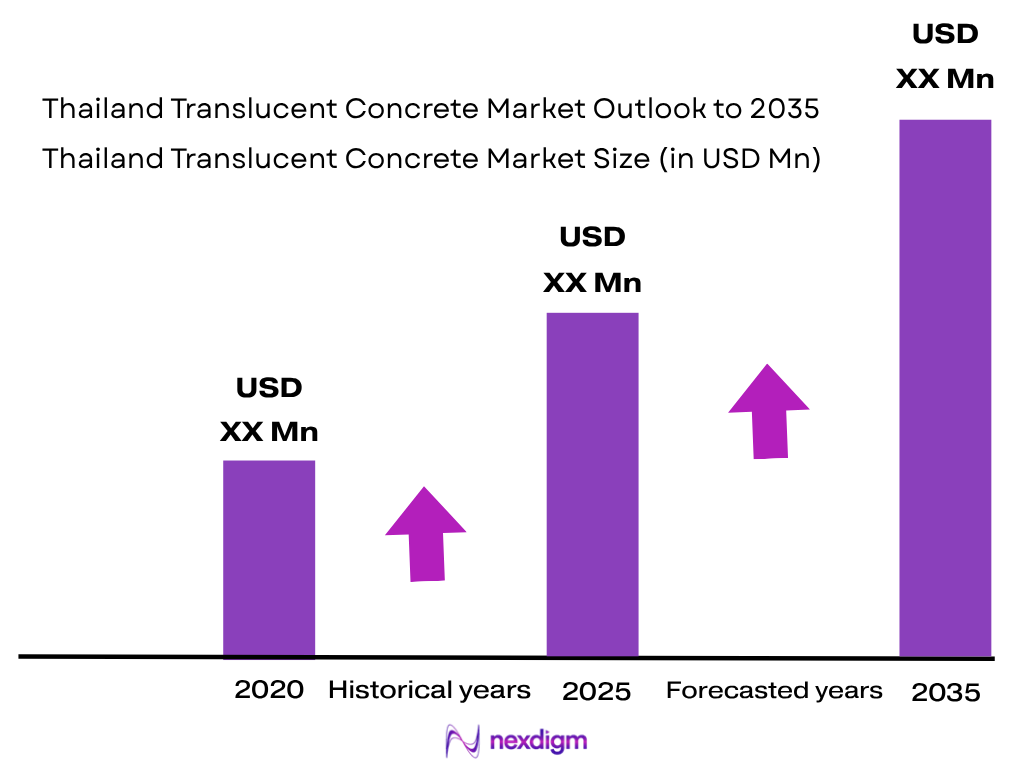
The Thailand Translucent Concrete Market is valued at approximately USD ~ million, compared with USD ~ million in the preceding period, supported by premium commercial construction, hospitality projects, energy-efficient buildings and architectural façade development. Thailand recorded 58.86 million square meters of new-building construction area, compared with 60.85 million square meters previously. The country’s Building Energy Code additionally covers 9 building categories measuring at least 2,000 square meters, supporting demand for innovative daylighting and envelope solutions.
Bangkok, the Bangkok vicinities, Chonburi, Rayong, Phuket and other tourism-led urban centers form the principal addressable locations for Thailand’s translucent-concrete industry. Bangkok recorded 3.65 million square meters of new construction while surrounding provinces recorded 12.22 million square meters. Thailand simultaneously hosted 35.55 million international tourist arrivals, while Bangkok generated THB 940,406 million and Phuket THB 497,524 million in visitor receipts, supporting continued investment in visually differentiated hotels, retail properties and mixed-use destinations.
Market Segmentation
By Light-Transmitting Technology
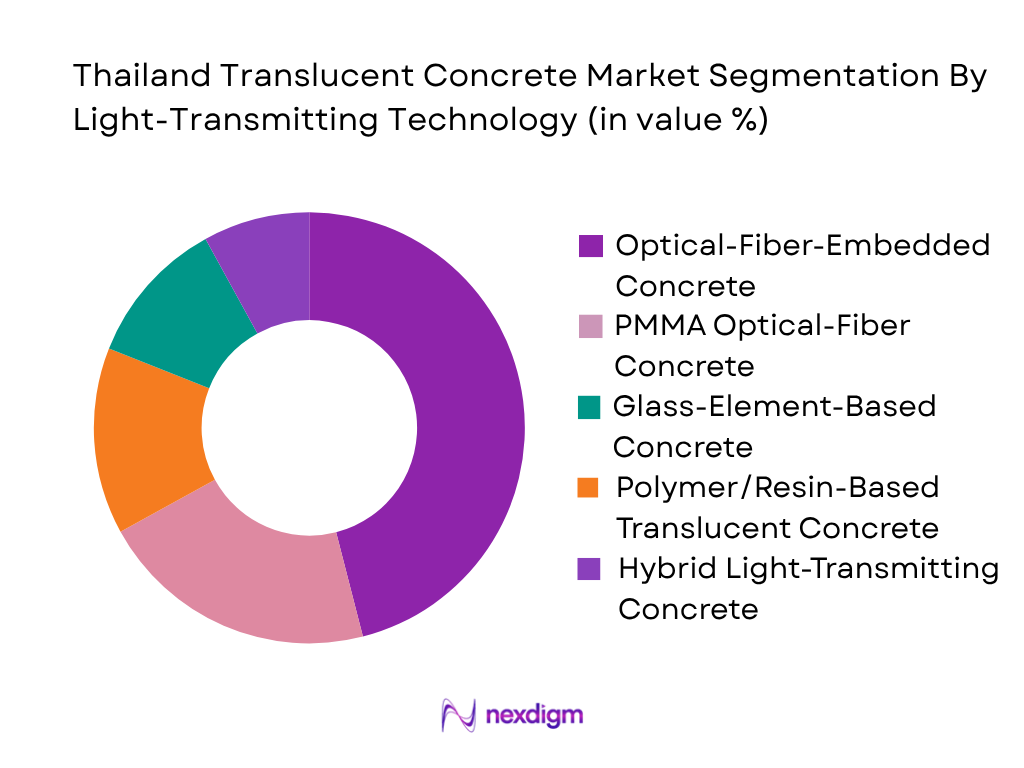
The Thailand Translucent Concrete Market is segmented into optical-fiber-embedded concrete, PMMA optical-fiber concrete, glass-element-based concrete, polymer/resin-based translucent concrete and hybrid light-guide systems. Optical-fiber-embedded concrete holds the dominant modeled market share because it represents the most commercially established method of transmitting light through cementitious material while retaining concrete’s architectural appearance. The technology is suitable for precast panels, illuminated walls, façades, partitions and branded surfaces. Commercial precedent is comparatively strong: LUCEM, founded in 2007, reports more than 600 realized projects worldwide, while Litracon traces its light-transmitting-concrete technology to 2001, patenting to 2002, and commercial company formation to 2004. Thailand’s extensive precast and cement ecosystem also improves the potential for integrating optical-fiber technology with locally fabricated cementitious panels. The technology is especially relevant to Bangkok hotels, shopping centers, corporate buildings and premium interiors where architects can justify specialty material selection through design differentiation and controlled lighting effects.
By Application
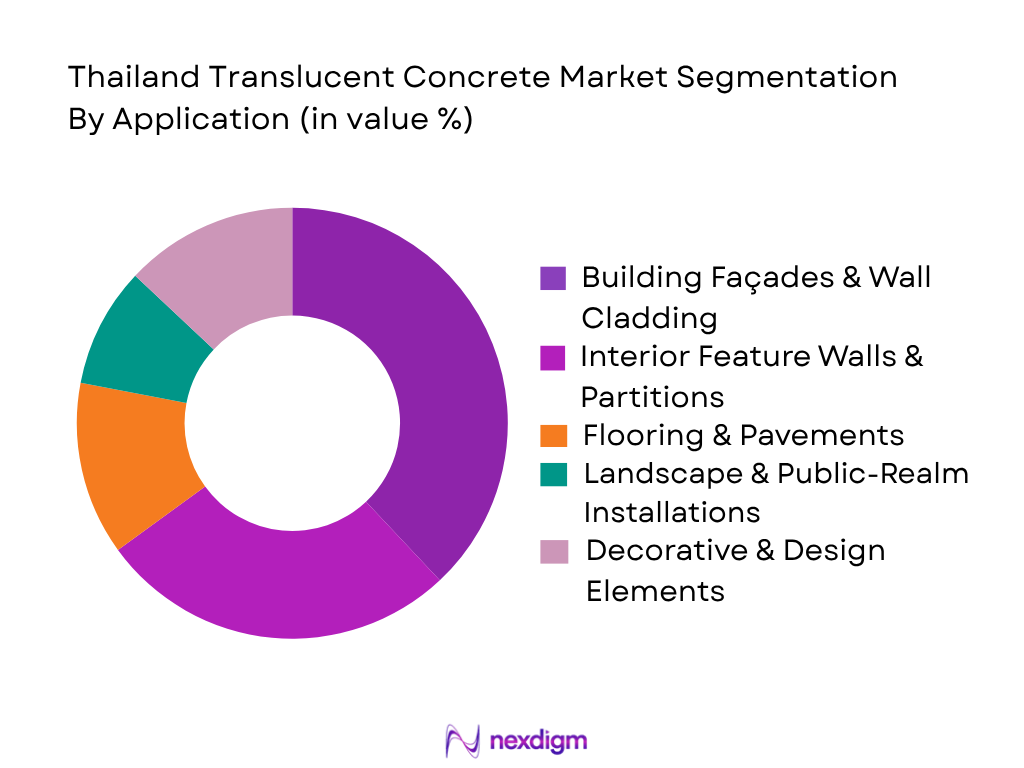
The Thailand Translucent Concrete Market is segmented into building façades and wall cladding, interior feature walls and partitions, flooring and pavements, landscape/public-realm installations and decorative architectural elements. Building façades and wall cladding represent the dominant modeled application because Thailand combines a substantial construction ecosystem with an extensive hospitality and commercial-property base. The country recorded 58.86 million square meters of new-building construction area, including 21.68 million square meters in the Central Region and 12.22 million square meters in Bangkok’s surrounding provinces. Thailand also contained 21,090 accommodation establishments with 794,514 rooms, including 6,859 hotels containing 446,943 rooms. These properties provide a significant architectural specification environment for specialty façade materials. Translucent concrete can differentiate hotel entrances, retail elevations, reception walls and illuminated exterior elements while integrating concrete texture with natural or artificial light. Thailand’s Building Energy Code also places building-envelope performance within the regulatory framework for large buildings, making daylighting-oriented material systems relevant to architectural design discussions.
Competitive Landscape
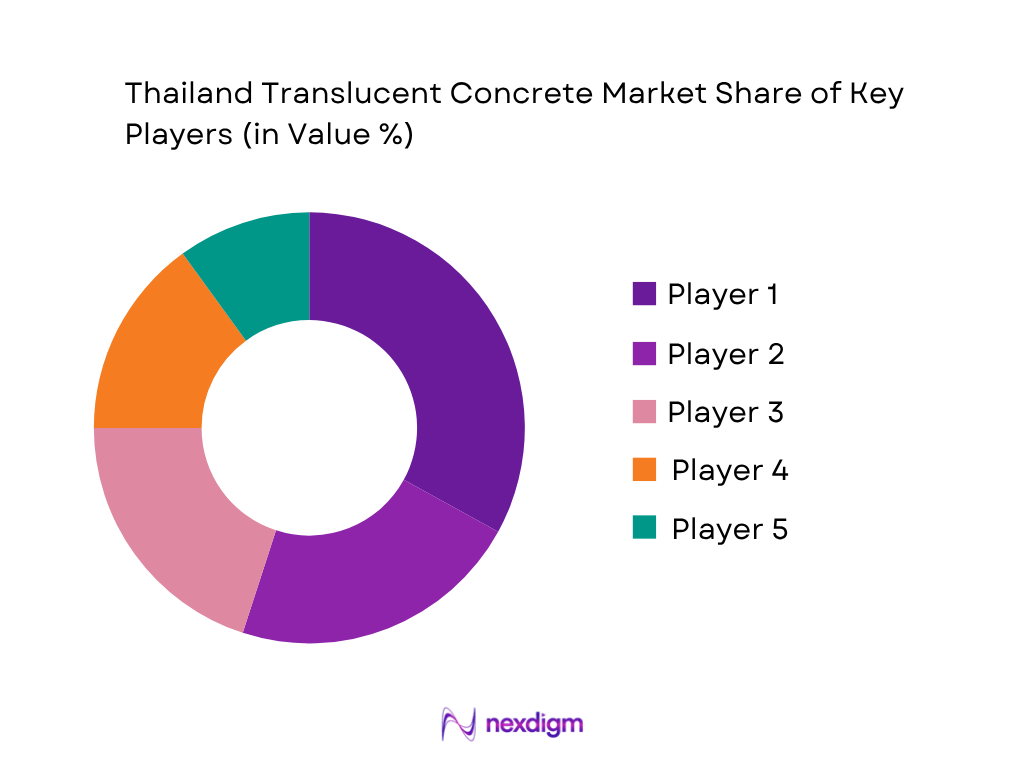
The Thailand Translucent Concrete Market combines international translucent-concrete technology specialists with established regional concrete and building-material companies. LUCEM and Litracon provide dedicated light-transmitting technologies, while SCG supplies Thailand with a substantial domestic cement and building-material ecosystem. Heidelberg Materials and Pan-United add international and Southeast Asian concrete capabilities. Competitive positioning therefore depends on optical-fiber technology, light transmission, precast capability, panel dimensions, customization, tropical-climate suitability, architectural specification support and access to Thai project stakeholders rather than conventional cement capacity alone.
| Major Player | Establishment Year | Headquarters | Core Technology | Primary Product Form | Façade Capability | Interior Capability | Customization Capability | Thailand/ASEAN Relevance |
| SCG / CPAC | 1913 | Thailand | ~ | ~ | ~ | ~ | ~ | ~ |
| LUCEM GmbH | 2007 | Germany | ~ | ~ | ~ | ~ | ~ | ~ |
| LiTraCon / Litracon | 2004 | Hungary | ~ | ~ | ~ | ~ | ~ | ~ |
| Heidelberg Materials / Italcementi | 1873 | Germany | ~ | ~ | ~ | ~ | ~ | ~ |
| Pan-United Corporation | 1999* | Singapore | ~ | ~ | ~ | ~ | ~ | ~ |
Thailand Translucent Concrete Market Analysis
Growth Drivers
Expansion of Large-Scale Building Construction and Architectural Development
Thailand’s substantial building-construction ecosystem creates a strong underlying demand environment for translucent concrete, particularly for façades, feature walls, partitions and customized precast architectural elements. In 2024, Thailand recorded 188,461 construction permits covering 256,994 new building constructions, while total new-building construction area reached 58,862,540 square meters. The Central Region accounted for 21,677,863 square meters, Bangkok’s surrounding provinces contributed 12,217,070 square meters, and Bangkok recorded another 3,654,628 square meters. Thailand’s economy simultaneously generated approximately USD 526 billion of GDP, providing the macroeconomic base for continued commercial, hospitality and infrastructure development. The scale of construction is particularly relevant for translucent concrete because the material is normally specified selectively within high-value developments rather than used as conventional structural concrete. Large offices, hotels, shopping centers, condominiums and mixed-use buildings provide opportunities for optical-fiber panels in entrances, lobby walls, illuminated façades and branded architectural surfaces. Thailand’s Building Energy Code further applies to 9 categories of new or modified buildings with floor areas beginning at 2,000 square meters, creating an institutional framework that encourages architects to evaluate building-envelope and lighting performance. This combination of extensive construction activity, metropolitan development and regulated large-building design strengthens the specification environment for advanced light-transmitting cementitious materials.
Hospitality and Tourism Infrastructure Supporting Premium Architectural Demand
Thailand’s large hospitality ecosystem strengthens demand potential for translucent concrete because hotels, resorts, retail destinations and tourism-oriented mixed-use developments place considerable emphasis on distinctive architectural design. The country welcomed 35,545,700 international tourist arrivals in 2024, compared with 28,150,000 arrivals in 2023, creating substantial utilization of hotels, resorts, shopping destinations and entertainment properties. Thailand had approximately 21,090 accommodation establishments containing 794,514 rooms, including 6,859 hotels with 446,943 rooms and 8,852 resorts with 238,940 rooms. The Southern Region alone contained 260,214 accommodation rooms, while the Central Region contained 178,109 rooms, illustrating the depth of the tourism-related property ecosystem. Thailand’s economy generated approximately USD 526 billion of GDP, while its population exceeded 71 million people, providing additional domestic demand for commercial and leisure infrastructure. These conditions are directly relevant to translucent concrete because premium hospitality properties frequently invest in reception areas, entrance façades, illuminated walls, restaurants, spas, signage and landscape architecture that emphasize visual differentiation. Optical-fiber-embedded concrete can combine concrete texture with controlled light transmission in these applications. Continued hotel renovation and repositioning can additionally create retrofit opportunities, allowing translucent panels to enter existing properties without requiring their use as primary structural material.
Market Challenges
Dependence on Specialized Optical Components and Limited Local Technology Availability
Thailand possesses a substantial conventional cement and concrete manufacturing base, but translucent concrete requires specialized optical fibers, PMMA light guides, precision molds and fabrication expertise that differ considerably from ordinary concrete production. This creates a supply-chain challenge despite Thailand recording 256,994 new building constructions across 58,862,540 square meters in 2024. The country’s broader economy generated approximately USD 526 billion of GDP and supported more than 71 million residents, meaning specialty-material suppliers must operate within a large construction environment where conventional products already benefit from established domestic production and distribution networks. Translucent-concrete fabrication requires optical elements to be accurately positioned through the cementitious matrix so that light can pass between panel surfaces after casting, cutting and finishing. The challenge becomes more significant when panels require customized light patterns, thin sections or integrated illumination. Bangkok alone recorded 3,654,628 square meters of new-building area, while surrounding provinces recorded 12,217,070 square meters, creating considerable potential demand but also requiring suppliers to establish reliable fabrication and technical-support capabilities. Without sufficient local specialization, projects can depend on imported optical components, overseas technology support or project-specific fabrication arrangements. Expanding adoption therefore requires development of domestic fiber-placement expertise, controlled precasting, polishing, anchorage engineering, installation knowledge and quality-assurance procedures compatible with Thailand’s established construction supply chain.
Tropical Climate Performance and Complex Building-System Integration
Thailand’s climatic and building-performance conditions create technical challenges for translucent concrete, particularly when the material is installed as exterior façade or wall-cladding panels. The country recorded 58,862,540 square meters of new-building construction area in 2024, including 21,677,863 square meters in the Central Region, 12,217,070 square meters in Bangkok’s vicinities and 8,246,647 square meters in the Southern Region. These regions expose building envelopes to high humidity, heavy seasonal rainfall and sustained solar conditions, requiring translucent-concrete systems to address moisture penetration, joints, anchorage, thermal movement and protection of embedded optical elements. Thailand’s Building Energy Code adds another technical layer by covering 9 building categories with floor areas beginning at 2,000 square meters and assessing 6 energy-related building systems, including envelopes and lighting. Translucent concrete therefore cannot be specified solely on visual performance; exterior systems must integrate with structural connections, waterproofing, insulation, façade detailing and building-energy requirements. Thailand’s approximately USD 526 billion economy supports increasingly sophisticated commercial buildings, making engineering compliance important for specialty materials entering major developments. Panel weight and dimensions also influence transportation and lifting requirements, while integrated backlighting requires electrical coordination. Successful market development therefore depends on multidisciplinary collaboration among precast manufacturers, façade engineers, architects, lighting designers, structural engineers, contractors and specialist installers.
Market Opportunities
Localization of Optical-Fiber Concrete and Advanced Precast Panel Manufacturing
Thailand has an opportunity to localize significant portions of translucent-concrete manufacturing by combining imported optical technology with its established domestic cement, precast and construction capabilities. The country recorded 256,994 new building constructions covering 58,862,540 square meters in 2024, demonstrating the industrial scale available to support specialized architectural-material production. The Central Region alone represented 21,677,863 square meters of construction area, while Bangkok and its surrounding provinces collectively represented 15,871,698 square meters. Thailand’s economy generated approximately USD 526 billion of GDP, providing a substantial manufacturing and construction base for technology partnerships. A localized translucent-concrete model could source specialized glass optical fibers, PMMA fibers or proprietary light guides internationally while carrying out concrete-matrix preparation, fiber positioning, casting, curing, cutting, polishing and surface finishing domestically. This would allow Thai manufacturers to tailor panel dimensions, fiber density, surface textures and lighting patterns to individual architectural specifications. Local production could also facilitate physical mock-ups before full project execution, an important requirement for premium façade and interior projects. Existing precast companies could develop dedicated production lines rather than establishing entirely new concrete supply chains. Technology licensing, joint ventures and manufacturing partnerships therefore offer a practical route for expanding translucent-concrete availability while building domestic expertise in optical-fiber placement, panel finishing, façade anchorage and integrated lighting systems.
Energy-Efficient Buildings, Hospitality and Premium Façade Applications
Thailand’s combination of regulated energy-efficient construction and a large hospitality ecosystem provides a forward-looking opportunity for translucent concrete in daylighting, illuminated façades and premium interior applications. The Building Energy Code applies to 9 building categories with total floor areas starting at 2,000 square meters and evaluates 6 building-energy systems, including the building envelope, lighting, air conditioning, hot-water equipment, overall energy consumption and renewable-energy utilization. Thailand simultaneously received 35,545,700 international tourists in 2024 and operated approximately 21,090 accommodation establishments containing 794,514 rooms. Of these, 446,943 rooms were located in hotels and 238,940 rooms in resorts. These current indicators create an extensive addressable property ecosystem without relying on speculative future construction figures. Translucent concrete can be incorporated into hotel entrances, resort reception areas, shopping centers, premium offices, condominium common areas and transportation facilities where designers require a combination of concrete aesthetics and controlled illumination. Optical-fiber panels can also be paired with artificial lighting to transform walls after daylight hours, increasing their relevance to hospitality and retail environments with extended operating hours. The opportunity is particularly strong where architects integrate daylighting, branding and façade identity rather than treating translucent concrete as conventional structural material. Thailand’s large construction base also provides the contractors, precast producers and building-system specialists needed to support wider commercial implementation.
Future Outlook
The Thailand Translucent Concrete Market is forecast to register an approximately ~% CAGR during 2026-2035. Future development is expected to be supported by premium hospitality construction, Bangkok mixed-use development, Eastern Economic Corridor investment, energy-efficient building design, advanced precast manufacturing and increasing demand for differentiated architectural materials. Opportunities should increasingly shift from completely imported products toward technology partnerships combining proprietary optical systems with Thai cement, concrete and fabrication capabilities.
Thailand’s regulatory environment also creates a meaningful architectural context for advanced façade materials. The Building Energy Code applies to 9 categories of new or modified buildings with total floor areas beginning at 2,000 square meters. It evaluates 6 building-energy systems, including building envelopes, lighting, air conditioning, hot-water equipment, overall building energy consumption and renewable-energy utilization. Translucent concrete therefore has potential where daylighting is incorporated into an integrated building-energy strategy rather than treated purely as decoration.
Major Players
- LUCEM GmbH
- LiTraCon / Litracon
- CRE Panel GmbH / LUCCON
- Heidelberg Materials / Italcementi
- Pan-United Corporation Ltd.
- SCG Cement and Green Solutions / CPAC
- Fapinex LLC
- FİBROBETON
- LCT GesmbH Light & Concrete Technology
- Gravelli / LiCrete
- Beton Brož
- Florack Bauunternehmung GmbH
- LBM EFO
- Concrete LCDA
- DITON s.r.o.
Key Target Audience
- Translucent Concrete Technology Developers and Manufacturers
- Cement, Precast Concrete and Architectural Panel Manufacturers
- Optical Fiber, PMMA and Light-Guide Component Suppliers
- Real Estate, Mixed-Use and Commercial Property Developers
- Hospitality, Resort and Luxury Retail Developers
- Façade Contractors and Specialty Building-Material Distributors
- Investments and Venture Capitalist Firms
- Government and Regulatory Bodies (Department of Alternative Energy Development and Efficiency, Department of Public Works and Town & Country Planning, Thai Industrial Standards Institute, Board of Investment of Thailand)
Research Methodology
Step 1: Identification of Key Variables
The initial phase constructs the Thailand Translucent Concrete Market ecosystem across optical-fiber suppliers, technology developers, cement producers, precast manufacturers, façade contractors, architects, lighting designers, developers and specialty-material distributors. Critical variables include installed area, light-transmission technology, panel format, optical-fiber density, application type, building category, domestic fabrication capability, import dependency and regional project concentration.
Step 2: Market Analysis and Construction
Historical analysis combines top-down and bottom-up market-sizing approaches. Top-down analysis evaluates Thailand’s construction area, hospitality infrastructure, commercial property development, Building Energy Code coverage and geographic construction concentration. Bottom-up analysis assesses available translucent-concrete technologies, panel dimensions, supplier portfolios, project installations, potential installed surface area and the specification pipeline across façades, interiors and decorative architectural applications.
Step 3: Hypothesis Validation and Expert Consultation
Market hypotheses are validated through CATIs and structured interviews with concrete producers, architects, façade specialists, precast manufacturers, developers, distributors, contractors and technology suppliers. Interviews evaluate product awareness, procurement practices, optical-fiber preferences, façade performance requirements, tropical-climate considerations, customization requirements, installation complexity and the commercial feasibility of imported versus locally fabricated translucent-concrete systems.
Step 4: Research Synthesis and Final Output
Primary findings are triangulated with Thai government construction statistics, Building Energy Code information, tourism and hospitality statistics, supplier technical documentation and project evidence. Bottom-up installation assumptions are reconciled with the addressable building base to prevent overstatement. The final output evaluates technology, applications, regional demand, competitive positioning, localization potential and future adoption while clearly distinguishing published statistics from analyst-modeled market values.

- Executive Summary
- Research Methodology (Market Definition and Scope, Thailand Translucent Concrete Market Classification, Light-Transmitting Concrete Technology Mapping, Optical-Fiber-Embedded Concrete Assessment, PMMA Optical Fiber Concrete Evaluation, Glass and Transparent-Element Concrete Analysis, Polymer and Resin-Based Translucent Concrete Assessment, Precast Translucent Concrete Panel Evaluation, Translucent Concrete Block and Tile Assessment, Light Transmission Efficiency Analysis, Optical Fiber Density Analysis, Compressive Strength Assessment, Flexural Strength Evaluation, Panel Thickness and Dimension Assessment, Surface Finish Evaluation, Façade Application Mapping, Interior Application Assessment, Building Energy Code Alignment Assessment, Tropical Climate Performance Assessment, Precast Manufacturing Capability Assessment, Architectural Specification Analysis, Import Dependency Assessment, Domestic Fabrication Capability Assessment)

- Definition and Scope
- Thailand Translucent Concrete Industry Evolution and Development of Optical-Fiber-Embedded Concrete, Light-Transmitting Cementitious Materials, Precast Translucent Concrete Panels, Architectural Façade Systems, Interior Feature-Wall Applications, Daylighting Solutions, High-Performance Concrete Matrices, PMMA Optical Fiber Integration, Glass Light-Guide Technologies, Customized Architectural Elements, Smart Concrete Surfaces, LED-Integrated Concrete, Low-Carbon Cementitious Matrices, Digital Fabrication, 3D Concrete Printing and Advanced Precast Manufacturing
- Translucent Concrete Value Chain Analysis
- Translucent Concrete Supply Chain Analysis
- Cement and Low-Carbon Binder Suppliers, Fine Aggregate Suppliers, Optical Fiber Manufacturers, PMMA Fiber Suppliers, Glass Light-Guide Suppliers, Chemical Admixture Manufacturers, Translucent Concrete Technology Developers, Precast Concrete Manufacturers, Architectural Panel Fabricators, Façade System Suppliers, Specialty Building Material Importers, Construction Material Distributors, Architects, Façade Consultants, Lighting Designers, Hotel and Retail Developers, General Contractors, Specialty Installers, Property Developers and Building Owners

- Growth Drivers (Expansion of Premium Commercial Construction, Growth of Hospitality and Resort Development, Building Energy Code Implementation, Increasing Demand for Daylighting Solutions, Adoption of Signature Building Façades, Expansion of Luxury Retail and Mixed-Use Developments, Growth of Advanced Precast Construction, Demand for Differentiated Architectural Materials)
- Market Challenges (High Optical Fiber and Specialized Component Requirements, Dependence on Imported Light-Guide Technologies, Limited Domestic Commercial-Scale Translucent Concrete Manufacturing, Labor-Intensive Optical Fiber Placement, Complex Precast Production Requirements, High-Humidity and Tropical Climate Performance Requirements, Façade Weathering Requirements)
- Market Opportunities (Localization of Translucent Concrete Panel Manufacturing, Partnership with Thailand Precast Concrete Producers, Technology Licensing and Joint Ventures, Building Energy Code-Oriented Daylighting Applications, Eastern Economic Corridor Project Specifications, Automated Optical Fiber Placement, Low-Carbon Translucent Concrete Matrices, Integrated LED Concrete Systems, Smart and Interactive Façades)
- Market Trends (Increasing Adoption of Advanced Architectural Concrete, Growth of Low-Carbon Cementitious Materials, Expansion of Custom Precast Panels, Integration of LED Backlighting, Development of Thin and Lightweight Panels, Increasing Use of Feature Walls and Signature Façades, Digital Fabrication, 3D Concrete Printing, Growing Integration of Daylighting and Building-Envelope Design)
- Government Regulations and Standards (Thailand Building Control Requirements, Building Energy Code Requirements, Building Envelope OTTV Requirements, Roof Thermal Transfer Requirements, Lighting Power Density Requirements, Energy Conservation Promotion Requirements, Thai Industrial Standards for Cement and Concrete Materials, Structural Concrete Requirements)
- SWOT Analysis
- Porter’s Five Forces Analysis
- PESTLE Analysis
- Stakeholder Ecosystem
- Competition Ecosystem

- By Market Value (2020-2025)
- By Installed Volume (2020-2025)
- By Installed Surface Area (2020-2025)
- By Average Selling Price per Square Meter (2020-2025)
- By Precast Translucent Concrete Panel Consumption Volume (2020-2025)
- By Optical-Fiber-Embedded Concrete Consumption Volume (2020-2025)
- By Translucent Concrete Block and Tile Consumption Volume (2020-2025)
- By Exterior Façade Application Volume (2020-2025)
- By Interior Architectural Application Volume (2020-2025)

- By Light-Transmitting Technology (In Value %)
Optical-Fiber-Embedded Cementitious Concrete
PMMA Optical-Fiber Concrete
Glass-Fiber and Glass-Element-Based Concrete
Polymer and Resin-Based Translucent Concrete
Hybrid Light-Guide Concrete Systems
Integrated LED Translucent Concrete
Alternative Light-Transmitting Cementitious Systems - By Product Form (In Value %)
Precast Translucent Concrete Panels
Translucent Concrete Slabs
Translucent Concrete Blocks and Bricks
Translucent Concrete Tiles
Thin Architectural Cladding Panels
Custom Architectural Elements
Decorative Concrete Components
Furniture and Interior Elements
Bespoke Formed and 3D Elements - By Application (In Value %)
Building Façades
Exterior Wall Cladding
Interior Feature Walls
Partitions and Space Dividers
Flooring and Pavements
Staircases and Vertical Circulation Elements
Reception Desks and Countertops
Signage and Branded Architectural Surfaces
Landscape and Public-Realm Installations
Furniture and Decorative Applications
Backlit Architectural Surfaces - By End-Use Building Type (In Value %)
Luxury Hotels and Resorts
Grade-A Offices and Corporate Buildings
Premium Residential and Condominium Developments
Retail Malls and Luxury Stores
Airports and Transportation Facilities
Hospitals and Healthcare Buildings
Museums, Galleries and Cultural Buildings
Entertainment and Leisure Destinations
Government and Civic Buildings
Mixed-Use Developments
Convention and Exhibition Facilities
Integrated Tourism Developments - By Region (In Value %)
Bangkok Metropolitan Region
Chonburi
Rayong
Chachoengsao
Phuket
Chiang Mai
Pattaya
Eastern Economic Corridor
Central Thailand
Southern Thailand
Rest of Thailand

- Market Share of Major Players (By Thailand Revenue, Translucent Concrete Product Portfolio, Optical-Fiber Technology Capability, Precast Panel Portfolio, Light Transmission Performance, Panel Size and Thickness Range, Exterior Façade Capability, Interior Application Coverage, Customization Capability, Integrated Lighting Capability, Manufacturing Scalability, Thailand and ASEAN Distribution Presence, Architectural Specification Reach, Project Portfolio, Technical Support Capability, Local Fabrication Partnership Capability)
- Cross Comparison Parameters (Light Transmission Efficiency, Compressive and Flexural Strength Performance, Panel Size and Thickness Range, Optical Fiber and Light-Guide Technology Capability, Thailand and ASEAN Project and Distribution Presence, Tropical-Climate Exterior Façade Capability, Customization and Integrated Lighting Capability, Manufacturing Scalability and Project Lead-Time Capability)
- SWOT Analysis of Major Players
- Competitive Positioning Matrix
- Translucent Concrete Technology and Architectural Application Benchmarking
- Panel Anchorage and Building-System Integration Assessment
- Tropical Climate, UV and Exterior Weathering Capability Assessment
- Thailand Distribution, Architectural Specification and Technical Support Assessment
- Major Companies
LUCEM GmbH
LiTraCon / Litracon
CRE Panel GmbH / LUCCON
Heidelberg Materials / Italcementi
Pan-United Corporation Ltd.
SCG Cement and Green Solutions / CPAC
Fapinex LLC
FİBROBETON
LCT GesmbH Light & Concrete Technology
Gravelli / LiCrete
Beton Brož
Florack Bauunternehmung GmbH
LBM EFO
Concrete LCDA
DITON s.r.o.

- Architectural Façade Requirement Assessment
- Exterior Wall Cladding Demand Analysis
- Interior Feature-Wall Requirement Assessment
- Building Energy Code and Daylighting Requirement Analysis
- Bangkok Grade-A Office Demand Assessment
- Luxury Hotel and Resort Application Assessment
- Luxury Retail and Shopping Mall Application Analysis

- By Market Value (2026-2035)
- By Installed Volume (2026-2035)
- By Installed Surface Area (2026-2035)
- By Average Selling Price per Square Meter (2026-2035)
- By Precast Translucent Concrete Panel Consumption Volume (2026-2035)
- By Optical-Fiber-Embedded Concrete Consumption Volume (2026-2035)
- By Translucent Concrete Block and Tile Consumption Volume (2026-2035)
- By Exterior Façade Application Volume (2026-2035)
- By Interior Architectural Application Volume (2026-2035)
- By Building Energy Code-Aligned Application Volume (2026-2035)


 Request a Sample
 Ask for Customization
 Get a Quote
 Enquire Now