

 Download PDF
Market Overview
The Thailand Waterproofing Chemicals Market is supported by a substantial construction and infrastructure base. Thailand’s National Statistical Office recorded 188,461 new-building construction permits and 52.10 million sq. m. of new building construction area in 2024. In addition, 3,395 permits were issued for additions and alterations, covering 2.82 million sq. m. NSO Civil-engineering construction also generated 4,979 new construction projects covering 2.38 million sq. m., creating demand for waterproofing across foundations, drainage structures, roads, bridges and other concrete assets.
Bangkok and the surrounding metropolitan area remain the principal demand centers for Thailand Waterproofing Chemicals because they concentrate high-density residential, commercial, institutional, transportation and redevelopment activity. The National Statistical Office recorded 19,603 building permits in Bangkok and 57,348 in the surrounding vicinity in 2024, while construction areas reached 4.90 million sq. m. and 13.75 million sq. m., respectively. NSO The Eastern region is another critical hub because of industrial and logistics development, while the Central region benefits from extensive residential, commercial and industrial construction.
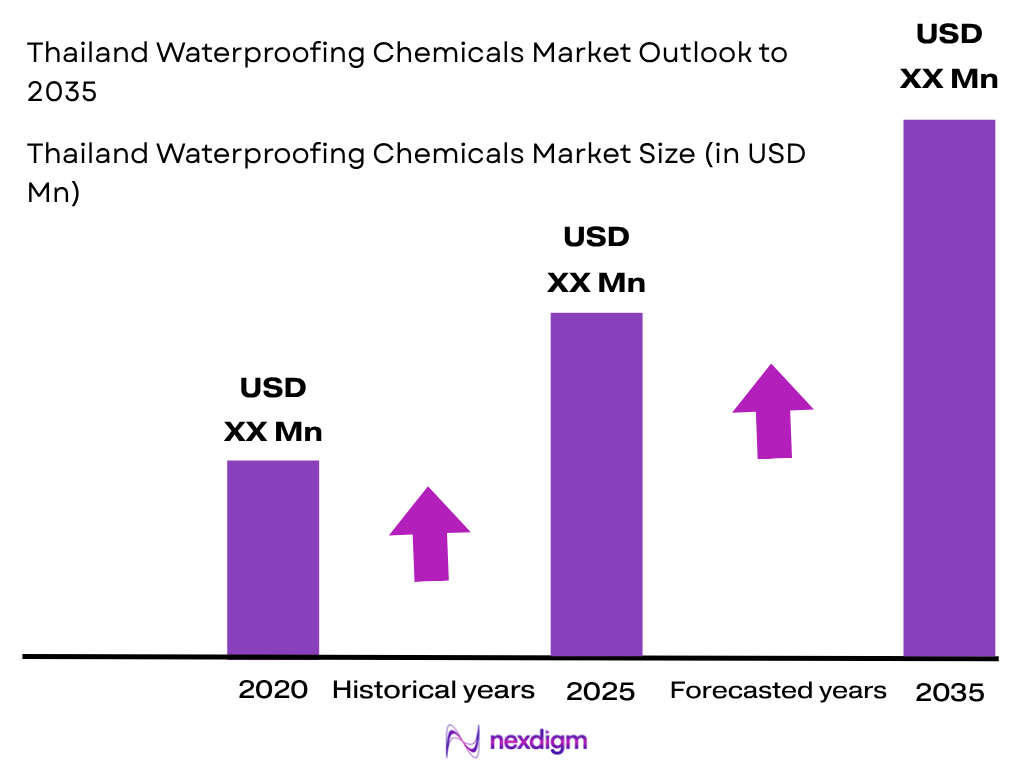
Market Segmentation
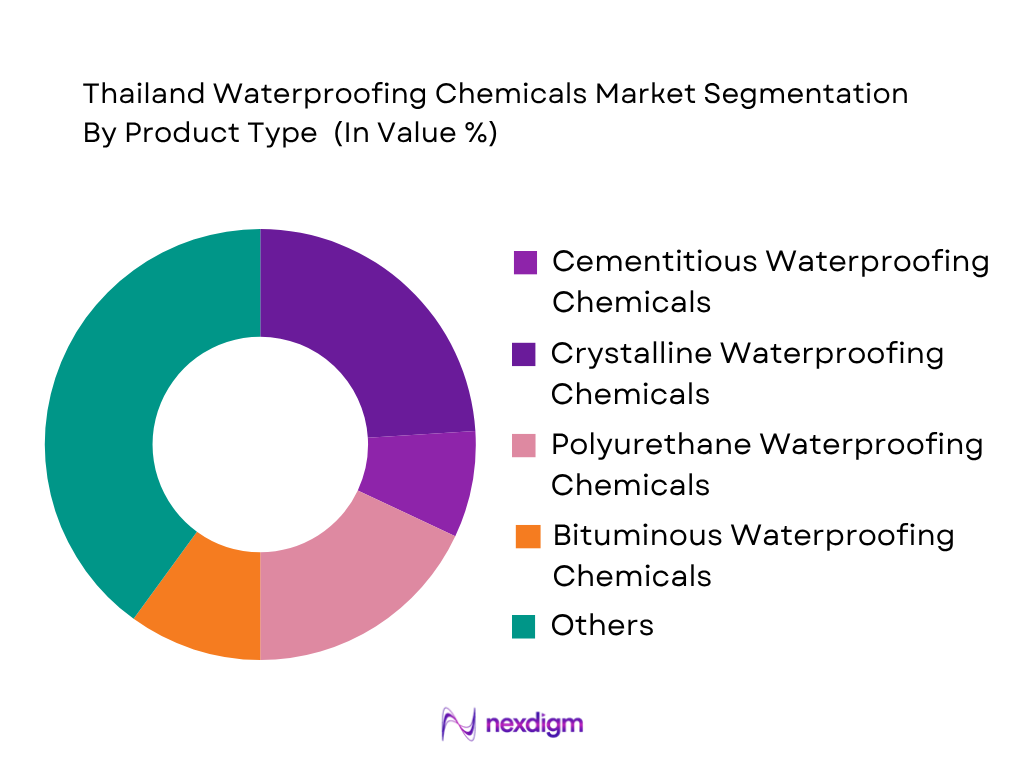
By Product Type
Thailand Waterproofing Chemicals Market is segmented by product type into cementitious waterproofing chemicals, polyurethane waterproofing chemicals, acrylic waterproofing chemicals, polyurea waterproofing chemicals, crystalline waterproofing chemicals, bituminous waterproofing chemicals, epoxy-based systems, silane and siloxane treatments, waterproofing admixtures, and injection grouts. Cementitious waterproofing chemicals are expected to represent the leading sub-segment, supported by their compatibility with concrete and masonry substrates, comparatively straightforward application, suitability for wet areas and foundations, and extensive use in residential and infrastructure projects. Their applicability across bathrooms, water tanks, basements, retaining structures and concrete repair makes them relevant across multiple construction categories. Polyurethane and polyurea systems remain important for projects requiring higher flexibility, crack-bridging capability and rapid application, while crystalline systems are increasingly relevant for integral protection of concrete. For report presentation, the 2024 segment shares can be represented using validated market calculations rather than unsupported estimates.
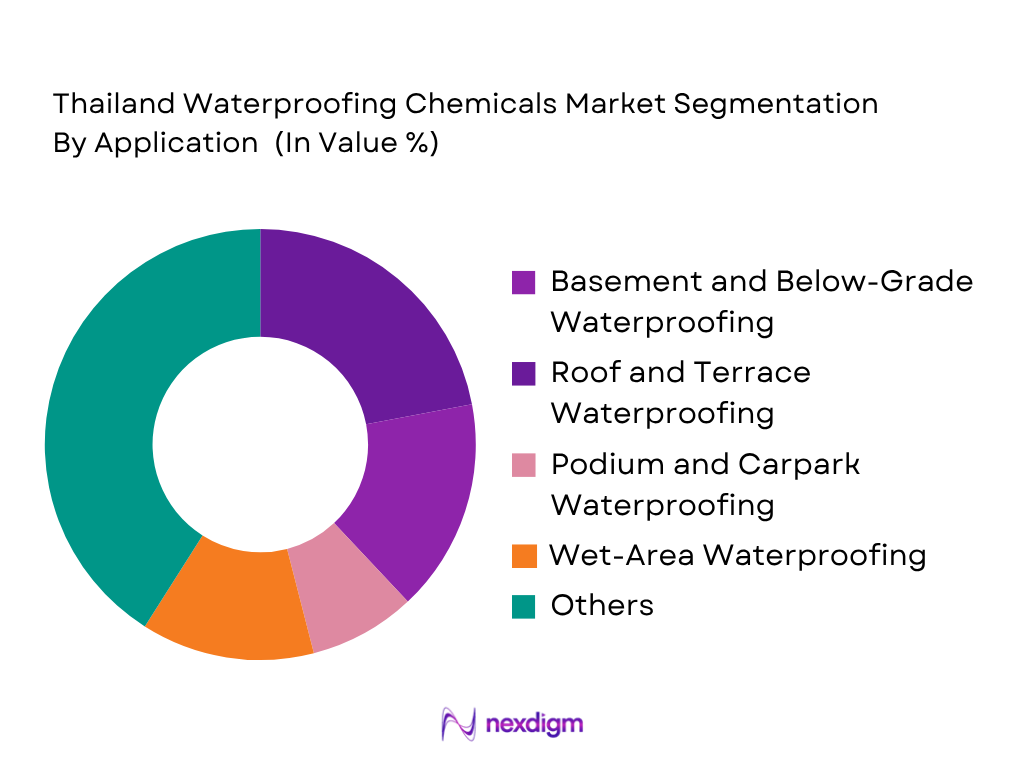
By Application
Thailand Waterproofing Chemicals Market is segmented by application into roof and terrace waterproofing, basement and below-grade waterproofing, bathroom and wet-area waterproofing, balcony and podium waterproofing, foundation waterproofing, water-tank and reservoir waterproofing, tunnel and underground-structure waterproofing, bridge and roadway waterproofing, industrial-floor and concrete waterproofing, swimming-pool waterproofing, and expansion-joint and crack waterproofing. Roof and terrace waterproofing is positioned as a leading application because Thailand’s tropical climate creates recurring exposure to rainfall, humidity, solar radiation and moisture penetration. Residential and commercial roofs require continuous protection, while refurbishment activity creates additional demand for liquid-applied systems that can be installed over existing substrates. Below-grade applications are also structurally important because basements, foundations and underground structures face groundwater and hydrostatic-pressure risks. Infrastructure applications provide another major demand pool as bridges, roads, drainage structures and transportation projects require concrete protection. Consequently, suppliers with technologies spanning roofs, wet areas, below-grade structures and infrastructure can address a wider portion of Thailand’s waterproofing requirements.
Competitive Landscape
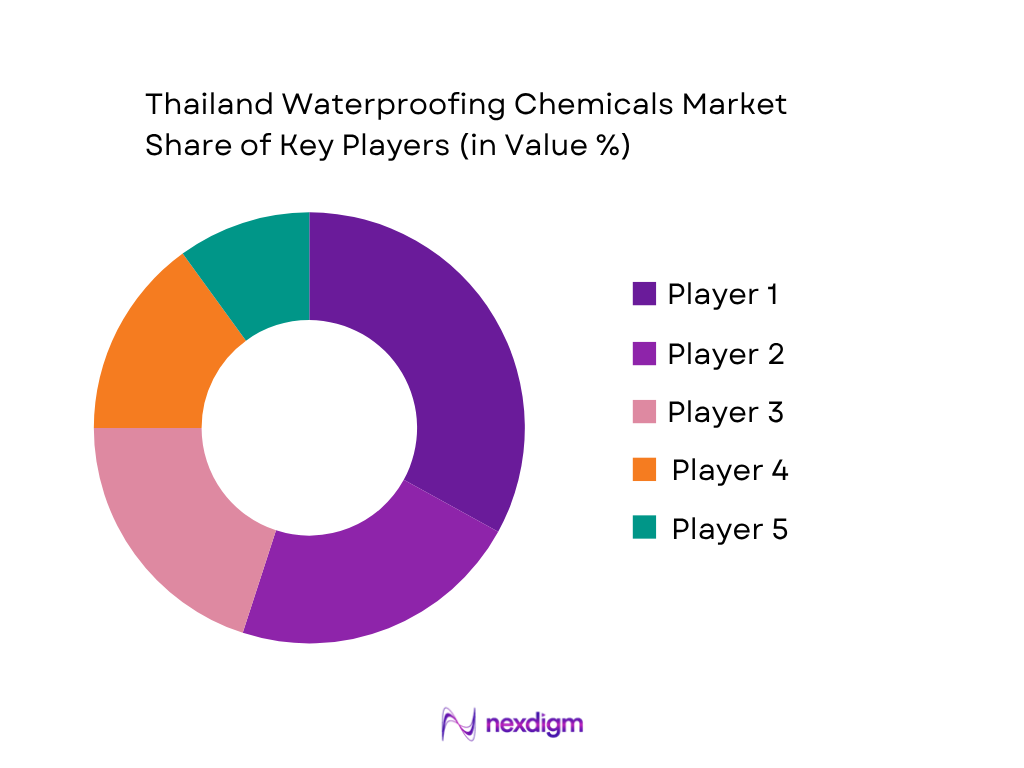
The Thailand Waterproofing Chemicals Market contains multinational construction-chemical manufacturers, Thai building-material companies, specialist waterproofing suppliers and regional distributors. Competition is shaped by product breadth, technical approval, contractor relationships, application support, distribution reach and the ability to provide complete waterproofing systems rather than individual chemical products. International suppliers generally compete through technology and specification support, while established Thai companies benefit from domestic distribution networks, local market knowledge and relationships with contractors and developers.
| Company | Establishment | Headquarters | Key Product Coverage | Waterproofing Technology | Thailand Presence | Technical Support | Primary Application Strength |
| Sika | 1910 | Baar, Switzerland | ~ | ~ | ~ | ~ | ~ |
| Saint-Gobain / Weber | 1665 | Paris, France | ~ | ~ | ~ | ~ | ~ |
| MAPEI | 1937 | Milan, Italy | ~ | ~ | ~ | ~ | ~ |
| Fosroc | 1934 | Dubai, UAE | ~ | ~ | ~ | ~ | ~ |
| TOA Paint | 1964 | Bangkok, Thailand | ~ | ~ | ~ | ~ | ~ |
Thailand Waterproofing Chemicals Market Analysis
Growth Drivers
Urban Construction Activity
Thailand’s urban construction base continues to provide a direct demand environment for waterproofing chemicals across residential buildings, commercial properties, industrial facilities and mixed-use developments. The National Statistical Office recorded 188,461 building-construction permits and 58.86 million sq. m. of new building construction area in 2024, providing a substantial substrate base for waterproofing applications across roofs, wet areas, foundations and below-grade structures. Bangkok, its surrounding provinces and the Central Region remain particularly important construction clusters, with the Central Region alone recording 19.54 million sq. m. of new building construction area in 2024. The broader macroeconomic environment also supports construction demand: IMF data places Thailand’s real GDP growth at 2.5% in 2024, while population reached 71.67 million. Waterproofing chemicals therefore benefit from both new-building activity and the requirement to protect concrete and masonry against Thailand’s humid and rainfall-intensive environment. The construction base also extends beyond residential buildings into commercial, industrial and institutional structures, creating multiple application points for cementitious coatings, polyurethane systems, crystalline treatments, injection materials and protective admixtures. This breadth makes construction activity a fundamental demand driver rather than a single-project-dependent source of waterproofing consumption.
Infrastructure Development
Infrastructure investment is creating additional waterproofing requirements across civil-engineering structures where concrete durability, water ingress protection and long service life are critical. Thailand’s National Statistical Office recorded 2.38 million sq. m. of new civil-construction activity in 2024, covering infrastructure categories such as roads, bridges, dams, water drains and related structures. Public infrastructure demand is reinforced by Thailand’s continued investment requirements in transport, utilities and industrial connectivity, while the IMF recorded 5.7% of GDP in public investment in 2024 and US$6.95 billion in net FDI. The Eastern Economic Corridor is another important demand channel: the EEC Office reported 36 projects associated with investor letters of intent between January 2023 and September 2024, with proposed investment of approximately THB135 billion. Such projects create requirements for waterproofing in underground structures, industrial facilities, utility systems, foundations, water-retaining structures and transportation assets. Waterproofing chemicals are particularly relevant where conventional surface protection must be combined with concrete repair or where complex geometries make liquid-applied systems advantageous. Continued infrastructure development therefore expands the addressable application base for polyurethane, polyurea, crystalline and cementitious waterproofing technologies across both new construction and rehabilitation projects.
Market Challenges
Polymer and Resin Feedstock Volatility
Waterproofing chemicals that rely on polyurethane, polyurea, acrylic, epoxy and other polymeric chemistries remain exposed to fluctuations in the availability and international trade of chemical feedstocks. Thailand imported US$4.71 billion of organic chemicals in 2024, illustrating the scale of the country’s dependence on internationally sourced chemical inputs. China supplied approximately US$1.72 billion, while Singapore supplied approximately US$429.6 million, Malaysia US$352.1 million, Japan US$279.9 million and India US$254.9 million. These flows demonstrate the importance of regional chemical supply chains to Thailand’s construction-chemical ecosystem. Thailand also imported US$688.9 million of chemical products and residual chemical products under HS 382390 in 2024. For waterproofing manufacturers and distributors, disruptions in upstream chemical availability can affect formulation continuity, procurement planning and production scheduling even when finished waterproofing products remain locally available. The challenge is particularly relevant to specialized polyurethane and polyurea systems because their performance depends on controlled chemical formulations rather than commodity construction materials alone. Consequently, manufacturers serving Thailand need resilient sourcing strategies, multiple regional suppliers and inventory planning for critical chemical inputs. Feedstock exposure can also complicate project specifications where contractors require consistent formulation characteristics across large construction phases.
Imported Specialty Chemical Dependence
Thailand’s construction-chemical ecosystem remains connected to international specialty-chemical supply chains, creating challenges for waterproofing products that require specialized polymers, additives, modifiers and performance-enhancing ingredients. World Bank WITS trade data shows Thailand imported US$4.71 billion of organic chemicals in 2024, while imports of chemical products and residual chemical products under HS 382390 reached US$688.94 million. The geographic concentration of these flows is significant, with China alone accounting for approximately US$249.36 million of HS 382390 imports, followed by the United States at US$96.93 million, Japan at US$75.23 million and Malaysia at US$46.12 million. Such dependence exposes waterproofing suppliers to shipping disruptions, customs clearance requirements, exchange-rate movements and changes in international chemical availability. The issue is especially relevant to specialized waterproofing systems used in infrastructure, industrial facilities and demanding below-grade applications, where replacement products may require technical qualification before being accepted. Thailand’s IMF-reported US$6.95 billion of net FDI in 2024 also indicates strong integration with international investment and supply networks, increasing the importance of meeting multinational project specifications. As project owners increasingly require documented technical performance and consistent product formulations, specialty-chemical supply resilience becomes an important competitive factor for waterproofing manufacturers and distributors.
Market Opportunities
Below-Grade Waterproofing Expansion
Below-grade waterproofing presents a strong opportunity because Thailand’s construction pipeline continues to generate foundations, basements, underground structures and utility spaces that require protection from water ingress. The National Statistical Office recorded 58.86 million sq. m. of new building construction area in 2024, alongside 2.38 million sq. m. of new civil-construction activity. The Central Region accounted for 19.54 million sq. m. of new building construction area, while Bangkok and its surrounding provinces together represented another substantial construction base. These structures create recurring requirements for waterproofing foundations, retaining walls, basement slabs, construction joints and concrete penetrations. Chemical systems such as crystalline waterproofing, cementitious coatings, polyurethane injection systems and liquid-applied membranes can address different substrate and leakage conditions, including situations where external membrane installation is difficult after construction. The opportunity is strengthened by Thailand’s infrastructure and industrial-development pipeline, which expands the volume of underground concrete structures requiring long-term moisture protection. IMF data also recorded 5.7% of GDP in public investment in 2024, reinforcing the relevance of public infrastructure expenditure to underground construction and rehabilitation. Suppliers that combine waterproofing with concrete repair, crack injection and durability protection can therefore address multiple project requirements through integrated systems rather than standalone waterproofing products.
Infrastructure Rehabilitation
Infrastructure rehabilitation creates an opportunity for waterproofing suppliers because existing bridges, drainage structures, tunnels, water facilities and concrete assets require protection against continuing moisture ingress rather than relying exclusively on new construction. Thailand recorded 2.38 million sq. m. of new civil-construction activity in 2024, while its public-investment base represented 5.7% of GDP, supporting continued expenditure on public assets and infrastructure. The country’s industrial and investment ecosystem also remains active: the Board of Investment reported 1.14 trillion baht of investment-promotion applications in 2024, including 150 digital-sector projects worth 243.3 billion baht, while the EEC Office identified approximately 135 billion baht of proposed investment across 36 projects associated with targeted industries. These developments increase the need for durable protection of concrete foundations, utility structures, drainage systems and industrial infrastructure. Rehabilitation projects are particularly suitable for liquid-applied polyurethane and polyurea systems, crystalline treatments, injection grouts and integrated repair-waterproofing solutions because these technologies can be adapted to existing structures and localized leakage conditions. The combination of public infrastructure investment, industrial development and an established concrete asset base creates a pathway for suppliers to expand beyond new-build waterproofing into maintenance, rehabilitation and lifecycle-protection applications.
Thailand Waterproofing Chemicals Market Future Outlook
Over the forecast period, the Thailand Waterproofing Chemicals Market is expected to benefit from continued urban construction, infrastructure development, industrial investment and building refurbishment. Demand should increasingly move toward systems that combine waterproofing with concrete protection, crack treatment and durability enhancement. Below-grade structures, transportation infrastructure, water facilities and roof restoration should remain important application areas. Product differentiation is expected to increasingly depend on application performance, tropical-climate suitability, technical support and compatibility with existing concrete systems.
Major Players
- Sika Thailand Limited
- Saint-Gobain / Weber Thailand
- MAPEI Thailand
- TOA Paint (Thailand) Public Company Limited
- Jorakay Corporation Co., Ltd.
- CEMKRETE Co., Ltd.
- CORMIX International Limited
- ARDEX Group
- Bostik (Arkema)
- Henkel Thailand
- RPM International
- Fosroc
- Pidilite Bamco Limited
- Xypex Chemical Corporation
- Act (Thailand) Co., Ltd.
Key Target Audience
- Waterproofing chemical manufacturers and formulation companies
- Building-material manufacturers and construction-chemical distributors
- Real estate developers and property development companies
- General contractors, waterproofing contractors and specialist applicators
- Infrastructure developers and transportation project contractors
- Investments and venture capitalist firms
- Government and regulatory bodies (Department of Public Works and Town & Country Planning, Department of Highways, Ministry of Transport, Ministry of Industry)
- Industrial, logistics, hospitality and commercial property owners
Research Methodology
Step 1: Identification of Key Variables
The initial phase involves constructing a Thailand Waterproofing Chemicals Market ecosystem covering manufacturers, raw-material suppliers, distributors, waterproofing contractors, applicators, developers, infrastructure authorities and project specifiers. Product families, application areas, construction activity, infrastructure requirements and technology adoption are mapped to establish the principal variables influencing market demand.
Step 2: Market Analysis and Construction
Historical market information is compiled through analysis of Thailand’s building permits, construction area, civil-engineering activity, infrastructure development and sector-level construction indicators. Product consumption is then assessed across residential, commercial, industrial, institutional, infrastructure and water-related applications to establish a structured market database.
Step 3: Hypothesis Validation and Expert Consultation
Market hypotheses are validated through discussions with waterproofing manufacturers, distributors, contractors, applicators, engineers and project-specification professionals. The consultation process focuses on technology preferences, product selection, application requirements, procurement practices, substrate conditions and project-specific waterproofing specifications.
Step 4: Research Synthesis and Final Output
The final stage integrates bottom-up product and application analysis with top-down construction and infrastructure indicators. Company-level findings, product portfolios, distribution structures, project applications and technology positioning are triangulated to produce the Thailand Waterproofing Chemicals Market assessment and forecast framework.

- Executive Summary
- Research Methodology (Market Definition and Scope, Thailand Waterproofing Chemicals Market Classification, Waterproofing Chemical Technology Mapping, Demand-Side Assessment, Supply-Side Assessment, Construction Activity Mapping, Infrastructure Project Assessment, Product and Application Mapping, Primary Industry Interviews, Manufacturer and Distributor Validation, Top-Down Analysis, Bottom-Up Analysis, Data Triangulation, Market Forecasting Framework, Market Sizing Assumptions, Limitations and Conclusions)

- Definition and Scope
- Thailand Waterproofing Chemicals Industry Evolution and Development of Cementitious Waterproofing, Polymer-Modified Waterproofing, Polyurethane Waterproofing, Acrylic Liquid-Applied Systems, Polyurea Coatings, Crystalline Waterproofing, Bituminous Chemical Systems, Concrete Integral Waterproofing, Injection Grouting, Joint and Crack Waterproofing, Roof Waterproofing, Below-Grade Waterproofing, Water-Retaining Structure Protection, Infrastructure Waterproofing and Concrete Repair-Integrated Waterproofing
- Waterproofing Chemicals Value Chain Analysis
- Waterproofing Chemicals Supply Chain Analysis
- Cement and Mineral Binder Suppliers, Polymer and Resin Manufacturers, Acrylic and Polyurethane Raw Material Suppliers, Chemical Additive Suppliers, Crystalline Technology Suppliers, Waterproofing Chemical Manufacturers, Local Formulators, International Construction Chemical Producers, Importers and Distributors, Building Material Distributors, Ready-Mix Concrete Producers, Precast Concrete Manufacturers, Waterproofing Contractors, Applicators, General Contractors, Real Estate Developers, Infrastructure Contractors, Architects, Engineers, Project Consultants and Government Infrastructure Authorities

- Growth Drivers (Urban Construction Activity, Infrastructure Development, Eastern Economic Corridor Expansion, Residential Building Development, Commercial Real Estate Development, Industrial Facility Expansion, Transportation Infrastructure Investment, Water and Wastewater Infrastructure Development, Tourism and Hospitality Construction, Monsoon and High-Moisture Exposure)
- Market Challenges (Polymer and Resin Feedstock Volatility, Imported Specialty Chemical Dependence, Skilled Applicator Shortages, Substrate Preparation Requirements, High Humidity During Application, Climate-Specific Performance Requirements, Product Compatibility Constraints, Contractor Quality Variability, Specification Compliance Requirements, Competition from Sheet Membranes and Preformed Waterproofing Systems)
- Market Opportunities (Below-Grade Waterproofing Expansion, Infrastructure Rehabilitation, MRT and Rail Infrastructure Waterproofing, Eastern Economic Corridor Industrial Projects, Water and Wastewater Infrastructure Protection, Roof Restoration, Low-VOC Waterproofing Formulations, Polyurea Spray Applications, High-Performance Polyurethane Systems, Crystalline Concrete Waterproofing, Bridge and Tunnel Protection, Integrated Concrete Repair and Waterproofing Systems)
- Market Trends (Liquid-Applied Waterproofing Adoption, Flexible Cementitious Systems, High-Performance Polyurethane Formulations, Crystalline Waterproofing for Concrete Structures, Spray-Applied Polyurea, Low-VOC Construction Chemicals, Pre-Packaged Single-Component Systems, Waterproofing and Concrete Repair Integration, Green Building Material Adoption, Durable Waterproofing for Tropical Climates)
- Government Regulations and Standards (Thai Industrial Standards Institute Requirements, TISI Product Standards, Thailand Green Label Requirements, Building Control Act Requirements, Department of Public Works and Town & Country Planning Standards, Department of Highways Specifications, Mass Rapid Transit Construction Specifications, Water Infrastructure Requirements, Environmental and VOC Requirements, Construction Material Safety Requirements)
- SWOT Analysis
- Porter’s Five Forces Analysis
- PESTLE Analysis
- Stakeholder Ecosystem
- Construction Chemical Distribution Ecosystem

- By Market Value (2020-2025)
- By Consumption Volume (2020-2025)
- By Waterproofing Chemical Consumption Volume (2020-2025)
- By Construction Application Volume (2020-2025)
- By Infrastructure Application Volume (2020-2025)

- By Product Type (In Value %)
Cementitious Waterproofing Chemicals
Polyurethane Waterproofing Chemicals
Acrylic Waterproofing Chemicals
Polyurea Waterproofing Chemicals
Crystalline Waterproofing Chemicals
Bituminous Waterproofing Chemicals
Epoxy-Based Waterproofing Chemicals
Silane and Siloxane Waterproofing Chemicals
Waterproofing Admixtures
Injection Grouts and Chemical Waterproofing Systems - By Technology (In Value %)
Water-Based Waterproofing Systems
Solvent-Based Waterproofing Systems
Single-Component Waterproofing Systems
Two-Component Waterproofing Systems
Reactive Waterproofing Systems
Integral Waterproofing Systems
Liquid-Applied Waterproofing Systems
Crystalline Capillary Waterproofing Systems
Spray-Applied Waterproofing Systems - By Application (In Value %)
Roof and Terrace Waterproofing
Basement and Below-Grade Waterproofing
Bathroom and Wet-Area Waterproofing
Balcony and Podium Waterproofing
Foundation Waterproofing
Water Tank and Reservoir Waterproofing
Tunnel and Underground Structure Waterproofing
Bridge and Roadway Waterproofing
Industrial Floor and Concrete Waterproofing
Swimming Pool Waterproofing
Expansion Joint and Crack Waterproofing - By End-Use Sector (In Value %)
Residential Construction
Commercial Buildings
Industrial and Manufacturing Facilities
Institutional Buildings
Infrastructure
Water and Wastewater Facilities
Hospitality and Tourism Facilities
Retail and Mixed-Use Developments - By Construction Activity (In Value %)
New Construction
Renovation and Refurbishment
Infrastructure Rehabilitation
Building Repair and Remediation
Roof Restoration
Below-Grade Rehabilitation
Concrete Repair and Waterproofing - By Region (In Value %)
Central Thailand
Eastern Thailand
Northern Thailand
Southern Thailand
Western Thailand
Bangkok Metropolitan Area
Eastern Economic Corridor
Rest of Thailand

- Market Share of Major Players (By Thailand Revenue, Product Portfolio Breadth, Waterproofing Technology Coverage, Residential Presence, Commercial Project Presence, Infrastructure Project Presence, Distribution Network, Local Manufacturing Capability, Technical Service Coverage, Project Specification Reach, Contractor Network, Product Certification, Application Training, Project References, Brand Recognition)
- Cross Comparison Parameters (Waterproofing Technology Portfolio Breadth, Chemical Waterproofing Product Range, Tropical Climate Performance, Below-Grade Waterproofing Capability, Polyurethane and Polyurea Technology Capability, Crystalline Waterproofing Capability, TISI and Green Building Compliance, Thailand Manufacturing and Technical Support Footprint)
- SWOT Analysis of Major Players
- Detailed Profiles of Major Companies
Sika Thailand Limited
Saint-Gobain Thailand
MAPEI Thailand
TOA Paint (Thailand) Public Company Limited
Jorakay Corporation Co., Ltd.
CEMKRETE Co., Ltd.
CORMIX International Limited
ARDEX GroupBostik (Arkema)
Henkel Thailand
RPM International
Fosroc / Saint-Gobain
Pidilite Bamco Limited
Xypex Chemical Corporation
Act (Thailand) Co., Ltd.

- Residential Waterproofing Requirement Assessment
- Commercial Building Waterproofing Requirement Analysis
- Industrial Waterproofing Demand Assessment
- Infrastructure Waterproofing Requirement Assessment
- Water and Wastewater Waterproofing Requirement Analysis
- Hospitality and Tourism Waterproofing Requirement Assessment
- Existing Building Remediation Analysis

- By Market Value (2026-2035)
- By Consumption Volume (2026-2035)
- By Waterproofing Chemical Consumption Volume (2026-2035)
- By Construction Application Volume (2026-2035)
- By Infrastructure Application Volume (2026-2035)


 Request a Sample
 Ask for Customization
 Get a Quote
 Enquire Now