

 Download PDF
 Download PDF
Market Overview
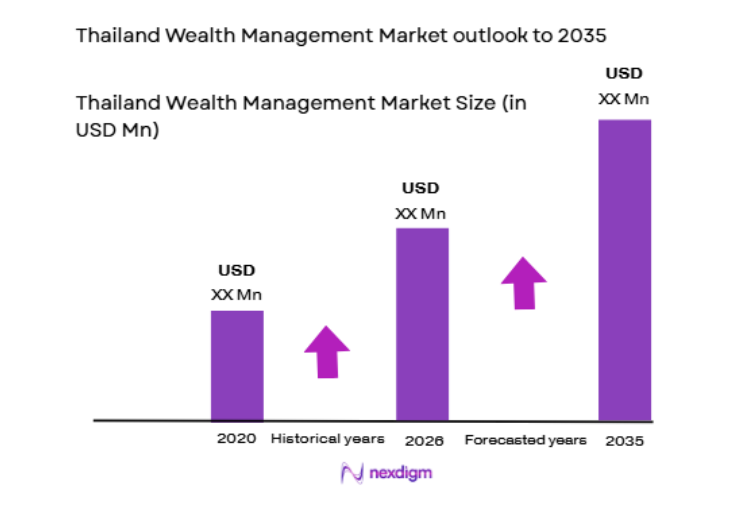
Thailand’s wealth management market represents approximately USD ~ million in assets under management, based on a recent historical assessment of household financial wealth and managed investment portfolios reported by national financial authorities and regional banking disclosures. The market is driven by expanding high-net-worth populations, rising capital market participation, and growing demand for diversified advisory-led investment solutions. Structural factors such as pension gaps, increased savings formalization, and banking-led distribution platforms continue accelerating managed wealth adoption across affluent and upper-mass segments.
Bangkok dominates Thailand’s wealth management activity due to concentration of financial institutions, affluent households, and capital market infrastructure, while secondary growth clusters are emerging in Chonburi, Chiang Mai, and Phuket due to tourism-linked income accumulation and regional business ownership. Cross-border wealth flows connected to ASEAN trade corridors and family-owned conglomerate wealth further reinforce Bangkok’s leadership. Financial literacy penetration, proximity to private banking hubs, and access to discretionary portfolio services explain sustained geographic concentration in metropolitan Thailand.
Market Segmentation
By Client Type
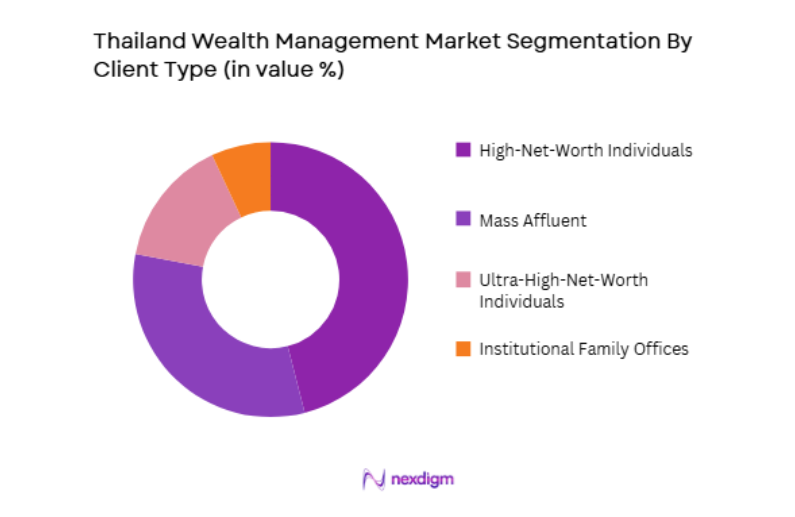
Thailand Wealth Management market is segmented by client type into high-net-worth individuals, ultra-high-net-worth individuals, mass affluent, and institutional family offices. Recently, high-net-worth individuals have a dominant market share due to factors such as expanding entrepreneurial wealth, property-linked asset accumulation, and growing participation in capital markets. Thailand’s mid-tier affluent population has expanded significantly through family-owned enterprises, export manufacturing, and services entrepreneurship, creating sustained demand for portfolio advisory, tax structuring, and succession planning. Private banks and domestic universal banks prioritize this segment through tailored discretionary mandates, structured products, and regional investment access. Regulatory suitability frameworks and suitability-based advisory also align strongly with high-net-worth profiles, encouraging formal wealth management adoption over self-directed investing.
By Service Type
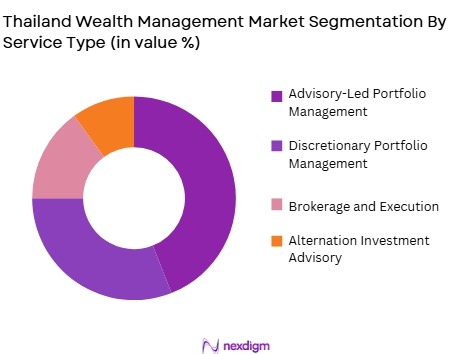
Thailand Wealth Management market is segmented by service type into discretionary portfolio management, advisory-led portfolio management, brokerage and execution, and alternative investment advisory. Recently, advisory-led portfolio management has a dominant market share due to factors such as investor preference for guided asset allocation, regulatory suitability requirements, and cost-sensitive discretionary adoption patterns. Thai investors historically maintain decision control while seeking professional allocation guidance, making advisory mandates more culturally aligned than fully discretionary models. Domestic banks scale advisory platforms efficiently across affluent tiers through model portfolios, capital-protected structures, and mutual fund distribution.
Competitive Landscape
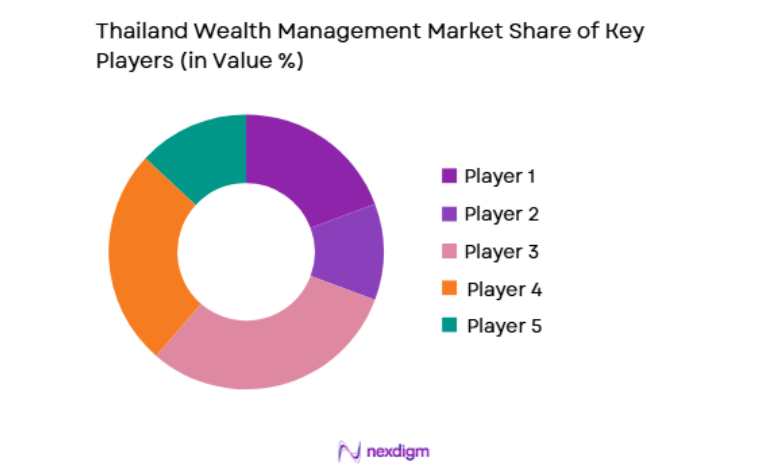
Thailand’s wealth management market is moderately consolidated, dominated by large domestic banks and regional private banking franchises leveraging integrated distribution and balance-sheet strength. Local universal banks maintain deep client relationships and regulatory familiarity, while international private banks compete in ultra-wealth and cross-border portfolios. Technology-enabled advisory and capital-market access capabilities differentiate leading providers, and consolidation trends favor institutions with digital portfolio platforms, offshore investment access, and structured product manufacturing capabilities.
| Company Name | Establishment Year | Headquarters | Technology Focus | Market Reach | Key Products | Revenue | Primary Client Tier |
| Bangkok Bank | 1944 | Bangkok | ~ | ~ | ~ | ~ | ~ |
| Kasikornbank | 1945 | Bangkok | ~ | ~ | ~ | ~ | ~ |
| Siam Commercial Bank | 1906 | Bangkok | ~ | ~ | ~ | ~ | ~ |
| HSBC Thailand | 1888 | Bangkok | ~ | ~ | ~ | ~ | ~ |
| UBS Thailand | 1996 | Bangkok | ~ | ~ | ~ | ~ | ~ |
Thailand Wealth Management Market Analysis
Growth Drivers
Expansion of High-Net-Worth Population from Entrepreneurial and Family Business Wealth
Thailand’s sustained growth in privately owned enterprises across manufacturing, trade, tourism, and services sectors has created a steadily expanding base of financially sophisticated high-net-worth households seeking professional wealth management solutions to preserve and grow accumulated capital. Family-owned conglomerates and second-generation business successors are transitioning from concentrated operating assets toward diversified financial portfolios, increasing demand for advisory-led allocation and succession-oriented investment structuring. Rising liquidity events from business divestments and capital market listings have converted corporate wealth into investable financial assets requiring structured portfolio oversight. Domestic banks and private banking units have scaled relationship-based wealth platforms targeting this segment through tailored mandates, capital-protected products, and offshore diversification channels. Increasing financial literacy and exposure to global investment strategies among entrepreneurial families has accelerated acceptance of professional wealth planning frameworks. Regulatory encouragement of suitability-based investment advisory has further legitimized formal wealth management engagement among affluent investors transitioning from self-directed holdings.
Shift from Deposit-Dominant Savings to Market-Linked Investment Allocation
Thailand’s household financial landscape is undergoing structural rebalancing from traditional bank deposits toward diversified capital-market instruments, significantly expanding the addressable base for wealth management services across affluent and emerging affluent investors. Persistently low real deposit yields and increasing awareness of long-term inflation erosion have encouraged investors to seek higher-return instruments including mutual funds, structured products, and discretionary portfolios managed by professional advisors. Domestic capital market development and broadened product availability have increased accessibility of equities, bonds, and multi-asset funds through bank-linked distribution networks. Regulatory investor-protection frameworks and suitability assessments have enhanced confidence in advisory-mediated investment participation, reducing perceived risk of market exposure. Digital investment platforms integrated into banking ecosystems have simplified onboarding, risk profiling, and portfolio monitoring for clients transitioning from deposits.
Market Challenges
Concentration of Wealth within Family-Controlled Illiquid Assets
A significant portion of Thai private wealth remains embedded in closely held businesses, real estate, and family-controlled operating assets, limiting the volume of liquid financial capital available for professional portfolio management services despite high nominal wealth levels across affluent households. Many wealthy families prioritize retaining ownership control and income-generating business assets over reallocating capital into diversified financial portfolios, constraining investable asset conversion into managed wealth channels. Cultural preference for tangible assets such as property and land continues to dominate long-term wealth storage strategies, reducing penetration of financial advisory solutions. Succession complexities and intergenerational governance disputes often delay formalization of estate planning and portfolio restructuring processes that would otherwise shift capital into managed investments. Limited liquidity events in privately held enterprises compared with more developed capital markets reduce frequency of wealth monetization opportunities.
Intensifying Competition from Low-Cost Digital Investment Platforms
The rapid emergence of digital investment platforms offering low-cost automated portfolios and direct market access is compressing traditional advisory margins and altering client expectations around fees, transparency, and service delivery within Thailand’s wealth management industry. Technology-enabled brokers and robo-advisory solutions appeal particularly to younger affluent and mass-affluent investors seeking convenient, self-directed investment control without premium advisory fees. Fee sensitivity is increasing across segments as digital providers promote low-cost index portfolios and transparent pricing structures compared with relationship-based advisory models. Traditional wealth managers must invest heavily in digital infrastructure and hybrid advisory platforms to remain competitive, increasing operational cost pressures. Clients increasingly compare performance and fees across providers using digital benchmarking tools, intensifying retention challenges for incumbent banks.
Opportunities
Expansion of Cross-Border ASEAN and Global Investment Diversification Demand
Thai high-net-worth investors are increasingly seeking geographic diversification beyond domestic markets to manage currency exposure, geopolitical risk, and return optimization, creating substantial growth opportunities for wealth managers capable of delivering cross-border portfolio access and global asset allocation strategies. Regional economic integration and outbound investment familiarity have expanded investor comfort with international equities, bonds, and alternative assets accessed through private banking platforms. Domestic banks partnering with global asset managers can scale offshore investment offerings and discretionary mandates aligned with client diversification objectives. Family businesses expanding regionally often require wealth structuring across jurisdictions, strengthening demand for multi-market advisory capabilities. Currency diversification and capital preservation concerns further motivate offshore portfolio allocation among affluent Thai households. Regulatory facilitation of outward investment quotas and foreign asset exposure supports market expansion.
Rising Retirement Planning Needs amid Aging Affluent Demographics
Thailand’s demographic transition toward an aging population with significant accumulated private wealth is generating expanding demand for retirement-oriented financial planning, income-generating portfolios, and capital preservation strategies delivered through professional wealth management platforms. Many affluent households lack formal pension structures beyond mandatory savings schemes, increasing reliance on managed investment portfolios to sustain post-retirement income and wealth longevity. Wealth managers can develop lifecycle portfolios, annuity-linked products, and income-focused asset allocations tailored to aging investors’ risk tolerance and liquidity needs. Intergenerational wealth transfer planning associated with retirement further drives advisory engagement. Longevity risk awareness encourages diversification into stable income instruments and managed withdrawal strategies. Healthcare cost planning and legacy objectives reinforce demand for integrated financial planning services. Banks integrating retirement advisory with wealth platforms can deepen long-term client relationships and asset retention.
Future Outlook
Thailand’s wealth management market is expected to expand steadily over the next five years as private wealth accumulation, capital-market participation, and cross-border investment demand increase across affluent segments. Digital advisory integration and hybrid wealth platforms will reshape service delivery, while regulatory support for diversified investment exposure strengthens adoption. Aging demographics and intergenerational wealth transfer will sustain portfolio management demand. Regional investment integration across ASEAN will further internationalize Thai wealth allocation patterns.
Major Players
- Bangkok Bank
- Kasikornbank
- Siam Commercial Bank
- Krungthai Bank
- TMB Thanachart Bank
- HSBC Thailand
- UBS Thailand
- Credit Suisse Thailand
- Citi Thailand
- Standard Chartered Thailand
- Bank of Ayudhya
- Kiatnakin Phatra Bank
- UOB Thailand
- Deutsche Bank Thailand
- Lombard Odier Asia
Key Target Audience
- Private banks
- Commercial banks
- Asset management companies
- Investments and venture capitalist firms
- Family offices
- Insurance companies
- Government and regulatory bodies
- Fintech wealth platforms
Research Methodology
Step 1: Identification of Key Variables
Core variables including investable household wealth, managed asset penetration, client segmentation, advisory adoption, and financial asset allocation patterns were identified. Data inputs were derived from national financial statistics, banking disclosures, and regional wealth reports to establish Thailand’s wealth structure baseline.
Step 2: Market Analysis and Construction
Thailand wealth pools were mapped across client tiers and service models, linking financial asset categories to wealth management penetration ratios. Institutional and private banking distribution channels were analyzed to construct market size and segmentation estimates aligned with domestic financial system characteristics.
Step 3: Hypothesis Validation and Expert Consultation
Assumptions on advisory adoption, asset conversion from business wealth, and portfolio diversification behavior were validated against private banking practices, investor behavior studies, and regional wealth benchmarks. Cross-verification ensured alignment with observed Thai investment culture and regulatory environment.
Step 4: Research Synthesis and Final Output
Validated quantitative and qualitative insights were integrated into a structured market model covering size, segmentation, drivers, and competitive dynamics. Analytical synthesis ensured consistency with Thailand’s financial ecosystem and wealth distribution patterns to produce the final outlook assessment.

- Executive Summary
- Research Methodology (Definitions, Scope, Industry Assumptions, Market Sizing Approach, Primary & Secondary Research Framework, Data Collection & Verification Protocol, Analytic Models & Forecast Methodology, Limitations & Research Validity Checks)

- Market Definition and Scope
- Value Chain & Stakeholder Ecosystem
- Regulatory / Certification Landscape
- Sector Dynamics Affecting Demand

- Growth Drivers
Rising High-Net-Worth Population and Asset Accumulation in Thailand
Expansion of Digital Wealth Platforms and Fintech Integration
Cross-Border Investment Liberalization and Offshore Structuring Demand - Market Challenges
Regulatory Complexity in Cross-Border Wealth Structuring
Limited Financial Literacy Across Emerging Affluent Segments
Talent Shortage in Advanced Advisory and Discretionary Services - Market Opportunities
Intergenerational Wealth Transfer and Succession Planning Demand
Expansion of ESG and Sustainable Investment Mandates
Growth of Regional ASEAN Wealth Hubs and Thailand Positioning - Trends
Shift Toward Hybrid Human–Digital Advisory Models
Increasing Allocation to Alternative and Global Assets - Government Regulations
- SWOT Analysis
- Porter’s Five Forces

- By Market Value, 2020-2025
- By Installed Units, 2020-2025
- By Average System Price, 2020-2025
- By System Complexity Tier, 2020-2025

- By System Type (In Value%)
Discretionary Portfolio Management
Advisory Wealth Management
Private Banking Services
Robo-Advisory Platforms
Family Office Services - By Platform Type (In Value%)
Bank-Led Wealth Platforms
Independent Wealth Firms
Digital Investment Platforms
Brokerage-Led Advisory Platforms
Insurance-Linked Wealth Platforms - By Fitment Type (In Value%)
Onshore Wealth Solutions
Offshore Wealth Solutions
Hybrid Domestic–Offshore Structures
Trust and Estate Structures - By End User Segment (In Value%)
High-Net-Worth Individuals
Ultra-High-Net-Worth Individuals
Affluent Mass Segment

- Market Share Analysis
- Cross Comparison Parameters (Client Segment Focus, Advisory Model, Product Breadth, Digital Capability, Offshore Access, Minimum AUM Threshold, Relationship Manager Ratio, Alternative Investment Access, ESG Offering Depth, Family Office Services, Fee Structure Model, )
- SWOT Analysis of Key Competitors
- Pricing & Procurement Analysis
- Key Players
SCB Wealth
Kasikornbank Private Banking
Bangkok Bank Wealth Management
Krungsri Private Banking
Kiatnakin Phatra Wealth
TMBThanachart Wealth Banking
UOB Thailand Wealth Banking
CIMB Thai Preferred
HSBC Thailand Wealth
Standard Chartered Thailand Private Banking
UBS Thailand
Julius Baer Thailand
Credit Suisse Thailand
Principal Asset Management Thailand
Maybank Securities Thailand

- Growing Sophistication of Thai HNWI Investment Preferences
- Rising Demand for Offshore Diversification Among UHNWIs
- Family Business Succession Structuring Needs
- Digital Engagement Expectations of Affluent Investors

- Forecast Market Value, 2026-2035
- Forecast Installed Units, 2026-2035
- Price Forecast by System Tier, 2026-2035
- Future Demand by Platform, 2026-2035


 Request a Sample
 Ask for Customization
 Get a Quote
 Enquire Now