
 Download PDF
Market Overview
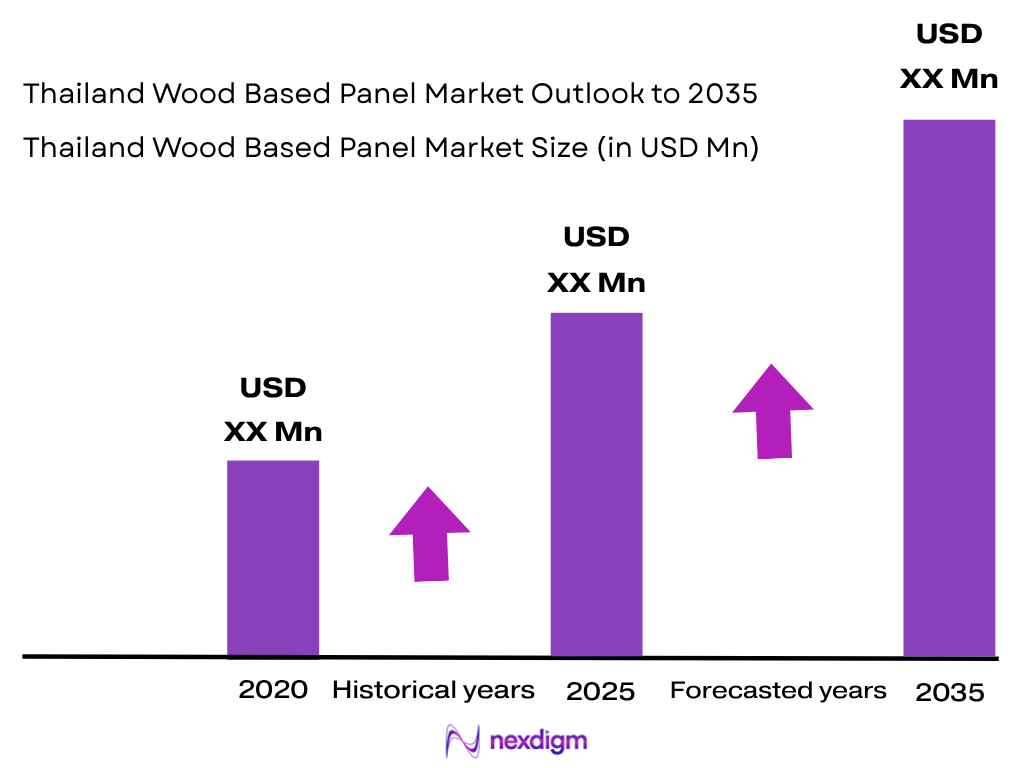
The Thailand Wood Based Panel Market is valued at approximately USD ~ billion in 2024, based on the report framework. Thailand has a large export-oriented manufacturing ecosystem: particleboard exports reached 2.18 billion kg, while dense fibreboard exports reached 2.54 billion kg. Domestic production is supported by rubberwood feedstock, furniture manufacturing, interior applications and established MDF and particleboard capacity, positioning engineered panels as an important downstream outlet for Thailand’s wood-processing industry.
Southern Thailand, Bangkok-linked Central Thailand and major industrial provinces are important production and processing locations because panel plants benefit from rubberwood availability, established manufacturing infrastructure and access to export logistics. Key overseas destinations include South Korea, Malaysia, Vietnam, China, the UAE and Saudi Arabia. Particleboard exports reached 2.18 billion kg, while dense fibreboard exports totaled 2.54 billion kg, demonstrating Thailand’s role as a major regional and international engineered-wood supplier.
Market Segmentation
By Product Type
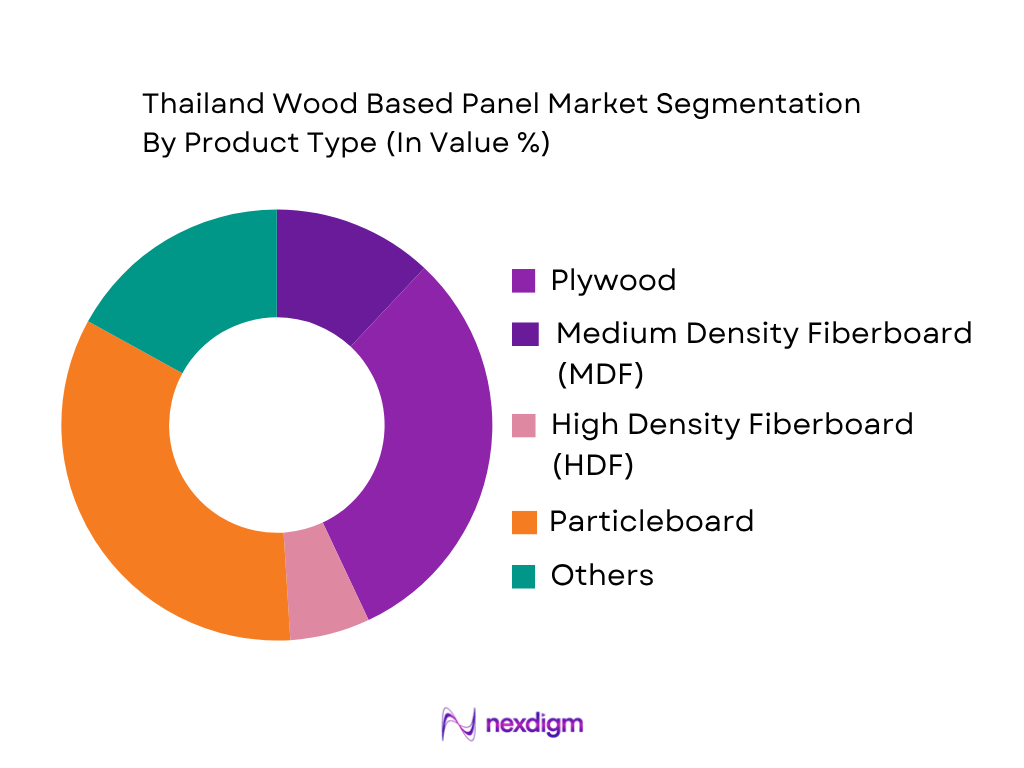
The Thailand Wood Based Panel Market is segmented by product type into particleboard, medium-density fibreboard, high-density fibreboard, plywood, oriented strand board, melamine-faced boards and other specialty engineered panels. Recently, particleboard has a dominant market share in Thailand under product-type segmentation in this report framework, supported by Thailand’s extensive rubberwood resource chain, large-scale manufacturing facilities and export-oriented production. Particleboard converts rubberwood chips and residues into standardized panels for furniture, cabinetry and interior applications, providing a commercially important utilization pathway for rubber trees after their latex-producing life. Thailand exported 2.18 billion kg of particleboard, demonstrating the scale of this production ecosystem. MDF is another major category, supported by furniture, mouldings, cabinetry, decorative surfaces and export applications. Panel Plus, for example, reports annual production capability of 330,000 cubic meters of particleboard and 670,000 cubic meters of MDF, highlighting the industrial scale available within Thailand.
By Application
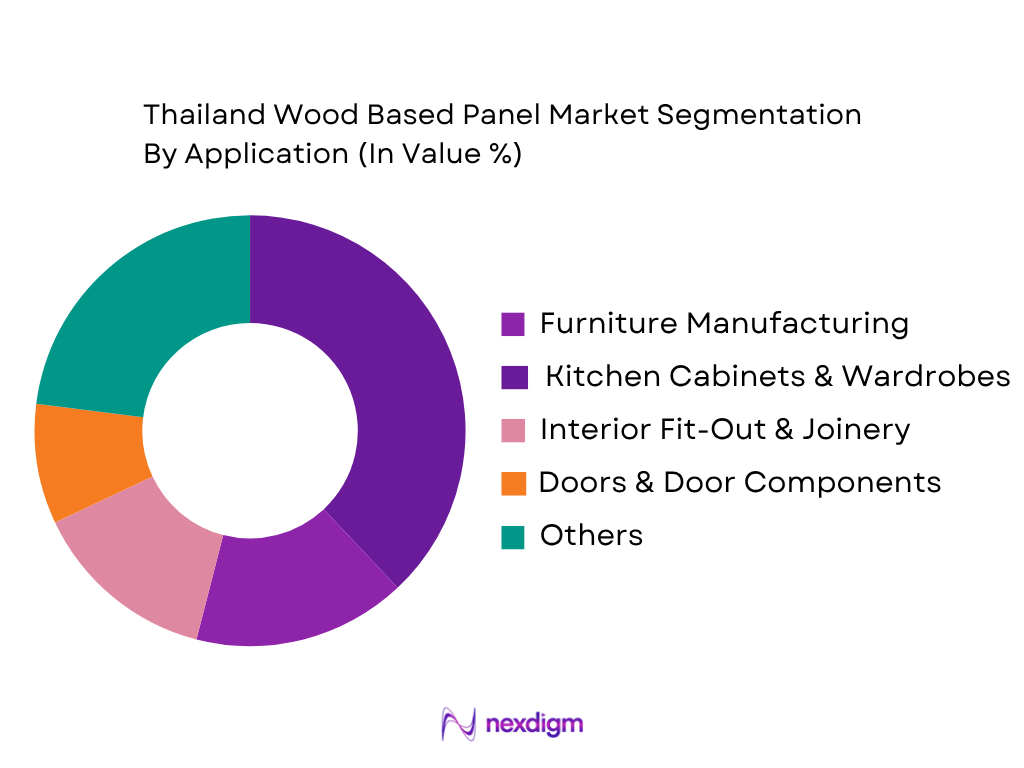
The Thailand Wood Based Panel Market is segmented by application into furniture manufacturing, kitchen cabinets and wardrobes, interior fit-out and joinery, doors, flooring, wall panels, construction, retail fixtures and industrial applications. Recently, furniture manufacturing has a dominant market share in Thailand under application segmentation in this report framework because particleboard and MDF provide standardized surfaces, thicknesses and machining characteristics suited to mass-produced and export-oriented furniture. Rubberwood-based particleboard is specifically positioned for interior-decoration applications, while MDF’s smooth surface supports built-in furniture, wardrobes, shelving, tabletops and decorative walls. Panel Plus offers MDF thicknesses ranging from approximately 1.5 mm to 40 mm and particleboard from 9 mm to 38 mm, illustrating the broad application range available to furniture and interior manufacturers. Moisture-resistant HDF exceeding 800 kg/m³ density further extends engineered panels into kitchens, flooring and doors where greater mechanical and humidity performance is required.
Competitive Landscape
The Thailand Wood Based Panel Market combines large integrated domestic manufacturers with specialist MDF, particleboard, plywood and decorative-panel producers. Competition is shaped by production capacity, access to rubberwood feedstock, export networks, formaldehyde-emission grades, moisture-resistant technology and decorative-surface capabilities. Export competitiveness is particularly important: Thailand shipped 2.18 billion kg of particleboard and 2.54 billion kg of dense fibreboard internationally, making overseas certifications and destination-market access major competitive differentiators.
| Major Player | Establishment Year | Headquarters | Core Panel Portfolio | Rubberwood Integration | Low-Emission Grades | Decorative Panel Capability | Export Orientation |
| Vanachai Group | 1943 | Bangkok, Thailand | ~ | ~ | ~ | ~ | ~ |
| Panel Plus | 1990 | Bangkok, Thailand | ~ | ~ | ~ | ~ | ~ |
| Metro-Ply Group | 1951 | Bangkok, Thailand | ~ | ~ | ~ | ~ | ~ |
| Advance Fiber | 1995 | Thailand | ~ | ~ | ~ | ~ | ~ |
| Wisewoods | 1990s | Thailand | ~ | ~ | ~ | ~ | ~ |
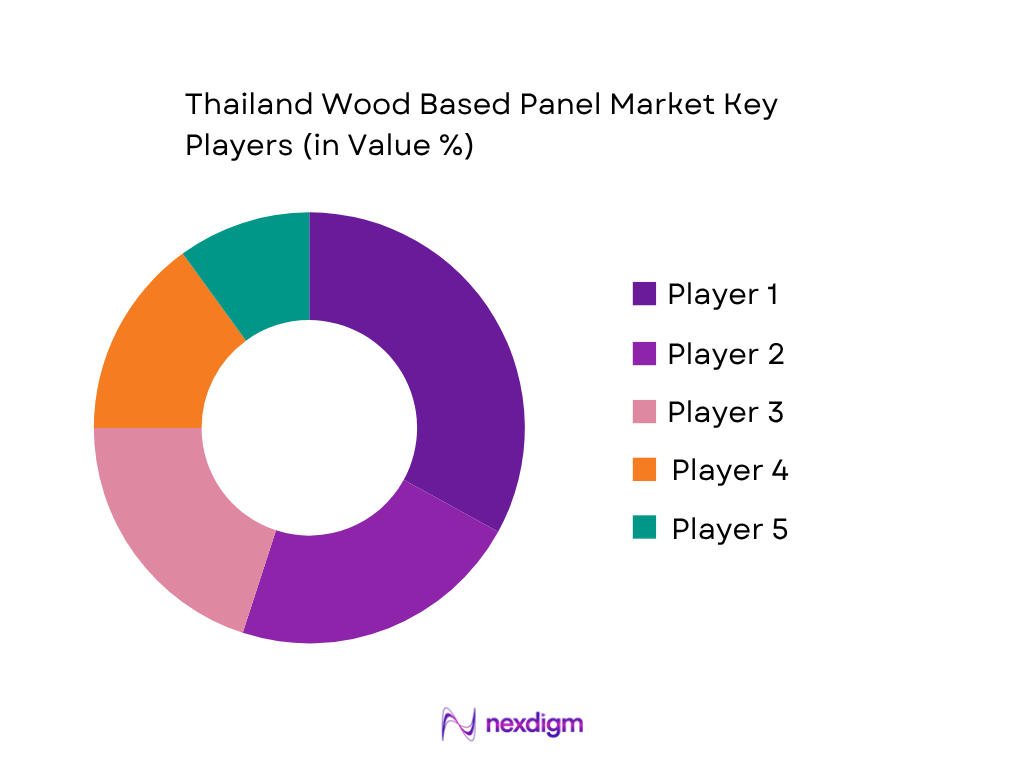
Thailand Wood Based Panel Market Analysis
Growth Drivers
Abundant Rubberwood Feedstock and Established Panel Manufacturing Capacity
Thailand’s wood-based panel industry benefits from an integrated rubberwood value chain that converts logs, branches, chips, sawdust and other residues from rubber plantations and sawmills into MDF and particleboard feedstock. This industrial model is particularly relevant because rubber trees can enter downstream wood processing after their latex-producing cycle, enabling panel manufacturers to use an established plantation resource rather than depending entirely on imported industrial timber. Thailand exported 2.18 billion kg of particleboard in 2024, including 595.1 million kg to South Korea, 490.9 million kg to Malaysia, 377.8 million kg to Vietnam and 252.7 million kg to China, demonstrating the scale supported by domestic manufacturing and feedstock availability. Thailand’s dense fibreboard exports also reached 2.54 billion kg in 2024, highlighting the depth of its MDF/HDF production ecosystem. The macroeconomic environment supports this manufacturing base: World Bank data recorded Thailand’s GDP at USD 526.5 billion in 2024, GDP per capita at approximately USD 7,345, and manufacturing value added at approximately USD 128.7 billion. Rubberwood availability, large panel plants, established fibre preparation and pressing infrastructure, and downstream furniture production therefore create a mutually reinforcing industrial ecosystem. The ability to convert relatively low-value wood residues into standardized boards additionally improves raw-material utilization and supports Thailand’s position as a major Asian engineered-wood production hub.
Export-Oriented MDF and Particleboard Industry Supporting Production Scale
Thailand’s large export footprint is a major growth driver because domestic panel manufacturers serve customers across East Asia, Southeast Asia, South Asia and the Middle East rather than depending solely on domestic furniture and construction demand. Official international trade data recorded 2.18 billion kg of particleboard exports in 2024, with South Korea receiving 595.1 million kg, Malaysia 490.9 million kg, Vietnam 377.8 million kg, China 252.7 million kg and Indonesia 134.9 million kg. Thailand also exported 2.54 billion kg of dense fibreboard, with major destinations including the UAE, Saudi Arabia, Vietnam, Egypt and South Korea, demonstrating geographically diversified demand for Thai MDF/HDF products. This export orientation is supported by Thailand’s broader merchandise-trading infrastructure: World Bank data place the country’s merchandise exports at approximately USD 300 billion in 2024, while national GDP reached USD 526.5 billion. The panel sector consequently benefits from established ports, containerized logistics, international distributor relationships and familiarity with destination-market product specifications. Export scale also supports specialization in E0/E1 boards, moisture-resistant products, melamine-faced panels and furniture-grade MDF because manufacturers can spread specialized production across a broader customer base. Continued regional furniture manufacturing and construction demand therefore provides Thai producers with multiple channels for maintaining plant utilization and expanding value-added engineered-wood production.
Market Challenges
Rubberwood Feedstock Competition and Wood Resource Availability
Although rubberwood is a structural advantage, competition for the same resource creates a significant constraint for Thailand’s MDF and particleboard manufacturers. Rubberwood logs and processing residues are consumed by sawmills, furniture producers, biomass facilities and panel manufacturers, meaning fibre availability depends on plantation harvesting, replanting activity, sawmill throughput and alternative uses of wood residues. The scale of Thailand’s panel industry illustrates the feedstock requirement: particleboard exports alone reached 2.18 billion kg in 2024, while dense fibreboard exports reached 2.54 billion kg. Maintaining output at this level requires continuous flows of wood chips, fibres, branches and sawmill residues with consistent moisture and contamination characteristics. Thailand’s broader manufacturing economy also creates competition for industrial inputs and energy; World Bank data show manufacturing generated approximately USD 128.7 billion of value added in 2024, within national GDP of USD 526.5 billion. For panel producers, insufficient or inconsistent feedstock can affect fibre preparation, dryer utilization, press scheduling and overall plant efficiency. MDF production is particularly sensitive to fibre quality because variations in species, moisture content and fibre morphology can influence density profile, surface quality and mechanical properties. Consequently, securing long-term rubberwood supply, expanding collection of branches and residues, improving wood-chip logistics and increasing recycled-fibre utilization are strategically important for maintaining Thailand’s existing panel-manufacturing scale.
Export-Market Compliance, Trade Remedies and Logistics Exposure
Thailand’s reliance on international panel demand exposes manufacturers to destination-market regulations, trade remedies, formaldehyde requirements and shipping conditions. With 2.18 billion kg of particleboard and 2.54 billion kg of dense fibreboard exported in 2024, even relatively narrow changes in overseas technical requirements can affect substantial production volumes. Thailand’s Department of Foreign Trade maintains trade-remedy cases involving fibreboard products and Thai exporters, demonstrating that engineered-wood manufacturers must manage anti-dumping and related market-access risks alongside normal commercial competition. Technical compliance creates an additional layer of complexity. Thailand’s industrial-standard framework includes requirements for particleboard, while formaldehyde-release testing for wood-based panels is covered within standards development and conformity infrastructure. Macroeconomic conditions reinforce the importance of export access: Thailand generated approximately USD 300 billion in merchandise exports in 2024, against GDP of USD 526.5 billion, making external trade integral to the manufacturing economy. Panel producers therefore need to manufacture different emission classes and specifications for markets applying E1, E0, CARB/EPA or other requirements. Container availability, port scheduling and longer-distance shipments to Middle Eastern markets add further operational exposure. Manufacturers with diversified destinations, multiple certifications and flexible production lines are better positioned to absorb these external disruptions.
Market Opportunities
Low-Emission, Moisture-Resistant and Higher-Performance Panel Expansion
Thailand has a significant opportunity to move further from commodity MDF and particleboard toward low-emission and performance-oriented products. The existing manufacturing base is already sufficiently large to support product specialization: Thailand exported 2.54 billion kg of dense fibreboard and 2.18 billion kg of particleboard in 2024, giving manufacturers an established platform from which to introduce E0, E1, moisture-resistant, fire-retardant and high-density products. Thai production capabilities already extend into moisture-resistant HDF with densities above 800 kg/m³, illustrating domestic capability to manufacture panels for demanding applications such as kitchens, doors and flooring. The opportunity is supported by Thailand’s sizeable industrial base: manufacturing value added reached approximately USD 128.7 billion in 2024, while GDP stood at USD 526.5 billion. Future growth can therefore come from increasing value per unit of processed fibre rather than simply increasing commodity output. Low-emission boards can target furniture and interiors requiring stricter indoor-air-quality specifications; moisture-resistant MDF can address kitchens, bathrooms and humid environments; fire-retardant boards can serve hotels, offices, airports and institutional interiors. Developing these products also allows Thai manufacturers to diversify customer segments while leveraging existing fibre preparation, continuous pressing, sanding, finishing and export infrastructure.
Decorative Panels, Furniture Components and Export-Market Diversification
Thailand’s established panel-export platform creates an opportunity to capture more downstream value through melamine-faced boards, synchronous surfaces, laminated panels, CNC-ready components and furniture parts rather than exporting predominantly unfinished boards. The scale available for conversion is substantial: 2.18 billion kg of particleboard and 2.54 billion kg of dense fibreboard were exported in 2024. Particleboard exports were already distributed across South Korea, Malaysia, Vietnam, China and Indonesia, while fibreboard reached markets including the UAE, Saudi Arabia, Vietnam, Egypt and South Korea. This geographic diversity provides a customer network into which higher-value decorative products can be introduced. Thailand’s macroeconomic base further supports downstream manufacturing, with USD 128.7 billion of manufacturing value added and approximately USD 300 billion of merchandise exports in 2024. Existing Thai manufacturing capabilities include melamine-faced boards with extensive décor portfolios and high-pressure laminate bonded products, demonstrating that the technical foundation for further value addition is already present. Future expansion can focus on furniture-ready cut panels, cabinet components, synchronized wood-grain surfaces, moisture-resistant decorative boards and certified sustainable products. This strategy would broaden Thailand’s role from a high-volume board producer toward an integrated supplier of engineered interior and furniture components.
Future Outlook
The Thailand Wood Based Panel Market is expected to record a ~% CAGR during 2026–2035, based on the report framework. Future development is expected to be shaped by Thailand’s established export position, rubberwood resource utilization, furniture manufacturing and greater production of value-added panels. Low-emission MDF, moisture-resistant products, decorative boards and certified sustainable panels should gain strategic importance. Manufacturers are also expected to focus increasingly on downstream conversion rather than relying exclusively on commodity board exports. Thailand already possesses a substantial platform for international expansion. Particleboard exports totaled 2.18 billion kg, led by South Korea, Malaysia, Vietnam and China, while dense fibreboard exports totaled 2.54 billion kg, with the UAE, Saudi Arabia, Vietnam, Egypt and South Korea among major destinations. This geographic diversification provides producers with exposure to furniture, construction and interior-material demand across Asia and the Middle East.
Low-emission technology should become increasingly important to product positioning. Thai manufacturers already produce E1, E0, SE0 and CARB P2/EPA compliant boards. Panel Plus discontinued E2 particleboard production and provides MDF and particleboard across lower-emission adhesive specifications.
Major Players
- Vanachai Group Public Company Limited
- Panel Plus Company Limited
- Metro-Ply Group
- Advance Fiber Company Limited
- Wisewoods Company Limited
- Siam Riso Wood Products Company Limited
- Green River Panels (Thailand) Company Limited
- Siam Fibreboard Company Limited
- Asia Fiber Public Company Limited
- Thai MDF Company Limited
- Siam Forestry Company Limited
- Siam Plywood Company Limited
- Thaiplywood Company Limited
- SKN Industrial Company Limited
- Green Panel Company Limited
Key Target Audience
- Wood Based Panel Manufacturers
- Rubberwood and Plantation Wood Suppliers
- Furniture and Downstream Wood Product Manufacturers
- Wood Panel Exporters and Distributors
- Interior Fit-Out and Building Material Companies
- Resin, Adhesive and Decorative Surface Suppliers
- Investments and Venture Capitalist Firms
- Government and Regulatory Bodies (Ministry of Industry, Thai Industrial Standards Institute, Department of Foreign Trade, Royal Forest Department)
Research Methodology
Step 1: Identification of Key Variables
The initial phase involves constructing a complete ecosystem map for the Thailand Wood Based Panel Market covering rubber plantations, rubberwood processors, sawmills, MDF and particleboard manufacturers, resin suppliers, furniture companies, distributors and exporters. Critical variables include production capacity, rubberwood availability, panel density, thickness, emission class, moisture resistance, decorative surfaces, export destinations and downstream applications.
Step 2: Market Analysis and Construction
Historical Thailand Wood Based Panel Market analysis combines production capacity, domestic panel consumption, export volumes, destination markets and demand from furniture, construction and interior applications. Top-down analysis assesses Thailand’s wider wood-processing and downstream manufacturing ecosystem, while bottom-up analysis evaluates individual manufacturers, plant capacities, panel categories and trade flows to construct and cross-check the market framework.
Step 3: Hypothesis Validation and Expert Consultation
Market hypotheses are validated through CATIs and structured consultations with panel manufacturers, rubberwood suppliers, furniture manufacturers, distributors, exporters and procurement professionals. Interviews examine plant utilization, feedstock sourcing, product specifications, emission grades, domestic demand, export behavior and specialty-board adoption. Primary findings are triangulated against international trade records, company disclosures and applicable Thai industrial standards.
Step 4: Research Synthesis and Final Output
The final phase integrates supply-side capacity, rubberwood availability, export flows and downstream consumption across furniture, kitchens, doors, flooring, interiors and construction. Bottom-up findings are reconciled with top-down industry indicators to validate the final Thailand Wood Based Panel Market structure. Forecast assumptions incorporate export diversification, low-emission boards, decorative surfaces, moisture-resistant panels, sustainability requirements and greater value-added processing.

- Executive Summary
- Research Methodology (Market Definitions and Assumptions, Wood Based Panel Classification, HS Code Mapping, MDF and HDF Assessment, Particleboard Assessment, Plywood Assessment, OSB Assessment, Melamine-Faced Panel Assessment, Rubberwood Feedstock Assessment, Plantation Wood Availability, Wood Residue Utilization, Resin and Adhesive Assessment, Panel Thickness and Density Mapping, Formaldehyde Emission Grade Mapping, Moisture-Resistance Assessment, Production Capacity Assessment, Capacity Utilization Assessment, Domestic Consumption Assessment, Export Demand Assessment, Destination-Country Mapping, Supply-Side Assessment, Demand-Side Assessment, Top-Down Market Sizing, Bottom-Up Market Sizing, Primary Industry Interviews, Trade Flow Assessment, Data Triangulation, Forecasting Framework)

- Definition and Scope
- Thailand Wood Based Panel Industry Evolution and Development of Particleboard, MDF, HDF, Plywood, OSB, Melamine-Faced Panels, High-Pressure Laminate Bonded Boards, Door Skins, Flooring Substrates, Furniture Boards, Moisture-Resistant Panels, Low-Emission Panels and Rubberwood-Based Engineered Wood Products
- Wood Based Panel Industry Value Chain Analysis
- Wood Based Panel Supply Chain Analysis
- Rubber Plantation Owners, Rubberwood Sawmills, Wood Residue Suppliers, Recycled Wood Suppliers, Resin and Adhesive Producers, Decorative Paper Suppliers, Panel Manufacturers, Laminators, Surface-Finishing Companies, Furniture Manufacturers, Door Manufacturers, Flooring Manufacturers, Exporters, Distributors, Interior Fit-Out Companies, Construction Contractors and Overseas Buyers

- Growth Drivers (Abundant Rubberwood Feedstock, Established Panel Manufacturing Capacity, Export-Oriented MDF Industry, Export-Oriented Particleboard Industry, Furniture Manufacturing Base, Rubber Plantation Renewal Cycle, Wood Residue Availability, Southeast Asian Market Access, Decorative Panel Demand, Interior and Construction Demand)
- Market Challenges (Rubberwood Feedstock Competition, Log and Wood Residue Availability, Resin and Adhesive Dependency, Formaldehyde Emission Compliance, Export Market Trade Remedies, Freight and Shipping Exposure, Moisture Control Requirements, Energy-Intensive Drying and Pressing, Alternative Panel Competition, Capacity Utilization Volatility)
- Market Opportunities (Ultra-Low-Emission MDF, E0 and E1 Panels, Moisture-Resistant MDF, Fire-Retardant Boards, OSB Capacity Expansion, Melamine-Faced Panels, Synchronous Decorative Surfaces, Rubberwood Residue Valorization, Recycled-Wood Panels, Biomass Integration, FSC-Certified Panels, High-Value Furniture Components, Export Market Diversification)
- Market Trends (Rubberwood Circularity, Low-Formaldehyde Resin Systems, Moisture-Resistant MDF, Decorative Melamine Surfaces, Synchronous Panels, Continuous Press Technology, Biomass Energy Integration, FSC-Certified Feedstock, CNC-Compatible Panels, Value-Added Panel Conversion, Lightweight Panel Development, Automated Panel Production)
- Government Regulations and Standards (Thai Industrial Standards Institute Requirements, TIS 876 Flat-Pressed Particleboard Standard, Wood Based Panel Formaldehyde Release Testing, Industrial Factory Requirements, Forestry and Timber Movement Requirements, Export Documentation Requirements, FSC Chain-of-Custody Requirements, CARB Compliance for Export Products, Japanese F-Star Requirements, European E1 Requirements, Environmental and Industrial Emission Requirements)
- SWOT Analysis (Rubberwood Feedstock Base, Large Manufacturing Capacity, Export Orientation, Established Panel Technology, Feedstock Competition, Export Concentration, Value-Added Product Potential, Trade Remedy Exposure)
- Porter’s Five Forces Analysis (Rubberwood Supplier Bargaining Power, Furniture and Export Buyer Bargaining Power, New Capacity Entry, Substitute Material Threat, Domestic Producer Rivalry)
- PESTLE Analysis (Industrial Policy, Export Conditions, Furniture Demand, Panel Manufacturing Technology, Product Standards, Plantation Sustainability)
- Stakeholder Ecosystem (Rubber Growers, Sawmills, Panel Manufacturers, Resin Producers, Furniture Manufacturers, Exporters, Distributors, Certification Bodies, Government Agencies)

- By Market Value (2020-2025)
- By Domestic Consumption Volume (2020-2025)
- By Total Production Volume (2020-2025)
- By Installed Production Capacity (2020-2025)
- By Capacity Utilization (2020-2025)
- By Export Value (2020-2025)

- By Product Type (In Value %)
Medium Density Fibreboard (MDF)
High Density Fibreboard (HDF)
Particleboard
Plywood
Oriented Strand Board (OSB)
Melamine-Faced MDF
Melamine-Faced Particleboard
High-Pressure Laminate Bonded Boards
Door Skin Panels
Decorative and Specialty Wood Panels - By Raw Material Type (In Value %)
Rubberwood
Eucalyptus Wood
Plantation Hardwood
Wood Chips and Sawmill Residues
Recycled Wood Fibre
Mixed Lignocellulosic Feedstock
Other Wood Feedstock - By Panel Grade (In Value %)
Standard Interior Grade
E2 Grade
E1 Low-Emission Grade
E0 Ultra-Low-Emission Grade
Moisture-Resistant Grade
High Moisture-Resistant Grade
Fire-Retardant Grade
Exterior Grade
Structural Grade
High-Density Grade - By Surface and Finish Type (In Value %)
Raw and Unfinished Panels
Melamine-Faced Panels
High-Pressure Laminate Bonded Panels
Natural Veneer-Faced Panels
Wood-Grain Decorative Panels
Synchronous Surface Panels
Paintable and Spray-Coating Panels
Textured Decorative Panels
Solid-Color Panels
Specialty Surface Panels - By Application (In Value %)
Furniture Manufacturing
Kitchen Cabinets and Wardrobes
Doors and Door Skins
Interior Fit-Out and Joinery
Laminate Flooring
Shelving and Storage Systems
Wall Paneling and Partitions
Retail Fixtures
Office Furniture
Construction Panels
Subfloor Applications
Packaging and Industrial Applications - By End User (In Value %)
Furniture Manufacturers
Kitchen and Cabinet Manufacturers
Door Manufacturers
Flooring Manufacturers
Interior Fit-Out Companies
Residential Construction
Commercial Construction
Hospitality and Tourism Properties
Retail and Commercial Interiors
Industrial Panel Processors
Export-Oriented Furniture Manufacturers

- Market Share of Major Players (By Revenue, Production Volume, Installed Capacity, MDF Capacity, Particleboard Capacity, OSB Capacity, Decorative Panel Capacity, Domestic Sales, Export Volume, Export Market Reach, Rubberwood Feedstock Access, Product Grade Portfolio)
- Cross Comparison Parameters (Installed MDF and Particleboard Production Capacity, Rubberwood Feedstock Integration, E0/E1 and Low-Formaldehyde Product Capability, Moisture-Resistant and Specialty Panel Portfolio, Melamine and Decorative Surface Capability, Export Market and Certification Reach, Biomass and Production Energy Integration, Furniture and Downstream Panel Application Coverage)
- SWOT Analysis of Major Players (Production Capacity, Feedstock Access, Export Network, Product Mix, Certifications, Value-Added Panel Capability)
- Detailed Profiles of Major Companies
Vanachai Group Public Company Limited
Panel Plus Company Limited
Metro-Ply Group
Advance Fiber Company Limited
Wisewoods Company Limited
Siam Riso Wood Products Company Limited
Green River Panels (Thailand) Company Limited
Siam Fibreboard Company Limited
Asia Fiber Public Company Limited
Thai MDF Company Limited
Siam Forestry Company Limited
Siam Plywood Company Limited
Thaiplywood Company Limited
SKN Industrial Company Limited
Green Panel Company Limited

- Furniture Manufacturer Panel Requirement Assessment
- Export Furniture Manufacturer Requirement Assessment
- Kitchen and Cabinet Manufacturer Requirement Assessment
- Door Manufacturer Requirement Assessment
- Flooring Manufacturer Requirement Assessment
- Interior Fit-Out Requirement Assessment
- Panel Processor Requirement Assessment
- Export Buyer Procurement Assessment

- By Market Value (2026-2035)
- By Domestic Consumption Volume (2026-2035)
- By Total Production Volume (2026-2035)
- By Installed Production Capacity (2026-2035)
- By Capacity Utilization (2026-2035)
- By Export Value (2026-2035)


 Request a Sample
 Ask for Customization
 Get a Quote
 Enquire Now