

 Download PDF
 Download PDF
Market Overview
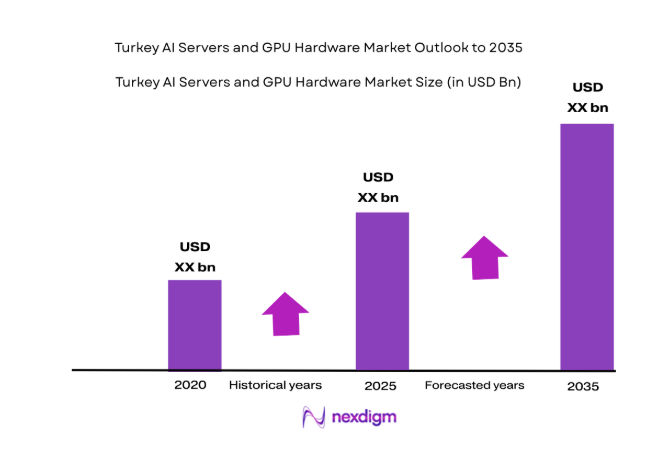
Turkey AI servers and GPU hardware market reached approximately USD ~ billion based on a recent historical assessment, reflecting rapid expansion in accelerated computing deployments across cloud, telecom, and enterprise data centers. Growth has been driven by hyperscale data center construction, enterprise adoption of generative artificial intelligence workloads, and government backed digital transformation initiatives supporting domestic compute capacity. Rising demand for high performance AI training clusters and inference infrastructure has increased procurement of GPU dense servers across national cloud and research ecosystems.
Istanbul and Ankara dominate Turkey AI servers and GPU hardware market due to concentration of hyperscale data centers, government digital infrastructure programs, and major telecom network hubs enabling low latency AI services. Istanbul hosts the largest commercial colocation and cloud campuses serving regional enterprises, while Ankara concentrates public sector, defense, and research computing investments requiring sovereign AI infrastructure. Emerging deployments in Izmir and Bursa are supported by industrial automation demand and proximity to manufacturing clusters integrating AI enabled analytics and robotics.
Market Segmentation
By Product Type
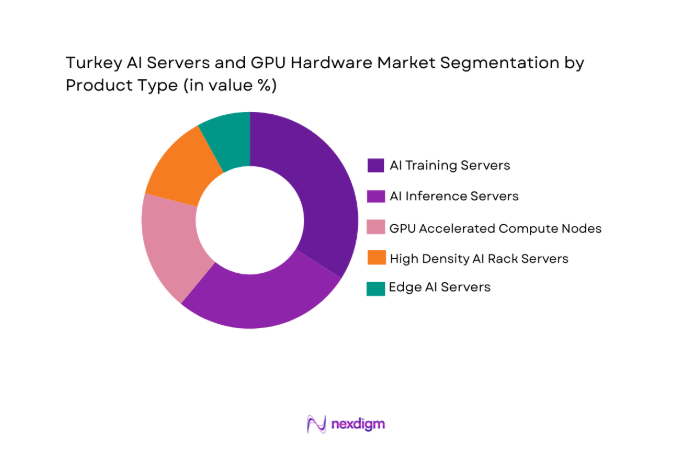
Turkey AI servers and GPU hardware market is segmented by product type into AI training servers, AI inference servers, GPU accelerated compute nodes, high density AI rack servers, and edge AI servers. Recently, AI training servers has a dominant market share due to factors such as demand patterns, brand presence, infrastructure availability, or consumer preference.
By Platform Type
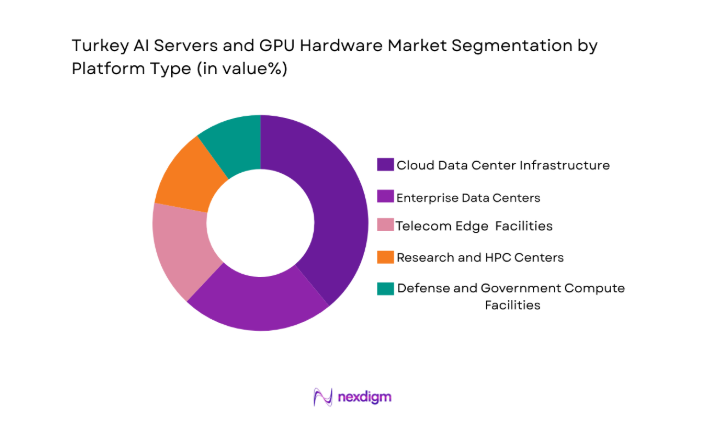
Turkey AI servers and GPU hardware market is segmented by platform type into cloud data centers, enterprise data centers, telecom edge facilities, research and HPC centers, and defense and government compute facilities. Recently, cloud data centers has a dominant market share due to factors such as demand patterns, brand presence, infrastructure availability, or consumer preference.
Competitive Landscape
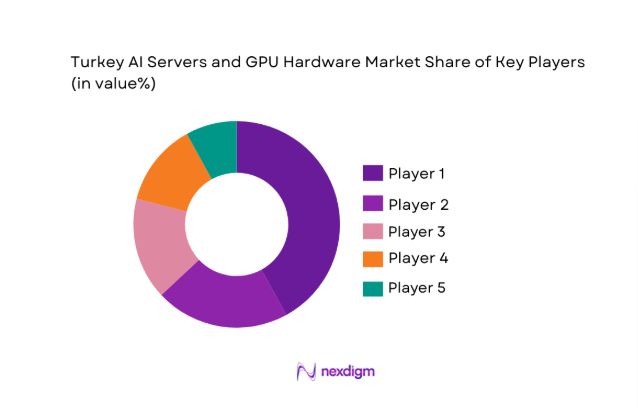
Turkey AI servers and GPU hardware market shows moderate consolidation with global server OEMs and GPU vendors controlling high performance segments while regional integrators compete in deployment and services. Major players influence procurement through partnerships with telecom operators, cloud providers, and government digital programs, creating strong ecosystem lock in around accelerator architectures and AI software stacks.
| Company Name | Establishment Year | Headquarters | Technology Focus | Market Reach | Key Products | Revenue | AI Accelerator Integration Capability |
| HPE | 1939 | United States | ~ | ~ | ~ | ~ | ~ |
| Dell Technologies | 1984 | United States | ~ | ~ | ~ | ~ | ~ |
| Lenovo | 1984 | China | ~ | ~ | ~ | ~ | ~ |
| Supermicro | 1993 | United States | ~ | ~ | ~ | ~ | ~ |
| NVIDIA | 1993 | United States | ~ | ~ | ~ | ~ | ~ |
Turkey AI servers and GPU hardware Market Analysis
Growth Drivers
National AI and Digital Transformation Investments Driving Domestic Compute Infrastructure
Turkey AI servers and GPU hardware market is expanding due to sustained public investment in national artificial intelligence strategies, sovereign data infrastructure programs, and digital government platforms requiring localized high performance compute capacity. Government agencies and state affiliated enterprises are deploying GPU dense clusters to support language models, cybersecurity analytics, and defense simulations, creating baseline demand independent of private sector cycles. Public funding incentives for data center construction and domestic cloud ecosystems are accelerating procurement of AI optimized servers by telecom operators and public cloud providers operating in Turkey. National policies emphasizing data localization and secure processing of sensitive datasets require in country AI infrastructure, increasing demand for enterprise and government GPU hardware deployments. Strategic initiatives supporting smart city platforms, digital public services, and national research supercomputing facilities are generating long term procurement pipelines for AI training and inference servers across multiple regions. Defense modernization and autonomous systems programs are integrating AI simulation, perception, and decision engines that rely on high throughput GPU clusters for development and testing workloads. Public sector backed AI innovation hubs and research centers are purchasing advanced AI servers to support academic and industrial collaboration on machine learning and robotics applications. State procurement frameworks and technology localization goals are encouraging partnerships between global server vendors and Turkish system integrators, strengthening domestic supply chains for AI hardware. Continuous expansion of e government platforms, biometric systems, and intelligent surveillance networks is further increasing demand for accelerated compute infrastructure across national agencies.
Enterprise and Cloud Adoption of Generative AI and Advanced Analytics Workloads
Turkey AI servers and GPU hardware market is driven by rapid enterprise digitalization and widespread adoption of generative artificial intelligence, predictive analytics, and automation platforms requiring large scale accelerated compute environments. Financial institutions, telecom operators, and large conglomerates are deploying GPU enabled data centers to train proprietary models, run risk analytics, and automate customer interactions across digital channels. Turkish cloud providers are scaling AI infrastructure capacity to offer model training, inference services, and AI platform as a service to domestic and regional clients seeking localized compute availability. Expansion of e commerce, fintech, and digital media ecosystems is increasing demand for recommendation engines, computer vision, and natural language processing workloads that rely on GPU acceleration. Industrial sectors such as manufacturing, automotive, and energy are integrating AI driven predictive maintenance, quality inspection, and optimization applications that require on premise GPU servers connected to operational systems. Hybrid cloud architectures combining enterprise GPU clusters with cloud based AI training resources are becoming common across large organizations in Turkey. Competitive pressure to adopt artificial intelligence capabilities is pushing enterprises to invest in high density AI rack servers and inference hardware to maintain productivity and customer engagement advantages. Software vendors and system integrators are bundling AI platforms with GPU infrastructure, lowering adoption barriers and accelerating enterprise deployment cycles. Rising availability of Turkish language models and localized AI applications is further stimulating domestic demand for training infrastructure within enterprise and cloud environments.
Market Challenges
Dependence on Imported GPUs and Exposure to Export Control Restrictions
Turkey AI servers and GPU hardware market faces structural constraints due to reliance on imported semiconductor components and advanced graphics processors sourced primarily from foreign suppliers subject to international trade regulations. Export control frameworks affecting high performance AI accelerators can limit availability of cutting edge GPU architectures, delaying deployment of advanced training clusters and reducing competitiveness of domestic compute infrastructure. Currency volatility and import costs increase capital expenditure requirements for AI servers, making procurement cycles sensitive to macroeconomic conditions and exchange rate fluctuations. Domestic manufacturing capability for advanced semiconductors and high performance accelerators remains limited, preventing local substitution for imported GPU hardware in large scale deployments. Lead times for specialized AI servers and accelerator modules can extend due to global supply chain disruptions, affecting project timelines for data center expansion and enterprise AI adoption. Compliance requirements and certification processes for imported technology can introduce additional administrative complexity and procurement delays for government and regulated sector buyers. Dependence on foreign software ecosystems linked to GPU platforms creates vendor lock in and reduces flexibility for Turkish operators seeking diversification of AI hardware suppliers. Strategic risk perception associated with reliance on external technology sources is prompting policy discussions on localization, but short term constraints remain. These structural import dependencies collectively limit scalability and cost efficiency of AI infrastructure expansion across Turkey.
Power Availability and Cooling Constraints for High Density AI Data Centers
Turkey AI servers and GPU hardware market growth is constrained by infrastructure challenges related to energy supply, grid capacity, and thermal management requirements of high density GPU clusters deployed in modern AI data centers. Advanced AI servers consume significantly higher power per rack than traditional compute systems, requiring upgraded electrical distribution, redundant supply, and high capacity substations that increase deployment complexity and cost. Electricity pricing volatility and industrial tariff structures affect operational expenditure for AI data centers, influencing location decisions and limiting expansion in some regions. Existing data center facilities designed for conventional IT loads often lack sufficient power density and cooling capacity to host liquid cooled or high wattage GPU racks without major retrofits. Deployment of liquid cooling systems and immersion technologies requires specialized expertise and infrastructure upgrades that may not be widely available among domestic operators. Urban data center hubs such as Istanbul face land, zoning, and grid connection constraints that restrict rapid scaling of large AI campuses. Renewable energy integration and sustainability requirements add further complexity to AI infrastructure planning and investment decisions. Thermal management and reliability risks associated with dense GPU clusters necessitate advanced monitoring and engineering capabilities that remain scarce in parts of the local ecosystem. These power and cooling constraints collectively moderate the pace of AI server deployment across Turkey despite strong demand fundamentals.
Opportunities
Development of Sovereign AI Cloud and Regional AI Compute Export Services
Turkey AI servers and GPU hardware market has significant opportunity to position the country as a sovereign AI cloud hub serving domestic demand while exporting AI compute services to neighboring regions lacking localized infrastructure. Strategic investment in national AI cloud platforms using domestically hosted GPU clusters can address data sovereignty requirements for government, defense, and regulated industries while supporting domestic AI innovation ecosystems. Turkey geographic position between Europe, Middle East, and Central Asia enables development of regional AI compute services accessible with low latency to emerging digital markets. Domestic cloud providers and telecom operators can monetize GPU infrastructure by offering AI training and inference services to enterprises across adjacent regions seeking cost effective alternatives to Western hyperscale clouds. Government incentives for digital infrastructure and technology localization can catalyze establishment of large scale AI campuses integrating renewable energy and advanced cooling technologies. Export of AI compute services can generate foreign revenue streams and strengthen Turkey digital economy positioning in global artificial intelligence value chains. Collaboration between universities, research institutes, and cloud operators around sovereign AI platforms can accelerate development of Turkish language models and domain specific AI applications. Regional demand for secure and compliant AI processing environments in finance, public sector, and telecom sectors supports long term utilization of domestic GPU infrastructure. This sovereign AI cloud strategy offers Turkey opportunity to become a regional center for AI infrastructure and services.
Local Assembly, Integration, and Ecosystem Development for AI Server Manufacturing
Turkey AI servers and GPU hardware market presents opportunity to build domestic value chains around assembly, integration, and system engineering of AI servers and accelerator based computing platforms. Partnerships between global GPU vendors and Turkish electronics manufacturers can enable local assembly of AI server chassis, racks, and cooling systems, reducing import costs and improving supply chain resilience. Development of domestic system integration expertise around AI infrastructure deployment, optimization, and lifecycle management can strengthen national capabilities and create skilled employment. Localization of components such as power supplies, enclosures, and thermal systems can gradually expand domestic content in AI hardware without requiring full semiconductor fabrication capacity. Government industrial policies and incentives targeting advanced electronics manufacturing can support investment in AI hardware assembly facilities and test labs. Establishment of Turkish AI infrastructure integrators capable of delivering turnkey data center and GPU cluster solutions can reduce dependence on foreign deployment services. Domestic ecosystem growth around AI software optimization, performance tuning, and workload engineering can enhance competitiveness of locally integrated AI servers. Export potential exists for regionally assembled AI infrastructure solutions tailored to Middle Eastern and Eastern European markets. This localized manufacturing and integration pathway can increase Turkey participation in the global AI hardware value chain while supporting domestic infrastructure expansion.
Future Outlook
Turkey AI servers and GPU hardware market is expected to expand steadily over the next five years supported by sustained artificial intelligence adoption across government, enterprise, and cloud sectors. Technological evolution toward higher density GPU architectures, liquid cooling, and AI optimized data centers will reshape infrastructure deployment models. Regulatory emphasis on data sovereignty and digital transformation will continue encouraging domestic compute investment. Rising regional demand for localized AI services and sovereign cloud capacity will further strengthen Turkey position as an emerging AI infrastructure hub.
Major Players
- HPE
- Dell Technologies
- Lenovo
- Supermicro
- NVIDIA
- AMD
- ASUS
- Gigabyte Technology
- Inspur
- Huawei
- Fujitsu
- Atos
- NEC
- Quanta Cloud Technology
- Penguin Solutions
Key Target Audience
- Hyperscale cloud service providers
- Telecommunications operators
- Government and regulatory bodies
- Defense and security agencies
- Large enterprise IT departments
- Data center developers and operators
- Semiconductor and electronics investors
- Investment and venture capitalist firms
Research Methodology
Step 1: Identification of Key Variables
Key supply, demand, pricing, and technology variables for Turkey AI servers and GPU hardware market were identified through secondary research on data center capacity, AI adoption trends, GPU deployment patterns, and policy frameworks. Macroeconomic and sectoral indicators influencing infrastructure investment were mapped to define analytical boundaries and segmentation logic.
Step 2: Market Analysis and Construction
Market size and segmentation were constructed using bottom up assessment of server shipments, GPU deployment density, data center capacity additions, and enterprise AI adoption levels across Turkey. Vendor revenue benchmarks, infrastructure spending proxies, and technology penetration factors were triangulated to derive market structure and shares.
Step 3: Hypothesis Validation and Expert Consultation
Preliminary estimates and structural assumptions were validated through consultation with data center engineers, AI infrastructure integrators, and cloud architects familiar with Turkey deployments. Feedback on technology adoption pace, procurement cycles, and regulatory impacts refined demand modeling and competitive positioning analysis.
Step 4: Research Synthesis and Final Output
Validated datasets and qualitative insights were synthesized into coherent market narratives covering growth drivers, constraints, opportunities, segmentation, and competitive landscape. Consistency checks ensured alignment across size estimates, technology trends, and ecosystem dynamics to produce the final Turkey AI servers and GPU hardware market report.

- Executive Summary
- Research Methodology (Definitions, Scope, Industry Assumptions, Market Sizing Approach, Primary & Secondary Research Framework, Data Collection & Verification Protocol, Analytic Models & Forecast Methodology, Limitations & Research Validity Checks)

- Market Definition and Scope
- Value Chain & Stakeholder Ecosystem
- Regulatory / Certification Landscape
- Sector Dynamics Affecting Demand
- Strategic Initiatives & Infrastructure Growth

- Growth Drivers
National AI strategy investments driving domestic compute infrastructure expansion
Rapid growth of Turkish cloud and data center capacity supporting AI workloads
Enterprise adoption of generative AI increasing GPU server demand
Defense digitalization programs requiring high performance compute platforms
Regional data sovereignty requirements encouraging local AI infrastructure - Market Challenges
High capital cost of advanced GPU hardware and cooling infrastructure
Dependence on imported semiconductors and export control risks
Power availability and energy cost constraints for dense AI clusters
Limited domestic expertise in large scale AI infrastructure deployment
Currency volatility impacting hardware procurement budgets - Market Opportunities
Development of sovereign AI cloud infrastructure within Turkey
Expansion of AI compute services for Middle East and Eastern Europe clients
Local assembly and integration of GPU servers to reduce import dependence - Trends
Shift toward liquid cooled high density GPU server racks
Adoption of AI optimized data center architectures in Turkey
Growth of telecom edge AI compute for low latency applications
Integration of AI accelerators into enterprise private clouds
Partnerships between Turkish integrators and global GPU vendors - Government Regulations & Defense Policy
National AI Strategy and Digital Transformation Office initiatives
Data localization and cybersecurity compliance frameworks
Defense industry localization policies for strategic computing systems - SWOT Analysis
- Stakeholder and Ecosystem Analysis
- Porter’s Five Forces Analysis
- Competition Intensity and Ecosystem Mapping

- By Market Value, 2020-2025
- By Installed Units, 2020-2025
- By Average System Price, 2020-2025
- By System Complexity Tier, 2020-2025

- By System Type (In Value%)
AI Training Servers
AI Inference Servers
GPU Accelerated Compute Nodes
High Density AI Rack Servers
Edge AI Servers - By Platform Type (In Value%)
Cloud Data Centers
Enterprise Data Centers
Telecom Edge Facilities
Research and HPC Centers
Defense and Government Compute Facilities - By Fitment Type (In Value%)
New Data Center Deployments
Retrofit GPU Acceleration Upgrades
Modular AI Pod Installations
On Premise Enterprise Integra - By End User Segment (In Value%)
Hyperscale Cloud Providers
Telecommunications Operators
Financial Services Institutions
Government and Defense Agencies
Academic and Research Institutions - By Procurement Channel (In Value%)
Direct OEM Procurement
System Integrator Contracts
Government Tenders
Distributor and Reseller Networks
Cloud Marketplace Procurement

- Market structure and competitive positioning
Market share snapshot of major players - Cross Comparison Parameters (GPU Performance Density, AI Training Throughput, Energy Efficiency, Cooling Architecture, Interconnect Bandwidth, Scalability, Software Ecosystem Support, Deployment Flexibility, Total Cost of Ownership)
- SWOT Analysis of Key Competitors
- Pricing & Procurement Analysis
- Key Players
HPE
Dell Technologies
Lenovo
Supermicro
NVIDIA
AMD
ASUS
Gigabyte Technology
Inspur
Huawei
Fujitsu
Atos
NEC
Quanta Cloud Technology
Penguin Solutions

- Cloud providers scaling AI infrastructure to meet regional demand growth
- Telecom operators deploying edge AI servers for 5G and analytics services
- Government and defense agencies prioritizing sovereign compute capabilities
- Enterprises integrating GPU servers for AI driven automation and analytics

- Forecast Market Value, 2026-2035
- Forecast Installed Units, 2026-2035
- Price Forecast by System Tier, 2026-2035
- Future Demand by Platform, 2026-2035


 Request a Sample
 Ask for Customization
 Get a Quote
 Enquire Now