

 Download PDF
 Download PDF
Market Overview
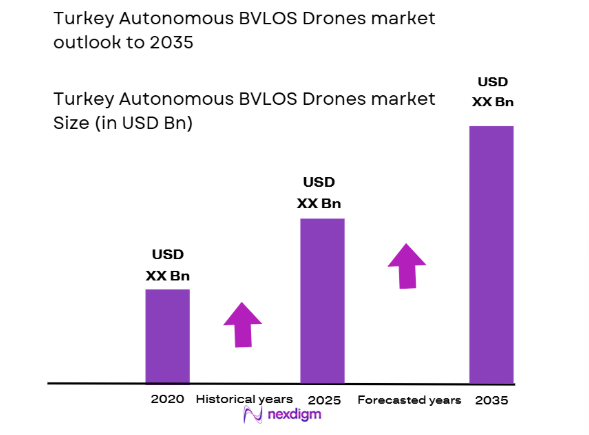
The market for Turkey’s autonomous BVLOS drones is witnessing significant growth, valued at approximately USD ~ billion based on recent assessments. This growth is primarily driven by advancements in drone technology, such as enhanced automation, AI-driven navigation, and improved battery life. Regulatory frameworks and governmental support for unmanned aerial systems further bolster this market, making it an attractive space for innovation and investment. The demand for autonomous drones, especially in sectors like agriculture, defense, and logistics, is pushing the market’s rapid expansion.
Turkey, with its strategic location between Europe and Asia, holds a strong position in the autonomous BVLOS drone market. The nation’s growing defense sector, robust manufacturing capabilities, and increasing adoption of drones in agriculture and infrastructure inspections contribute to its dominance. Major cities like Ankara and Istanbul are pivotal, serving as innovation hubs for the aerospace and defense industries. Government policies that support drone integration into national airspace systems also play a key role in reinforcing Turkey’s leadership in this market.
Market Segmentation
By System Type
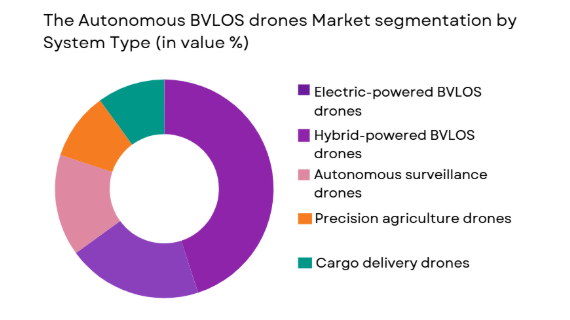
The autonomous BVLOS drones market is segmented by system type into electric-powered BVLOS drones, hybrid-powered BVLOS drones, autonomous surveillance drones, precision agriculture drones, and cargo delivery drones. Recently, electric-powered BVLOS drones have dominated the market due to their cost-effectiveness, longer operational range, and minimal environmental impact. These drones have become increasingly popular in both defense and commercial sectors, especially for surveillance and agricultural monitoring. Electric propulsion offers a more sustainable and efficient alternative to traditional fuel-powered drones, making it the preferred choice for businesses aiming to reduce operational costs and enhance efficiency.
By Platform Type
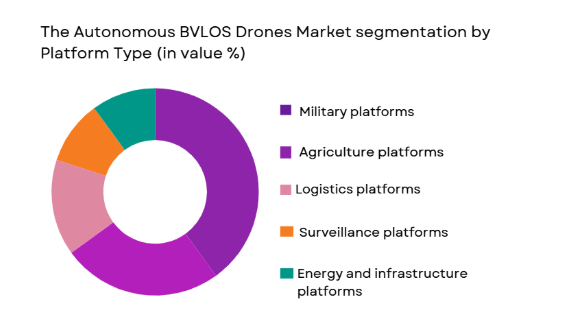
The autonomous BVLOS drones market is segmented by platform type into military platforms, agriculture platforms, logistics platforms, surveillance platforms, and energy and infrastructure inspection platforms. Military platforms dominate the market share due to the Turkish defense sector’s ongoing investment in unmanned aerial vehicles (UAVs) for surveillance, reconnaissance, and tactical operations. With rising geopolitical tensions and the need for enhanced security measures, military applications of BVLOS drones are growing rapidly. These drones provide significant advantages in military operations, offering real-time intelligence and reducing the need for manned missions in hostile environments. Additionally, the Turkish military’s commitment to modernizing its defense capabilities and increasing reliance on autonomous technologies has propelled the demand for military platforms in the market, establishing this segment as the dominant force.
Competitive Landscape
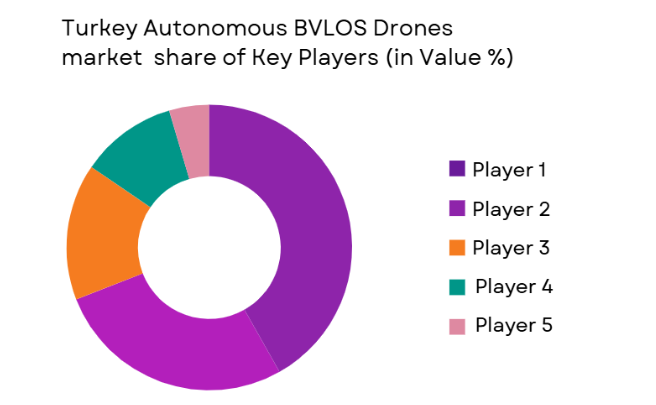
The competitive landscape of the autonomous BVLOS drones market in Turkey is shaped by both local innovators and global players. Consolidation is evident as many companies aim to secure strategic partnerships with government bodies and private enterprises in defense, agriculture, and logistics. Major players are focusing on technological advancements, particularly in AI and battery systems, to gain a competitive edge. The market is becoming increasingly competitive as players adopt different strategies, such as mergers, acquisitions, and collaborations to expand their market share and technological capabilities.
| Company Name | Establishment Year | Headquarters | Technology Focus | Market Reach | Key Products | Revenue | Additional Parameter |
| Turkish Aerospace | 1984 | Ankara, Turkey | ~ | ~ | ~ | ~ | ~ |
| Aselsan | 1975 | Ankara, Turkey | ~ | ~ | ~ | ~ | ~ |
| Baykar | 1986 | Istanbul, Turkey | ~ | ~ | ~ | ~ | ~ |
| STM | 1991 | Ankara, Turkey | ~ | ~ | ~ | ~ | ~ |
| Vestel Savunma | 1984 | Manisa, Turkey | ~ | ~ | ~ | ~ | ~ |
Turkey Autonomous BVLOS Drones Market Analysis
Growth Drivers
Technological Advancements in Autonomous Systems
Technological innovations in autonomous systems have emerged as a significant growth driver for Turkey’s autonomous BVLOS drone market. Advances in artificial intelligence, machine learning, and GPS-based navigation systems have substantially enhanced the performance and capabilities of drones, allowing them to operate without human intervention over long distances. These advancements have led to increased demand from various sectors, including agriculture, surveillance, and defense, where autonomous drones are sought after for their precision, efficiency, and ability to carry out operations in challenging environments. Furthermore, improvements in battery technology and power efficiency are enabling drones to cover longer distances and remain operational for extended periods, increasing their appeal to both commercial and military applications. With AI-driven automation, drones can now analyze vast amounts of data, improving decision-making processes and operational outcomes. The combination of these technological advancements makes autonomous BVLOS drones more reliable and cost-effective, thus accelerating their adoption and market growth.
Government Initiatives and Regulatory Support
Turkish government’s active support for the autonomous BVLOS drone sector has significantly contributed to market growth. Through initiatives such as the introduction of policies that support drone integration into national airspace, Turkey has created a favorable environment for drone manufacturers and operators. These regulatory frameworks ensure that drones can operate safely in both controlled and uncontrolled airspace while maintaining security standards. Furthermore, the government’s investment in drone-related infrastructure, such as air traffic management systems tailored to unmanned aerial vehicles, has provided a boost to the industry. By incentivizing the development and deployment of autonomous drones, the government is helping to position Turkey as a leader in the global drone market. This policy support, along with efforts to align with international standards, is expected to drive growth, particularly in sectors like defense, logistics, and agriculture, where drones are poised to revolutionize operations. The ability to operate BVLOS drones in commercial and military applications underpinned by clear regulations will continue to shape the growth trajectory of this market.
Market Challenges
Regulatory Barriers to BVLOS Operations
Despite the favorable outlook for Turkey’s autonomous BVLOS drone market, regulatory challenges remain a significant hurdle. While the Turkish government has taken steps to support drone operations, the integration of autonomous BVLOS drones into national airspace is still subject to stringent regulations and approval processes. These regulations often limit the scope of operations, especially in densely populated areas or regions with sensitive infrastructure. Operators face the challenge of adhering to a complex set of rules concerning air traffic management, communication protocols, and safety standards. Additionally, international regulations governing cross-border drone operations remain fragmented, making it difficult for Turkish drone manufacturers to expand into foreign markets without navigating an array of regulatory obstacles. The slow pace of regulatory change and the ongoing need for infrastructure development to accommodate BVLOS drones further complicate market growth. To overcome these challenges, stakeholders must work closely with regulators to ensure that safety, security, and operational efficiency are prioritized while facilitating the smooth integration of autonomous drones into airspace management systems.
High Initial Investment and Operational Costs
Another significant challenge facing Turkey’s autonomous BVLOS drone market is the high initial investment and operational costs associated with the technology. Although drone technology has made significant strides in recent years, the upfront costs of autonomous BVLOS drones remain high. This includes the expenses related to the development of sophisticated systems, advanced sensors, and onboard artificial intelligence algorithms. Moreover, maintenance and operational costs also present barriers, particularly for small-to-medium enterprises that may struggle to justify such large investments. While drones offer long-term cost savings, such as reduced labor costs and increased operational efficiency, the initial outlay remains a considerable hurdle. For businesses, particularly in the agriculture and logistics sectors, the cost-benefit analysis of adopting autonomous drones may not always yield immediate returns, making it difficult for some industries to transition to drone-based solutions. This challenge is compounded by the lack of established funding mechanisms or subsidies that could ease the financial burden on companies looking to adopt these advanced technologies. Overcoming these economic barriers will require the development of more affordable solutions and the establishment of financing models to facilitate widespread adoption.
Opportunities
Integration of Autonomous Drones in Agriculture
One of the most promising opportunities for the autonomous BVLOS drone market in Turkey lies in the integration of drones within the agricultural sector. With Turkey being a major agricultural producer, the adoption of autonomous drones offers numerous benefits, including enhanced crop monitoring, pest control, and precision farming. Drones equipped with multispectral sensors can gather real-time data on crop health, soil conditions, and water usage, allowing farmers to make more informed decisions and optimize yields. This use of drones is especially crucial in regions with limited access to traditional agricultural technology, as drones can significantly reduce operational costs and improve efficiency. Moreover, the Turkish government’s focus on supporting the digitization of agriculture provides an ideal environment for the proliferation of autonomous drone solutions in the sector. By automating routine tasks such as crop spraying and soil monitoring, drones can help farmers increase productivity while reducing the need for manual labor, contributing to a more sustainable agricultural future. The growing demand for precision agriculture in Turkey presents a clear opportunity for drone manufacturers to tailor their offerings to meet the unique needs of the farming industry, making it a key growth area for the market.
Expansion of Military Applications
Another significant opportunity for Turkey’s autonomous BVLOS drone market lies in the expansion of military applications. The Turkish defense industry has long been a leader in UAV technology, and autonomous drones are increasingly being integrated into the country’s military operations for surveillance, reconnaissance, and tactical support. These drones offer strategic advantages by providing real-time intelligence, reducing the need for manned missions in hostile territories, and enhancing the capabilities of military forces. As geopolitical tensions persist in the region, the demand for advanced autonomous drones capable of performing complex missions in hostile environments is expected to rise. Furthermore, the Turkish military’s investment in drone technology, coupled with its ongoing research and development initiatives, creates a robust environment for the growth of autonomous BVLOS drones. As Turkey continues to modernize its defense capabilities, autonomous drones will play a critical role in strengthening national security, offering new opportunities for both domestic and international sales. This expansion of military applications is likely to drive significant growth in the autonomous BVLOS drone market, making it a key opportunity for manufacturers and operators within the defense sector.
Future Outlook
The future of Turkey’s autonomous BVLOS drone market looks promising, with continued technological advancements expected to drive growth. Innovations in artificial intelligence, battery technology, and autonomous flight systems will further enhance the operational efficiency of drones, making them more appealing to a wide range of industries. The government’s ongoing support for drone integration into airspace systems and the development of infrastructure to accommodate BVLOS operations will also play a crucial role in market expansion. As demand increases in agriculture, defense, and logistics, Turkey is well-positioned to become a regional leader in autonomous drone technology, with opportunities for both domestic and international growth. With a favorable regulatory environment and increasing investment in drone-related research and development, the market is expected to experience sustained growth over the next several years.
Major Players
- Turkish Aerospace Industries
- Aselsan
- Baykar
- STM
- Vestel Savunma
- Roketsan
- TUSAŞ
- Kale Group
- Altinay Technology
- Mikrotek
- General Atomics Aeronautical Systems
- Lockheed Martin
- Northrop Grumman
- Airbus Defense and Space
- DJI
Key Target Audience
- Investments and venture capitalist firms
- Government and regulatory bodies
- Drone manufacturers and suppliers
- Aerospace and defense contractors
- Military agencies
- Agricultural firms and cooperatives
- Logistics and transportation companies
- Infrastructure development companies
Research Methodology
Step 1: Identification of Key Variables
This step involves identifying the critical market variables that influence the development and growth of the autonomous BVLOS drones market in Turkey. These variables include technological advancements, regulatory frameworks, and market demands.
Step 2: Market Analysis and Construction
In this phase, market data is collected through secondary and primary research to build a comprehensive understanding of the market. This includes analyzing current market trends, competitive landscapes, and customer preferences.
Step 3: Hypothesis Validation and Expert Consultation
In this step, market hypotheses are validated by consulting industry experts, regulatory bodies, and key stakeholders to ensure the accuracy of findings. Expert insights are gathered to refine market assumptions.
Step 4: Research Synthesis and Final Output
The final step involves synthesizing the data collected and preparing a detailed market report that offers actionable insights for stakeholders. This report includes a thorough analysis of market trends, growth drivers, challenges, and opportunities.

- Executive Summary
- Research Methodology (Definitions, Scope, Industry Assumptions, Market Sizing Approach, Primary & Secondary Research Framework, Data Collection & Verification Protocol, Analytic Models & Forecast Methodology, Limitations & Research Validity Checks)

- Market Definition and Scope
- Value Chain & Stakeholder Ecosystem
- Regulatory / Certification Landscape
- Sector Dynamics Affecting Demand
- Strategic Initiatives & Infrastructure Growth

- Growth Drivers
Advancements in drone automation technology
Government support for autonomous drone development
Increased demand for efficient logistics solutions
Rising adoption in agricultural practices
Technological innovations in drone navigation and communication - Market Challenges
Regulatory hurdles for BVLOS operations
High cost of advanced drone technologies
Limited infrastructure for drone operations
Concerns over airspace safety and security
Short battery life of drones in long-distance operations - Market Opportunities
Expansion into new verticals like energy and infrastructure
Integration with autonomous transport and delivery systems
Growing demand for surveillance and monitoring applications - Trends
Increased adoption of AI and machine learning in drones
Integration of BVLOS drones with 5G networks for better connectivity
Rise in private and public investments in drone technologies
Expansion of drone use in precision agriculture
Improvement in drone battery technology - Government Regulations & Defense Policy
Regulation of BVLOS operations in Turkish airspace
Government initiatives to promote drone technology development
Defense policies supporting autonomous systems in security operations - SWOT Analysis
- Stakeholder and Ecosystem Analysis
- Porter’s Five Forces Analysis
- Competition Intensity and Ecosystem Mapping

- By Market Value, 2020-2025
- By Installed Units, 2020-2025
- By Average System Price, 2020-2025
- By System Complexity Tier, 2020-2025

- By System Type (In Value%)
Electric-powered BVLOS drones
Hybrid-powered BVLOS drones
Autonomous surveillance drones
Precision agriculture drones
Cargo delivery drones - By Platform Type (In Value%)
Military platforms
Agriculture platforms
Logistics platforms
Surveillance platforms
Energy and infrastructure inspection platforms - By Fitment Type (In Value%)
OEM autonomous BVLOS drones
Aftermarket autonomous BVLOS drones
Customized BVLOS drones
Integration-ready BVLOS drones
Hybrid fitment BVLOS drones - By EndUser Segment (In Value%)
Agriculture and farming
Military and defense
Logistics and transportation
Energy and utilities
Government and surveillance - By Procurement Channel (In Value%)
Direct procurement from manufacturers
Third-party distributors
Online platforms
Government procurement channels
Collaborative partnerships - By Material / Technology (In Value%)
Electric propulsion technology
Hybrid propulsion systems
Artificial intelligence (AI) for autonomous control
Advanced battery technology
Lightweight composite materials

- Market structure and competitive positioning
Market share snapshot of major players - Cross Comparison Parameters (Price, System complexity, Battery life, Payload capacity, Navigation technology, Regulatory compliance, Performance in BVLOS conditions, Market penetration, R&D investments, Production scalability)
- SWOT Analysis of Key Players
- Pricing & Procurement Analysis
- Key Players
Turkish Aerospace Industries
Aselsan
Baykar
STM
Vestel Savunma
Rocketron
TUSAŞ
Kale Group
Altinay Technology
Mikro AeroTech
Airbus Defense and Space
General Atomics Aeronautical Systems
Lockheed Martin
Northrop Grumman
DJI

- Demand for autonomous BVLOS drones in agriculture for crop monitoring
- Military interest in BVLOS drones for surveillance and reconnaissance
- Growth in logistics and delivery services with autonomous drone systems
- Energy sector adoption for infrastructure inspections and maintenance

- Forecast Market Value, 2026-2035
- Forecast Installed Units, 2026-2035
- Price Forecast by System Tier, 2026-2035
- Future Demand by Platform, 2026-2035


 Request a Sample
 Ask for Customization
 Get a Quote
 Enquire Now