

 Download PDF
 Download PDF
Market Overview
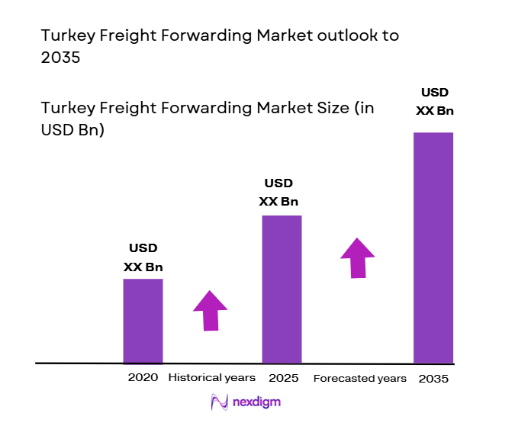
The Turkey Freight Forwarding market is estimated to reach USD ~ billion, driven by increasing demand for efficient supply chain solutions, advancements in logistics technology, and the country’s strategic location. Turkey’s role as a hub for trade between Europe, Asia, and the Middle East boosts its position in the global logistics network, encouraging robust market growth. Strong infrastructure investments in transportation and port facilities also contribute to this growth trajectory.
Istanbul, as a major logistics and trade hub, dominates the market due to its accessibility to key international shipping routes and proximity to Europe and Asia. Other key regions contributing to market growth include Ankara and Izmir, where government initiatives and industrial development focus on improving transportation efficiency. Additionally, the expansion of e-commerce and retail sectors in these areas fuels demand for freight forwarding services, solidifying Turkey’s market dominance.
Market Segmentation
By Product Type:
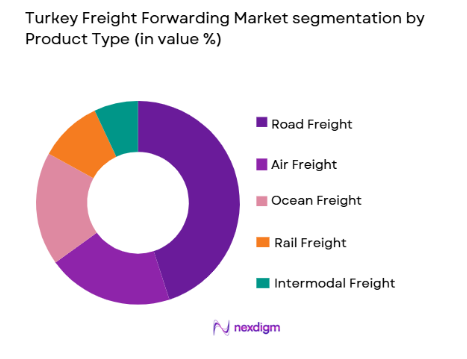
The Turkey Freight Forwarding market is segmented by product type into road freight, air freight, ocean freight, rail freight, and intermodal freight. Recently, road freight has seen a dominant market share due to the extensive road network in Turkey and the proximity to key European and Asian markets. This segment is driven by the high demand for road-based delivery of goods within Turkey and surrounding regions. The development of better road infrastructure, coupled with cost-effectiveness compared to air and sea freight, ensures the road freight segment continues to lead the market share.
By Platform Type:
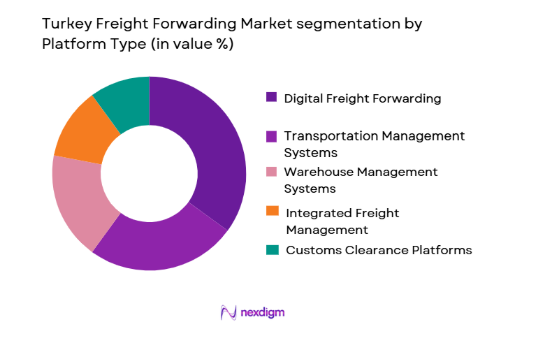
The market is segmented by platform type into transportation management systems (TMS), warehouse management systems (WMS), integrated freight management platforms, customs clearance platforms, and digital freight forwarding platforms. Digital freight forwarding platforms have a dominant share due to the growing trend of automating logistics processes and providing real-time tracking services. These platforms allow businesses to streamline freight booking and documentation, reducing costs and time. As the demand for more efficient and transparent logistics solutions rises, digital platforms become more attractive, leading to their increasing dominance.
Competitive Landscape
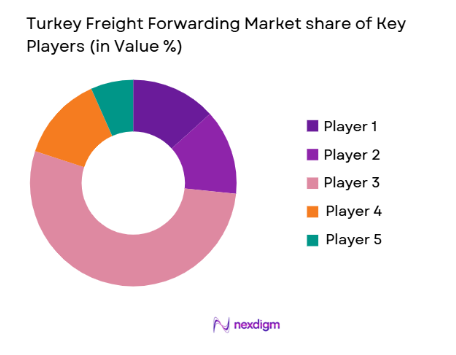
The competitive landscape in the Turkey Freight Forwarding market is characterized by consolidation, with major international and regional players expanding their presence. The market is increasingly influenced by the adoption of advanced technologies like AI and IoT for efficient logistics management, leading to increased competition among both traditional logistics companies and tech-driven startups. With growing demand, larger companies are focusing on expanding their infrastructure and digital offerings, ensuring their competitive edge in the market.
| Company Name | Establishment Year | Headquarters | Technology Focus | Market Reach | Key Products | Revenue (USD Billion) | Additional Market-Specific Parameter |
| DB Schenker | 1872 | Germany | ~ | ~ | ~ | ~ | ~ |
| Kuehne + Nagel | 1890 | Switzerland | ~ | ~ | ~ | ~ | ~ |
| DHL | 1969 | Germany | ~ | ~ | ~ | ~ | ~ |
| XPO Logistics | 1989 | United States | ~ | ~ | ~ | ~ | ~ |
| Agility Logistics | 1979 | Kuwait | ~ | ~ | ~ | ~ | ~ |
Turkey Freight Forwarding Market Analysis
Growth Drivers
Turkey’s Strategic Location:
Turkey’s unique geographical location, serving as a gateway between Europe, Asia, and the Middle East, significantly drives the freight forwarding market. This prime location allows Turkey to benefit from high-volume trade, positioning it as a key logistics hub. Additionally, the Turkish government’s focus on enhancing infrastructure, such as major highways, ports, and airports, strengthens the nation’s global trade capacity. These improvements directly contribute to the ease of moving goods and services within and outside the country. The continued development of logistics corridors and investment in transportation infrastructure supports greater efficiency, which drives market growth. Turkey’s free trade agreements with multiple countries further solidify its position as a hub for global trade and transportation. These initiatives are expected to continuously boost demand for freight forwarding services in the coming years.
E-commerce Growth in Turkey:
The surge in e-commerce activities in Turkey has also been a major factor driving the demand for freight forwarding services. The rise of online shopping and the need for fast, reliable delivery of goods have made freight forwarding solutions integral to e-commerce businesses. As Turkish consumers continue to embrace online shopping, the demand for both domestic and international shipping services has grown exponentially. The logistics industry is responding by adapting to new consumer demands, providing services such as last-mile delivery and fast shipping solutions. Companies in the freight forwarding market are increasingly focusing on digital freight solutions to offer real-time tracking and streamline operations for e-commerce customers. The growth in e-commerce is set to continue fueling demand for efficient and reliable freight services across Turkey.
Market Challenges
Infrastructure Bottlenecks:
Despite the ongoing investments in transportation infrastructure, Turkey’s freight forwarding sector continues to face significant bottlenecks in areas such as customs clearance and congestion in major ports. These infrastructure challenges can delay shipments, which increases operational costs for businesses. The underdeveloped road networks in certain regions and limited capacity at critical ports like Istanbul and Mersin lead to inefficiencies in the logistics chain. In addition, Turkey’s customs processes, though improving, remain complex, and navigating these regulations can lead to delays and increased costs. As Turkey aims to improve its position as a key logistics hub, addressing these bottlenecks becomes critical for maintaining competitiveness in the global market. The development of new infrastructure projects and the optimization of existing logistics facilities will be vital to overcoming these challenges and ensuring smoother freight operations in the future.
Rising Operational Costs:
The rising cost of operations, particularly fuel prices, poses a significant challenge to the freight forwarding market in Turkey. The volatility of global fuel prices directly impacts transportation costs, making it difficult for logistics companies to maintain profitability. Additionally, higher labor costs, especially for skilled workforce management, are contributing to increased operational expenditures. With the demand for rapid delivery and improved services, logistics companies are forced to invest heavily in technology, leading to higher upfront costs. Although automation and technology adoption offer long-term benefits, the short-term financial strain on companies remains a challenge. Freight forwarding businesses must balance cost control while continuing to meet customer expectations for faster, cheaper, and more reliable delivery services. This challenge will require innovative solutions to optimize operations and manage costs effectively.
Opportunities
Green Freight Solutions:
With global environmental concerns gaining importance, there is a growing shift towards sustainable practices in the logistics sector. Green freight solutions, including the adoption of electric vehicles, eco-friendly packaging, and optimized routing, are gaining traction. The Turkish government’s initiatives to reduce carbon emissions and promote eco-friendly logistics practices align with the global demand for sustainable supply chain solutions. Freight forwarding companies in Turkey are now increasingly focusing on adopting these solutions to meet regulatory requirements and cater to environmentally conscious consumers. The transition to greener logistics will also help businesses reduce operational costs in the long term, particularly in terms of fuel and energy consumption. As more companies adopt sustainable practices, the demand for green freight solutions is expected to increase, creating new opportunities for players in the Turkish freight forwarding market.
Digital Freight Solutions:
The shift towards digital freight platforms represents a significant opportunity for the Turkey Freight Forwarding market. Digital platforms offer streamlined processes, real-time tracking, and automated shipment management, providing substantial advantages over traditional methods. As businesses look to improve operational efficiency and reduce costs, there is an increasing demand for digital freight forwarding solutions. Turkey’s logistics sector, which has traditionally relied on manual operations, is gradually transitioning to digital platforms that offer better visibility and control over shipments. These digital platforms also provide scalability for businesses looking to expand their operations and enhance customer service. As e-commerce continues to grow, so does the need for these digital solutions, creating a lucrative opportunity for service providers in Turkey’s freight forwarding market.
Future Outlook
The Turkey Freight Forwarding market is poised for continued growth, driven by increasing trade volumes, investments in infrastructure, and the adoption of digital solutions. Over the next five years, the demand for efficient and sustainable freight services will rise, particularly in response to the growing e-commerce sector. Technological advancements, such as AI and IoT, will further enhance operational efficiency. Regulatory support, including green logistics initiatives, will also play a key role in shaping the market’s trajectory. Overall, Turkey’s strategic location and infrastructure improvements will ensure its continued prominence in global logistics.
Major Players
- DB Schenker
- Kuehne + Nagel
- DHL
- XPO Logistics
- Agility Logistics
- CEVA Logistics
- UPS
- DSV Panalpina
- J.B. Hunt Transport Services
- Sinotrans
- Yusen Logistics
- CMA CGM Group
- ZIM Integrated Shipping Services
- Panalpina
- Expeditors International of Washington
Key Target Audience
- Investments and venture capitalist firms
- Government and regulatory bodies
- Freight forwarding companies
- E-commerce businesses
- Logistics service providers
- Manufacturing industries
- Retail and wholesale distributors
- Shipping and transport authorities
Research Methodology
Step 1: Identification of Key Variables
In this step, critical factors influencing the market are identified, including technological trends, regulatory frameworks, and consumer behavior patterns.
Step 2: Market Analysis and Construction
Data is collected and analyzed through secondary research, surveys, and market data, constructing a clear picture of market dynamics and trends.
Step 3: Hypothesis Validation and Expert Consultation
Experts from the logistics and freight forwarding industry are consulted to validate findings and refine hypotheses based on practical insights.
Step 4: Research Synthesis and Final Output
The data is synthesized into a final comprehensive report, presenting insights and market forecasts.

- Executive Summary
- Research Methodology (Definitions, Scope, Industry Assumptions, Market Sizing Approach, Primary & Secondary Research Framework, Data Collection & Verification Protocol, Analytic Models & Forecast Methodology, Limitations & Research Validity Checks)

- Market Definition and Scope
- Value Chain & Stakeholder Ecosystem
- Regulatory / Certification Landscape
- Sector Dynamics Affecting Demand
- Strategic Initiatives & Infrastructure Growth

- Growth Drivers
Government Investment in Infrastructure
Technological Advancements in Freight Forwarding
Growth in E-commerce and Retail Sector
Increasing Demand for Global Trade
Turkey’s Strategic Geographical Location - Market Challenges
High Operational Costs
Complex Regulatory Compliance
Capacity Constraints in Freight Networks
Environmental and Sustainability Issues
Dependence on Global Economic Fluctuations - Market Opportunities
Expansion in E-commerce-driven Freight Solutions
Partnerships with Technology Providers for Automation
Adoption of Green Freight and Sustainable Practices - Trends
Adoption of AI and Automation in Freight Forwarding
Rising Demand for Real-Time Tracking Solutions
Integration of Blockchain for Transparency
Growth of Digital Freight Forwarding Platforms
Focus on Sustainability in Transportation - Government Regulations & Defense Policy
Regulation on Cross-border Freight Movements
Environmental Regulations on Freight Industry
Government Incentives for Green Logistics - SWOT Analysis
- Stakeholder and Ecosystem Analysis
- Porter’s Five Forces Analysis
- Competition Intensity and Ecosystem Mapping

- By Market Value, 2020-2025
- By Installed Units, 2020-2025
- By Average System Price, 2020-2025
- By System Complexity Tier, 2020-2025

- By System Type (In Value%)
Road Freight
Air Freight
Ocean Freight
Rail Freight
Intermodal Freight - By Platform Type (In Value%)
Transportation Management Systems
Warehouse Management Systems
Integrated Freight Management Platforms
Customs Clearance Platforms
Digital Freight Forwarding Platforms - By Fitment Type (In Value%)
On-premise Solutions
Cloud-based Solutions
Hybrid Solutions
Modular Solutions
Integrated Solutions - By EndUser Segment (In Value%)
Manufacturing Industry
Retail & E-commerce
Automotive Industry
Consumer Electronics
Pharmaceuticals - By Procurement Channel (In Value%)
Direct Procurement
Third-party Logistics Providers
Online Freight Platforms
Freight Forwarding Agents
Freight Brokers - By Material / Technology (in Value%)
Advanced Tracking Systems
AI-driven Freight Optimization
Blockchain Technology
Internet of Things (IoT)
Cloud Computing Solutions

- Market structure and competitive positioning
- Market share snapshot of major players
- CrossComparison Parameters (System Type, Platform Type, Procurement Channel, EndUser Segment, Fitment Type, Material/Technology, Government Regulations, Competitive Intensity, Pricing Strategies, Operational Efficiency)
- SWOT Analysis of Key Players
- Pricing & Procurement Analysis
- Key Players
DB Schenker
Kuehne + Nagel
DHL
Ceva Logistics
XPO Logistics
TNT Express
Agility Logistics
UPS
Maersk
Yusen Logistics
C.H. Robinson
DHL Global Forwarding
Panalpina
Geodis
Sinotrans

- Manufacturers Increasing Focus on Efficient Freight Solutions
- Retailers Adopting Digital Freight Forwarding Platforms
- Automotive Sector’s Dependence on Freight Services
- Pharmaceutical Industry’s Need for Secure Freight

- Forecast Market Value, 2026-2035
- Forecast Installed Units, 2026-2035
- Price Forecast by System Tier, 2026-2035
- Future Demand by Platform, 2026-2035


 Request a Sample
 Ask for Customization
 Get a Quote
 Enquire Now