
 Download PDF
 Download PDF
Market Overview
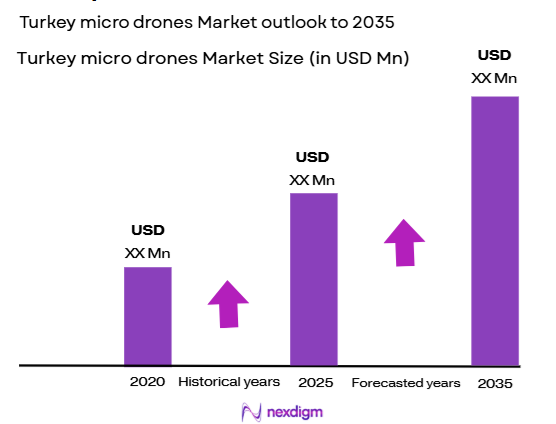
The Turkey Micro Drones market is expected to reach a valuation of USD ~million in 2024, driven by the rapid technological advancements in drone systems and government support for the UAV industry. The market has been experiencing steady growth due to an increasing demand for micro drones in sectors such as surveillance, agriculture, and defense. This growth is largely propelled by innovations in drone capabilities, such as improved battery life and advanced imaging systems, along with the increasing need for security solutions across various industries.
Cities like Istanbul, Ankara, and Izmir dominate the Turkish Micro Drones market due to their well-established industrial ecosystems, access to technological infrastructure, and proximity to government and defense institutions. Istanbul, being the largest city, is the primary hub for technological development and the commercial deployment of drones. Furthermore, Ankara, as the capital, is the focal point for defense-related drone applications, contributing significantly to the market’s expansion.
Market Segmentation
By System Type
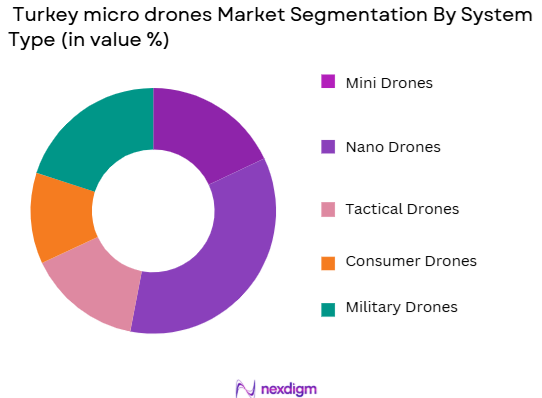
The Turkey Micro Drones market is segmented by system type into Mini Drones, Nano Drones, Tactical Drones, Consumer Drones, and Military Drones. Currently, Nano Drones dominate the system type segmentation due to their compact size, cost-effectiveness, and versatility. Nano drones are ideal for both commercial and military applications, offering maneuverability in urban environments and being highly effective for surveillance and mapping. Their adoption in various sectors like security, agriculture, and logistics has contributed to their growing market share.
By Platform Type
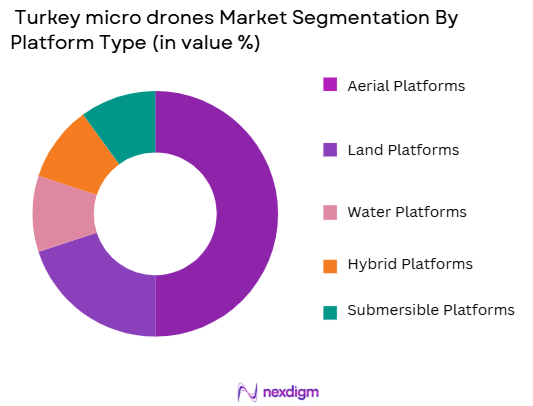
The market is segmented by platform type into Aerial Platforms, Land Platforms, Water Platforms, Hybrid Platforms, and Submersible Platforms. Aerial Platforms hold the dominant market share due to their widespread use in surveillance, defense, and commercial applications. Their ability to cover large areas from the air and their ease of deployment in various environments have made aerial platforms the preferred choice for both private companies and government organizations in Turkey.
Competitive Landscape
The Turkey Micro Drones market is dominated by a few key players, including local defense contractors and global drone manufacturers. Companies like Aselsan and Baykar Technologies lead the market due to their long-standing relationships with government and defense agencies, as well as their advanced technological capabilities in UAV systems. These companies are leveraging government support and defense contracts to maintain a competitive edge.
| Company | Establishment Year | Headquarters | Government Partnerships | Technological Expertise | Key Applications | Revenue Growth Rate | Market Share Focus |
| Aselsan | 1975 | Ankara, Turkey | ~ | ~ | ~ | ~ | ~ |
| Baykar Technologies | 1984 | Istanbul, Turkey | ~ | ~ | ~ | ~ | ~ |
| Vestel | 1984 | Istanbul, Turkey | ~ | ~ | ~ | ~ | ~ |
| Teknofest | 2011 | Istanbul, Turkey | ~ | ~ | ~ | ~ | ~ |
| FlytBase | 2017 | Istanbul, Turkey | ~ | ~ | ~ | ~ | ~ |
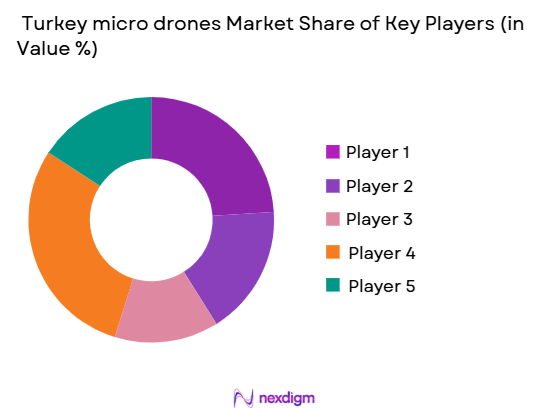
Turkey Micro Drones Market Analysis
Growth Drivers
Urbanization
Urbanization is a significant growth driver for the Turkey Micro Drones market. As urban areas expand, the need for efficient monitoring, delivery, and security solutions grows. In Turkey, the urbanization rate is projected to increase steadily, with urban populations expected to reach ~% by 2024, compared to ~% in 2020, according to the World Bank. This urbanization trend is creating a strong demand for micro drones in sectors such as infrastructure monitoring, delivery services, and surveillance. Drones are increasingly becoming a part of smart city projects in Turkey, contributing to a streamlined and cost-effective urban management system.
Industrialization
Industrialization in Turkey is propelling the demand for micro drones, especially in sectors like manufacturing, agriculture, and infrastructure development. The country’s industrial sector contributed around 30% to the GDP in 2023, as reported by the Turkish Statistical Institute. With industrial growth comes an increased need for surveillance, site inspections, and supply chain optimization, where drones play an essential role. In agriculture, the shift toward precision farming requires micro drones for real-time data collection, pest monitoring, and crop health assessment. This growing industrial base is expected to drive demand for drone technology in Turkey.
Restraints
High Initial Costs
The high initial cost of acquiring and maintaining micro drones is a significant barrier to widespread adoption in Turkey. In 2024, the price of advanced micro drones with high-end cameras and long battery life remains a major challenge for small and medium enterprises (SMEs) and individual consumers. For example, a high-quality surveillance drone can cost anywhere from USD ~to USD ~ which is out of reach for many businesses that would benefit from UAV technology. Although prices are expected to gradually decrease with advances in technology, the initial costs remain a challenge to market penetration.
Technical Challenges
Technical challenges are a major constraint for the micro drone market in Turkey. Despite technological advancements, issues such as limited battery life, the need for advanced navigation systems, and the reliability of drone sensors remain a concern. In 2024, most commercially available micro drones can operate for no more than 30 minutes on a single charge, limiting their use for extended operations. Additionally, the integration of AI and machine learning in drones remains in its nascent stages, and further technological advancements are required to achieve full autonomy, which is crucial for industries like agriculture and defense.
Opportunities
Technological Advancements
Technological advancements in battery life, GPS precision, and autonomous capabilities present significant opportunities for the Turkey Micro Drones market. In 2024, innovations in AI, machine learning, and drone software are expected to revolutionize how micro drones are used in agriculture, logistics, and security. For example, new AI algorithms can help micro drones operate autonomously for longer durations, increasing their effectiveness in agricultural surveillance and precision farming. The adoption of these advancements is likely to drive the market’s future growth, as businesses look for more efficient ways to incorporate drones into their operations.
International Collaborations
International collaborations offer significant growth opportunities for the Turkish Micro Drones market. Turkish drone manufacturers, such as Baykar Technologies, have already begun establishing partnerships with global players to enhance their technological capabilities. These collaborations allow for the exchange of knowledge, expertise, and access to foreign markets. As of 2024, Turkey’s involvement in international drone competitions, such as the Drone Racing League, is fostering global recognition of its drone technology. This trend is expected to continue, opening up new opportunities for collaboration with multinational corporations and driving market growth.
Future Outlook
Over the next decade, the Turkey Micro Drones market is poised for significant growth. With continued government support, advancements in drone technology, and the increasing demand for UAVs in sectors such as defense, agriculture, and logistics, the market is expected to experience a steady rise. New developments in drone autonomy and artificial intelligence are expected to further drive market growth, particularly in surveillance and military applications.
Major Players in the Market
- Aselsan
- Baykar Technologies
- Vestel
- Teknofest
- FlytBase
- Türk Havacılık ve Uzay Sanayi (TUSAŞ)
- Prox Dynamics
- Delair
- Ares Aeronautics
- Havelsan
- Parrot Drones
- DJI Innovations
- Quantum Systems
- Draganfly
- SenseFly
Key Target Audience
- Investment and Venture Capitalist Firms
- Turkish Ministry of Defense
- Turkish Civil Aviation Authority
- Agricultural Businesses and Farming Cooperatives
- Logistics and Delivery Companies
- Surveillance and Security Agencies
- R&D Departments in Aerospace and Technology Companies
- Drone Manufacturers and Component Suppliers
Research Methodology
Step 1: Identification of Key Variables
The initial phase involves constructing an ecosystem map encompassing all major stakeholders within the Turkey Micro Drones market. This step is underpinned by extensive desk research, utilizing a combination of secondary and proprietary databases to gather comprehensive industry-level information. The primary objective is to identify and define the critical variables that influence market dynamics.
Step 2: Market Analysis and Construction
In this phase, we will compile and analyze historical data pertaining to the Turkey Micro Drones market. This includes assessing market penetration, the ratio of marketplaces to service providers, and the resultant revenue generation. Furthermore, an evaluation of service quality statistics will be conducted to ensure the reliability and accuracy of the revenue estimates.
Step 3: Hypothesis Validation and Expert Consultation
Market hypotheses will be developed and subsequently validated through computer-assisted telephone interviews (CATIs) with industry experts representing a diverse array of companies. These consultations will provide valuable operational and financial insights directly from industry practitioners, which will be instrumental in refining and corroborating the market data.
Step 4: Research Synthesis and Final Output
The final phase involves direct engagement with multiple drone manufacturers to acquire detailed insights into product segments, sales performance, consumer preferences, and other pertinent factors. This interaction will serve to verify and complement the statistics derived from the bottom-up approach, thereby ensuring a comprehensive, accurate, and validated analysis of the Turkey Micro Drones market.

- Executive Summary
- Research Methodology(Definitions, Scope, Industry Assumptions, Market Sizing Approach, Primary & Secondary Research Framework, Data Collection & Verification Protocol, Analytic Models & Forecast Methodology, Limitations & Research Validity Checks)

- Market Definition and Scope
- Value Chain & Stakeholder Ecosystem
- Regulatory / Certification Landscape
- Sector Dynamics Affecting Demand
- Strategic Initiatives & Infrastructure Growth

- Growth Drivers
Government initiatives to promote UAV usage in agriculture
Technological advancements in drone battery and navigation systems
Rising demand for surveillance and monitoring in various sectors - Market Challenges
Strict regulations governing UAV usage
High cost of advanced micro drone systems
Lack of standardized infrastructure for drone operations - Trends
Rise in drone deliveries for e-commerce
Advancements in autonomous flight capabilities
Increasing use of micro drones in environmental monitoring
- Market Opportunities
Expansion of drones in precision agriculture
Integration of artificial intelligence in micro drones
Growing demand for drones in emergency response and disaster management - Government regulations
New legislation for UAVs in public spaces
Safety protocols for drone operations in urban areas
Standards for drone certification and licensing - SWOT analysis
Strength in innovative drone technologies
Weakness in cost-effective mass production
Opportunity for market growth in emerging sectors - Porters 5 forces
High bargaining power of suppliers due to specialized components
Moderate threat of new entrants due to regulatory barriers
High competition in the consumer drone market

- By Market Value, 2020-2025
- By Installed Units, 2020-2025
- By Average System Price, 2020-2025
- By System Complexity Tier, 2020-2025

- By System Type (In Value%)
Mini Drones
Nano Drones
Tactical Drones
Consumer Drones
Military Drones - By Platform Type (In Value%)
Aerial Platforms
Land Platforms
Water Platforms
Hybrid Platforms
Submersible Platforms - By Fitment Type (In Value%)
Handheld
Vehicle-Mounted
Aerial-Mounted
Wearable
Integrated Systems - By EndUser Segment (In Value%)
Military & Defense
Agriculture
Logistics
Surveillance & Security
Entertainment - By Procurement Channel (In Value%)
Direct Procurement
Government Tenders
Commercial Procurement
OEM Partnerships
Distributors & Retail

- Market Share Analysis
- CrossComparison Parameters(Product Innovation, Pricing Strategies, Market Penetration, Brand Recognition, Customer Service)
- SWOT Analysis of Key Competitors
- Pricing & Procurement Analysis
- Key Players
Aselsan
Baykar Technologies
Vestel
Türk Havacılık ve Uzay Sanayi
Teknofest
FlytBase
Ares Aeronautics
Havelsan
Prox Dynamics
Delair
Parrot Drones
DJI Innovations
SenseFly
Quantum Systems
Draganfly

- Increasing adoption of micro drones in agriculture for precision farming
- Security and surveillance sectors boosting micro drone adoption
- Defense sector focusing on micro drones for tactical missions
- Consumer market shifting towards affordable personal drone systems

- Forecast Market Value, 2026-2035
- Forecast Installed Units, 2026-2035
- Price Forecast by System Tier, 2026-2035
- Future Demand by Platform, 2026-2035


 Request a Sample
 Ask for Customization
 Get a Quote
 Enquire Now