

 Download PDF
 Download PDF
Market Overview
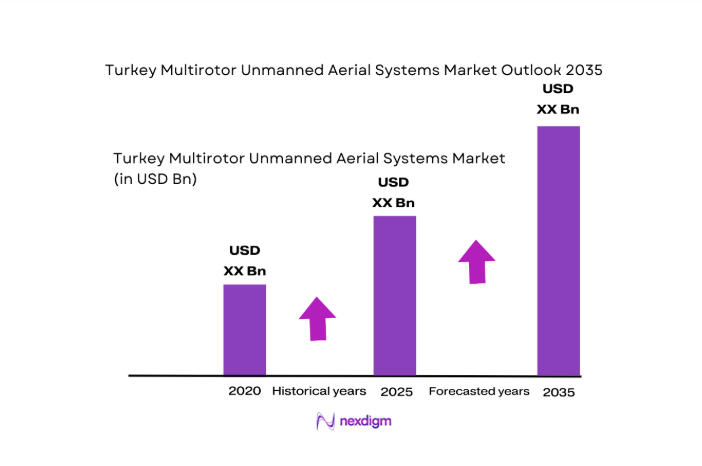
The Turkey Multirotor Unmanned Aerial Systems market is valued at approximately USD ~ in 2025. This growth is largely driven by increasing demand from the defense sector, technological advancements in drone capabilities, and the rapid expansion of commercial applications such as agriculture, logistics, and surveillance. The government’s support through regulations and policies promoting the use of UAS in various sectors also contributes to the market’s expansion. A rise in consumer and business adoption, especially in industries such as surveying, agriculture, and media, further supports the demand for multirotor systems.
Turkey dominates the multirotor UAS market, driven by the presence of key players such as Aselsan and Baykar, as well as a strong defense industry infrastructure. Major cities like Ankara and Istanbul are pivotal to the growth of this market, with a high concentration of aerospace and defense firms, as well as research and development (R&D) activities. These regions also benefit from governmental support, with initiatives to integrate drones into surveillance, agriculture, and public safety systems. The country’s strategic location as a bridge between Europe and Asia makes it an ideal hub for UAS development and deployment.
Market Segmentation
By System Type
The Turkey Multirotor UAS market is segmented by system type into quadcopters, hexacopters, octocopters, tethered multirotors, and hybrid multirotors. Among these, quadcopters have the dominant market share in 2024. Their widespread use in commercial and military applications, due to their affordability, versatility, and ease of operation, make them the preferred choice. The demand for quadcopters is further fueled by their adoption in agricultural monitoring, surveillance, and aerial photography. With advancements in battery life and AI, quadcopters are expected to maintain a strong market presence, even as other system types evolve.

By Platform Type
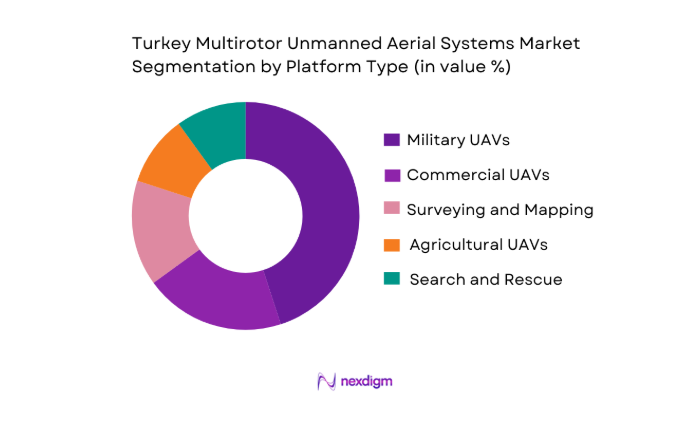
The multirotor UAS market in Turkey is also segmented by platform type, which includes commercial platforms, military platforms, surveying and mapping platforms, agricultural platforms, and search and rescue platforms. The military platforms segment holds the largest market share in 2024. This dominance is attributed to the extensive use of drones in military reconnaissance, surveillance, and combat operations. The Turkish Armed Forces’ integration of UAS for border control and intelligence gathering has driven demand in this segment. Military platforms are also bolstered by ongoing government investment in defense technology.
Competitive Landscape
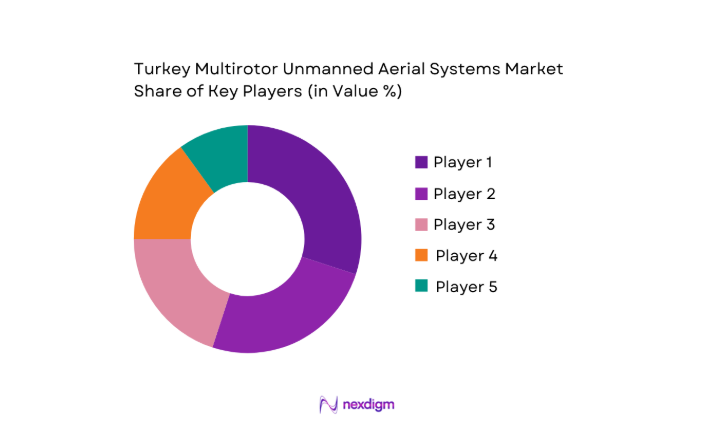
The Turkey Multirotor UAS market is dominated by a few major players, with local manufacturers such as Aselsan, Baykar, and Turkish Aerospace Industries leading the charge. International players like DJI and Parrot also have a significant presence, although local players dominate due to their close alignment with the country’s defense and technological needs. This consolidation underscores the importance of technological innovation, regulatory support, and government partnerships in shaping market dynamics.
| Company | Establishment Year | Headquarters | Market Focus | Technological Innovation | Government Partnerships | R&D Investment | Customer Base | Global Reach | Strategic Initiatives |
| Aselsan | 1975 | Ankara, Turkey | ~ | ~ | ~ | ~ | ~ | ~ | ~ |
| Baykar | 1984 | Istanbul, Turkey | ~ | ~ | ~ | ~ | ~ | ~ | ~ |
| Turkish Aerospace Industries (TAI) | 1984 | Ankara, Turkey | ~ | ~ | ~ | ~ | ~ | ~ | ~ |
| DJI | 2006 | Shenzhen, China | ~ | ~ | ~ | ~ | ~ | ~ | ~ |
| Parrot | 1994 | Paris, France | ~ | ~ | ~ | ~ | ~ | ~ | ~ |
Turkey Multirotor Unmanned Aerial Systems Market Analysis
Growth Drivers
Increasing demand for surveillance and monitoring applications
The Turkey Multirotor UAS market is heavily influenced by the rising demand for surveillance and monitoring applications across various sectors such as defense, agriculture, and urban planning. The Turkish government has significantly increased its investments in security infrastructure, especially for border surveillance. In 2024, Turkey allocated approximately TRY ~ to national security and defense technologies, including unmanned aerial systems (UAS) for surveillance. Additionally, the global rise in security concerns, such as border control and urban monitoring, has led to increased deployments of UAS for real-time data collection and surveillance tasks. According to the Turkish Ministry of Interior, the use of UAS in national security operations has risen by 20% annually over the past three years. These factors strongly contribute to the market’s growth, with surveillance and monitoring applications expected to remain a dominant driver.
Advancements in drone technology enhancing operational efficiency
Technological advancements in UAS are a significant growth driver for the Turkey Multirotor UAS market. In recent years, Turkey’s focus on improving drone technology, particularly in the areas of autonomous navigation, AI integration, and real-time data processing, has resulted in higher operational efficiency. The Turkish aerospace industry, supported by companies such as Aselsan and Baykar, has seen rapid progress in drone capabilities, leading to more sophisticated and efficient UAS. By 2024, Turkey’s military and commercial drones feature cutting-edge technology, with AI-driven drones improving decision-making and data processing speeds. Additionally, the introduction of autonomous flight systems has made drones more efficient in conducting complex tasks such as search-and-rescue operations and environmental monitoring. In line with global advancements, Turkey’s drone industry is benefitting from these innovations, positioning it as a leading player in drone technology development.
Market Challenges
Regulatory challenges and airspace restrictions
The rapid growth of the Turkey Multirotor UAS market faces a major challenge due to stringent regulations and airspace restrictions. The Turkish Directorate General of Civil Aviation (DGCA) has imposed strict rules governing drone operations, particularly for commercial and industrial use. In 2024, the DGCA issued a regulation that requires commercial drone operators to obtain permits for flight operations in certain areas, especially near airports and military zones. Additionally, Turkey’s airspace restrictions, which are aimed at ensuring safety and security, limit the use of drones in certain regions, causing delays in deployments. These restrictions create hurdles for UAS manufacturers and service providers looking to expand their operations, especially in urban and high-density areas. As of 2024, over 30% of drone operation requests in Turkey face approval delays due to regulatory hurdles.
High initial investment and operational costs
The Turkey Multirotor UAS market faces significant challenges related to the high initial investment and operational costs associated with drone technology. The cost of purchasing high-performance drones for both commercial and defense applications remains substantial. In 2024, the cost of a single advanced drone system, such as those used by the Turkish military, can exceed TRY ~. This high upfront cost is a barrier for small and medium-sized enterprises (SMEs) in Turkey looking to adopt drone technologies. Furthermore, maintenance, insurance, and operator training add to the ongoing operational costs. As the Turkish government pushes for greater drone adoption in sectors like agriculture, these costs remain a critical challenge. For example, agricultural drone users report operational costs as high as TRY ~ per year for maintenance and training alone.
Opportunities
Emerging markets in agriculture for crop monitoring
Agriculture in Turkey is undergoing a transformation, with drones becoming an integral part of modern farming practices. In 2024, the Turkish Ministry of Agriculture and Forestry reported a rise in drone usage for crop monitoring, pest control, and precision farming. As the Turkish agricultural sector continues to modernize, the demand for UAS to monitor crop health, optimize irrigation, and assess soil conditions is expected to rise. Currently, over 10% of Turkish farms are utilizing drone technology, and this is expected to increase rapidly due to the efficiency and cost savings provided by drone services. In addition, the Turkish government’s support for digital agriculture, including providing grants and subsidies for adopting drone technology, is further driving the growth of drones in the agricultural sector.
Integration of AI and machine learning for autonomous operations
The integration of artificial intelligence and machine learning technologies into drones offers significant growth opportunities for the Turkey Multirotor UAS market. AI-driven autonomous drones can perform complex tasks such as object detection, tracking, and real-time decision-making without human intervention. In 2024, Turkey is actively investing in AI and ML for UAS, with research centers in Ankara and Istanbul focused on autonomous drone technologies. This integration is expected to enhance the capabilities of drones in military and civilian applications, improving efficiency and reducing human error. With the Turkish government supporting the development of AI technologies, the market for autonomous UAS is set to expand rapidly in the coming years.
Future Outlook
Over the next decade, the Turkey Multirotor UAS market is expected to experience significant growth, primarily driven by advancements in drone technology, increased government investments in defense, and expanding applications in commercial sectors. As drones continue to evolve in terms of AI integration, battery life, and payload capacity, Turkey’s multirotor UAS industry is poised to become one of the leading players in the global drone ecosystem. The ongoing adoption of drones in agriculture, logistics, and surveillance will further propel this growth, contributing to an increasing market share for Turkish UAS manufacturers.
Major Players
- Aselsan
- Baykar
- Turkish Aerospace Industries
- DJI
- Parrot
- Vestel Savunma
- STM
- Otokar
- Pars UAV Systems
- Dogan Aerospace
- AeroVironment
- Insitu
- Arcturus UAV
- MDT International
- Progeny Systems
Key Target Audience
- Defense Ministries
- Military contractors and suppliers
- Aerospace and defense manufacturers
- UAV technology developers
- Investments and venture capitalist firms
- Government and regulatory bodies
- Private drone service providers
- Agricultural technology firms
Research Methodology
Step 1: Identification of Key Variables
This phase involves constructing an ecosystem map of all major stakeholders in the Turkey Multirotor UAS market. This map is built using secondary data from industry reports, government publications, and proprietary databases. The goal is to define critical variables such as government regulations, technological trends, and military applications.
Step 2: Market Analysis and Construction
Historical data from the Turkish aerospace and defense sectors is compiled to understand the adoption patterns of multirotor UAS. This phase involves assessing revenue generation from both military and commercial applications, using data from companies and government agencies.
Step 3: Hypothesis Validation and Expert Consultation
Market hypotheses developed in the previous phase are validated through consultations with key experts in the UAS and aerospace industries. These consultations are conducted via computer-assisted telephone interviews (CATIs), focusing on industry-specific operations, technology, and regulations.
Step 4: Research Synthesis and Final Output
The final step is engaging directly with UAS manufacturers to acquire detailed insights into product segments, sales performance, and consumer preferences. These insights help refine the market data and ensure that the final output reflects a holistic view of the Turkey Multirotor UAS market.

- Executive Summary
- Research Methodology (Definitions, Scope, Industry Assumptions, Market Sizing Approach, Primary & Secondary Research Framework, Data Collection & Verification Protocol, Analytic Models & Forecast Methodology, Limitations & Research Validity Checks)

- Definition and Scope
- Market dynamics
- Historical overview
- Timeline

- Growth Drivers
Increasing demand for surveillance and monitoring applications
Advancements in drone technology enhancing operational efficiency
Government support for unmanned aerial systems in defense and public services - Market Challenges
Regulatory challenges and airspace restrictions
High initial investment and operational costs
Technological limitations and battery life concerns - Opportunities
Emerging markets in agriculture for crop monitoring
Integration of AI and machine learning for autonomous operations
Growth in logistics and delivery services - Trends
Growing adoption of drone-based delivery systems
Focus on energy efficiency and reduced carbon footprint - Government Regulations
- SWOT Analysis
- Porters 5 forces

- By Market Value, 2020-2025
- By Volume, 2020-2025
- By Average Price, 2020-2025

- By System Type (In Value%)
Quadcopters
Hexacopters
Octocopters
Tethered Multirotors
Hybrid Multirotors - By Platform Type (In Value%)
Commercial Platforms
Military Platforms
Surveying and Mapping Platforms
Agricultural Platforms
Search and Rescue Platforms - By Fitment Type (In Value%)
OEM Fitment
Aftermarket Fitment
Custom Fitment
Modular Fitment
Fixed Fitment - By EndUser Segment (In Value%)
Military & Defense
Agriculture
Construction
Surveying & Mapping
Logistics - By Procurement Channel (In Value%)
Direct Sales
Distributors
Online Retailers

- Market Share Analysis
- Cross Comparison Parameters (Price, Performance, Technological Innovation, Customer Support, Market Reach)
- SWOT Analysis of Key Players
- Pricing Analysis of Major Players
- Key Players
Aselsan
Vestel Savunma
STM
TUSAS
Baykar
Turkish Aerospace Industries (TAI)
Pars UAV Systems
Dogan Aerospace
Otokar
Progeny Systems
MDT International
Arcturus UAV
Insitu
AeroVironment
Aurora Flight Sciences

- Military adoption of unmanned aerial systems for surveillance and reconnaissance
- Agriculture sector driving adoption for crop surveillance and pest control
- Use in construction for site monitoring and aerial surveying
- Surveying and mapping companies leveraging drones for accurate topographical data

- By Market Value, 2026-2035
- By Volume, 2026-2035
- By Average Price, 2026-2035


 Request a Sample
 Ask for Customization
 Get a Quote
 Enquire Now